Category Archives: Markets

Parkwood LE061 revised

parkwood_pw_le061_body

I’m laughing at myself today!

I realised that I crashed into my own blind spot with this story on the Parkwood guitar.

https://blackwoodgrowers.com.au/2016/09/25/parkwood-le061/

I focused the entire story on the maker, the beautiful wood and the guitar…….

and completely ignored where the wood came from…who grew the wood!!

BLIND SPOT!!

I chew this old bone everyday thinking about luthiers and the tonewood market and their obsessions and blind spots.

Wood is a pretty unique resource because the wood we use today started as a seedling 30, 50, 100, 200, or maybe 400+ years ago!! No other renewable resource has this extreme production time-lag characteristic.

So the people who manage the forests and plant the trees so that we can have beautiful wood in 30+ years time are pretty extraordinary people.

But these people are rarely acknowledged or appreciated by the tonewood market. In fact have I ever seen the tonewood market acknowledge a tree grower? Many in the tonewood market don’t even understand these people exist.

The story of a guitar does NOT begin with a piece of wood (no matter how beautiful, exotic, rare or endangered)! Wood doesn’t magically appear out of thin air.

It begins with a tree and a grower!

Hopefully a grower who makes a profit and is therefore encouraged to plant more trees.

The tonewood market is running out of traditional tonewoods. It is time to support and acknowledge tree growers. Without tree growers these beautiful guitars will cease to exist.

Every new product launch, every guitar review should acknowledge where the timber comes from.

To continue to perpetuate the myth that tonewood magically appears out of thin air is dishonest and undermines the future of the guitar industry.

So to complete the Parkwood story:


This beautiful blackwood timber came from the public native forests of the Otway Ranges in south western Victoria, Australia. The Otway Ranges run parallel to the coastline facing the great Southern Ocean. The cool wet climate (average 1700 mm rainfall per year) provides ideal growing conditions for blackwood.

The wood was harvested by Murray Kidman from Otway Tonewoods who has a special permit to harvest blackwood in these forests.

You can read my story about Murray here:

https://blackwoodgrowers.com.au/2013/07/13/murray-kidman/

It’s not an ideal situation from a commercial private blackwood growers viewpoint. I’d like to acknowledge the people of Victoria for growing this blackwood and allowing Murray to harvest it. But it’s a taxpayer-funded community service not a commercial operation.

Maybe one day the tonewood market will acknowledge and support commercial blackwood growers.

REVIEW

And while I’m here I may as well write a review of the Parkwood LE061.

I think the Parkwood LE061 and the newer LE081CE guitars deserve much more recognition; all 210 of them!

I bought this guitar secondhand and after a trip to my local guitar tech for some repairs I’ve now been playing it for a month.

I bought the Parkwood a month after I also bought a new Cort AS-06, which is a solid blackwood back and sides, spruce top guitar with the same body shape and size as the Parkwood, but with a 45mm compared to a 42mm neck. So I can at least compare the two guitars. I also have an old Washburn dreadnought.

I’ve been learning the guitar for 6 years.

Sound

To my ears the Parkwood sounds much like my old dreadnought with a big, rich round sound, maybe without the big bottom end of the dreadnought. It’s a great sound and others, including my teacher, have commented (without prompting) on the quality of the sound. I haven’t noticed any dead spots on the fretboard, and even up high on the fretboard it still rings loud and clear.

How does the 9 year old Parkwood compare with the new Cort?

Given how similar these two guitars are in design and materials the sound is very different. Why are they different? Is it age? Solid wood guitars are supposed to improve with age but there’s no scientific evidence to support this idea. Is it the spruce top vs the blackwood top?

Sound is a very subjective thing.

To my ears the Parkwood has a rich full sound, while the new Cort sounds more “dry”, less “deep” and “full”. I enjoy the sound of both; they are just different that’s all.

Playability

My old dreadnought has a 42mm neck and one of the reasons I bought the Cort AS-06 was the wider fretboard. I tend towards being a fingerstyle player and I was hoping the wider neck would make playing easier. It did, and one of my concerns about buying the Parkwood was the narrow neck. I have big hands with fat fingers so getting good lefthand technique has been a real challenge. I needn’t have worried, the Parkwood is easy to play up and down the neck. Maybe it’s the neck profile, I’m not sure. By contrast the wider neck on the Cort makes for a very different, very spacious playing experience,

Build Quality

The Parkwood is superbly built, with (to my eyes) a great aesthetic in the style of Martin 42s. The ebony fretboard, one-piece mahogany neck, all solid master-grade Australian blackwood, Gotoh tuners, dovetail neck join and the bling all add up to a great quality guitar.

Value

I bought the Parkwood second hand at what I consider to be a very good price. If this guitar was made in the US it would sell for many times its current value. Will the guitar market ever recognise quality made outside the USA? The only comparable guitars on the market are the Taylor Koa series which get rave reviews and sell at a premium price.

Sustainability

So how sustainable are these tonewoods? The rarity of master grade Australian blackwood tonewood does not currently allow for guitars of this beauty to be in regular production. But plain grain blackwood is in reasonable supply, and has the potential with enough market support, to be fully sustainable into the future via a growers cooperative.

Who knows where Parkwood got their ebony from. The mahogany neck shows wide growth rings so I’m guessing it is plantation-grown. Fijian mahogany perhaps!!

A footnote on tonewood grading:

I think the current tonewood grading system is part of the industry’s problem. The grading system is all about the visuals, and it is blatantly discriminatory. The grading system keeps the tonewood market obsessed with the rare, exotic, beautiful rainforest/oldgrowth timbers. Shouldn’t tonewood grading be more about “tone”, and perhaps sustainability; rather than rare, exotic, beautiful and endangered?

Competitive Neutrality in Forestry

pc-competitive-neutrality2

In 2001 the Productivity Commission released a report into the competitive neutrality of the State government forest agencies in Australia.

http://www.pc.gov.au/research/supporting/forestry

The report makes for interesting reading 15 years after it was published.

So what is competitive neutrality?

Competitive neutrality (CN) means that state-owned and private businesses compete on a level playing field. This is essential to use resources effectively within the economy and thus achieve growth and development.

CN policy forms part of the 1995 Council of Australian Governments’ agreement on National Competition Policy (NCP).

CN policy aims to promote efficient competition between public and private businesses. Specifically, it seeks to ensure that government businesses do not enjoy competitive advantages (or suffer from a competitive disadvantage) over their private competitors simply by virtue of their public ownership.

The fact that the Productivity Commission felt the need to write such a report says a great deal about the forest industry in Australia. Remember this was in 2001 immediately after the Regional Forest Agreements (RFA) had been completed and signed.

Why weren’t competitive neutrality issues covered as part of the RFA reforms?

It is certainly my belief one of the major reasons we don’t have a thriving blackwood industry in Tasmania is the absence of competitive neutrality.

Here’s my precise of the report by chapter, and what I regard as some of the more salient points from a blackwood growers perspective.

1 Introduction

Forest products industries source wood from both public and privately managed forests, although public forests have traditionally accounted for the overwhelming bulk of wood supplies.

The situation has changed dramatically over the past 15 years with most wood grown and sold in Australia now coming from private forest growers. But State forest agencies continue to exert a significant influence on the industry especially around policy and politics.

Also the privatization of public plantation assets has introduced new distortions in the marketplace such as new owners being exempt from paying local Government rates and charges, competing against other private forest growers who do pay rates and charges. Local communities are now forced to subsidize the new private forest owners.

As forestry agencies are deemed to be significant government businesses, they are subject to CN. This requires them to:

  • charge prices that reflect costs;
  • pay all relevant government taxes and charges;
  • pay commercial interest rates on their borrowings;
  • earn commercially acceptable returns on their assets;
  • and operate under the same regulatory regime as their private sector counterparts.


To this list I would add:

  1. receive no direct or indirect taxpayer subsidies;
  2. harvest all timber on a fully commercial basis. Undertake no community service timber harvesting;
  3. provide complete and separate annual accounts for all Government-funded community service activities (CSOs).

There would certainly be other CN principles that could be added to this list.

2 Forestry background and institutional framework

Competitive neutrality is about a level playing field but the report provides little insight into the nature of the forest industry playing field and the numerous factors that impact the quality of the playing surface. For example there is a section in Chapter 2 discussing employment in the forestry sector, but no discussion on how sector employment impacts CN and the quality of the playing surface!

Chapter 2 provides a background summary of the industry and its institutional framework. There is discussion about “recent reforms” (many of which never eventuated, or were implemented only to be undone at a future date), National Forest Policy and the Regional Forest Agreements (RFA), the 2020 Plantation Vision, National Competition Policy, and Australian Accounting Standard for Self-Generating and Regenerating Assets (AAS 35). But within all this discussion there is little said about competitive neutrality. For example the discussion about the RFAs says nothing about if or how CN was dealt with within the RFAs.

As for the 1995 National Forest Policy it has never been implemented; and it contains no discussion at all about competitive neutrality.

In fact one of the key objectives of the RFA process should have been to set the State forest agencies on a level competitive playing field with each other AND private forest growers; with the objective to become profitable or cease to exist.

Unfortunately that did not happen; in my opinion a major failure of the RFA process.

There is considerable discussion in the report about Australian Accounting Standard AAS 35 ending with this classic quote:

AAS 35 provides a consistent framework for forest asset valuations across jurisdictions, but gives forest agencies considerable flexibility in implementing it. This has led to differences in asset valuations between agencies, and has particular implications for the implementation of CN by forest agencies.

In other words, never mind the level playing field!!

3 Application of CN to forestry

Chapter 3 talks about the implementation, monitoring and reporting of CN across Australian State forest agencies.

Progress in implementing CN is mixed. Jurisdictional differences in the application of CN to forestry agencies include the:

  • institutional models within which CN compliance is being pursued;
  • pricing and log allocation mechanisms;
  • transparency of CSO funding;
  • determination of target rates of return;
  • allocation of overheads to commercial wood outputs (see box 3.1);
  • approaches to achieving regulatory equivalence;
  • monitoring arrangements; and
  • asset valuation methodology used.


In other words the State forest agencies cannot even create a level playing field between themselves, let alone with private forest growers. So much for National Forest Policy!

[CN] Monitoring arrangements vary across jurisdictions [States].

In Tasmania, Forestry Tasmania is subject to monitoring by the State’s Prices Oversight Commission [now the Office of the Tasmanian Economic Regulator]. It also provides quarterly reports to Treasury on performance against agreed indicators.

Clearly no one is doing any monitoring or reporting in Tasmania. Go to the websites of either of these organisations (OTER or Treasury) and you will find NO information about CN monitoring or reporting by Forestry Tasmania. Forestry Tasmania’s own website contains NO mention of CN policy, objectives or performance.

http://www.economicregulator.tas.gov.au/

https://www.treasury.tas.gov.au/

All State government forest agencies should be required by law to have the exact same competitive neutrality policies, objectives, monitoring and reporting procedures. Otherwise the National Competition Policy is just wasted paper.

The report spends considerable time discussing whether logs are being sold at their ‘full’ market value, without the obvious answer that full contestable market value of public forest assets needs to be regularly and transparently determined “by the market”.

4 Log pricing issues

Over the last twenty years, there has been considerable evidence to suggest that forest agencies have frequently sold logs at less than their full market value. … evidence suggests that, in the past, royalties for sawlogs from State forests have often been some 20 to 70 per cent below their market value.

This doesn’t mean log underpricing began in the 1980s. It’s just that in the 1980s some people began to think this was a serious issue. Some people still think it is still a serious issue.

In 2016 the issue of log prices and marketing from State Government forest agencies remains unresolved. Deliberate underpricing continues unabated. Both Western Australia and Victoria started to go down the road towards market-based log sales and pricing, but changes in State governments saw those policies reversed.

In a fully competitive market environment, a sawmill [or other wood processor] will compete against other processors for log supplies from growers…. In practice, the market for logs sourced from State forests [or other growers] cannot always be regarded as fully competitive.

This market situation is no different to any other primary industry [cows, milk, apples, cabbages, etc.].

One of the issues around State forest agencies is that only wood processors are allowed to purchase public forest assets. Organisations that may wish to purchase public forest assets such as carbon sequestration or conservation are deliberately excluded from the market. This is not the case with privately owned forests in Australia. This is a deliberate breach of CN principles. Why can’t public forest assets be sold to the highest bidder (subject to certain management constraints)?

The Report talks about the various difficulties of determining real market prices for logs.

The Report fails to discuss issues around market and price transparency.

Section 4.3 (p. 36) discusses the impact of underpricing on private forest growers.

The major concern expressed about the price of logs sold by forestry agencies has related to underpricing. Whatever the underlying reason, allegations of underpricing [by State forest agencies] have frequently been cited as a factor impeding the development of private wood growing enterprises.

And

Recent reforms have created incentives for forest agencies to price logs on a more commercial basis. Consequently, it is possible that other factors may now have a greater impact on private growers than underpricing by forest agencies.

In 2001 that was wishful thinking. In 2016 it’s a bad joke!

The Report then discusses how underpricing of logs has left the Australian wood processing industry inefficient and uncompetitive, and therefore unable to pay full market prices for logs. It’s a debilitating spiral to bankruptcy.

A priori, the application of CN would be expected to reduce the incidence of log underpricing, because it requires forest agencies to act more commercially by charging prices that cover all the costs of growing and managing the forest, including a commercially acceptable return to the land and timber assets. This should help ensure that the full market value is realised for logs sold by State forestry agencies.

Lots of hope and optimism with little evidence in 2001 that CN reforms were really being implemented. In 2016 we know that hope was misplaced.

5 CN and the broader policy context

The implementation of CN in forestry will contribute to better cost recovery and pricing policies, and hence a more efficient and better managed public forest estate.

We haven’t seen any evidence of this in the last 15 years!!

It is often argued that the use of competitive tendering (or auctions) for the sale of logs would lead to higher prices because processors would be forced to pay the ‘true’ valuation of the logs.

Outcomes from the relatively few auctions held to date suggest that a competitive market could also lead to greater differentials in log prices.

In other words premium timbers like blackwood would achieve much higher prices than they do under the current system of Government-set prices. Either that or hardwood sawlogs and pulpwood would be at give-away prices.

The role of secondary markets for harvesting rights may be of greater significance in achieving more competitive log pricing in such [one seller/grower, one buyer] markets. Competitive secondary markets for log entitlements would strengthen the processing sector’s incentive to operate efficiently.

Currently, harvesting rights [to public native forest] can only be held by wood processors. However, there would seem to be no reason why parties other than wood processors should not be able to bid for, and hold, such rights. If a timber right was modified to become a right to appropriate all the values of the forest, then holders may be better able to balance all possible uses — particularly in light of the potential development of some markets for environmental services.

Private forest growers are not subject to such market restrictions so why are State forest agencies?

There is very little published information on [log] prices realised by forest agencies. …[log] pricing policies and the terms on which harvesting licenses are allocated are generally confidential.

These are public assets being sold and the public has absolutely no right to understand the basis on which they are commercially managed!!

In the United States, the Department of Agriculture regularly publishes detailed information on stumpage prices (royalties), fob mill prices, harvest rates and sustainable harvest rates by species and region (Warren 2000). While the relatively small size of the Australian industry may prevent the publication of statistics in the same level of detail without breaching confidentiality, the limited information available in Australia denies the community information on a very significant natural asset and inhibits scrutiny of the pricing practices of State forest agencies. This increases the difficulties in assessing the performance of these agencies. At the same time, the absence of public information on market prices and conditions itself may constitute an impediment to private investment in forestry — information about farmgate or market prices is readily available to potential investors in most other natural resource and primary industries.

Overall it is not a great report. It could have been better.

Here’s my thoughts on a few other CN-related issues not discussed in the report:

Public benefit

The NCP allows State Governments to ignore CN principles if they claim public benefit overrides commercial interests. In 2001 when most wood grown and sold in Australia came from State forest agencies this was pretty easy. However in 2016 the reverse is now true, most wood now grown and sold in Australia comes from private forest growers. The public benefit from being a minor player in the forest industry is much more difficult to argue. Growing trees for wood production is now very definitely a commercial business not a community service.

Transparency

One of the fundamental issues around competitive neutrality is that it must be transparent. Private businesses that compete against Government businesses must be able to clearly and readily see that they are operating on a level playing field. The PC Report says:

The focus on cost recovery, and the trend toward greater transparency and accountability of public agencies in their management of public resources, has encouraged forest agencies to evaluate their forest management practices in terms of their impacts on efficiency and financial performance.

Otherwise the Report is generally critical of State governments and State forest agencies in their lack of CN transparency.

Log Export

There always seems to be strong community concern around the export of native forest logs. But the concept of competitive neutrality means that whatever markets are available to private tree growers must also be available to public forest managers. That is the level playing field. If private forest growers look to improve their profitability through log export markets, then the same must be available to the State forest agencies, including the export of sawlogs and specialty timbers. If high value log exports are banned then the viability of commercial native forest management may be compromised. Unfortunately the PC report does not discuss this issue.

Resource Security

Any legislation, regulation or policy that seeks to create a distinction between the public and private commercial forest is in breach of competitive neutrality principles. For example the concept of “resource security” is by definition a breach of competitive neutrality principles, because the concept is only applied to the public forest resource, never to the private resource. The Report even mentions resource security (p. 15) but fails to identify it as a breach of CN!

In New Zealand, where 100% of the forest industry is privately owned, they don’t talk about resource security. They do talk about the tensions between supply and demand, and how to manage fluctuations in supply and demand, but resource security is never mentioned.


State governments and State forest agencies continue to ignore their commitments and responsibilities under the National Competition Policy.

The so called level playing field has never been realised in the forest industry.

Vast sums of taxpayer’s money continue to be squandered on the industry. The most recent example is the Western Australian Government’s announcement of investing $21 million of taxpayers money in softwood plantation expansion without a business case. Presumably “public benefit” overrides the need for wise investment.

https://au.news.yahoo.com/thewest/wa/a/32691021/wa-leads-nation-in-forestry/#page1

Blackwood

Of course with blackwood in Tasmania competitive neutrality has been thrown under a bus with the Government and Forestry Tasmania declaring “public benefit”; blackwood is officially a taxpayer-funded community service not a commercial activity.

It is time for the Productivity Commission to revisit and review the issue of competitive neutrality in the forest industry in Australia.

When will Tasmania get a fully commercial, profitable forest industry?

Global rosewood market continues to tighten

rosewood

The current CITES Summit (Convention on International Trade in Endangered Species of Wild Fauna and Flora) in Johannesburg South Africa has voted to further tighten global trade on all Rosewood species in another attempt to save these species from extinction.

CITES says that rosewood timber is the world’s most illegally trafficked product accounting for 30% of all seizures by value.

The Convention on the Trade in Endangered Species (Cites) summit on Thursday placed all 300 species of rosewood under international trade restrictions.

Here’s a report from The Guardian:

https://www.theguardian.com/environment/2016/sep/29/wildlife-summit-cracks-down-on-illegal-rosewood-trade

Rosewood is one of the world’s premium tonewood timbers, and whilst the tonewood market accounts for only a small percentage of demand nevertheless it is a significant driver in the rosewood marketplace.

Sooner or later the tonewood market is going to have to face the reality of rosewoods bleak future.

https://cites.org/eng

Parkwood LE061

parkwood_pw_le061_body

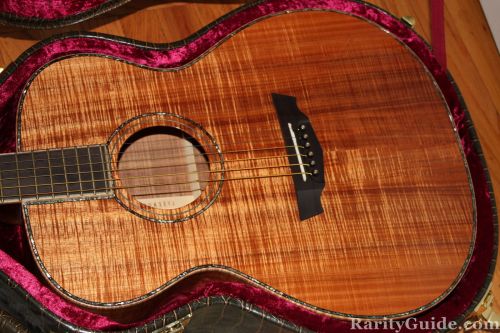
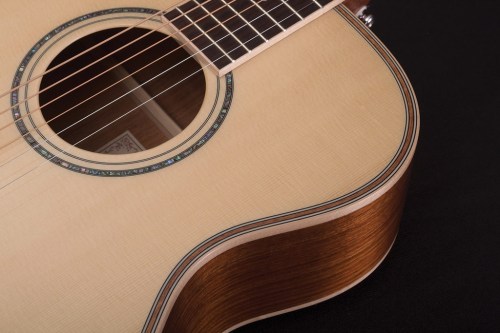
This might just be the most beautiful commercially built blackwood acoustic guitar ever made.

Only 150 of the 2007 Parkwood Limited Edition LE061 models were built.

With Master Grade solid fiddleback blackwood back, sides and soundboard and abalone trim, this guitar is definite eye candy. The chatoyance of the fiddleback is extraordinary.

In a plush red velvet with faux crocodile skin case this guitar was designed for the collectors market.

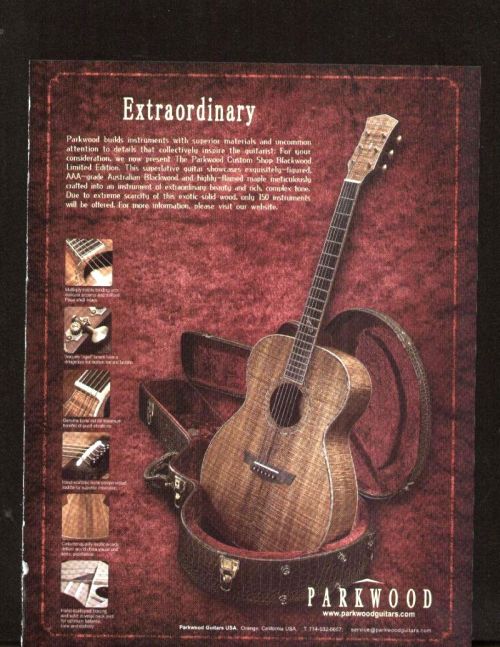
The full page add in Guitar World magazine in 2007 was clearly designed to impress.

parkwoodxtra8811

Parkwood is the premium brand name for the Cort Guitar company based in South Korea.

http://www.parkwoodguitars.co.kr/

These days Parkwood guitars are hard to find with limited distribution. That’s unfortunate given their quality and price.

parkwood_pw_le061_headstock

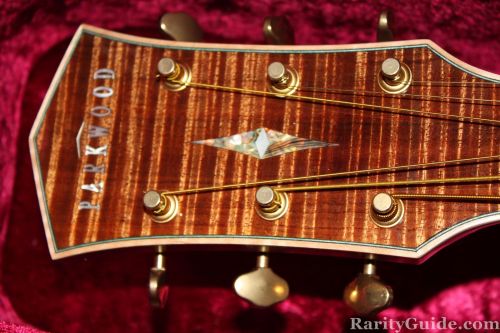
I especially like the matching blackwood on the headstock.

Fiddleback blackwood tonewood of this quality is very rare. A Tasmanian Blackwood Growers Cooperative could potentially supply tonewood like this under two scenarios:

  1. Occasional arising from the active management of the remnant native blackwood forest that exists on farmland across northern Tasmania;
  2. Research is needed to determine the extent to which fiddleback blackwood can be cloned. Cloned fiddleback blackwood would then only have value within the context of a commercial blackwood plantation program.

The question remains is anyone in the tonewood market prepared to support such an opportunity?

And why am I writing about this 9 year old guitar?

Because I finally got my hands on one that’s why!

Extraordinary!!

In 2013 Parkwood released an updated version of the LE061 called the LE081CE. This model has a cut out and onboard electronics, again with limited production (only 60) and distribution. Check this out!

Beautiful!!

Here’s one currently for sale on Ebay:

http://www.ebay.com.au/itm/Parkwood-LE081CE-Grand-Auditorium-Acoustic-Electric-Guitar-Number-2-of-60-/252548250225?hash=item3acd0c7a71:g:rRYAAOSwzaJX2Jcz

Addendum: Here’s an LE061 for sale in the USA on Reverb:

https://reverb.com/au/item/3151805-parkwood-le061-australian-blackwood


Blackwood Timber Price Rises by 15%

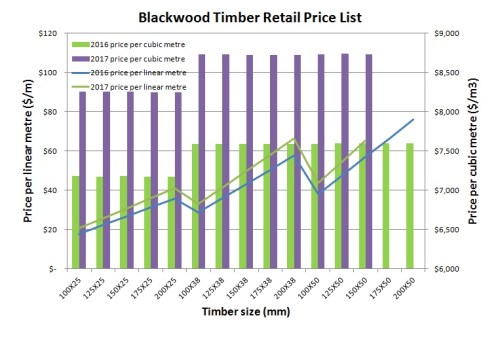
One retailer has recently increased the price of their blackwood timber by 15% or $1100 per cubic metre!!

Here’s a chart showing the old and new prices:

abpl0916

There’s no explanation given by the retailer for the price rise.

Is it due to declining supply, rising demand, or increasing costs of production? Or is it a combination of these factors?

Is the price increase likely to affect existing or potential growers?

If forestry operated under normal market conditions then a timber price increase of 15% would cause a significant response in the marketplace.

Under normal markets farmers would be doing their calculations and deciding if and how much to invest in growing commercial blackwood.

A 15% price increase should be stimulating new blackwood planting.

But forestry in Australia does not operate under normal market conditions. In fact forestry avoids “normal markets”. Using market forces to generate new investment is fundamental to any business.

Without my detective work these price increases would be largely unknown.

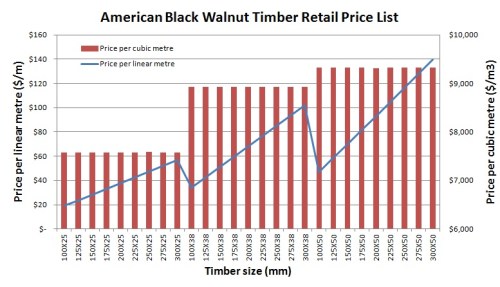
By way of comparison here’s a chart showing the price list for imported American Black Walnut offered by the same retailer:

abwpl0916

Black Walnut is regarded as one of America’s premium appearance grade timbers. Most supply of this timber comes from private native forest owners in the eastern and mid-west United States, although some Americans are growing this species in plantations.

So this retailer at least regards blackwood as being on par with the finest hardwoods in the world.

So why isn’t that message (and the price) making its way back through the marketplace to help stimulate supportive policy and investment?

Guitaronomics: The Rising Cost of Tonewood

guitaronomics.jpg

Here is another article about the international tonewood market and the coming tonewood famine.

https://reverb.com/au/news/guitaronomics-the-rising-cost-of-tonewood

“Guitar enthusiasts love to talk about tonewood….. Rarely do the words sustainability or scarcity come up.

These terms, however, are now central to the lexicon of the guitar industry.”

The article features comments from three people in the tonewood market:

Chris Herrod of Luthiers Mercantile International [LMI], a major American tonewood retailer, which is seeing major changes in the tonewood market.

“LMI aims to provide as many “new” varieties [of tonewoods] they can find to offer alternatives to the classics while educating the customer base along the way.”

Perry Ormsby a small Perth [Australia]-based luthier provides us with this great quote:

“Using Tasmanian blackwood (Acacia melanoxylon) as a substitution [for Honduran mahogany] has been a game changer.”

“A close cousin to Hawaiian Koa, it is heavier than mahogany and difficult to work with, but it sounds great. It looks cool, and it’s Aussie,” Ormsby says.

“When his customers are educated about the wide range of wood possibilities he is using and and see the results, it makes them rethink everything they wanted out of their dream guitar.”

And finally Bob Taylor from Taylor Guitars features prominently in the article.

“When the wood is in rare supply, the price goes up. Nearly all our woods have probably increased in price about 15% over the last few years. I don’t blame this on regulation. I blame it on supply. But since the supply is so low, it’s also become highly regulated to the point of illegality.”

In addition to its ebony partnership in Cameroon in west Africa, Taylor have also started a company called Paniolo Tonewoods, a partnership with Pacific Rim Tonewoods. Together they are undertaking a massive planting of Koa (Acacia koa) timber in Hawaii.

Tasmanian blackwood also gets a mention within the discussion about Taylor Guitars as a growing alternative sustainable tonewood.

But I’m not sure the article finishes on the right note.

There’s a strong emphasis on nostalgia and traditional tonewoods. There is not a strong message about the future and sustainable tonewoods.

In that regard it tends to reflect where the general tonewood market is at right now – caught between the traditional buying habits of its customers and lacking the commitment and leadership to move to a sustainable future.

But the time of the profitable sustainable tonewood will come; perhaps in the next few years.

Ultimately if the tonewood market wants to continue to access quality wood then it will have to start paying farmers to plant trees. There is no other option.

Will Tasmania be ready when the time comes?

The forests behind the label – Why standards are not enough

Here’s a great Ted Talk about going beyond Forest Certification with the focus on small scale forest growers like existing and potential Tasmanian blackwood growers.

And when I think about the synergies between their connect-with-the grower model and a Tasmanian Blackwood Growers Cooperative I get excited.

This is just what Tasmanian blackwood growers need to get the support and recognition.

It’s about connecting consumers and manufacturers with forest growers.

What a great idea!

The Ted Talk is by Constance McDermott who is a James Martin Senior Fellow and Chair of the Forest Governance Group at the Environmental Change Institute, University of Oxford.

http://www.eci.ox.ac.uk/people/cmcdermott.html

This is a 12 minute talk well worth watching.

Hydrowood blackwood prices at Uptons

HWs.jpg

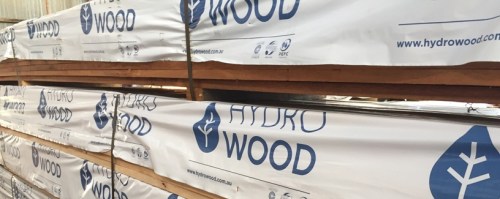
It’s time for another blackwood timber market price review, this time courtesy of Hydrowood and Uptons.

http://hydrowood.com.au/news/hydrowood-now-available-at-uptons/

http://uptons.net.au/

My previous price list reviews have generally not named the suppliers, but in this instance I think I need too since Hydrowood is likely to be the major supplier of premium grade blackwood timber for the next 5 to 10+ years. Hydrowood will therefore set the price ceiling for quite some time.

Go here to read my reviews of other blackwood (and other species) timber price lists:

https://blackwoodgrowers.com.au/category/price-lists/

Here are the current prices are for Hydrowood blackwood from Uptons:

HydrowoodBWD

These prices are for rough-sawn, kiln-dried blackwood timber.

It’s a curious price list for a number of reasons.

Firstly there are only two grades of Hydrowood blackwood – fiddleback and everything else! The price for select (clear) grade is the same as for natural (knotty& defective)!!

The other curious feature (and I’ve discussed this in relation to other timber price lists) is the lack of price increase (per cubic metre) with increasing piece size. Whilst you can cut large trees into small pieces of wood the reverse is not true. You can only cut large dimension timber from bigger, older trees. And bigger, older trees cost more time and money to grow. Therefore larger dimension timber should attract a higher per cubic metre price to reflect the higher cost to the grower.

Of course there isn’t a “grower” in this case, but given that the owner of this resource (the Tasmanian Government) isn’t charging any royalties, and Hydrowood are a dominant supplier in the blackwood market, this creates significant pricing distortions in the marketplace.

But there’s the thing. These prices bear no relationship to the cost of growing the wood. This is salvage timber from the bottom of hydro lakes. No forest management costs, no roading costs, no expensive forest practices plans, no royalties paid to the Government!

This is low cost blackwood.

In that regard it shares much with Forestry Tasmania the other major producer of blackwood. Forestry Tasmania produces blackwood at below cost and receives a direct taxpayer subsidy for doing so.

If we want to encourage and develop a profitable sustainable forest industry then this isn’t the way to do it!

This blackwood is even cheaper than Select grade Tas Oak at Bunnings!!

https://blackwoodgrowers.com.au/2016/07/01/bunnings-timber-price-lists/

The other interesting feature of the Hydrowood price list is that there are only three pricing structures for all of their species/products, of which two are shown in the above chart.

The Natural/Select Blackwood pricing is shared with plain Myrtle, or what Hydrowood calls Western Beech (Nothofagus cunninghamii), and Tas Oak (Eucalyptus sp.)!! The fiddleback blackwood pricing structure is shared with Black Heart Sassafras (Atherosperma moschatum), Huon pine (Lagarostrobos franklinii), Marine-grade Celery Top Pine (Phyllocladus aspleniifolius), and flame-grain Myrtle/Western Beech. An intermediate pricing of $5,900 per cubic metre is applied to all Knotty Celery Top pine and plain coloured Sassafras.

Of course the impact of these pricing structures on the future of the other (non-blackwood) species is irrelevant. These other slow-growing species do not provide any investment opportunities. But farmers can invest in growing commercial blackwood provided that markets are working properly, and Government and industry policy is supportive.

No chance of that here in Tasmania.

This is the fourth blackwood timber price list I have reviewed and what these price lists show is a blackwood marketplace in disarray. Blackwood prices are all over the place, from cheaper than radiata pine, to prices that rival the most expensive premium timbers in the world!

If you were wondering whether to invest in growing commercial blackwood then this marketplace would not provide you with any confidence. I wish I could say that these prices clearly demonstrate the viability of growing commercial blackwood but I can’t.

These blackwood timber price lists do not reflect the cost of growing the wood. Nor do they reflect an industry that has a vision for its future. Instead they remind me more of a closing down sale!

They reflect an industry that has lost hope, and is now in a desperate race to the bottom.

Without a solid commercial foundation the forest industry doesn’t have a future.

So now you know where to get your cheap premium blackwood timber.

When will Tasmania get a fully commercial profitable forest industry?
 

Cort Guitars expanding use of blackwood

CortAS06

Giant Korean-based guitar manufacturer Cort continues to expand its range of guitars featuring Australian blackwood.

http://www.cortguitars.net/en/

Cort produce guitars for other well known brands under license but also have their own brand.

In addition to limited edition models for the Australian market, Cort is now expanding the use of blackwood in its international models.

Here are a few examples:

Frank Gambale Signature (FGS) model

I previewed this new model back in February:

https://blackwoodgrowers.com.au/2016/02/29/cort-frank-gambale-signature-model/

AS 06 Orchestra Model (OM)

http://www.cortguitars.net/en/product/product_view.asp?qCate=00002&qSeries=0&qProdTag=&qPack=&qNew=&qKey=all&qWord=&idx=168

The AS series is Cort’s flagship series of premium acoustic guitars. The other models in the series feature Indian Rosewood and Mahogany. The AS06 is the first AS model to feature an “exotic” non-traditional tonewood.

Both the AS06 and the FGS models are top-of-the-line acoustic guitars featuring solid blackwood back and sides. Both retail for about $AU1,500 but neither is currently available in Australia.

But if you want something really special from Cort check out their 1200 series models. To date only three 1200 models have been produced the Earth 1200 dreadnought, the L1200P parlor and the MR1200FX dreadnought. All of these models feature solid rosewood, but I do have concerns about the legality and sustainability of rosewood timber. Now if a 1200 blackwood model should ever come along I’ll be down the shop in no time, and ringing bells on this website!!

Grand Regal GA5F-BW

Another recent addition to Cort’s international range. A Grand Auditorium body in a mid-priced guitar.

http://www.cortguitars.net/en/product/product_view.asp?qCate=00002&qSeries=0&qProdTag=&qPack=&qNew=&qKey=all&qWord=&idx=203

This model is available in Australia and retails for around $650.

MR710F –BW

A mid-priced Dreadnought workhorse featuring blackwood that retails for around $600.

http://www.cortguitars.com/uk/product/mr710f-bw

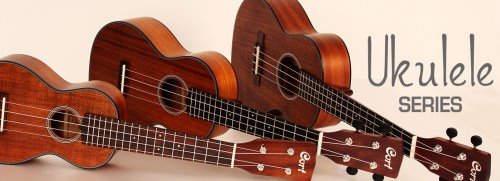
Ukeleles

Cort_Ukulele

Cort’s answer to the ukulele craze that has gripped the planet for the past 10 years is a series of solid quality blackwood ukes.

http://www.cortguitars.net/en/product/series_view.asp?qCate=00002&idx=154

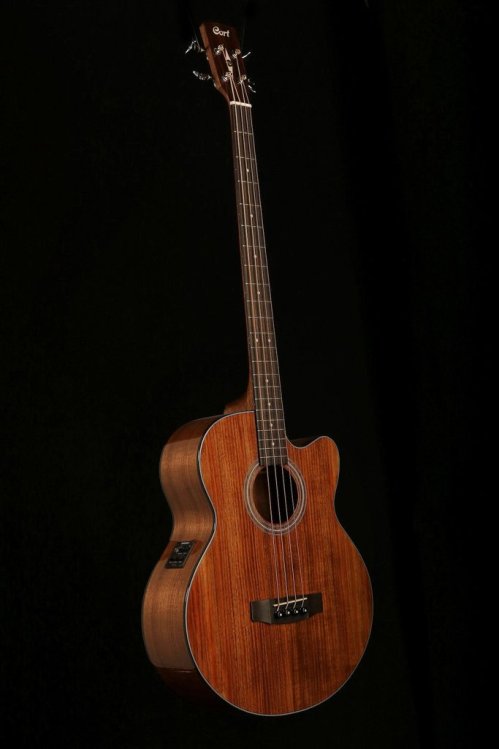
Cort SJB Blackwood

And for the bass players the Cort SJB Blackwood. This model is currently only available in Australia.

http://www.basscentre.com.au/collections/acoustic-basses/products/cort-sjb5-blackwood

Cort-sjb-blackwood

Cort’s ability to gain exposure for blackwood tonewood by catering to the mass guitar market can only be a good thing. Blackwood may be highly regarded in the domestic Australian guitar market but it is still largely unknown overseas.

With a production capacity of over 1,000,000 guitars per year (I read somewhere that this represents 30% of total world production!) even if 1% of that production included blackwood it would provide a significant boost to local demand for blackwood timber. All of these guitars use plain-grain blackwood which is another bonus to growers.

It would be fantastic if Cort joined the growing trend for guitar companies to demonstrate greater environmental and social awareness and engagement as a good global corporate citizen.

Resource-sensitive Global Production Networks (GPN): Reconfigured Geographies of Timber and Acoustic Guitar Manufacturing

Taylor300

A few months back I was contacted by two academics based at the University of Wollongong, New South Wales. They are economic geographers and were starting a project looking at local and international tonewood markets.

Chris Gibson and Andrew Warren came to Hobart and I was pleased to catch up and discuss issues around tonewood supply and tonewood markets.

On their way to writing a book on the subject they have published the first academic paper from their research so far.

Chris Gibson & Andrew Warren (2016): Resource-Sensitive Global Production Networks: Reconfigured Geographies of Timber and Acoustic Guitar Manufacturing, Economic Geography, DOI: 10.1080/00130095.2016.1178569

http://www.tandfonline.com/doi/pdf/10.1080/00130095.2016.1178569

Unfortunately this paper doesn’t make for easy reading with 22 pages of dense, convoluted prose.

I would encourage the authors to write a shortened popular version of the paper as I have no doubt they would find plenty of consumer and industry magazines and websites keen to publish.

Here’s my review.

Where in the 1970’s and 1980’s labour costs and shifts in production to cheap labour markets were the dominant force in the guitar industry, today it is access to secure, reliable wood resources that is becoming the major industry driver. This is happening within an increasingly complex, increasingly regulated international trade in wood resources.

Such [increasing] regulation [and diminishing supply] has, since the 1990s, transformed both tonewood procurement and guitar making. A resource-sensitive GPN has emerged in which upstream resource actors are increasingly important, with manufacturing firms responding differently to scarcity and regulation. Other industries dependent on timber, such as paper milling, furniture, and the construction industry are not as species dependent and have been able to switch more easily to substitutes, including quick-growing plantation species sourced locally. Guitar manufacturers for the most part remained bound by the guitar’s type form, requiring timbers with tensile strength, aesthetics of color and grain, and rich acoustic resonance. Moreover, as a form of manufacturing appealing to consumers for whom emotional value and identity-affirming qualities were intrinsic, the industry was encumbered with strong traditions and customer expectations. As Dick Boak, from C. F. Martin & Co., explained, convincing guitarists to switch to instruments made from sustainable materials proved difficult: “musicians, who represent some of the most savvy, ecologically minded people around, are resistant to anything about changing the tone of their guitars”. Put simply, “musicians cling to the old materials”.

As I’ve said previously, guitar companies are often their own worst enemies when it comes to product development, marketing and mixed/confused messages. Even the most evangelical of guitar manufacturers still provide a soft, oblique message to the market when it comes to environmental issues. But the aesthetic and the exotic become the focus when it comes to sales and marketing. Many guitar companies show no concern about resource supply and environmental issues whatsoever.

https://blackwoodgrowers.com.au/2015/08/11/ooops-not-such-a-success/

But there is evidence that consumer and market change is coming. Just a few examples include the No More Blood Wood campaign, the Leonardo Guitar Research Project, and the Musicians for Sustainable Tonewoods:

http://reverb.org/no-more-blood-wood-campaign/

http://www.leonardo-guitar-research.com/

https://www.facebook.com/Musicians-for-Sustainable-Tone-Wood-100977326654291/

The 2009 and 2011 raids on the Gibson Guitar Company by US law enforcement agencies in relation to importing endangered species were a watershed moment for the guitar/tonewood industry, sending shockwaves throughout the marketplace and concerned consumers.

Irrespective of the evidence and veracity of the raids, in August 2012, Gibson settled out of court, effectively admitting to violating the Lacey Act, and agreed to a $300,000 fine.

Since 2011 the international tonewood market has changed dramatically. The paper highlights three strategies being used by guitar manufacturers to adjust to the changing tonewood market:

  • Alternative species
  • Vertical integration
  • Salvage wood

In short, material scarcity in combination with higher degrees of CITES/Lacey Act enforcement made legally sound international procurement of traditional timbers more difficult, inconsistent in quality, and expensive. Accordingly, product innovation ensued, entailing new models that shifted away from rosewoods, ebonies, and mahoganies of potentially suspicious provenance, toward new alternative timbers that satisfied strength, resonance, and aesthetic benchmarks, and that could be sourced either locally or more transparently from countries with robust regulation, certification, and enforcement.

Well that is a trend that is only just beginning. If you look at most guitar websites you will still find rosewood, mahogany and ebony in abundance.

Much of the search for alternative species is focused on other tropical rainforest timbers not on the CITES list. A few American companies are increasing their focus on readily available North American hardwood species. In Australia the two commercial makers, Maton and Cole Clark, are increasing their use of locally grown and native timbers.

Taylor Guitars so far is the only major company following the vertical integration pathway back up the supply chain to timber cultivation, harvesting and milling. This is really only an option for large companies that have the resources necessary to invest upstream.

Rather than engaging in the expensive option of buying land and growing trees themselves, these companies should consider the option of contracting the growing and supply of tonewood to local farmer cooperatives. I’m pretty confident that if a major company pursued this option in Tasmania it would receive plenty of positive support from the farming community.

The third strategy being developed by small-to-medium size guitar companies is the use of salvage wood from specialised “timber hunters”. The problem here is that salvage wood is not a secure long-term resource. It comes with increased risk of resource supply. It also doesn’t help the major manufacturers and therefore the bulk of the guitar-buying public who can’t afford custom built guitars, ie. there are no large volumes of salvage wood available.


So how can Tasmanian blackwood feature in these three tonewood strategies?

  1. Tasmanian blackwood is one of the few alternative quality tonewood species that is non-tropical and potentially sustainable. It can be grown in profitable commercial plantations. It is well known in the domestic Australian market but has yet to break into the international market. Efforts by Taylor and Cort to introduce blackwood into international markets will hopeful make progress in this area.
  2. Taylor Guitars have strong links with their Tasmanian supplier (Tasmanian Tonewoods) but have yet to demonstrate any commitment beyond this relationship. To date their vertical integration is confined to the USA, and Cameroon in Africa in partnership with Madinter. Will other major guitar companies follow Taylor’s lead and seek upstream supply relationships?
  3. There is a sizable existing blackwood resource suitable for salvage on farmland across northern Tasmania, from Goulds Country in the east, to Marrawah on the west coast. This unmanaged resource of native remnant and planted blackwood could be used to stimulate farmer interest in growing commercial blackwood, whilst supplying international tonewood markets in the short term, should a major buyer wish to take up this opportunity.

Tasmanian blackwood is discussed on page 19 of the paper.

Following the Australian lead (Maton and Cole Clark), North American tonewood suppliers and manufacturers began importing Australian blackwood to use in high-end production guitars. A species considered invasive in some areas (unlike practically all other tonewoods), Australian blackwood is harvested in small volumes from farms and mixed-forest plantations without the need for invasive harvesting techniques or CITES paperwork (Reid 2006).

I don’t know where the mixed-forest blackwood plantations are? I’ve never heard anything about them. And why mention the invasive bit? The invasive tendencies of other species are not discussed at all. If blackwood is planted on Tasmanian farms where it is already a native how can it be considered invasive?

The only way that the tonewood market can have a secure future is to pay landowners to grow trees. Unfortunately the paper fails to discuss this strategy, I guess because so far none of the guitar companies are actually using this strategy.

Major manufacturers need significant volumes of quality timber and they need resource security to safeguard their investment. This means paying people to actually grow trees, and having strong, long-term relationships with growers.

The paper focuses on the current changing dynamics in the international tonewood market which are still in their infancy.

As the paper states, the current changes are unpredictable and likely to result in unexpected outcomes as new players and new opportunities emerge. The interplay between the consumer, the manufacturer, the supply chain, and the grower will result in significant market changes.

One important piece of information missing in the paper is an estimate of the size of the international tonewood market. In all the dense discussion it is not possible to get a sense of scale of the issue. On pages 10-11 there is a table providing some statistics about example companies, including production and employment, but nothing about tonewood demand.

Another observation is that the paper talks about the tonewood market everywhere from sawmillers/tonewood merchants all the way through to consumers; but fails to discuss forests, plantations and growers. If there’s a tonewood supply problem then not discussing trees and growers seems a bit odd.

So who will grow the tonewoods of the future?

I’m looking forward to seeing what these academics come up with over the next year or so of their project.