Category Archives: Markets

Two Fender blackwood guitars for sale

Here are two Fender Tasmanian blackwood guitars currently for sale.

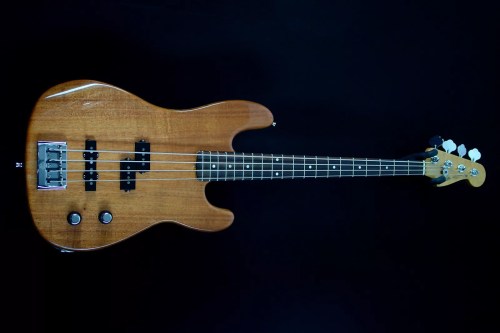
First is a Fender Custom Shop Artisan Postmodern Bass PJ 2016 Tasmanian Blackwood:

fender-bwdpmbass

https://reverb.com/item/3919477-fender-custom-shop-artisan-postmodern-bass-pj-2016-tasmanian-blackwood

I’m not sure what a postmodern bass sounds like, but it sure looks great!

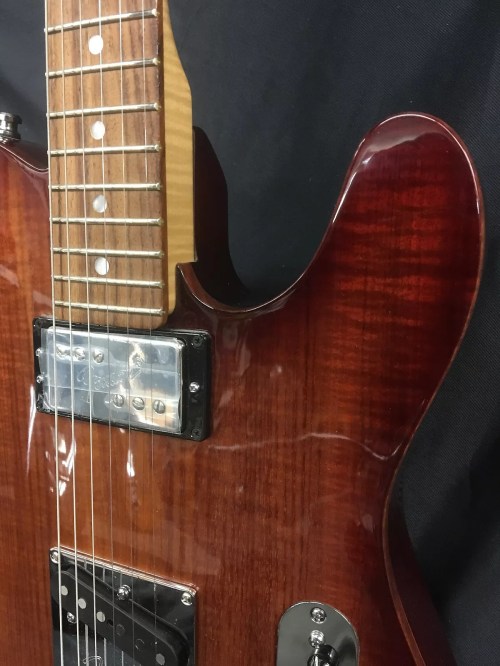
The second is an American Select HS Blackwood Telecaster:

fenderbwdtele

This Telecaster is for you budding Keith Richards types out there.

https://reverb.com/item/3991070-american-select-hs-blackwood-telecaster

Two fine instruments from Fender featuring Tasmanian blackwood.

www.fender.com


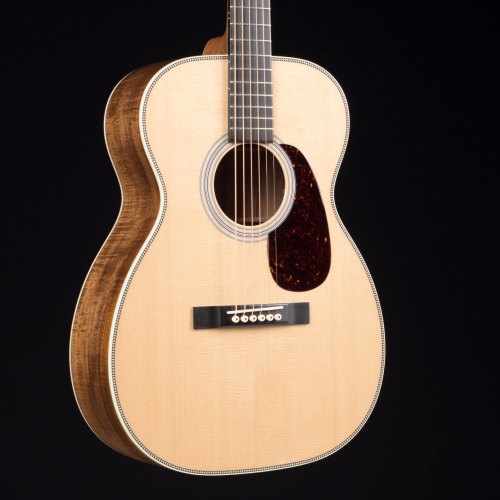
Martin Custom Shop 00-14 Fret Tasmanian Blackwood

martin-custom-shop-0014fdb-tazblkwood_2018002_angle-left__80417-1478028819-1280-1280

Here’s another one-off custom guitar from CF Martin featuring Tasmanian blackwood currently for sale from Moore Music in Indiana, USA.

http://www.mooremusicguitars.com/martin-custom-shop-00-14-fret-tasmanian-blackwood-8002/

This little beauty is very much in the traditional CF Martin style. Nothing flash. Just good old honest Martin quality.


Body Size: 00-14

Top: Sitka Spruce-Vintage Tone System

Rosette: Style 28

Back: Tasmanian Blackwood

Purfling: HD Zig Zag

Back Binding: 5/32” Grained Ivoroid

Back Inlay: .0325” B/W Boltaron

Sides: Tasmanian Blackwood

Neck: Genuine Mahogany

Neck Shape: Mod Low Oval

Headplate: Tasmanian Blackwood

Tuning: Machines: Gotoh Nickel Open Geared w/ Butterbean Knobs

Fingerboard: Black Ebony (Stain-Yes, Oil-Yes)

Radius: 16”

Width At Nut: 1 ¾” (1.750)

Width At 12th Fret: 2 1/8” (2.125)

Fingerboard Bind: None

Bridge: Black Ebony


Nice guitar!

It’s All About The Wood

Here’s a great new video from Cole Clark Guitars about their use of Australian grown timber.

Cole Clark is breaking all the rules and for that they must be congratulated!

http://www.coleclarkguitars.com/

Faced with a diminishing supply of traditional tonewoods, Cole Clark is challenging the marketplace and looking towards a sustainable future.

Their use of non-traditional, and especially the use of fast-grown woods for soundboards, is revolutionary.

At the moment Cole Clark are trialling these woods from salvaged planted trees, of which this video tells a great story.

Cole Clark is also a big user of farm-grown Tasmanian blackwood.

So if you are looking for a sustainable guitar Cole Clark is a good option. Check them out.

Eventually I hope Cole Clark will take the next step on the road to sustainability and promote farm-grown tonewoods.

It’s all about the farmer!

Plant a guitar today!!

Music Industry Advisory on New Rosewood Trade Regulations

rosewood

For Australian readers here is a current list of new regulations around the import, export and personal travel with items containing rosewood timber due to the recent CITES changes:

http://www.australianmusic.asn.au/industry-advisory-on-new-rosewood-trade-regulations/

Please note CITES documentation is generally not required for imports and exports of personal items of up to 10 kg per shipment containing either Dalbergia or any of the three listed Guibourtia species.

Almost all acoustic guitars have at least a rosewood fretboard.

https://www.environment.gov.au/biodiversity/wildlife-trade/cites

These new trade restrictions on all rosewood species, including Indian rosewood, effectively mean the end rosewood as a commercial tonewood.

Rosewood is regarded as the premium tonewood.

The idea that the music products industry is somehow the innocent bystander in this situation (because little of the rosewood cut in the world goes towards guitars) is from what I understand a bending of the truth. Being a minor party in a crime does not make one innocent.

The adage about “lying down with dogs” comes to mind.

The guitar industry is still generally a very long way from sourcing sustainable timber and being supportive and transparent about it.

And as for customers/buyers who turn a blind eye to the continuing problem.

So what will the market do now?

My guess is they will turn to other rainforest timbers. If they can’t get rosewood at least they can still get cheap timber. The plundering of the worlds rainforests won’t stop just because of the restrictions on rosewood.

Ultimately it must come down to the consumer.

If the consumer wants to help preserve what remains of the planets rainforests then guitar buyers have to start making the tough informed choices.

Tasmanian Primary Wood Processors Directory 2016

pft_tpwpd2016

http://www.pft.tas.gov.au/publications/market_information

The 2016 Wood Processor Directory is now available from the Private Forests Tasmania website.

I’ve reviewed these Directories in previous years:

https://blackwoodgrowers.com.au/2015/10/07/tasmanian-primary-wood-processor-directory-2015/

This Directory is the sum total of “market information” that the forest industry in Tasmania wants the general public to see. Apparently the expectation is that farmers will rush out and invest in growing trees because of this directory. Or is it simply there to assist in the salvage of what remains of the private forest estate?

The Directory is a listing of 42 of the estimated 51 primary wood processors believed to be operating in the State of Tasmania. It has been primarily developed to help private forest owners with logs for sale to identify potential buyers as well as enabling the forest owner to more easily locate and contact primary wood processors.  The Directory also helps the listed primary wood processors to source logs from the Tasmanian private forest estate.

There’s nothing in that statement about becoming more efficient, profitable and building the industry.

Of the 42 businesses listed in the directory 16 indicate they are looking to buy blackwood logs from private growers, whilst 2 businesses list special species sawlogs without specifically mentioning blackwood. I assume these 2 businesses include blackwood in their requirements.

As in previous years Britton Brothers PL of Smithton, Australia’s largest blackwood sawmiller, apparently does not buy blackwood sawlogs from private growers.

That makes 18 out of 42 businesses (43%) listed as buying blackwood sawlogs from private growers.

To find these businesses:

  1. download the directory from the PFT website
  2. open the directory in Acrobat Reader
  3. Press CTRL+Shift+F to open the Search box
  4. Type “blackwood” in the search box and press Search.

As I said last year, there are far too many players in the blackwood market for the tiny volumes coming off private property.

Yes we need competition.

We also need much greater price and market transparency.

Simply having a Directory of Processors is a long way from building a profitable sustainable future.

The Tasmanian blackwood industry needs to be more commercial, efficient and profitable. This means fewer processors who are processing larger volumes more efficiently, accessing more valuable markets and offering growers better money to encourage more blackwood growing.

Clearly this is not happening in Tasmania!

Which of these 18 businesses are offering the best prices for blackwood logs?

Which of these 18 businesses have access to a variety of high-value domestic and export markets?

Which of these 18 businesses provide price and market transparency to stimulate interest and encourage investment?

Which of these 18 businesses are actively encouraging Tasmanian farmers to grow/regrow commercial blackwood for the future?

Which of these 18 businesses are actually looking to build the future of the blackwood industry?

Do these businesses understand the critical part they play in ensuring the future of the industry?

Or are we still in salvage mode?

When will Tasmania get a fully commercial profitable forest industry?

Island Specialty Timbers Tender Results

ist

http://www.islandspecialtytimbers.com.au

For the past three years I’ve been collecting, analysing and reporting blackwood log tender results from Island Specialty Timbers (IST) as, despite the miniscule volumes and generally poor quality, these are the only competitive blackwood log prices that are publically available.

Just for the fun of it I thought I would start collecting and analysing all the tender results. You never know what might turn up!

This data doesn’t have much market value. Besides blackwood, no one is going to invest money based on the tender results for the other specialty species, which are too slow growing to allow for profitable investment.

The best value this data has is to show what the marketplace might pay for premium quality timber. When Tasmanian public native forest oldgrowth and rainforest timbers are no longer available, will the marketplace come to better appreciate farm-grown Tasmanian blackwood?

Forestry Tasmania and the Tasmanian Government consider the management and harvesting of public native forest specialty timbers (including blackwood) as a taxpayer funded community service. So why does Forestry Tasmania/IST put these tiny volumes to tender and publish the results? What is the point?

Forestry Tasmania’s major product Tasmanian Oak has no price or market transparency. Why the need for competitive markets and price transparency for community-service specialty timbers, where there is no competitive markets and price transparency for eucalypt hardwood? It makes no sense!

IST was established ”to increase the recovery, availability and value of specialty timbers from harvesting activities in [Tasmanian] State forests”. Does IST achieve its stated objectives? Does it operate at a profit? We will never know!

Island Specialty Timbers has been operating for 25 years. In that time it has never produced a market report; and only in the last 3 years has Forestry Tasmania included IST sales highlights in its Annual Report.

http://www.forestrytas.com.au/about-us/publications

So far as I’m aware these are the only publically available competitive market log price results available anywhere in Australia!

30 million cubic metres of wood is harvested in Australia every year and all we have are competitive price results for less than 200 cubic metres! Isn’t that extraordinary??

Does the forest industry really want to encourage investment?

isttender-chart

The size and quality of products tendered by IST varies enormously so it is difficult to draw conclusions from these results.

Remember these prices are equivalent to mill door log prices, so harvesting and transport costs are theoretically included in the prices.

All up over the 15 months 210 cubic metres of logs were sold by tender with total revenue of $162,000. An additional $18,100 revenue was received by Forestry Tasmania directly from Tasmanian taxpayers to compensate for the costs of harvesting this 210 cubic metres.

87 cubic metres remained unsold from the tender process. Few of the logs tendered were of premium (Category 4) grade, most of which are sold under private long term sales agreements, including virtually all of the Huon pine.

Five species attract strong demand and high prices, these being black heart sassafras, plain white sassafras, king-billy and huon pine and leatherwood with average log prices over $1,000 per cubic metre. Celery top pine sold for an average price of $530 per cubic metre. All of these species take 400-1,000 years to reach maturity so I suspect even these prices are cheap.

And don’t forget these public native forest specialty timbers come to you courteously of an $86.27 per cubic metre direct taxpayer subsidy.

https://blackwoodgrowers.com.au/2016/11/13/special-timbers-subsidised-charade-continues/

Black heart sassafras and blackwood made up 25% each of the successful tendered volume over this 15 month period, but made up 46% and 6% of the sales revenue respectively. Blackwood comprised 55% of unsold log volume, perhaps suggesting that the local Tasmanian market for plain grain blackwood is saturated. This is not surprising given you can buy plain grain select blackwood timber in Tasmania for the same price as Radiata pine.

https://blackwoodgrowers.com.au/2016/11/12/blackwood-timber-price-list-summary-2016/

The harvesting of specialty timbers from Tasmanian public native forests is neither profitable nor sustainable.

I will provide an update on IST tender results every six months.

A Major Tonewood Milestone from Taylor Guitars

taylorblackwoodbaritones

The latest Wood & Steel (86) magazine from Taylor Guitars has a few interesting articles relevant to the blackwood market.

https://www.taylorguitars.com/wood-and-steel

The first is Bob Taylor’s column Bobspeak, which outlines a major milestone in the tonewood market. Taylor Guitars are now promoting guitars made using deliberately grown, not “native” wood.

This year we will make thousands of guitars using wood that was planted by man rather than having grown naturally in a forest. As a player you won’t be able to easily target these guitars to either avoid them or to embrace them because they’re completely legitimate and blend in with the choices of other guitars made from traditional forest wood. There’s not enough of this kind of wood to make all the guitars from it yet, but this is a huge breakthrough and signals a way forward. We are now starting our own tree-planting projects.

A huge breakthrough is absolutely on the mark!

Congratulations to Bob Taylor and the team!!

I’m looking forward to the day when I read an article in Wood & Steel about a tonewood grower. Perhaps it will be an article about a Tasmanian blackwood grower.

I hope you’re willing to hear a wood report from me often, nearly every time I write, because it’s become one of the most important aspects of my contribution to the world of guitars.

  • Bob Taylor, President


I think Bob Taylor is well on the way to having a significant wood supply and marketing advantage over his competitors.


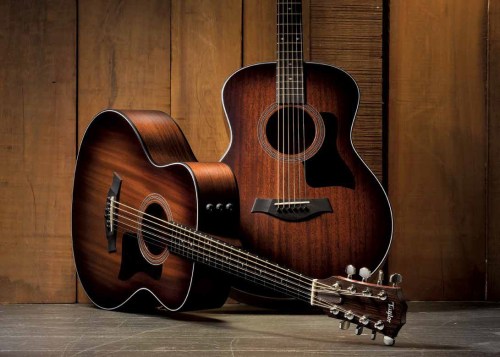
The second article of note is the promotion of new Limited Edition baritone guitars on page 22 featuring mahogany tops and Tasmanian blackwood back and sides (see illustration above) as part of the 300 Series.

“A hardwood top like mahogany is really good, he says. “Blackwood is also a good fit — it’s responsive and keeps everything warm, yet has a clear focus to it. Together, the two woods are well suited for a baritone [guitar].”

https://www.taylorguitars.com/guitars/acoustic/326e-baritone-6-ltd

https://www.taylorguitars.com/guitars/acoustic/326e-baritone-8-ltd


The third article is a feature on bluegrass player Trey Hensley (p. 24). His latest CD collaboration with Dobro player Rob Ickes The Country Blues features a Taylor 510e Tasmanian blackwood guitar on every track.

“I’d never heard of blackwood,” he says. “It’s like mahogany on steroids!”

http://treyhensley.com/

http://www.robandtrey.com/albums/the-country-blues/

“I brought a bunch of guitars into the studio — rosewood, mahogany — but that one [Taylor 510e] really cut through the mix better than all the rest. I used it on the whole thing.”

The Taylor 510e was a 2014 Fall Limited Edition dreadnought model.

https://www.taylorguitars.com/guitars/acoustic/510e-fltd

https://blackwoodgrowers.com.au/2014/10/03/the-fall-limited-sweepstakes/

It is great to have such positive support for Tasmanian blackwood from Taylor Guitars, and their supplier Robert Mac Millan at Tasmanian Tonewoods.

http://tasmaniantonewoods.com/

Happy reading!

New Zealand Blackwood Market Report

The latest edition of New Zealand Tree Grower Vol 37(4) has a market report from blackwood grower Malcolm Mackenzie.

http://www.nzffa.org.nz/

It makes for positive reading given the NZ blackwood market is still in its infancy.

As a farmer Malcolm has made a significant investment in farm forestry including 30 ha of plantation blackwood now 30 years old and reaching commercial maturity.

You can read Malcolm’s previous articles about blackwood milling and collective marketing here:

https://blackwoodgrowers.com.au/2013/11/29/recent-new-zealand-blackwood-articles/

And watch a video about Malcolm the tree grower here:

As the report shows, with less than three years data, both the volume and the value of blackwood being sold by Malcolm is increasing.

As the NZ market gains confidence in the quality and quantity of the home grown product things will only improve.

New Zealand farm-grown blackwood is a great product. I’m looking forward to the day it will be available for sale here in Australia.

Mackenzie2016.jpg

Blackwood Timber Price List Summary 2016

It’s a year since I started down the road looking at sawn timber retail prices in Australia.

Part of the reason is the lack of publically available market-based stumpage prices for blackwood.

What I have found is blackwood timber pricing that is all over the place.

Here’s a summary of the four timber price lists I have found so far.

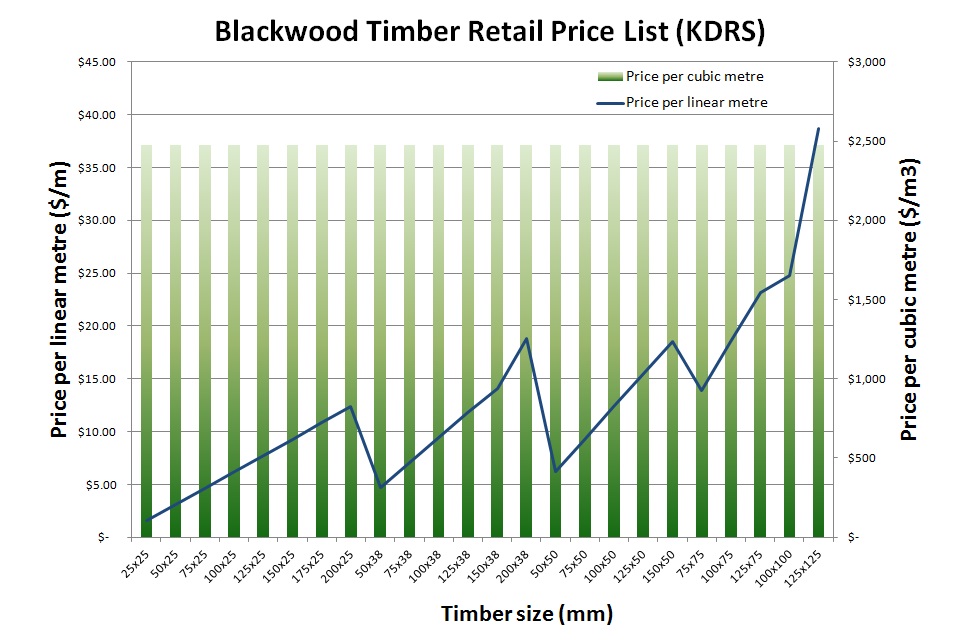
BPL1

https://blackwoodgrowers.com.au/2015/10/19/blackwood-pricing-and-the-forest-industry-1/

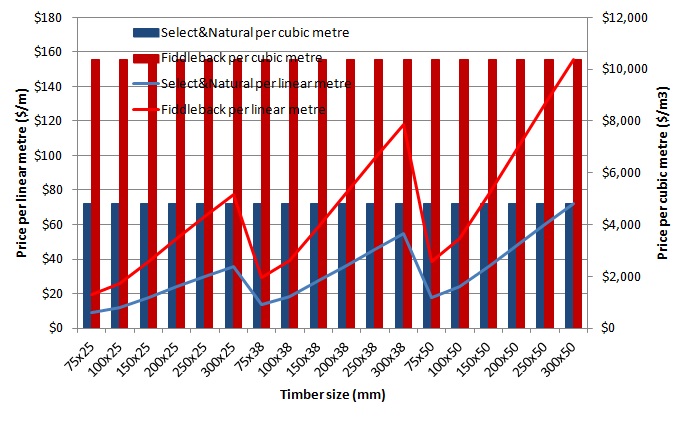
Here we have Select grade blackwood selling for the same price as Radiata pine at Bunnings Hardware, and with no price premium for larger dimension timber.

I hate to think what the grower of this blackwood got paid for their logs!

Blackwood doesn’t have a future at these prices.

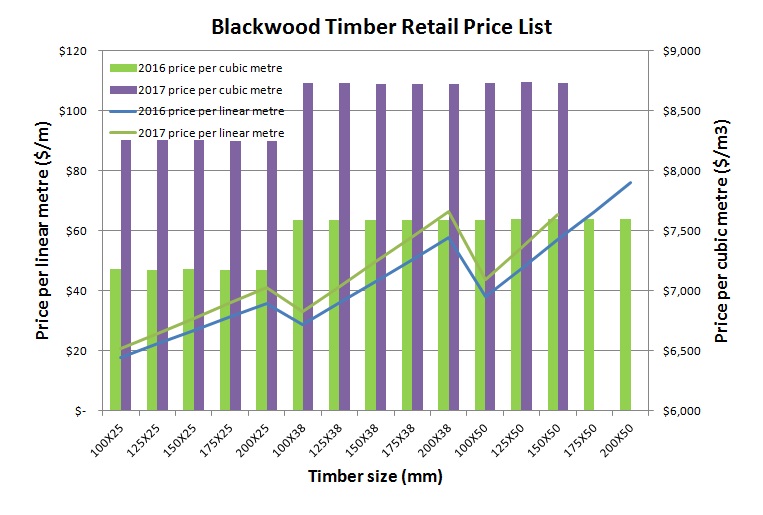
abpl0916

https://blackwoodgrowers.com.au/2015/10/26/blackwood-pricing-and-the-forest-industry-2/

https://blackwoodgrowers.com.au/2016/09/12/blackwood-timber-price-rises-by-15/

This price list looks much better. It even has a modest 5.8% price premium for sizes above 25mm. And with the recent 15% price increase we are beginning to rival global premium timber prices.

If this was the standard retail price for Select grade blackwood we might get some investor interest.

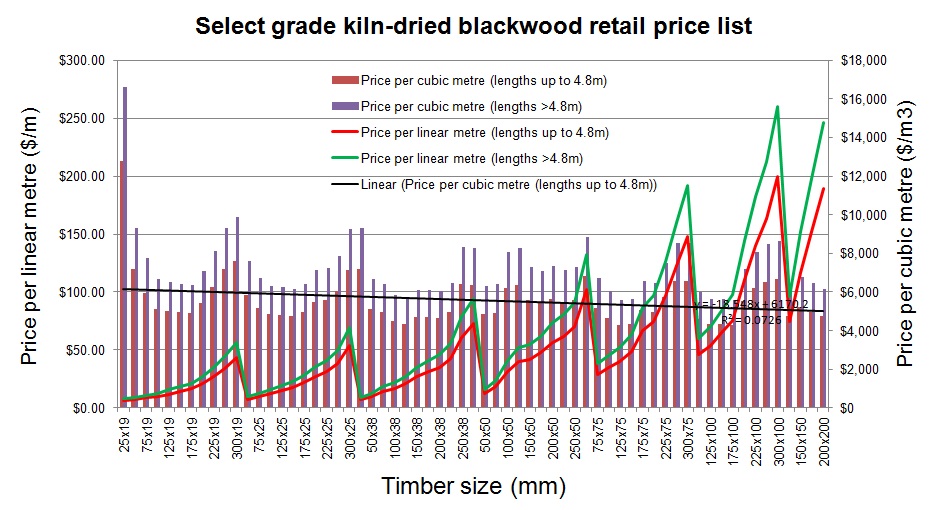
BPL3KD

https://blackwoodgrowers.com.au/2015/11/09/price-list-from-hell-revised/

This price list seems very confused. It offers a price premium for both small and large dimension timber (width), but this premium decreases with increasing timber thickness!?

A huge ranges of sizes are offered, in two length classes.

However these prices equate to Select Grade Tas Oak prices at Bunning. These prices are not those for a premium timber species.

Yet another road to blackwood ruin.

HydrowoodBWD

https://blackwoodgrowers.com.au/2016/08/03/hydrowood-blackwood-prices-at-uptons/

And finally we have retail prices for Hydrowood blackwood, which are much cheaper than Tas Oak at Bunnings.

Bargain basement salvage blackwood timber designed to destroy the blackwood industry.

In summary we have kiln dried select grade blackwood timber available from $2,500 to over $8,500 per cubic metre, with most price lists setting no price premium for larger dimension timber. In one case there is a negative premium for large dimension timber!

It’s complete market chaos!

With so much taxpayer-subsidised blackwood in the marketplace it’s impossible to know what the real market price for blackwood timber is.

It is certainly not a growers market, and if growers can’t make any money then blackwood doesn’t have much of a future.

The only basis for a successful forest industry is profitable tree growing.

This is what happens when Government and industry policy dictates that the forest industry must be a community service and not a business.

Frank Gambale

Here’s a bit of weekend entertainment.

A chance to leave the politics behind for a moment.

Australian jazz guitar wizard Frank Gambale is currently doing guitar workshops in major centres through Asia promoting the new Cort Frank Gambale Signature acoustic guitar made with solid blackwood.

http://www.cortluxe.com/

http://www.cortguitars.com/en/community/news_view.asp?idx=606

Thanks to Roger Lee for posting this on Youtube.

Great playing Frank!

Enjoy!