Blackwood Planting Time

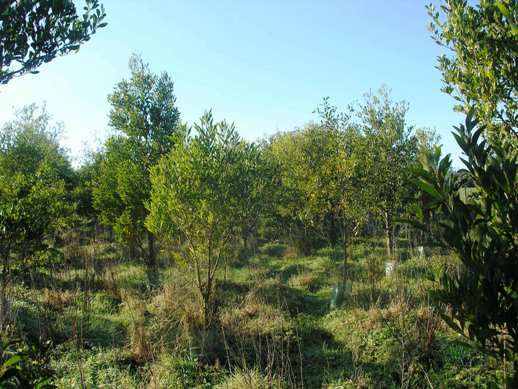
It’s planting time. Is anyone thinking of planting commercial blackwood this autumn?

If so please let me know – I’d like to help.

It has been a very dry season so far. Unless we get some rain in the next few weeks it may be too dry to plant in some places this year.

Remember the first rule for successfully growing commercial blackwood is selecting the right site. If you are unsure I can help.

We can actually use the current dry season to help identify good sites. If your proposed planting site still has green grass then that is a very good sign that there is plenty of summer soil moisture. These sites are the best for getting good blackwood growth.

As for the planting regime my recommendation is to keep it simple. Until we gain more experience and confidence in growing commercial blackwood then keeping things as simple as possible is the best place to start.

If you are planting this autumn then your site preparation should be happening now:

1. Protection from browsing by all herbivores is very important. Unless your site is more than about 1 hectare in area, you will need tree guards for each tree. For larger areas you might consider mesh fencing. Work out the costings and see what is your cheapest option – tree guards or fencing.

2. Mark out your site with a 7 x 7 metre grid. This equates to 204 trees per hectare. With this tree spacing there will be no need to thin. Not every tree will survive or prosper with good management I would expect better than 80% success.

3. Do weed control in a 1 metre radius circle at each grid point.

4. You should now be ready to plant.

The best time to plant is from late March through to early May. Again, rainfall and soil moisture will be critical to watch in the coming weeks.

Commercial blackwood plantation – perfect land use and investment for that difficult, weed-covered slope.

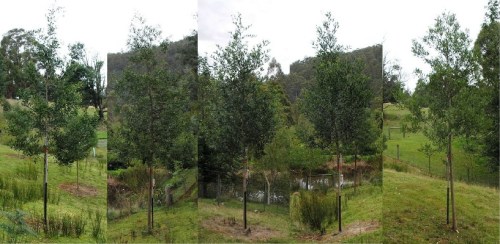
Update on the textbook blackwood plantation at age 6 years

A lot has changed since I last wrote about this small plantation south of Hobart in December 2011.

http://www.blackwoodgrowers.com.au/the-textbook-plantation-blackwood

This plantation is an experiment to test a simple approach to growing commercial blackwood. It seems to be working at least in terms of growth and tree form. Success has not been 100% so there is still plenty to learn, but the planting has been sufficiently successful to warrant my continuing support.

Why the simple approach to growing plantation blackwood rather than following the New Zealand or Tasmanian methods?

One of the common problems with farmers growing plantations for wood production is that the silvicultural management (pruning and/or thinning) is often not done properly and/or on time. The plantation becomes a wasted effort. Recognising the limited knowledge and resources that farmers have is important in helping to guarantee success.

Making the task of growing commercial plantation blackwood as simple and easy as possible is an important objective.

15 months ago the largest trees were 4.5 metres tall with single straight stems. But I was concerned that too few trees were doing well. Now at age 6 years the largest trees are 6.0 metres tall, single straight stems, pruned to 2.0 metres with stem diameter at breast height (DBH) of 10.0 cm. Last winter these trees had a dbh of 7.0 cm, so they have increased in diameter by over 2.0 cm this past season! Coloured heartwood should now be forming in the largest trees.

This is a good growth rate and with this good site, with the trees at their final spacing (200 trees per hectare), and with no thinning to worry about, I would expect this growth rate to continue for the next 20-25 years.

The picture below shows some of the best trees. Note that the pole lopper is 2.3 metres tall. Remember the goal is to grow blackwoods that are straight, single-stem and pruned free of branches for the first 6 metres. Three more years of annual pruning and these trees will have reached that goal. Then it will be time to sit back and watch them grow. At about age 35 years these trees will each contain about 1.5 cubic metres of clear premium blackwood timber.

Importantly more of the trees are showing improved growth and form, thanks largely I assume to the regular weed control that has happened over the past 2 years, the annual pruning, and having good growing seasons. Keeping young blackwoods weed free for a 1 metre radius around each tree for the first few years is obviously critical to getting good early growth. And getting good early growth is absolutely essential.

Continued leader training will generally not be necessary on the tallest trees now over 6.0 metres tall (my pruner won’t reach much further anyway). However as experience in New Zealand has shown, it is important to avoid having a major stem fork immediately above the pruned 6m butt log, especially in wind-prone areas. Major-fork splitting is not uncommon in wind-prone blackwood plantations. If a fork-split occurs immediately above the pruned log it will lead to rot and decay in the pruned stem, and a loss of commercial value.

There are still some trees that are struggling to grow or recover from wind damage. Some of these have been replaced with advanced nursery stock blackwood. These advanced blackwood have done surprisingly well, becoming established and showing very good growth. Using advanced stock is not something I’d recommend due to cost and the effort of planting these big trees, but it certainly proved a point – blackwood are incredibly tough and versatile.

This past season has been very dry with no effective rainfall since September. While trees on the upper westerly slope have not grown much this season, the rest of the site continues to grow well, with grass staying green on the lower slopes. It is these dry periods that really help identify the best blackwood sites.

In December 2011 I was concerned that I had misjudged the site, or used poor establishment techniques. Now I am confident that it is a good site, although exposure to strong winds is an ongoing problem. If there was more protection from wind this would be an excellent site. This has been a valuable learning experience with an overall good result, and certainly gives me confidence that the simple approach to growing commercial blackwood can work.

Is anyone interested? I’d love to see some more plantations like this established in Tasmania.

New website host

Hi,

As of the 17th April 2013 the blackwood coop website is on a new web host. I’ll be working on it over the coming weeks to improve it’s appearance and content. Feedback welcome.

Cheers,

Gordon.

The sad passing of Ian Nicholas

It was with great surprise and sadness to learn of the death recently (22/3/2013) of New Zealand friend, blackwood scientist and farm forestry advocate Ian Nicholas at the age of 59.

I only got to know Ian personally in the last 10 years but in that time I developed a great respect and appreciation for his immense knowledge and understanding, but also for his quite strength and determination. He was a tremendous advocate for broadening the range of commercial tree species grown in New Zealand including blackwood. His determination and hard work provided much of the momentum and progress in the small world of plantation blackwood.

Over many decades Ian provided the New Zealand focus and did much of the research that helped turn blackwood from an unruly opportunity into a commercial reality. With Ian’s help New Zealand farmers have mastered the art of growing commercial blackwood, and are now starting to reap the benefits. In 2002, in conjunction with Ian Brown he wrote the plantation blackwood bible, the Growers Handbook, while in the past few years he took on the role of managing the New Zealand blackwood growers group (AMIGO).

On his last visit to Tasmania in May 2011 Ian, together with two Chilean forest scientists and blackwood experts, were on a fact-finding mission to see what we were doing with blackwood. They left Tasmania realising that they knew far more about growing blackwood than we do. Ian was disappointed with where the forest industry had got to in Tasmania. I wrote an article about it in Tasmanian Times. It was Ian’s visit that pushed me to develop the Growers Cooperative proposal.

http://tasmaniantimes.com/index.php?/weblog/article/a-missed-opportunity-for-the-forestry-peace-agreement/

Ian was very supportive of my proposal to establish a blackwood growers cooperative in Tasmania.

My dream was that one day I would enjoy Ian’s company as he showed me around the blackwood highlights of New Zealand. Sadly that dream will never be realised.

Thank you for your support and friendship Ian.

Rest in Peace.

Major customer interest in the Blackwood Growers Cooperative!

American-flag-2a

I have established direct communication with one of the major US guitar makers who have recently visited Tasmania and initiated a commercial relationship with a supplier. The company wishes to remain anonymous for the time being. However they have been at the forefront of the sustainable tonewoods movement over the past 10+ years, having established commercial relationships with sustainable tonewood ventures in a number of countries. Here are some extracts from their emails:

“You seem to have a very well laid out [blackwood grower cooperative] plan, one we may discuss publicly supporting in the future. At this point we aren’t ready to do that, since we have yet to really do business on a long term (or short term) basis in Tasmania.”

“I will probably be taking a trip to Tasmania in the next 5 months and would like to meet with you at that time, we can see how we stand and how to move forward.”

While the local forest industry remains deeply divided and political, we have an important commercial opportunity in the making.

If we can get 2, 3 or even 4 major international guitar manufacturers buying farm-grown Tasmanian blackwood it might generate enough business to at least partly fund a cooperative, and certainly create plenty of market profile and momentum.

For the coop to be fully self-funding however there needs to be enough blackwood volume/value leaving farm gates to generate sufficient harvest levy. We don’t have any information about the existing private blackwood resource in terms of commercial volume/value/sustainable yield, but I doubt the resource is enough to fully fund a coop. Can the commercial potential of this existing resource be improved and realised? Absolutely! Can this resource be better managed to improve its future value? Absolutely! But we also need to plant more blackwood to create a new resource that will provide more volume/value out the farm gates of the future. Plantation blackwood will provide the necessary volume and value to help fully fund the coop. The tonewood market is the catalyst that will allow this process to begin.

The tonewood market is a premium market that can utilise short logs that are common in the existing unmanaged farm blackwood resource. Because it is a high-value market more of this low-volume, widely-dispersed resource can be profitably accessed. With enough support more information can be provided to landowners about their blackwood resource in terms of log specifications, prices, demand, etc. which should provide farmers with greater assurance that the forestry market is functioning more like a proper commercial market. Also many of these major guitar companies are looking for opportunities to promote their environmentally sustainable sources and practices once solid commercial relationships have been established. Tasmania could be next on the list as the home of premium quality sustainable tonewoods.

I’m looking forward to meeting with the guitar company representative when he is next in Tasmania and discussing how we might build the Blackwood Cooperative as a successful commercial business.

Native timbers lure big guitar makers

ABC Radio

Tasmanian Country Hour

Friday, 25 January 2013

http://www.abc.net.au/rural/tas/content/2013/01/s3676869.htm

My friend Robert MacMillan (Tasmanian Tonewoods) was recently interviewed by Rose Grant on the ABC Radio Country Hour, providing a small window into what is currently happening in Tasmania regarding the tonewood market. Read the story and listen to the podcast.

As I’ve said previously, the international tonewood market has the potential to completely change the future of blackwood in Tasmania. Major buyers are looking for new sustainable supplies, and blackwood is already regarded as a premium tonewood. There is a large existing blackwood resource on private land that can supply current tonewood demand.

It’s great and so rare to get some real market information about blackwood. If this information was more regular and transparent, we would know much more about prices and product specifications. This would then help generate interest in growing blackwood and hence help build a growers cooperative.

In this interview Robert provides some indications of current demand (20 truck loads per year), product specs (almost –dead trees?) and pricing (fiddleback more valuable than plain grain), but it is really just a teaser. I don’t think it provides enough detail to get farmers to take notice in harvesting their existing trees, let alone consider planting more blackwood. But it is a start.

It would be even better if some of these major US guitar builders would come here and do some media and promotion in support of growing blackwood. If they think that sustainable farm-grown blackwood is going to happen with no transparency and promotion then they will be sadly disappointed.

Also checkout Roberts recent interview with Barratts Music in Launceston. Great work Bob!!

Recently I was contacted by a very well known Tasmanian custom furniture builder. I’ll call him M. We had a long conversation on the phone about forestry, blackwood, and future possiblilities. M prefers to source most of his timber from private land as he doesn’t support current forest industry policy and practices on public land. M is very interested in the growers coop proposal. Particularly the prospect it offers in the future for selecting and breeding premium blackwood cultivars such as fiddleback. I certainly value having M’s support, as things have been a bit quite lately.

I hope everyone had a great summer break, and are refreshed and ready for another year. And I hope the Legislative Council Committee see the light and approve the TFA Legislation.

Cheers!

Phew!!!! It’s about time

Hurray!!!!!
 
The media are reporting that the IGA parties have finally reached an agreement.
 
After years of argy bargy, on again – off again grandstanding it looks like some real results at last.
 
Curiously on the same day that a ceasefire is announced in the middle east. Maybe the middle east conflict gave the IGA parties some genuine perspective.
 
But I'm not celebrating just yet.
 
The enabling legislation has to go through parliament today. That is no foregone conclusion.
 
But I will head to the bottleshop and get a bottle of bubbly just in case.
 
After thinking that my proposal to establish a blackwood growers cooperative was rapidly fading, things are suddenly looking positive again.
 
But I still need greater profile and support to help get funding under the IGA if today goes well. If anyone wants to write a letter of support to their local newspaper that would be greatly appreciated.
 
The next few weeks and months will be hectic.
 
Cheers!


Forest Talks Fail, but……..

This is very disappointing.

But not unexpected.

The IGA parties reaching an agreement was always the less likely outcome.

But at least they tried and for that I congratulate them.

The last two years have shown that this has not been a “road to Damascus” revelation for the forest industry, just the same old nags running the same old race while the crowd bays for blood.

Only this time the context has been completely different. The forest industry in Tasmania has all but disappeared over the past 2 years. And the failure to reach agreement will mean that the forestry wars will continue and the remaining Crown native forest customers and FT will wither and die over the next 5-10 years. But at least they will disappear with the deep satisfaction of having someone else to blame.

It will continue to be difficult to attract new investment while the industry remains highly politicised and the forestry wars continue. Will a change of State or Federal government solve the problem? I doubt it very much. I suspect it will instead exacerbate and prolong the problem.

The inability of the forest industry to understand its own predicament and resolve its own problems has been simply astonishing. In the 21st century the forest industry in Australia should be enjoying unprecedented support and commercial success. Instead it is characterised by social damnation and bankruptcy.

The failure of the IGA is not unexpected. That the private forest growers did not take the initiative during the IGA and set a new agenda for the forest industry will go down as one of the great lost opportunities. The private forest growers could have had a profound and positive influence on the IGA negotiations. They did not need to have a seat at the table in order to achieve this.

Instead private forest growers in Tasmania remain convinced that their interests are 100% aligned with FT and the remaining Crown customers. This position exposes them to greater political risk and commercial uncertainty than FT and its customers. In finance-speak private forest growers remain exposed to all the downside of the industry and none of the upside. Just extraordinary! They need to change their position.

Regardless of the outcome of the IGA private forest growers will eventually become the dominant force in the forest industry in Tasmania. This will be a good thing. But it is going to take a long time to get there. Neither the State nor Federal Governments have the interest or ability to drive this change. So the initiative must come from the farmers and commercial tree growers themselves. As yet the TFGA shows no signs of supporting such a move.

And what of the blackwood industry?

The failure of the IGA means $100m of Federal money will not come to Tasmania, that could have helped fund the Blackwood Growers Coop. It also means that the existing blackwood industry (the sawmills, furniture makers and retailers, craftspersons, luthiers, etc.) will disappear along with the rest of the native forest industry in Tasmania. In a few years time we will be importing most of our blackwood timber from New Zealand (farm-grown plantation blackwood). That is assuming we can compete with the Chinese. More likely the Chinese will buy all the blackwood timber that NZ can produce at prices that we just can’t match.

Tasmanian farmers will miss out on diversifying their income, utilising land that currently is unproductive. The Tasmanian community will lose its blackwood expertise and heritage.


But I’m not giving up hope just yet…..

I’ve been informed that if I can demonstrate the Coop can get FSC certification and start attracting a few customers, then it may attract private investment.

1.    I’ve recently made further enquiries about FSC certification and been told there is a good chance that the Coop could achieve FSC certification for harvesting existing farm blackwood, and establishing blackwood plantations. I am looking further into this and will keep you informed.

2.    A major US guitar maker will be arriving in Tasmania in the next few weeks looking to establish a long term relationship with blackwood suppliers. This company has shown a major commitment to developing sustainable tonewood supplies in other countries. If they show a similar commitment here, and we can demonstrate that we are moving towards an FSC certified Blackwood Growers Cooperative, then this may provide the Coop with the necessary momentum to get us going.

3.    So if we can show progress on the above issues then I’ve been informed that private investment may be interested in helping getting the Coop going. The failure of the IGA may in fact help create a different positive dynamic for the Coop as the forestry wars resume.

The next few months will prove decisive for the Coop for better or worse. But even with the failure of the IGA there remains enough potential and hope that the Blackwood Growers Cooperative may yet rise from the ashes. Watch this space!

Quilliam plantation update

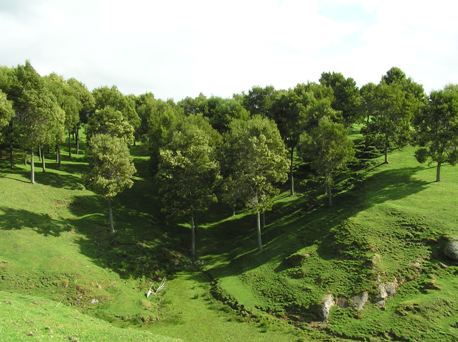
A recent revisit to the Quilliam property at Smithton to do some pruning was time well spent. All up about 7 hours was spent selecting and pruning the best of the blackwoods in the two block plantings (see initial report). These trees have now been marked and pruned to remove large limbs, trim side branches and remove multiple leaders. These selected trees will receive weed control over the coming weeks as the ground begins to dry out. Oh yes! The new pair of gumboots definitely came in handy. Despite the heavy grass competition some of the trees are showing very vigorous apical growth. There was also some evidence of wattle grub which was a surprise in this wet environment. It will definitely be interesting to revisit these trees in 12 months time for an inspection and annual pruning.

In 12 months time some of the block-planted blackwood will be reaching crown closure, which will be useful in limiting side branch growth and encouraging height growth. It will also mean weed growth will start to slow.

As for the single-row windbreak blackwoods, closer inspection found too few trees suitable for pruning that it wasn’t worth the effort. The combination of exposure to wind and the extraordinary weed growth has meant that these trees are struggling to grow. They will produce an excellent windbreak eventually, but no timber production. Mixing wood production with windbreak objectives is difficult even in good conditions and generally requires multiple-row shelterbelts. On the swampy flats of Circular Head it would be a real challenge.

Quilliam plantation

P8110112s

This is the second of two property reports from my recent trip north. This property is on the swampy flats near Smithton.

The soils are saturated for much of the year and there is little in the way of shelter.

If it was a greenfield site I would have advised caution in planting blackwood for wood production. The exposure to strong winds and the high water table present challenges in growing any trees, let alone tall, straight ones.

The property includes two block planting of almost pure blackwood at 3 metre spacing (1,111 trees per hectare) totalling about 1.5 ha, plus a considerable length of shelterbelt/drainside planting that includes a single row of blackwood at 3 metre spacing. The trees are up to 5 years of age. Protection from stock and wallabies was provided by electric fences and the common, soft-plastic tree guards shown in the picture. Obviously there can’t be too many wallabies about.

Despite the exposure and the rampant grass growth, the blackwoods are showing surprisingly good growth and form, particularly in the block plantings. My first response was “what would these trees look like with some weed control and pruning?” Weed control is certainly a problem when there is free-flowing water over the ground for at least half the year. So a single weed control in summer is needed once the ground has dried out, to get these trees growing quickly. The faster the growth the better the form.

Some of the trees are obviously no longer suitable for keeping due to lack of timely pruning, but there are still plenty of suitable trees from which to select the final crop, given that about 80% of the trees will need to be thinned to waste in the next 10 years.

The owner is unsure how to do the pruning, so I will be going back in a few weeks to help select the final crop trees and get them into shape with Mr. Quilliam’s help (and a new pair of gumboots!!).

Given the high water table and the exposure to strong winds there is a real risk of windthrow and crown breakage at this site. Planting at the higher stocking will help reduce that risk as the trees will quickly reach crown closure and help support each other. The trick will then be to gradually thin the trees at regular intervals, to retain near-full crown cover, while also allowing the trees to grow at the maximum possible rate. Leaving the windward row of blackwood trees unthinned and unpruned will also help provide protection and stability for the block plantings.

The combination of early crown closure, annual pruning and regular thinning should result in trees of excellent growth and form.

What then of the single-row blackwood plantings along the drains? I only saw a small section of these but I suspect tree form will not be so good. Given that part of the objective is for farm shelter, the best management may be to just prune and weed those trees that have the best form, and leave the rest to become big and branchy.  Hopefully the unpruned shelter trees will help support the pruned trees in strong winds.

This blackwood planting was a great surprise. It was great that it is still young enough to be brought under good management. Also great that it demonstrates that even on wet exposed sites blackwood can grow very well. There are certainly challenges and risks ahead with windthrow and crown wind damage, but these are currently balanced by the positives of good growth and form.

I will give an update once the next pruning is completed. Stay tuned.