Calling all Kiwis

I’ve just added “New Zealand” as a blog category.

I would love to get comments, ideas and stories from New Zealanders who grow, process or use blackwood.

I know there are plenty of Kiwi farmers who grow blackwood. I want to hear of your experiences, both the successes and the failures.

Ditto with NZ luthiers. I know some of you use locally grown blackwood. Send me your stories and pictures of some of your work.

Looking forward to hearing from you soon.

Cheers,

Gordon Bradbury.

Blackwood supply set to plummet, prices to skyrocket

With the pending implementation of the Tasmanian Forests Agreement and the unsustainable management of the public blackwood resource over the past 17 years, the supply of blackwood sawlog from State forest is set to plummet. Read the Certification and Supply page (above) for further background on how we came to this unfortunate situation. Following the planned resource review sustainable annual sawlog supply could go as low as 4,000 cubic metres, down from the current approximate annual harvest of 10,000 cubic metres.

This will have a dramatic and positive impact on sawlog prices and provide a significant commercial opportunity for existing and potential private blackwood growers.

The key question in all of this is:

Will the forest industry open itself up to allow greater competition and market transparency so that these changes in supply can be allowed to transparently affect sawlog prices and hence stimulate supply from private growers?

No doubt some market substitution will occur in response to this change in blackwood supply (Economics 101). We will start importing blackwood timber from New Zealand farmers, while some buyers will seek alternative species from mainland and overseas suppliers. Yes even the New Zealand farmers will benefit from the Tasmanian Forests Agreement.

There is insufficient information publically available to get a clear picture, but what parts of the jigsaw puzzle are available suggest that the blackwood market is set for a major disruption. Will market forces be allowed to respond accordingly?

So what do you think?

  1. What changes in forest market behaviour would you want to see happen before you considered the blackwood market “open for business”? Regular market reports in Tasmanian Country? Sawmillers regularly advertising for growers/suppliers? Regular auctions by Forestry Tasmania of blackwood sawlog parcels to gauge current markets and provide greater price transparency?
  2. If you are a farmer/landowner, at what sawlog price would you start considering investing in blackwood plantations? $200, $400, $600, or $1000 per cubic metre? At what sawlog price would you consider better managing your existing farm blackwood to improve its commercial value?
  3. If you are a blackwood buyer/processor what changes would you like to see happen to see the blackwood industry put on a more commercial, sustainable future?
  4. Do you think a Blackwood Growers Cooperative would provide the blackwood industry with the basis for a secure, commercial, sustainable future? What support should the coop receive to help become established?

Give us your thoughts and comments.
Impressive performance

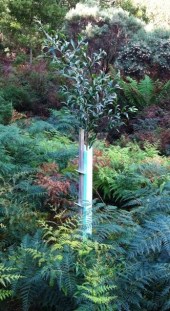
IMG_0399sThis 2.5 metre tall tree is the first 12 months growth on an impressive tree a in a new blackwood plantation in southern Tasmania. Not bad given it was such a dry season! It should be stressed that this was an exceptional tree in the plantation. Even so the rest of the plantation did very well considering, most trees being about 1.3 metres tall.


There are always exceptional trees in any plantation, and they are very good at providing inspiration.

That bracken will need to be slashed again this winter.

This is a very protected site so there is little risk of wind damage.

Can we look forward to a 6.0 metre tall tree in 12 months time? At that rate of growth all the necessary leader and branch pruning will be completed in 2 years. Awesome!

Here come the Americans!

(and a challenge for my readers)

As I’ve written previously (1,2,3,4) blackwood is a recognised quality tonewood and international customers are scrambling to find sustainable sources as the traditional supplies (mostly from tropical rainforests) become exhausted. One of the key players in this movement is Taylor Guitars from California. They publish an impressive quarterly owners newsletter “Wood & Steel”.

So here’s the challenge – download a copy of the 2013 Winter edition of “Wood & Steel” below (7.5 MB pdf file) and see if you can discover how many times the word “Tasmania” appears, and I mean do more than just a quick word search. Read the articles. Especially read the article by Taylor’s President Bob Taylor on page 5. Bob Taylor is one switched-on, passionate executive.

http://www.taylorguitars.com/sites/default/files/Wood-Steel-Winter-2013-English.pdf

There is enough potential demand in the international tonewood market to make a significant difference to the blackwood industry in Tasmania. And the advantage is this market can utilise shorter log lengths that traditional sawmillers don’t want; the kind of material that is currently growing unmanaged and unappreciated on hundreds of farms around Tasmania. This demand, coupled with this existing resource could kick-start a blackwood growers cooperative. Four steps to a profitable, sustainable blackwood future:

1. Realise the commercial potential of the existing farm blackwood resource and put money into farmers pockets now;

2. Build the industry by helping farmers grow more quality blackwood in plantations for the future;

3. Gain FSC Certification for farm-grown Tasmanian blackwood;

4. Build another iconic Tasmanian industry.

With the TFA legislation now passed in the Tasmanian Parliament and the associated $400 million of Federal money soon to become available, now is the time for the industry and the community to demonstrate support for the future of the blackwood industry. Please post you comments of support.

Green groups to back forestry peace deal

http://www.abc.net.au/news/2013-04-30/greens-to-back-forestry-peace-deal/4659544?section=tas

Well the TFA signatories are bravely going where no forestry agreement has ever gone before (the closest Australian example I can think of is the old Qld RFA from 1999); defying the politicians and the critics, and boldly maintaining the initiative. The forestry wars have been completely turned upside down.

No doubt it is a more mature approach than throwing in the towel and ordering the troops back to the trenches. Only time will tell whether it will work.

One thing is certain. The ongoing dialogue between the signatories can only be a good thing.

But the Liberals have promised that we will go to yet another State election where forestry will be the dominant issue. Sighhhh!!! Will the Liberals end up opposing FSC Certification?

The promise by Forestry Tasmania to stay out of the contentious forests regardless of whether they are formally reserved or not, is certainly an interesting development.

http://www.theaustralian.com.au/national-affairs/state-politics/forestry-firm-goes-green-to-save-pact/story-e6frgczx-1226631878986

Can this promise be kept if we end up with a Liberal State Government? Will the FT Board stand up to a new Government? Presumably they will have to resign en masse if FT is ordered by a future Liberal Government to resume old-growth logging.

So stand by for many more years of forestry drama. The evidence is clear that while we continue to log public native forests in Tasmania this drama will never cease.

In the mean time support my campaign to establish a blackwood growers cooperative, and help shift the forest industry away from the political and social turmoil to a proud, profitable future.

Tasmanian timber businesses chart new future (ABC Rural Report)

Check out this recent story on the ABC Radio Rural Report, especially the second part about Tasmanian Tonewoods Bob MacMillan. Read the story and listen to the podcast interview with ABC reporter Rosemary Grant.

http://www.abc.net.au/rural/content/2013/s3739938.htm

Taking Tasmanian timbers to the end of the iconic, value adding chain. Most of the tonewood Bob ships is blackwood. What a great story!

But I do take exception to the final comment by Tasmanian shipping agent Brett Charlton about the product just “sitting in our forests”. Products that just “sit in the forests” are not sustainable and have no future. This just reflects such old 19th century thinking and attitudes.

Our commercially valuable blackwood should no longer be “just sitting in the forest”. We should be promoting it and encouraging farmers to better manage their existing blackwood, and learning how to grow more.

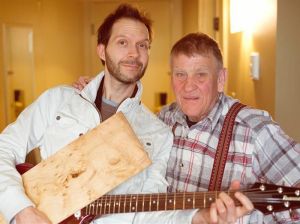
Gilbert and MacMillan

Bob MacMillan and US guitarist Paul Gilbert.

Fender Guitars now using Tasmanian blackwood

The international profile of Tasmanian blackwood as a premium tonewood just keeps on growing. American guitar makers Fender are now producing a limited release Blackwood Telecaster guitar as part of their Fender Select range.

The Fender Telecaster was originally developed by electric guitar pioneer Leo Fender in 1950, and was the design that finally put the solid-body guitar on the map.

http://www.fender.com/en-AU/series/fender-select/fender-select-carved-blackwood-top-telecaster-sh

Tasmania’s musical ambassador to the world. A thing of real beauty! An icon.

Now all we need is for a major artist to adopt this Tele as their axe of choice. Any suggestions?

Blackwood Fender

Of course this story brilliantly highlights one of the major challenges that prevents a blackwood growers coop from becoming established. Here we have blackwood being harvested in Tasmania and going to the end of the line, the top of the tree in terms of iconic value-adding, and not a single Tasmanian farmer has been stimulated or motivated to grow more blackwood as a result.

Does anyone else besides me find this situation bizarre?

If we sell cherries to China, apples to Japan or truffles to France it is front page news. But put blackwood on the world stage – literally – and barely a whisper.

Blackwood is Australia’s premier forest product and has been making its way to the very top-end of the value-adding chain for over 100 years. If things had worked out better, farmers would have worked out how to grow blackwood for wood production long ago, and every farm in Tasmania that could, would now have a grove of blackwood managed for quality blackwood timber.

Instead the Government took control and we now have the forest industry on its death bed. It’s time to put the blackwood industry in the hands of the farming community.

Until players in the forest industry (and that includes manufacturers like Fender) come to understand that greater market transparency is essential for its future, then the industry will continue its current freefall. We need to develop regular strong public feedback from all industry players, particularly directed towards current and potential growers.

Sustainable ebony – another sustainable tonewoods story

Here’s a great story (and update) of what Taylor Guitars (a major American guitar maker) are doing in Africa to help drive sustainability in the international tonewood market. Ebony is the traditional wood used for guitar fretboards. It is a slow-growing rainforest tree, with worldwide supplies becoming scarce.

http://www.taylorguitars.com/about/sustainable-ebony

http://www.taylorguitars.com/blog/sustainability/celebrating-progress-cameroon

A great example of wood processors driving positive change in forest management.

Blackwood Planting Time

It’s planting time. Is anyone thinking of planting commercial blackwood this autumn?

If so please let me know – I’d like to help.

It has been a very dry season so far. Unless we get some rain in the next few weeks it may be too dry to plant in some places this year.

Remember the first rule for successfully growing commercial blackwood is selecting the right site. If you are unsure I can help.

We can actually use the current dry season to help identify good sites. If your proposed planting site still has green grass then that is a very good sign that there is plenty of summer soil moisture. These sites are the best for getting good blackwood growth.

As for the planting regime my recommendation is to keep it simple. Until we gain more experience and confidence in growing commercial blackwood then keeping things as simple as possible is the best place to start.

If you are planting this autumn then your site preparation should be happening now:

1. Protection from browsing by all herbivores is very important. Unless your site is more than about 1 hectare in area, you will need tree guards for each tree. For larger areas you might consider mesh fencing. Work out the costings and see what is your cheapest option – tree guards or fencing.

2. Mark out your site with a 7 x 7 metre grid. This equates to 204 trees per hectare. With this tree spacing there will be no need to thin. Not every tree will survive or prosper with good management I would expect better than 80% success.

3. Do weed control in a 1 metre radius circle at each grid point.

4. You should now be ready to plant.

The best time to plant is from late March through to early May. Again, rainfall and soil moisture will be critical to watch in the coming weeks.

Commercial blackwood plantation – perfect land use and investment for that difficult, weed-covered slope.

Update on the textbook blackwood plantation at age 6 years

A lot has changed since I last wrote about this small plantation south of Hobart in December 2011.

http://www.blackwoodgrowers.com.au/the-textbook-plantation-blackwood

This plantation is an experiment to test a simple approach to growing commercial blackwood. It seems to be working at least in terms of growth and tree form. Success has not been 100% so there is still plenty to learn, but the planting has been sufficiently successful to warrant my continuing support.

Why the simple approach to growing plantation blackwood rather than following the New Zealand or Tasmanian methods?

One of the common problems with farmers growing plantations for wood production is that the silvicultural management (pruning and/or thinning) is often not done properly and/or on time. The plantation becomes a wasted effort. Recognising the limited knowledge and resources that farmers have is important in helping to guarantee success.

Making the task of growing commercial plantation blackwood as simple and easy as possible is an important objective.

15 months ago the largest trees were 4.5 metres tall with single straight stems. But I was concerned that too few trees were doing well. Now at age 6 years the largest trees are 6.0 metres tall, single straight stems, pruned to 2.0 metres with stem diameter at breast height (DBH) of 10.0 cm. Last winter these trees had a dbh of 7.0 cm, so they have increased in diameter by over 2.0 cm this past season! Coloured heartwood should now be forming in the largest trees.

This is a good growth rate and with this good site, with the trees at their final spacing (200 trees per hectare), and with no thinning to worry about, I would expect this growth rate to continue for the next 20-25 years.

The picture below shows some of the best trees. Note that the pole lopper is 2.3 metres tall. Remember the goal is to grow blackwoods that are straight, single-stem and pruned free of branches for the first 6 metres. Three more years of annual pruning and these trees will have reached that goal. Then it will be time to sit back and watch them grow. At about age 35 years these trees will each contain about 1.5 cubic metres of clear premium blackwood timber.

Importantly more of the trees are showing improved growth and form, thanks largely I assume to the regular weed control that has happened over the past 2 years, the annual pruning, and having good growing seasons. Keeping young blackwoods weed free for a 1 metre radius around each tree for the first few years is obviously critical to getting good early growth. And getting good early growth is absolutely essential.

Continued leader training will generally not be necessary on the tallest trees now over 6.0 metres tall (my pruner won’t reach much further anyway). However as experience in New Zealand has shown, it is important to avoid having a major stem fork immediately above the pruned 6m butt log, especially in wind-prone areas. Major-fork splitting is not uncommon in wind-prone blackwood plantations. If a fork-split occurs immediately above the pruned log it will lead to rot and decay in the pruned stem, and a loss of commercial value.

There are still some trees that are struggling to grow or recover from wind damage. Some of these have been replaced with advanced nursery stock blackwood. These advanced blackwood have done surprisingly well, becoming established and showing very good growth. Using advanced stock is not something I’d recommend due to cost and the effort of planting these big trees, but it certainly proved a point – blackwood are incredibly tough and versatile.

This past season has been very dry with no effective rainfall since September. While trees on the upper westerly slope have not grown much this season, the rest of the site continues to grow well, with grass staying green on the lower slopes. It is these dry periods that really help identify the best blackwood sites.

In December 2011 I was concerned that I had misjudged the site, or used poor establishment techniques. Now I am confident that it is a good site, although exposure to strong winds is an ongoing problem. If there was more protection from wind this would be an excellent site. This has been a valuable learning experience with an overall good result, and certainly gives me confidence that the simple approach to growing commercial blackwood can work.

Is anyone interested? I’d love to see some more plantations like this established in Tasmania.