Happy tree-growing farmers

In travelling around and talking to Tasmanian farmers and others about growing blackwood I’m often faced with the statement (or some variation of it) – “but they take so long to grow!”

I’m certainly not saying that time and money are not essential issues in investment; but good money can still be made on investments up to around 40 years. And this is without considering the many other benefits in growing trees on farms.

Amongst the blackwoods

So how do farmers get past this initial resistance to investing in trees and including trees in their farming business?

As a passionate forester I’m always inspired by the stories from New Zealand where many farmers have taken to growing trees as part of their farming business. Twenty years ago the New Zealand Government (which was then the major player in the forest industry) decided that politics and forestry didn’t mix, and if the forest industry was to succeed and thrive then it was time for the Government to exit the industry. So the Government shut down the public native forest industry and sold off the large public plantation and sawmilling assets. It was a controversial decision that was opposed at the time by the industry and the forestry profession, but the Government still went ahead. Today the forest industry is a thriving cornerstone of the NZ economy, and the farmers are the beneficiaries of that brave decision 20 years ago. I only wish Tasmanian farmers were in the same situation.

The organisation that represents New Zealand farm foresters is the NZ Farm Forestry Association. Their website has a vast array of information and ideas. One is this collection of farm case studies that showcase 15 farmers and their experiences with growing trees. They are all well worth reading. Some of the stories include farmers growing blackwood.

http://www.nzffa.org.nz/farm-forestry-model/case-studies/

These stories demonstrate that farmers can overcome their reluctance to long-term investment of trees. Where the opportunity allows, a series of forestry investments over time can eventually make a major ongoing contribution to farm income. Some of the case studies include harvesting and the financial returns that have been achieved. Perhaps the best example is “Hockings, Bulls, Wanganui” the sixth on the list that includes a table showing the significant contribution of forestry to farm income over an 18 year period. Very impressive! Indeed I have read of NZ farmers who over time have converted their entire properties to forestry and become 100% tree farmers. They have discovered that farming trees is both enjoyable and profitable.

And because blackwood is high-value, smaller investments are still viable and profitable, compared to hardwood pulpwood or radiata pine where scale of investment is more important.

I hope you find these stories inspirational and educational.

Blackwood – the yet-to-be sustainable tonewood

“Blackwood also is sourced from forests that are responsibly managed, making it a sustainable wood for guitar making.”

Guitar

This is a quote I recently found in a newsletter published by a major guitar maker.

Regular readers of this blog will understand that “responsible” and “sustainable” are not words I would use to describe blackwood management and production in Tasmania. Not yet anyway.

Not that blackwood is in danger of becoming extinct as a species. Far from it. But in the next 2-3 years it will become commercially extinct; that is the wood volumes available for harvesting will drop to levels that only allow a craft industry to persist. But the forest industry is not yet prepared to admit this disaster, and is currently heading in the opposite direction required to fix the problem.

Nor am I implying deception on the part of the guitar maker. It is easy to be swayed by the official forest industry information into thinking that all is well. But you don’t need to scratch hard to begin finding problems.

Most blackwood timber comes from the harvesting of public native forests that have been the subject of increasingly bitter community conflict over the past 30 years. These forests are managed by the Government forest agency Forestry Tasmania. Blackwood is also a common tree on farmland across northern Tasmania, and while there is a small amount of blackwood timber harvested from private land most farmers do not regard their blackwood as having any commercial value. The forest industry here has traditionally been a Government dominated closed shop so most farmers know not to bother growing trees for wood production.

But the only possibility for restoring responsible, sustainable blackwood supply back to commercial levels is from private land. And the blackwood industry (including guitar makers) needs to understand, appreciate and openly support this.

In three recent blogs I discussed in detail the numerous issues that the blackwood industry currently faces around the public blackwood resource and State forest policy, some of which directly hinder the development of the private blackwood industry. These include:

  • Long term overcutting of the resource;
  • Poor resource management;
  • Major decline in supply in the next 2-3 years;
  • Failed new resource initiatives;
  • Non-profit taxpayer-subsidised business model;
  • Anti-competitive sales and pricing processes;
  • Lack of market competition and transparency.

Meanwhile the blackwood industry sits quietly on it’s hands and says nothing, hoping that a fairy godmother will soon arrive and fix this ungodly mess. Certainly no farmer or anyone else will invest in blackwood under these conditions.

Tasmanian blackwood could be a sustainable tonewood supplying international markets. It is a recognised premium tonewood. It is fast growing. The establishment of a plantation program could see a selection and breeding strategy commenced to grow the best possible blackwood for the tonewood market. But not yet. Under current policy and practice Tasmanian blackwood timber production is anything but responsible and sustainable.

More reading about tonewood markets

Here’s a couple of articles I found recently that feature around the troubled issue of international tonewoods.

The first is a recent article from National Geographic (April 2013) on the fate of mahogany in Peru titled “Mahogany’s Last Stand” – not a happy story.

http://ngm.nationalgeographic.com/2013/04/mahogany/wallace-text

The second is from a website called Impact Forestry – Smart Forest Investment. The articles about the tonewood market are interesting, especially his idea of creating an “international tonewood reserve & plantation” to ensure future tonewood supplies.

http://impactforestry.org/category/tonewoods/

A Tasmanian Blackwood Growers Cooperative would fit very well into that kind of model.

A stunning new Martin blackwood guitar (please Mr Santa!)

I just stumbled across this today on the internet. Santa can drop one of these off at my place this Christmas if he’s feeling generous (I really do promise to be good….). There’s no way as a forest industry volunteer that I’m ever going to be able to buy one.

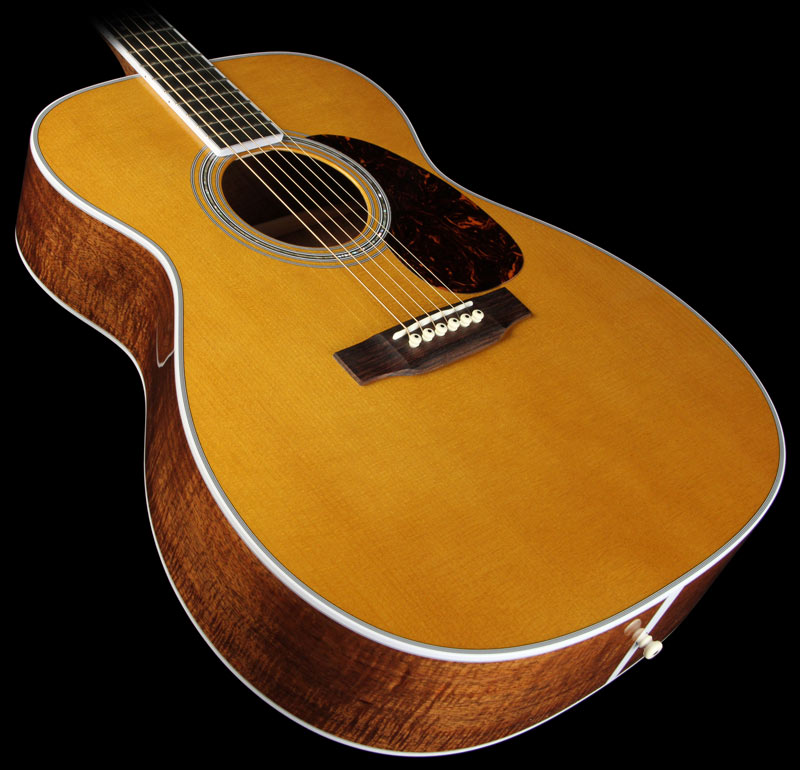
Martin 018_Custom_14_Fret_Tasmanian

C.F.Martin is the prestige acoustic guitar company in America. This is Tasmanian blackwood appearing at Carnegie Hall; the very pinnacle of the timber value adding mountain. Martin has used Tasmanian blackwood occasionally in the past but it has been a while. The last examples that I’m aware of were beautiful OM-45 and D-42 models produced about 10 years ago.

And then today I found this absolute beauty. It is a Martin Custom Shop 018-T-Tasmanian Blackwood. Size “0” is the baby in the Martin family, while the “18” denotes a moderate degree of decoration (compared to the above “OM-45” that is literally dripping with bling). This custom baby model is only available at Music Zoo in Roslyn, New York. Check it out!

http://www.themusiczoo.com/product/13778/Martin-Custom-Shop-5-14-Fret-018-T-Tasmanian-Blackwood-Acoustic-Guitar-/

Baby Martin size “0” guitars are relative rare these days. They were common years ago, being introduced during the Great Depression to help boost sales at Martin Guitars. Martin also makes a custom order “0” in all solid mahogany including soundboard, which is another beautiful guitar. But I would happily sit this blackwood baby on my lap for a strum.

But all that Tasmanian promotion and marketing potential is being wasted. Tasmania is not internationally renowned as a reliable producer of sustainable profitable quality tonewood. To date most of the international commercial relationships have been short lived, difficult affairs, not to mention the local politics and conflict. We have the potential to once again walk the stage at Carnegie Hall with our quality profitable sustainable blackwood tonewood. To date there appears to be little interest here in Tasmania. Such a wasted opportunity.

Submission for TFIA funding

I have submitted my proposal for funding  for the Blackwood Growers Cooperative under the TFIA Economic Diversification Funding Stream.

http://www.development.tas.gov.au/?a=77116

Submissions close today at 5pm. I’ve been waiting over 2 years for this moment. The submission can be found here:

TFIGA_EDF_blackwoodgrowerscoop.pdf

To date neither the State government, the Special Council nor the forest industry seem to have developed any plan for the future of the forest industry in Tasmania around which any of the TFIA funding can be made. The TFIA document itself certainly provides no vision/plan for the future of the industry. I’m especially disappointed that private forest growers appear to have not taken advantage of the situation to advance their cause. So this is a very chaotic and random situation with lots of conflicting and competing interests. We’ll see what happens.

$540 per cubic metre blackwood sawlog price!

Island Specialty Timbers (IST) has published the results of their June 2013 log tender. Only one blackwood log was tendered but it achieved a fantastic price for a plain-grain sawlog of $540/m3!!

Yes it was a large diameter log, and log prices are strongly correlated with log diameter. This is because recovery of sawn timber is exponentially correlated to log diameter, ie. a small increase in log diameter can result in a big increase in sawn recovery.

Even remembering that IST is run as a non-profit business this is a great result. If this result provides any indication of general blackwood sawlog open market prices then there is significant opportunity in private investment in growing blackwood, provided that current policy obstructions are removed.

Murray Kidman

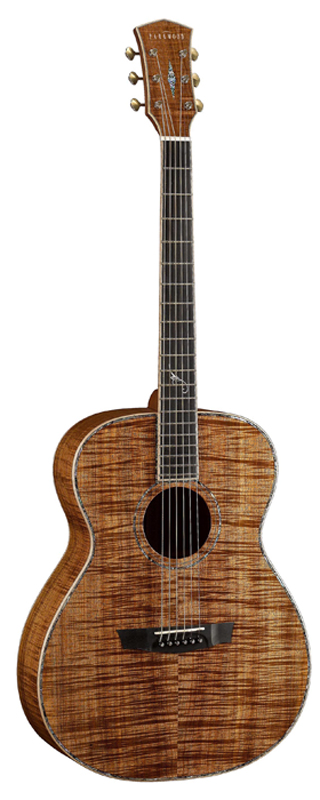
A series of coincidences allowed me to catch up last week with long-time blackwood legend Murray Kidman. Murray has been harvesting blackwood from the Otway Ranges in Victoria for the past 30 years. He started out salvaging stumps and other “waste” wood from commercially harvested areas of State forest. Word gradually spread that Murray had a very impressive collection of figured blackwood, which attracted the attention of a few local luthiers. Eventually Maton Guitars heard about Murray and a long-term partnership was formed. Murray now only supplies the tonewood market, including Maton Guitars, a number of custom luthiers and the occasional commercial order, such as the recent limited edition blackwood guitars by Cort and it’s subsidiary Parkwood, one of the largest guitar manufacturers in the world.

Kidman Parkwood_le601nsmso9

When commercial native forest harvesting ceased in the Otway Ranges in about 2008, with the help of Maton guitars Murray managed to get a license to continue small-scale selective logging of blackwood. Murray’s only tool is his chainsaw. All the timber harvested is carried out of the forest by hand, with all operations controlled and managed by the Department of Environment and Primary Industries. Murray has just had his license renewed allowing him to harvest a total of 100 cubic metres of blackwood over the next 3 years. This is a small boutique business that just manages to provide Murray with a very basic living. But the man loves his work and is passionate about blackwood. Here is a video about Murray from the Maton Guitar website.

And yes, Murray does have a very impressive collection of figured blackwood timber some of which can be seen on his website. He also has a very impressive dog! You can read more about Murray’s story on his website:

http://otwaytonewoods.com.au

But what about the future? Murray is a sole operator approaching the end of his working life. His son James might take over the business, but it is a labour of love more than fortune. And what about the resource? The management of public native forest will always be contentious. In terms of regulation and politics Murray walks a tightrope every day in his accessing a public resource. Continuing access to the public resource is not guaranteed. There is a relatively active farm-forestry group in the Otway region, but so far there hasn’t been any collaboration with this group. There will certainly be blackwood growing on private land in the Otway Ranges, and opportunity to plant more. Can these various opportunities come together for everyone’s benefit to help build a more commercially, socially and politically sustainable blackwood industry in Victoria?

What Murray does may be inspiring and results in the creation of high-value products, but we need to get to the point where growing blackwood is a profitable commercial activity that attracts the attention of farmers. This can only happen if the market provides sufficient interest and attraction to farmers by way of price signals and communication. Only then will Maton and the other luthiers have a sustainable future supply of Otway blackwood.

Thanks Murray for a very enjoyable and informative afternoon.

A meeting with Forestry Tasmania

I had a meeting last week with representatives of Forestry Tasmania (FT) to discuss special timbers and blackwood issues. The meeting was in response to my recent commentary about public subsidies and pricing policies. It was an informal meeting with no minutes recorded. Here is a brief summary of what I learnt and concluded:

  • FT did not dispute my figures and analysis regarding the special timbers subsidy and pricing.

Business model

  • FT regards special timbers very much as a non-profit, non-commercial community service requiring public subsidies. The worse the special timbers economics become (and there appears to be no bottom-line to this) the greater the public subsidy that will be required.
  • FT has no interest in getting a better price for its special timbers sawlogs.
  • I got the impression that FT would continue to support the current beneficiaries of subsidised public special timbers while the current beneficiaries resist any attempts to introduce commercial reforms.

(NB. The special timbers industry appears to have convinced many people that paying real market prices for special timbers sawlogs would destroy the industry! While opening up the special timbers market is vital for the success of private special timbers growers.)

  • Island Specialty Timbers (IST) appears to be deliberately run as a loss-making venture, breaking even in the occasional good year, but generally operating at a loss. Apparently no attempt is made to make IST profitable or commercially focused. IST compete directly with many small private sawmill operators around Tasmania. Anticompetitive behaviour clearly doesn’t seem to bother these guys.
  • The IST tender results are used to inform the contracted price for special timbers, with tender prices “informing” the upper limit to contract prices. See my discussion here for further analysis and commentary of FT pricing policy.

Supply

  • The supply of special timbers, including blackwood, from State forest will be greatly reduced with the implementation of the Tasmanian Forestry Agreement (TFA), with increasing public subsidies the likely outcome under current policy.
  • The 880 ha of blackwood plantation established by FT 20 years ago have now apparently been written off as a failure. These plantations were originally expected to contribute over 250,000 cubic metres of blackwood sawlog to the sustainable yield beginning in 2018, but will now contribute nothing to the future blackwood industry.  Over $4 million was spent establishing these plantations.

(NB. Most of these plantations were located at Beulah, south of Sheffield on a site unsuited to growing commercial blackwood, using a complex and risky silvicultural model).

  • Production of blackwood sawlog from the Fenced Intensive Blackwood (FIB) areas has now been pushed back from 2033 to at least 2050. These areas were expected to contribute at least another 250,000 cubic metres of sawlog to the sustainable yield. However it is unknown whether these areas are being managed or are performing according to original expectations.
  • For at least the next 40 years therefore the production of blackwood sawlog from State forest will be centred on the swamp forests of Circular Head. My estimation is that supply will shrink to about 3,000 cubic metres per year.

The future

  • FT regards any private person (including yours truly) who thinks they can grow blackwood commercially and profitably either now or in the future as seriously misguided, and certainly not deserving of a fair go let alone to be encouraged by the introduction commercial reforms and a real market price.
  • On that basis FT regard the non-profit, taxpayer-subsidised management of the public blackwood resource as having no bearing whatsoever on any existing or potential future private blackwood development by Tasmanian farmers.

This cavalier attitude to Tasmanian farmers and the special timbers industry ignores the fact that New Zealand farmers have been successfully growing blackwood for the past 30 years. Also as I have noted previously, when New Zealand blackwood expert Ian Nicholas last visited Tasmania in 2011 he was very frustrated and disappointed with the way the blackwood industry was being managed. He thought farm-grown blackwood had a great future in Tasmania. In fact it was Ian’s enthusiasm that got me thinking about a growers cooperative. And finally I am not aware of anyone in Tasmania (including FT) applying the successful New Zealand model for growing blackwood including the use of the Three Principles, so significant opportunity remains for further technical development and understanding.

The proposition that FT must manage its special timbers business activities as a non-profit community service is extraordinary and certainly deserving of the commentary and criticism in The Mercury Editorial of September 24, 2011 “Strong medicine for GBEs”.

The proposition that the special timbers industry cannot survive paying real market sawlog prices is logically self-contradictory and straight economic nonsense. Only real market prices can determine the viability and sustainability of the special timbers industry.

The proposition that Tasmanian farmers should be denied the opportunity of growing commercial blackwood in contrast to their New Zealand peers is an extraordinary expression of State forest policy.

If we were talking about any other primary industry such as beef, dairy, vegetables or fruit Tasmanian farmers would be marching on Parliament house. Fortunately, for example, we do not have a non-profit dairy GBE, but many farmers have an intimate knowledge of dairy markets and a long history of running profitable dairy farms. Unfortunately we do have a non-profit forestry GBE, whilst few farmers have much knowledge of forestry markets and little history or understanding of how to profitably grow trees for wood production.

This must now change because profitable, commercially-focused private growers now supply the vast majority of wood grown and harvested in Australia. Why do we therefore persist with State forest agencies that are managed on any other basis, while denying our farmers commercial opportunities, and wasting taxpayers money?

The special timbers and blackwood industries remain in serious crisis with things about to get a whole lot worse, with no indication of any positive change.


As we were leaving the meeting one of the FT representatives asked me whether I thought the TFA would succeed and save the forest industry. I thought it was a curious question given that I had just experienced a perfect 30 minute demonstration of exactly why the forest industry is in its current crisis, and why the TFA faces significant challenges.

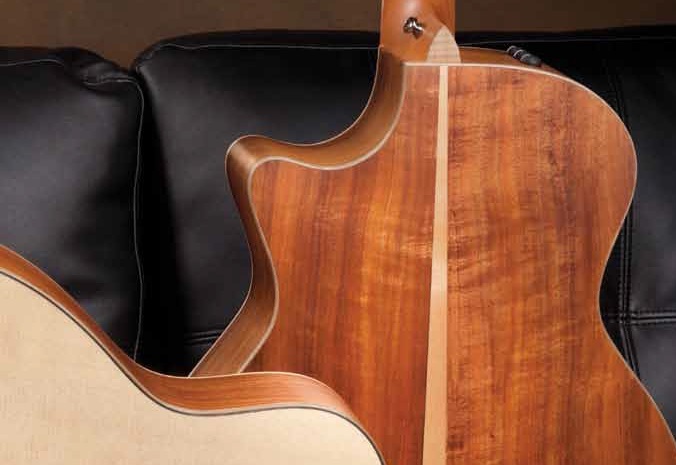
Using New Zealand farm-grown plantation blackwood in stringed instruments

Here is a great story featuring New Zealand farm-grown plantation blackwood timber being used in the manufacture of high-end custom-built stringed instruments.

http://www.burginguitars.co.nz/now-in-stock-2/

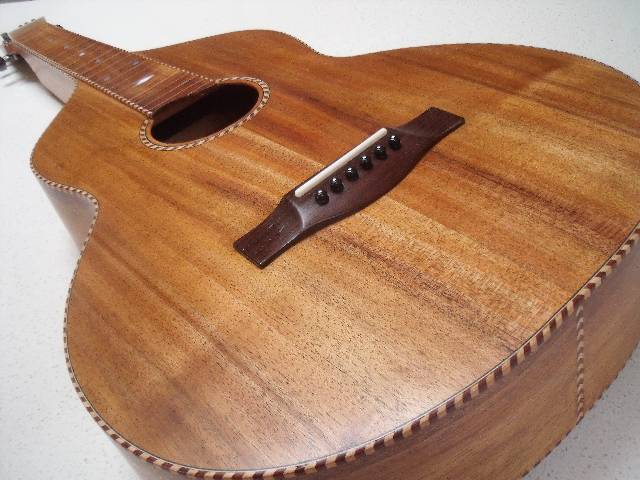
Paddy Burgin is a luthier based in Wellington New Zealand. Paddy has customers from all around the world. Amongst other timbers Paddy uses both Tasmanian and New Zealand grown blackwood to build his custom stringed instruments. The latter is farm-grown plantation blackwood, in this case sourced from a farm at Golden Bay in the far north-west corner of the south island. This particular farmer has been growing blackwood since the 1970s. While Tasmanian blackwood is more commonly used in instruments, examples of NZ blackwood in lutherie are still relatively rare. I suspect this is because a) there aren’t many luthiers in New Zealand, b) NZ blackwood is not widely available outside NZ, and c) there is still a lingering prejudice against plantation wood.

So here is a great example of a weissenborn guitar made from NZ plantation blackwood. Weissenborn are a style of lap slide guitar that was originally developed in the 1920’s in California during the Hawaiian music craze.

golden-bay-finish-1

Paddy recognises that the NZ blackwood has different tonal properties to Tasmanian grown blackwood but is very well suited to the task of producing quality instruments. As time passes and the NZ blackwood industry matures perhaps a selection and breeding program may develop plantation blackwood that is custom grown to meet the needs of the tonewood market. But it takes pioneers like Paddy to challenge our prejudices and help drive the future of the tonewood and blackwood industries. Check out Paddy’s web site and read this great story. Thanks Paddy and keep up the great work!

PS. More blackwood stories from New Zealand would be greatly appreciated……

Congratulations Pav

Congratulations to Pavel Ruzicka who has been recently appointed the new member of the Tasmanian Forestry Agreement Special Council representing the interests of the Tasmanian special species timber industry, as announced by the Minister for Energy and Resources Bryan Green in the State Government Gazette 6th June 2013.

Pav has a massive task ahead to try and put the special timbers industry onto a fully commercial, profitable and sustainable basis for all special timbers growers. Top of my wish list is the removal of all existing market distortions (subsidies, pricing and sales) so that a) Forestry Tasmania adopts a fully commercial approach to special timbers management, and b) fair, honest and transparent markets become available to private special timbers growers. I offer my services to assist Pav in any way I can.