
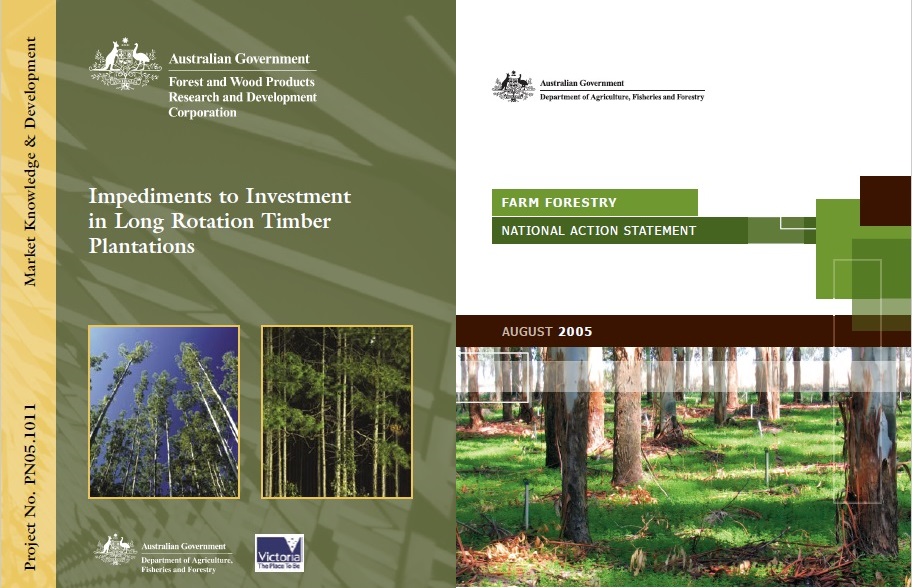
Both of these reports were published in 2005.
Both of these reports have (had??) significant potential impact upon the future of the Tasmanian blackwood industry.
Both of these reports contain important information and recommendations about reforms to the forest industry.
From what I have seen nothing from either of these reports has ever been implemented!!!
Ten years after these reports were published both are still available on Government websites as if they form the basis of current Government policy, but from what I can see neither of them are currently active.
The information and recommendations in these two reports has not been taken up and included in any forest industry policy documents (eg. FIAT), political party policies, nor in any farm lobby group policies (eg. the TFGA). Why not??
Tasmanian Government forest policy does not include any of the recommendations from these reports.
If only half of the recommendations from these two reports had been implemented the forest industry would be in a much better position today, and investment in the future of the blackwood industry would be a whole lot easier.
Here are the links to these two reports:
http://www.planningplantations.com.au/assets/content/plantations_sustainability/economic/ownership.html
(the link to the pdf report is at the bottom of the page)
http://www.agriculture.gov.au/forestry/australias-forests/plantation-farm-forestry/publications/farm_forestry_national_action_statement
Personally I think the future of long rotation plantations is looking more uncertain except in markets where high value appearance-grade timber is needed. Construction-grade timber is increasingly made from engineered wood products rather than solid wood; engineered from short-rotation plantation-grown wood.
But the market for long rotation appearance-grade timber is relatively small, especially if we are just talking about the domestic Australian market. The international market for quality appearance-grade timber is significant but is still dominated by the illegal trade in rainforest timbers.
The opportunity for supplying profitable, quality, farm-grown plantation grown Tasmanian blackwood into the export market is significant.
And this is where the Farm Forestry National (In)Action Statement (NAS) becomes important.
To achieve the vision, the Australian, State and Territory governments and the forest and wood products industry need to progress 16 actions, grouped under four action imperatives:
- Develop appropriate, integrated and consistent Australian, State, Territory and local government policies for farm forestry;
- Coordinate actions and build relationships to support farm forestry;
- Recognise and, where possible, quantify farm forestry’s economic, environmental and social benefits and costs;
- Promote the development of markets for farm forestry products and services.
The 16 actions are broken down into 33 measurable outcomes, listing deadlines and who is responsible for implementing the outcomes.
None of it has been implemented!!
The Federal and all State Governments and the forest industry all signed up to do this.
So much for commitment!
So much for leadership!
Perhaps the Tasmanian Government and the Tasmanian forest industry should revisit the NAS and recommit to implementing its recommendations.






 Tasmanian Blackwood Growers Cooperative
Blackwood Plantation Financial Model
This is a financial model that calculates the Internal Rate of Return (IRR) from an investment in one hectare of commercial blackwood plantation. The model is setup in an Excel spreadsheet:
Blackwood financial model.xlsx
Here’s the link to find out more about the IRR function in Excel:
https://support.office.com/en-us/article/IRR-function-64925eaa-9988-495b-b290-3ad0c163c1bc
This model is a work in progress and is designed to encourage feedback, comment and updating.
You can download the model and use your own numbers if you wish.
Contact me if you want help modifying the model to your personal requirements.
To begin with I went back to the New Zealand Blackwood Growers Handbook that contains an financial model on page 77. I set this model up in a spreadsheet and came up with the same values as shown in the handbook.
http://www.nzffa.org.nz/farm-forestry-model/species/blackwood/#Blackwood handbook
I then modified the model according to my own recommended simplified plantation regime. This simplified plantation regime reduces the initial establishment and management costs, and reduces the workload required in the first 10 years.
I also changed some of the values in the model to better reflect what I consider are current costs.
Assumptions
http://blackwoodgrowers.com.au/2015/12/11/tasmanian-blackwood-sawlogs-at-625-per-cubic-metre/
Results
The model shows an internal rate of return on Tasmanian blackwood plantation investment of around 10% over 35 years.
For a 35 year investment that is a decent return. Fixed term deposits are currently offering around 3.00% over 4 years (updated Feb 2016).
http://www.infochoice.com.au/banking/savings-account/term-deposit-interest-rates.aspx
If a very good site is planted and hence the rotation shortened to 30 years the return on investment increases to 12%. Alternatively if the value of the plantation after 35 years is only $100,000 per hectare the rate of return is still 9%.
In other words the investment is quite robust to changes in conditions and markets.
Commercial blackwood plantations are a profitable investment under current market conditions.
I wouldn’t recommend buying land just to grow commercial blackwood. Blackwood is not a broad-acre crop but requires certain site characteristics to grow successfully.
Many Tasmanian farms have areas that are currently underperforming or neglected; covered in weeds, bracken and blackberries. These areas are not contributing to farm income, but many of these areas are suitable for growing commercial blackwood.
If a farm has a number of these areas, the investment and the workload can be spaced over time, for example by planting an area every 5 years. After 35 years a set of periodic incomes is achieved from regular harvesting and replanting of plantation blackwood.
Now the one major feature missing in the forest industry is greater market and price transparency to help encourage this investment.
14 Comments
Posted in Commentary, Plantations