Category Archives: New Zealand

Wish List

Makeawish

The forest industry in Tasmania is heading towards oblivion, at least the part of the industry dependent on the public native forest resource. Decades of poor policy, politics and conflict have reduced the industry to a smoking ruin. But we seem to have trouble learning from past mistakes and from other people’s successes. Getting people to invest in the forest industry (from planting trees to investing in sawmilling and processing equipment) just won’t happen under the current regime. So here is my one dozen wish list:

  1. We need to start thinking of forestry as a primary industry and not as a Government-run, politically-driven, employment program. Sure it has a few unique features like a long investment time lag, but forestry is about business and profits; markets, costs and prices. It is not about politics or employment! Most wood now grown and sold in Australia comes from private tree growers. It is time to put the policy focus on private growers.One example of this change in focus would be to move Private Forests Tasmania (PFT) from the Department of State Growth Tasmania to the Department of Primary Industries, Parks, Water and Environment (DPIPWE). At the moment this DPIPWE website contains no mention of forestry at all:http://dpipwe.tas.gov.au/agricultureWhy isn’t forestry regarded as a primary industry in Tasmania?

    Also the Government Minister responsible for PFT/DPIPWE should also be responsible for Forestry Tasmania, so that all commercial forest policy and practice is aligned with primary industry policy. Does that sound logical or what?

  2. And like all primary industries the only basis for a successful forest industry is for tree growing (public and private) to be transparently profitable.That’s the golden rule! It’s that simple!Commercially focused, profitable tree growers are the foundation of a successful forest industry. The forest industry is not about subsidizing the sawmillers, papermakers, or woodchippers, or the furniture makers, craftsmen, luthiers or boatbuilders. These people are important, but without profitable tree growers they are irrelevant. Forest industry policy should be focused on profitable tree growers.
  3. We need to get the politics and conflict out of the industry. That means either a) completely transforming Forestry Tasmania into an independent, fully commercial, profitable business, or b) shutting down public native forest logging. There are no other options!
  4. Public and private tree growers must be able to compete in the marketplace on a level playing field. This means no more subsidies or political protection for public tree growers. Forestry Tasmania must be structured and managed just like a private tree grower – independent, fully commercial and profitable. Anything else is anti-competitive.
  5. The Tasmanian Farmers and Graziers Association (TFGA) needs to become a genuine independent, vigorous advocate for private forest growers. The interests of private forest growers are not the same as those of sawmillers, or Forestry Tasmania nor the Government of the day. A thriving commercially competitive, profitable forest industry can only exist when private tree growers have a strong, fearless, independent voice.
  6. It’s time for the forest industry (and I’m talking about everyone here from tree growers to wood processors and log exporters) to publically demonstrate some real commercial muscle. Where are the profits? Where are the prices? Where are the markets? Where is the transparency and market feedback? For far too long the industry has focused on political muscle. It’s time to “put the rubber to the road” and lead by commercial example.
  7. Unlike many other primary industry markets, Australia’s forestry markets have historically been opaque to near invisible, and continue to be that way. Hidden markets do not encourage investment in planting and infrastructure. The forest industry in New Zealand issues regular monthly market reports. This helps everyone better understand the marketplace. We desperately need similar transparency in forestry markets here in Australia.
  8. To help overcome the natural reluctance of many people to make the long-time investment in forestry (the time between planting and harvesting), the industry needs to be incredibly (aggressively??) transparent in the marketplace. This means lots of market reports and updates, lots of price and demand information, etc. We need significant market stimulation to help landowners get past the big time factor!!
  9. Farmers need to have greater understanding and confidence in forestry markets. Again this requires forestry markets to be much more transparent and commercially focused; just like other rural commodities. Investing in forestry is not easy. There’s the technical stuff and the long investment period, and just the switch to thinking “long term”. When we start getting forestry market updates in the rural media then I will know that the forest industry has come of age.
  10. The forest industry needs a new Forest Practices Code, or rather it doesn’t. Let me explain.The forest industry in New Zealand is huge (bigger than Australia’s) and very successful, but New Zealand does not have a Forest Practices Code. Imagine that! In New Zealand they regard the forest industry as just another primary industry, which must abide by the same code of environmental practice as all the other primary industries. It’s called a level playing field.The code is called the Resource Management Act 1991, and it applies to most primary industries. It is designed to protect environmental values regardless of land use. So growing trees for wood production has the same regulatory framework as other primary land uses. A brilliant idea!Here in Tasmania the forest industry is far and away the most (over?) regulated primary industry in the State. This creates market distortions and discourages sensible land use and investment decisions.Forest plantations on already cleared land should be no more or less regulated that any other agricultural crop. For many Tasmanians that will be a very difficult thing to imagine after the MIS hardwood plantation disaster.

    (And whilst on the subject of New Zealand, the forest industry there survives without any resource security. That’s right! Whatever trees the private forest growers have to sell is the only resource available to industry. That’s all. If a sawmiller wants “resource security” then they need to pay a competitive price to stay in business. The issue of “resource security” is a furphy!)

  11. And following on from the previous item, why do we have Private Timber Reserves in Tasmania?http://www.pft.tas.gov.au/index.php/services/services/1-website-articleWhy not Private Onion Reserves, Private Poppy Reserves, Private Cow Reserves or Private Apple Reserves? In fact why not make all primary industries subject to a single Statewide planning system? Wouldn’t that be fairer? We could even call it the Resource Management Act!
  12. And finally I’d like to see Tasmanian farmers incorporate commercial blackwood growing into their business models (either plantation or native bush), developing the skills, passion and expertise in growing this iconic quality Tasmanian product. But this won’t happen to any extent unless change occurs within the forest industry and Government policy.

When you compare my wish list with the current forest industry you can see an enormous abyss. Current forest policy is focused on a public native forest resource, a bankrupt, non-commercial public forest manager, a handful of taxpayer-subsidised sawmillers and processors, and enormous amounts of politics and community conflict. It has been this way for decades!

It seems that none of this will change unless the TFGA (on behalf of private forest growers) start demanding reform. And based on recent events I can’t see this happening any time soon.

What do you think? Comments? Continue reading

United Forestry Group NZ

UFG

Notice was given of the formation of this New Zealand organisation in my story back in August.

http://blackwoodgrowers.com.au/2014/08/23/new-group-looks-to-become-fonterra-of-forestry/

So here they are up and running with their own website.

http://www.unitedforestrygroup.co.nz/

And here’s a collection of “cut and paste” from that website to give you an idea of what they have to offer the small forest owner in New Zealand.

United Forestry Group | UFG

A strong new company, United Forestry Group Ltd (UFG), has been formed in New Zealand to help the owners of some 14,000 small plantation forests, totalling more than half a million hectares, with the challenge of marketing a  “wall of wood” coming to maturity  over the next two decades.

Mission Statement

To unite the interests of forest owners to provide innovative and attractive harvesting options incorporating world class logistics and marketing resources delivering excellent commercial and community benefits.

Our approach will assist small forest owners to compete with the owners of larger forests who currently enjoy the advantages of economies of scale and greater expertise.

About Us

Joining with United Forestry Group (UFG) will enable small forest owners to compete more successfully and achieve better returns than by trying to go it alone.

United Forestry Group (UFG) shareholders bring local forestry management expertise and contacts together with considerable financial resources, long established contacts in the Asian and local markets, and shipping and supply chain expertise.

Joint Venture Superpen Limited, a NZ company, is a cornerstone investor in the new company. Partners in the joint venture are major players in timber exporting – international timber marketer Pentarch of Australia and Chinese conglomerate Xiamen Xiangyu, which has considerable logistics, shipping and and supply chain assets.

The Superpen joint venture will deliver expertise, contacts with timber buyers, shipping services and financial strength to United Forestry Group (UFG).

Financial Strength

Our financial strength, our expertise and contacts, and a strategy devised to improve the return from small forests whether by marketing to local processors or overseas buyers, are the key.

Our size and resources will enable us to buy and consolidate existing forests and co-ordinate orderly harvesting, marketing and shipping. Our approach enables small foresters to join with us and extract the maximum possible return – the lowest possible cost and and the best possible price. At the same time we offer forest owners investment opportunities if they wish to participate in the wider forestry industry.

Asset Protection and Security

We believe that union is strength and that owners of a single small forest are vulnerable because of their limited bargaining power and marketing ability.

Consolidating forests through UFG (United Forestry Group) will enable you to enjoy the benefits of economies of scale, greater bargaining power and greater expertise. It will be possible to manage a consolidated forest resource sustainably to produce better outcomes and to time the market better.

Consolidation will protect your asset and give you greater security.


I doubt we will see anything like this in Tasmania anytime soon but it sure sounds like a great idea.

It will be interesting to see whether they can attract the support of small forest growers and become a major player in the New Zealand forest industry.

Those New Zealand farm foresters are lucky to have such an option.

Go to the website and check them out.
Trees on Farms videos (featuring blackwood)

I’ve recently realised that the New Zealand Farm Forestry Association has posted videos on their excellent website featuring farmers who grow blackwood.

http://www.nzffa.org.nz/farm-forestry-model/species/blackwood/#Trees on Farms videos

Two of these videos are particularly good.

One features Malcolm McKenzie who is a passionate farmer and blackwood grower. Trees are combined with dairy support grazing on this 57-hectare block, with trees occupying the steeper land. Malcolm grows top-quality blackwoods as well as poplar, cypresses and radiata pine. Markets for blackwoods are discussed.

The other video features Northland farmer Brian Simms. Brian’s farm combines grazing with high value trees. Tree species planted include radiata pine, blackwood and silky oak (Grevillea robusta). Brian plants for erosion control and beautification of the farm, while also producing high value timber.

The passion and enthusiasm of these farmers is clearly evident. All of these videos are well worth watching. Much of the country reminds me of areas in northern Tasmania. Excellent farming country with pockets of steep and difficult land very suitable for growing high value timber such as blackwood.

Now how do we encourage Tasmanian farmers to copy their Kiwi peers?

Enjoy!

New group looks to become Fonterra of forestry

Here’s a great story for all those 14,000 New Zealand farm forest growers with plantations coming due for harvesting. If this is successful it will revolutionise the already very successful New Zealand forest industry. Forestry is New Zealand’s third largest export earner after dairy and meat. Last year’s total forestry exports were worth $NZ4.3 billion.

Yesterday a new forestry company, United Forestry Group, targeting owners of small forests in New Zealand was launched. Its cornerstone shareholder is a joint venture between international timber marketer Pentarch, which is headquartered in Melbourne and has been operating in New Zealand for more than 10 years, and a Chinese conglomerate, Xiangyu Group. The company’s offering small forest owners (there are around 14,000 forests under 1000 hectares which account for just over a third of New Zealand’s plantation resource) benefits similar to the pastoral sector’s co-operatives such as Fonterra in marketing and economies of scale.

It is believed production from New Zealand’s small forest growers over the next 20 years could be worth $NZ30 billion.

http://www.fridayoffcuts.com/#1

http://www.3news.co.nz/United-Forestry-Group-aims-to-fight-wall-of-wood/tabid/421/articleID/357877/Default.aspx#ixzz3B9znGRRR

I wonder if the United Forestry Group will form sub-groups to offer these services to growers of other species besides Pinus radiata, such as blackwood? New Zealand blackwood growers would really benefit from such a service.

Those New Zealanders really do understand what forestry is all about.

I will be following this story closely over the coming years to see how it develops and keep readers informed. It’s good to have a good news story.

Blackwood – the start of a learning curve

by Ian Brown

For over 30 years I have been on a learning curve for blackwood. I planted my first blackwoods in 1980 on a small abandoned farm property I had bought in the far north of New Zealand. It was a long way from home, but it was cheap, and the nearby coast was appealing for family holidays. It was located in an elevated valley, sheltered from prevailing winds, an adjacent range provided good rainfall, and had clay loam soils based on ancient volcanics. In response to a recent study carried out by Ian Nicholas at Forest Research, who had been working on a project to select a limited number of species to supplement our monoculture of radiata pine, my brother and I decided to trial some alternative species, including blackwood.

Blackwoods have been planted in New Zealand from the 19th century. It had been generally assumed that to produce good form they should be interplanted with another species, and many had been planted in native bush, or in mixtures with eucalypts or pines. There had been little interest in pruning blackwood for form correction.

1980 trial planting.

We planted 500 blackwoods in groups of 4 trees, 8 metres between groups, and interplanted with pines. When we visited the site in the first summer the blackwoods were growing strongly, and were about chest height, but some of them were developing double leaders and competing branches. It seemed logical to trim these back, leaving a single leading shoot. Without a clear agenda, we set to with secateurs. However competing demands for time (fishing) meant we did not finish the job. In the following summer, two things were apparent: the trees we had pruned were much better in form than the unpruned trees, and the pruning had not affected their growth rate. And the blackwoods were growing faster than the pines, which were clearly having no influence on them. Over each of the following summers we continued with form pruning, directing attention to competing shoots near the top of the trees, and from about year 4 followed through with clearwood pruning from the base. When the trees were above 6 metres we thinned them to one per group.

The pines lagged behind, and made no contribution until about year 4, and by year 6 were suppressing the blackwoods. We then felled the pines. This left a thick layer of slash, which made access difficult for further silvicultural work. The pines had clearly been more trouble than they were worth.

I have a trial plot on the site, and in 2010 at age 30 the mean diameter was 55 cm. It should be close to 60 cm by 35 years, when I hope to mill them.

The message we got from this block was that on a good site, blackwoods respond well to annual form pruning, without the need for a nurse. So we decided to try something novel.

1982. Open grown planting.

In 1982 we planted blackwoods, again in groups at 7 to 8 metre spacing between groups, in the open, and undertook annual form pruning, but without a nurse species. These are probably the first blackwoods to have had this form of intensive annual treatment. Of the systems we have tried, it proved to be the simplest and most effective, and with some modifications it has been the method I have used since then.

At the same time we planted blackwoods in holes cut in an area of regenerating native scrub. This worked well, but the trees still needed an annual visit for light form pruning and remove overhanging branches. I tended to get lost when locating the trees, and spent some time wandering about in circles. This might have been avoided by cutting lines in the scrub.

1983. Blackwoods and eucalypts.

   In 1983 we returned to orthodox management, and interplanted blackwoods in a mixture with with E. saligna. This worked well for the first few years, and we started to clearfell the eucalypts at about year 5. Half way through the program we encountered a problem familiar to growers who have tried this regime: we were seduced by the eucs, which were growing strongly, and looked too good to fell. So we kept them, in the hope of eventually milling both species. It didn’t work out. The blackwoods became badly suppressed, and the eucalypts thrived. Where we had thinned the eucs, the blackwoods grew well.

The message here was that nurse species provide some benefit for a limited period, but although improving form, they do not eliminate the need for form pruning. They add costs and complicate the management, and to avoid suppression have to be sacrificed on time.

In subsequent planting in the Waikato I have relied on form pruning on open-grown trees, planted in groups of 3 or 4 at final spacing. This has worked well, and has done so on other plantations in NZ that I have looked at, provided one essential condition is met: to grow blackwoods in the open and without a nurse you must have a good site, one that will encourage rapid growth. This means warmth, shelter, adequate moisture, and decent soils. On sites that are cold, dry or exposed, it is very difficult to control form in open grown trees. In those conditions you might get away with it by using a nurse crop. Or it might be better to simply plant another species.

153 (3)

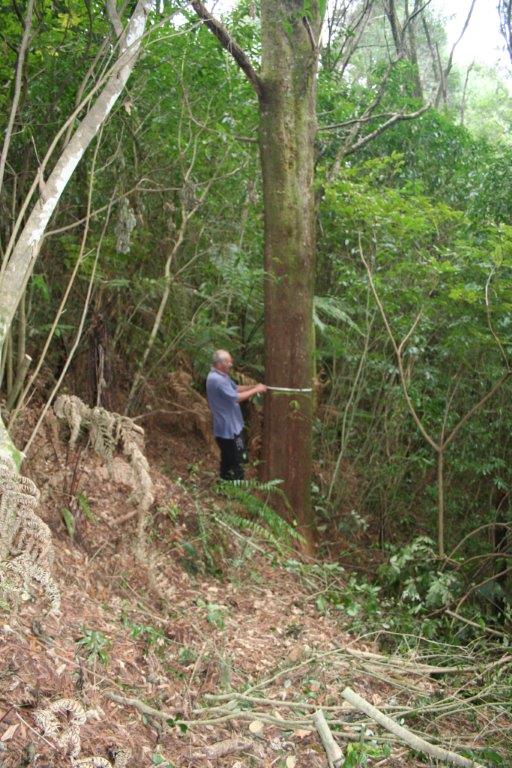
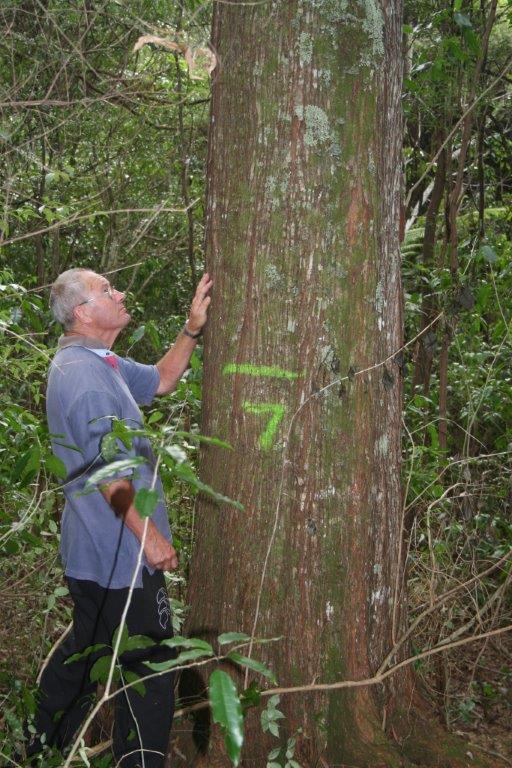
Photos are from the Northland planting, taken in April 2010. The top photo is from the 1980 planting. The scrub is natural regeneration. The tree marked 7 (below) is from the 1982 planting, open planted and annually form pruned DBH 70 cm at age 28. Naturally it is one of the bigger trees.

143 (3)

Thanks Ian for a great contribution. I hope it generates some discussion amongst readers.

Recent New Zealand blackwood articles

The latest New Zealand Tree Grower November 2013 34(4) journal, published by the NZ Farm Forestry Association, contains some excellent articles and discussion about blackwood.

Two articles by tree farmer Malcolm Mackenzie are worth reading.

http://www.nzffa.org.nz/farm-forestry-model/species/blackwood/blackwood-milling/

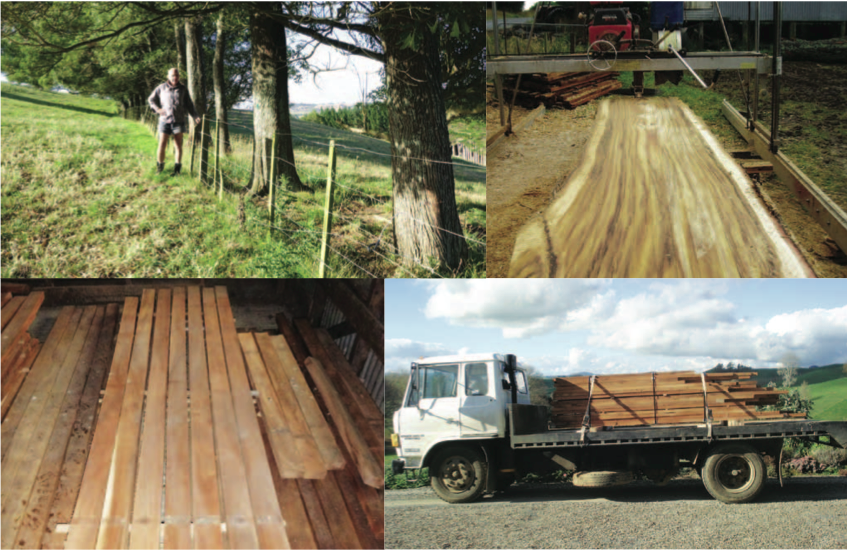
This article reports the results of a small sawmilling study looking at factors affecting sawn timber recovery in farm-grown blackwood. The logs used came from a 27-year-old shelterbelt, and were on the small side, so the recoveries were generally not that high. But the best log gave a 66% sawn recovery, including 78% of clear blackwood timber, which sells in New Zealand for $3,000 per cubic metre!

Two log quality factors that Mr Mackenzie did not report on were sweep and taper, which can also affect sawn recovery. It would have also been useful to include sawn clear recovery for the entire study, as it is the clear, knot-free wood that has the premium price.

But as Mr Mackenzie says “my challenge to fellow farm foresters is to become more scientific in their analysis of their trees in their growing stages and in their harvest. It takes time but it is useful information. I would ask that we accept the need to share information particularly as it applies to harvest results.” I couldn’t agree more.

These results hint at the possibilities that will result once New Zealand blackwood farmers begin harvesting their well managed plantations in the near future. When this happens someone needs to organise a sawn recovery study of premium plantation grown blackwood sawlogs. I’m looking forward to reading that report.

Blackwood-milling1

http://www.nzffa.org.nz/farm-forestry-model/species/blackwood/collective-blackwood-marketing/

In the second article Malcolm Mackenzie talks about his ideas regarding collective marketing of New Zealand blackwood. His focus is the domestic New Zealand market. The article contains some excellent ideas.

However I suspect that the New Zealand farm blackwood resource will be more than enough to supply the local market, with the export market being much more significant for NZ growers, including the Australian market.

The export market will provide advantages that the NZ domestic market cannot, including:

  • markets for knotty blackwood timber that the NZ market cannot take;
  • strong price competition;
  • multiple markets and buyers looking for reliable supplies of premium grade timber;
  • access to high-value prestige markets such as the international tonewood market;
  • the well established Australian blackwood market in particular will be looking for alternative sources of blackwood timber, as supplies from Tasmania decline in the coming years.

I recently did a rough scoping study and calculated that New Zealand could be producing up to 10,000 cubic metres of premium blackwood sawlog per year within the next 5-10 years. Once markets, demand and price transparency become established, the feedback signals to farmers will quickly see the New Zealand blackwood resource expand further.

Perhaps Tasmanian farmers will then start to take notice.


NB. Thanks to the NZFFA for putting these two articles online allowing general public access.

Blackwood in New Zealand video now available on-line

From the latest AMIGO Newsletter:

This video, which was part-funded by AMIGO, was the brain-child of the late Ian Nicholas. It is one of Ian’s many legacies that NZ blackwood growers can be grateful for.

Ian features in the video, discussing a series of 25-year-old blackwood regime trials, where different pruning, thinning, and final crop stocking regimes have led to some clear conclusions about optimal silvicultural regimes to maximise timber volume and value.

A number of experienced blackwood growers from both the North and South Islands discuss their experiences with growing blackwoods on range of site types, and provide recommendations for successful establishment and maximising the timber crop value.

Finally, the potential for blackwood timber is highlighted by Ian Nicholas and others. Peter King of Kings IVth Generation Timber, Carterton, shows how his company produces high-value blackwood bench-tops, and Paul Millen discusses how he has developed a production thinning regime in his Marlborough forest to produce timber for blackwood flooring. We also see inside an award-winning Marlborough house which features a stunning blackwood floor.

The video is about 45 minutes long, and ‘high definition’. Anyone unable to view it on-line should contact me and I will arrange for a DVD to be sent to you.

A great video and well worth watching. Check it out!

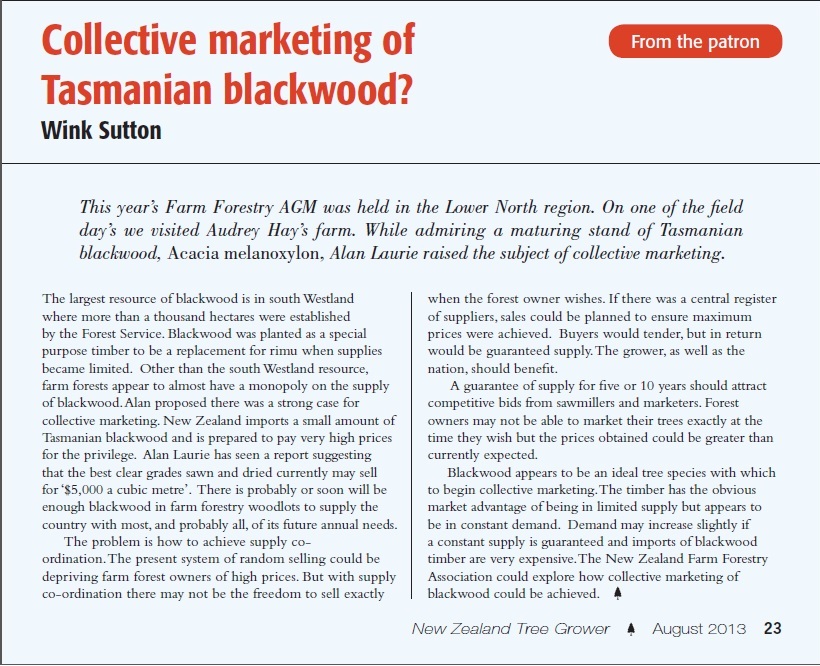
Collective marketing of Tasmanian blackwood?

Collective marketing - Tree Grower 34-3

This is an interesting article from the latest New Zealand Tree Grower journal from the New Zealand Farm Forestry Association, and potentially represents a significant milestone in the fledgling NZ blackwood industry.

Alan Laurie runs Laurie Forestry Ltd a progressive and commercially focused forest management, harvesting and marketing business. I always enjoy reading Alan’s regular forestry market reports that always me to know much more about what is happening with the NZ forest industry than I know about the industry here in Australia.

For Alan to make these comments about the potential of New Zealand blackwood is a significant vote of confidence in the industry. While there is a blackwood interest group (AMIGO) established under the NZFFA, they have yet to evolve into a marketing cooperative despite the fact that steady volumes of quality NZ blackwood timber are now coming onto the NZ market. Certainly what needs to happen soon is greater market transparency and feedback, so that prices and return on investment allow more potential blackwood growers to take an interest and help build the industry.

Blackwood appears to be an ideal tree species with which to begin collective marketing. The timber has the obvious market advantage of being in limited supply but appears to be in constant demand. Demand may increase slightly if a constant supply is guaranteed and imports of blackwood timber are very expensive.

To this comment from Alan Laurie I would also add that blackwood also has the advantage of a well established market presence and profile as a premium quality timber, so marketing and sales should be straight forward, compared to many lesser-known species.

So can the NZFFA/AMIGO evolve into a marketing cooperative and help take the NZ blackwood industry to the next level?

I would think given Alan Laurie’s knowledge, experience and place in the industry he could play a pivotal role in making the collective marketing happen.


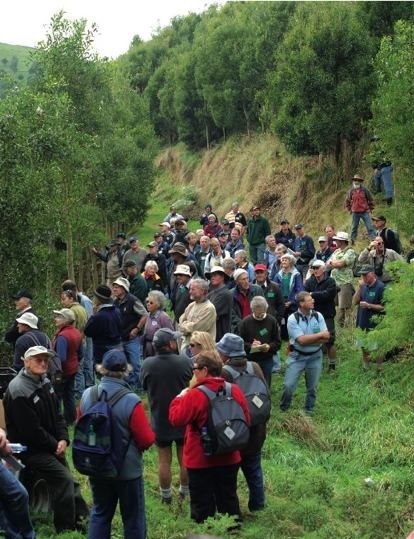
Happy tree-growing farmers

In travelling around and talking to Tasmanian farmers and others about growing blackwood I’m often faced with the statement (or some variation of it) – “but they take so long to grow!”

I’m certainly not saying that time and money are not essential issues in investment; but good money can still be made on investments up to around 40 years. And this is without considering the many other benefits in growing trees on farms.

Amongst the blackwoods

So how do farmers get past this initial resistance to investing in trees and including trees in their farming business?

As a passionate forester I’m always inspired by the stories from New Zealand where many farmers have taken to growing trees as part of their farming business. Twenty years ago the New Zealand Government (which was then the major player in the forest industry) decided that politics and forestry didn’t mix, and if the forest industry was to succeed and thrive then it was time for the Government to exit the industry. So the Government shut down the public native forest industry and sold off the large public plantation and sawmilling assets. It was a controversial decision that was opposed at the time by the industry and the forestry profession, but the Government still went ahead. Today the forest industry is a thriving cornerstone of the NZ economy, and the farmers are the beneficiaries of that brave decision 20 years ago. I only wish Tasmanian farmers were in the same situation.

The organisation that represents New Zealand farm foresters is the NZ Farm Forestry Association. Their website has a vast array of information and ideas. One is this collection of farm case studies that showcase 15 farmers and their experiences with growing trees. They are all well worth reading. Some of the stories include farmers growing blackwood.

http://www.nzffa.org.nz/farm-forestry-model/case-studies/

These stories demonstrate that farmers can overcome their reluctance to long-term investment of trees. Where the opportunity allows, a series of forestry investments over time can eventually make a major ongoing contribution to farm income. Some of the case studies include harvesting and the financial returns that have been achieved. Perhaps the best example is “Hockings, Bulls, Wanganui” the sixth on the list that includes a table showing the significant contribution of forestry to farm income over an 18 year period. Very impressive! Indeed I have read of NZ farmers who over time have converted their entire properties to forestry and become 100% tree farmers. They have discovered that farming trees is both enjoyable and profitable.

And because blackwood is high-value, smaller investments are still viable and profitable, compared to hardwood pulpwood or radiata pine where scale of investment is more important.

I hope you find these stories inspirational and educational.

Using New Zealand farm-grown plantation blackwood in stringed instruments

Here is a great story featuring New Zealand farm-grown plantation blackwood timber being used in the manufacture of high-end custom-built stringed instruments.

http://www.burginguitars.co.nz/now-in-stock-2/

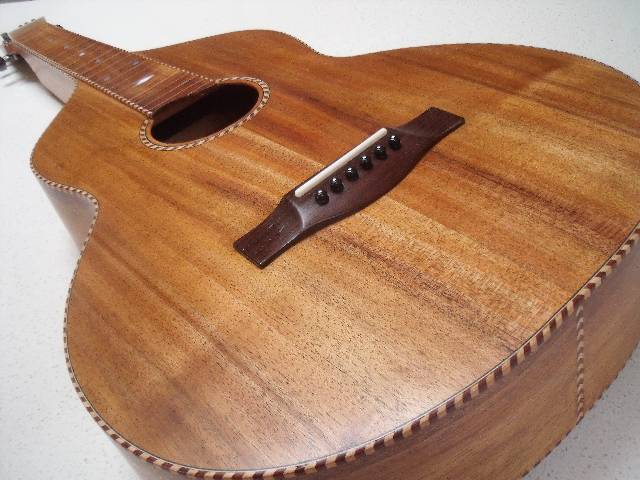
Paddy Burgin is a luthier based in Wellington New Zealand. Paddy has customers from all around the world. Amongst other timbers Paddy uses both Tasmanian and New Zealand grown blackwood to build his custom stringed instruments. The latter is farm-grown plantation blackwood, in this case sourced from a farm at Golden Bay in the far north-west corner of the south island. This particular farmer has been growing blackwood since the 1970s. While Tasmanian blackwood is more commonly used in instruments, examples of NZ blackwood in lutherie are still relatively rare. I suspect this is because a) there aren’t many luthiers in New Zealand, b) NZ blackwood is not widely available outside NZ, and c) there is still a lingering prejudice against plantation wood.

So here is a great example of a weissenborn guitar made from NZ plantation blackwood. Weissenborn are a style of lap slide guitar that was originally developed in the 1920’s in California during the Hawaiian music craze.

golden-bay-finish-1

Paddy recognises that the NZ blackwood has different tonal properties to Tasmanian grown blackwood but is very well suited to the task of producing quality instruments. As time passes and the NZ blackwood industry matures perhaps a selection and breeding program may develop plantation blackwood that is custom grown to meet the needs of the tonewood market. But it takes pioneers like Paddy to challenge our prejudices and help drive the future of the tonewood and blackwood industries. Check out Paddy’s web site and read this great story. Thanks Paddy and keep up the great work!

PS. More blackwood stories from New Zealand would be greatly appreciated……