Category Archives: New Zealand

New Zealand Cypress Market Report

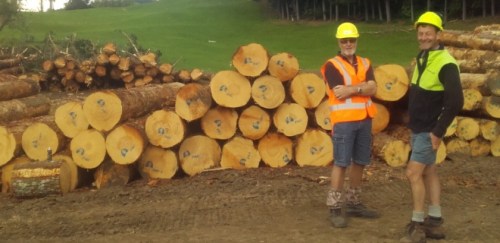
And one VERY switched on sawmiller!!

Macdirect

This has little to do with farm grown Tasmanian blackwood, but in terms of where I wish the forest industry in Tasmania was right now, this is a fantastic example. In fact I would rate this little piece as one of the best things I’ve read in my 40 year career as a forester:

http://www.nzffa.org.nz/specialty-timber-market/headlines/member-profile—macdirect/

It’s a shame it’s hidden away in a corner of the New Zealand Farm Forestry Association (NZFFA) website so that very few people will ever read it.

I suspect Murray Grant, Director/Owner of MacDirect Ltd., didn’t set out to write a cypress market report. But that is exactly what this is. This “member profile” is jam packed with lots of useful information for existing and potential cypress growers.

Most Tasmanians would only know macrocarpa cypress as large scraggly farm windbreak trees. Only a handful of Tasmanians know that this tree is fast growing and produces a high value, high quality, durable timber. New Zealand farmers have been growing it in commercial plantations for 40 years. There are only a handful of small cypress plantations in Tasmania.

MacDirect Ltd is NZ’s number 1 Building Grade Macrocarpa supplier.

https://www.macdirect.co.nz/

To me the thing that makes Murray Grant unique is that he’s not just thinking about how to improve his sawmills profitability; he’s not just thinking about the logs that will be coming into his sawmill tomorrow or next week.

He’s thinking about the logs that will be harvested in 10, 20 and 30 years time!!

He’s thinking about the trees that need to be planted tomorrow!!

The major priority of EVERY sawmiller is NOT to produce profitable sawn timber! That’s the easy part of the business!!

Given that timber takes 30+ years to grow, the major priority of every sawmiller is to ensure that farmers are growing more (profitable) trees for wood production to meet market demand.

Sawing up logs is the easy part!!!

And Murray Grant knows this when he says:

We would love to hear from any farm foresters who are keen to work closely with us to grow plantations into the future, get our perspective on silviculture for the marketplace and/or look at log price and harvesting.

Murray Grant knows the critical part that sawmillers (and the market generally) play in ensuring their own future.

Murray Grant is a hero!

He needs a medal!!


Reflections on New Zealand

MWE

I finally made it to the Shakey Isles after all these years, or at least the North Island; and thankfully they didn’t shake or erupt while we were there.

Here is a collection of thoughts on New Zealand forestry from a visiting forester from Tasmania.

If I think about the farm forest industry as a jigsaw puzzle then the New Zealanders seem to have most of the pieces in place, unlike here in Australia where we haven’t even found the puzzle box yet.

Potential

Despite its already huge forest industry New Zealand still has enormous potential to expand its industry further. There are huge areas of cleared farm land whose best long-term and most profitable use would be forestry.

This land is mostly marginal cattle and sheep grazing country, but I was amazed to see dairy farmers happily incorporating tree-growing into their businesses – harvesting timber whilst milking the cows! Brilliant!!

Whether the country’s road, rail, and port infrastructure could handle the increase is a different question.

There are also huge areas of cleared farm land whose best long-term use would be planted back to native forest – but that’s another story. Grazing cows on 70 degree slopes? Really?

With it’s potential for growing a wide range of quality timber species New Zealand could easily become the quality timber capital of the world.

Tree Growing Culture

For someone from Australia one of the things that stands out in NZ is the abundance of planted trees on farms. NZ farmers have an obvious passion for growing trees. This is not surprising in the North Island as everything grows with such rampant abundance. Trees are planted for aesthetic and utility purposes, sometimes for environmental purposes and occasionally for wood production. Most of the planted trees will eventually become liabilities that need to be cleared and burnt, instead of assets to be harvested and sold.

This tree-growing culture is a real advantage for New Zealand.

The question is – how do you progress that culture to be one of passionate profitable wood growing?

Wood Festival

One of the ways to build a culture of passionate profitable wood growing is with a wood festival.

For all its forest heritage I was surprised to learn that New Zealand does not have a Wood Festival. In order to build a focus around farm grown quality wood and farm foresters, New Zealand needs a Wood Festival. Whether it is a National Festival or a separate one for each island the future can determine. My recommendation would be to begin with a Wood Festival in the North Island, since this has the advantage in being able to grow a wider range of quality timbers.

I think the Maleny Wood Expo would be a good model for the New Zealanders to start with and develop further.

http://www.malenywoodexpo.com/

The Wood Festival should include a wide range of people from tree growers, tree nurseries, harvesting contractors, sawmillers, craft people, cabinet and furniture makers, architects, builders, etc.

The Maori community and its wood carving heritage definitely need to be part of the Festival.

The purpose of the festival is to build a community of proud tree growers and wood users, and to build links between growers and the market.

Eventually the world will come to the New Zealand Wood Festival. Major companies like Ikea will come to NZ and establish connections. I have absolutely no doubt the Festival will become an international event.

Building markets

New Zealand farmers have ready access to markets if they grow meat, vegetables, fruit, flowers, wool, wine, etc. But access to forestry markets is more difficult. Markets are well established if you grow radiata pine, douglas fir or cypress. But many farmers are growing a host of other tree species, including Tasmanian blackwood, in the hope of breaking into higher value timber markets.

But these higher value markets are yet to understand that they can no longer rely on the plunder of the worlds native forests. They have yet to understand that if they want wood today and tomorrow they need to ensure there is tree planting today and tomorrow.

Just going to the hardware or the timber merchant to buy timber is a dead end road, unless the hardware chains and timber merchants are actively supporting local tree growers.

A wood festival would help resolve this market dysfunction.

Architects

Coming from Tasmania one of the immediate impressions of New Zealand is of a go-ahead prosperous country. The NZ economy is going very well right now. There is construction and building happening everywhere.

One of the ways for NZ tree growers to establish market presence is through the architecture profession.

I strongly recommend that the New Zealand Farm Forestry Association establish a close working relationship with the New Zealand Institute of Architects (NZIA). Perhaps even a partnership!

http://www.nzffa.org.nz

https://www.nzia.co.nz/

The NZIA should be supporting local wood growers and the use of locally grow quality timber. A policy around this would a good start.

Having the NZIA onboard promoting and supporting local wood growers would be a major boost to local growers – definitely one of the missing pieces of puzzle!

Blackwood

During my trip I caught up with NZ blackwood growers Malcolm Mackenzie and Ian Brown. It was a breath of fresh air! Thanks guys!! ….and thanks also to Alison.

I saw a lot of blackwood planted around the North Island. Most of it is unmanaged aesthetic plantings, with scraggly blackwood trees being the result. I saw only a few blackwood plantations, including Malcolm and Ian’s. No one has ever said blackwood is easy to grow, even in NZ. But with care, commitment and a focus on the Three Principles it can be done. Tasmanian blackwood obviously loves growing in the north island of NZ. It’s the perfect climate and soils.

The main challenge now is not the growing of blackwood but creating and building markets. The hope is that as markets develop more trees will be planted.

Ian Brown has approximately 4,000 cubic metres of high quality blackwood sawlogs available for sale over the next 5-10 years and he needs to find a buyer. The buyer needs to pay a good price but also share a commitment to the future of the New Zealand blackwood industry. Is there anybody out there?

New Zealand is a very inspiring place for a battle-weary forester.

New Zealand Historical Pine Log Price Data

In the early 1990s the New Zealand Government made the fateful decision to hand the forest industry over to the private sector.

It was a brave and visionary decision.

Before then the New Zealand forest industry was a Government run community service that included plundering public native forests and running a massive pine plantation employment program.

Public native forestry was shut down and the pine plantation resource was sold to the private sector.

The forest industry was mortified! Apoplectic!

Twenty five (25) years later and NZ has one of the most successful forest industries in the world, based on profitable private tree growers. Can anyone challenge this assessment?

Forestry was third in the list of exports by value in 2016 in New Zealand (after dairy and meat; with no Government subsidies):

What did New Zealand export in 2016

http://atlas.cid.harvard.edu/explore/?country=166&partner=undefined&product=undefined&productClass=HS&startYear=undefined&target=Product&year=2016

Once the pine plantation resource was privatised then pine log prices became realistic and meaningful and the NZ Ministry of Primary Industries began recording pine log price data.

So here we have twenty five (25) years of export pine log price data.

http://www.mpi.govt.nz/news-and-resources/open-data-and-forecasting/forestry/wood-product-markets/historic-indicative-new-zealand-radiata-pine-log-prices/

What an astonishing achievement!

Well done New Zealand!!

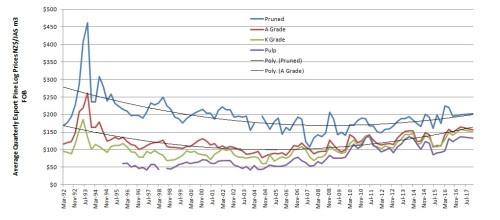
I’ve converted the data into a chart and added some second order polynomial trend lines.

Before June 2017 the data is numerical average price. Post June 2017 the prices are weighted average which should mean more realistic and stable data.

NZpinelogpricesdata25

The obvious trends are a major spike in 1994 due to the Northern Spotted Owl crisis in North America (1) followed by a gradual price decline until the GFC in 2007/08. Following the Global Financial Crisis export pine log prices have seen a steady 10-year price improvement, to the advantage of NZ pine growers.

The other interesting trend in the chart is the convergence over the last 10 years of the A Grade, K Grade and Pulp log prices. Pruned pine log prices have continued show a significant price differential.

Oh how I wish we had meaningful long term blackwood log price data.

No chance! Not in Tasmania!

Good luck to New Zealand pine growers!!

New Zealand Tree Growers Enjoying Good Times

Pine

New Zealand has one of the world’s most successful forest industries.

And right now they are riding the tide of strong demand and high prices.

New Zealand farmers will be raking in the money.

http://www.laurieforestry.co.nz/Monthly-Newsletter

Forest owners are enjoying the most sustained, stable and highest prices for logs ever recorded.

http://www.nzffa.org.nz/market-report/

http://www.scoop.co.nz/stories/BU1711/S00809/nz-structural-log-prices-rise-to-24-year-high.htm

It’s mostly about China and export markets.

Log export markets are absolutely vital to the New Zealand forest industry.

Why?

Because the New Zealand forest industry is ALL about profitable private tree growers. Local New Zealand sawmillers have to survive in a very competitive market. This keeps them focused, efficient and hardworking. That’s business!

And for that the forest industry makes a huge contribution to the New Zealand economy.

Why can’t Tasmania have a forest industry like New Zealand?

Two Great Videos from New Zealand

As many people know the New Zealand forest industry is fully commercial and very successful; perhaps the most successful forest industry in the world.

It is a major contributor to the NZ economy both from local processing and log export. The industry is still largely based on Radiata pine, but that is slowly changing.

The New Zealand Farm Forestry Association (NZFFA) helps to ensure that New Zealand farmers have a strong voice in the forest industry.

http://www.nzffa.org.nz/

They also have a strong focus on extension and support to the farming community.

These two videos are great examples of that focus.

The first video focuses on the economics and commercial returns to growers from forestry investment. These are real examples from real farmers making good money growing trees.

Returns from Harvesting

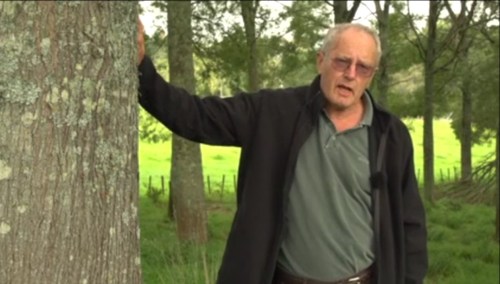
The second video shows examples of farmers who have grown, milled and used their own timber. Towards the end of this video is blackwood grower and miller Paul Millen talking about farm-grown and milled blackwood.

Using Timber from Trees on Farms

Two inspiring videos for existing or prospective farm tree growers.

Other videos that are worth watching can be found here:

http://www.nzffa.org.nz/farm-forestry-model/resource-centre/trees-on-farms-videos/

It’s a shame we don’t have anything like this from Australia/Tasmania!

Trans-Tasman Blackwood Grower Friendship

Simms

I just received this great email from my friend and blackwood grower Gilles which I couldn’t resist turning into a blog.

I like good news stories!

And yes…it’s another story from New Zealand.

Hi Gordon,

I just got back from a 3 weeks trip in New Zealand , originally it was a meant to be just a vacation with some friends but after a week I ended up travelling on my own and i soon found myself on a farm near Kaitaia in the Northland,  guest of Brian and Gaye Simms ( they are friends of a friend of mine who sent me there ).

As I got there we were soon talking blackwoods and Brian ask me if I knew you …

I was so lucky to spend 4 days with them and look very closely at his 40 years work on his farm, planting  natives and of course blackwoods to create windbreaks and stabilise the hills … an impressive result !

What a great example of what needs to be done on most farms to improve the production and create an asset that, in his case, he is able to start harvesting.

Here are some photos I took last week:

I hope Brian posts some stories of his experiences as he begins his first blackwood harvesting.

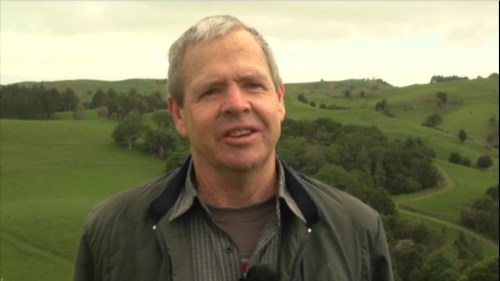
Here’s a video of Brian talking about his farm and his trees produced by the New Zealand Farm Forestry Association:

Keep up the great work Brian.

Thanks to Gilles for the inspiration and photos.

A Harvest Result to Confound the Experts

Here’s another great little story from the latest New Zealand Tree Grower (Vol 38/1 p. 19) journal that will be of interest to farmers.

www.nzffa.org.nz

Harvest result to confound the experts NZTG 38-1

The story follows from my other recent blog:

https://blackwoodgrowers.com.au/2017/03/01/good-news-story-great-returns-from-small-blocks/

The story isn’t about blackwood, but it illustrates what commitment, good management and planning can achieve on a farm even with a commodity wood like Radiata pine.

Every year for the past 27 years the Wilson family have planted and managed 1 hectare of pine plantation on their farm near Otorohanga, North Island NZ. The farm is obviously close to markets and on easy ground so harvest and transport costs are minimised.

The recent first harvest of 1 hectare of well managed pine plantation netted the Wilson family $NZ57,700.

All up they now have 27 hectares of well managed pine plantation on their farm, and good annual income in perpetuity (markets permitting). Now if they want they could replant another hectare each year so that in 27 years time they are harvesting 2 hectares per year.

This is an excellent example of how to incorporate wood production into your farming business.

Yes it takes time for trees to grow, but that time will pass regardless of whether the trees are planted or not. And as the Wilsons now discover their commitment and hard work will pay a handsome annual dividend.

Your farm may not allow 1.0 hectare to be planted every year for 30+ years. Or it might have difficult terrain or greater distance to markets.

You could make a planting every 2 years, or every 5 years. Most farms have areas that are not being used as part of the main productive activity, whether its grazing, cropping or dairy, due to size, location, slope or drainage. These areas could be used for growing valuable wood products.

Eventually, as the Wilsons discovered, you end up with a regular handsome dividend from your work and commitment.

Notes on West coast (NZ) blackwoods

IanBrown

New Zealand blackwood grower and co-author of the blackwood growers handbook Ian Brown has posted a useful and detailed update on his view of current blackwood management. It makes for thoughtful reading for current and prospective blackwood growers.

Here’s the handbook:

http://www.nzffa.org.nz/farm-forestry-model/species/blackwood/#Blackwood handbook

Here’s the update:

http://www.nzffa.org.nz/nzffa-member-blogs/ian-browns-blog/notes-on-west-coast-blackwoods/

I have two comments on Ian’s notes:

Firstly on the issue of blackwood growth rate and wood quality.

Certainly current research shows that growth rate has little to no impact on blackwood wood quality in terms of heartwood colour and basic density.

But my PhD research showed that blackwood wood quality can vary enormously from tree to tree. This is supported by numerous other studies, and is shown to be mostly genetically based.

So if you want good quality wood from plantation blackwood you need to plant good quality genetic stock.

Unfortunately we don’t yet have a blackwood selection and breeding program.

Fortunately the incidence of poor wood quality genes is relatively low.

Also note that research shows there is no correlation between heartwood colour and wood basic density.

Secondly on the issue of pruning height.

Pruning height will obviously affect the final value of the crop and in a big way since most of the value is in the clear pruned log.

Where the site dictates that you can only prune to 4 metres so be it.

But a fully stocked blackwood plantation of 200 trees with an average tree diameter of 60cm dbh pruned to 6 metres will have approximately 300 cubic metres of clear grade premium blackwood per hectare. Only prune to 4 metres and the volume of clear grade blackwood comes down to 215 cubic metres per hectare a reduction of 28%!!

Whilst you have the trees growing you may as well get the most value out of them that you can.

Thanks to Ian Brown for posting his comments.

Milling blackwood in the Marlborough Sounds, New Zealand

The latest edition of New Zealand Tree Grower produced by the New Zealand Farm Forestry Association, contains a nice article by blackwood grower and sawmiller Paul Millen (NZTG 38(1) p. 7-8).

http://www.nzffa.org.nz/

Paul runs a business called Marlborough Timbers.

http://www.marlboroughtimbers.co.nz/

Here’s the story in summary:

  • 8 plantation blackwood trees milled
  • Tree age: 30 years
  • Tree dbh: 30 – 60cm
  • Pruned height: 4 – 6m
  • Total log volume: 10 cubic metres
  • Total sawn recovery: 4.0 cubic metres
  • Total sawn recovery: 40%
  • Three to four logs per tree were milled, at lengths between 2.4 metres and 3.6 metres, including unpruned logs from above the pruning lift that were targeted to produce decorative knotty flooring.
  • Knotty boards were rough sawn 157 x 27mm and sold green at $NZ1800 per cubic metre. In future they hope to sell this grade of knotty blackwood for $NZ2,500 green or $NZ3,000 kiln dried.
  • They hope to sell kiln dried clear (select) grade blackwood for $NZ4,000 per cubic metre, which equates with what Malcolm Mackenzie is selling select grade blackwood into the NZ market:
  • https://blackwoodgrowers.com.au/2016/11/21/new-zealand-blackwood-market-report/

Here’s a link to the article (pdf file):

Milling blackwood in the Marlborough Sounds NZTG 38-1

I got the extra information from Paul to help fill out the story.

Blackwood is a niche timber that I suggest is like the pinot noir variety of New Zealand exotic timbers. The timber has some incredible colour and diversity, and it is a relatively easy hardwood to saw and season. There is a lot of satisfaction in producing a really top notch product. I know there is some excellent mature well-managed farm forestry stands and these growers deserve to receive a high return given the demanding silviculture required to manage these early plantations.

Maybe the New Zealanders should market blackwood as Noirwood!!

As more of the New Zealand farm-grown blackwood resource matures we will be seeing more of these success stories.

Thanks to Paul Millen for the story and further information.

Good news story – Great returns from small blocks

Great returns.jpg

https://nz.pfolsen.com/about-pf-olsen/case-studies/great-returns-from-small-blocks/

Following on from my previous blog about the importance of front line troops in the forest industry, here coincidently is a recent fantastic example from New Zealand.

This is the kind of media the forest industry needs to generate on a regular basis to stimulate interest and investment.

New Zealand has a very successful forest industry which is a major contributor to that country’s economy, without taxpayer subsidies.

Sure they have their challenges – that’s fundamental in business. Any business that doesn’t have challenges is going out of business quick smart.

Those clever Kiwis know how to run a proper forest industry.

It’s nothing to do with blackwood apart from showing that farmers can grow trees on a small scale and make very good money, provided Government and industry policies are right and the market’s working properly.

Kevin Thomsen, a small farm forester at Hawkes Bay, harvested just 8.6 hectares of well managed pine grown on land not suited to other land uses. And here are the results:

The harvesting results far exceeded expectations for 24 and 25 year old trees. Key statistics averaged across the two blocks (both Radiata pine) are:


Per hectare log yield of 875 tonnes over 8.6 hectares.


Net income (stumpage) of $NZ528,297


Net income (stumpage) per hectare $NZ61,430


Net income (stumpage) per hectare per year of $NZ2,507


Net income (stumpage) per tonne of $NZ67.63

Kevin credits a lot of this successful result and “stress-free harvesting” to PF Olsen and “the specialised marketing division based in Rotorua who have access to a number of competing overseas buyers of our logs.”

Clearly Mr Thomsen, besides having a well managed quality resource to sell, was close to markets and had easy harvesting conditions.

What a great story!

And another thing we don’t have here in Australia – great forest product market information like that provided by PF Olsen:

https://nz.pfolsen.com/market-info-news/

When will Tasmania get a fully commercial profitable forest industry?