
Category Archives: New Zealand

Happy tree-growing farmers

In travelling around and talking to Tasmanian farmers and others about growing blackwood I’m often faced with the statement (or some variation of it) – “but they take so long to grow!”

I’m certainly not saying that time and money are not essential issues in investment; but good money can still be made on investments up to around 40 years. And this is without considering the many other benefits in growing trees on farms.

Amongst the blackwoods

So how do farmers get past this initial resistance to investing in trees and including trees in their farming business?

As a passionate forester I’m always inspired by the stories from New Zealand where many farmers have taken to growing trees as part of their farming business. Twenty years ago the New Zealand Government (which was then the major player in the forest industry) decided that politics and forestry didn’t mix, and if the forest industry was to succeed and thrive then it was time for the Government to exit the industry. So the Government shut down the public native forest industry and sold off the large public plantation and sawmilling assets. It was a controversial decision that was opposed at the time by the industry and the forestry profession, but the Government still went ahead. Today the forest industry is a thriving cornerstone of the NZ economy, and the farmers are the beneficiaries of that brave decision 20 years ago. I only wish Tasmanian farmers were in the same situation.

The organisation that represents New Zealand farm foresters is the NZ Farm Forestry Association. Their website has a vast array of information and ideas. One is this collection of farm case studies that showcase 15 farmers and their experiences with growing trees. They are all well worth reading. Some of the stories include farmers growing blackwood.

http://www.nzffa.org.nz/farm-forestry-model/case-studies/

These stories demonstrate that farmers can overcome their reluctance to long-term investment of trees. Where the opportunity allows, a series of forestry investments over time can eventually make a major ongoing contribution to farm income. Some of the case studies include harvesting and the financial returns that have been achieved. Perhaps the best example is “Hockings, Bulls, Wanganui” the sixth on the list that includes a table showing the significant contribution of forestry to farm income over an 18 year period. Very impressive! Indeed I have read of NZ farmers who over time have converted their entire properties to forestry and become 100% tree farmers. They have discovered that farming trees is both enjoyable and profitable.

And because blackwood is high-value, smaller investments are still viable and profitable, compared to hardwood pulpwood or radiata pine where scale of investment is more important.

I hope you find these stories inspirational and educational.

Using New Zealand farm-grown plantation blackwood in stringed instruments

Here is a great story featuring New Zealand farm-grown plantation blackwood timber being used in the manufacture of high-end custom-built stringed instruments.

http://www.burginguitars.co.nz/now-in-stock-2/

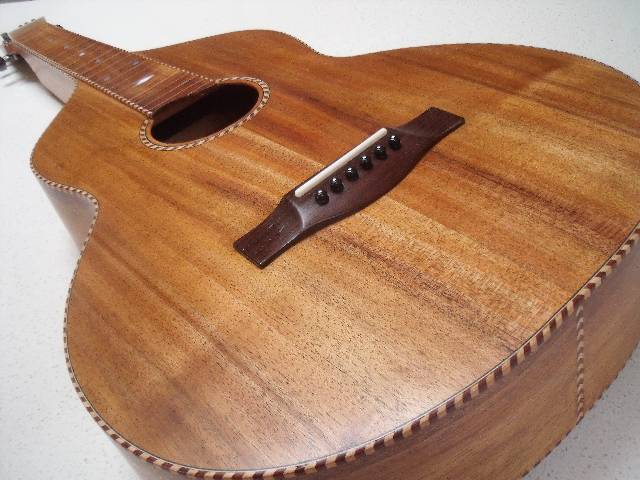
Paddy Burgin is a luthier based in Wellington New Zealand. Paddy has customers from all around the world. Amongst other timbers Paddy uses both Tasmanian and New Zealand grown blackwood to build his custom stringed instruments. The latter is farm-grown plantation blackwood, in this case sourced from a farm at Golden Bay in the far north-west corner of the south island. This particular farmer has been growing blackwood since the 1970s. While Tasmanian blackwood is more commonly used in instruments, examples of NZ blackwood in lutherie are still relatively rare. I suspect this is because a) there aren’t many luthiers in New Zealand, b) NZ blackwood is not widely available outside NZ, and c) there is still a lingering prejudice against plantation wood.

So here is a great example of a weissenborn guitar made from NZ plantation blackwood. Weissenborn are a style of lap slide guitar that was originally developed in the 1920’s in California during the Hawaiian music craze.
golden-bay-finish-1

Paddy recognises that the NZ blackwood has different tonal properties to Tasmanian grown blackwood but is very well suited to the task of producing quality instruments. As time passes and the NZ blackwood industry matures perhaps a selection and breeding program may develop plantation blackwood that is custom grown to meet the needs of the tonewood market. But it takes pioneers like Paddy to challenge our prejudices and help drive the future of the tonewood and blackwood industries. Check out Paddy’s web site and read this great story. Thanks Paddy and keep up the great work!

PS. More blackwood stories from New Zealand would be greatly appreciated……
Calling all Kiwis

I’ve just added “New Zealand” as a blog category.

I would love to get comments, ideas and stories from New Zealanders who grow, process or use blackwood.

I know there are plenty of Kiwi farmers who grow blackwood. I want to hear of your experiences, both the successes and the failures.

Ditto with NZ luthiers. I know some of you use locally grown blackwood. Send me your stories and pictures of some of your work.

Looking forward to hearing from you soon.

Cheers,

Gordon Bradbury.

The sad passing of Ian Nicholas

It was with great surprise and sadness to learn of the death recently (22/3/2013) of New Zealand friend, blackwood scientist and farm forestry advocate Ian Nicholas at the age of 59.

I only got to know Ian personally in the last 10 years but in that time I developed a great respect and appreciation for his immense knowledge and understanding, but also for his quite strength and determination. He was a tremendous advocate for broadening the range of commercial tree species grown in New Zealand including blackwood. His determination and hard work provided much of the momentum and progress in the small world of plantation blackwood.

Over many decades Ian provided the New Zealand focus and did much of the research that helped turn blackwood from an unruly opportunity into a commercial reality. With Ian’s help New Zealand farmers have mastered the art of growing commercial blackwood, and are now starting to reap the benefits. In 2002, in conjunction with Ian Brown he wrote the plantation blackwood bible, the Growers Handbook, while in the past few years he took on the role of managing the New Zealand blackwood growers group (AMIGO).

On his last visit to Tasmania in May 2011 Ian, together with two Chilean forest scientists and blackwood experts, were on a fact-finding mission to see what we were doing with blackwood. They left Tasmania realising that they knew far more about growing blackwood than we do. Ian was disappointed with where the forest industry had got to in Tasmania. I wrote an article about it in Tasmanian Times. It was Ian’s visit that pushed me to develop the Growers Cooperative proposal.

http://tasmaniantimes.com/index.php?/weblog/article/a-missed-opportunity-for-the-forestry-peace-agreement/

Ian was very supportive of my proposal to establish a blackwood growers cooperative in Tasmania.

My dream was that one day I would enjoy Ian’s company as he showed me around the blackwood highlights of New Zealand. Sadly that dream will never be realised.

Thank you for your support and friendship Ian.

Rest in Peace.

Award Winning House has Blackwood Floor

Glenroy_rmbhoy2011

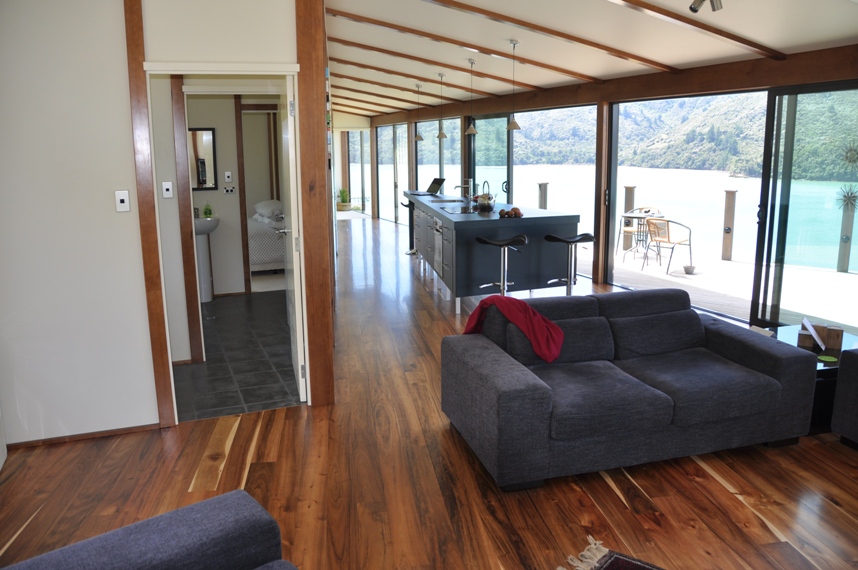
Last year the New Zealand Registered Master Builders 2011 House of the Year featured a stunning blackwood floor. But this was no blackwood imported blackwood from Tasmania, this was New Zealand plantation-grown blackwood.

http://www.houseoftheyear.co.nz/index.asp?id=83

The following is an article from the latest New Zealand Tree Grower journal (Feb 2012) written by Ian Nicholas and Paul Millen. Ian Nicholas is Chairman of AMIGO (the NZ blackwood growers group) and Paul Millen is a director of Marlborough Timbers

In November last year, a Marlborough Sounds house built by Glenroy Housing of Blenheim won the New Homes category $350,000 to $450,000 house of the year Registered Master Builders award. The house went on to claim the Supreme House of the Year award fighting off one and two million dollar houses. The house has been built for Marcus and Alex Myring who see their home as very special.

The Master Builders promotional description of the house states that locally milled blackwood has been laid in a distinctive pattern in the main living room, achieving a blend of warmth and sophistication and complementing the natural timber used extensively inside and out.

The judges in the new home category noted that the authentic blackwood timber flooring, locally milled and conditioned on site, has been laid to perfection with an innovative border trim, just one example of the complex detailing executed to perfection.

The timber for the floor was locally grown by Paul and Ash Millen of Marlborough Timbers at their forest, Tai Tane located nearby in Linkwater. They started sawing 18 to 20-year-old blackwood thinnings in 2004 when they first supplied timber for the floor of another Marlborough house.

Here is the builder’s website with lots more stunning images of the feature floor:

http://www.glenroyhousing.co.nz/awards.html

Examples like this clearly show that New Zealand farmers are well on track to producing high-quality, valuable, plantation-grown blackwood timber. Where are the Tasmanian farmers who will follow their New Zealand peers?

Cheers!

Those New Zealand farmers are on a winner growing blackwood.

The latest newsletter from AMIGO, the New Zealand blackwood growers group has just arrived. They are having their AGM on the 5-6th November 2011, but unfortunately I can’t attend. Maybe next year. The newsletter has some interesting information. Here are some quotes from AMIGO Chairman Ian Nicholas:

“In May I was fortunate to host two Chile Researchers from INFOR, the government Forest Research Institute, Juan Carlos Pinilla from Concepcion and Juan Carlos Valencia from Valdivia. I took them on a whistle stop tour of blackwood in NZ that included Hunua ranges, Waikato, King Country, Rotorua, Tauranga, Harihari and Canterbury.

From Canterbury I joined them to see blackwood in Tasmania. I think this was a major shock to them. Kiwis growing plantation blackwood and Tasmanians still pursuing mixtures or sticking with managing native regeneration. There were a few nice examples of good trees and some showing disastrous experiences.

I was a little frustrated, after visiting Tasmania for 23 ears, there is almost no best practice plantations to show a visitor! Even one of their key blackwood sawmillers suggested there was no future in plantations, will they still say that when we export timber to them?

While there the two Juans gave a talk to a forestry audience and I chipped in with a summary of NZ experiences with blackwood.

This fired up ex-blackwood researcher Dr Gordon Bradbury who has subsequently tried to initiate a blackwood growers group in Tasmania. As chairman of AMIGO I provided a letter of support, watch this space.”

So both the New Zealanders and the Chileans think Tasmania is lagging behind in developing its blackwood potential. Maybe it is time to change….

And here is another interesting piece from the newsletter:

“Blackwood timber fetches good prices: On the good news front Malcolm Mackenzie from Otorohanga, who felled some blackwood trees as part of a pine logging operation, had them sawn up and recently sold some dried timber to Peter King’s 4th Generation (http://generation-4.co.nz/) factory at Carterton. On boards that were clear on
two faces and met King’s criteria, Malcolm was receiving $3,000/m3.

With imported blackwood ranging from $3,120/m3 to $5,170/m3 for 100 x 25 mm to 150 x 40 mm respectively (www.timspec.co.nz) there is an opportunity for good prices from Z grown quality timber. Congratulations to Paul Millen who spotted that 30% is added to these prices for lengths 2.1 m or longer (i.e. $4,056/m3 and $6,72l1m3!). Another reason to get pruning blackwood for form and clearwood.”

The majority of New Zealand’s well-managed farm-grown blackwood is still a few years away from harvest age, but small volumes are starting to come onto the market, and obviously having no trouble getting good local prices, even in competition with blackwood imported from Tasmania!!
Cheers!