(Blackwood Market Report #1)
If only!! Headlines like this should have been appearing regularly in our newspapers over the past 20 years or more.
Competition!
OK! Here is some homework for readers of this blog. Please write me an essay of 250 words or less (dot points are fine) on the following:
Q. Why would publicity like the headline above be important to the forest industry, and what would be the benefits to the Tasmanian community and particularly to the rural community?
The winning entry will be posted on this blog and will receive a free bottle of Tasmanian wine. YES I’M SERIOUS ABOUT THIS!
However instead of this kind of major market profile one of the great disincentives to investing in forestry in Australia is the lack of proper market processes that provide information on price, demand, quality, and markets. Without this basic fundamental information it is very difficult to justify long-term investments in planting trees for wood production. There are other benefits to both the forest industry and the community that I hope readers will help to expand on in the coming weeks (see above competition).
So when was the last time anyone saw a forest products market report in Tasmanian Country? No I didn’t think so!
The Blackwood Growers Cooperative appreciates that issues of market competition, transparency, product differentiation and segregation are critical in achieving the best financial outcomes from our forests and plantations. They are also vital in stimulating investment in forestry, especially given the long investment periods involved.
One of the key objectives of the Blackwood Growers Cooperative, as part of its strong commercial focus, will be to increase market information to allow farmers to make better informed investment decisions and improve the profitability of blackwood plantations.
As Australia’s premium appearance-grade timber species the market for blackwood logs should be as transparent and competitive as possible to help stimulate value-adding and investment. Instead the opposite situation prevails. Nevertheless there are enough snippets of information available to provide some comfort that blackwood plantations will be a profitable investment.
Island Specialty Timbers
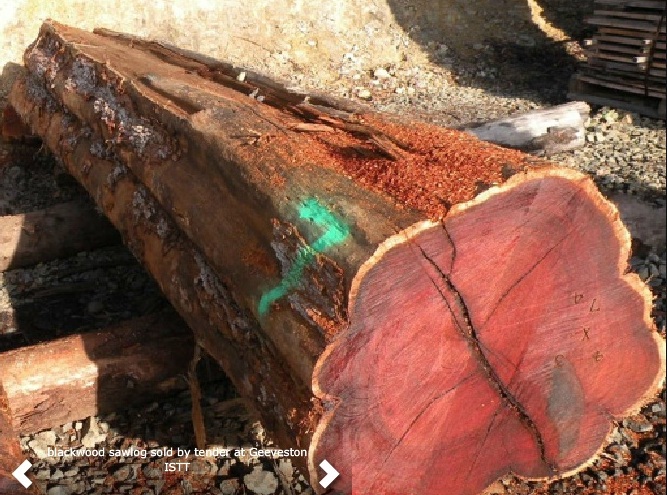
Island Specialty Timbers (IST) (islandspecialtytimbers.com.au), run by Forestry Tasmania, is one of only two forestry organisations to provide publically available competitive log price data in Australia. IST holds regular public tenders for small parcels of specialty timber logs including blackwood, and publishes the results. These are not stumpage prices but could be regarded as indicative “mill door” prices. The Tender Prices provides information by species and broad quality classes on logs that have been sold by public tender.
Here are general historical prices posted on their web site at June 2012:
· Blackwood log shorts, plain grain, $275 / m3
· Blackwood logs with birds-eye figure – from $550 / m3
· Blackwood stump sections with fiddle-back grain – $500 – $800 / m3
· Blackwood logs with fiddle-back grain – up to $1900 / m3
And here are the results for the May 2012 auction for individual blackwood logs:
· log 8, Blackwood log, good size and quality, $480 / m3
· log 9, Blackwood log, average quality, $390 / m3
IST “generally only offers material for sale by tender whose quality is very good or better”. However there are no real log quality specifications (eg. Heartwood colour, density, figured grain, log diameter, length) so the relationship between price and log quality is pretty vague. It is expected that plantation-grown blackwood timber would generally be equivalent to “plain grain” quality.
So good size and quality “plain grain” blackwood logs are currently selling for ~$500 / m3 mill door.
Unfortunately IST does not present any time series price data to track changes in the market over time. Is the price for blackwood increasing or decreasing? Is it seasonal and subject to availability? These questions are important to potential growers.
How applicable are IST prices to plantation-grown blackwood?
The answer to this question is both technical and market driven:
Research has shown that blackwood timber from native forests is very variable in quality, ranging from very poor to very high quality. This is due to both environmental and genetic factors. The same is also true of plantation blackwood timber at the moment, because there is not yet a blackwood breeding program. Research has shown that blackwood can be grown in plantations without any negative impact on wood quality, so it comes down to genetics and the site.
As for markets it becomes a matter of matching expectations with reality and price. Is plantation blackwood timber fit-for-purpose? There are indications that New Zealand farmers are having no trouble selling good quality, plantation-grown blackwood timber into their domestic market. However the volumes being harvested are still too small to establish a market price.
Given the tiny volumes sold by tender by IST how indicative are they of general market prices?
A very important question and one that seems impossible to answer. Some time series data from IST on blackwood log prices would help shed some light on the problem. If real prices have been increasing over time that would be a positive indication. Another aspect affecting blackwood price is future supply. The Forestry Tasmania 2010 Special Species Strategy estimates 10,000 m3 per year of blackwood sawlog supply from public native forest until 2019. After that year no figures are available. Most of this blackwood will come from harvesting of mature eucalypt forest. Regrowth eucalypt forest has little or no blackwood sawlog. So regardless of the outcome of the forestry IGA the production of blackwood sawlog from public native forest will decline. This will have a positive impact on prices.
New Zealand farmers are expecting to harvest approximately 300 cubic metres of premium plantation blackwood sawlog per hectare after a 35 to 40 year rotation. Using the IST indicative price of $500 / m3 for quality plain-grain blackwood that equates to $150,000 per hectare mill door value. Subtract harvesting and transport costs to get an approximate price at stump. Imagine what the value per hectare would be if we can clone and grow fiddleback blackwood (see further discussion below).
New Zealand
I expect that once significant volumes of plantation blackwood timber start to appear in New Zealand in the next few years that a transparent competitive market price will become established. This will help us to understand the blackwood market and encourage investment in blackwood plantations in Tasmania. The New Zealand Farm Forestry Association is gearing up to help farmers market the growing volumes of minor species including blackwood, that are expected to become available in the next few years.
Demand
As a consequence of promoting the Blackwood Cooperative I am starting to get regular enquiries from sawmillers, furniture makers and other customers looking for sources of blackwood timber from private landowners. These people understand that current and future supplies of blackwood timber from public native forest are limited and precarious. Some of them also want to reduce their exposure to the perpetual political risk inherent in the public native forest industry.
While this is not my current focus, I am certainly happy to help connect blackwood growers with potential customers. Plenty of Tasmania farmers already have blackwood trees and stands on their properties. Some of these will have immediate commercial value. If you are a farmer wanting to understand the commercial value of your existing blackwood and how it can be realised/improved please contact me (mob. 0428 754 233).
“Tell him he’s dreaming”
The highly variable nature of blackwood in terms of tree growth and form, and wood quality is a major challenge in the development of commercial blackwood plantations. One of the objectives of the Cooperative therefore, will be to establish a blackwood selection and breeding program. This could be done in cooperation with the New Zealand blackwood growers (AMIGO), and possibly also the Chilean blackwood community. The objectives of the breeding program will be:
1. To improve the growth and form of plantation blackwood trees, in order to reduce rotation times and reduce silvicultural (pruning) costs;
2. To improve the quality and consistency of plantation blackwood timber;
3. To identify and select a range of premium blackwood genetic material for possible commercial development, including:
· trees of outstanding growth potential;
· trees with outstanding wood quality based on wood colour, wood density or figured grain (eg. fiddleback and birdseye);
· trees that have wood qualities that meet particular high-value niche markets (eg. the tonewood market).
All of these objectives are aimed at improving the profitability of commercial blackwood plantations. One example is that of fiddleback blackwood. Over the years I have known people who have made attempts at cloning fiddleback blackwood. I believe this can be done, and with the very high prices paid for fiddleback logs, the commercial potential is obvious. The Blackwood Cooperative would form the natural focus for this kind of commercial research.
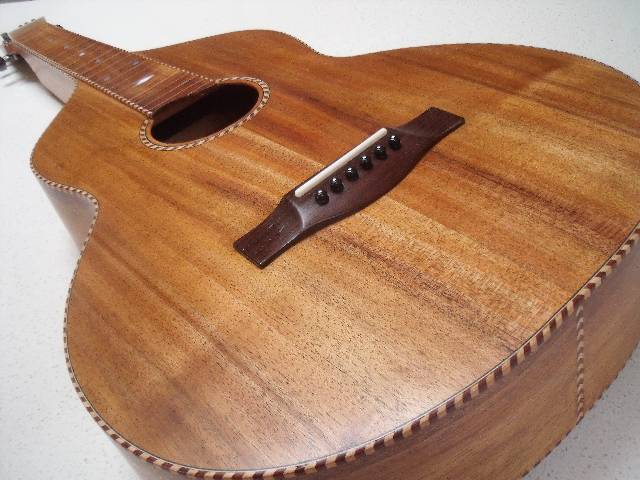
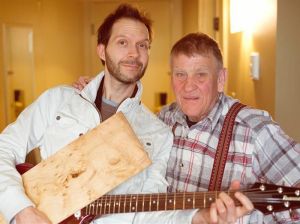
Another example is the tonewood market. A huge amount of research has been done and continues, into the relationship between wood quality and its impact on the sound quality of stringed instruments. The acoustic guitar market is the main market for blackwood tonewood. Guitar makers worldwide are facing declining supplies of quality tonewoods and are looking for sustainable supplies. Prices for quality tonewoods are increasing. Blackwood is one of the few established quality tonewoods that can be grown in commercial plantations. The opportunities to supply this market and to cooperate to develop selected genetic lines to meet tonewood market requirements seem obvious.
Apologies for such a long blog. I hope you found it interesting. And please enter the competition for that great prize.
Cheers!






Pricing blackwood out of the market
2013 UPDATE:
As of 2012/13 Forestry Tasmania have stopped reporting their average mill door log values (MDLV) by product grade, so it is no longer possible to track and report on their product sales and pricing performance. So much for greater accountability and transparency.
________________________________________________________
It is very clear from recent pricing and production from Forestry Tasmania that the special timbers industry is completely divorced from any commercial reality. The administered sales and pricing policies are sucking what little life there is left out of the industry, and consequently the blackwood industry has a very bleak future unless there is serious change.
This is the second part in my analysis of the special timbers market in Tasmania. In the first part I discussed how in 2010 Forestry Tasmania decided that henceforth their special timbers business activities would be non-profit non-commercial, and therefore deserving of a massive 50%+ taxpayer subsidy to the value of $5.1 million dollars over the past 3 years. In part one I discussed how this change of forest policy disadvantaged private forest growers, the Tasmanian community and would ultimately lead the special timbers industry down the same road as Ford Australia.
In this second part I look at the special timbers pricing and sales policies of Forestry Tasmania and how they contribute to this perfect commercial storm, effectively destroying the industry and any potential that the blackwood industry has of a prosperous, profitable future based on a farm-grown resource.
Forestry Tasmania (FT) is the major special timbers grower in Tasmania so analysing their production and revenue figures provides useful insights into the opaque world of the “administered” special timbers market. With blackwood comprising 70% of special timbers production by volume over the last 5 years this analysis is largely relevant to the blackwood market and its future. Over the last 5 years Forestry Tasmania has provided separate blackwood production figures but not separate blackwood revenue figures. The chart below shows total special timbers (ST) and blackwood production, and the average unit special timbers mill door log value (MDLV). All data is from FT annual reports.
The chart shows that the introduction by Forestry Tasmania in 2010 of the non-profit non-commercial policy plus major taxpayer subsidy appears to have had no impact on the price or production of special timbers. Certainly none of the subsidy appears to have been passed on to the rest of the industry, unless the industry was already enjoying heavily discounted prices, and FT was just seeking formal reimbursement from the Tasmanian taxpayer.
We also know that FT sells their sawlog through “administered pricing” that “are not determined by regular market forces of supply and demand”. These administered prices are even immune to global financial disasters. The global financial crisis that struck half way through the 2007-08 financial year had a significant impact on demand, with special timbers production almost halving, but had no impact on the administered price. Extraordinary!
Forestry Tasmania provides no information on what basis they determine administered special timbers sawlog prices. With a non-profit business objective and a generous taxpayer subsidy the administered special timbers sawlog pricing policy is anything but clear.
What is clear from the above chart is that special timbers sawlog prices are basically indexed to inflation. Over the above 7 year period sawlog prices increased by an average 3.4% per annum – the long-term inflation rate. In other words special timbers prices are not determined by regular market forces of supply and demand, and do not increase in real terms over time. If that is not a disincentive to private growers and investment I don’t know what is!
All of this has little relevance except for the fact that:
So what does the above chart mean for blackwood sawlog prices and the blackwood market in the Tasmania?
Another useful perspective special timbers pricing is gained from looking at tender prices achieved by Forestry Tasmania subsidiary Island Specialty Timbers (IST). IST provides the only market-based special timbers price information available anywhere. IST only tender a tiny volume of special timbers every year (less than 100 cubic metres) so their tender results may not represent actual market conditions. But if the tenders are competitive and the results show the best offers received then they are much more indicative of real current market value than the FT administered price. IST doesn’t produce any regular market report or annual report so tracking their performance is impossible.
What is clear is that there is a significant disparity between the IST tender results and the average administered price received by Forestry Tasmania ($128 per cubic metre in 2012). Obviously Forestry Tasmania does not use its own tender results to inform their administered pricing rules, and why the special timbers industry is receiving a massive taxpayer subsidy while these price discrepancies exist raises serious questions.
Presumably blackwood administered sawlog prices are less than the average price of $128/m3, due to it’s greater availability and quicker growth rates compared to the other species. However given the dominance and the importance of the blackwood market to the future of the special timber industry and to private growers IST provides scant information on this species. Current tender results for plain-grain blackwood sawlogs range from $250 – $450 per cubic metre, significantly higher than $128. This shows that the market is prepared to pay significantly more than the administered price for special timbers. But to help gain greater accuracy, detail and transparency into the blackwood market IST should be tendering at least 500 cubic metres of blackwood sawlog per year and publishing more detailed and regular market reports.
If Forestry Tasmania’s administered pricing more closely reflected IST tender results we could potentially have a tripling of FT special timbers revenue. The industry would then be transparently profitable, no longer in need of a significant public subsidy and would instead contribute revenue to the State Treasury and the community.
These changes would also provide significant stimulus into the blackwood market, Tasmanian farmers would be selling more blackwood at higher prices and wondering how to grow more. And that is where the blackwood growers cooperative proposal becomes important.
To help put these special timbers sawlog prices into some perspective (which is not easy as sawlog prices in Australia are extremely opaque, while New Zealand sawlog prices are very transparent), current NZ Pinus radiata pruned sawlogs are $AU103 per cubic metre at wharf (allowing for differences in the exchange rate), while NZ unpruned douglas fir sawlog at wharf is $AU96. Pruned, farm-grown NZ Cupressus macrocarpa sawlogs are $AU240 per cubic metre at mill door, with macrocarpa grown on ~35 year rotations. Based on these comparisons Forestry Tasmania’s administered prices for our premium timbers are very shabby indeed and do not justify any public subsidy.
For the past 2 years I have been trying to understand why blackwood, a product that has been a quality Tasmanian icon for over 100 years, seems to have so little market activity, profile, price or transparency. Blackwood isn’t just an icon, it’s an enigma.
The commercial management of the special timbers industry by Forestry Tasmania and the State government is an unqualified disaster. The accounting, sales and pricing policies of Forestry Tasmania are directly inhibiting blackwood investment, destroying the special timbers industry and costing the Tasmanian community money at a time when the State can least afford it.
So what do you think?
Is Tasmania getting a fair deal for its public special timbers resource?
Do you think the industry has a great future as a profitable commercial Tasmanian icon?
Should FT change its sales and pricing policies to give Tasmanians and Tasmanian farmers a better deal for their special timbers?
Is a consumer boycott of the special timbers industry needed to motivate the industry to change?
Leave a comment
Posted in Commentary, Markets