Having had a few discussions recently about blackwood prices and price lists I have begun to investigate this aspect of the forest industry and the marketplace. Pricing a commodity that takes 20-100+ years to grow requires stepping outside the realms of normal economic theory. And when you are a retailer and not a grower, are you rewarding and motivating the grower, or are you killing the forest industry?
What the market is prepared to pay, product substitution and technology become critical issues. This is particularly true in the wood commodity markets such as pulp, paper and construction which accounts for the lion’s share of the wood market.
But what about the premium end of the wood market where wood quality and appearance are fundamental aspects of the market? This market exhibits a significant degree of inelasticity (with a high capacity to pay), and a resistance to product substitution, as well as technological change. This is the market that Tasmanian blackwood inhabits.
From a blackwood growers viewpoint, how does pricing affect grower behaviour? Most premium timbers around the world come from (public and private) native forests. Few premium timbers are grown in plantations. Economic management and performance of native forests is quite different to growing timber in plantations. Compared to native forests plantations have high establishment and management costs, with little or no income from the investment until harvest in 20-30+ years time. As a straight investment this requires careful planning and management in order to achieve a reasonable profit from the investment (not to mention a great deal of passion and patience).
So what does the marketplace tell us about the economics of growing trees for premium quality wood production?
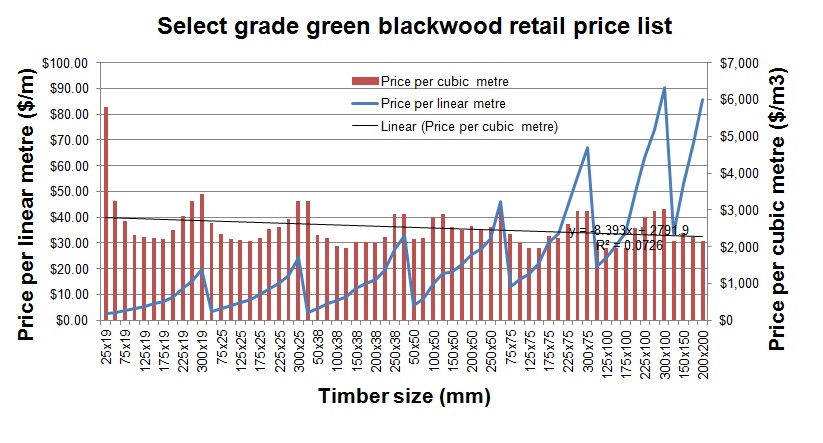
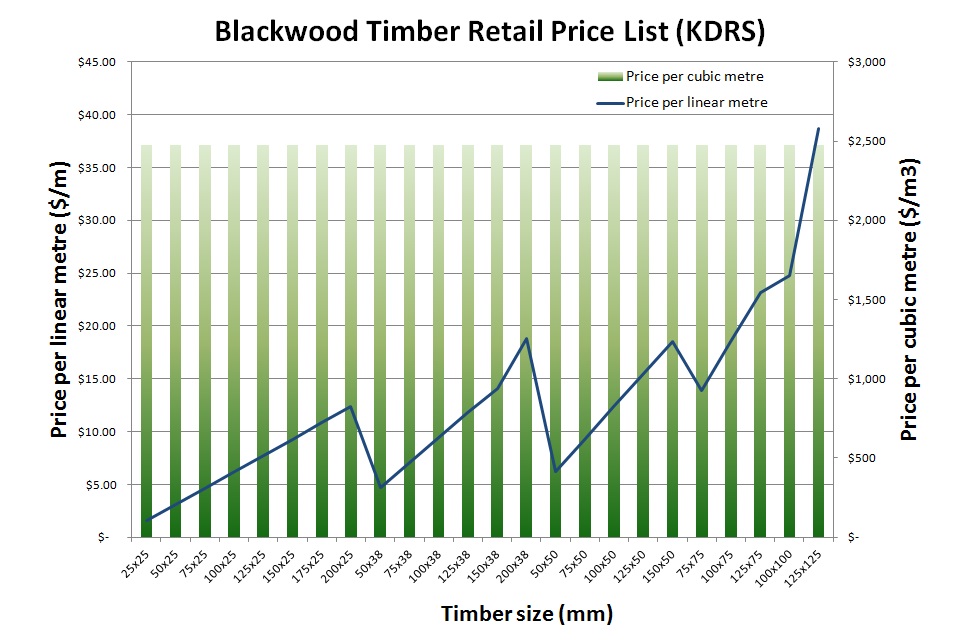
Here’s an example of a real blackwood price list of dimensions and prices per linear metre. I then calculated the price per cubic metre for each of the dimensions and made a chart of the results. The prices are for kiln-dried rough-sawn (KDRS) clear-grade blackwood.
I was horrified!
This pricing and pricing structure will kill the blackwood industry stone dead!!
Firstly I don’t know too much about the costs of regulation, harvesting, transport and sawmilling, but I suspect the growers of this blackwood got bugger all for their trees.
If the retailer is selling blackwood for $AU2,500 per cubic metre regardless of size, what did they pay the sawmiller? And after paying the costs of planning, harvesting, transport and sawmilling, what did the sawmiller pay the poor growers? I reckon the growers got the clear message that growing commercial blackwood is for mugs and losers!
Instead of providing incentive and reward for their blackwood growing efforts the marketplace punished these growers.
So do we want the forest industry to have a future?
It won’t have a future with this retail pricing!
Do we want to be able to buy blackwood timber in the future?
There wont be any to harvest if these prices continue?
I don’t know where in Tasmania the blackwood timber came from but it wasn’t plantation grown. It could be public or private native forest; meaning these trees were between 40 and 80 years old when harvested.
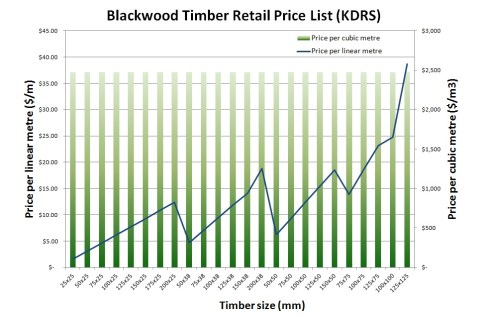
The second failing of this price list is the complete absence of the cost of “time”.
Time costs money. That’s what interest rates are all about. They represent the cost of money over time – for either loans or investments.
In general the price of timber reflects the volume/size of the piece of wood. The greater the dimensions and length the greater the price. The above pricing structure would be fine IF blackwood was produced in a factory where the ingredients were fed into one end of a machine and the various sizes and lengths came out the other end, with little time involved in production.
Unfortunately blackwood timber grows on trees and trees take time to grow, and time costs money. The bigger the piece of timber the bigger the tree required, and the longer it takes to grow, and greater the cost to the grower/investor.
But the above pricing list says that size (and hence time) has no cost. Wrong!!
The above list says that a cubic metre of 25x25mm costs the same to grow/produce as a cubic metre of 125x125mm. Wrong!!
You can cut 25x25mm timber from young 30 cm diameter trees, but you need much older 60+ cm diameter trees to produce 200×50 mm or 125x125mm blackwood.
A common complaint in the premium timber market is the scarcity of wide boards. However the above price list fails to provide any incentive/reward to the grower to grow bigger older trees.
A common caveat in the premium timber market goes something like:
Availability of specific sizes and lengths cannot be guaranteed.
This is largely due to the wood being sourced from native forest where tree size and supply are relatively random. In forestry lingo it’s called “run of the bush” – whatever turns up.
Plantations however are highly controlled and managed, so that (if things work out) size and supply can be better managed. A bit of tree selection and breeding and wood quality and supply is more assured. No caveats required.
So if you want to contribute to the destruction of Tasmania’s iconic blackwood industry here’s the place to buy your timber. It’s a double whammy for the industry!
But if you want to support a profitable, sustainable forest industry then understand that time (and big trees) costs money!
Alternatively this price list may just reflect the fact that in Tasmania growing blackwood is according to Government policy a (taxpayer-funded if you are a public grower) community service not a business. These may just be community service prices, not real prices reflecting the cost of production let alone building and growing the industry.
In my next blog on blackwood pricing I’ll show an example of a better timber pricing structure together with much more realistic prices.
When will Tasmania get a fully commercial profitable forest industry?
Comments and ideas welcome!!





Two significant forest industry reports that went nowhere
Both of these reports were published in 2005.
Both of these reports have (had??) significant potential impact upon the future of the Tasmanian blackwood industry.
Both of these reports contain important information and recommendations about reforms to the forest industry.
From what I have seen nothing from either of these reports has ever been implemented!!!
Ten years after these reports were published both are still available on Government websites as if they form the basis of current Government policy, but from what I can see neither of them are currently active.
The information and recommendations in these two reports has not been taken up and included in any forest industry policy documents (eg. FIAT), political party policies, nor in any farm lobby group policies (eg. the TFGA). Why not??
Tasmanian Government forest policy does not include any of the recommendations from these reports.
If only half of the recommendations from these two reports had been implemented the forest industry would be in a much better position today, and investment in the future of the blackwood industry would be a whole lot easier.
Here are the links to these two reports:
http://www.planningplantations.com.au/assets/content/plantations_sustainability/economic/ownership.html
(the link to the pdf report is at the bottom of the page)
http://www.agriculture.gov.au/forestry/australias-forests/plantation-farm-forestry/publications/farm_forestry_national_action_statement
Personally I think the future of long rotation plantations is looking more uncertain except in markets where high value appearance-grade timber is needed. Construction-grade timber is increasingly made from engineered wood products rather than solid wood; engineered from short-rotation plantation-grown wood.
But the market for long rotation appearance-grade timber is relatively small, especially if we are just talking about the domestic Australian market. The international market for quality appearance-grade timber is significant but is still dominated by the illegal trade in rainforest timbers.
The opportunity for supplying profitable, quality, farm-grown plantation grown Tasmanian blackwood into the export market is significant.
And this is where the Farm Forestry National (In)Action Statement (NAS) becomes important.
To achieve the vision, the Australian, State and Territory governments and the forest and wood products industry need to progress 16 actions, grouped under four action imperatives:
The 16 actions are broken down into 33 measurable outcomes, listing deadlines and who is responsible for implementing the outcomes.
None of it has been implemented!!
The Federal and all State Governments and the forest industry all signed up to do this.
So much for commitment!
So much for leadership!
Perhaps the Tasmanian Government and the Tasmanian forest industry should revisit the NAS and recommit to implementing its recommendations.
Leave a comment
Posted in Commentary, Markets, Plantations, Politics
Tagged Farm Forestry National Action Statement, Impediments to investment in long rotation timber plantations