Application to Churchill Trust for funding for overseas study tour

Koa_logging

Last Friday I had an interview as part of my application for funding from the Churchill Trust for a four-week overseas tour to study blackwood cultivation, research and farmer experiences in New Zealand and Chile.

www.churchilltrust.com.au

It all started last year when I was invited to join the New Zealand AMIGO tour of Chile. The New Zealand blackwood growers group is organising a week-long tour of blackwood cultivation and research in Chile in October 2012. Being short of money it seemed unlikely that I would be able to attend. Then in February this year I happened to notice an ad in the newspaper asking for applications for funding from the Churchill Trust. With the activity surrounding the blackwood growers coop, this seemed like a perfect opportunity to combine some fact-finding, the Chile tour, and help promote the coop proposal. AMIGO Chairman Ian Nicholas helped with the two week itinerary in New Zealand.

The eight members of the interview panel seemed very interested in the proposal and my planned overseas trip, asking many searching and pertinent questions. The 30 minute intensive interview certainly got my adrenalin pumping.

My itinerary involves two weeks touring New Zealand visiting blackwood growers, and meeting members of AMIGO. I will also make two presentations of the results from my PhD research to foresters, students and farmers. From there I join the AMIGO tour to Chile where we will visit research centres and various blackwood trials. The final leg of the tour involves a week in Hawaii looking at Acacia koa.

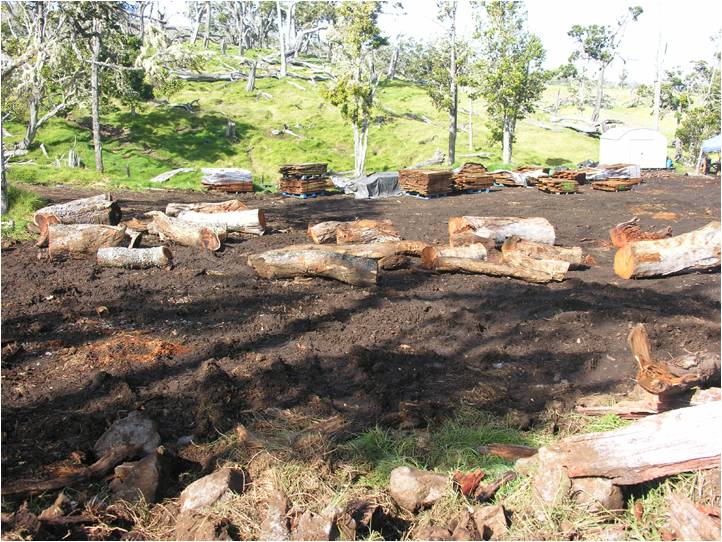
So what is Acacia koa? It is one of Hawaii’s main forest trees, endemic to the islands. Just like blackwood it has a long heritage as a premium timber species, and was very important to the native Hawaiians before European contact. Much of the koa forest has been cleared for farming, with only a small amount of wood now harvested from salvage operations from private land that look more like firewood operations than valuable timber harvesting (above image, Nick Dudley HARC).

But farming in Hawaii is changing and there are moves to restore some of the koa forest and provide future supplies of this valuable timber. There is a lot of research going on. Dr. James Friday from the University of Hawaii, Forestry Extension Service has invited me to visit.

I will find out in June if my application for funding was successful.

If successful I will come back with greater understanding of both the technical aspects but also of the human factor – what motivates farmers to want to grow trees, their experiences and frustrations. I will hopefully have lots of images and stories to post on the blog and use to promote the blackwood growers coop.

Helping blackwood stay on the straight and narrow

P3310051s

Research has shown, and certainly my own experience agrees, that blackwood growth rate and stem form are positively correlated. The faster the blackwood grows, the better the stem form and the less pruning is required to create a single straight-stemmed tree. Good growth rates are achieved by good site selection, good establishment techniques and good ongoing management.

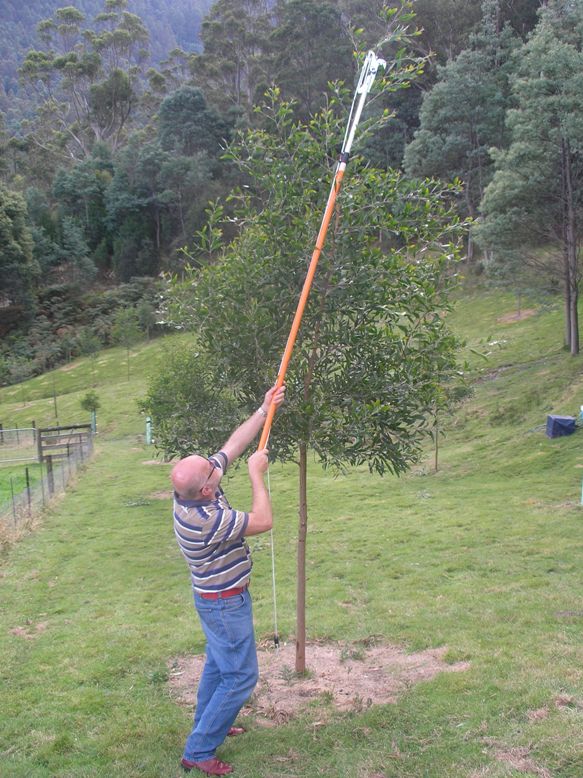
But some pruning is inevitable. For a variety of reasons blackwood loses its growing tip and then goes on to develop multiple leaders that need to be managed. Here’s a recent example of form pruning to help keep these blackwoods on the straight and narrow. It’s not hard work, and can be enjoyable.

The following excerpt on blackwood pruning comes from the NZFFA website:

(http://www.nzffa.org.nz/farm-forestry-model/resource-centre/farm-forestry-association-leaflet-series/no-20-australian-blackwood)

There has been an increasing acceptance that pruning is essential in managing blackwood. The method has no resemblance to pruning radiata pine; it is not difficult, but requires a commitment to visit the trees annually during the establishment of the 6 metre stem. There are two stages, which overlap:

·         form pruning

·         clearwood pruning

Form pruning

Blackwoods have poor apical dominance. Periods of stem growth are interrupted by abortion of the shoot tip. When growth resumes, several shoots compete for leadership. A blackwood stem is therefore formed by segments of straight growth which are interrupted by zones of disturbance which contain double or multiple leaders. The aim of form pruning is to identify and remove these competing leaders while they are still small (< 3cm diameter), and this requires an annual pruning visit during the formation of the 6 metre butt log. Long-handled pruners are useful.

Clearwood pruning

The aim is to confine the defect core. Clearwood pruning is done annually, starting at about year 3, and is complete by about year 8. It is carried out in stages, in which the largest branches on the stem are removed first, using a 3cm calliper. The trunk is then pruned to the diameter of your defect core (10 to 12cm). No more than a third of the foliage is removed at one visit. It is recommended that about 3 metres of the crown is left after each lift. Ladders that grip the trunk should not be used.

Perhaps not the best description of clearwood pruning. I would define the aim as controlling side branching, and then to progressively removing all branches from below to a height of 6 metres, while retaining about 3 metres of green live crown after each pruning.

Blackwood Cooperative ignored in landmark report

Growing blackwood in farm forestry plantations as an option to secure and counter the declining supply from public native forest was omitted from the recently leaked report into the IGA wood supply scenarios. The 97 page report “Review of Tasmanian Forest Estate Wood Supply Scenarios” by Mark Burgman and Andrew Robinson was recently leaked to the media, with the final version being officially released today. It analyses many wood supply options and possibilities both plantation and native forest, both public and private, for the eucalypt hardwood resource. But it devotes just over one page (p. 9-10) to the issue of so called “special species”.

On the subject of blackwood it notes that beyond 2019 the supply of blackwood sawlog from public native forest is not clear, with a strong likelihood that the supply will diminish. And that’s it!

No mention of the proposal to grow blackwood in farm forestry plantations, which would not only counter the declining supply from public native forest, but would actually grow the blackwood industry many times larger than it has ever been.

The blackwood growers cooperative is the only positive proposal for the future of the forest industry in Tasmania that has yet emerged out of the IGA mess. The proposal was first made public in May last year. And still it continues to be ignored by the negotiators and the politicians.

This is just extraordinary, and very disappointing.

I have written to the authors of the report and Professor Jonathan West expressing my extreme disappointment at this omission. I hope I will receive some measure of explanation and some means whereby this error can be remedied.

The Tasmanian Blackwood Growers Cooperative must be placed on the IGA table of options to be seriously considered in the future supply of this valuable Tasmanian timber resource.

My March trip around the north

Nw_rough_grazing

It was great touring around the north last week visiting people. Apologies to those people I missed seeing. You are at the top of my list for the next visit north. Here are a few of my observations from the trip.

1.    North East Tasmania

It’s not often I get to tour the north east. Most of my travels seem to take me to the north west. What I really appreciated this time was the great potential of the region for growing blackwood. Many farms in the high rainfall areas of the north east have areas suitable for growing blackwood, that are currently being used for rough grazing or are covered in the usual bracken and blackberries. One dairy farm I visited was a perfect example – intensively managed flat land, but plenty of steep slopes and back corners that are ideal for growing blackwood. I can’t see why the north east couldn’t support 1000 ha of blackwood plantation. That may not seem much, but that area would supply annual blackwood sawlog volumes equivalent to what is currently produced from native forest in Tasmania! There are also plenty of farms with existing native blackwood that could be managed for sustainable wood production.

2.    North West

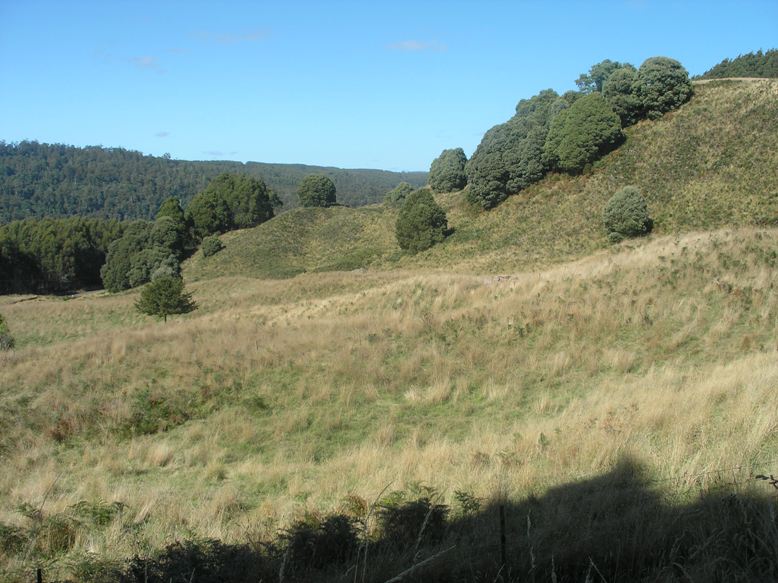
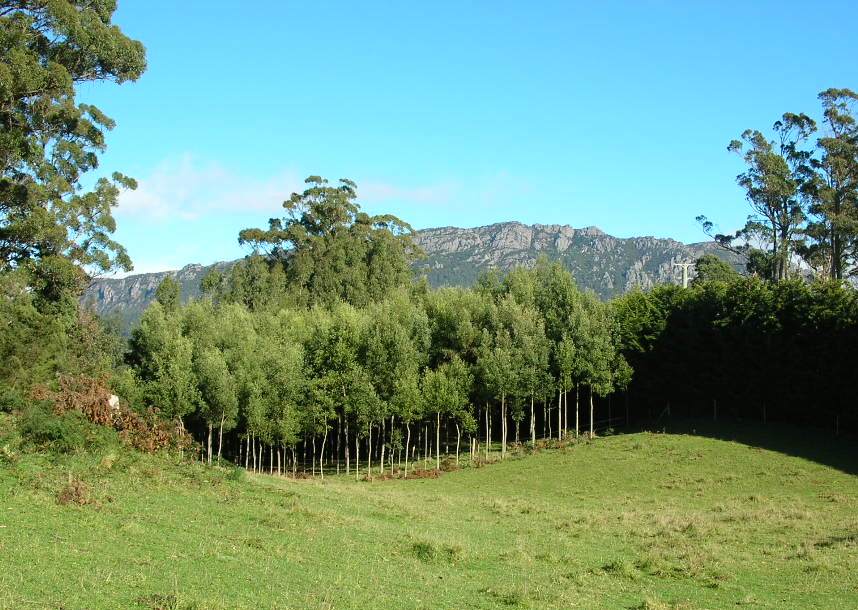
Touring around the back roads of the north west is always a pleasure, especially when the weather is great. Visiting Gilles Carrabin and his excellent example of plantation blackwood was inspiring. It just shows what passion and commitment can do. I also saw plenty of land that could be growing plantation blackwood (like in the above photo), even in the most intensively managed areas; areas that are currently underutilised.  If only we can get the ball rolling.

3.    Connecting with the rural community

Most people I spoke to expressed interest in and support for a blackwood growers cooperative. I drove around to many small local shops where I posted flyers. This made me appreciate the difficult task of both engaging with the rural community. There are lots of people who recognise blackwood is a Tasmanian icon and have some idea of its commercial potential, but taking the next step towards commercial development will obviously take time and effort. Having a few local success stories like Gilles Carrabin will obviously help promote interest, but I need to try and locate other farmers who are successfully growing blackwood. I can then hopefully organise a field day based around these properties, with the owners permission. Hopefully the politicians will then recognise the degree of community interest and support.

4.    General

I was surprised by the general sentiment of people towards the current state of the forest industry. I have been thinking that trying to get support and interest for a new commercial forestry venture in the current climate would be difficult. Many people certainly understand that the industry needs to change, but despite the current industry malaise, many people expressed optimism that the forest industry has a great future in Tasmania provided the ongoing conflict can be resolved. Many people expressed concern as to whether the current players were up to that task.

5.    Next trip

I already have the start of an itinerary for my next trip north. Once I get a few more enquiries I’ll schedule a trip.

Cheers!

Carrabin blackwood plantation continued…….

Carrabin_2012s

A big part of the blackwood cooperative (if we get funding) will be sharing experiences in growing blackwood, both the successes AND the failures. Only by sharing can we gain greater understanding and confidence.

Having previously reported on this plantation based on photos and emails supplied by the owner I can now provide an update based on my visit in March 2012. This is one of the very few successful blackwood plantations in Tasmania, and is a testament to the care and dedication of the owner Gilles Carrabin. Gilles is not only passionate about his trees, he is a joiner/builder/cabinetmaker with a great love of fine timber.

The plantation is not without problems, but with continued care and management this plantation will eventually produce high quality blackwood timber. Most of the intensive management has been completed. The major task now is to carefully thin the plantation down to a final stocking and watch the blackwoods grow.

Site selection and establishment

The plantation is approximately 0.5 ha in area. Originally I assumed the site was on red basalt soils, but I was wrong. Nevertheless the deep clay loams still support tall eucalypt forest nearby. At time of planting no soil preparation was done, no fertiliser added, but weeds were sprayed. Blackwoods were planted at 2x2m spacing (=2,500 trees per hectare!!) to try and control branching and promote good stem form. Protection for from browsing was provided by mesh fencing around the site and 900mm tall tubular Corflute® tree guards. Trees were mulched. Two different blackwood seed sources were planted. The blackwoods were originally interplanted with Silver wattle as a nurse crop, but these grew so quickly that they were removed after a few years.

The plantation has a cypress hedge on the western boundary which was planted some years prior to the plantation been established. This has provided valuable shelter from the prevailing strong winds, with a single row Eucalyptus nitens hedge planted along the southern boundary. Shelter from strong winds is critical in ensuring good growth and stem form are achieved in plantation blackwood.  Of particular interest is that the blackwoods planted next to the cypress hedge show no signs of reduced growth or vigour from competing with the pre-existing hedge.

Another advantage of the chosen site is that it adjoins a public road, so that come harvest time, access for machinery will be easier.

Management

Gilles has focused enormous effort on ensuring the blackwoods have good stem form and small branches. No thinning has yet been done and there has been little mortality. Every single tree has been pruned to 5-6 metres. This is an incredible effort given that 92% of the existing trees will need to be removed to allow the best 200 trees per hectare grow to final commercial size. Perhaps not the most efficient way to achieve the desired end result, but given the uncertainty and blackwoods reputation as a difficult tree to control, a very understandable approach.

The strong focus on achieving good stem form has come at the expense of diameter growth. The current trees range in diameter from 3 – 20 cm dbh with a probable average of 4-5 cm. This is very small for a 12 year old blackwood plantation, where average diameter growth rates should be about 2.0 cm per year. At age 12 years this plantation should have an average stem diameter of about 20 – 24 cm. At least another 10 years has been added to the rotation length as a result of this conservative approach to management. Thinning of the plantation is now critical to allow the final crop trees to start to put on some serious diameter growth.

The goal is to produce ~200 trees per hectare with an average diameter of 60cm at 1.3m above ground at time of harvest, with all trees straight and pruned to 6 metres.

On the positive side the trees are all very healthy and growing well given the intense competition they must be experiencing. There are many pruned trees with excellent stem form from which to select the final crop trees. With such a high stocking of 2,500 trees per hectare, the trees are tall and thin, which makes them potentially susceptible to windthrow. Gilles will have to thin the plantation in stages over a number of years (say 3 years) to minimise the chance of windthrow. This gives the trees adequate time to become windfirm.

I would also recommend Gilles begin an inventory of his plantation. It is small enough that all trees could be measured for diameter at breast height (1.3m) before any thinning. When he has identified the final crop trees that will remain after the thinning is completed, the pruning history and pruned height of these trees should also be recorded and photographed. This will help future potential buyers know that the pruned sawlogs in the trees are indeed free of branches and knots. The retained crop trees can then be remeasured every 5 years or so, so that Gilles can track their response to the thinning, and understand how blackwood responds to good management on this site.

During the thinning process wood samples (discs) should be kept from any thinned trees that have begun to develop heartwood. These will become valuable in helping determine the heartwood colour range that is likely to be encountered when the final harvest becomes due. Heartwood colour, as well as wood basic density, are two of the most important wood properties determining blackwood value. While we don’t yet know whether wood colour within the tree changes over time, we do know that heartwood colour may or may not vary from the pith to the outer edge of the heartwood as the tree grows. We also know that there is wide tree-to-tree variation in heartwood colour in blackwood (at least some of this variation is under genetic control), so having any information on this at the time of final harvest will be important in negotiating a sale.

Oh yes, and I’m sure the retained trees would appreciate a dose of super phosphate to help them to achieve those greater growth rates.

Conclusion

As I said in the original blog, this plantation shows many positive features, including the use of hedges for shelter, good site selection and establishment techniques, and the importance of dedicated, focused management for the first 10 years. Gilles passion for blackwood is clearly evident. The completion of the task with thinning, plus commencing an inventory, should see this excellent plantation become an inspiration to other Tasmanian farmers wishing to grow blackwood.

Cheers!

Award Winning House has Blackwood Floor

Glenroy_rmbhoy2011

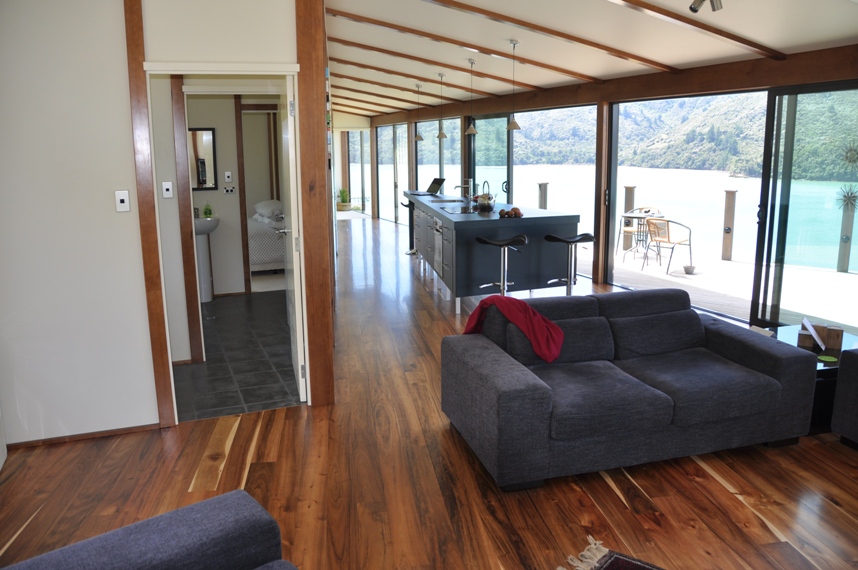
Last year the New Zealand Registered Master Builders 2011 House of the Year featured a stunning blackwood floor. But this was no blackwood imported blackwood from Tasmania, this was New Zealand plantation-grown blackwood.

http://www.houseoftheyear.co.nz/index.asp?id=83

The following is an article from the latest New Zealand Tree Grower journal (Feb 2012) written by Ian Nicholas and Paul Millen. Ian Nicholas is Chairman of AMIGO (the NZ blackwood growers group) and Paul Millen is a director of Marlborough Timbers

In November last year, a Marlborough Sounds house built by Glenroy Housing of Blenheim won the New Homes category $350,000 to $450,000 house of the year Registered Master Builders award. The house went on to claim the Supreme House of the Year award fighting off one and two million dollar houses. The house has been built for Marcus and Alex Myring who see their home as very special.

The Master Builders promotional description of the house states that locally milled blackwood has been laid in a distinctive pattern in the main living room, achieving a blend of warmth and sophistication and complementing the natural timber used extensively inside and out.

The judges in the new home category noted that the authentic blackwood timber flooring, locally milled and conditioned on site, has been laid to perfection with an innovative border trim, just one example of the complex detailing executed to perfection.

The timber for the floor was locally grown by Paul and Ash Millen of Marlborough Timbers at their forest, Tai Tane located nearby in Linkwater. They started sawing 18 to 20-year-old blackwood thinnings in 2004 when they first supplied timber for the floor of another Marlborough house.

Here is the builder’s website with lots more stunning images of the feature floor:

http://www.glenroyhousing.co.nz/awards.html

Examples like this clearly show that New Zealand farmers are well on track to producing high-quality, valuable, plantation-grown blackwood timber. Where are the Tasmanian farmers who will follow their New Zealand peers?

Cheers!

Sustainable guitars

Hi,
 
Check this out. As I've said before, the tonewood market will be a big player in the future of blackwood.
 

Cheers,

My thoughts on the IGA

My local corner store had a sign out the front recently telling customers that they also employ 40 Tasmanians; presumably an allusion to the latest round of the forestry wars. The vital pieces of missing information on the sign were:

1.   They employ 40 Tasmanians AND are profitable;

2.   The Tasmanian taxpayer is not out-of-pocket as a result of the activities of this corner store;

3.   The store was established with NO government financial support; and

4.   The store enjoys strong community support.

My corner store is just a typical successful commercial business.

My thoughts on the IGA come from the perspective of a forester who has spent the past 30 years watching the forest industry in Australia fall slowly into decline and disrepute. A truly bizarre and frustrating situation.

In the 21st century in an era of increasing concern for renewable resources and the environment the forest industry in Australia should be enjoying unprecedented levels of commercial, political, and community support. Instead the opposite is true.

Something has to change.

In fact quite a lot has to change. A commercially successful, politically and community supported forest industry could be very profitable and achieve a great deal of good in the 21st century, just as it is in New Zealand. But opportunities for change are rare. To my mind the IGA represents a pretty good opportunity, but few people seem to recognise this. Instead the disparate and polarised positions within the debate make finding a solution difficult, and support for the IGA is thin on the ground.

Yes the IGA is a flawed process but what forestry agreement hasn’t been. But a “business as usual outcome” will be of no benefit to anyone. The forest industry will not survive if the forestry wars continue. I guess having no forest industry is one way to resolve the forestry wars!

There is no single road to reform, and no perfect solution to the forestry wars. But for the future of Tasmania, find a solution we must. If the IGA fails due to lack of industry, community and political support there will be no “better” solution to replace it. Certainly the politicians cannot provide a better outcome, although they will make those kinds of promises. Change must be driven by the industry and the community. Instead of standing back and criticising the Agreement, it is time for people to step forward with support, ideas and energy to help keep the reform process going. The IGA is only the first round.

Will the IGA bring peace in the forests? Of course not!! There are issues that are fundamental to the functioning of the Tasmanian forest industry that are not addressed in the Statement of Principles. Issues of management, of governance, of commercial performance, accountability and transparency, issues to do with ongoing communication and relationships. Many of these issues focus around the Government, Parliament and Forestry Tasmania. The forestry wars will most certainly continue unless these issues are also addressed.

Actually my major criticism of the IGA is that it fails to identify the major issues facing the forest industry. So people are left with the assumption that putting more forest areas into reserve is all that is required for the forest industry to regain commercial, social and political relevance. I suspect this is one of the reasons why the IGA has had so few supporters. People understand that by itself the IGA cannot deliver what it proposes to deliver, and no one has outlined the rest of the process.

Reform in the forest industry is vital. The IGA is just the first step. A blackwood growers cooperative will only survive and prosper if the IGA is supported and successful, and further reforms are pursued.

Cheers!

“Greater than the sum of its parts”

http://bob-brown.greensmps.org.au/content/media-release/jobs-flow-forest-agreement-fund

It’s great to see someone finally come out with a positive vision post-TFIA. It’s long overdue, but better late than never.  The report commissioned by Senator Bob Brown and authored by Naomi Edwards and Jamie Hanson (EHR) outlines potential areas where the TFIA regional development money ($120m) could possibly be spent to build a stronger, more diverse Tasmanian economy. There’s just one problem…

There’s no mention of any future forest industry. Or rather it says that “the IGA provides for the existence of a sustainable forestry industry going forward.” This is clearly not true! The IGA merely defines what remaining public native forest will be available for harvesting. That is not a vision of a future prosperous forest industry.

The EHR also indicates that none of the IGA regional development money should be used in forestry-related projects. Why?

Just because commercial access to public native forest is declining doesn’t mean the end of the forest industry (although curiously the TFGA would have us believe this to be the case). There is already a significant private forest resource (both native forest and plantation) existing in the State.  With proper policy and support this could grow and be a major contributor to the State’s economy (Jan Davis where are you?). My own proposal for a blackwood growers cooperative is just one of a range of private forestry initiatives that could see Tasmania become a major private forest grower and processor.

At the risk of being repetitive and boring I will remind readers that New Zealand has a thriving, sustainable, privately-owned, profitable forest industry that is a cornerstone of their economy. There is no reason why Tasmania cannot follow the New Zealand example if it wants too. Why is such an option deliberately excluded from the Edwards-Hanson report?

Deliberately excluding the forest industry from the EHR will just enflame those who support the forest industry, who will see the EHR as merely a political document reflecting Bob Browns own political agenda. The IGA doesn’t need more antagonists. We already have a surplus of those (with little or no commercial potential).

Using the New Zealand forest industry as an example Tasmania could have a thriving profitable private forest industry, producing a range of wood products from high-value to commodity. A good foundation already exists. Why deliberately exclude this option from the EHR?

Cheers!

Share, learn, understand and grow

005a

A big part of the blackwood cooperative (if we get funding) will be sharing experiences in growing blackwood. Only by sharing can we gain greater understanding and confidence. Here is a great 11-year-old blackwood plantation in north-west Tasmania. I’m writing this blog from just the photo and the owner’s emails. I’m looking forward to visiting the plantation in 2012.

Site selection and establishment

Red basalt soil in a relatively high rainfall area at an altitude of 300m provides pretty good conditions for growing commercial blackwood. I’m not sure what protection from browsing was used but it was obviously successful. Like much of north-west Tasmania the site is an exposed windy ridge. This exposure has been overcome by planting a windbreak on the western side and appears to have been effective so far, although the blackwoods are now getting above the windbreak.

Management

The trees are obviously being pruned.  But the plantation is definitely due for a thinning. At final stocking this plantation will have somewhere between 18 and 24 trees, so clearly a lot of the existing trees will have to go. Once the green crowns close (meet) then the lower part of the crown starts to die due to lack of light. This means the trees are seriously competing with each other and growth is slowing.  It is better to stay ahead of this by thinning the stand to ensure there is no crown die-off and that growth remains at its maximum potential.

The intensive management of blackwood plantations means that competition between trees is not needed to control branching and improve stem form. Instead branches and stem form are managed by pruning. So the focus for commercial blackwood is to prune and keep the trees growing as fast as possible. So a lot of pruning effort here has gone onto trees that will become firewood. Some early expert advice may have helped optimise the management.

Conclusion

A site visit will tell how effective the management has been in creating trees that will continue to grow into valuable sawlogs. Nevertheless it is one of the best examples of blackwood plantation I’ve seen in Tasmania. This is a great example of using shelterbelts in what would otherwise we quite an exposed windy site. There is a lot of exposed ridge-top country in north-west Tasmania that could grow commercial blackwood provided shelter was available. Here is one example of how it can be done.

Thinning the plantation down to final stocking of ~200 trees per hectare will allow the crowns of remaining trees to fill out and maximise the growth potential of the site. The trees are now rather tall and thin so thinning may need to be done in two stages over 2-3 years to minimise the risk of windthrow.

Once I’ve visited the site I’ll provide an update. Thanks to the plantation owner for allowing me to share this story.

Cheers,

Gordon.