Hi,
As of the 17th April 2013 the blackwood coop website is on a new web host. I’ll be working on it over the coming weeks to improve it’s appearance and content. Feedback welcome.
Cheers,
Gordon.

Hi,
As of the 17th April 2013 the blackwood coop website is on a new web host. I’ll be working on it over the coming weeks to improve it’s appearance and content. Feedback welcome.
Cheers,
Gordon.
Posted in Uncategorized

I have established direct communication with one of the major US guitar makers who have recently visited Tasmania and initiated a commercial relationship with a supplier. The company wishes to remain anonymous for the time being. However they have been at the forefront of the sustainable tonewoods movement over the past 10+ years, having established commercial relationships with sustainable tonewood ventures in a number of countries. Here are some extracts from their emails:
“You seem to have a very well laid out [blackwood grower cooperative] plan, one we may discuss publicly supporting in the future. At this point we aren’t ready to do that, since we have yet to really do business on a long term (or short term) basis in Tasmania.”
“I will probably be taking a trip to Tasmania in the next 5 months and would like to meet with you at that time, we can see how we stand and how to move forward.”
While the local forest industry remains deeply divided and political, we have an important commercial opportunity in the making.
If we can get 2, 3 or even 4 major international guitar manufacturers buying farm-grown Tasmanian blackwood it might generate enough business to at least partly fund a cooperative, and certainly create plenty of market profile and momentum.
For the coop to be fully self-funding however there needs to be enough blackwood volume/value leaving farm gates to generate sufficient harvest levy. We don’t have any information about the existing private blackwood resource in terms of commercial volume/value/sustainable yield, but I doubt the resource is enough to fully fund a coop. Can the commercial potential of this existing resource be improved and realised? Absolutely! Can this resource be better managed to improve its future value? Absolutely! But we also need to plant more blackwood to create a new resource that will provide more volume/value out the farm gates of the future. Plantation blackwood will provide the necessary volume and value to help fully fund the coop. The tonewood market is the catalyst that will allow this process to begin.
The tonewood market is a premium market that can utilise short logs that are common in the existing unmanaged farm blackwood resource. Because it is a high-value market more of this low-volume, widely-dispersed resource can be profitably accessed. With enough support more information can be provided to landowners about their blackwood resource in terms of log specifications, prices, demand, etc. which should provide farmers with greater assurance that the forestry market is functioning more like a proper commercial market. Also many of these major guitar companies are looking for opportunities to promote their environmentally sustainable sources and practices once solid commercial relationships have been established. Tasmania could be next on the list as the home of premium quality sustainable tonewoods.
I’m looking forward to meeting with the guitar company representative when he is next in Tasmania and discussing how we might build the Blackwood Cooperative as a successful commercial business.
ABC Radio
Tasmanian Country Hour
Friday, 25 January 2013
http://www.abc.net.au/rural/tas/content/2013/01/s3676869.htm
My friend Robert MacMillan (Tasmanian Tonewoods) was recently interviewed by Rose Grant on the ABC Radio Country Hour, providing a small window into what is currently happening in Tasmania regarding the tonewood market. Read the story and listen to the podcast.
As I’ve said previously, the international tonewood market has the potential to completely change the future of blackwood in Tasmania. Major buyers are looking for new sustainable supplies, and blackwood is already regarded as a premium tonewood. There is a large existing blackwood resource on private land that can supply current tonewood demand.
It’s great and so rare to get some real market information about blackwood. If this information was more regular and transparent, we would know much more about prices and product specifications. This would then help generate interest in growing blackwood and hence help build a growers cooperative.
In this interview Robert provides some indications of current demand (20 truck loads per year), product specs (almost –dead trees?) and pricing (fiddleback more valuable than plain grain), but it is really just a teaser. I don’t think it provides enough detail to get farmers to take notice in harvesting their existing trees, let alone consider planting more blackwood. But it is a start.
It would be even better if some of these major US guitar builders would come here and do some media and promotion in support of growing blackwood. If they think that sustainable farm-grown blackwood is going to happen with no transparency and promotion then they will be sadly disappointed.
Also checkout Roberts recent interview with Barratts Music in Launceston. Great work Bob!!
Recently I was contacted by a very well known Tasmanian custom furniture builder. I’ll call him M. We had a long conversation on the phone about forestry, blackwood, and future possiblilities. M prefers to source most of his timber from private land as he doesn’t support current forest industry policy and practices on public land. M is very interested in the growers coop proposal. Particularly the prospect it offers in the future for selecting and breeding premium blackwood cultivars such as fiddleback. I certainly value having M’s support, as things have been a bit quite lately.
I hope everyone had a great summer break, and are refreshed and ready for another year. And I hope the Legislative Council Committee see the light and approve the TFA Legislation.
Cheers!
Posted in Uncategorized
This is very disappointing.
But not unexpected.
The IGA parties reaching an agreement was always the less likely outcome.
But at least they tried and for that I congratulate them.
The last two years have shown that this has not been a “road to Damascus” revelation for the forest industry, just the same old nags running the same old race while the crowd bays for blood.
Only this time the context has been completely different. The forest industry in Tasmania has all but disappeared over the past 2 years. And the failure to reach agreement will mean that the forestry wars will continue and the remaining Crown native forest customers and FT will wither and die over the next 5-10 years. But at least they will disappear with the deep satisfaction of having someone else to blame.
It will continue to be difficult to attract new investment while the industry remains highly politicised and the forestry wars continue. Will a change of State or Federal government solve the problem? I doubt it very much. I suspect it will instead exacerbate and prolong the problem.
The inability of the forest industry to understand its own predicament and resolve its own problems has been simply astonishing. In the 21st century the forest industry in Australia should be enjoying unprecedented support and commercial success. Instead it is characterised by social damnation and bankruptcy.
The failure of the IGA is not unexpected. That the private forest growers did not take the initiative during the IGA and set a new agenda for the forest industry will go down as one of the great lost opportunities. The private forest growers could have had a profound and positive influence on the IGA negotiations. They did not need to have a seat at the table in order to achieve this.
Instead private forest growers in Tasmania remain convinced that their interests are 100% aligned with FT and the remaining Crown customers. This position exposes them to greater political risk and commercial uncertainty than FT and its customers. In finance-speak private forest growers remain exposed to all the downside of the industry and none of the upside. Just extraordinary! They need to change their position.
Regardless of the outcome of the IGA private forest growers will eventually become the dominant force in the forest industry in Tasmania. This will be a good thing. But it is going to take a long time to get there. Neither the State nor Federal Governments have the interest or ability to drive this change. So the initiative must come from the farmers and commercial tree growers themselves. As yet the TFGA shows no signs of supporting such a move.
And what of the blackwood industry?
The failure of the IGA means $100m of Federal money will not come to Tasmania, that could have helped fund the Blackwood Growers Coop. It also means that the existing blackwood industry (the sawmills, furniture makers and retailers, craftspersons, luthiers, etc.) will disappear along with the rest of the native forest industry in Tasmania. In a few years time we will be importing most of our blackwood timber from New Zealand (farm-grown plantation blackwood). That is assuming we can compete with the Chinese. More likely the Chinese will buy all the blackwood timber that NZ can produce at prices that we just can’t match.
Tasmanian farmers will miss out on diversifying their income, utilising land that currently is unproductive. The Tasmanian community will lose its blackwood expertise and heritage.
But I’m not giving up hope just yet…..
I’ve been informed that if I can demonstrate the Coop can get FSC certification and start attracting a few customers, then it may attract private investment.
1. I’ve recently made further enquiries about FSC certification and been told there is a good chance that the Coop could achieve FSC certification for harvesting existing farm blackwood, and establishing blackwood plantations. I am looking further into this and will keep you informed.
2. A major US guitar maker will be arriving in Tasmania in the next few weeks looking to establish a long term relationship with blackwood suppliers. This company has shown a major commitment to developing sustainable tonewood supplies in other countries. If they show a similar commitment here, and we can demonstrate that we are moving towards an FSC certified Blackwood Growers Cooperative, then this may provide the Coop with the necessary momentum to get us going.
3. So if we can show progress on the above issues then I’ve been informed that private investment may be interested in helping getting the Coop going. The failure of the IGA may in fact help create a different positive dynamic for the Coop as the forestry wars resume.
The next few months will prove decisive for the Coop for better or worse. But even with the failure of the IGA there remains enough potential and hope that the Blackwood Growers Cooperative may yet rise from the ashes. Watch this space!
Posted in Uncategorized
A recent revisit to the Quilliam property at Smithton to do some pruning was time well spent. All up about 7 hours was spent selecting and pruning the best of the blackwoods in the two block plantings (see initial report). These trees have now been marked and pruned to remove large limbs, trim side branches and remove multiple leaders. These selected trees will receive weed control over the coming weeks as the ground begins to dry out. Oh yes! The new pair of gumboots definitely came in handy. Despite the heavy grass competition some of the trees are showing very vigorous apical growth. There was also some evidence of wattle grub which was a surprise in this wet environment. It will definitely be interesting to revisit these trees in 12 months time for an inspection and annual pruning.
In 12 months time some of the block-planted blackwood will be reaching crown closure, which will be useful in limiting side branch growth and encouraging height growth. It will also mean weed growth will start to slow.
As for the single-row windbreak blackwoods, closer inspection found too few trees suitable for pruning that it wasn’t worth the effort. The combination of exposure to wind and the extraordinary weed growth has meant that these trees are struggling to grow. They will produce an excellent windbreak eventually, but no timber production. Mixing wood production with windbreak objectives is difficult even in good conditions and generally requires multiple-row shelterbelts. On the swampy flats of Circular Head it would be a real challenge.
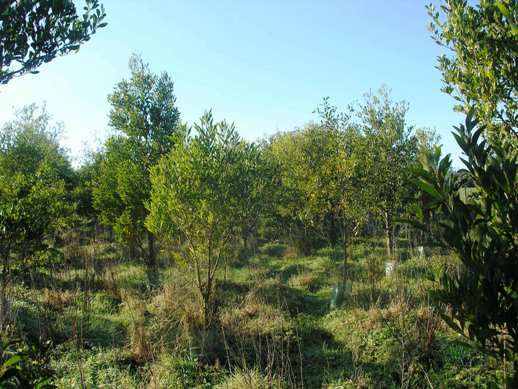
This is the second of two property reports from my recent trip north. This property is on the swampy flats near Smithton.
The soils are saturated for much of the year and there is little in the way of shelter.
If it was a greenfield site I would have advised caution in planting blackwood for wood production. The exposure to strong winds and the high water table present challenges in growing any trees, let alone tall, straight ones.
The property includes two block planting of almost pure blackwood at 3 metre spacing (1,111 trees per hectare) totalling about 1.5 ha, plus a considerable length of shelterbelt/drainside planting that includes a single row of blackwood at 3 metre spacing. The trees are up to 5 years of age. Protection from stock and wallabies was provided by electric fences and the common, soft-plastic tree guards shown in the picture. Obviously there can’t be too many wallabies about.
Despite the exposure and the rampant grass growth, the blackwoods are showing surprisingly good growth and form, particularly in the block plantings. My first response was “what would these trees look like with some weed control and pruning?” Weed control is certainly a problem when there is free-flowing water over the ground for at least half the year. So a single weed control in summer is needed once the ground has dried out, to get these trees growing quickly. The faster the growth the better the form.
Some of the trees are obviously no longer suitable for keeping due to lack of timely pruning, but there are still plenty of suitable trees from which to select the final crop, given that about 80% of the trees will need to be thinned to waste in the next 10 years.
The owner is unsure how to do the pruning, so I will be going back in a few weeks to help select the final crop trees and get them into shape with Mr. Quilliam’s help (and a new pair of gumboots!!).
Given the high water table and the exposure to strong winds there is a real risk of windthrow and crown breakage at this site. Planting at the higher stocking will help reduce that risk as the trees will quickly reach crown closure and help support each other. The trick will then be to gradually thin the trees at regular intervals, to retain near-full crown cover, while also allowing the trees to grow at the maximum possible rate. Leaving the windward row of blackwood trees unthinned and unpruned will also help provide protection and stability for the block plantings.
The combination of early crown closure, annual pruning and regular thinning should result in trees of excellent growth and form.
What then of the single-row blackwood plantings along the drains? I only saw a small section of these but I suspect tree form will not be so good. Given that part of the objective is for farm shelter, the best management may be to just prune and weed those trees that have the best form, and leave the rest to become big and branchy. Hopefully the unpruned shelter trees will help support the pruned trees in strong winds.
This blackwood planting was a great surprise. It was great that it is still young enough to be brought under good management. Also great that it demonstrates that even on wet exposed sites blackwood can grow very well. There are certainly challenges and risks ahead with windthrow and crown wind damage, but these are currently balanced by the positives of good growth and form.
I will give an update once the next pruning is completed. Stay tuned.
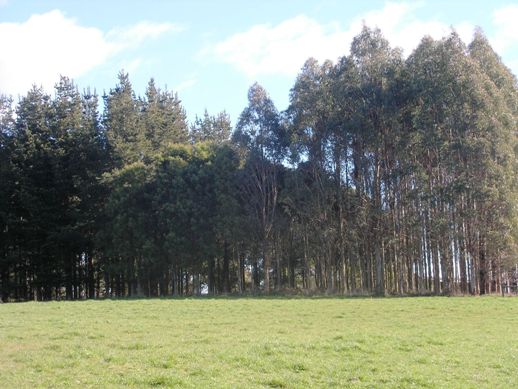
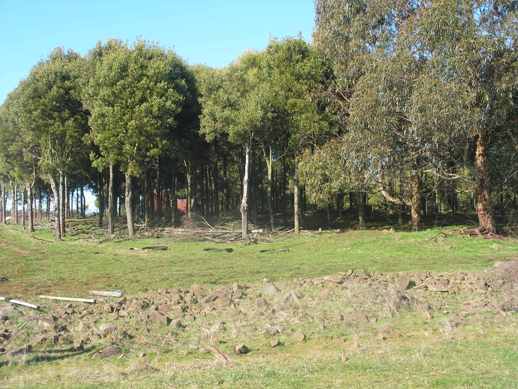
This is the first of two property reports from my recent trip north. This is a large mixed farm at Sunnyside. Most of the property is on red basalt soils with reasonable rainfall. Ideal conditions for growing blackwood? Well the situation turned out to be much more complex.
Like many properties the farm contains damp areas, gullies, steep slopes, and rocky knobs that don’t fit with current farm activities. Some of these sites were on a neighbouring property that was bought 3 years ago, having been planted to plantations of pine, Eucalyptus nitens and blackwood. It is obviously very good country for growing pine and nitens, but the blackwood story was more mixed.
There are 4 block plantings of 15 year-old pure blackwood. Until acquired by the current owner, none of these had received any thinning or pruning. Three of these plantings are on a stony ridge top with shallow soils. The result is that these blackwoods are all short, of poor form, and in the worst case have dead tops and are infested with wattle grub (a clear indication the trees have been under drought stress). These three areas are now providing useful stock shelter but have no commercial wood production potential.
The fourth blackwood planting was something of a surprise and shows that the property does have the potential to grow good plantation blackwood. Although planted on an exposed ridge top this site obviously has deep soils that have allowed the blackwood to thrive. Six rows of pure blackwood have been planted at approx. 3 metre spacing between a pine planting on the south side, and a nitens planting on the north side, all are 15 years old. Both the pine and nitens plantings have provided protection for the blackwood from winds on this high ridge. The nitens planting on the north side has also provided shading that has encouraged the blackwood to grow tall and straight. If this blackwood planting had been properly managed at an early age with pruning and thinning it would now be a great example of a successful blackwood plantation. As it is the blackwoods are 15-18 m tall with an average stem diameter of approx. 15 cm, but with most trees having some large branches in the lower stem. The owner is currently slowly thinning this stand to concentrate growth on the better trees.
The farm also contains an interesting range of remnant-native and planted blackwood, including a magnificent remnant pure blackwood stand on a very steep rocky south-facing slope. The growth and form of this native and planted blackwood varied enormously. Some were small and stunted, while others showed great growth potential. South facing slopes and wet gullies did not always have the best blackwood. Soil type and depth were obvious facts affecting growth. The owner also mentioned soil pH. Apparently much of the farm has very acidic soils with pH below 6.0. At this soil acidity many legumes, and presumably blackwood included, show reduced growth and vigour. Agronomists generally recommend neutral to slightly acidic soils (pH 6.0 – 7.0) for best legume growth. I’m not aware of any research where the affects of soil pH on the growth of blackwood or other Acacias has been done, so there is an opportunity for some practical research here.
I definitely found this farm to be a learning experience with the unexpected growth behaviours, and the obvious failures of blackwood planted on the wrong sites and the lack of timely management. But these were countered by the unexpected successes of ridgetop blackwood using shade and shelter. This farm shows plenty of potential for growing good plantation blackwood, but with issues of soil acidity and depth that need to be understood and managed. Where they are an option, lower slopes are preferred for blackwood plantations, rather than upper slopes and ridgetops. This farm still has plenty of areas that are underutilised and could be considered for blackwood plantation. Past experiences and mistakes can be used to help guide future successes.
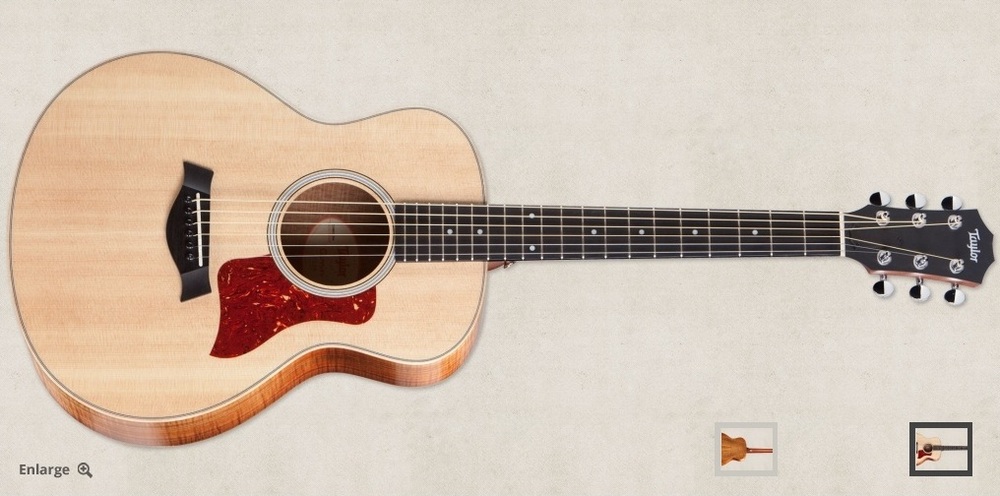
A Taylor Mini GS Blackwood guitar.
Tasmania is sitting on a fantastic business opportunity that few people know about, but this opportunity remains unrealised because it involves the forest industry, and while the forest industry remains highly politicised the opportunity is stillborn.
I have written previously about the potential of the tonewood market to change the future of the blackwood industry. Gibson, Fender, Martin and Taylor are the four major guitar makers in the USA. To date two of these makers have used Tasmanian blackwood in their guitars for limited production models. These are major instrument-making companies with big international profiles.
Traditional tonewood supplies are becoming increasing scarce and major guitar makers are scrambling to find certified, sustainable supplies of quality tonewoods. Tasmania is sitting on a small goldmine and doesn’t know it.
Robert MacMillan of Tasmanian Tonewoods tells me that two of these US makers are sending teams to Tasmania in the next few months to try and negotiate supply contracts particularly for blackwood timber. But the last thing these companies want is to become entangled in forest politics. Like all good companies they know that any bad publicity can quickly destroy company reputation and profits. In addition to avoiding political intrigue these companies would also prefer to source their timber from certified suppliers. Robert also informed me that for the past 5 years he has refused business with a third major US maker because he cannot guarantee the supply of blackwood.
This is just plain stupidity and reflects the poor state of public forest policy and management in Tasmania.
While we are talking relatively small volume, high value markets, the potential demand is more than enough to make a significant difference to the growing and selling of blackwood in Tasmania.
Is Tasmania up to the challenge?
These companies are well aware of the sovereign risk associated with the current major source of blackwood timber from public native forests. Even if the IGA is successfully negotiated and legislation passed through State parliament, the risk may be reduced but it will always be present. That is the nature of politics and the management of public assets. The future supply of blackwood timber from public native forests is also bound to the commercial viability of the greater native forest industry, for which there is still considerable uncertainty.
Robert is keen to access more blackwood and other tonewoods from private land to help supply these major US customers.
There is a very large existing native blackwood resource on private land in Tasmania, which currently has little or no commercial value. Much of it is of poor form, and much is still too small to be harvested. But some of this resource has the potential to supply the international tonewood market. Logs as short as 1.2 metres in length can be sawn for tonewood. Realising the commercial value of this private resource will require resolving a number of issues. A major issue will be how to wrap this existing private blackwood resource into a forest certification scheme. A Blackwood Growers Cooperative would provide a possible solution to this problem, with ongoing management and plantation establishment to provide a sustainable resource.
As New Zealand farmers have discovered blackwood is an ideal farm forestry species. It is the only Tasmanian native tree that is currently known to be profitably grown in plantations to produce high quality timber. And as I am discovering in my travels around the State, many farms have land ideally suited to growing blackwood. In addition the forest industry needs to break away from its dependence on the public native forest resource, and broaden and strengthen its support base. Put these two factors together and you have the basis for a Blackwood Growers Cooperative.
Tasmania could become the proud home of one of the worlds few certified and sustainable high-quality tonewoods, providing income for Tasmanian farmers and a range of associated businesses. The blackwood industry could become a high-value niche industry to join our truffle, wasabi, saffron and wine industries. I’m getting plenty of interest from the Tasmanian rural community; international buyers are coming; now can our politicians look to the future of the forest industry?
Posted in Uncategorized
 | gordonjbradbury on 2026 Tasmanian oak prices at B… |
 | Bruce on 2026 Tasmanian oak prices at B… |
 | John Hill on 2026 Tasmanian oak prices at B… |
 | Brett Waring on An open letter to Kirsha … |
| Bruce Gibbs on Tasmanian oak prices at Bunnin… |
 Tasmanian Blackwood Growers Cooperative
The sad passing of Ian Nicholas
It was with great surprise and sadness to learn of the death recently (22/3/2013) of New Zealand friend, blackwood scientist and farm forestry advocate Ian Nicholas at the age of 59.
I only got to know Ian personally in the last 10 years but in that time I developed a great respect and appreciation for his immense knowledge and understanding, but also for his quite strength and determination. He was a tremendous advocate for broadening the range of commercial tree species grown in New Zealand including blackwood. His determination and hard work provided much of the momentum and progress in the small world of plantation blackwood.
Over many decades Ian provided the New Zealand focus and did much of the research that helped turn blackwood from an unruly opportunity into a commercial reality. With Ian’s help New Zealand farmers have mastered the art of growing commercial blackwood, and are now starting to reap the benefits. In 2002, in conjunction with Ian Brown he wrote the plantation blackwood bible, the Growers Handbook, while in the past few years he took on the role of managing the New Zealand blackwood growers group (AMIGO).
On his last visit to Tasmania in May 2011 Ian, together with two Chilean forest scientists and blackwood experts, were on a fact-finding mission to see what we were doing with blackwood. They left Tasmania realising that they knew far more about growing blackwood than we do. Ian was disappointed with where the forest industry had got to in Tasmania. I wrote an article about it in Tasmanian Times. It was Ian’s visit that pushed me to develop the Growers Cooperative proposal.
http://tasmaniantimes.com/index.php?/weblog/article/a-missed-opportunity-for-the-forestry-peace-agreement/
Ian was very supportive of my proposal to establish a blackwood growers cooperative in Tasmania.
My dream was that one day I would enjoy Ian’s company as he showed me around the blackwood highlights of New Zealand. Sadly that dream will never be realised.
Thank you for your support and friendship Ian.
Rest in Peace.
Leave a comment
Posted in Commentary, New Zealand