Premium blackwood sawlog sells for $9,600!!

The results of the Island Specialty Timbers October auction have been posted. Lot 13 didn’t quite make the magic number of $10,000 as I had hoped but came very close at $9,600. On a cubic metre basis the log sold for $2,900, $200 per cubic metre more than the head log at the August tender.

That’s a total of $17,000 for the two logs totalling six (6) cubic metres from the one tree! An extraordinary price for one extraordinary blackwood tree.

Here’s a description of the Lot 13:
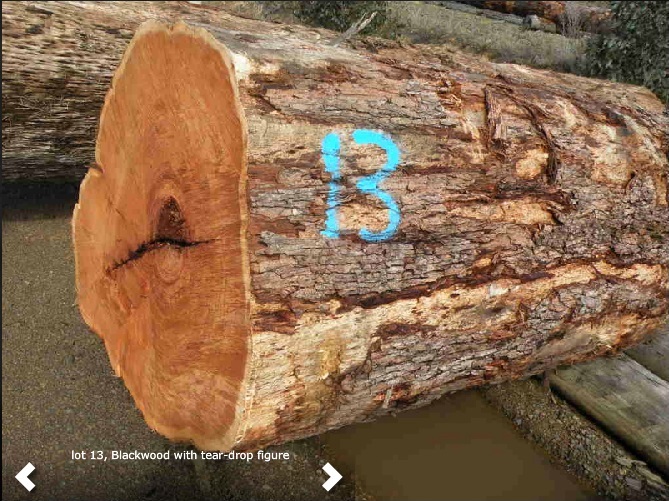
Lot 13

Will this blackwood sawlog sell for over $10,000?

IST described the October tender price results as “sensible, fair prices” which is a very odd thing to say.

Anyway it was a fantastic result!

One reason this log achieved such a great price was the tear drop figured grain. Feature grain in any quality log such as fiddleback or tear drop will improve the market value significantly. While little research has been done into the origins and causes of feature grain in any species, it is generally believed that this trait is at least under partial genetic control. This means it can potentially be cloned.

But cloning of feature grain blackwood (like Lot 13) will only happen within the context of a profitable, commercially driven blackwood growers cooperative. There is no point cloning feature grain blackwood unless you can grow the stuff in profitable plantations. The sooner we get Tasmanian farmers growing commercial blackwood the sooner we can start thinking about cloning tear drop and fiddleback blackwood.

The two plain grain logs in the October tender (lots 11 and 12) went for good prices although the logic behind the prices seems contrary. The larger log (lot 11) sold for $300 per cubic metre while the smaller log (lot 12) sold for $600 per cubic metre!! Was there a typo or a data entry error? It makes no sense, unless there was some quality aspect in the larger log that was not properly reported. Either way the results were good, and indicates that plain grain blackwood logs are attracting good prices. At $300 per cubic metre a well managed blackwood plantation would be worth $90,000 per hectare after 30-35 years. And at $600 a hectare of plantation would be worth……..

Anyone interested?
Blackwood in New Zealand video now available on-line

From the latest AMIGO Newsletter:

This video, which was part-funded by AMIGO, was the brain-child of the late Ian Nicholas. It is one of Ian’s many legacies that NZ blackwood growers can be grateful for.

Ian features in the video, discussing a series of 25-year-old blackwood regime trials, where different pruning, thinning, and final crop stocking regimes have led to some clear conclusions about optimal silvicultural regimes to maximise timber volume and value.

A number of experienced blackwood growers from both the North and South Islands discuss their experiences with growing blackwoods on range of site types, and provide recommendations for successful establishment and maximising the timber crop value.

Finally, the potential for blackwood timber is highlighted by Ian Nicholas and others. Peter King of Kings IVth Generation Timber, Carterton, shows how his company produces high-value blackwood bench-tops, and Paul Millen discusses how he has developed a production thinning regime in his Marlborough forest to produce timber for blackwood flooring. We also see inside an award-winning Marlborough house which features a stunning blackwood floor.

The video is about 45 minutes long, and ‘high definition’. Anyone unable to view it on-line should contact me and I will arrange for a DVD to be sent to you.

A great video and well worth watching. Check it out!

Forestry Tasmania stakeholder registration now open

FT Help Us Improve

As part of the move towards applying for FSC Certification Forestry Tasmania are now seeking community feedback and stakeholder engagement. Stakeholder registration is now open. Visit the website:

http://www.forestrytas.com.au/help-us-improve

Current FT policy and practice effectively prevents private investment in blackwood by treating the public special timbers and blackwood resource as a non-profit, publicly subsidised charity. No private blackwood investment will happen until the special timbers industry is reformed on a fully commercial basis. Without this change the special timbers industry is doomed, and all your favourite Tasmanian timbers will no longer be commercially available.

For more information read my blog here:

http://blackwoodgrowers.com.au/markets/

You can help bring about this important change by becoming a FT stakeholder and letting them know that reform is vital to the future of blackwood as a profitable commercial opportunity.

They have a online survey you can also do to provide FT with some quick feedback.

Help support the future of Tasmania’s special timbers industry and demand change.

Thanks for your support!

The sweet sound of Tasmanian guitars

Check out this great little story from ABC Northern Tasmania about Melbourne-based luthier Chris Wynne.

http://www.abc.net.au/local/photos/2013/10/09/3865202.htm?site=northtas

Chris runs luthier (guitar building) workshops in Stanley and has been a proud promoter of Tasmanian tonewoods for many years. He also runs very popular workshops in Italy. Check out his website:

http://www.thomaslloydguitars.com.au/

Read the ABC story and listen to the interview.

PS. Here’s a similar story in The Advocate:

http://www.theadvocate.com.au/story/1822279/creating-a-unique-sound/?cs=87


Will this blackwood sawlog sell for over $10,000?

Not content with breaking the blackwood sawlog price record at their August tender, Island Specialty Timbers have saved the best til last. It turns out that the record breaking August sawlog was just the head log from what must have been a truly magnificent blackwood tree. The butt log from this same tree is now up for tender at IST Geeveston – lot 13. Tenders close 22nd October 2013.

Lot 13

Here’s the description of this log:

Lot 13, Blackwood, figured.  A fresh, very large diameter log with little taper, excellent dark colour and tear drop figure.  This is the butt log from below log 3 sold in the August tender. One of the best logs offered in an IST tender!  Length 4.4 metres, butt diameter 103 cm, head diameter 93 cm, volume 3.31 cubic metres, weight about 3650 kg.

This butt log is of similar length to the August sawlog but has 20% more volume, so the potential sawn recovery will be very high. The August sawlog went for $2750 per cubic metre for a total value of $7,500. What will this massive sawlog sell for?

The October IST tender also includes two other blackwood sawlogs amongst the 22 lots, one of which equates in size and quality to what might be grown in a blackwood plantation (lot 11). It will be interesting to see what price this log achieves.

Blackwood is the only Tasmanian special species which has the potential to be grown commercially and profitably by Tasmanian farmers in either plantations (like NZ farmers) or through better management of existing on-farm blackwood. While sawlogs of this quality are not common, the prices being achieved should be gaining interest amongst the rural community. Clearly the market for premium appearance grade timber is very much alive and in good health. When will the Tasmanian rural community wake up to the opportunity?

Another record price at IST tender

The September tender of special timbers at Island Specialty Timbers achieved yet another record result.  The price wasn’t for a blackwood log (none were offered in the September sale) but the result clearly demonstrates that the market for premium timbers is very strong indeed.

An incredible $5,380 per cubic metre was paid for a high quality tiger-stain myrtle sawlog, the highest unit price ever paid at an IST special timbers tender.

Unfortunately Myrtle (Nothofagus cunninghamii) cannot be domesticated as a commercial crop, so this sales result has no direct commercial importance. It takes at least 200 years for Myrtle to reach commercial size, and the fungal infection that produces the tiger staining has not yet been identified. Those few lucky Tasmanian farmers who have existing Myrtle on their properties now have a better appreciation of what they may have growing. Other farmers may have areas suitable for growing a few Myrtles as a hobby or special interest (eg. river reserve or steep south-facing slope).

But if farmers want to grow these high-value premium timbers as a profitable commercial crop then blackwood is the clear and obvious answer. That is the clear indirect message from these latest tender results from IST. The premium timber market is beginning to shout at farmers and landowners – please grow high quality timber. Are any farmers listening?

Record price achieved for premium blackwood sawlog at IST tender

The August tender of special timbers at Island Specialty Timbers achieved a record price for a blackwood sawlog. Described by IST as possibly the best blackwood log ever offered for tender at IST Geeveston, the log achieved a price of $2750 per cubic metre for a total value of $7,500!!

Here is the description of the log from IST:

A large diameter fresh log with dark wood, tight grain and tear-drop figure affecting its full length.  Probably the best blackwood log offered for tender at IST Geeveston.   Length 4.5 m, butt diameter 93 cm, head diameter 83 cm, volume 2.73 cubic metres, weight about 2000 kg. 

The log had two important attributes that contributed to its premium price: very large size, and tear-drop grain figure. Tear-drop is a relatively rare feature grain.

The other blackwood log sold at the August tender was a standard grade log with plain grain that achieved a good price of $420 per cubic metre. This log was of equivalent size and quality to what would be achieved in plantation grown blackwood. At these prices blackwood plantations are a good investment.

Blackwood plantations produce approximately 300 cubic metres of premium sawlog per hectare, which at $420 per cubic metre equates to approx. $120,000 per hectare at harvest in 35 years!! Is anyone interested?

There is also some evidence that figured grain is under at least partial genetic control which means that tear-drop grained blackwood could potentially be cloned. But this will only happen with private blackwood investment. At $825,000 per hectare in 35 years that seems like a reasonable investment!

The other tender result worth noting was the price paid for a high quality blackheart sassafras log of $5,000 per cubic metre!! Unlike blackwood, sassafras cannot be domesticated as a commercial species. But the result clearly demonstrates the ability of the specialty timbers market to pay very high prices for quality sawlogs.

Clearly the market for premium appearance grade timber is very much alive and in good health.

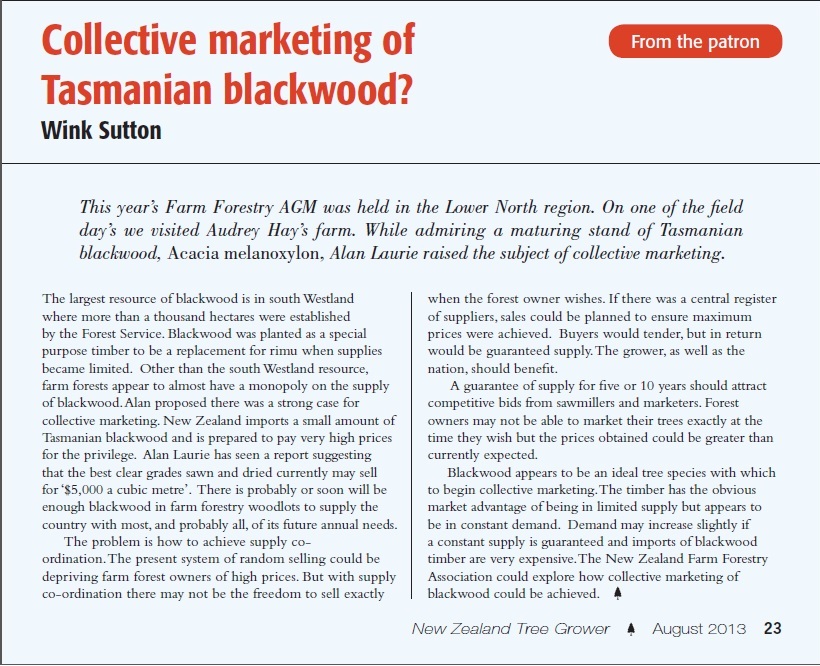
Collective marketing of Tasmanian blackwood?

Collective marketing - Tree Grower 34-3

This is an interesting article from the latest New Zealand Tree Grower journal from the New Zealand Farm Forestry Association, and potentially represents a significant milestone in the fledgling NZ blackwood industry.

Alan Laurie runs Laurie Forestry Ltd a progressive and commercially focused forest management, harvesting and marketing business. I always enjoy reading Alan’s regular forestry market reports that always me to know much more about what is happening with the NZ forest industry than I know about the industry here in Australia.

For Alan to make these comments about the potential of New Zealand blackwood is a significant vote of confidence in the industry. While there is a blackwood interest group (AMIGO) established under the NZFFA, they have yet to evolve into a marketing cooperative despite the fact that steady volumes of quality NZ blackwood timber are now coming onto the NZ market. Certainly what needs to happen soon is greater market transparency and feedback, so that prices and return on investment allow more potential blackwood growers to take an interest and help build the industry.

Blackwood appears to be an ideal tree species with which to begin collective marketing. The timber has the obvious market advantage of being in limited supply but appears to be in constant demand. Demand may increase slightly if a constant supply is guaranteed and imports of blackwood timber are very expensive.

To this comment from Alan Laurie I would also add that blackwood also has the advantage of a well established market presence and profile as a premium quality timber, so marketing and sales should be straight forward, compared to many lesser-known species.

So can the NZFFA/AMIGO evolve into a marketing cooperative and help take the NZ blackwood industry to the next level?

I would think given Alan Laurie’s knowledge, experience and place in the industry he could play a pivotal role in making the collective marketing happen.


Happy tree-growing farmers

In travelling around and talking to Tasmanian farmers and others about growing blackwood I’m often faced with the statement (or some variation of it) – “but they take so long to grow!”

I’m certainly not saying that time and money are not essential issues in investment; but good money can still be made on investments up to around 40 years. And this is without considering the many other benefits in growing trees on farms.

Amongst the blackwoods

So how do farmers get past this initial resistance to investing in trees and including trees in their farming business?

As a passionate forester I’m always inspired by the stories from New Zealand where many farmers have taken to growing trees as part of their farming business. Twenty years ago the New Zealand Government (which was then the major player in the forest industry) decided that politics and forestry didn’t mix, and if the forest industry was to succeed and thrive then it was time for the Government to exit the industry. So the Government shut down the public native forest industry and sold off the large public plantation and sawmilling assets. It was a controversial decision that was opposed at the time by the industry and the forestry profession, but the Government still went ahead. Today the forest industry is a thriving cornerstone of the NZ economy, and the farmers are the beneficiaries of that brave decision 20 years ago. I only wish Tasmanian farmers were in the same situation.

The organisation that represents New Zealand farm foresters is the NZ Farm Forestry Association. Their website has a vast array of information and ideas. One is this collection of farm case studies that showcase 15 farmers and their experiences with growing trees. They are all well worth reading. Some of the stories include farmers growing blackwood.

http://www.nzffa.org.nz/farm-forestry-model/case-studies/

These stories demonstrate that farmers can overcome their reluctance to long-term investment of trees. Where the opportunity allows, a series of forestry investments over time can eventually make a major ongoing contribution to farm income. Some of the case studies include harvesting and the financial returns that have been achieved. Perhaps the best example is “Hockings, Bulls, Wanganui” the sixth on the list that includes a table showing the significant contribution of forestry to farm income over an 18 year period. Very impressive! Indeed I have read of NZ farmers who over time have converted their entire properties to forestry and become 100% tree farmers. They have discovered that farming trees is both enjoyable and profitable.

And because blackwood is high-value, smaller investments are still viable and profitable, compared to hardwood pulpwood or radiata pine where scale of investment is more important.

I hope you find these stories inspirational and educational.

Blackwood – the yet-to-be sustainable tonewood

Blackwood also is sourced from forests that are responsibly managed, making it a sustainable wood for guitar making.”

Guitar

This is a quote I recently found in a newsletter published by a major guitar maker.

Regular readers of this blog will understand that “responsible” and “sustainable” are not words I would use to describe blackwood management and production in Tasmania. Not yet anyway.

Not that blackwood is in danger of becoming extinct as a species. Far from it. But in the next 2-3 years it will become commercially extinct; that is the wood volumes available for harvesting will drop to levels that only allow a craft industry to persist. But the forest industry is not yet prepared to admit this disaster, and is currently heading in the opposite direction required to fix the problem.

Nor am I implying deception on the part of the guitar maker. It is easy to be swayed by the official forest industry information into thinking that all is well. But you don’t need to scratch hard to begin finding problems.

Most blackwood timber comes from the harvesting of public native forests that have been the subject of increasingly bitter community conflict over the past 30 years. These forests are managed by the Government forest agency Forestry Tasmania. Blackwood is also a common tree on farmland across northern Tasmania, and while there is a small amount of blackwood timber harvested from private land most farmers do not regard their blackwood as having any commercial value. The forest industry here has traditionally been a Government dominated closed shop so most farmers know not to bother growing trees for wood production.

But the only possibility for restoring responsible, sustainable blackwood supply back to commercial levels is from private land. And the blackwood industry (including guitar makers) needs to understand, appreciate and openly support this.

In three recent blogs I discussed in detail the numerous issues that the blackwood industry currently faces around the public blackwood resource and State forest policy, some of which directly hinder the development of the private blackwood industry. These include:

  • Long term overcutting of the resource;
  • Poor resource management;
  • Major decline in supply in the next 2-3 years;
  • Failed new resource initiatives;
  • Non-profit taxpayer-subsidised business model;
  • Anti-competitive sales and pricing processes;
  • Lack of market competition and transparency.

Meanwhile the blackwood industry sits quietly on it’s hands and says nothing, hoping that a fairy godmother will soon arrive and fix this ungodly mess. Certainly no farmer or anyone else will invest in blackwood under these conditions.

Tasmanian blackwood could be a sustainable tonewood supplying international markets. It is a recognised premium tonewood. It is fast growing. The establishment of a plantation program could see a selection and breeding strategy commenced to grow the best possible blackwood for the tonewood market. But not yet. Under current policy and practice Tasmanian blackwood timber production is anything but responsible and sustainable.