It’s time for my annual summary of Island Specialty Timbers (IST) log tender results.
http://www.islandspecialtytimbers.com.au/
This is the only competitive market forest log price data publically available anywhere in Australia.
General
During the year Island Specialty Timbers conducted 7 tenders putting a total of 154 cubic metres of special species logs, craftwood and sawn wood to tender.
Total sold volume was 99.8 cubic metres (65%).
Total tender revenue was $90,900.

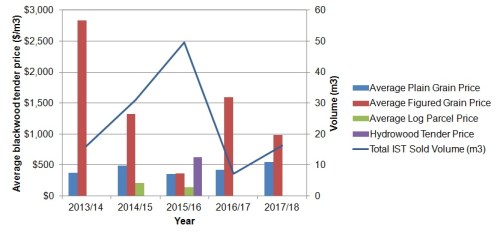
The above chart shows the log volumes and log prices paid per tender. Craftwood and sawn wood are not included in this chart.
The large volume of unsold logs at the April 2018 tender was mostly due to a large parcel of Silver wattle (Acacia dealbata) logs.
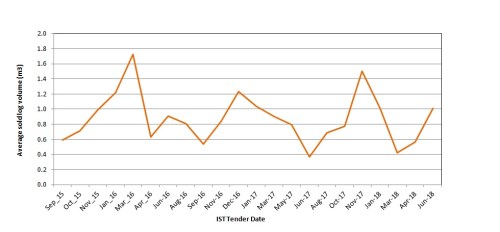
The above chart shows the average volume of logs sold at tender by IST. For some context to this chart, the target plantation blackwood log is 1.5 cubic metres in volume (DBH 60 cm pruned to 6 metres). So it can be seen most of the IST logs sold at tender are small to very small in size.
The highlights for the year were a) a tiny black heart sassafras log (1.1m length, 30 cm small end diameter, 0.07 cubic metres volume) that sold for $3,800 per cubic metre. Indeed at this August 2017 tender 5 small BH sassafras logs totalling 0.54 cubic metres sold for a total of $2,025; and b) a very large huon pine log (4.3 cubic metres) sold for a total $4,623.
Two species attracted strong demand and high prices during the year, these being black heart sassafras (BHS) and huon pine, with average log prices well over $1,000 per cubic metre. BHS and huon pine made up 21% and 13% respectively of the sold volume. Blackwood and feature eucalypt/tas oak were the other major sellers at 18% and 23% of sold volume.
In fact 2 tear-drop grain tas oak logs sold for over $1,700 per cubic metre, an extraordinary price for a wood that the market generally regards as a cheap commodity.
Celery top pine sold for an average $580 per cubic metre (3.7 cubic metres total sold).
Silver wattle and blackwood made up 76% and 15% respectively of the unsold volume for the year.
So what can we say with three years of IST tender results in the chart?
Answer: Not much!
There is no apparent trend in price over the last 3 years. Sure the volumes are small, the market is restricted and the quality of produce is highly variable.
What can be said is that even given these limitations the market will pay very good prices for quality wood when it wants to, with maximum prices averaging $3,000 per cubic metre, even for tiny logs!
These tendered log volumes represent less than 1% of the special timbers annual harvest, and a mere 0.01% of the wood harvested annually from public native forest in Tasmania. The rest is sold at Government (non-market) prices on long term, perpetual sales contracts.
According to Forestry Tasmania’s Annual Report in 2016/17 IST sold a total of 829 cubic metres of product [tender and direct sales]. The annual report does not give separate accounts for IST so their income and costs are unknown.
Blackwood
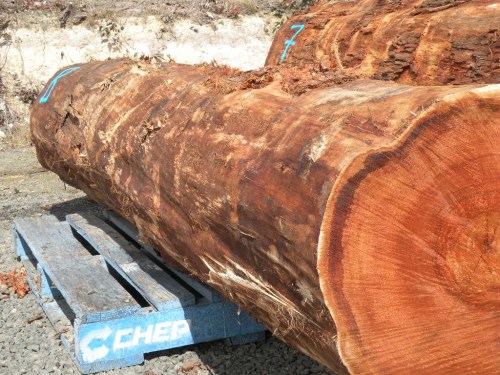
In general the IST tender results provide little information that is useful to the marketplace with the exception of blackwood. Tasmanian blackwood is the only Tasmanian “special species” that has the potential to be grown commercially; the other species being too slow growing.
Sixteen blackwood logs (23.5 cubic metres) were put to tender in 2017-18 of which 10 were sold (16.3 cubic metres) for a total of $12,210.
Five of the sold logs (7.6 cubic metres), described as having figured grain, sold for a total of $7,460. These logs averaged 5.2 metres length, 57 cm small end diameter and 1.5 cubic metres volume.
The 5 plain grain logs (8.7 cubic metres) sold for a total of $4,754, an average price of $545 per cubic metre. These five logs averaged 6.0 metres in length, 54 cm small end diameter and 1.7 cubic metres volume. In other words these were good size, quality logs equivalent to what can be grown in a well managed blackwood plantation, which would produce approx. 300 cubic metres of high quality sawlog per hectare at harvest.
This is a very good price and a substantial increase on the last three years.
The stand out blackwood results for the year were a) $1,300 per cubic metre for a 1.76 cubic metre log containing tear-drop figured grain, and b) $2,467 total price for a very large (2.53 cubic metre) figured log.
The unsold blackwood logs consisted of a) one huge figured grain log measuring 5.7m length 75 cm small end diametre and 3.4 cubic metre volume, and b) 5 plain grain logs averaging 4.3 metres length, 46 cm small end diameter and 0.8 cubic metres volume.
Remember these are tiny volumes in a small market (southern Tasmania). Whether they represent the broader blackwood market is unknown.
Remember these prices are “mill door” equivalent prices with harvesting and transport costs already “included”. They are not stumpage prices.
Also remember that Sustainable Timbers Tasmania/IST is a taxpayer funded community service organisation bringing these timbers to market from Tasmania’s public native oldgrowth and rainforests:
Tasmanian regional forest agreement delivers $1.3bn losses in ‘giant fraud’ on taxpayers




National Forest Industries Plan 2018
The only basis for a successful forest industry is profitable private tree growers.
And once again the Federal Government and the Australian forest industry have failed to deliver.
Last week the Federal Government launched another plan for the Australian forest industry:
http://www.agriculture.gov.au/forestry
http://ausfpa.com.au/media-releases/morrison-government-promises-a-billion-new-production-trees-sets-new-vision-for-growing-australias-renewable-forest-industries/
Yet another opportunity for Australian taxpayers to give generously to the tune of $20 million over the next 4 years with more to come.
But wait! There is a Federal election due before November 2019.
Surely this is coincidence!
Another forest industry plan so close to an election. Is that pork I smell cooking?
Apologies for my cynicism but I’ve seen this so many times before.
Forest industry plans have a short shelf life in Australia. The Use By Date generally coincides with the next election/change of Government.
The Plan is 15 pages long, 15 pages of marketing and spin with very little substance. Just reading the 2 page Preface tells me that I’ve read all this many times before.
If this Plan was an investment prospectus it would be in the bin within the hour.
The Preface tells me:
The Plan has 15 Actions listed under 4 headings. Every one of the Actions is what the Government/taxpayer is going to do for the wood processors. Not one of the Actions concerns what the forest industry will do for itself.
There is no Implementation Plan. How, who and when are these Actions going to be fulfilled? Based in past industry plans I assume few if any of the Actions will see the light of day.
The word “export” is completely absent from the Plan. Access to log export markets is an essential part of the future of any viable profitable forest industry.
The Plan fails to address the many distortions and blockages in forestry markets in Australia (like Government control and manipulation of log prices). One major issue here is the management and performance of the various State forest agencies. All these agencies MUST be made fully commercial and profitable, or they must be must be shut down.
Many reports have been written highlighting the issues preventing investment in tree planting in Australia. This Plan ignores these issues entirely!
As I said in my previous blog forest policy should not be about sawmillers/wood processors. That is the wrong focus. Good forest policy should be about profitable private tree growers. Once tree growing is demonstrably profitable then the investment in processing will follow.
This Plan is all about sawmillers/processors.
The political and industry spin doctors really had fun with this statement:
The National Farmers Federation’s support for the inclusion of farm forestry tree plantings as a supplement to primary agricultural purposes confirms that farmers are poised to support a bigger part of tree growing in our landscape.
The National Farmers Federation (NFF) has only recently decided that forestry might be a primary industry. To date their interest and commitment has been minimal. They have no policies or farm forestry programs.
The one single positive I can say about the Plan is that it has a stronger emphasis on farm forestry than previous plans, but not in a way I find encouraging.
If you have 30 minutes and want some light entertainment download the Plan and have a read. Then tell me what you think!
Will this Plan ignite the forest industry in Australia?
Or will it join the dozens of previous forest industry plans collecting dust on library shelves around the country?
Cheers!
Leave a comment
Posted in Commentary, Plantations, Politics