
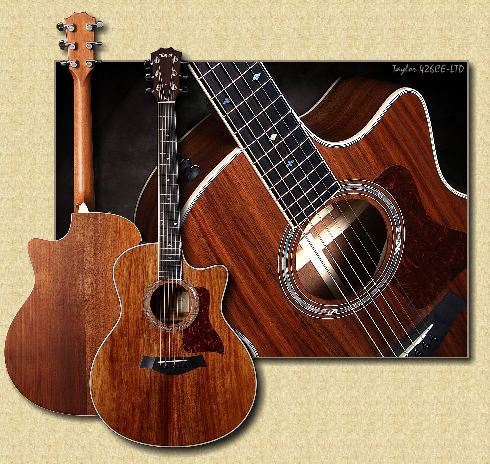
An American made Taylor 426CE-LTD, a premium guitar using Tasmanian blackwood top, back and sides.
One of the important drivers in the future of plantation blackwood I believe will be the demand for sustainable tonewoods. Tonewoods are woods used in the manufacture of musical instruments. Blackwood is most commonly used in the manufacture of acoustic guitars. While the volumes required may be relatively small, and the log specifications may be restrictive, the high value and prestige associated with this market will help drive the development of blackwood as a premium plantation species.
Like most music instruments the history and development of the guitar has been a struggle between tradition and innovation. In the case of the violin tradition reigns supreme, with the Cremonese era (17th – 18th century) being regarded as the pinnacle of violin manufacture. With the steel-string acoustic guitar, the pre-war (WW2) American guitars are today regarded as the pinnacle, but innovation and adaptation continue to drive the development of the guitar. One factor driving innovation is the supply of quality wood. Brazilian rosewood (Dalbergia nigra) is regarded as the holy grail of guitar tonewoods, but it is now subject to a CITES restrictions that severely limits availability. Like Brazilian rosewood, many traditional tonewoods come from the logging of rainforest, with very few coming from sustainable sources. This is where blackwood has a distinct advantage.
Blackwood entered the tonewood market due to the success of its American cousin Acacia koa. Hawaiian music was extremely popular in America in the 1920’s, with many guitars being made using Koa which is only found in Hawaii. As a result Koa quickly established itself as a quality tonewood. Koa wood comes from the logging of Hawaii’s very limited native forests, and with supplies dwindling, guitar makers are looking for a substitute. In Australia, Melbourne-based guitar makers Maton have pioneered the use of Australian timbers for many years, including blackwood.
Blackwood tonewood currently enjoys retail prices ranging from $70,000 for relatively plain sets, to $150,000+ per cubic metre for highly figured and decorative examples. I don’t have any figures that convert these prices back to stumpages (price at stump), but they must be considerably higher than standard sawlog stumpages.
With most blackwood timber currently coming from the logging of public forest in Tasmania, and with the ongoing uncertainty about the future management of these forests, the opportunity to establish a sustainable plantation resource to supply this market is great.
Major guitar manufacturers are becoming increasing involved in the supply side of their tonewoods, to ensure they come from quality, sustainable sources. Examples of this include the Musicwood Coalition (www.musicwood.org). One of my objectives with the blackwood growers cooperative would be to establish relationships with some of these major manufacturers such as Taylor, Martin and Gibson, so that their requirements for tonewood would help drive the development of the coop.
There is plenty of evidence to show that international demand for blackwood tonewood has increased dramatically over the last 10 years. We just need to get the supply side of the business working.
Cheers!
References
Ellis A, Saufley C, Gerken T (2008) The future of tonewood. Acoustic Guitar 18(8):80-86.
Evans P (2007) The use of blackwood in the Australian guitar-making industry. In: Beadle C. L. and Brown A. G. (eds) Acacia Utilisation and Management: Adding Value – 3rd Blackwood Industry Group (BIG) workshop. 26-29 April 2006, Marysville, Victoria, RIRDC Publication No. 07/095, Canberra, Australia. pp. 45-46.
Morrow A (2007) Evaluation of Australian timbers for use in musical instruments. J. W. Gottstein Memorial Trust Fund, Clayton South, Vic., Aust.
(http://www.gottsteintrust.org/html/reports/catalog.htm#AMorrow).


 Tasmanian Blackwood Growers Cooperative