Category Archives: Markets

Deloraine Stringfest 2015

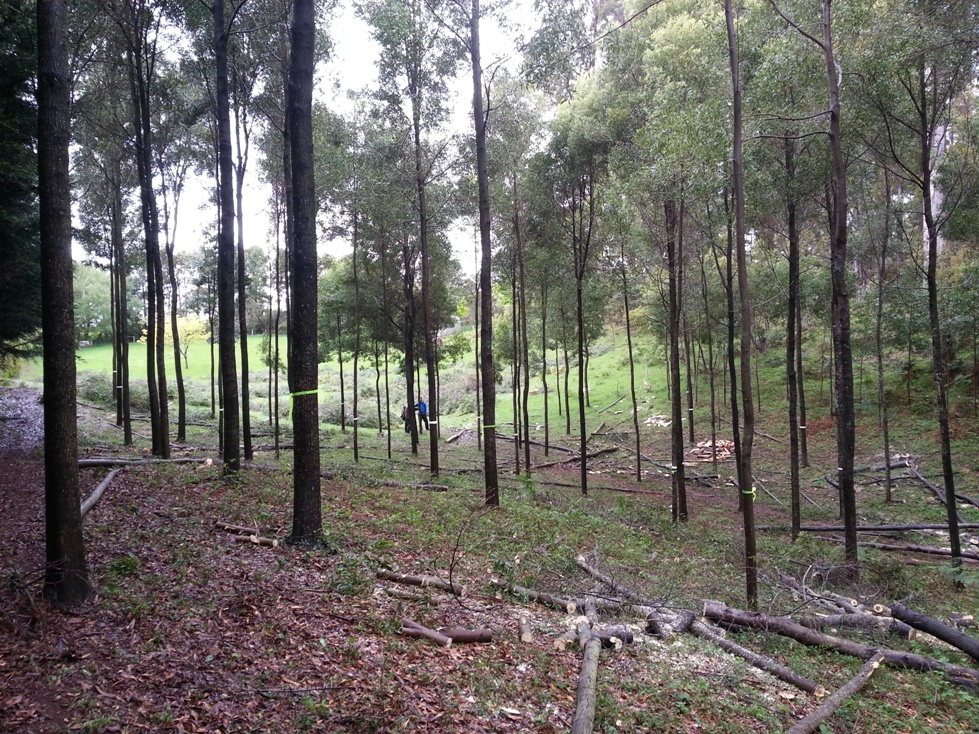
Planning is underway to include a visit to a successful private blackwood plantation as part of the Deloraine Stringfest in March 2015. Transport will be by bus so places will be limited. Your chance to see and learn the art of growing commercial blackwood. Details to follow.

20131113_111101s

More Taylor Guitars promotion of Tasmanian tonewoods

Here’s Taylor Guitar’s Master Luthier Andy Powers promoting the new limited edition models featuring Tasmanian blackwood and black heart sassafras. Great video! Go Tasmanian tonewoods!


The incomplete history and current practice of unsustainable blackwood mismanagement

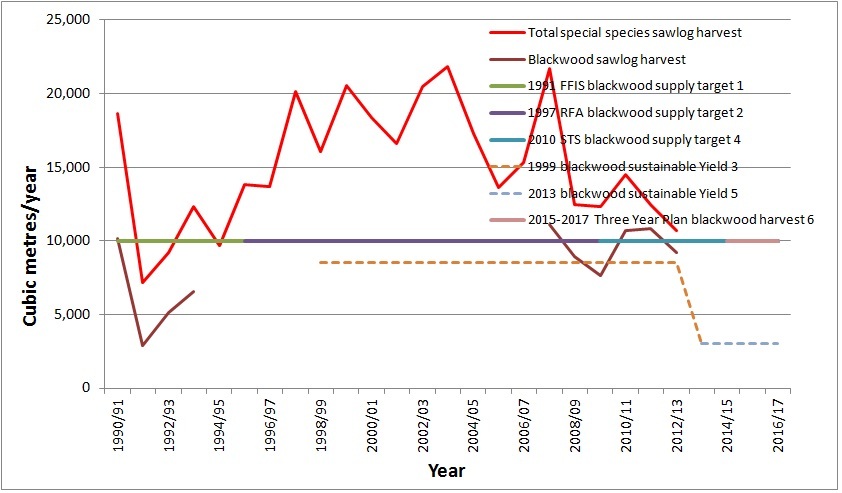
Having spent some time in the library I can now add a bit more detail to the chart that summarises the history of the public blackwood and special species timber resource management over the last 25 years.

http://blackwoodgrowers.com.au/2014/06/23/the-incomplete-history-of-unsustainable-blackwood-mismanagement/

Between 1995 and 2007 Forestry Tasmania published no data on the annual harvest of blackwood sawlog. The next best available data is the total special species sawlog harvest data. Knowing that blackwood comprises the majority of the special species harvested it is clear that blackwood harvest during this time was well above the sustainable level set in the 1999 blackwood resource review. This has been blatant overcutting of the resource; all of it legal and approved by successive Tasmanian Governments and Parliaments.

The contrast between the recent blackwood sawlog resource review sustainable yield estimate and the 2015-17 Three Year Harvest Plan clearly shows that the overcutting of blackwood will continue.

Tasmania’s iconic blackwood industry is heading for extinction.

Incomplete history 2

Chart notes:

  1. The 1991 Forest and Forest Industry Strategy (FFIS) set a blackwood supply target of 10,000 m3 of blackwood sawlogs per year.
  2. The 1997 Tasmanian Regional Forest Agreement (RFA) reaffirmed the FFIS blackwood sawlog supply target.
  3. The Forestry Tasmania 1999 Review of the sustainable blackwood (Acacia melanoxylon) sawlog supply from Tasmanian State forest calculated the Statewide sustainable yield of blackwood sawlog at 8,500 m3 of blackwood sawlogs per year. The figure for just the BMZ was 6,800 m3 of blackwood sawlogs per year, with the remainder coming from the rest of the State.
  4. The Forestry Tasmania 2010 Special Timbers Strategy (STS) continued to reaffirm the supply target of 10,000 m3 of blackwood sawlogs per year until 2019.
  5. The Forestry Tasmania 2013 Review of the Sustainable Sawlog Supply from the Blackwood Management Zone (BMZ) recalculates the blackwood sawlog sustainable yield at 3,000 m3 per year. Production of blackwood sawlog from public forest outside the BMZ is expected to be negligible.
  6. The 2015-2017 Forestry Tasmania Three Year Wood Production Plan shows the harvest of blackwood sawlog will continue at 10,000 m3/year, in blatant disregard for the revised blackwood sawlog sustainable yield.

Taylor Guitars put Tasmanian tonewoods on display

Taylor-fall-limited-2014

Major American builder Taylor Guitars have just released their 2014 (northern) Autumn Limited Edition guitars featuring beautiful Tasmanian tonewoods, including five Tasmanian blackwood models and three models featuring blackheart sassafras. The series also includes a selection of models featuring Acacia koa which is a tree native to the Hawaiian Islands.

http://www.taylorguitars.com/guitars/limited-editions/fall-2014

These timbers were supplied to Taylor Guitars by Robert Mac Millan of Tasmanian Tonewoods.


Overcutting of the public blackwood sawlog resource to continue

Tasmania’s icon blackwood industry is well and truly heading for a complete wipeout.

Future supplies of blackwood timber, veneer and craftwood from Tasmania’s public native forests are looking increasingly endangered as Forestry Tasmania continues to overcut the resource well above sustainable yield.

I outlined in a recent blog the sad past management of the public blackwood resource, in response to the recent release by Forestry Tasmania of a new Review of the Sustainable Sawlog Supply from the Blackwood Management Zone (BMZ).

http://blackwoodgrowers.com.au/2014/06/23/the-incomplete-history-of-unsustainable-blackwood-mismanagement/

Now Forestry Tasmania has released its latest Three Year Wood Production Plan.

http://www.forestrytas.com.au/forest-management/3yp

This plan shows that blackwood sawlog will continue to be harvested from Tasmania’s public native forests at 10,000 cubic metres of sawlog per year for the next three years. The current sustainable sawlog yield is estimated to be 3,000 m3 sawlog per year.

In the name of internationally certified (PEFC/AFS) responsible forest management Forestry Tasmania will be harvesting 3 times the sustainable yield of blackwood for the next three years.

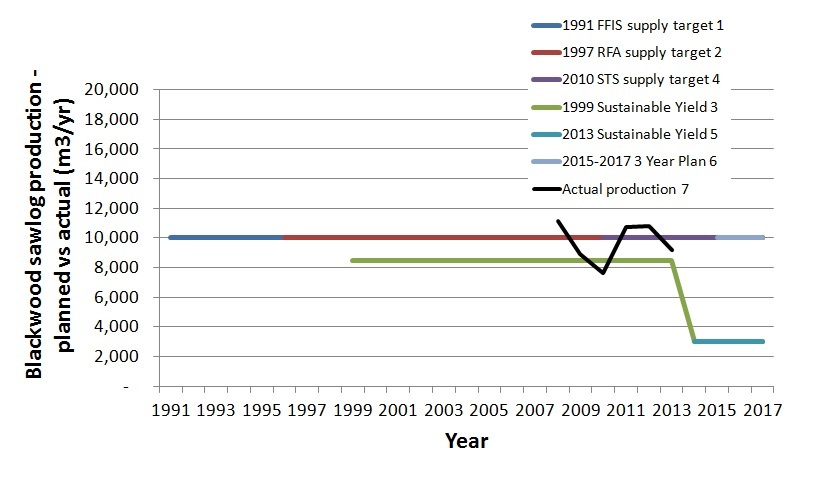
Here’s an update of the chart from the above blog with this new information:

Incomplete history plus 3YP

Chart notes:

  1. The 1991 Forest and Forest Industry Strategy (FFIS) set a blackwood supply target of 10,000 m3 of blackwood sawlogs per year.
  2. The 1997 Tasmanian Regional Forest Agreement (RFA) reaffirmed the FFIS blackwood sawlog supply target.
  3. The Forestry Tasmania 1999 Review of the sustainable blackwood (Acacia melanoxylon) sawlog supply from Tasmanian State forest calculated the Statewide sustainable yield of blackwood sawlog at 8,500 m3 of blackwood sawlogs per year. The figure for just the BMZ was 6,800 m3 of blackwood sawlogs per year, with the remainder coming from the rest of the State.
  4. The Forestry Tasmania 2010 Special Timbers Strategy (STS) continued to reaffirm the blackwood supply target of 10,000 m3 of blackwood sawlogs per year until 2019.
  5. The Forestry Tasmania 2013 Review of the Sustainable Sawlog Supply from the Blackwood Management Zone (BMZ) recalculates the blackwood sawlog sustainable yield at 3,000 m3 per year. Production of blackwood sawlog from public forest outside the BMZ is expected to be negligible.
  6. Planned blackwood sawlog harvest according to the Forestry Tasmania 2015-2017 Three Year Wood Production Plan.
  7. Actual blackwood production figures from 1991 to 2006 are not publically available. The 2013 Review only provides actual blackwood sawlog production figures from 2008. Forestry Tasmania wood production dropped dramatically following the 2007 GFC.

Taylor Guitars 524ce Tasmanian Blackwood prototype

The international appreciation and development of Tasmanian blackwood as a quality tonewood continues apace. Continuing on from my recent story about Bob Taylor

http://blackwoodgrowers.com.au/2014/05/01/bob-taylor-wants-more-tasmanian-blackwood-growers/

here’s a recent review of a new prototype from Taylor Guitars featuring all Tasmanian blackwood.

Beautiful quality blackwood supplied by Tasmanian farmers and Tasmanian Tonewoods.

Enjoy!


Blackwood Sawlog Tender Results 2013-14

images2

Here’s a summary of tender results for blackwood logs sold by Island Specialty Timbers (IST) for the 2013-14 financial year. In the absence of any IST Market Report or any better market information, this small dataset is as good as it gets.

Island Specialty Timbers, an enterprise of Forestry Tasmania, was established at Geeveston in 1992 to increase the recovery, availability and value of specialty timbers from harvesting activities in State forests.

Unfortunately this laudable “mission statement” is not translated into anything concrete or measureable like a business plan. Are these objectives being achieved? What are the measurable performance criteria? How has performance changed over the years? Unfortunately IST does not produce any annual reports, market reports or sales summaries. Also Forestry Tasmania does not report separate financial results for its special timbers activities including IST. So while the “mission statement” is couched in pseudo-commercial language, unfortunately IST exhibits all the hallmarks of a politically motivated public relations exercise.

How do special timbers contribute to Forestry Tasmania’s profitability?

Such a non-commercial, anti-competitive environment makes it difficult to convince farmers that the forest industry is about business and not politics.

It is also curious that although over 80% of the volume of special timbers sold by Forestry Tasmania is blackwood, blackwood makes up only a minor component of the volume of logs tendered by IST every year.

Note that all of the logs and wood sold by IST comes from the harvesting of public native forest. Remember also these tender prices are effectively mill door prices that already include harvesting and transport costs. They are not stumpage prices.

Still I am grateful for the small scraps of commercially useful information that IST provides. This is my attempt to summarise these scraps for the past 12 months.

Summary

For the year 2013-14 a total of 12 blackwood logs were put up for tender by IST. Three of these logs, including the single log in the June 2014 tender, failed to sell. The total value of blackwood logs sold at tender for 2013-14 by IST was $20,800.

The highlight for the year were two very large tear-drop grain logs from the one tree which sold for $9,600 and $7,500 ($2,900 and $2,750 per cubic metre respectively) or a total of $17,100 for 6.04 cubic metres of log from the one exceptional tree. The combination of feature grain, good log quality and large size clearly attracts a significant price premium.

With such incredible prices the obvious question is can blackwood of this size and quality be grown on private land? There are a few key issues that need to be discussed:

Size

The butt log from the above tree had a diametre of over 1 metre, with a total combined merchantable length of 9 metres. Even at the top of the top log the diameter was 83 cm! That is a big blackwood by anyone’s reckoning. Such a log could really only be grown in a (public or private) native forest environment. So yes! Private native forest could be managed to grow blackwood of this size and value given enough time and good management. The goal in blackwood plantations is to produce trees with a diameter at breast height (dbh) of 60 cm in about 35 years. It would take at least 50-60 years to grow a 1 metre diameter blackwood even in a fast-growing environment.

Figured grain

The other key factor with the above logs was the tear-drop grain. Figured grain of any sort is relatively rare in blackwood, tear-drop grain being more rare than fiddleback. Little research has been done on figured grain in trees anywhere in the world. My own belief is that it is both genetic and physiological in origin. Just about all trees have some fiddleback in their stumps as a response to physiological stress. If figure has a genetic component to its origin then there is the potential for cloning. I know a few people in Tasmania who have spent time trying to clone blackwood fiddleback. If feature grain can be cloned then the prospects for commercial blackwood growers improve dramatically. But cloning will only happen within the context of a private blackwood growers industry.

Plain-grain logs

Seven (7) plain grain blackwood logs totalling 10.0 cubic metres sold at tender during the year for a mean of $390 per cubic metre, or a volume-weighted mean of $370 (see Table 1). Some of these logs may be considered equivalent to those grown in commercial blackwood plantations. Logs ranged in size from 0.57 to 3.46 cubic metres, with the smallest log attracting the biggest unit price of $600 per cubic metre!

TABLE 1

  Number Average of SED (cm) Average of Len (m) Average of Vol (m3) Sum of Vol (m3) Average Unit Price ($/m3) Sum of Value ($)
Sold 7 59 4.1 1.4 10.05 $390 $3,707
Unsold 3 59 4.5 1.5 4.35
Plain Total 10 59 4.3 1.4 14.40 $390 $3,707
Sold 2 88 4.5 3.0 6.04 $2,825 $17,107
Tear drop Total 2 88 4.5 3.0 6.04 $2,825 $17,107

Notes: SED is log small end diameter, Len is log length, Vol is average log volume.

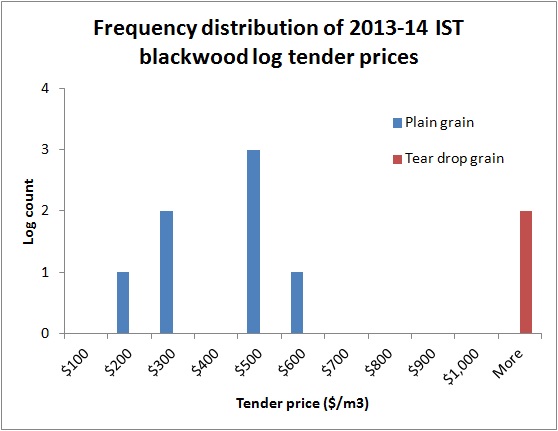
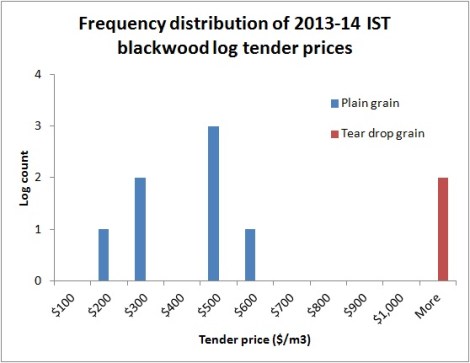
Figure 1 shows the frequency distribution of prices for the blackwood logs sold. For plain grain blackwood logs prices ranged from $180 to $600 per cubic metre. With a mean sale price of $390 per cubic metre, blackwood is attracting a similar price to good quality pruned Macrocarpa cypress sawlogs in New Zealand (see Allan Laurie’s great website). This is surprising given the long heritage of blackwood in the market compared to Macrocarpa which is a relative newcomer to the premium timber market. I have yet to see any equivalent mill-door prices for New Zealand grown blackwood.

FIGURE 1
IST price histogram

The dataset was too small to allow any analysis or correlations to be made between price and log quality for the plain grain logs. The fact that the very large 3.5 cubic metre log from the April tender, by far the biggest plain grain log for the year, sold for only $430 per cubic metre indicates that log size by itself does not necessarily attract a price premium.

It seems unlikely that this tiny set of market-based blackwood log prices is representative of the broader blackwood market, given that they represent just 0.18% of the annual blackwood harvest (excluding the unknown volume sold from private property). I suspect the IST tenders attract only a very limited range of small, custom buyers with limited purchasing power.

It would certainly improve market transparency and stimulate greater investor confidence if IST would tender more blackwood and demonstrate real commercial focus. Increasing the blackwood volume tendered to even 100 cubic metres per year would be a good start. At a bare minimum IST could produce an annual summary of tender results.

In the mean time I look forward to providing another summary of IST blackwood tender results next year.

At $390 per cubic metre a mature blackwood plantation is still valued at over $100,000 per hectare!

Now how do I get Tasmanian farmers interested?

Bob Taylor wants more Tasmanian blackwood growers

The latest Wood and Steel magazine produced by Taylor Guitars just arrived in my mail box. Here’s a letter in the “Ask Bob [Taylor]” column (p.6) that just “ticked all my boxes”. I couldn’t resist posting it here. The Ask Bob column lists a selection of letters sent in by Taylor guitar owners which are then answered by Bob Taylor.

Bob Taylor

Here’s the letter:

I picked up a used [Grand Symphony] 426 with Tasmanian blackwood back, sides and top. After playing it a few weeks, it seemed to meld with my playing style (I got used to how to fingerpick it), and I’m one of those people who believes that good guitars will adjust themselves to a player’s sound. It sounds absolutely stunning with the kinds of blues I play. I think it sounds better than any all-koa, mahogany or walnut guitar I’ve heard. I’d bet you could find a pretty good market for this model with acoustic blues players looking for that really old-fashioned sound that can be elusive. Have you considered making this a regular model?

Jim Sabatke

And here’s the reply from Bob Taylor:

Actually, Jim, in some ways we prefer the sound quality of Tasmanian blackwood to koa. Both are acacia trees and are nearly identical, or as close as cousins can be to one another, but blackwood has a very nice sound. We have been considering using blackwood on a regular basis for many years, but the challenge is getting a regular supply of guitar-grade wood. We have spent considerable time and energy in the country, working and developing relationships. We want to obtain wood in the most ethical and environmentally sound manner, so we’ve backed away from the traditional logging supply in favor of more sustainable methods that benefit local people. Tasmania has so much going for it with the species available there, and the added plus is that it’s a well-developed country rather than a poverty-stricken country. This condition puts many wonderful rules in place, and we are now working on some wonderful possibilities for obtaining blackwood. Currently we have a great relationship with a man who gets blackwood in the most ideal way. You can expect to see at least limited runs of guitars with this wood for years to come. Someday it may also become a standard model, but it’s too soon to tell at this point.

Bob Taylor

I’ve been learning the guitar the last 4 years and like Mr Sabatke my inspiration are the old pre-war blues players; people like Skip James, Son House, Furry Lewis and Scrapper Blackwell. Just a man (or woman), their voice and an acoustic guitar. To me it’s the perfect combination. I would love an all-blackwood Taylor 426 like the one Mr Sabatke picked up (and featured in my December 2011 blog). The perfect country blues axe!

I think Bob Taylor’s reply contains many interesting points. Remember Bob Taylor is President of Taylor Guitars, one of the biggest guitar makers in the USA. So these comments should be of interest to many Tasmanians, especially Tasmanian farmers.

Bob Taylor’s response can be summarised as follows:

  1. We like Tasmanian blackwood a lot;
  2. We want to buy Tasmanian blackwood from private growers;
  3. We want more growers to help establish a regular supply;
  4. If we get a regular supply going then blackwood will become one of our standard timbers.

This is a clear signal of support for Tasmanian farmers to sit up and take notice.

Do Tasmanian farmers want to grow quality sustainable blackwood timber to supply Taylor Guitars?

Do Tasmanian farmers want to use their existing blackwood resource to build a sustainable supply for Bob Taylor right now?

There is a significant existing blackwood resource on private land in Tasmania that has the potential to supply the guitar industry. All we need to do is work together on this. This is a long term project. Utilise the existing resource and grow more blackwood.

Taylor’s “man” in Tasmania is Robert MacMillan of Tasmanian Tonewoods.

”Someday it may also become a standard model, but it’s too soon to tell at this point.”

I don’t think it’s too soon at all. I believe there is enough existing private “guitar-grade” blackwood on Tasmanian farms right now to make Bob Taylor’s wish a reality. With improved management and new plantations we can build this opportunity further.

So how can we make this opportunity happen?

Promotion

To date Bob Taylor has been pretty quiet about his support for blackwood. No doubt running a major company keeps him busy. No doubt he’s also cautious about wading into the war zone that is the forest industry in Tasmania.

But the war zone shows no sign of disappearing anytime soon, so if Bob Taylor wants to get his wish then wade in he must. A visit to Tasmania with some discussion, promotion and media coverage will go a long way to getting this opportunity started. The local media could show more interest as well, and not just peddle the old forest war clichés.

Quality, Price and Supply

Travelling around Tasmania picking up small volumes of blackwood from dozens if not hundreds of farms will be a challenging business. Keeping costs low so that everyone gets their fair share of the rewards will be important. Having the right equipment for the business will be essential. Maintaining and building strong long-term relationships and trust will be critical.

Establishing clear simple pricing structures and clear simple sales contracts will be vital. I hear many stories of farmers who have very optimistic expectations whenever someone enquires about buying their blackwood. Certainly high quality figured blackwood is worth good money, but plain grain blackwood is another matter. Often the quality of the timber isn’t known until the tree is “on the ground”. Given the general lack of experience in the timber market and poor market transparency it may take some time before farmers become familiar with the blackwood timber market. And it does take time to build trust and good relationships.

Harvesting guitar-grade blackwood from Tasmanian farms will also generate volumes of blackwood not suitable for guitars but suitable for other uses. Markets will need to be found for this timber.

Hopefully all of this extra activity will encourage Tasmanian farmers to want to learn to grow commercial blackwood and help build a growers cooperative. That’s my wish!

So if you are a Tasmanian farmer/landowner and want to be a part of Bob Taylor’s wish then please contact me or Robert MacMillan.

Thanks to Bob Taylor for his continuing support and belief in Tasmanian blackwood. Congratulations on the 40th anniversary of the Taylor Guitar company. And please come to Tasmania and promote you dream.

Good price paid for monster blackwood with issues

19 items were sold at the IST Geeveston April 2014 tender, only one of which was a blackwood log. The monster blackwood log of 3.46 cubic metres sold for just under $1,500 or $430 per cubic metre. The log measured 5.1 metres long, with 104 cm and 82 cm large end (LED) and small end diameters (SED). This was a plain-grain log but with significant spiral grain and butt fluting, so getting large straight grain boards from this log will be difficult. Despite this a good price was paid.

Log 1 April 2014

Good prices were also paid for the other 18 lots comprising mostly small sassafras logs.

Even in these uncertain times quality wood is still attracting good prices.

At $430 per cubic metre a hectare of blackwood plantation would be worth approximately $120,000 at maturity.

Now!

How can I get Tasmanian farmers interested?
More Stringfest Thoughts

In the review of my experiences and thoughts on the inaugural Deloraine Stringfest I said the major element missing were the proud, passionate and profitable tree-growing farmers – the first link in the chain from tree to instrument, farmer to artist. I was the only one exhibiting at Stringfest representing existing and future growers of blackwood and other special timbers.

From a business/market process point of view the Stringfest exhibitors (luthiers and tonewood merchants) were all pushing in the one direction. The luthiers were promoting and selling their instruments to players and performers, while tonewood merchants were promoting and selling their timbers to the luthiers – links in a chain. But there was little action in the opposite direction.

Why do we need action in the opposite direction? What action?

Markets work by an interplay/tension between supply and demand. The push and pull of the marketplace. If we are to encourage farmers to grow our special timbers for us then we need to provide as much incentive and information as possible. Trees are a challenging investment at the best of times so Stringfest provides an ideal forum for providing market, price and demand information in BOTH directions back to the farmer/tree grower all the way to the consumer/artist. All that passion, dedication and commitment can help drive some significant market activity.

At Stringfest the tonewood merchants should be looking to both sell their tonewood timbers to luthiers AND buy suitable trees/logs from farmers, and establish long-term relationships with tree-growing farmers. It would have been great to see some “LOGS WANTED” signs showing at Stringfest. Even some information telling people about what goes to making a good tonewood log, species, sizes, indicative prices, etc. The average farmer has absolutely no idea about the tonewood market. This needs to change and change quickly, so the more information the better.

Similarly Stringfest provides an ideal opportunity for luthiers to talk to tonewood merchants about their wood requirements and indicative prices. I saw plenty of this happening at the weekend, hopefully with some positive outcomes.

At Stringfest I spoke to a number of people who had trees they were interested in selling and I pointed them towards the tonewood merchants. I heard of a number of follow-ups being arranged which was great. At the moment the Blackwood Growers Coop remains more a dream than a reality. As the Coop develops then building relationships and markets with sawmillers and tonewood merchants will be an important goal. Hopefully in the future I will have “LOGS FOR SALE” as part of my Stringfest display.

Stringfest was not really marketed at the farming community but the farming community needs to be brought into the audience in future.

The question of the future supply of our special timbers was definitely the “elephant in the room” at Stringfest, especially given the extraordinary political events on the Friday. Stringfest provides a brilliant focus and opportunity to help resolve that question and remove the elephant once and for all. I’m already thinking about next years festival.

Cheers!