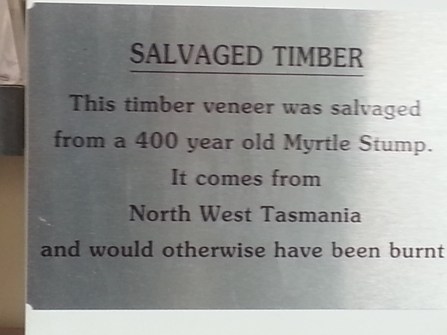
I discovered this small inconspicuous sign in a business I recently visited in Hobart. I found the sign rather curious. Other customers also found the sign curious.
The sign says a great deal about the mixed, confused emotions and morals, and acute sensitivity that surround the special timbers industry in Tasmania.
The business, like many in Tasmania, features Tasmanian timber in the shop fittings.
So is the sign an explanation or an apology?
I’m not sure.
Or perhaps it is a statement of pride.
If so it leaves me confused.
Here’s what I think the sign is saying:
A patch of old growth native forest in North West Tasmania was clearfelled to feed the industrial forestry business model that dominates Tasmania. After the industrial clearfelling operation was completed, a second smaller operation recovered some craftwood from the site including the 400-year-old Myrtle stump. The logging coupe was then burnt and resown to native forest. Or perhaps the coupe was converted to plantation. The harvesting duo (industrial and craft) then moved on to the next old growth forest logging coupe to repeat the cycle of sin and redemption.
Is that what the sign is about? Sin and redemption!
It’s a pretty standard story about the fate of Tasmanian old growth forest.
Most people regard the clearfelling of Tasmanian old growth forest as unacceptable practice in the 21st century.
But somehow the idea of “salvaging” after the industrial clearfelling has finished attracts some crumb of virtue.
Why? Where is the virtue?
For the past 40 years the Tasmanian special timbers industry only existed because it was a minor subset of the industrial forestry business model. It needed the industrial harvesting to continue for its own existence.
But to improve its status and product differentiation from those industrial loggers the special timbers industry adopted the word “salvage”.
“Are’t we good people! We help save all that good special timber that would have been wasted.”
No that’s not quite true now is it?
Yes there has been plenty of waste. That’s to be expected when dealing with a low value commodity. But to call the special timbers craftwood operation a virtuous salvage is specious indeed.
No virtue attached at all.
Just a marketing con.
The old growth forest in North West Tasmania is gone. Where is the virtue in that?
But the market now believes the virtuous salvage story and continues to buy these special timbers.
So perhaps the sign could just as well read:
This timber veneer was harvested from a 400 year old Myrtle stump as part of an old growth forest clearfelling operation. It comes from North West Tasmania. The site was subsequently burnt, cleared and converted to eucalypt pulp plantation.
It would be just as informative and a lot more honest!
By the way what did happen to the 400-year-old Myrtle tree that sat upon the stump? Where did it end up?
A second point is that the word salvage should automatically imply to the reader there is no notion of sustainability. It’s a cleanup operation, that’s all! But in the forest industry you will sometimes see the phrase sustainable salvage being used. I don’t think so. Another marketing con job.
Now is there such a thing as genuine virtuous timber salvage?
Absolutely!
The Hydrowood operation on the west coast comes close. Unfortunately it is wrapped up in the wrong marketing spin.
http://www.abc.net.au/landline/content/2014/s4129593.htm
Dead, dying and storm-damaged trees can also be honestly salvaged. They do this under strict Government supervision and competitive tender on Crown Land in New Zealand:
http://www.nzherald.co.nz/nz/news/article.cfm?c_id=1&objectid=11278973
And private property in Tasmania:
http://tasmaniantonewoods.com/salvaging-old-growth-standing-dead-blackwood/
But a craftwood harvest that is part of regular industrial old growth forest clearfelling operations does not classify as salvage in my books. And certainly has no virtue!
Finally now that Gunns has gone industrial forestry in our native forests is looking pretty sick. But never mind, the mouse has now become the lion. The (public native forest dependent) special timbers industry now dominates and controls old growth forest policy in Tasmania, with the Tasmanian Wilderness World Heritage Area firmly in its sights. It will be wrapped up in a glossy “strategy” and the language of virtue, but don’t be fooled.
Customers need to understand the consequences of their purchase decisions.
Ask for special timbers that are grown on private property. Let’s give Tasmanian farmers the clear message that they can grow and supply the profitable, sustainable special timbers market.
What do you think?
Post your comments.









 Tasmanian Blackwood Growers Cooperative
Special Species Timber Management Plan Update #1
Continuing on from my previous blog:
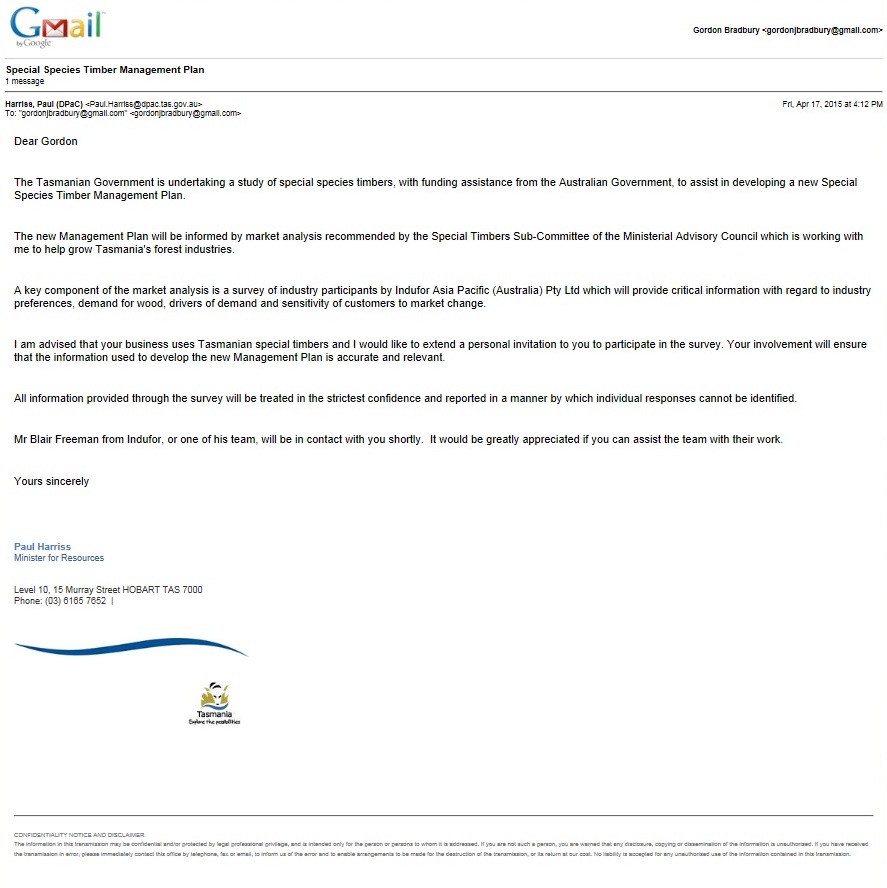
http://blackwoodgrowers.com.au/2015/04/19/an-invitation-to-participate-in-the-special-species-timber-management-plan/
and the invitation from Minister Paul Harriss to participate in the Special Species Timber Management Plan, I was contacted by Mr Blair Freeman from the consulting firm Indufor. We ended up talking for about an hour over the phone.
Here are some brief comments:
A survey form was sent out by Indufor to selected members of the special timbers industry to provide critical information with regard to industry preferences, demand for wood, drivers of demand and sensitivity of customers to market change.
SST Market Demand Survey Sawmillers
My one comment about the survey form was the obvious omission from the survey of any opportunity for stakeholders to make comments on strategic, political or policy issues. If special timbers stakeholders had any questions or concerns about any of these issues then the Minister and the Special Timbers Sub-Committee of the Ministerial Advisory Council are just not interested!
If logging the Tasmanian Wilderness World Heritage Area at taxpayers’ expense is of any concern to stakeholders the Minister Paul Harriss doesn’t want to know about it!
So much for accurate and relevant information!
Given that just about all of my comments relate directly to strategic, political and policy issues around special timbers I found the survey form frustrating. Luckily Mr. Freeman anticipated my frustration and instead we opened up the conversation to address broader issues.
I see my business as being in direct competition with the Government/Forestry Tasmania. And I’m not short of criticism of my competitor.
Putting aside for one moment the political/policy issues, the one primary objective of the proposed Special Species Timber Management Plan should be to clearly demonstrate that growing and harvesting special timbers is profitable within normal competitive, transparent market processes.
The primary purpose of the Plan should not be to demonstrate the existence of a resource, nor of demand, nor analyse current employment or the characteristics of the special timbers marketplace. These issues are completely irrelevant without the fundamental commercial foundation of tree-growing profitability.
Value-adding begins in the forest or plantation and not at the sawmill or the furniture factory.
As far as I’m aware no study is being conducted into the profitability of growing special timbers as input into the proposed management plan. Using the “horse and cart” analogy, this proposed Management Plan will say much about the cart and tell us nothing at all about the horse! Just like the 2010 Special Timbers Strategy.
Mr Freeman indicated in our conversation an awareness of the politically-charged nature of their assignment, and Indufors limited ability to influence the outcome. Why they chose to take the job in the first place is an interesting question.
As I say on (too?) many occasions I think Tasmanian blackwood has a great future as an iconic profitable, farm-based industry; but not until we get the politics and ideology out and get the policy settings working properly.
Thanks to Mr. Blair Freeman for his time and interest. Good luck!
Only another 2 years before the Management Plan is completed/released.
Stay tuned!
Leave a comment
Posted in Commentary, Management Plan, Politics
Tagged Special Species Timber Management Plan