The Australia Institute is hosting this event at the Hobart Town Hall 1.00 pm Tuesday 14th November.
I wish I could go, but I’ll be away then.
So here are my thoughts on how to end Public Native Welfare Forestry in Tasmania.
The Tasmanian Parliament WILL NEVER, EVER END THE FORESTRY WARS!
That fact is perfectly clear!
Therefore the end of public native forest logging in Tasmania MUST come from outside Tasmania, either from Canberra or the marketplace.
Forest protests have very limited impact on Government policy and no impact on the marketplace.
The current Federal Labor government, led by Prime Minister Anthony Albanese, has proven itself to be a conservative Liberal government in disguise. The Federal Labor government will not enter the national forestry wars!
This leaves us with only one choice – the marketplace!
Traditionally the Australian timber marketplace has been more than happy to support the continuing plunder of our public native forests in the face of overwhelming data and community opposition. Tens of thousands of Australian businesses remain utterly mute on their most important resource.
And to date little community focus has been placed on this marketplace complacency.
I believe it is well past time for the marketplace to be held accountable for its complacency and arrogance.
Bunnings and Mitre10 are the biggest retailers of Tasmanian timber in Australia.
It is time to put significant community pressure on both of these major timber retailers.
The Australia Institute meeting in the Hobart Town Hall must pass a resolution calling upon Bunnings and Mitre10 to stop selling all Tasmanian oak products immediately.
There is no other option to end public native logging in Tasmania.
The latest statistics from the Federal department of Agriculture, Fisheries and Forestry show Australia’s plantation estate continuing to decline.
Soon that Federal department will have to be renamed the Department of Agriculture and Fisheries.
And therein lies part of the industry’s problem. Growing wood should be regarded by the rural community as standard agricultural practice, but Australia is a million miles from that cultural and economic change.
It should not be Agriculture and Forestry! It should just be Agriculture!!
But a declining forest industry sends a very loud and clear signal to the rural community that growing wood is not commercially viable.
As such the industry decline will only snowball, unless the industry can demonstrate commercial credibility. To date the forest industry has refused to do so!
The forest industry has been in the media a lot lately.
That is no surprise as we have now entered the final battle in the decades long Forestry Wars.
The old forest warriors are back in the trenches – shouting and vilifying, rattling sabres and thumping hairy chests. Just like the good old days!
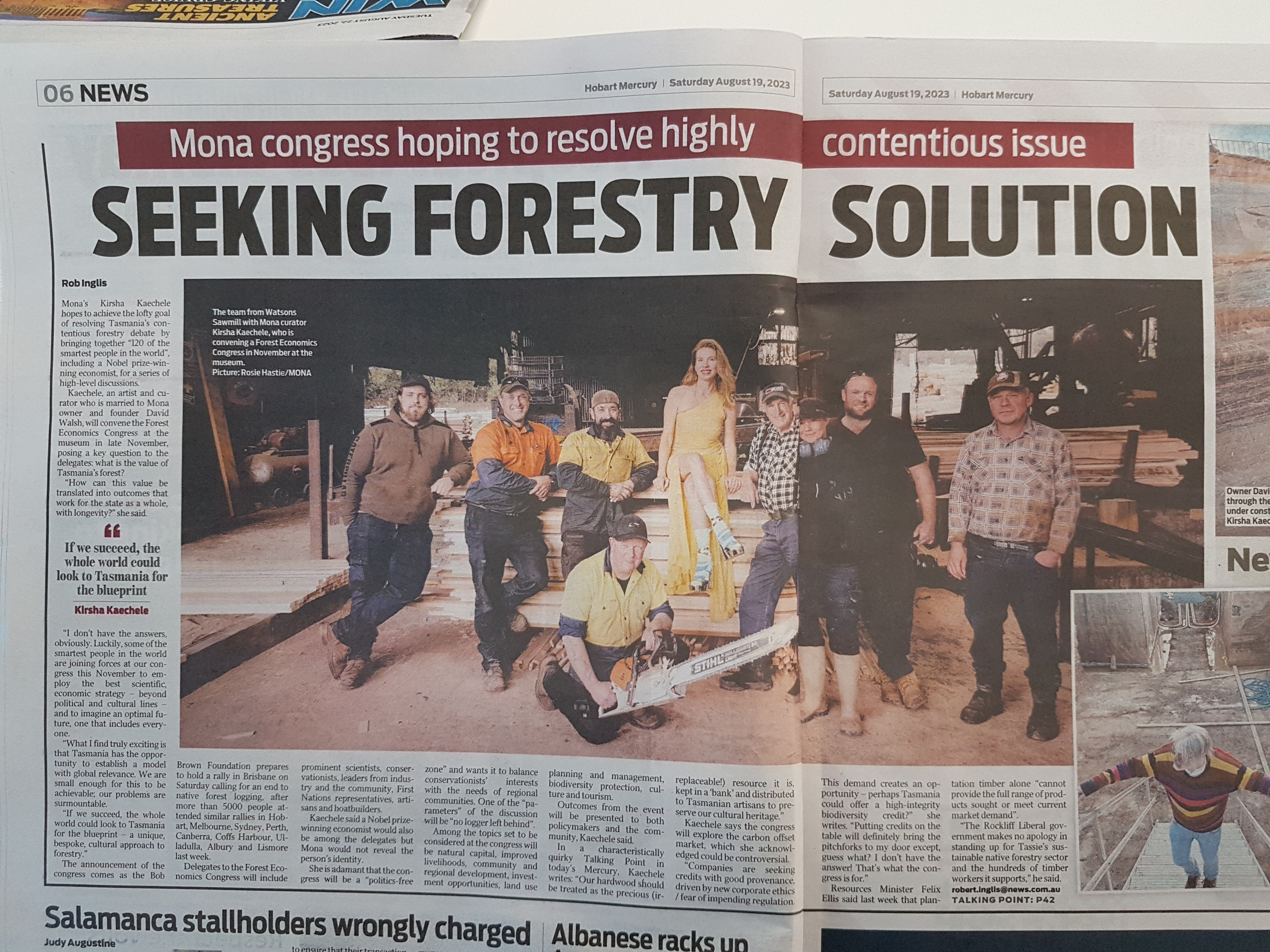
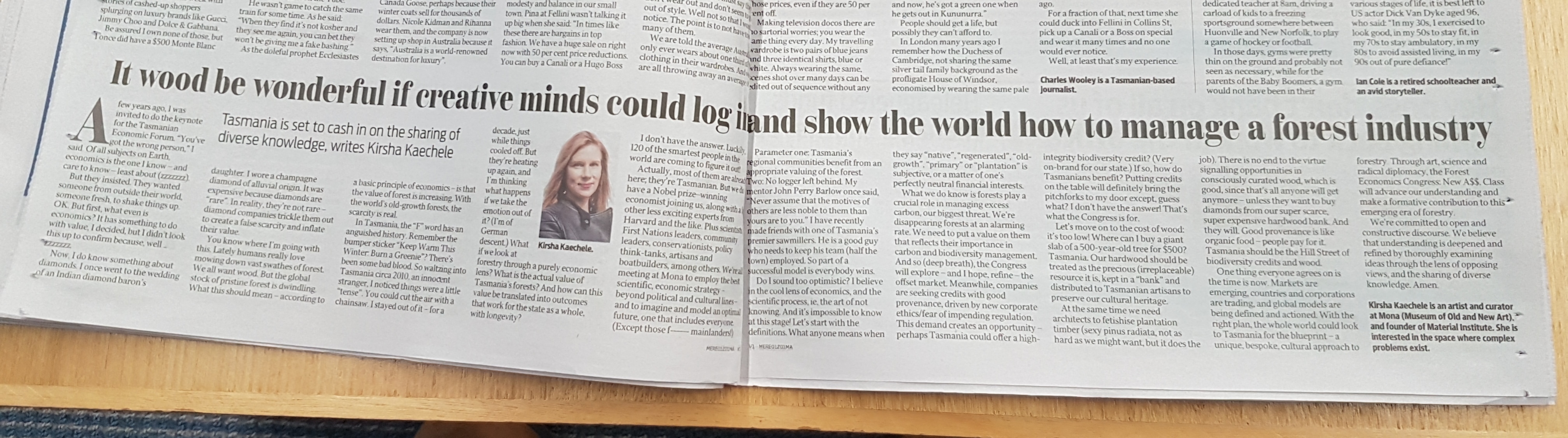
One thing different this time is the so called Forest Economics Congress being organised by Kirsha Kaechele later this year, as reported in The Mercury newspaper Saturday 19th August.
The idea that after decades of bitter conflict a bunch of people can sit down and solve the forestry wars seems completely fanciful. Especially so after the 2014 Tasmanian State election when the last attempt at discussion and compromise was destroyed by Tasmania’s corrupt political system.
Ms Kaechele is promising free and open discussion about a positive forestry future for Tasmania.
Part of the problem however is that Ms Kaechele has already set a long list of Terms of Reference for the Congress that are identified in these two articles.
These Terms of Reference include:
the continued logging of public native forests, including oldgrowth forests;
“artisans and boatbuilders” will be given preferential access to our public native forests;
sawmillers are our friends!
It seems that many outcomes from the Congress have already been determined
Curiously Ms Kaechele fails to mention anything about politics, as if the Congress will define and implement a positive forestry future completely independent of our State parliament.
Q. How can a public resource (our forests) be managed outside of the political system in a small corrupt fishbowl like Tasmania?
A. It can’t! Never has, never will!!
I could ask 100 people in the forest industry what their vision of the future is and I would get 150 different answers, many of them mutually exclusive. Many people are not prepared to compromise, and many people have utterly fanciful ideas about our forests. There is much distrust, anger and hostility in the mix as well.
How can common ground be reached under these difficult conditions?
Many of the fundamental issues facing timber markets and the forest industry are not mentioned in either of these articles. Fundamental issues like the complete absence of proper functioning timber markets in Australia, the absence of level playing fields for all tree growers, farm forestry, etc..
No doubt the Congress will provide some interesting discussion, but I for one am not holding much hope. One thing is guaranteed – the forestry wars will not be resolved by the Tasmanian parliament. The Tasmanian parliament can only enflame and exacerbate the conflict.
That is the reality that Kirsha Kaechele faces.
PS. Never mind that John Lawrence has spent the last 18 years repeatedly destroying Forestry Tasmania’s business model and their very dodgy accounting practices. What really are they going to talk about in November?
This is a very clear message to the Tasmanian farming community!
Plant trees at your peril!!
This is further to my previous blog, and tells us how utterly broken and corrupt is the forest industry in Tasmania, not to mention our political system.
Government forest policy in Tasmania (and the rest of Australia) has always been about subsidising sawmillers.
It has never been about profitable tree growing.
So here we are in the 21st century still implementing 19th century policy.
And if there is any challenge to that welfare policy the forest industry will scream bloody murder from the mountain tops!
The above link to the Tasmanian Times website provides all the blood-soaked details of the current forestry drama.
As I said in my previous blog, this drama could well end up in the High Court of Australia, with the Tasmanian government facing various commercial and trade practices charges, never mind a blatant breach of the Australian Constitution, which guarantees free trade between States.
As I stated previously, the Tasmanian forest industry does not want a transparent, competitive market for forest products in Tasmania.
The Tasmanian forest industry is demanding market manipulation and price controls to ensure Tasmanian businesses continue to enjoy unfettered access to forest welfare.
The letter from the Tasmanian Forest Products Association to the Tasmanian Premier is clearly and openly demanding that the State government deliberately breach Australia’s consumer and competition laws.
The fact that the State Labor opposition openly supports market manipulation and price control tells us that the forest industry probably does not have a future in Tasmania.
Anyone who is a forest grower will be horrified by this.
Someone needs to write a letter to the Tasmanian Premier threatening to take the Government to the High Court over this whole fiasco.
In fact a Royal Commission into trade practices within the forest industry is long overdue.
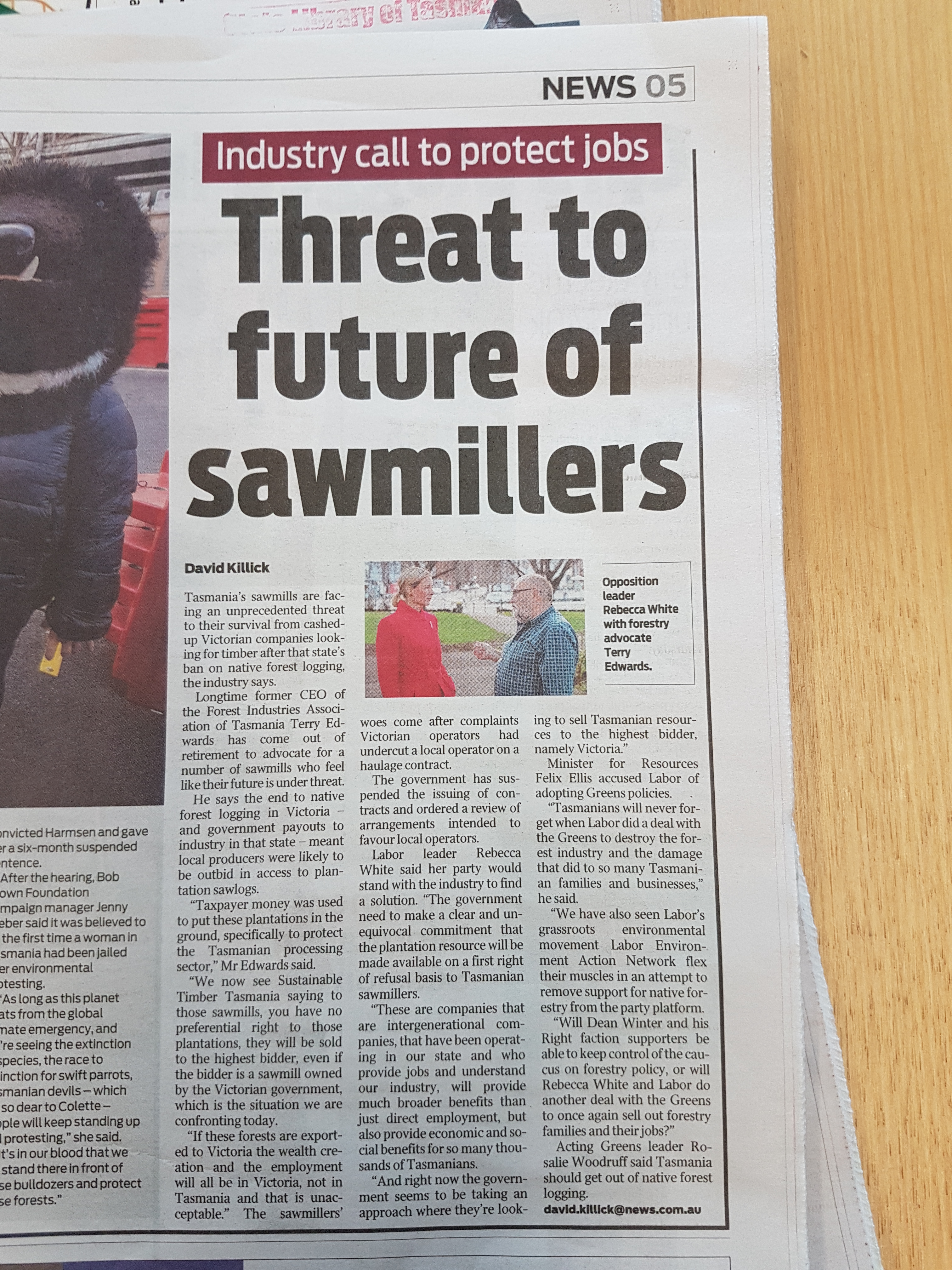
This article appeared in The Mercury newspaper last Saturday the 15th July.
It’s a monster!
Terry Edwards is the old Tasmanian forest industry warhorse now retired. But old warhorses never really retire.
And here is Terry back beating the war drums once again.
This time it’s not “The Greenies” he is raging against but the State government!
How dare the Tasmanian State government not continue to subsidise the very welfare dependent forest industry.
How dare the Tasmanian State government sell it’s forest products onto the open commercial market, and not give them to local sawmillers.
It’s an outrage!!!
No! It’s the forest welfare industry doing what it has always done – cry poor and play politics!
It doesn’t say but I assume the sawlogs being discussed are the first harvest of Regional Forest Agreement pruned hardwood plantation sawlogs, that the local sawmillers said they weren’t interested in 25 years ago when they were planted.
My how times change! And old behaviours and attitudes don’t!
What Terry Edwards is saying is that the Tasmanian sawmillers don’t want to operate in a competitive commercial marketplace. They haven’t for 200+ years and they certainly are in no position to be competitive now. Two hundred years living on forest welfare has left the Tasmanian industry a complete basket case.
Subsidizing sawmillers has been government policy in Australia since 1788, which is why our forest industry today is now at deaths door.
The other message from Mr Edwards is about sawlog price control and manipulation. The forest industry does not want an open competitive market operating in Tasmania.
That is a very clear message to Tasmanian farmers to never plant a tree for the forest industry because you will never ever get a fair market price!
Terry Edwards wants the forest industry to wither and die.
I could also point out that what Mr Edwards is proposing is in breach of numerous commercial and trade practice laws. Those cashed up Victorian sawmillers may very well take the Tasmanian government to the High Court, and bring the whole facade crashing down.
Now that would be fun to watch!
Until we get all the welfare recipients and their supporters (like Mr. Edwards) out of the forest industry there will no future.
Island Specialty Timbers is the only source of competitive, transparent log prices anywhere in Australia, including blackwood sawlog prices. That simple statement tells us a great deal about the dire condition of the forest industry!
The lack of commercial credibility is just one of the many challenges facing the forest industry in Australia.
IST is a business enterprise of Sustainable Timber Tasmania (STT) which sources and retails raw material of Tasmanian specialty timbers from harvest or salvage operations conducted on State owned Permanent Timber Production Zone land (PTPZl).
IST is not really a “business” just as the State forest agency Sustainable Timber Tasmania is not a business either. Logging of public native forest in Tasmania requires significant taxpayer subsidies every year.
IST conducted 7 tenders during the year with a total of 198 cubic metres of special species sawlog and craftwood put to public tender. Tasmania defines “special species” as any native forest timber apart from plain grain Tasmanian oak (Eucalyptus sp.).
Blackwood Results
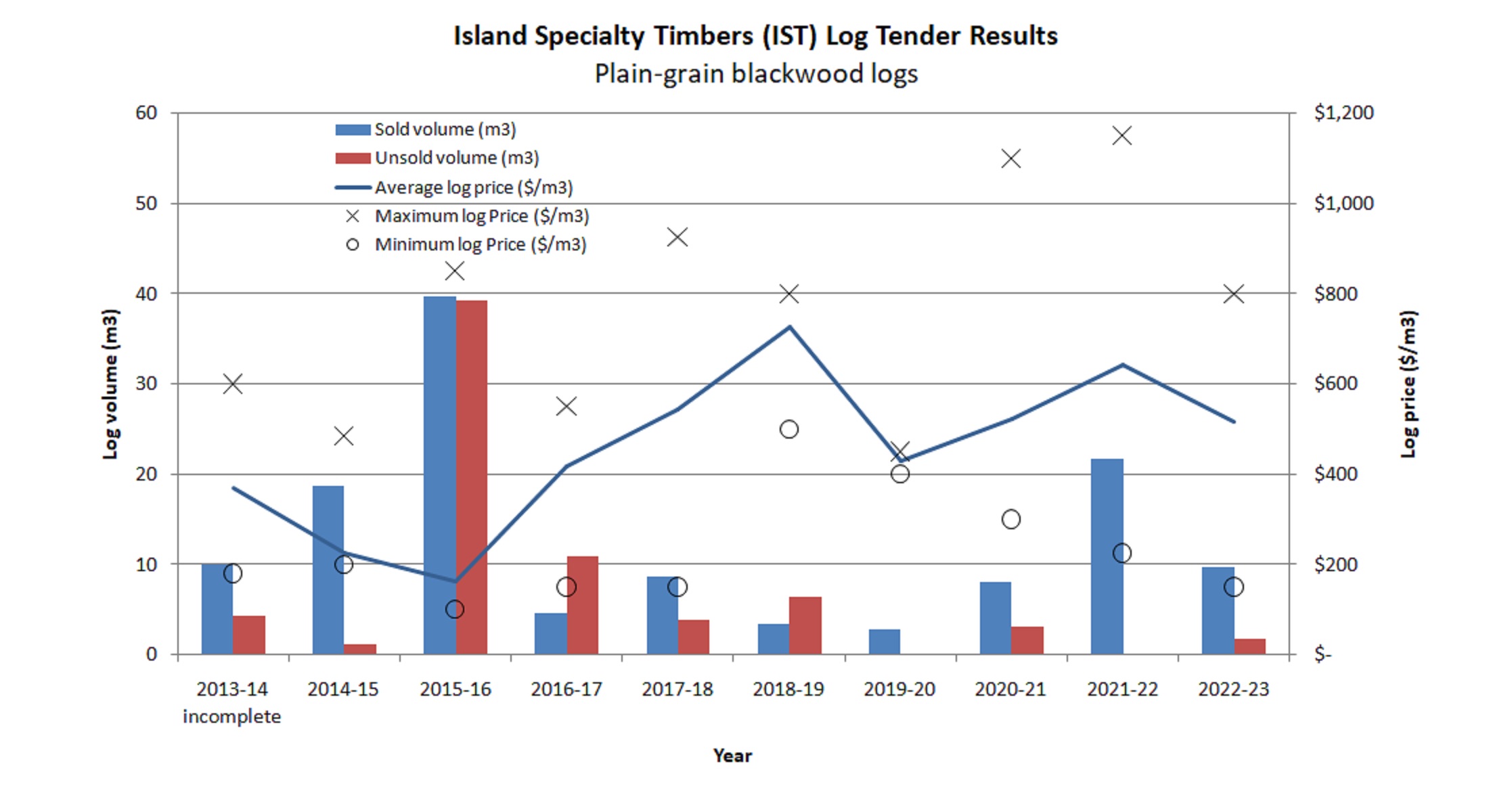
Following two years of strong price increases for plain grain blackwood logs, this year saw a softening of markets. Maximum, minimum and average log prices all declined in 2022-23.
IST put a mere 16 plain grain blackwood logs to tender totalling 11.5 cubic metres. Three logs totalling 1.8 cubic metres were unsold at tender. Prices ranged from $150 to $800 per cubic metre with an average price of $518.
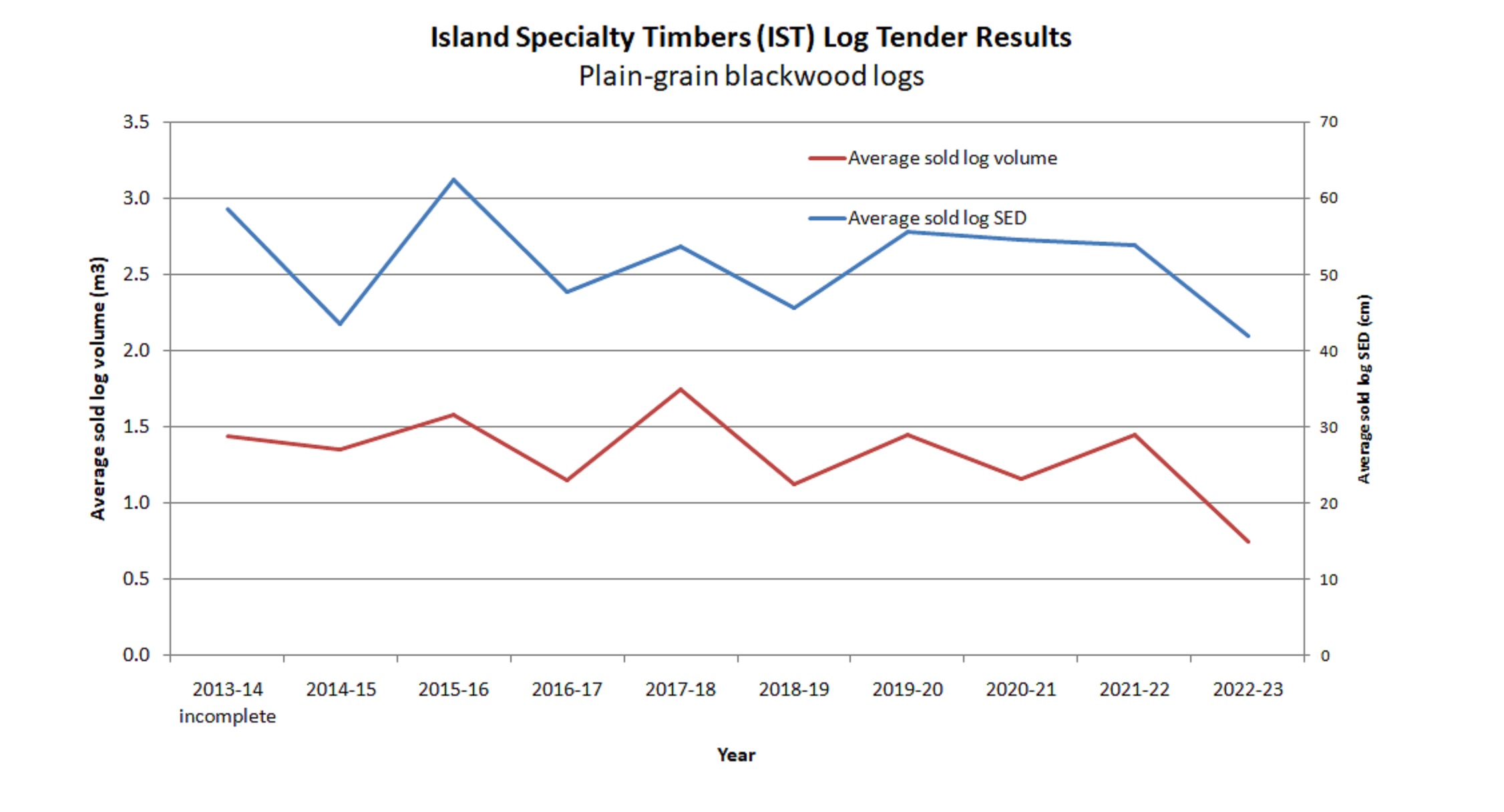
One possible explanation for the softer prices was the significant drop in log size from previous years. Smaller logs mean less sawn recovery per log volume so lower prices.
One figured grain blackwood log (1.6 cubic metres) was sold at tender for a $800/m3.
Generally ~9,000 cubic metres of blackwood is harvested annually from Tasmania’s public native forests with 99.99% being sold at heavily discounted Government prices on long term sales contracts.
The Tasmanian government dominates and deliberately undermines the blackwood log and timber market. These log tender results need to be interpreted bearing this fact in mind.
Premium plain grain sawlogs are what can be grown in blackwood plantations. The “target” sawlog in a blackwood plantation is 1.5 cubic metres in volume.
General Results
Overall a total of 198 cubic metres of special species sawlog and craftwood were put to public tender during the year. Forty five cubic metres failed to sell at tender, a significant increase over the last few years.
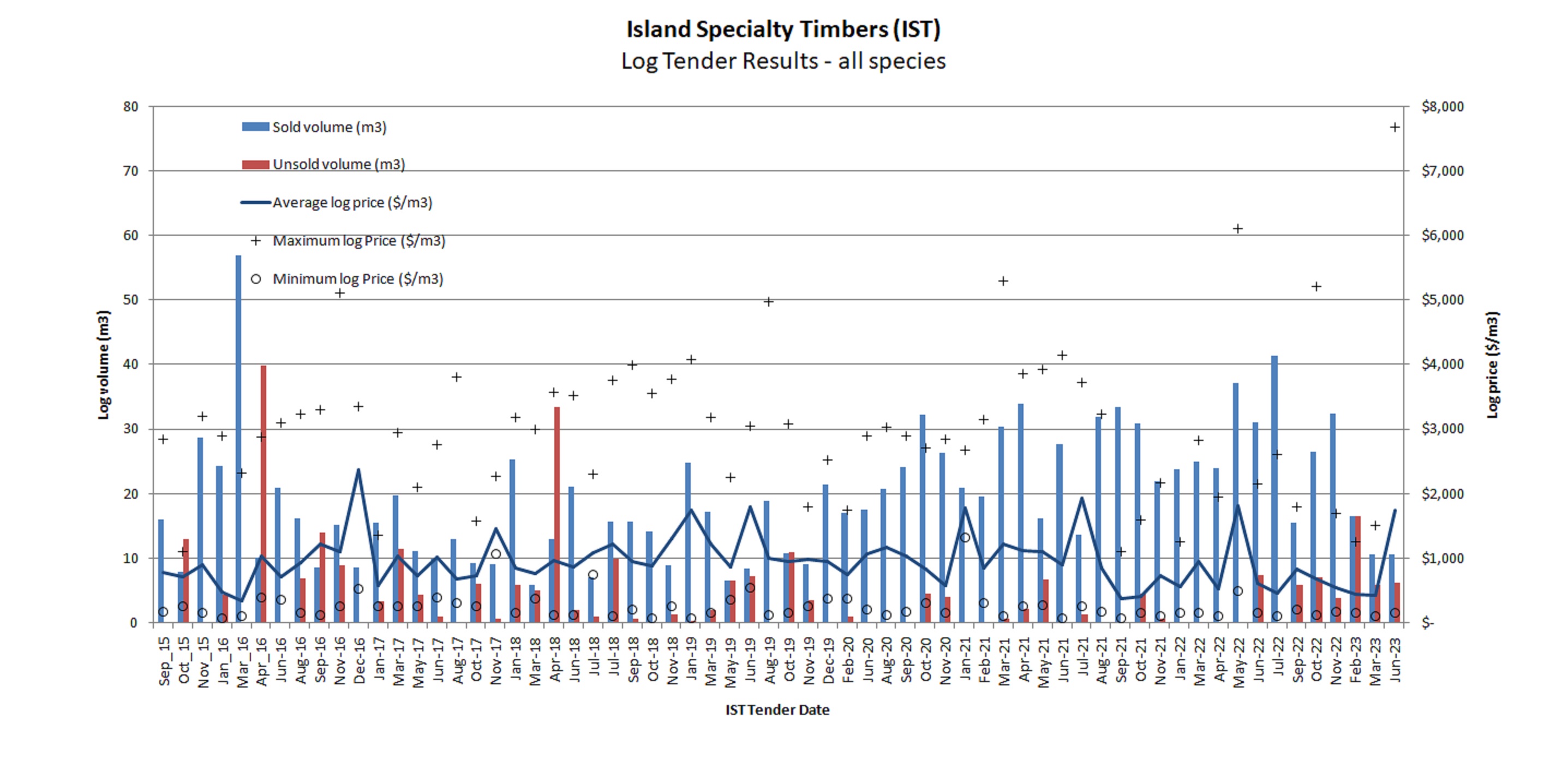
Apart from the June 2023 tender that contained a large volume of Huon pine material, 2022-23 continued the trend from last year of declining average prices.
Total tender revenue for 2022-23 was only $97,400 which is a significant drop from last year, and the result of the combined lower volumes and lower prices.
It’s a good thing Island Specialty Timbers is not run as a business otherwise they would be calling in the receivers. Just more taxpayer-funded welfare for the woodcraft industry.
The one positive result for the year was a record price paid for a Tasmanian special timbers log. The June 2023 tender saw a Huon pine log (66cm LED, 47cm SED, 2.4m length, 0.41 cubic metres volume) sell for $7,675 per cubic metre. This continues the trend of the past five years of ever increasing maximum prices paid for quality premium timber.
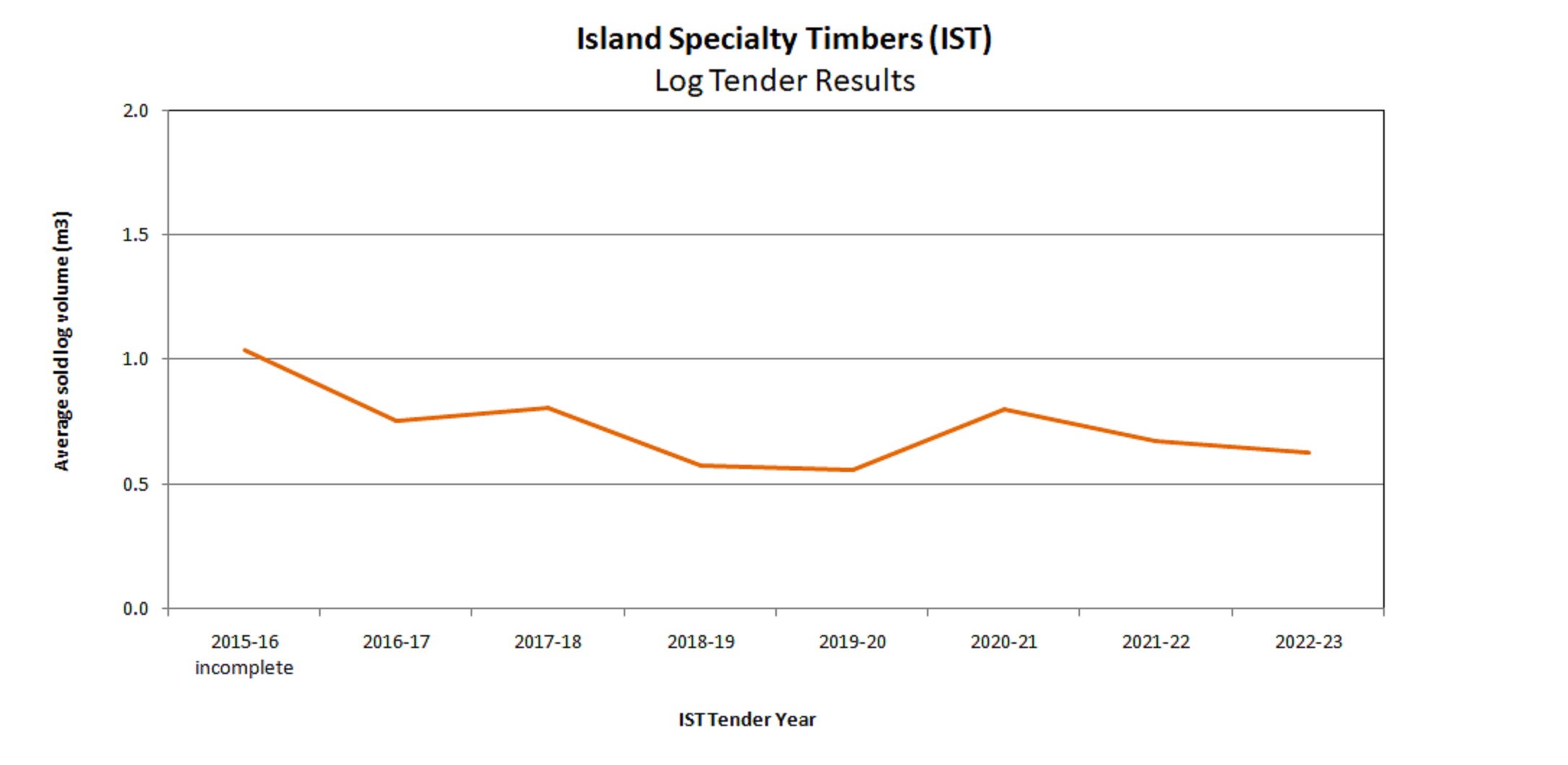
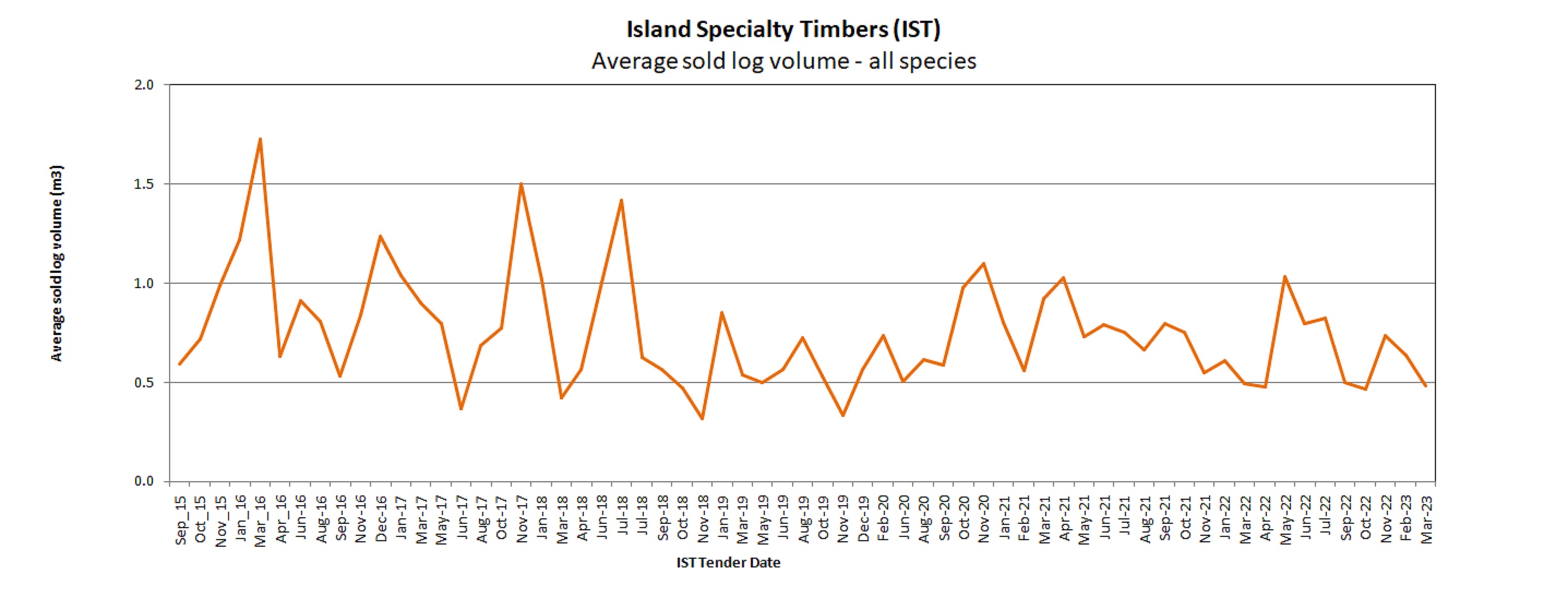
After a year 2020-21 where average log size increased, the last 2 years have seen a resumption of falling log size at the IST tenders.
Remember these IST tender sales represent tiny log volumes sold into the small southern Tasmanian market. They represent mill door prices not stumpages.
The following chart shows the volume and price summary for 64 log tenders back to 2015.
The tiny volumes and wide variability in species and quality of logs that IST put to tender makes assessing market trends over time difficult.
The following chart shows that average log size at the IST tenders continues to be very small. Extracting value out of these small logs must present quite a challenge for the buyers.
With Tasmania and New South Wales being the only States that have not committed to closing down public native forestry, the future of Island Specialty Timbers is now very much on borrowed time.
I won’t be writing these annual reports for much longer!
We will probably never know the real history of public native forestry in Victoria (or any other State for that matter) and the reasons why it failed. History was never on the side of native forest logging anyway, it was always a matter of time and circumstances.
New Zealand made the right decision 30 years ago. It’s a shame that Australia didn’t change then also. As a result the New Zealand forest industry is now much more advanced than ours in Australia.
The problem here in Australia is that the forest industry is preparing to die in the trenches over public native forestry. According to forest industry leaders, dying in the trenches is a better strategy than have a plan for the future. I can’t see the logic in that thinking myself.
Tasmania
Following the announcement in Victoria, the adrenalin started pumping over in Tasmania where forest industry leaders think they see a major commercial opportunity coming their way.
Swimming against the tide as usual the forest industry in Tasmania wants greater access to public forests to take advantage of the lack of competition on the mainland. Instead of seeing their future now very much on borrowed time, the Tasmanian industry thinks their ship has come in!!
That demonstrates beyond doubt just how utterly deluded the forest industry has become.
There is no doubt that New South Wales will be the next State to end public native welfare forestry in the next 1-3 years, leaving Tasmania as the recalcitrant State as usual.
After almost 60 years of forestry wars in Australia the end of the war is finally in sight.
Much damage has been done politically, environmentally and socially. Many people will never recover from their wounds and deep prejudices. Such is the way of human stupidity and ego.
Probably Tasmania is the State that has suffered the most from the Forestry Wars. It has permanently corrupted our political system and left the community deeply divided.
The damage to the Tasmanian forest industry is probably permanent.
In my next blog I will reflect on possible futures for timber markets and the forest industry.
I was invited to be a speaker at the 2023 Maleny Wood Expo (MWE), an invitation which I readily accepted. The MWE is one of the very few businesses/organisations in Australia that expresses an interest in where their wood comes.
The other thousands of Australian businesses/organisations continue to expect wood to just fall from the sky as it has in the past. None of them take any responsibility for the future supply of timber. But everyone knows those days are coming to an end. We are in the last days of forest (and taxpayer) plunder.
So here is a brief summary of my experience at the MWE.
The basis of my talk at the Expo was “the failure of timber markets in Australia”.
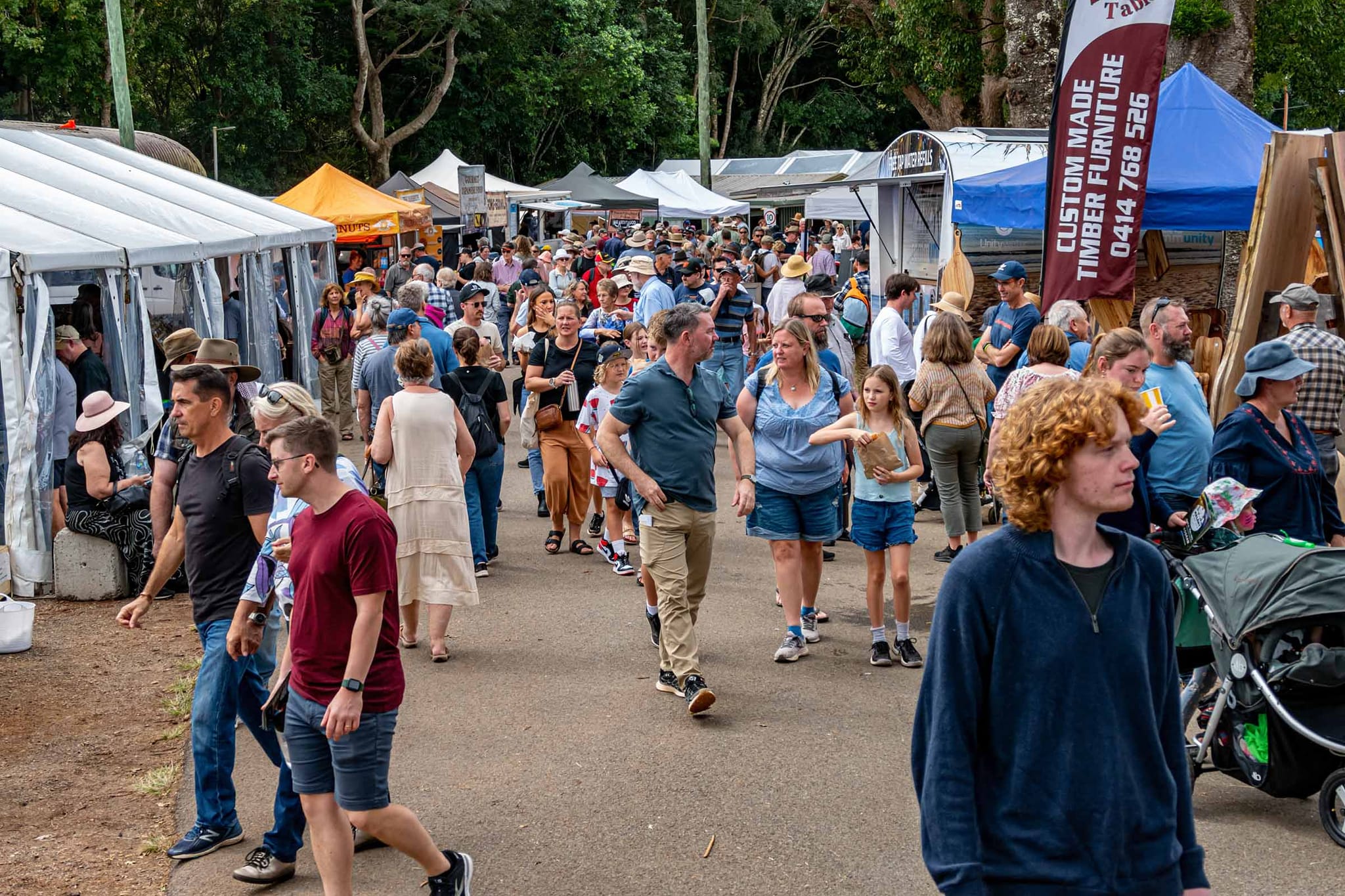
The MWE is huge!!
Maleny is a small town and the MWE utterly dominates the town over the Queensland Labor Day long weekend. The Expo is held at the local showground (a breathtakingly beautiful site) where thousands upon thousands of people come.
The Expo is run by the local Barung Landcare Group, which is why it has its unique focus.
The Expo is also the home of the Wootha Woodcraft Prize, Australia’s richest woodcraft prize which is sponsored by the local Sunshine Coast Council.
The current focus of the Expo is timber sales, woodcraft workshops, sales and display; woodcraft tool sales, food and entertainment. There was also a display of wooden boats.
So I arrived at the Expo to wander around and see if it really did live up to its values. With the mind of a farmer I was also on the lookout for technical and market information and support that might indicate that planting and growing trees really was a viable commercial opportunity.
Sadly I was disappointed with both of my expectations.
Despite its good intentions it seems that none of the Expo stallholders share or support those values. I can’t say I visited every stall, but I saw absolutely no expression of support for the Expo values.
Any farmer visiting the Expo would leave with absolutely no interest in planting and growing tomorrows timber.
For me the Maleny Wood Expo represents one of the few (the ONLY!) opportunities in Australia to rebuild the forest industry and start the slow process of building a proper functioning timber market, where the sale of timber directly results in the planting of more trees by the farming community (just like every other farm product market eg. bananas).
The MWE could help build the bridge between the market and the farming community.
There is an enormous amount of passion, energy and enthusiasm at the MWE and a large existing audience. But the Expo is only doing half the job. If anything it is currently supporting the last days of plunder. In its current form the MWE is undermining its own future!
Where does the wood come from? Who is growing it? Who is planting trees for tomorrow? Is growing tomorrows timber a commercial opportunity? Who is helping to build a proper functioning timber market?
I saw no answers to any of these questions at the MWE.
Not even any of the Wootha Prize winners cared to share any of this information and help generate farming community interest!!
The MWE committee members I spoke to were certainly aware of the shortfalls of the Expo and were interested in my message. But past failures and current timber industry and farming community attitudes have blunted their enthusiasm.
To help drive the change that is needed I think the MWE needs to have a vision. It needs to publically express its values and have a vision of where it wants to be in 10, 20 years. It then needs to ask its stallholders and prize entrants to publically state how they support those values and the vision.
I have plenty of other ideas as well.
I ran my talk at the Expo as a Q&A. I set the context for my talk and let the audience questions and comments flow. There was plenty of interest in what I had to say.
Overall I had a great time in Maleny. Thanks to the MWE Committee for the invitation. I will happily return next year should the invitation be repeated.
So how do we turn this thing around and drive the changes needed?
This is hilarious and so characteristic of forest industry thinking in Australia.
The Western Australian Forest Products Commission FPC (State forest agency) is offering free/low cost pine seedlings to farmers to establish pine plantations.
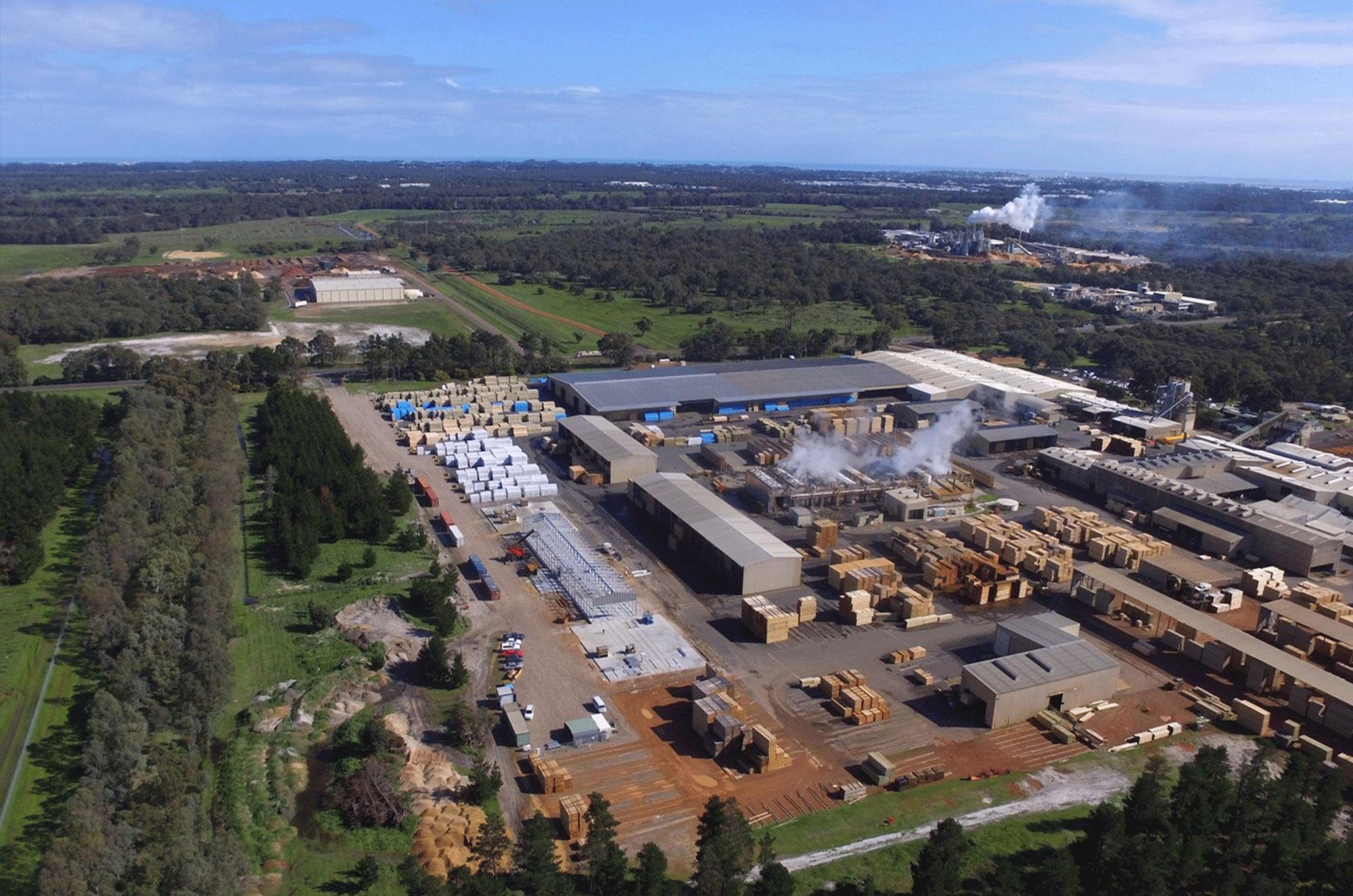
Western Australia is shutting down its public native forestry next year (2024), and its small softwood plantation industry is shrinking due to loss of plantation resource (due to a number of factors). The vast majority of Western Australia’s softwood plantations are government owned, and there is only one softwood sawmill called Wespine.
As far as I’m aware there are no other markets for softwood logs in Western Australia, not even log export.
The Western Australian government wants to grow the softwood plantation industry to help maintain the competitive viability of the existing industry.
But there is the flawed thinking!
The Western Australian government wants farmers to grow Radiata pine to then sell to a monopoly buyer whilst competing against the government who dominant the pine log market!
Now what farmer is going to fall for a scam like that?
The whole focus of government policy is industry support (ie. corporate welfare).
The focus of government policy should be on profitable tree growing not corporate welfare. Even if tree growing were profitable it would still take enormous effort to convince farmers to make the 30+ year investment in tree growing.
My other observation is that Wespine is your typical sawmiller. They take absolutely no responsibility for their own future in terms of log supply and company growth.
Go to the Wespine website and see if there is any engagement with the farming/tree-grower community.
How much is Wespine willing to pay growers for pine logs?
What is the condition of current markets?
What are Wespines plans for the future?
How is Wespine supporting, encouraging and rewarding tree growers?
Nothing but a deafening silence!!
The Western Australian softwood industry has no future under current government and industry policy and thinking.
It is completely laughable!
So dear readers, tell me your ideas about how Western Australia should grow its softwood plantation industry. Does it have a future?
For the past 30+ years we have been told by politicians and the forest industry that Tasmania’s public native forest industry is 100% sustainable and internationally certified (PEFC/Responsible Wood).
We have been told that ad nauseam!
But few people outside politics and the forest industry now believe the story anymore.
We have been told a lie!!
Never mind the incredible cost to Tasmanian taxpayers and our public forests.
So we now hear that the so called special timbers industry is running out of oldgrowth timbers.
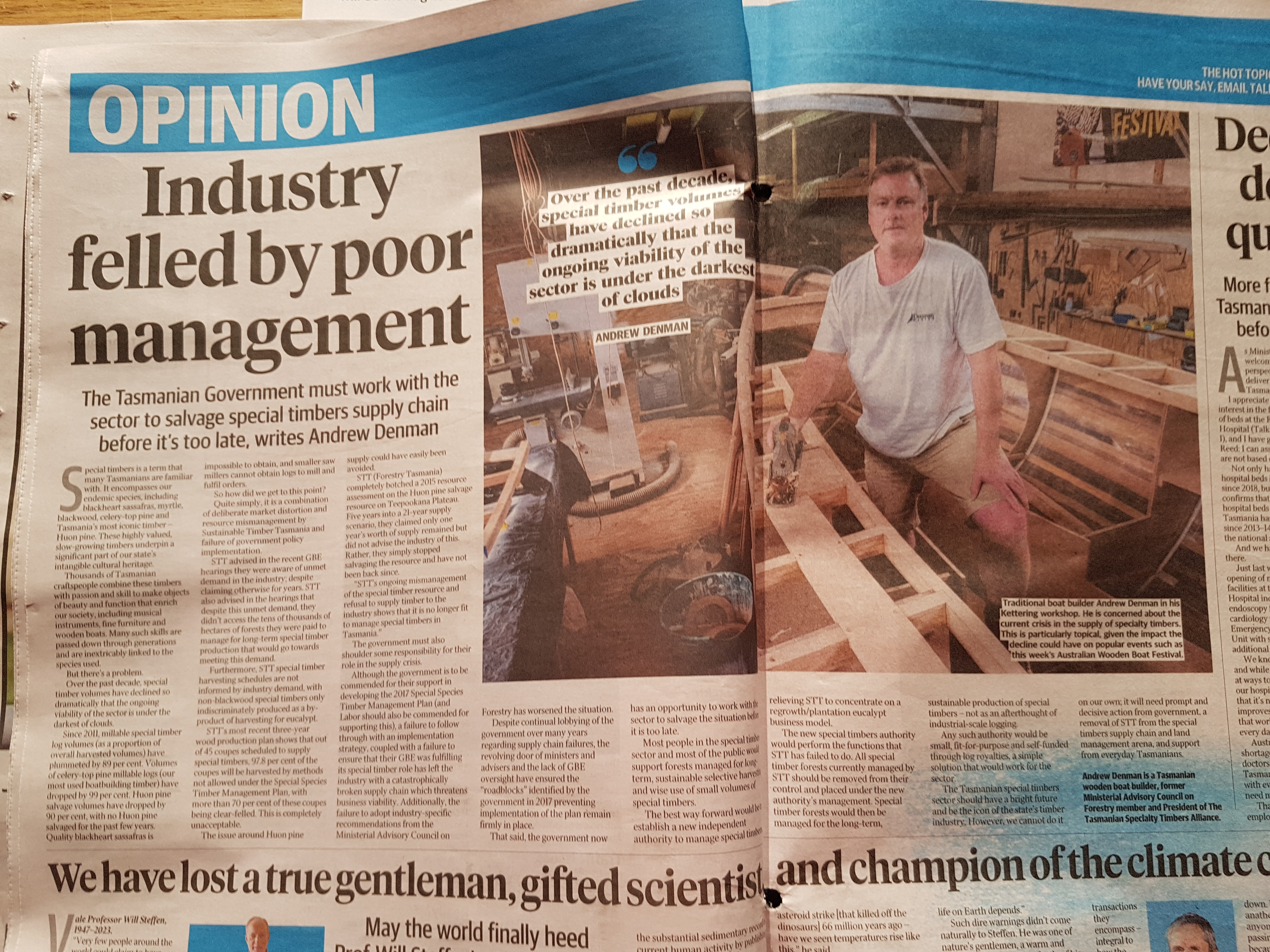
If half of what Mr Denman says of Government policy and STT management is true then Tasmanians should have no faith in either their politicians or their public servants.
With the Tasmanian public native forest industry likely to be shut down within the next 10 years, the special timbers industry are now crying poor. They want to quarantine their special timbers forest welfare from the closure of STT by creating a new government authority just for their welfare.
This article in The Mercury newspaper Tuesday 7th February is perfectly timed just a few days before the start of the Australian Wooden Boat Festival in Hobart. It wouldn’t surprise me if a deal has already been stitched up with the Tasmanian State government to establish a Special Timbers Authority, and the Premier will announce it at the Festival this weekend.
The idea that the politicians who created this mess are now going to fix it is utterly laughable!!
And of course the subtext for this article is that if this proposal doesn’t happen then the wooden boat festival will cease to exist. As I said in my previous blog the Tasmanian government and the Tasmanian community are being held to ransom by the wooden boat community and the rest of the special timbers rentseekers.
“The failure [of the government] to follow through with an implementation strategy, coupled with a failure to ensure that their GBE [ie. STT] was fulfilling its special timbers role….” says enough! For the Government, special timbers is just another political football to gain votes at election time, nothing else!! All promise! No delivery!! And the wooden boat community expect this to change?
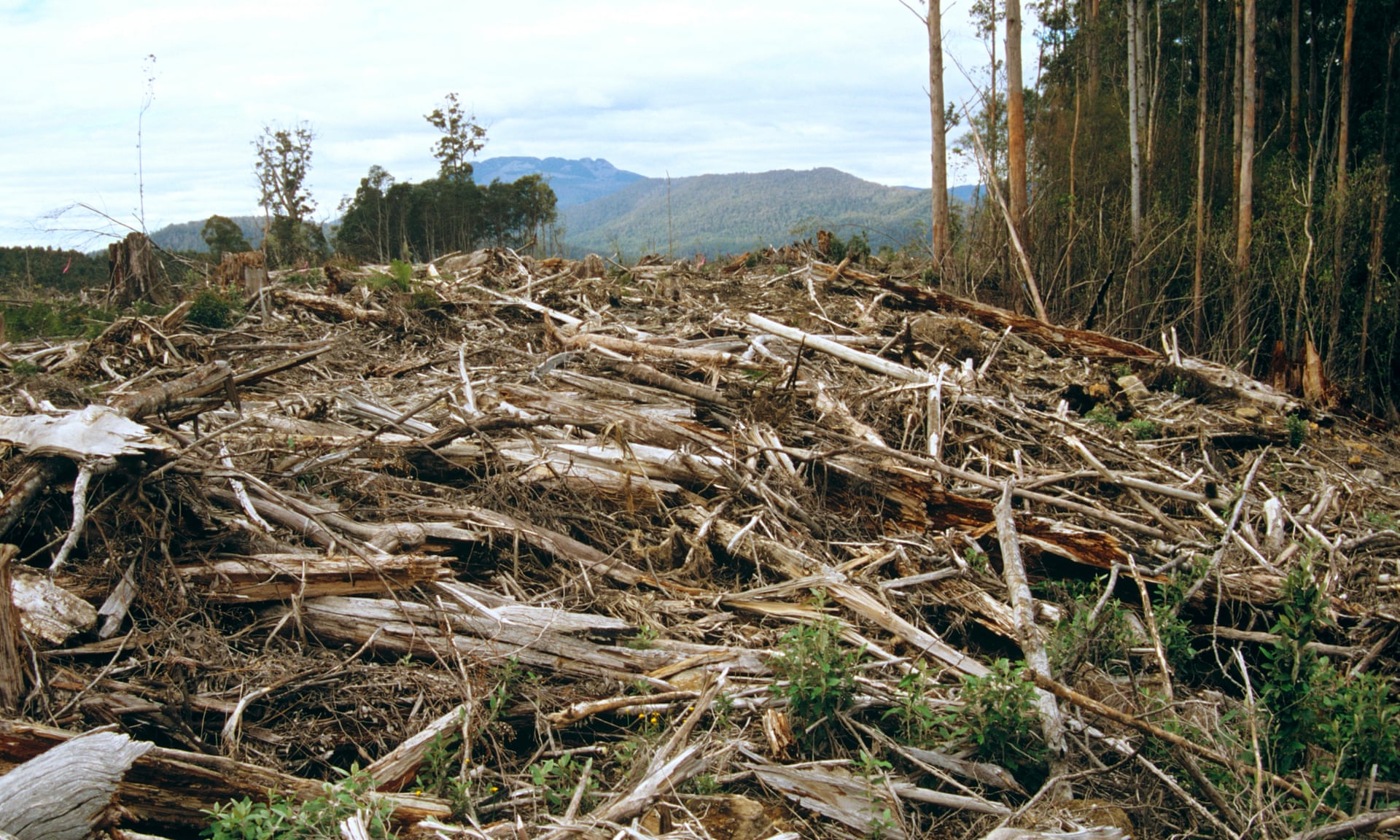
The plundering of Tasmania’s oldgrowth forests will continue for many years yet it seems. National Parks and Reserves will not be safe either I suspect.
Mr Denman deliberately ignores the cost to the Tasmanian taxpayer and to Tasmanias oldgrowth forests. Matters of welfare and plunder are apparently unimportant to the wooden boat community.
There is no scientific, economic or social model on which the Special Timbers Authority can stand. It is a smoke screen for plunder-as-usual!
“Most people in the special timbers sector and most of the public would support forests managed for long-term selective harvesting and wise use of small volumes of special timbers”. I would love to see where Mr Denman gets his data for such a grandiose statement. Given the history of politics and the forest industry in Tasmania that really is utter delusion!
“Any such [special timbers] authority would be small, fit-for-purpose and self-funded through log royalties, a simple solution that would work for the sector”. I would classify that statement as a blatant lie!
Industry Felled by greed, ignorance, corruption and politics, and that includes every single forest welfare recipient/rentseeker.
The idea of cutting down 500-1000+ year-old trees to satisfy a handful of boat owners in the 21st century is insanity writ large. Welcome to Tasmania!
With this article in The Mercury newspaper the Australian Wooden Boat Festival has deliberately and intentionally march into the forest war zone! Both the Australian Wooden Boat Festival and the Special Timbers Authority will become the focus of community protest and demonstration. That is 100% guaranteed and apparently what the wooden boat community wishes.




 Tasmanian Blackwood Growers Cooperative
An industry in decline and utterly clueless
The future of the forest industry in Australia is with profitable private plantations.
There is no other future!
But the forest industry remains utterly and completely clueless how to create that future.
Having never in its history demonstrated a cent of commercial credibility, Australia’s forest industry remains on track for an irrelevant future.
The latest statistics from the Federal department of Agriculture, Fisheries and Forestry show Australia’s plantation estate continuing to decline.
Soon that Federal department will have to be renamed the Department of Agriculture and Fisheries.
And therein lies part of the industry’s problem. Growing wood should be regarded by the rural community as standard agricultural practice, but Australia is a million miles from that cultural and economic change.
It should not be Agriculture and Forestry! It should just be Agriculture!!
But a declining forest industry sends a very loud and clear signal to the rural community that growing wood is not commercially viable.
As such the industry decline will only snowball, unless the industry can demonstrate commercial credibility. To date the forest industry has refused to do so!
https://www.agriculture.gov.au/abares/research-topics/forests/forest-economics/plantations-update
The future of the forest industry is NOT in the hands of politicians.
The forest industry is responsible for its own future.
So far there has been no evidence of this!
Leave a comment
Posted in Commentary, Plantations