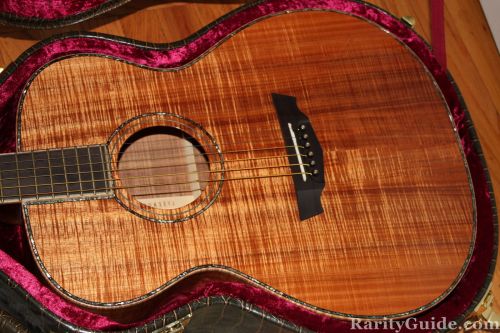
I’m laughing at myself today!
I realised that I crashed into my own blind spot with this story on the Parkwood guitar.
https://blackwoodgrowers.com.au/2016/09/25/parkwood-le061/
I focused the entire story on the maker, the beautiful wood and the guitar…….
and completely ignored where the wood came from…who grew the wood!!
BLIND SPOT!!
I chew this old bone everyday thinking about luthiers and the tonewood market and their obsessions and blind spots.
Wood is a pretty unique resource because the wood we use today started as a seedling 30, 50, 100, 200, or maybe 400+ years ago!! No other renewable resource has this extreme production time-lag characteristic.
So the people who manage the forests and plant the trees so that we can have beautiful wood in 30+ years time are pretty extraordinary people.
But these people are rarely acknowledged or appreciated by the tonewood market. In fact have I ever seen the tonewood market acknowledge a tree grower? Many in the tonewood market don’t even understand these people exist.
The story of a guitar does NOT begin with a piece of wood (no matter how beautiful, exotic, rare or endangered)! Wood doesn’t magically appear out of thin air.
It begins with a tree and a grower!
Hopefully a grower who makes a profit and is therefore encouraged to plant more trees.
The tonewood market is running out of traditional tonewoods. It is time to support and acknowledge tree growers. Without tree growers these beautiful guitars will cease to exist.
Every new product launch, every guitar review should acknowledge where the timber comes from.
To continue to perpetuate the myth that tonewood magically appears out of thin air is dishonest and undermines the future of the guitar industry.
So to complete the Parkwood story:
This beautiful blackwood timber came from the public native forests of the Otway Ranges in south western Victoria, Australia. The Otway Ranges run parallel to the coastline facing the great Southern Ocean. The cool wet climate (average 1700 mm rainfall per year) provides ideal growing conditions for blackwood.
The wood was harvested by Murray Kidman from Otway Tonewoods who has a special permit to harvest blackwood in these forests.
You can read my story about Murray here:
https://blackwoodgrowers.com.au/2013/07/13/murray-kidman/
It’s not an ideal situation from a commercial private blackwood growers viewpoint. I’d like to acknowledge the people of Victoria for growing this blackwood and allowing Murray to harvest it. But it’s a taxpayer-funded community service not a commercial operation.
Maybe one day the tonewood market will acknowledge and support commercial blackwood growers.
REVIEW
And while I’m here I may as well write a review of the Parkwood LE061.
I think the Parkwood LE061 and the newer LE081CE guitars deserve much more recognition; all 210 of them!
I bought this guitar secondhand and after a trip to my local guitar tech for some repairs I’ve now been playing it for a month.
I bought the Parkwood a month after I also bought a new Cort AS-06, which is a solid blackwood back and sides, spruce top guitar with the same body shape and size as the Parkwood, but with a 45mm compared to a 42mm neck. So I can at least compare the two guitars. I also have an old Washburn dreadnought.
I’ve been learning the guitar for 6 years.
Sound
To my ears the Parkwood sounds much like my old dreadnought with a big, rich round sound, maybe without the big bottom end of the dreadnought. It’s a great sound and others, including my teacher, have commented (without prompting) on the quality of the sound. I haven’t noticed any dead spots on the fretboard, and even up high on the fretboard it still rings loud and clear.
How does the 9 year old Parkwood compare with the new Cort?
Given how similar these two guitars are in design and materials the sound is very different. Why are they different? Is it age? Solid wood guitars are supposed to improve with age but there’s no scientific evidence to support this idea. Is it the spruce top vs the blackwood top?
Sound is a very subjective thing.
To my ears the Parkwood has a rich full sound, while the new Cort sounds more “dry”, less “deep” and “full”. I enjoy the sound of both; they are just different that’s all.
Playability
My old dreadnought has a 42mm neck and one of the reasons I bought the Cort AS-06 was the wider fretboard. I tend towards being a fingerstyle player and I was hoping the wider neck would make playing easier. It did, and one of my concerns about buying the Parkwood was the narrow neck. I have big hands with fat fingers so getting good lefthand technique has been a real challenge. I needn’t have worried, the Parkwood is easy to play up and down the neck. Maybe it’s the neck profile, I’m not sure. By contrast the wider neck on the Cort makes for a very different, very spacious playing experience,
Build Quality
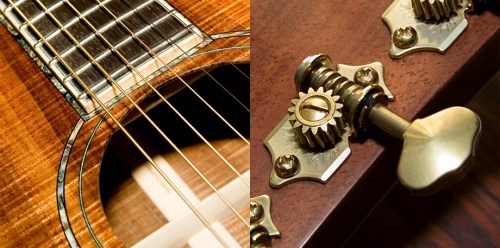
The Parkwood is superbly built, with (to my eyes) a great aesthetic in the style of Martin 42s. The ebony fretboard, one-piece mahogany neck, all solid master-grade Australian blackwood, Gotoh tuners, dovetail neck join and the bling all add up to a great quality guitar.
Value
I bought the Parkwood second hand at what I consider to be a very good price. If this guitar was made in the US it would sell for many times its current value. Will the guitar market ever recognise quality made outside the USA? The only comparable guitars on the market are the Taylor Koa series which get rave reviews and sell at a premium price.
Sustainability
So how sustainable are these tonewoods? The rarity of master grade Australian blackwood tonewood does not currently allow for guitars of this beauty to be in regular production. But plain grain blackwood is in reasonable supply, and has the potential with enough market support, to be fully sustainable into the future via a growers cooperative.
Who knows where Parkwood got their ebony from. The mahogany neck shows wide growth rings so I’m guessing it is plantation-grown. Fijian mahogany perhaps!!
A footnote on tonewood grading:
I think the current tonewood grading system is part of the industry’s problem. The grading system is all about the visuals, and it is blatantly discriminatory. The grading system keeps the tonewood market obsessed with the rare, exotic, beautiful rainforest/oldgrowth timbers. Shouldn’t tonewood grading be more about “tone”, and perhaps sustainability; rather than rare, exotic, beautiful and endangered?






 Tasmanian Blackwood Growers Cooperative
Wish List Revisited
The recent Ministerial Statement by Tasmanian Resources Minister Guy Barnett, and the strong negative reaction it provoked from both the community and the forest industry got me thinking about the wish list I wrote last year.
http://www.premier.tas.gov.au/releases/ministerial_statement_-_forestry
So I’ve decided to update my Wish List.
Does Tasmania want a successful forest industry?
If so then here are a few ideas:
Tasmanian Government forest policy continues to focus on public native forest, a failed State forest agency, and protecting local jobs at any cost. If we adopted this same thinking for any other primary industry Tasmania would be an economic basket case. Our politicians and large sections of the forest industry and the community still think of the forest industry as a community service, a government employment program.
Sorry guys but it’s the 21st century.
The only basis for a successful modern forest industry is profitable tree growing.
Most wood now grown and sold in Australia comes from private tree growers.
It is time to put the policy focus on profitable private tree growers and away from public native forest and a failed State forest agency.
Implementing the Federal Government’s Farm Forestry National Action Statement 2005 would be a good place to begin.
http://www.agriculture.gov.au/forestry/australias-forests/plantation-farm-forestry/publications/farm_forestry_national_action_statement
We need to think of forestry as a primary industry and not as a Government-run, politically-driven, taxpayer-funded employment program.
One example of this change would be to move Private Forests Tasmania (PFT) from the Department of State Growth Tasmania to the Department of Primary Industries, Parks, Water and Environment (DPIPWE). At the moment this DPIPWE website contains no mention of forestry at all:
http://dpipwe.tas.gov.au/agriculture
Why isn’t forestry regarded as a primary industry in Tasmania?
Why isn’t Private Forests Tasmania part of DPIPWE?
So that all commercial forest policy and practice is aligned with primary industry policy the Government Minister responsible for PFT/DPIPWE should also be responsible for Forestry Tasmania. Now does that sound logical or what?
Following from the above logic Private Forests Tasmania needs to become the dominant Government forest agency, NOT Forestry Tasmania.
And following on we need to get the politics, conflict and the anti-competitive policies out of the industry. That means either a) completely transforming Forestry Tasmania into an independent, fully commercial, profitable business, or b) shutting down public native forest logging.
The future of the forest industry is plantations. And like all primary industries the only basis for a successful forest industry is for (public and private) tree growing to be transparently profitable. The forest industry and the Government need to do everything they can to encourage profitable market-driven plantation investment. No scams!! See below for my comments on forest practices and markets and transparency for two ways to achieve this.
If there is any value/profitability at all left in logging Tasmanian native forest it must be pretty marginal. The Tasmanian Oak brand has been pretty well trashed over the last 50 years. Commercially managing native forest is a very costly operation. The only way it can be viable is by producing very high value products from most of the resource. This has never happened. Certainly in the pulp and construction markets, which account for the vast majority of the wood market, native forests don’t stand a chance competing against plantation-grown wood.
Using scarce taxpayers money to cut down 400+ year old public native rainforest and oldgrowth in the 21st century, with the excuse that special timbers are an essential part of “Brand Tasmania”, makes no sense whatsoever. All wood production must be fully commercial and profitable. There must be no community-service forestry in Australia. Given that blackwood makes up the vast majority of special timbers production anyway, and it can be grown in commercial plantations, the focus of special timbers policy must change.
I have four thoughts here:
http://www.fpa.tas.gov.au/
http://epa.tas.gov.au/
The Tasmanian Farmers and Graziers Association (TFGA) needs to become a genuine independent, vigorous advocate for private forest growers. The interests of private forest growers are not the same as those of sawmillers, or Forestry Tasmania nor the Government of the day. A thriving commercially competitive, profitable forest industry can only exist when private tree growers have a strong, fearless, independent voice. The TFGA is the only option currently available.
The forest industry in Australia hates open market processes and transparency! This is not surprising given its history. When was the last time you saw a forestry market report in the Australian media? When was the last time you saw a sawmiller hang out his slate looking to buy sawlogs?
In my books this is the major challenge for the industry. There have been a few attempts in the past to change this but they have failed due to lack of industry support. The industry will have no future until it becomes fully commercial – aggressively commercial!!! It’s all about competition, prices, markets and transparency. Farmers will never take the forest industry seriously until this happens.
Tasmania is a great place for growing trees for wood production.
But Tasmania is a small island a long way from world markets.
Because of our size and remoteness we cannot compete well in commodity markets like pulpwood and construction timber. We must think small volume high value niche markets such as appearance grade timbers and timbers for specialty markets. New Zealand farmers are doing this. But it needs focus and a strategy, not a random shotgun approach. One obvious example is macrocarpa cypress. There is a growing demand for this timber, as a handful of people in Tasmania know very well. NZ has thousands of hectares of cypress plantation growing on farms. Why doesn’t Tasmania?
Tasmanian blackwood provides another ideal example of a low volume high value forest product with which to help rebuild the forest industry. Quality appearance grade timber will always be sort after in the market, especially the super premium market. Tasmania could easily be producing 30,000 cubic metres of premium blackwood sawlog per year with the right policy and industry backing. At $500 per cubic metre that equates to $15 million in farm gate value per year. So where is the policy and industry support that will make this happen?
Unfortunately all of these ideas are so beyond current forest industry and political thinking they will never happen.
Certainly Minister Barnett’s Ministerial Statement contains nothing like the above plan.
No one is campaigning in Tasmania for private forest growers and a fully commercial profitable forest industry!
Tasmania does a good job running a successful dairy industry; and a pretty good job running beef, vegetable, apple, cherry and wine industries. So what is it about the forest industry?
When will Tasmania get a fully commercial profitable forest industry?
Leave a comment
Posted in Commentary, Forestry Tasmania, Politics
Tagged Forest Industry Policy, Guy Barnett, TFGA