
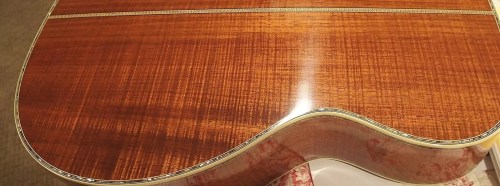
CF Martin is possibly the name in steel string acoustic guitars in the world.
As a tree grower, to have your product associated with the CF Martin brand is as good as it gets.
But the Tasmanian farmers who grew this wood never got that recognition and support. If they had, they might now be growing more quality tonewood.
Unfortunately the tonewood market and the guitar industry don’t work that way.
Not yet!!
Martin admits their customer base is conservative and fickle; they have a hard time introducing new tonewoods into their product range. Tasmanian blackwood has been a disappointment for them in terms of market acceptance.
Nevertheless here’s a not-so-complete summary of CF Martin’s use of Tasmanian blackwood.
For those unfamiliar with Martin’s product codes, the OM is an Orchestra Model body shape/size and D is for Dreadnought body shape; the 42/45 designates the amount of bling (abalone and other exotica) on the guitar with “45” being bling-max!
Eight months after Taylor Guitars first introduced Tasmanian blackwood into their Limited Editions, CF Martin also introduced blackwood into their Limited Edition models at the 2005 Summer NAMM Show. And whilst Taylor went for a more affordable market, Martin went for the top shelf market.
These are rare premium guitars from a premium builder!
2005 OM-45 Tasmanian Blackwood (The Sounding Board Vol. 19 p. 8)
The OM-45 Tasmanian Blackwood NAMM Show Special is tonally enhanced with an extremely rare flamed Engelmann spruce soundboard, and bookmatched back, sides and headplate of highly flamed Tasmanian blackwood. Special appointments include fossilized ivory bridge pins and endpin, Style 45 abalone trim with a boxed endpiece, Style 45 snowflake fingerboard inlays, gold plated Waverly hand-engraved tuning machines, a modified torch headstock inlay nested beneath the C. F. Martin & Co. logo inlaid in abalone, and a premium Accord case. This NAMM Show Special will be limited to no more than thirty instruments. Dealers may only place orders in person during the 2005 Indianapolis NAMM Show.
Here’s a link with some images of the OM-45 TB:
http://acousticguitarforum.com/forums/showthread.php?t=287129
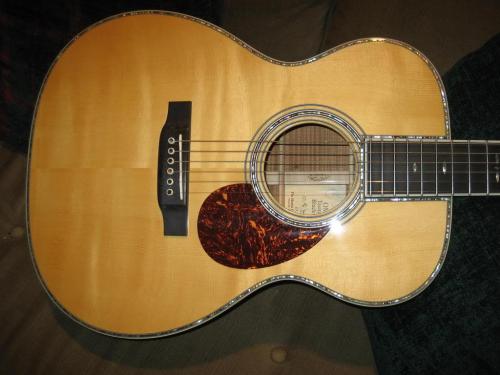
2010 D-42 Tasmanian Blackwood (The Sounding Board Vol. 29 p. 11)
Once again, Martin has produced a NAMM Show Special guitar which truly lives up to its “special” designation – the D-42 Blackwood. Backs and sides of this exquisite instrument are crafted of flamed Tasmanian Blackwood, a close relative of Hawaiian Koa both in looks and tone, and which grows primarily on the island of Tasmania off the southeast coast of Australia. Its tone is clear and bright and highly reflective, a perfect match for the D-42’s Adirondack (Red Spruce) top, prized for its resonance and big, open bass voice. Top braces, also Adirondack, are carefully scalloped and tapered. The small maple bridgeplate is typical of Golden Era 30s Martins. As a special touch, European flamed maple is used for the top binding, fingerboard binding, heelcap and endpiece. The entire top perimeter and fingerboard extension are inlaid with colorful heart abalone pearl as is the style 45 rosette. A polished and beveled Delmar tortoise pickguard accents the pearl binding. Ebony fingerboard (inlaid with Golden Era snowflake, cats eye & concave squares) and bridge (with long bone saddle). “Alternative” flower pot headplate inlay. Only 10 of these unique guitars will be offered. Orders will be taken only at the Summer NAMM Show.
Here’s a link with some images of the D-42 TB:
http://theunofficialmartinguitarforum.yuku.com/topic/103988#.WOHlJtKGNdg
2011 OM-42 Tasmanian Blackwood (The Sounding Board Vol. 31 p. 27)
We should have called OM-42 Tasmanian Blackwood NAMM Show Special the “Show Stopper!” This magnificent 14-fret, longscale (25.4″), Orchestra Model exemplifies the very best that Martin has to offer the discriminating collector and player. For starters, back and sides are crafted of rare flamed Tasmanian blackwood from Eastern Australia. Visually, it’s similar to premium figured Hawaiian koa. Tonally, it shares the brightness of koa but with the rich overtones of rosewood, giving it a unique and very balanced voice. With its solid Adirondack spruce top and 1/4″ scalloped “Golden Era” braces, it’s also got a big voice, with plenty of volume when you need it. Finger-picking or rhythm, this is your guitar. In the 42-style, the top, rosette and fingerboard extension are inlaid with colorful Paua pearl. Martin’s early (and rarer) “alternate” pearl torch design is inlaid into a polished ebony headplate. The ebony fingerboard is likewise inlaid with “Golden Era” snowflakes. A vintage 1930s ebony “belly” bridge features long bone saddle, bone bridge pins (and end pin) with pearl dots. European flame maple top binding, heelcap and endpiece. Gold engraved Gotoh tuners. Modified V neck, of course. Only 15 of these beautiful instruments will be offered, each personally signed by C. F. Martin IV and numbered in sequence. Exquisite. Resonant. And oh-so-limited.
Here’s a link with some images of the OM-42 TB:
2011 was the last time Tasmanian blackwood featured on a Martin Limited Edition guitar. Perhaps aiming at the top shelf market wasn’t best way to introduce a new tonewood into the market.
In addition to these limited release NAMM Show Specials Martin continues to produce the occasional custom model featuring Tasmanian blackwood, some of which have featured on this website over the years, including the Martin Custom Shop 018-T-Tasmanian Blackwood and the Martin Custom CEO7 Tasmanian Blackwood.
https://blackwoodgrowers.com.au/category/cf-martin-guitars/
With CF Martin’s focus on FSC as their lifeline to a sustainable future, Tasmanian blackwood will have a hard time staying in Martin’s tonewood catalogue. There is currently no FSC certified Tasmanian blackwood available anywhere, and this is unlikely to change in the foreseeable future. The best chance of FSC Blackwood will come from New Zealand as farmers there ramp up production over the coming years.
https://blackwoodgrowers.com.au/2017/03/28/c-f-martin-guitars-sustainable-tonewoods/
Tasmanian blackwood needs lots of market support to reach the stage where it may be possible to achieve FSC certification. It’s up to the market to build a sustainable future for Tasmanian blackwood. The FSC won’t achieve that by itself.





 Tasmanian Blackwood Growers Cooperative
Special Timbers in Western Australia
Forest Products Commission (FPC) of Western Australia (the Government forest agency) puts all special timbers that come from Crown land and State forest to public auction. The objective is not for the Forest Products Commission to maximise revenue (unfortunately that is not one of their corporate objectives), but to be impartial in terms of who gets access to the limited resource, and attempt to ensure some kind of fair market price is paid. I’m guessing much of this because the FPC actually tells us very little about their special timbers operations.
http://www.fpc.wa.gov.au/timberauctions
http://www.fpc.wa.gov.au/speciality-timbers-go-under-hammer
There are generally four auctions per year, the first for 2017 is this Saturday the 6th of May. Over 100 lots are to be auctioned this Saturday totalling over 1,000 tonnes of specialty woods.
Here’s the auctioneers website:
https://www.auctions.com.au/auctions/2017/05/06/wa-log-burl-burl-slices-craft-packs-and-slabs-auction.html
Western Australia doesn’t have a Special Timbers Management Plan. Whatever wood is salvaged from other activities on Crown Land and State forest is what special timbers are available and that’s it.
There are no taxpayer subsidies (that I can see anyway) and no logging of parks and reserves just to pander to the wood craft people.
In 2016 FPC auctioned approximately 3000 tonnes (approx. 3,000 cubic metres) of specialty timbers. That’s 150 truckloads of specialty timbers. Compare that with just 200 cubic metres tendered by Island Specialty Timbers/Forestry Tasmania last year.
The FPC is reluctant to talk about their specialty timbers operations, apart from announcing the auction dates. Here is the sum total of what the last FPC Annual Report had to say:
Local buyers bid keenly for a variety of Goldfields timbers for musical instruments, wood turning projects and unique pieces of furniture. Wood from this region is difficult to access, and bidders at the auction were impressed by the bold colours and patterns found in the timber.
Also on offer was a selection of South West native forest specialty feature timbers including marri, blackbutt and sheoak.
That’s it!!
Just some motherhood statements!!
No discussion about sales highlights, market conditions, total volume sold or total revenue.
If the FPC wanted to engage with stakeholders and the general public this would be a great opportunity. Apparently not!!
Like Forestry Tasmania the Forest Products Commission is not run as a commercial business but as a community service to achieve political objectives. Being a profitable tree grower is not the vision of either of these public forest managers.
Remember the only basis for a successful forest industry is profitable tree growers and public auctions are a great way to maximise profitability and create greater market transparency.
Leave a comment
Posted in Commentary, Island Specialty Timbers, Markets