Hi,
Check this out. As I've said before, the tonewood market will be a big player in the future of blackwood.
Cheers,

Cheers,
Posted in Uncategorized
My local corner store had a sign out the front recently telling customers that they also employ 40 Tasmanians; presumably an allusion to the latest round of the forestry wars. The vital pieces of missing information on the sign were:
1. They employ 40 Tasmanians AND are profitable;
2. The Tasmanian taxpayer is not out-of-pocket as a result of the activities of this corner store;
3. The store was established with NO government financial support; and
4. The store enjoys strong community support.
My corner store is just a typical successful commercial business.
My thoughts on the IGA come from the perspective of a forester who has spent the past 30 years watching the forest industry in Australia fall slowly into decline and disrepute. A truly bizarre and frustrating situation.
In the 21st century in an era of increasing concern for renewable resources and the environment the forest industry in Australia should be enjoying unprecedented levels of commercial, political, and community support. Instead the opposite is true.
Something has to change.
In fact quite a lot has to change. A commercially successful, politically and community supported forest industry could be very profitable and achieve a great deal of good in the 21st century, just as it is in New Zealand. But opportunities for change are rare. To my mind the IGA represents a pretty good opportunity, but few people seem to recognise this. Instead the disparate and polarised positions within the debate make finding a solution difficult, and support for the IGA is thin on the ground.
Yes the IGA is a flawed process but what forestry agreement hasn’t been. But a “business as usual outcome” will be of no benefit to anyone. The forest industry will not survive if the forestry wars continue. I guess having no forest industry is one way to resolve the forestry wars!
There is no single road to reform, and no perfect solution to the forestry wars. But for the future of Tasmania, find a solution we must. If the IGA fails due to lack of industry, community and political support there will be no “better” solution to replace it. Certainly the politicians cannot provide a better outcome, although they will make those kinds of promises. Change must be driven by the industry and the community. Instead of standing back and criticising the Agreement, it is time for people to step forward with support, ideas and energy to help keep the reform process going. The IGA is only the first round.
Will the IGA bring peace in the forests? Of course not!! There are issues that are fundamental to the functioning of the Tasmanian forest industry that are not addressed in the Statement of Principles. Issues of management, of governance, of commercial performance, accountability and transparency, issues to do with ongoing communication and relationships. Many of these issues focus around the Government, Parliament and Forestry Tasmania. The forestry wars will most certainly continue unless these issues are also addressed.
Actually my major criticism of the IGA is that it fails to identify the major issues facing the forest industry. So people are left with the assumption that putting more forest areas into reserve is all that is required for the forest industry to regain commercial, social and political relevance. I suspect this is one of the reasons why the IGA has had so few supporters. People understand that by itself the IGA cannot deliver what it proposes to deliver, and no one has outlined the rest of the process.
Reform in the forest industry is vital. The IGA is just the first step. A blackwood growers cooperative will only survive and prosper if the IGA is supported and successful, and further reforms are pursued.
Posted in Uncategorized
http://bob-brown.greensmps.org.au/content/media-release/jobs-flow-forest-agreement-fund
It’s great to see someone finally come out with a positive vision post-TFIA. It’s long overdue, but better late than never. The report commissioned by Senator Bob Brown and authored by Naomi Edwards and Jamie Hanson (EHR) outlines potential areas where the TFIA regional development money ($120m) could possibly be spent to build a stronger, more diverse Tasmanian economy. There’s just one problem…
There’s no mention of any future forest industry. Or rather it says that “the IGA provides for the existence of a sustainable forestry industry going forward.” This is clearly not true! The IGA merely defines what remaining public native forest will be available for harvesting. That is not a vision of a future prosperous forest industry.
The EHR also indicates that none of the IGA regional development money should be used in forestry-related projects. Why?
Just because commercial access to public native forest is declining doesn’t mean the end of the forest industry (although curiously the TFGA would have us believe this to be the case). There is already a significant private forest resource (both native forest and plantation) existing in the State. With proper policy and support this could grow and be a major contributor to the State’s economy (Jan Davis where are you?). My own proposal for a blackwood growers cooperative is just one of a range of private forestry initiatives that could see Tasmania become a major private forest grower and processor.
At the risk of being repetitive and boring I will remind readers that New Zealand has a thriving, sustainable, privately-owned, profitable forest industry that is a cornerstone of their economy. There is no reason why Tasmania cannot follow the New Zealand example if it wants too. Why is such an option deliberately excluded from the Edwards-Hanson report?
Deliberately excluding the forest industry from the EHR will just enflame those who support the forest industry, who will see the EHR as merely a political document reflecting Bob Browns own political agenda. The IGA doesn’t need more antagonists. We already have a surplus of those (with little or no commercial potential).
Using the New Zealand forest industry as an example Tasmania could have a thriving profitable private forest industry, producing a range of wood products from high-value to commodity. A good foundation already exists. Why deliberately exclude this option from the EHR?
Cheers!
Posted in Uncategorized
Posted in Uncategorized
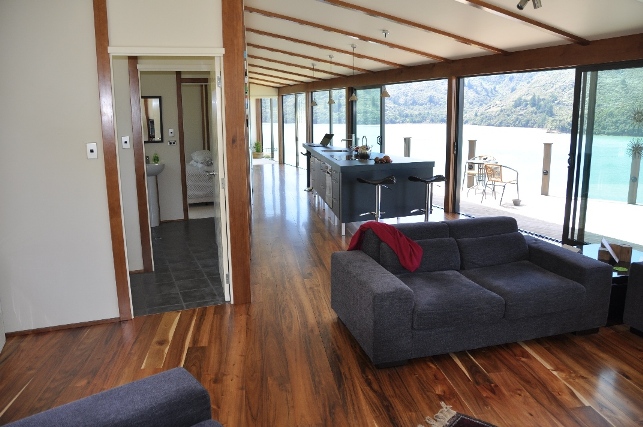
It would have been better if the picture was included to show farmers what the floor looked like.
NEW Zealand plantation-grown blackwood floor demonstrates the potential for a new revenue source for farmers in Tasmania.
Dr Gordon Bradbury, a forester with 30 years experience, is endeavouring to establish a commercially-focused Tasmanian Blackwood Growers Co-operative to emulate the success of the New Zealand farmers.
“Many farms have a steep wet gully or slope that only grows blackberries and bracken. These unproductive areas could potentially be used to grow blackwood,'' Dr Bradbury said.
“This commercial opportunity does not exist in Tasmania just yet.'' The 2011 New Zealand Master Builder House of the Year features a blackwood timber floor. Not blackwood imported from Tasmania, however, but 15-20 year old New Zealand plantation grown trees.
Dr Bradbury said the award is a major boost for New Zealand farmers who are on the verge of their first significant harvests of plantation blackwood.
The Tasmanian Farmers and Graziers Association (TFGA), who represents private foresters, backs opportunities for farmers to explore sources of revenue.
“This is one of many opportunities floating about, but the fullness of time will sort out its feasibility,'' TFGA boss Jan Davis said.
Ms Davis said the blackwood co-operative would require serious commitment from the industry to see it through.
Dr Bradbury said the proposed co-operative would assist farmers to forest manage their native blackwood for wood production, genetic conservation, and the environment.
He said farmers could grow blackwood in plantations to produce high value, high quality blackwood timber for local and export markets.
“A major objective of the co-operative would be to establish a blackwood breeding program to improve the quality and consistency of plantation timber,'' Dr Bradbury said.
Australian Forest Growers (AFG), which is a national organisation which includes representing farm plantation growers, said it is a step towards a sustainable privately owned high-value resource.
Dr Bradbury, who has completed a PhD at UTas on blackwood wood quality and genetics, is seeking community support and industry support to establish the co-operative under the industry reforms outlined in the Tasmanian Forest Inter-Governmental Agreement (TFIA).
“If New Zealand farmers can do it, why can't we?'' he said.
More details: www.blackwoodgrowers.com.au
Posted in Uncategorized

Posted in Uncategorized
Even with the chaos and uncertainty surrounding the TFIA, there is uncertainty and confusion around what projects will be eligible for TFIA funding, including this proposal for a blackwood growers cooperative. See my article of Tas Times.
http://tasmaniantimes.com/index.php?/weblog/article/blackwood-the-tfia-and-funding/
This highlights the need for more community and rural support if a blackwood coop has any chance of gaining funding support. So please sign up and express your interest and support.
Cheers,
Gordon.
Posted in Uncategorized
Welcome to the internet presence of the Blackwood Growers Coop.
This is very much a work in progress as I improve my internet design and editing skills.
But I am very keen to hear from people who are interested in growing commercial blackwood in Tasmania, or wish to support the Coop.
Please phone, email, or post a Comment here.
Cheers! And stay tuned…
Posted in Uncategorized
 | gordonjbradbury on 2026 Tasmanian oak prices at B… |
 | Bruce on 2026 Tasmanian oak prices at B… |
 | John Hill on 2026 Tasmanian oak prices at B… |
 | Brett Waring on An open letter to Kirsha … |
| Bruce Gibbs on Tasmanian oak prices at Bunnin… |
 Tasmanian Blackwood Growers Cooperative