

Category Archives: Uncategorized

From Liability to Opportunity

Taylor_mini_gs_blackwood_2012

A Taylor Mini GS Blackwood guitar.

Tasmania is sitting on a fantastic business opportunity that few people know about, but this opportunity remains unrealised because it involves the forest industry, and while the forest industry remains highly politicised the opportunity is stillborn.

I have written previously about the potential of the tonewood market to change the future of the blackwood industry. Gibson, Fender, Martin and Taylor are the four major guitar makers in the USA. To date two of these makers have used Tasmanian blackwood in their guitars for limited production models. These are major instrument-making companies with big international profiles.

Traditional tonewood supplies are becoming increasing scarce and major guitar makers are scrambling to find certified, sustainable supplies of quality tonewoods. Tasmania is sitting on a small goldmine and doesn’t know it.

Robert MacMillan of Tasmanian Tonewoods tells me that two of these US makers are sending teams to Tasmania in the next few months to try and negotiate supply contracts particularly for blackwood timber. But the last thing these companies want is to become entangled in forest politics. Like all good companies they know that any bad publicity can quickly destroy company reputation and profits. In addition to avoiding political intrigue these companies would also prefer to source their timber from certified suppliers. Robert also informed me that for the past 5 years he has refused business with a third major US maker because he cannot guarantee the supply of blackwood.

This is just plain stupidity and reflects the poor state of public forest policy and management in Tasmania.

While we are talking relatively small volume, high value markets, the potential demand is more than enough to make a significant difference to the growing and selling of blackwood in Tasmania.

Is Tasmania up to the challenge?

These companies are well aware of the sovereign risk associated with the current major source of blackwood timber from public native forests. Even if the IGA is successfully negotiated and legislation passed through State parliament, the risk may be reduced but it will always be present. That is the nature of politics and the management of public assets. The future supply of blackwood timber from public native forests is also bound to the commercial viability of the greater native forest industry, for which there is still considerable uncertainty.

Robert is keen to access more blackwood and other tonewoods from private land to help supply these major US customers.

There is a very large existing native blackwood resource on private land in Tasmania, which currently has little or no commercial value. Much of it is of poor form, and much is still too small to be harvested. But some of this resource has the potential to supply the international tonewood market. Logs as short as 1.2 metres in length can be sawn for tonewood. Realising the commercial value of this private resource will require resolving a number of issues. A major issue will be how to wrap this existing private blackwood resource into a forest certification scheme. A Blackwood Growers Cooperative would provide a possible solution to this problem, with ongoing management and plantation establishment to provide a sustainable resource.

As New Zealand farmers have discovered blackwood is an ideal farm forestry species. It is the only Tasmanian native tree that is currently known to be profitably grown in plantations to produce high quality timber. And as I am discovering in my travels around the State, many farms have land ideally suited to growing blackwood. In addition the forest industry needs to break away from its dependence on the public native forest resource, and broaden and strengthen its support base. Put these two factors together and you have the basis for a Blackwood Growers Cooperative.

Tasmania could become the proud home of one of the worlds few certified and sustainable high-quality tonewoods, providing income for Tasmanian farmers and a range of associated businesses. The blackwood industry could become a high-value niche industry to join our truffle, wasabi, saffron and wine industries. I’m getting plenty of interest from the Tasmanian rural community; international buyers are coming; now can our politicians look to the future of the forest industry?
August trip to the north

I had another successful and enjoyable trip around the north west last week, visiting farmers/landowners and attending the Australian Forest Grower (Tas branch) AGM and annual dinner.
 
I will post a few property reports here in the next few days with experiences and insights learnt from a couple of farms I visited, including a few surprises.
 
The AFG AGM and dinner gave me some exposure to the private farm forestry community. It seems to me that many in the industry are still in a state of denial, still hoping that the old days will come back; or hoping that having someone to blame will somehow solve the problems of the industry. There was a big turnout at the annual dinner in Launceston with three very interesting presentations, but the elephant in the room was deliberately ignored.
 
I will soon be posting an update on a very important opportunity that will shortly be knocking on Tasmanias door, that directly affects the future of blackwood and the Blackwood Growers Coop proposal. So stay tuned!

Forestry talks: no one wants to be first to walk

http://www.theaustralian.com.au/national-affairs/state-politics/forestry-talks-no-one-wants-to-be-first-to-walk/story-e6frgczx-1226445148657

This article in The Australian newspaper today paints a bleak picture for an IGA agreement being successfully negotiated.

It seems after two years of negotiations the parties just can’t get there; and no IGA = no blackwood growers cooperative.

My advice would be to call in a professional facilitator. When everyone around the table has an agenda it is difficult for new ideas and new approaches to be heard. That is where a professional facilitator comes in very handy. They are experts at freeing up discussion and challenging fixed positions, which is exactly what the IGA parties need.

More than likely after 2 years they are all physically and mentally exhausted, and absolutely dread the idea of more discussions. That’s how they looked on the TV the other night – like zombies. It is time for a radical change of approach. Hop on a bus guys and take a field trip – go and walk in the forests together and go visit a sawmill. Go and visit Lifestyle Furniture in Salamanca and talk to the owner. Then you might get some new ideas.

I tend to agree with Jonathon West who predicted that the failure to reach an agreement would see both the destruction of the remaining old-growth forests AND the destruction of what remains of the forest industry. And the damage and division inflicted upon the Tasmanian community would have no resolution. The anger will linger for decades and likely be transferred to a new context.

As Tasmanians we need to demonstrate some maturity and ability to resolve our own problems. Otherwise our future will look very bleak indeed.

Coop Update:

I continue to get 2-3 enquiries per week from farmers and landowners interested in being part of a blackwood growers cooperative. This is very encouraging. I only wish some of this positive energy and enthusiasm for the future could be transferred to the IGA members.

Cheers!

Treegrowers’ Co-operatives: The Key To The Future Of Farm Forestry

Here is a very informative article I found that discusses farm forestry cooperatives in Australia.

http://www.coopdevelopment.org.au/treecoops.html

Overall the article is positive about farm-forest cooperatives, but many of the industry and policy issues that existed in Australia in 1997 when the article was written still persist today.

Of particular interest and relevance is the discussion on the situation in Tasmania, and the factors that have undermined and continue to undermine the commercial viability of the industry here.

http://www.coopdevelopment.org.au/treecoops.html#effect

I have contacted Tony Gill, the author of the article, to seek his help with the blackwood growers coop.

Happy reading.

Market development with NZ’s specialty timbers

Those clever Kiwi farmers are at it again.

Here’s a news story of interest to special species growers everywhere, but especially in New Zealand.

http://www.fridayoffcuts.com/#12

And if you visit the NZ Farm Forestry Specialty Timber Market website as directed in the article you will find plenty of information about New Zealand farm-grown blackwood.

Check it out.

Another successful trip north

I spent three enjoyable days this past week touring the north.

Property visits

The two farms I visited turned out to be ideal for growing plantation blackwood. They also have good native farm blackwood that could be managed for commercial, genetic and other benefits.

One farm was a typical north east dairy farm with well managed paddocks, interspersed with short steep slopes, gutters and difficult corners that will make ideal sites for growing commercial blackwood. In total these areas added to about 10 ha. There was plenty of existing native blackwood some of excellent quality. The owner is keen to get started and believes the Coop is a great idea.

The second farm was a mixed business (including farm forestry) located in the north west. The farm is in a sheltered valley at 400m altitude on basalt soils. I had previously regarded 400m as being marginal for growing plantation blackwood due to the increased frost risk, which would result in reduced growth rates and poor tree form. Instead what I found was some of the most magnificent native farm blackwood I have ever seem. In addition, the landowner had recently felled some trees so we could check the annual rings for growth rates. These clearly showed that at these altitudes on good sites blackwood can grow at 2cm diameter increment per year over an extended period.

What this means is that there is potentially more suitable land than I had originally anticipated. Shelter is still important especially at these higher altitudes, but I am now more confident in recommending planting on good sites at these higher altitudes, especially if it produces trees like those I saw on this north west property.

Like the NE dairy farmer, this farmer also appreciates the commercial potential of blackwood but is cautious to invest further in farm forestry given his experience with MIS schemes, and the current uncertainty surrounding the forest industry. I’m hoping he will come on board and establish his own blackwood plantation. His land certainly has great potential.

Strong interest from the rural community

As a result of my promotion of a blackwood growers cooperative there are now over 30 ha of farmland either planted or committed to being established to blackwood plantation over the next 12 months. All of this land is ideally suited for growing commercial blackwood. This has been achieved with limited advertising and promotion. This is just based on farmers passion and belief in the commercial future of blackwood, no financial incentives, no existing coop.

I am now confident there is plenty of suitable land and strong interest from landowners. This is a significant milestone in getting a cooperative going.

However this progress and momentum won’t last long unless we get more political support and funding under the IGA. To date I’ve been running all of this off my own savings. I have no income. I am passionate about using my expertise and knowledge, and the passion and interest in the Tasmanian community, to get a blackwood growers cooperative established. I will assist existing plantation owners in establishing and managing their plantations through to the point where they are fully pruned and ready to be left to grow to final harvest. But if I can’t get funding then I will have to abandon this dream and find another source of income.

ABC Local Radio

A few weeks ago I received a phone call from ABC rural reporter Rosemary Grant. She was interested in the coop proposal and wanted to find out more. My trip north provided an opportunity to catch up with Rosemary. We recorded a spontaneous interview which I wasn’t expecting to happen.  Like so many Tasmanians Rosemary has plenty of her own blackwood stories, so she appreciates its social and cultural importance. Hopefully there will be a blackwood coop story on the ABC Rural Report soon. Thanks for your interest Rosemary.

http://www.abc.net.au/rural/regions/northerntas

Carrabin plantation update

Finally I had a free afternoon so I caught up with Gilles Carrabin where we spent two hours marking trees to begin the thinning process for this great blackwood plantation. Read my last update to find out more.

http://www.blackwoodgrowers.com.au/carrabin-blackwood-plantation-continued

I hope we can get the first phase of this thinning done this winter and allow this plantation to continue growing.

Cheers!

May update

Churchill Trust

I have received notice that my application for funding from the Churchill Trust for a four-week overseas tour to study blackwood cultivation, research and farmer experiences in New Zealand and Chile has not been successful. I failed to make the shortlist of Tasmanian applications that went to Canberra for final assessment.

May trip north

I was up north again last week visiting people. It was great meeting people who are interested in planting blackwood or who are keen to become involved in other ways. I saw some sites that will be very suitable for growing blackwood. Hopefully we will soon see some new blackwood plantations being established. Not all sites are suitable however. Some sites are clearly unsuitable, while others I currently class as marginal. As our experience and confidence grows in the future, some of these marginal sites may become suitable. But for now I want to recommend and concentrate on sites I have a high degree of confidence of success.

I had great conversations about various issues of plantation establishment. For example the size and type of planting stock to use, and how this affects protection strategies and costs. Site cultivation was also discussed. Where planting rates are so low (200 trees per hectare), spot cultivation seems to be the way to go. What is the most economical way to achieve this? www.wilco.co.nz, www.rotree.com.au.

New blackwood plantation

Here is the start of what will become a new 3 hectare blackwood plantation at Nubeena. Tree guards were cheaper than fencing for protection from wallabies and possums. The site has deep sandy loam soils, excellent shelter and rainfall. The weeds have been sprayed. With good spring rainfall I expect these trees to be well above the tree guards in 12 months time. There is native blackwood forest nearby that shows the site has reasonable blackwood potential which will improve with fertiliser and TLC. Watch this space!

IGA

The other day Professor Jonathon West made the dire prediction to a Legislative Council inquiry that the IGA would not be achieved, that the parties would fail to reach a negotiated settlement (Forestry peace goes: West). That would indeed be a sad outcome for the proposed blackwood growers cooperative. It totally boggles my mind that anyone can imagine that a return to the forestry wars will provide a better outcome, than the small beginning to a new future that the IGA represents.

Many people seem to have unrealistic expectations about the IGA. For my logic the IGA needs to be successfully negotiated within the context of further ongoing discussion and negotiations between the parties. After all, it is the establishment of ongoing trust and communication between the parties that is at the very heart of the IGA. The details are just a “means to an end”.

Cheers!

Application to Churchill Trust for funding for overseas study tour

Koa_logging

Last Friday I had an interview as part of my application for funding from the Churchill Trust for a four-week overseas tour to study blackwood cultivation, research and farmer experiences in New Zealand and Chile.

www.churchilltrust.com.au

It all started last year when I was invited to join the New Zealand AMIGO tour of Chile. The New Zealand blackwood growers group is organising a week-long tour of blackwood cultivation and research in Chile in October 2012. Being short of money it seemed unlikely that I would be able to attend. Then in February this year I happened to notice an ad in the newspaper asking for applications for funding from the Churchill Trust. With the activity surrounding the blackwood growers coop, this seemed like a perfect opportunity to combine some fact-finding, the Chile tour, and help promote the coop proposal. AMIGO Chairman Ian Nicholas helped with the two week itinerary in New Zealand.

The eight members of the interview panel seemed very interested in the proposal and my planned overseas trip, asking many searching and pertinent questions. The 30 minute intensive interview certainly got my adrenalin pumping.

My itinerary involves two weeks touring New Zealand visiting blackwood growers, and meeting members of AMIGO. I will also make two presentations of the results from my PhD research to foresters, students and farmers. From there I join the AMIGO tour to Chile where we will visit research centres and various blackwood trials. The final leg of the tour involves a week in Hawaii looking at Acacia koa.

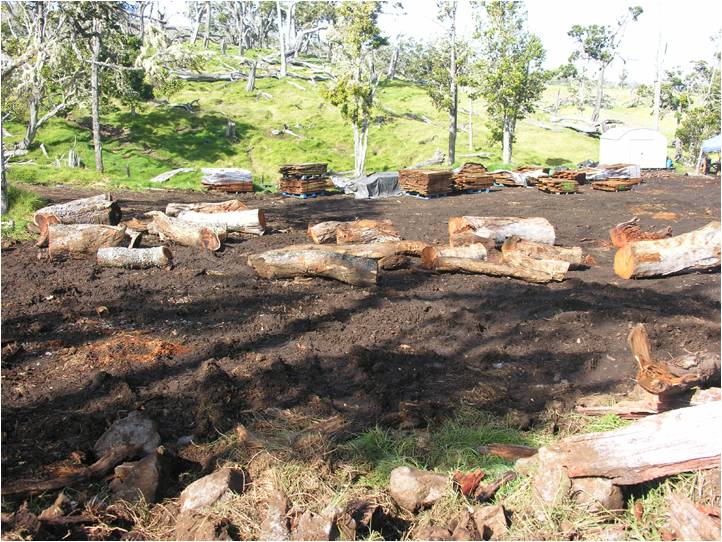
So what is Acacia koa? It is one of Hawaii’s main forest trees, endemic to the islands. Just like blackwood it has a long heritage as a premium timber species, and was very important to the native Hawaiians before European contact. Much of the koa forest has been cleared for farming, with only a small amount of wood now harvested from salvage operations from private land that look more like firewood operations than valuable timber harvesting (above image, Nick Dudley HARC).

But farming in Hawaii is changing and there are moves to restore some of the koa forest and provide future supplies of this valuable timber. There is a lot of research going on. Dr. James Friday from the University of Hawaii, Forestry Extension Service has invited me to visit.

I will find out in June if my application for funding was successful.

If successful I will come back with greater understanding of both the technical aspects but also of the human factor – what motivates farmers to want to grow trees, their experiences and frustrations. I will hopefully have lots of images and stories to post on the blog and use to promote the blackwood growers coop.

Blackwood Cooperative ignored in landmark report

Growing blackwood in farm forestry plantations as an option to secure and counter the declining supply from public native forest was omitted from the recently leaked report into the IGA wood supply scenarios. The 97 page report “Review of Tasmanian Forest Estate Wood Supply Scenarios” by Mark Burgman and Andrew Robinson was recently leaked to the media, with the final version being officially released today. It analyses many wood supply options and possibilities both plantation and native forest, both public and private, for the eucalypt hardwood resource. But it devotes just over one page (p. 9-10) to the issue of so called “special species”.

On the subject of blackwood it notes that beyond 2019 the supply of blackwood sawlog from public native forest is not clear, with a strong likelihood that the supply will diminish. And that’s it!

No mention of the proposal to grow blackwood in farm forestry plantations, which would not only counter the declining supply from public native forest, but would actually grow the blackwood industry many times larger than it has ever been.

The blackwood growers cooperative is the only positive proposal for the future of the forest industry in Tasmania that has yet emerged out of the IGA mess. The proposal was first made public in May last year. And still it continues to be ignored by the negotiators and the politicians.

This is just extraordinary, and very disappointing.

I have written to the authors of the report and Professor Jonathan West expressing my extreme disappointment at this omission. I hope I will receive some measure of explanation and some means whereby this error can be remedied.

The Tasmanian Blackwood Growers Cooperative must be placed on the IGA table of options to be seriously considered in the future supply of this valuable Tasmanian timber resource.

My March trip around the north

Nw_rough_grazing

It was great touring around the north last week visiting people. Apologies to those people I missed seeing. You are at the top of my list for the next visit north. Here are a few of my observations from the trip.

1.    North East Tasmania

It’s not often I get to tour the north east. Most of my travels seem to take me to the north west. What I really appreciated this time was the great potential of the region for growing blackwood. Many farms in the high rainfall areas of the north east have areas suitable for growing blackwood, that are currently being used for rough grazing or are covered in the usual bracken and blackberries. One dairy farm I visited was a perfect example – intensively managed flat land, but plenty of steep slopes and back corners that are ideal for growing blackwood. I can’t see why the north east couldn’t support 1000 ha of blackwood plantation. That may not seem much, but that area would supply annual blackwood sawlog volumes equivalent to what is currently produced from native forest in Tasmania! There are also plenty of farms with existing native blackwood that could be managed for sustainable wood production.

2.    North West

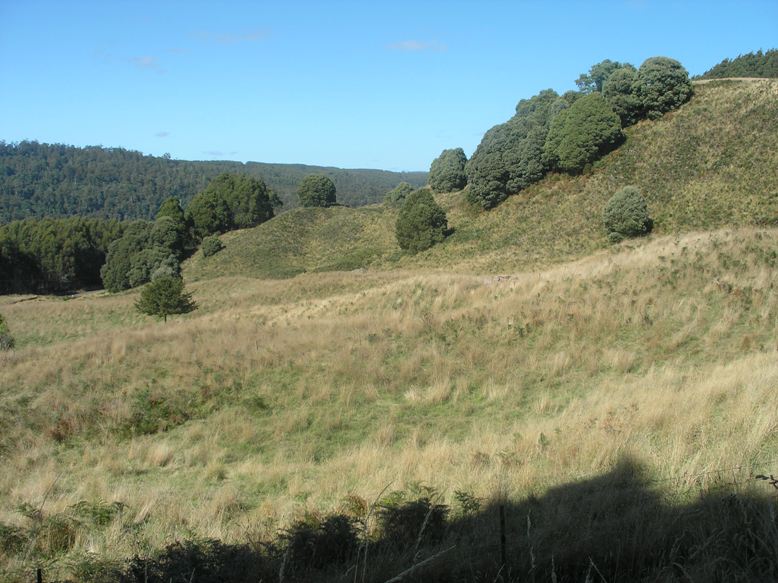
Touring around the back roads of the north west is always a pleasure, especially when the weather is great. Visiting Gilles Carrabin and his excellent example of plantation blackwood was inspiring. It just shows what passion and commitment can do. I also saw plenty of land that could be growing plantation blackwood (like in the above photo), even in the most intensively managed areas; areas that are currently underutilised.  If only we can get the ball rolling.

3.    Connecting with the rural community

Most people I spoke to expressed interest in and support for a blackwood growers cooperative. I drove around to many small local shops where I posted flyers. This made me appreciate the difficult task of both engaging with the rural community. There are lots of people who recognise blackwood is a Tasmanian icon and have some idea of its commercial potential, but taking the next step towards commercial development will obviously take time and effort. Having a few local success stories like Gilles Carrabin will obviously help promote interest, but I need to try and locate other farmers who are successfully growing blackwood. I can then hopefully organise a field day based around these properties, with the owners permission. Hopefully the politicians will then recognise the degree of community interest and support.

4.    General

I was surprised by the general sentiment of people towards the current state of the forest industry. I have been thinking that trying to get support and interest for a new commercial forestry venture in the current climate would be difficult. Many people certainly understand that the industry needs to change, but despite the current industry malaise, many people expressed optimism that the forest industry has a great future in Tasmania provided the ongoing conflict can be resolved. Many people expressed concern as to whether the current players were up to that task.

5.    Next trip

I already have the start of an itinerary for my next trip north. Once I get a few more enquiries I’ll schedule a trip.

Cheers!