
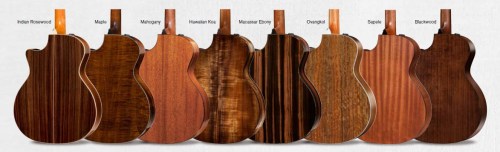
The latest Wood & Steel magazine (Winter 2016) from Taylor Guitars offers yet another big promotion of Tasmanian blackwood, featuring in three of the articles in the magazine:
- New 12-String Voices
- 12-Fret Revival
- The 300 Series Branches Out
https://www.taylorguitars.com/wood-and-steel
Here’s the main Tasmanian blackwood promotion found on page 15:
Blackwood’s Broadening Appeal
“Blackwood is one of my all-time favorite tonewoods,” declares Taylor’s master guitar designer Andy Powers, reflecting on the Tasmanian timber’s addition to the series. “I‘ve enjoyed its characteristics in every guitar I’ve built with it. It always sounds good.”
A lot of us at Taylor, in fact, are fans of the tonewood. Our product development team has crafted several series of limited edition blackwood guitars in recent years (including our 2014 500 Series Fall Limiteds) in the hope of broadening the appreciation among guitar players who haven’t been exposed to it. While blackwood has been a staple among guitar makers in and around its native region of Australia, its usage has been more limited in North America due in part to its lack of geographic proximity.
“That’s one of the factors blackwood had going against it,” Andy says. “It’s a long way to America from Australia. Historically, in the formative years of the steel-string guitar, it was a lot easier to get mahogany and rosewood here because they were already being imported for furniture.”
Despite its more limited usage in this hemisphere, blackwood has earned a loyal following across the industry.
“Martin has built some nice guitars with heavily figured blackwood, and they sound great,” Andy says. “And I know a number of small builders who work with it and live in the same camp as me; we all feel it’s amazing.”
The supply is also sustainable, with a healthy sourcing outlook for the future. From a guitar-making point of view, blackwood’s relatively rapid growth cycle can often yield guitar quality wood in under 40 years, and the abundant supply of older, bigger trees produces a lot of straight-grained wood that is easy for guitar makers to work with. We purchased our blackwood from Tasmanian wood supplier Bob Mac Millan (profiled in our Fall 2014 issue), who also sourced the much rarer blackheart sassafras we recently used for limited edition models.
http://tasmaniantonewoods.com/
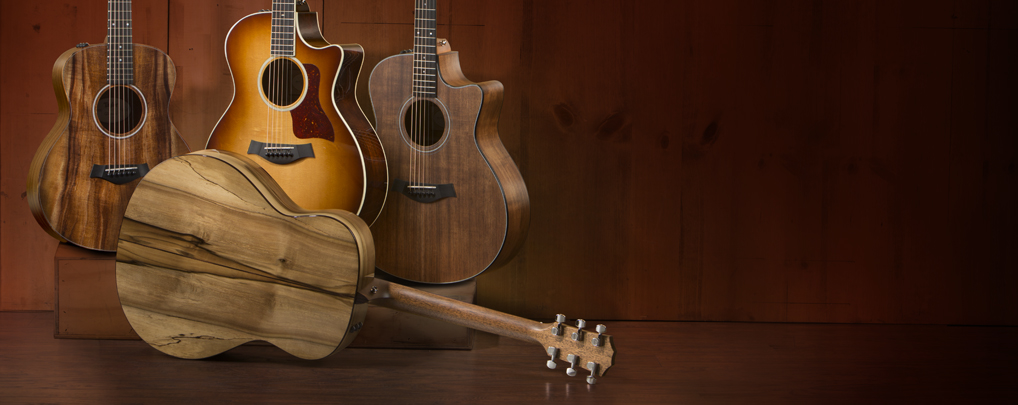
As an acacia wood species, blackwood sometimes draws comparisons to Hawaiian koa, another member of the acacia family, although, in reality, Andy says, the two species are unique.
“People sometimes refer to blackwood as the old cousin of koa, a more prehistoric version,” he explains. “While that may be so, blackwood has some distinct working characteristics, color, and grain structure, which distinguish it from koa.”
While blackwood will occasionally display exotic figure, Andy says our grading specifications for the sets used with the 300 Series call for more of a classic, straight-grained structure.
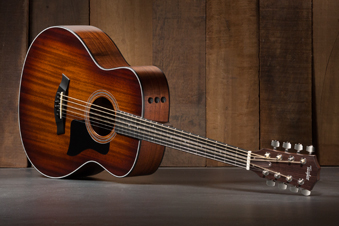
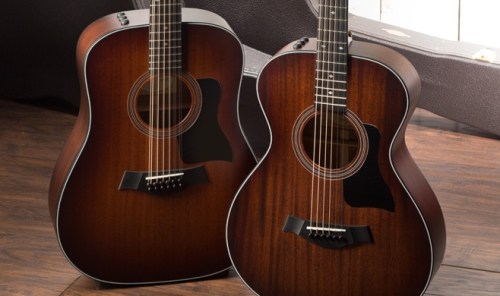
“We wanted a staple wood we could count on,” he says. “It’s a high quality guitar wood, clean, clear and straight-grained. In terms of color and overall appearance, it’s not a dramatic change from the classic mahogany or sapele aesthetic. It has a similar look a lot of times, especially paired with the mahogany tops and with a nice shaded edgeburst. Frankly, a lot of players may not even visually notice the difference unless they’re really looking for it.”
A color-matched stain for the blackwood back and sides and mahogany top and neck brings a seamless visual cohesion to the guitars, adding a rich undertone to the natural cinnamon-brown hues and highlighting the similar grain structure of both woods. Tonally, blackwood yields a strong midrange focus — dry and clear yet also warm, like mahogany and koa — with a splash of top-end shimmer and richness similar to rosewood. Its musicality, Andy says, suits a variety of body sizes and musical styles. Paired with a mahogany top, players can expect plenty of dynamic range.
Phew!
There’s a lot of promise, hope and opportunity in all those excellent words. Can they be matched by some clever product development and marketing, and finally by market acceptance and appreciation?
On top of the blackwood promotion there is other good news including the fact that Taylor Guitars has been the top-selling acoustic guitar brand in the USA for 26 straight months, with total (acoustic and electric) production in 2015 of 165,000 guitars and employ over 1,000 people! Even then they still can’t keep up with the demand.
Also the article Forestry for the Future on page 5 by Bob Taylor makes for interesting reading. Mr Taylor says “A word that has now become part of my daily vocabulary is “forestry.” He goes on…” The foresters I’ve met are mostly very good and brimming with concern, ideas and skills to help us all. And they’re frustrated because they work in a structure that often doesn’t allow them to work. Their work takes committed clients, and it also takes time.”
And as we have seen in Tasmania over the past 40 years, good intentions can so easily become corrupted and distorted to the point where the forest industry struggles to operate effectively because of the domination of ego, ideology and politics.
Bob Taylor says that forestry is the answer. I would say that good leadership is the answer. And I’m happy to say that Bob Taylor fits the leadership role pretty well!
I certainly sympathise with the expression of frustration! Being a forester in Tasmania means living with permanent dose of frustration.
Taylor Guitars and Bob Mac Millan at Tasmanian Tonewoods are doing their bit to bring Tasmanian blackwood to the world stage.
Now what can we in Tasmania do to support Taylor Guitars promotion of profitable, sustainable Tasmanian blackwood tonewood?
This is a commercial opportunity going begging.
Are Tasmanian farmers interested?
Are our politicians interested?
Is the TFGA interested?
We need leadership!
We need cooperation!





 Tasmanian Blackwood Growers Cooperative
Resource-sensitive Global Production Networks (GPN): Reconfigured Geographies of Timber and Acoustic Guitar Manufacturing
A few months back I was contacted by two academics based at the University of Wollongong, New South Wales. They are economic geographers and were starting a project looking at local and international tonewood markets.
Chris Gibson and Andrew Warren came to Hobart and I was pleased to catch up and discuss issues around tonewood supply and tonewood markets.
On their way to writing a book on the subject they have published the first academic paper from their research so far.
Chris Gibson & Andrew Warren (2016): Resource-Sensitive Global Production Networks: Reconfigured Geographies of Timber and Acoustic Guitar Manufacturing, Economic Geography, DOI: 10.1080/00130095.2016.1178569
http://www.tandfonline.com/doi/pdf/10.1080/00130095.2016.1178569
Unfortunately this paper doesn’t make for easy reading with 22 pages of dense, convoluted prose.
I would encourage the authors to write a shortened popular version of the paper as I have no doubt they would find plenty of consumer and industry magazines and websites keen to publish.
Here’s my review.
Where in the 1970’s and 1980’s labour costs and shifts in production to cheap labour markets were the dominant force in the guitar industry, today it is access to secure, reliable wood resources that is becoming the major industry driver. This is happening within an increasingly complex, increasingly regulated international trade in wood resources.
Such [increasing] regulation [and diminishing supply] has, since the 1990s, transformed both tonewood procurement and guitar making. A resource-sensitive GPN has emerged in which upstream resource actors are increasingly important, with manufacturing firms responding differently to scarcity and regulation. Other industries dependent on timber, such as paper milling, furniture, and the construction industry are not as species dependent and have been able to switch more easily to substitutes, including quick-growing plantation species sourced locally. Guitar manufacturers for the most part remained bound by the guitar’s type form, requiring timbers with tensile strength, aesthetics of color and grain, and rich acoustic resonance. Moreover, as a form of manufacturing appealing to consumers for whom emotional value and identity-affirming qualities were intrinsic, the industry was encumbered with strong traditions and customer expectations. As Dick Boak, from C. F. Martin & Co., explained, convincing guitarists to switch to instruments made from sustainable materials proved difficult: “musicians, who represent some of the most savvy, ecologically minded people around, are resistant to anything about changing the tone of their guitars”. Put simply, “musicians cling to the old materials”.
As I’ve said previously, guitar companies are often their own worst enemies when it comes to product development, marketing and mixed/confused messages. Even the most evangelical of guitar manufacturers still provide a soft, oblique message to the market when it comes to environmental issues. But the aesthetic and the exotic become the focus when it comes to sales and marketing. Many guitar companies show no concern about resource supply and environmental issues whatsoever.
https://blackwoodgrowers.com.au/2015/08/11/ooops-not-such-a-success/
But there is evidence that consumer and market change is coming. Just a few examples include the No More Blood Wood campaign, the Leonardo Guitar Research Project, and the Musicians for Sustainable Tonewoods:
http://reverb.org/no-more-blood-wood-campaign/
http://www.leonardo-guitar-research.com/
https://www.facebook.com/Musicians-for-Sustainable-Tone-Wood-100977326654291/
The 2009 and 2011 raids on the Gibson Guitar Company by US law enforcement agencies in relation to importing endangered species were a watershed moment for the guitar/tonewood industry, sending shockwaves throughout the marketplace and concerned consumers.
Irrespective of the evidence and veracity of the raids, in August 2012, Gibson settled out of court, effectively admitting to violating the Lacey Act, and agreed to a $300,000 fine.
Since 2011 the international tonewood market has changed dramatically. The paper highlights three strategies being used by guitar manufacturers to adjust to the changing tonewood market:
In short, material scarcity in combination with higher degrees of CITES/Lacey Act enforcement made legally sound international procurement of traditional timbers more difficult, inconsistent in quality, and expensive. Accordingly, product innovation ensued, entailing new models that shifted away from rosewoods, ebonies, and mahoganies of potentially suspicious provenance, toward new alternative timbers that satisfied strength, resonance, and aesthetic benchmarks, and that could be sourced either locally or more transparently from countries with robust regulation, certification, and enforcement.
Well that is a trend that is only just beginning. If you look at most guitar websites you will still find rosewood, mahogany and ebony in abundance.
Much of the search for alternative species is focused on other tropical rainforest timbers not on the CITES list. A few American companies are increasing their focus on readily available North American hardwood species. In Australia the two commercial makers, Maton and Cole Clark, are increasing their use of locally grown and native timbers.
Taylor Guitars so far is the only major company following the vertical integration pathway back up the supply chain to timber cultivation, harvesting and milling. This is really only an option for large companies that have the resources necessary to invest upstream.
Rather than engaging in the expensive option of buying land and growing trees themselves, these companies should consider the option of contracting the growing and supply of tonewood to local farmer cooperatives. I’m pretty confident that if a major company pursued this option in Tasmania it would receive plenty of positive support from the farming community.
The third strategy being developed by small-to-medium size guitar companies is the use of salvage wood from specialised “timber hunters”. The problem here is that salvage wood is not a secure long-term resource. It comes with increased risk of resource supply. It also doesn’t help the major manufacturers and therefore the bulk of the guitar-buying public who can’t afford custom built guitars, ie. there are no large volumes of salvage wood available.
So how can Tasmanian blackwood feature in these three tonewood strategies?
Tasmanian blackwood is discussed on page 19 of the paper.
Following the Australian lead (Maton and Cole Clark), North American tonewood suppliers and manufacturers began importing Australian blackwood to use in high-end production guitars. A species considered invasive in some areas (unlike practically all other tonewoods), Australian blackwood is harvested in small volumes from farms and mixed-forest plantations without the need for invasive harvesting techniques or CITES paperwork (Reid 2006).
I don’t know where the mixed-forest blackwood plantations are? I’ve never heard anything about them. And why mention the invasive bit? The invasive tendencies of other species are not discussed at all. If blackwood is planted on Tasmanian farms where it is already a native how can it be considered invasive?
The only way that the tonewood market can have a secure future is to pay landowners to grow trees. Unfortunately the paper fails to discuss this strategy, I guess because so far none of the guitar companies are actually using this strategy.
Major manufacturers need significant volumes of quality timber and they need resource security to safeguard their investment. This means paying people to actually grow trees, and having strong, long-term relationships with growers.
The paper focuses on the current changing dynamics in the international tonewood market which are still in their infancy.
As the paper states, the current changes are unpredictable and likely to result in unexpected outcomes as new players and new opportunities emerge. The interplay between the consumer, the manufacturer, the supply chain, and the grower will result in significant market changes.
One important piece of information missing in the paper is an estimate of the size of the international tonewood market. In all the dense discussion it is not possible to get a sense of scale of the issue. On pages 10-11 there is a table providing some statistics about example companies, including production and employment, but nothing about tonewood demand.
Another observation is that the paper talks about the tonewood market everywhere from sawmillers/tonewood merchants all the way through to consumers; but fails to discuss forests, plantations and growers. If there’s a tonewood supply problem then not discussing trees and growers seems a bit odd.
So who will grow the tonewoods of the future?
I’m looking forward to seeing what these academics come up with over the next year or so of their project.
Leave a comment
Posted in Commentary, Markets, Taylor Guitars, Tonewood
Tagged Andrew Warren, Chris Gibson