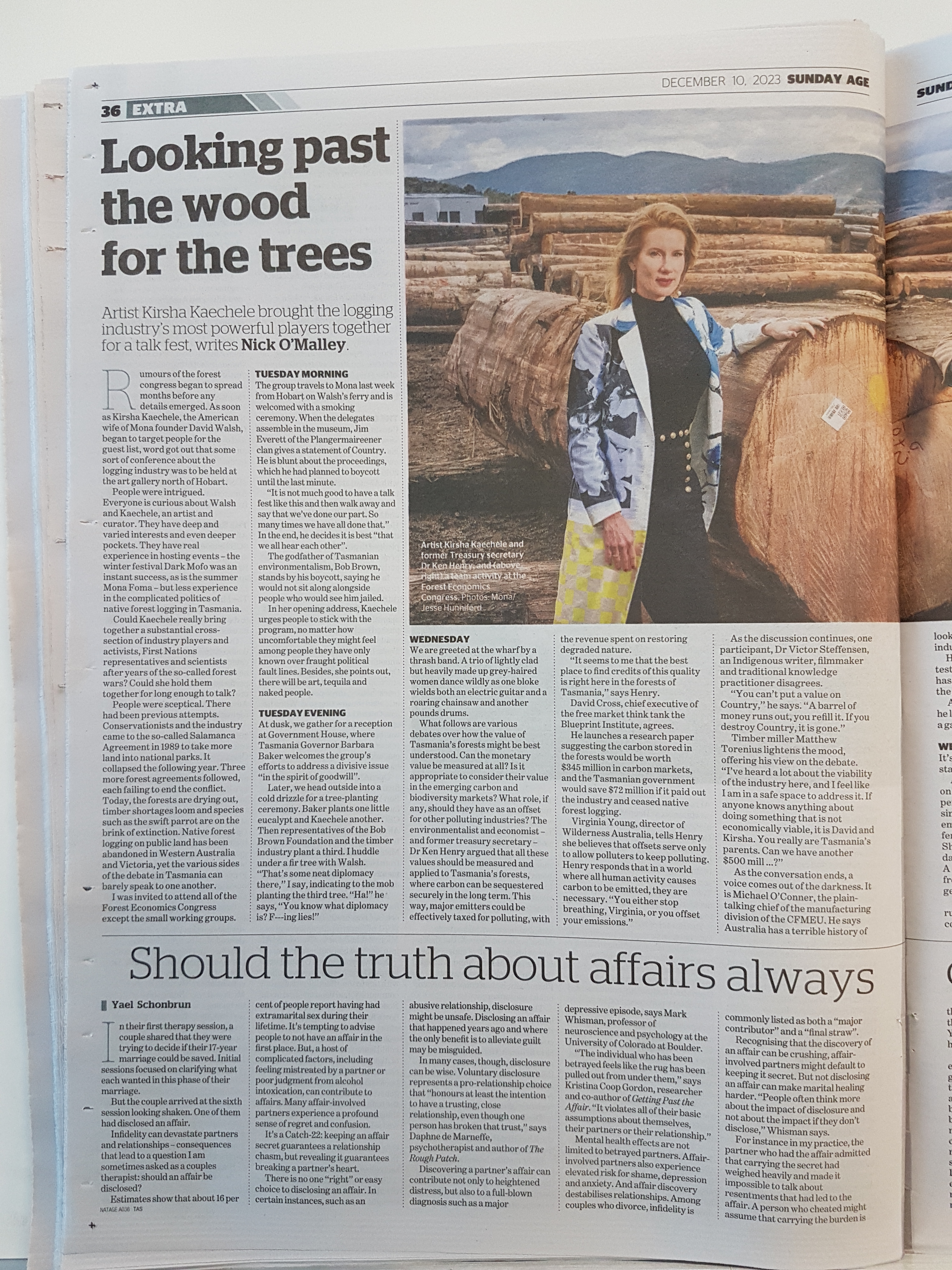
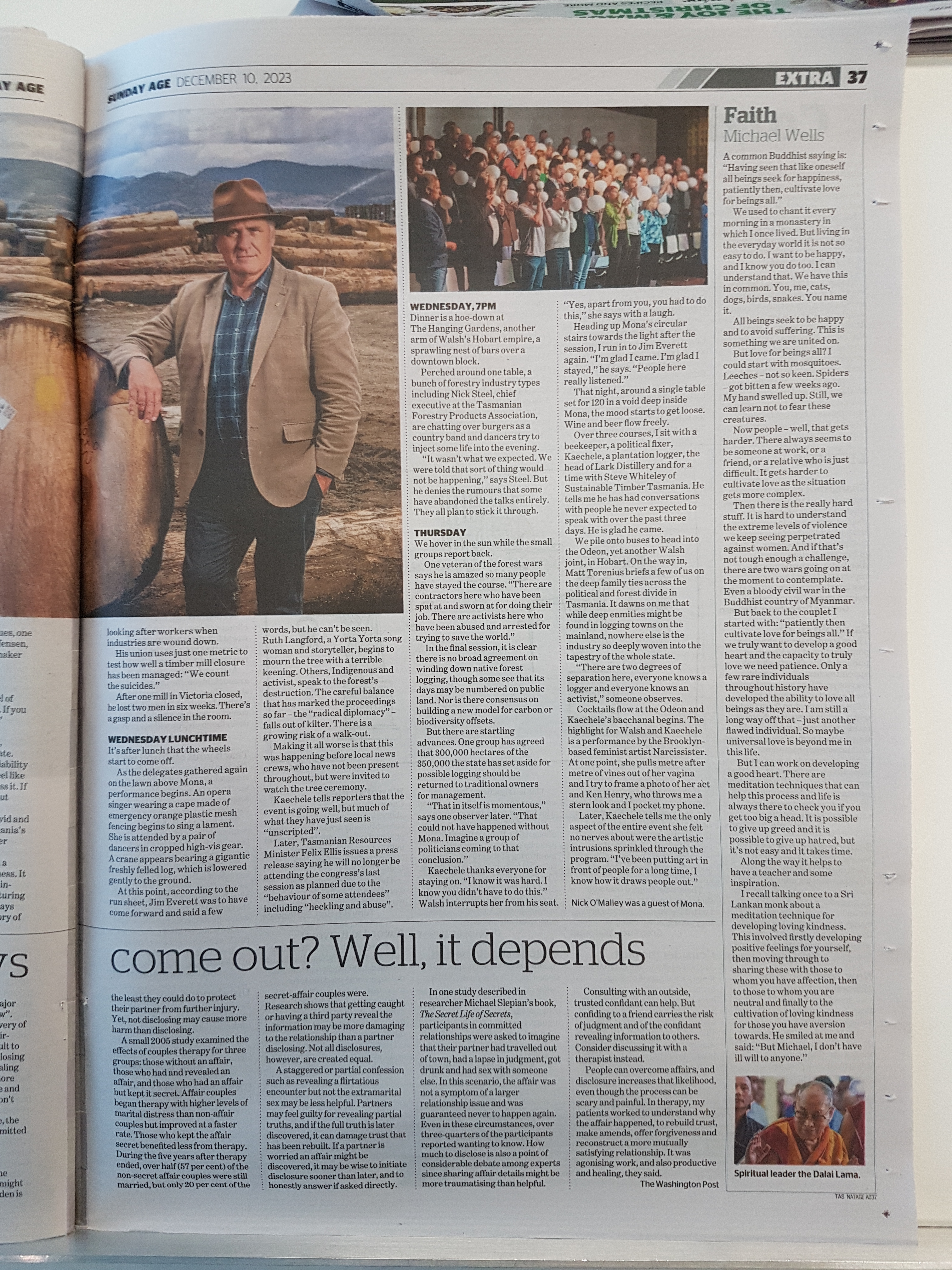
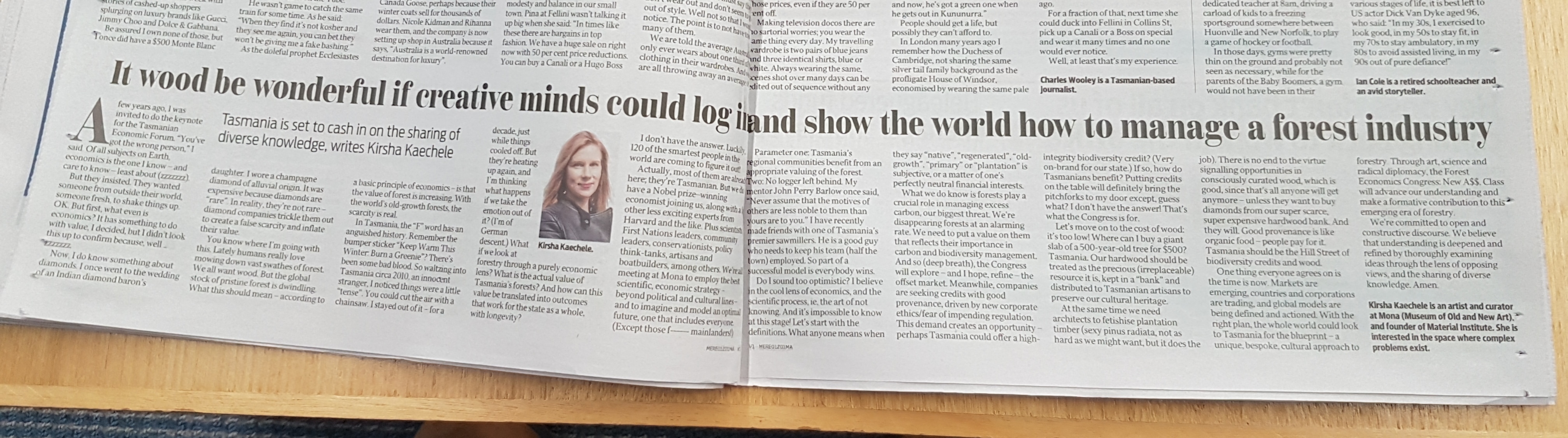
The following 2 page article appeared in The Age newspaper Sunday 10th December written by Nick O’Malley. It is a superficial summary of the three day congress:
It’s a long and wordy article that provides few insights into what actually happened at the congress apart from the artistic interludes.
Given that it took many painful months of negotiation to conclude the 2012 Tasmanian Forestry Agreement, a three day meeting was hardly going to start a revolution.
One gets the impression that the congress made little progress..
The fact that the congress didn’t even issue a joint communiqué expressing thanks to Messrs Kaechele and Walsh, and a hope for the future, tells us that there is unlikely to be any subsequent meetings.
If Ms Kaechele wishes to resolve the 40+ year old Tasmanian Forestry Wars she will have to be more creative and imaginative. A less direct approach to the problem may provide surprises.
I did not get an invitation to the congress so I cannot write from personal experience, only from what I have read and my long history in Tasmanian politics and the forest industry.
The congress received considerable media coverage, especially on the mainland.
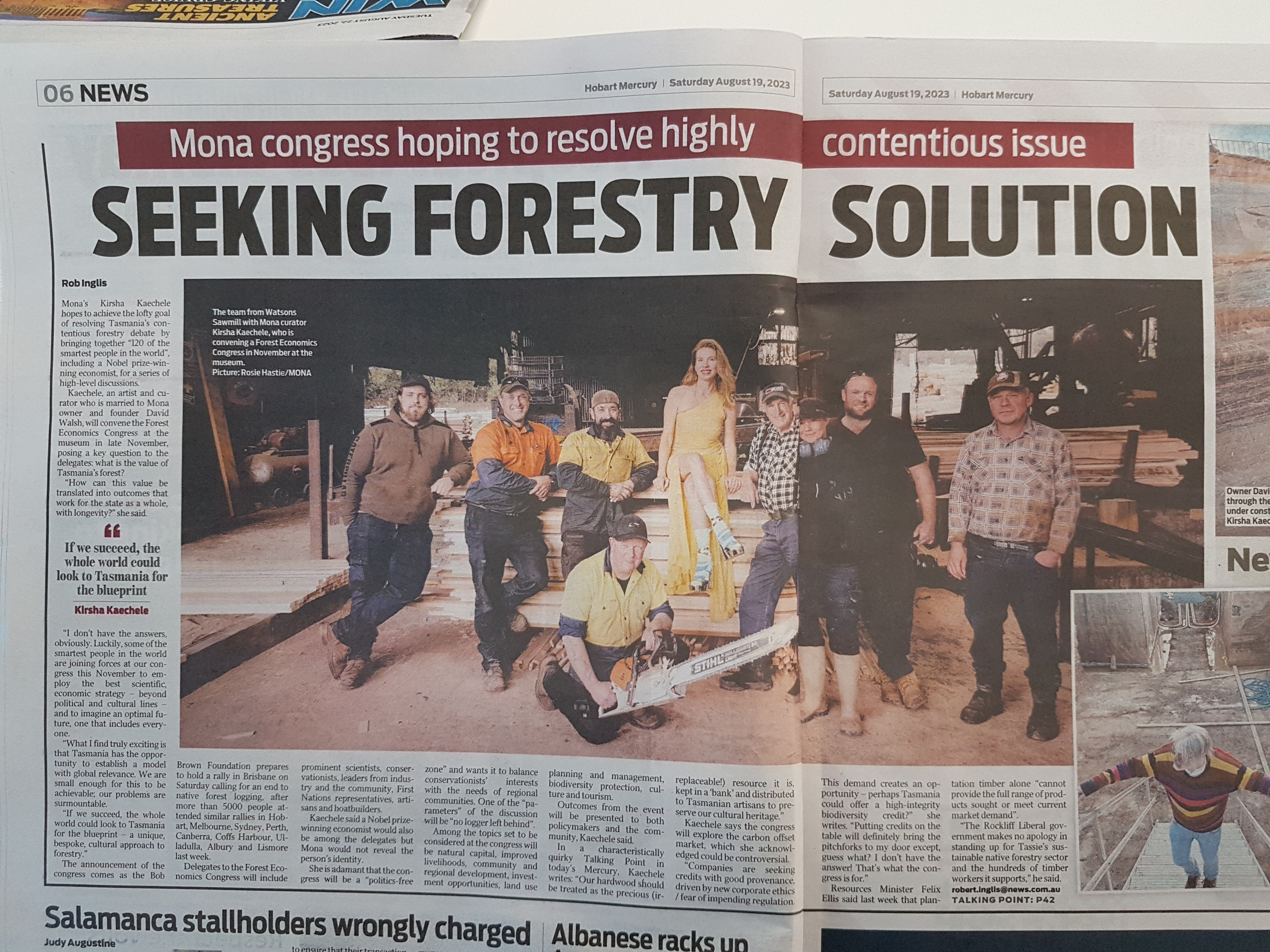
The only post-congress media coverage was the following article in The Mercury newspaper Saturday 2nd December.
To date MONA has not published any details about the congress – who were the speakers, what was discussed, what was agreed and what was disagreed?
As expected, the usual suspects attempted to make political mileage out of the congress, rather than act in a respectful and positive manner. There are plenty of people who want the status quo to remain.
The further “working sessions” that Ms Kaechele plans to organise should be interesting. Where is all this discussion heading? Any change in the forest industry status quo will inevitably result in winners and losers. How do we stop this becoming yet another forestry bun fight?
Edit: We have had “collaboration” before in 2011-2012 with the 2013 Tasmanian Forestry Agreement, but that collaboration was betrayed by Tasmania’s corrupt political system and the 2014 Tasmanian State election. The corrupt political system remains a major threat to Ms Kaechele’s plans.
The fundamental problem is that public native forestry is a political decision made by the Tasmanian government, and the Tasmanian parliament has made it perfectly clear that the status quo is unlikely to change.
If Ms Kaechele wishes to promote change in the forest industry and politics, then she must engage with the wider Tasmanian community. Otherwise she risks repeating the disaster of the 2013 Tasmanian Forestry Agreement/2014 State election. She, and the members of the congress, must convince a significant portion of the Tasmanian community that a better future is available. Otherwise the congress will become yet another forestry political football used to divide and destroy the Tasmanian community, just like the 2013 Forestry Agreement.
The failure of both the Tasmanian government and the Tasmanian forest industry to respond positively to the congress may well be the straw that finally breaks the camel’s back. This charade called public native forestry is teetering on the brink. Any player in the charade may finally decide the game is over, and bring the house of cards crashing to the ground.
The Australia Institute is hosting this event at the Hobart Town Hall 1.00 pm Tuesday 14th November.
I wish I could go, but I’ll be away then.
So here are my thoughts on how to end Public Native Welfare Forestry in Tasmania.
The Tasmanian Parliament WILL NEVER, EVER END THE FORESTRY WARS!
That fact is perfectly clear!
Therefore the end of public native forest logging in Tasmania MUST come from outside Tasmania, either from Canberra or the marketplace.
Forest protests have very limited impact on Government policy and no impact on the marketplace.
The current Federal Labor government, led by Prime Minister Anthony Albanese, has proven itself to be a conservative Liberal government in disguise. The Federal Labor government will not enter the national forestry wars!
This leaves us with only one choice – the marketplace!
Traditionally the Australian timber marketplace has been more than happy to support the continuing plunder of our public native forests in the face of overwhelming data and community opposition. Tens of thousands of Australian businesses remain utterly mute on their most important resource.
And to date little community focus has been placed on this marketplace complacency.
I believe it is well past time for the marketplace to be held accountable for its complacency and arrogance.
Bunnings and Mitre10 are the biggest retailers of Tasmanian timber in Australia.
It is time to put significant community pressure on both of these major timber retailers.
The Australia Institute meeting in the Hobart Town Hall must pass a resolution calling upon Bunnings and Mitre10 to stop selling all Tasmanian oak products immediately.
There is no other option to end public native logging in Tasmania.
The forest industry has been in the media a lot lately.
That is no surprise as we have now entered the final battle in the decades long Forestry Wars.
The old forest warriors are back in the trenches – shouting and vilifying, rattling sabres and thumping hairy chests. Just like the good old days!
One thing different this time is the so called Forest Economics Congress being organised by Kirsha Kaechele later this year, as reported in The Mercury newspaper Saturday 19th August.
The idea that after decades of bitter conflict a bunch of people can sit down and solve the forestry wars seems completely fanciful. Especially so after the 2014 Tasmanian State election when the last attempt at discussion and compromise was destroyed by Tasmania’s corrupt political system.
Ms Kaechele is promising free and open discussion about a positive forestry future for Tasmania.
Part of the problem however is that Ms Kaechele has already set a long list of Terms of Reference for the Congress that are identified in these two articles.
These Terms of Reference include:
the continued logging of public native forests, including oldgrowth forests;
“artisans and boatbuilders” will be given preferential access to our public native forests;
sawmillers are our friends!
It seems that many outcomes from the Congress have already been determined
Curiously Ms Kaechele fails to mention anything about politics, as if the Congress will define and implement a positive forestry future completely independent of our State parliament.
Q. How can a public resource (our forests) be managed outside of the political system in a small corrupt fishbowl like Tasmania?
A. It can’t! Never has, never will!!
I could ask 100 people in the forest industry what their vision of the future is and I would get 150 different answers, many of them mutually exclusive. Many people are not prepared to compromise, and many people have utterly fanciful ideas about our forests. There is much distrust, anger and hostility in the mix as well.
How can common ground be reached under these difficult conditions?
Many of the fundamental issues facing timber markets and the forest industry are not mentioned in either of these articles. Fundamental issues like the complete absence of proper functioning timber markets in Australia, the absence of level playing fields for all tree growers, farm forestry, etc..
No doubt the Congress will provide some interesting discussion, but I for one am not holding much hope. One thing is guaranteed – the forestry wars will not be resolved by the Tasmanian parliament. The Tasmanian parliament can only enflame and exacerbate the conflict.
That is the reality that Kirsha Kaechele faces.
PS. Never mind that John Lawrence has spent the last 18 years repeatedly destroying Forestry Tasmania’s business model and their very dodgy accounting practices. What really are they going to talk about in November?
This is a very clear message to the Tasmanian farming community!
Plant trees at your peril!!
This is further to my previous blog, and tells us how utterly broken and corrupt is the forest industry in Tasmania, not to mention our political system.
Government forest policy in Tasmania (and the rest of Australia) has always been about subsidising sawmillers.
It has never been about profitable tree growing.
So here we are in the 21st century still implementing 19th century policy.
And if there is any challenge to that welfare policy the forest industry will scream bloody murder from the mountain tops!
The above link to the Tasmanian Times website provides all the blood-soaked details of the current forestry drama.
As I said in my previous blog, this drama could well end up in the High Court of Australia, with the Tasmanian government facing various commercial and trade practices charges, never mind a blatant breach of the Australian Constitution, which guarantees free trade between States.
As I stated previously, the Tasmanian forest industry does not want a transparent, competitive market for forest products in Tasmania.
The Tasmanian forest industry is demanding market manipulation and price controls to ensure Tasmanian businesses continue to enjoy unfettered access to forest welfare.
The letter from the Tasmanian Forest Products Association to the Tasmanian Premier is clearly and openly demanding that the State government deliberately breach Australia’s consumer and competition laws.
The fact that the State Labor opposition openly supports market manipulation and price control tells us that the forest industry probably does not have a future in Tasmania.
Anyone who is a forest grower will be horrified by this.
Someone needs to write a letter to the Tasmanian Premier threatening to take the Government to the High Court over this whole fiasco.
In fact a Royal Commission into trade practices within the forest industry is long overdue.
Island Specialty Timbers is the only source of competitive, transparent log prices anywhere in Australia, including blackwood sawlog prices. That simple statement tells us a great deal about the dire condition of the forest industry!
The lack of commercial credibility is just one of the many challenges facing the forest industry in Australia.
IST is a business enterprise of Sustainable Timber Tasmania (STT) which sources and retails raw material of Tasmanian specialty timbers from harvest or salvage operations conducted on State owned Permanent Timber Production Zone land (PTPZl).
IST is not really a “business” just as the State forest agency Sustainable Timber Tasmania is not a business either. Logging of public native forest in Tasmania requires significant taxpayer subsidies every year.
IST conducted 7 tenders during the year with a total of 198 cubic metres of special species sawlog and craftwood put to public tender. Tasmania defines “special species” as any native forest timber apart from plain grain Tasmanian oak (Eucalyptus sp.).
Blackwood Results
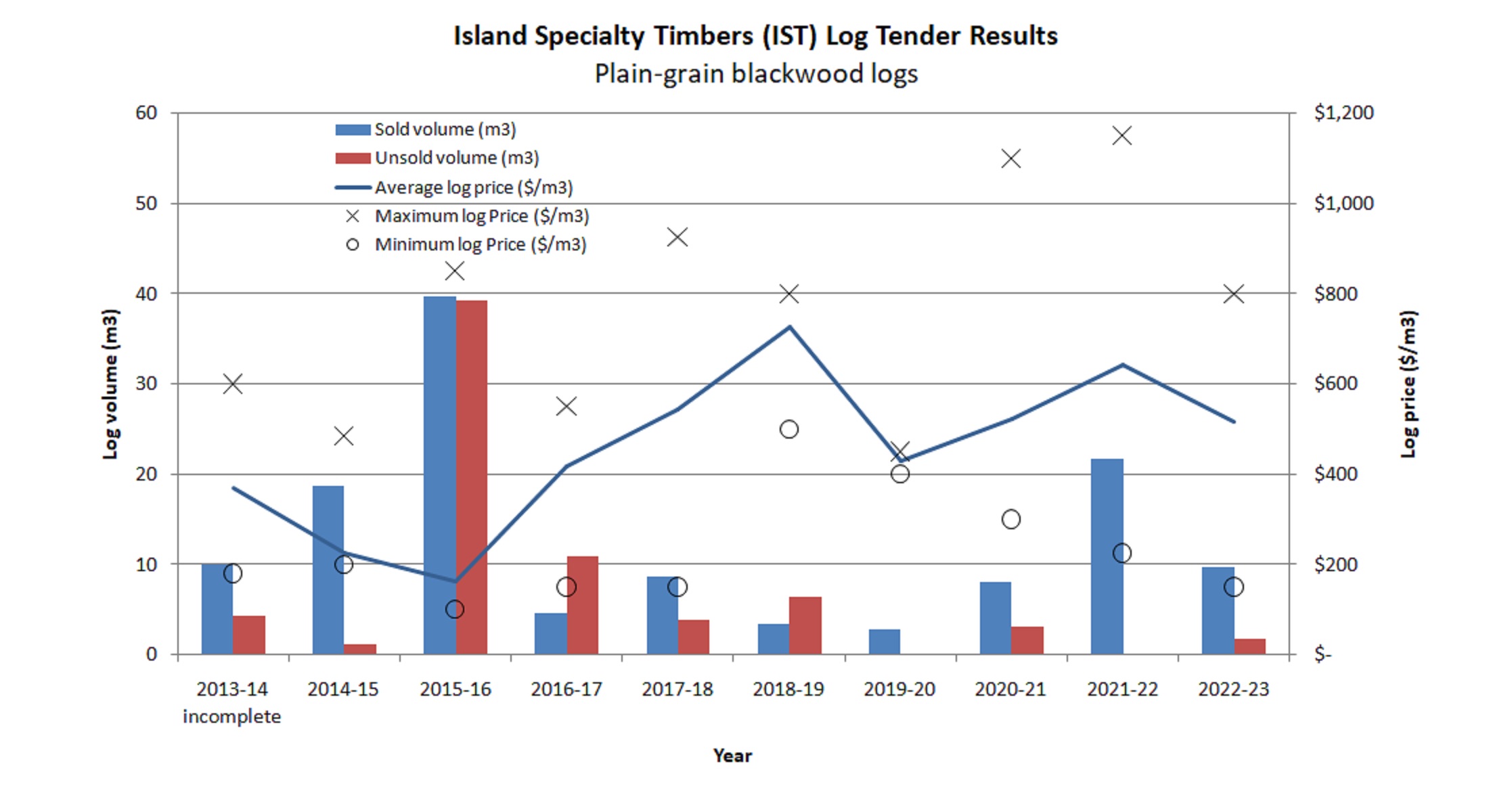
Following two years of strong price increases for plain grain blackwood logs, this year saw a softening of markets. Maximum, minimum and average log prices all declined in 2022-23.
IST put a mere 16 plain grain blackwood logs to tender totalling 11.5 cubic metres. Three logs totalling 1.8 cubic metres were unsold at tender. Prices ranged from $150 to $800 per cubic metre with an average price of $518.
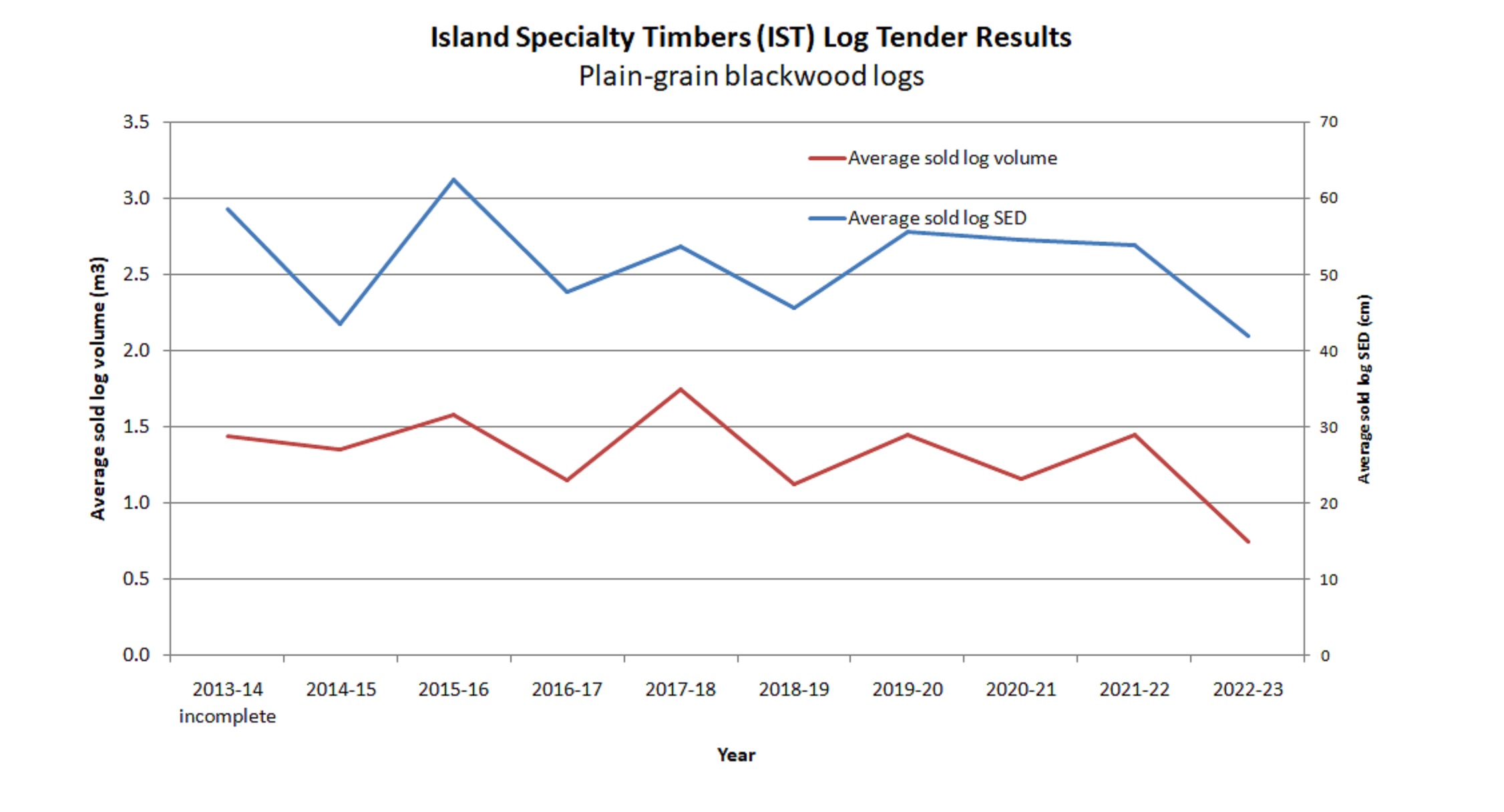
One possible explanation for the softer prices was the significant drop in log size from previous years. Smaller logs mean less sawn recovery per log volume so lower prices.
One figured grain blackwood log (1.6 cubic metres) was sold at tender for a $800/m3.
Generally ~9,000 cubic metres of blackwood is harvested annually from Tasmania’s public native forests with 99.99% being sold at heavily discounted Government prices on long term sales contracts.
The Tasmanian government dominates and deliberately undermines the blackwood log and timber market. These log tender results need to be interpreted bearing this fact in mind.
Premium plain grain sawlogs are what can be grown in blackwood plantations. The “target” sawlog in a blackwood plantation is 1.5 cubic metres in volume.
General Results
Overall a total of 198 cubic metres of special species sawlog and craftwood were put to public tender during the year. Forty five cubic metres failed to sell at tender, a significant increase over the last few years.
Apart from the June 2023 tender that contained a large volume of Huon pine material, 2022-23 continued the trend from last year of declining average prices.
Total tender revenue for 2022-23 was only $97,400 which is a significant drop from last year, and the result of the combined lower volumes and lower prices.
It’s a good thing Island Specialty Timbers is not run as a business otherwise they would be calling in the receivers. Just more taxpayer-funded welfare for the woodcraft industry.
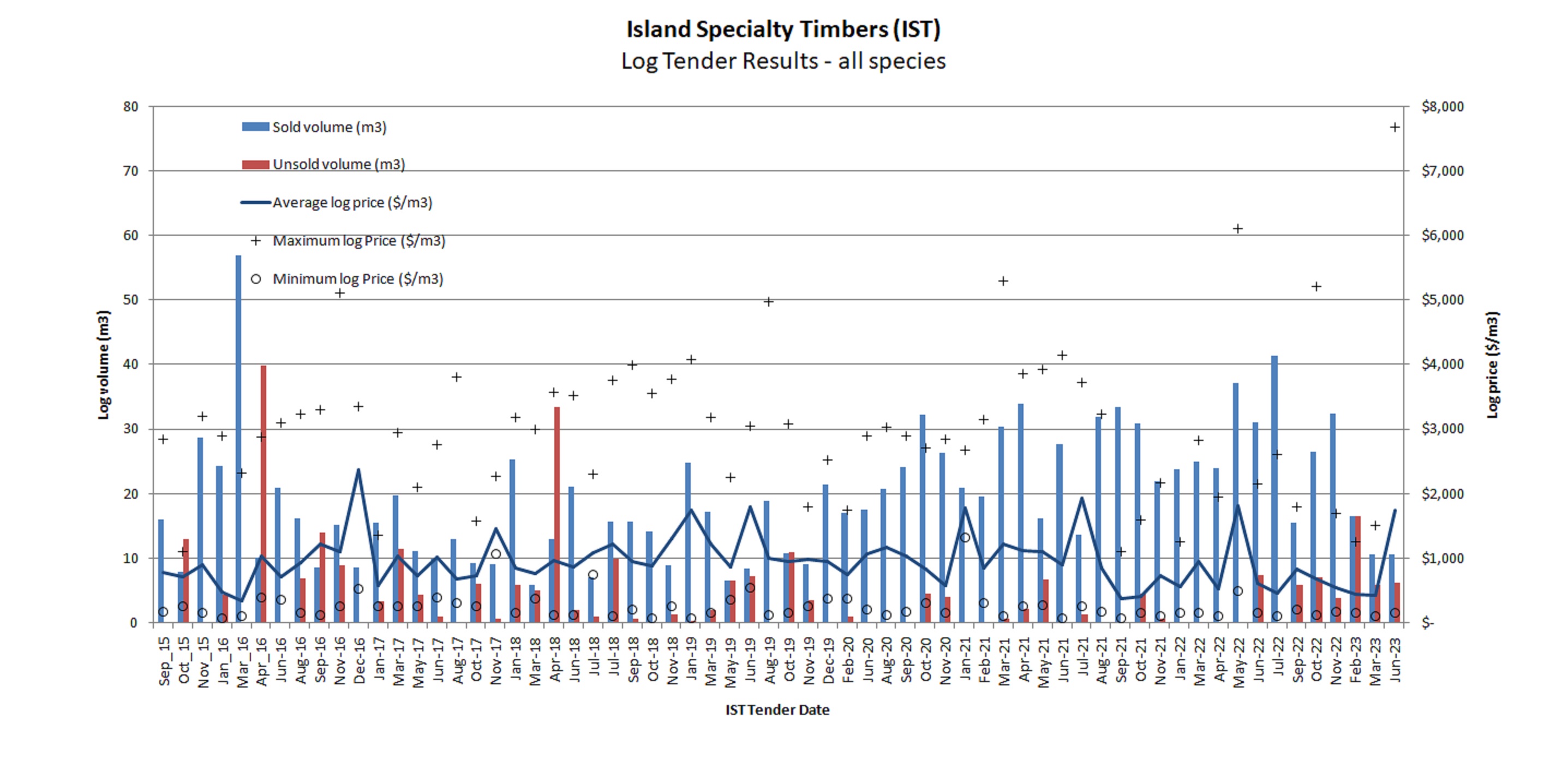
The one positive result for the year was a record price paid for a Tasmanian special timbers log. The June 2023 tender saw a Huon pine log (66cm LED, 47cm SED, 2.4m length, 0.41 cubic metres volume) sell for $7,675 per cubic metre. This continues the trend of the past five years of ever increasing maximum prices paid for quality premium timber.
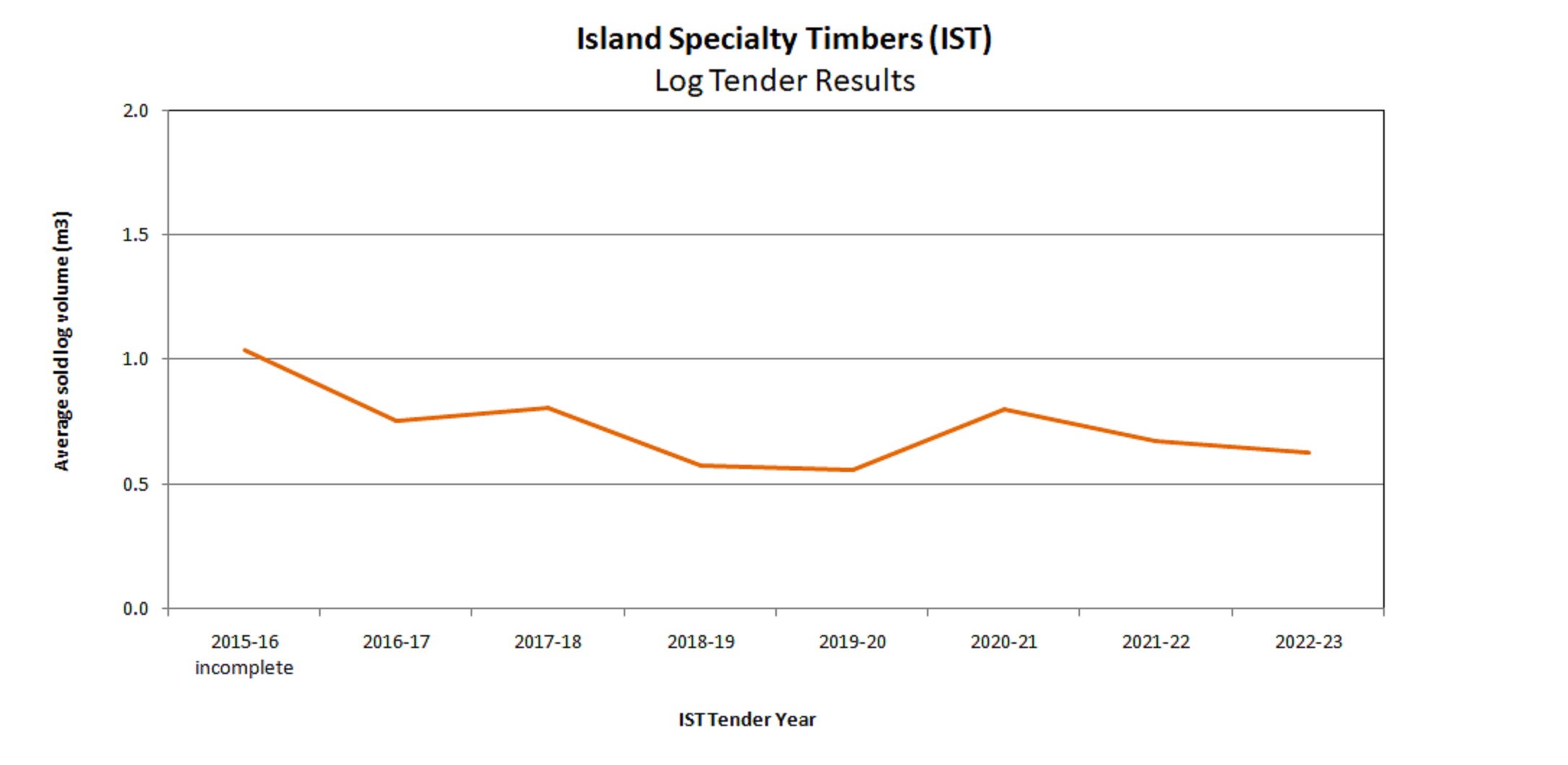
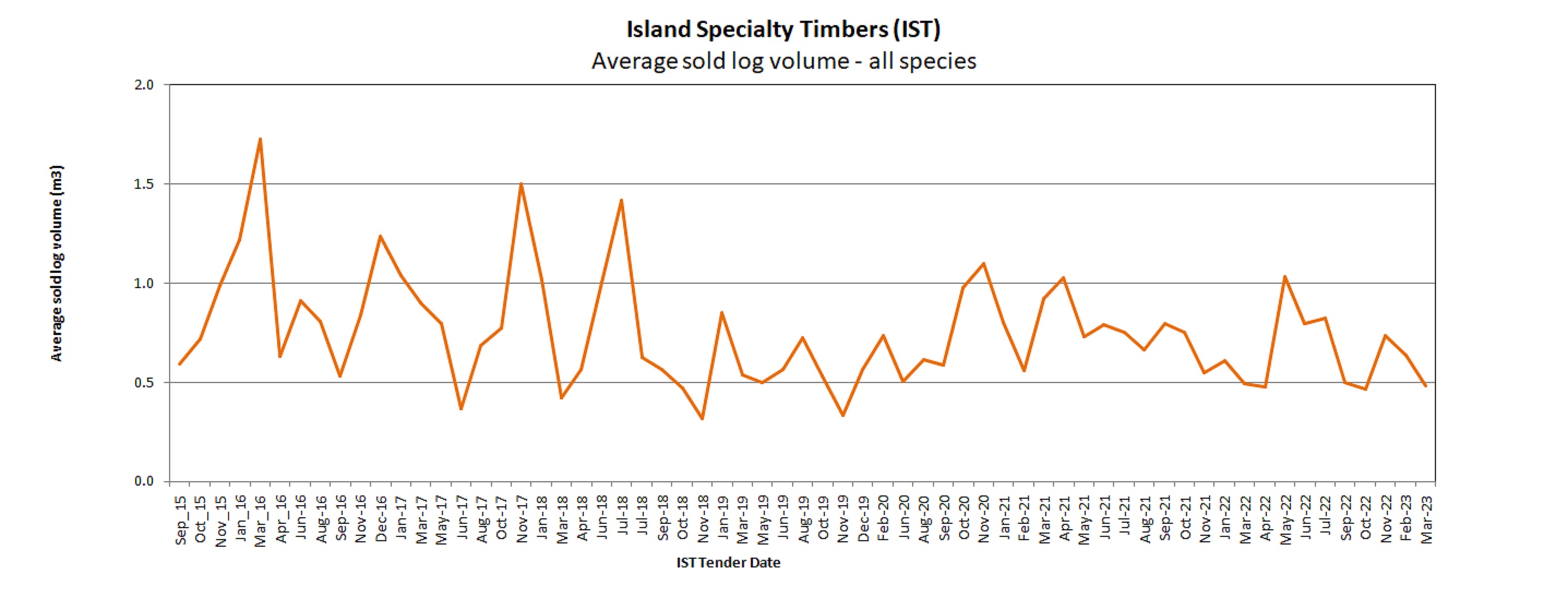
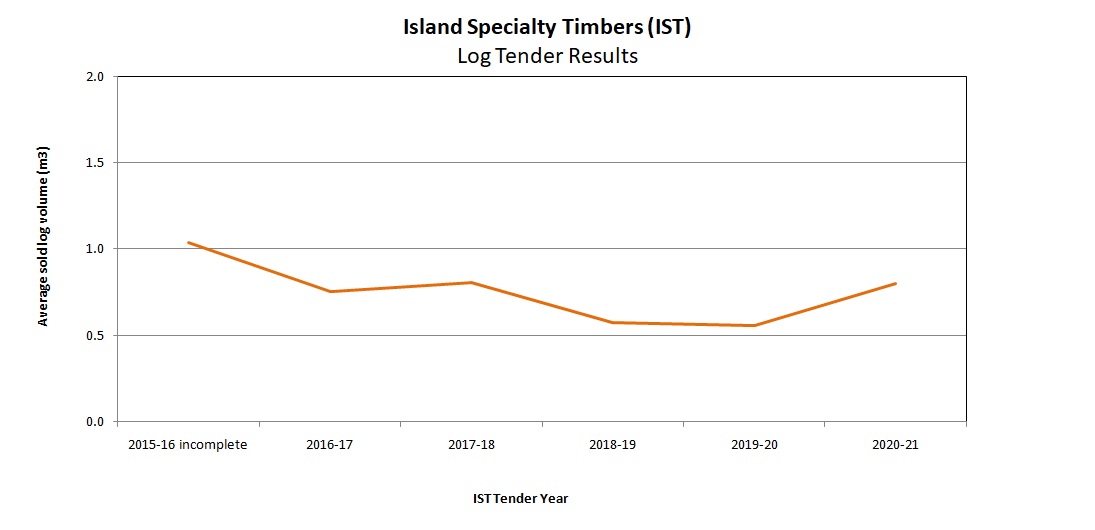
After a year 2020-21 where average log size increased, the last 2 years have seen a resumption of falling log size at the IST tenders.
Remember these IST tender sales represent tiny log volumes sold into the small southern Tasmanian market. They represent mill door prices not stumpages.
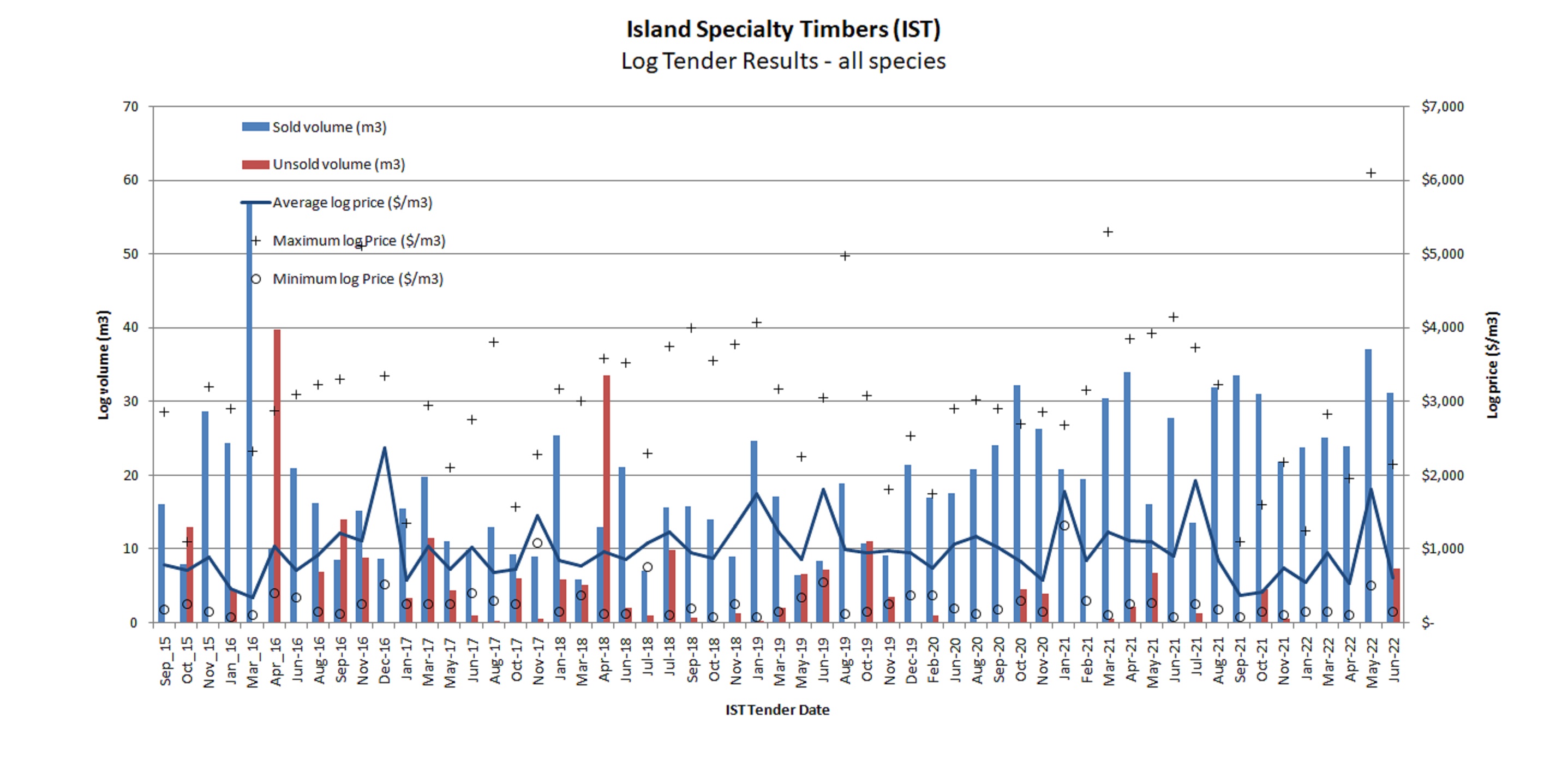
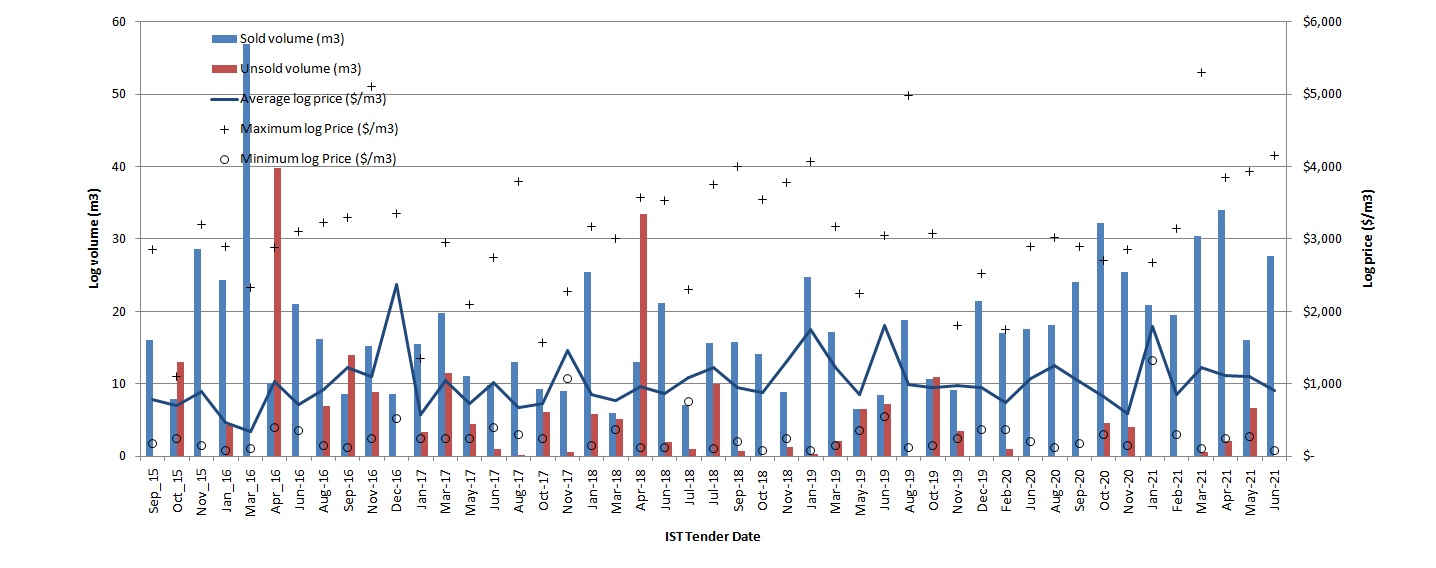
The following chart shows the volume and price summary for 64 log tenders back to 2015.
The tiny volumes and wide variability in species and quality of logs that IST put to tender makes assessing market trends over time difficult.
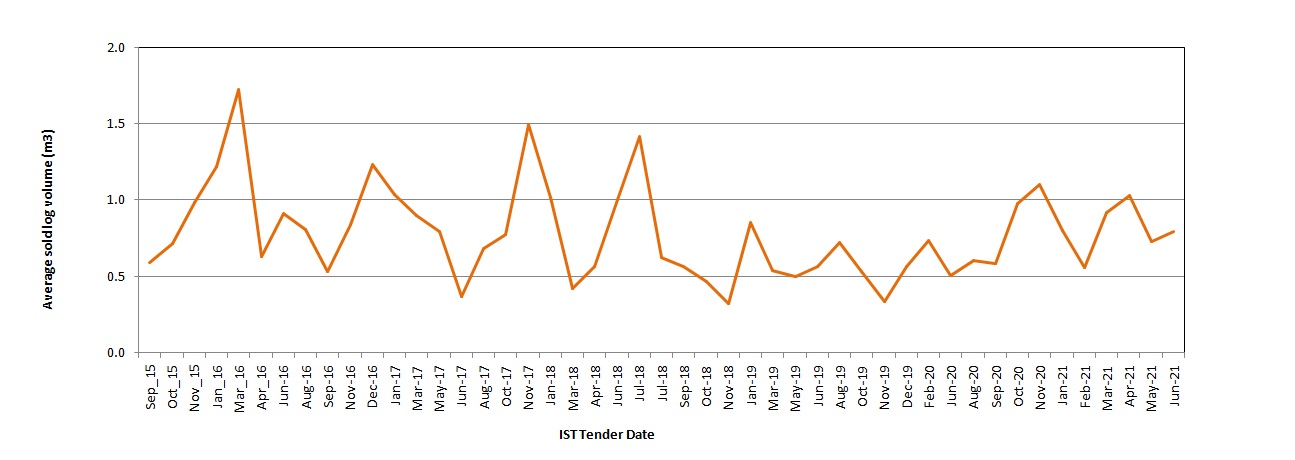
The following chart shows that average log size at the IST tenders continues to be very small. Extracting value out of these small logs must present quite a challenge for the buyers.
With Tasmania and New South Wales being the only States that have not committed to closing down public native forestry, the future of Island Specialty Timbers is now very much on borrowed time.
I won’t be writing these annual reports for much longer!
We will probably never know the real history of public native forestry in Victoria (or any other State for that matter) and the reasons why it failed. History was never on the side of native forest logging anyway, it was always a matter of time and circumstances.
New Zealand made the right decision 30 years ago. It’s a shame that Australia didn’t change then also. As a result the New Zealand forest industry is now much more advanced than ours in Australia.
The problem here in Australia is that the forest industry is preparing to die in the trenches over public native forestry. According to forest industry leaders, dying in the trenches is a better strategy than have a plan for the future. I can’t see the logic in that thinking myself.
Tasmania
Following the announcement in Victoria, the adrenalin started pumping over in Tasmania where forest industry leaders think they see a major commercial opportunity coming their way.
Swimming against the tide as usual the forest industry in Tasmania wants greater access to public forests to take advantage of the lack of competition on the mainland. Instead of seeing their future now very much on borrowed time, the Tasmanian industry thinks their ship has come in!!
That demonstrates beyond doubt just how utterly deluded the forest industry has become.
There is no doubt that New South Wales will be the next State to end public native welfare forestry in the next 1-3 years, leaving Tasmania as the recalcitrant State as usual.
After almost 60 years of forestry wars in Australia the end of the war is finally in sight.
Much damage has been done politically, environmentally and socially. Many people will never recover from their wounds and deep prejudices. Such is the way of human stupidity and ego.
Probably Tasmania is the State that has suffered the most from the Forestry Wars. It has permanently corrupted our political system and left the community deeply divided.
The damage to the Tasmanian forest industry is probably permanent.
In my next blog I will reflect on possible futures for timber markets and the forest industry.
For the past 30+ years we have been told by politicians and the forest industry that Tasmania’s public native forest industry is 100% sustainable and internationally certified (PEFC/Responsible Wood).
We have been told that ad nauseam!
But few people outside politics and the forest industry now believe the story anymore.
We have been told a lie!!
Never mind the incredible cost to Tasmanian taxpayers and our public forests.
So we now hear that the so called special timbers industry is running out of oldgrowth timbers.
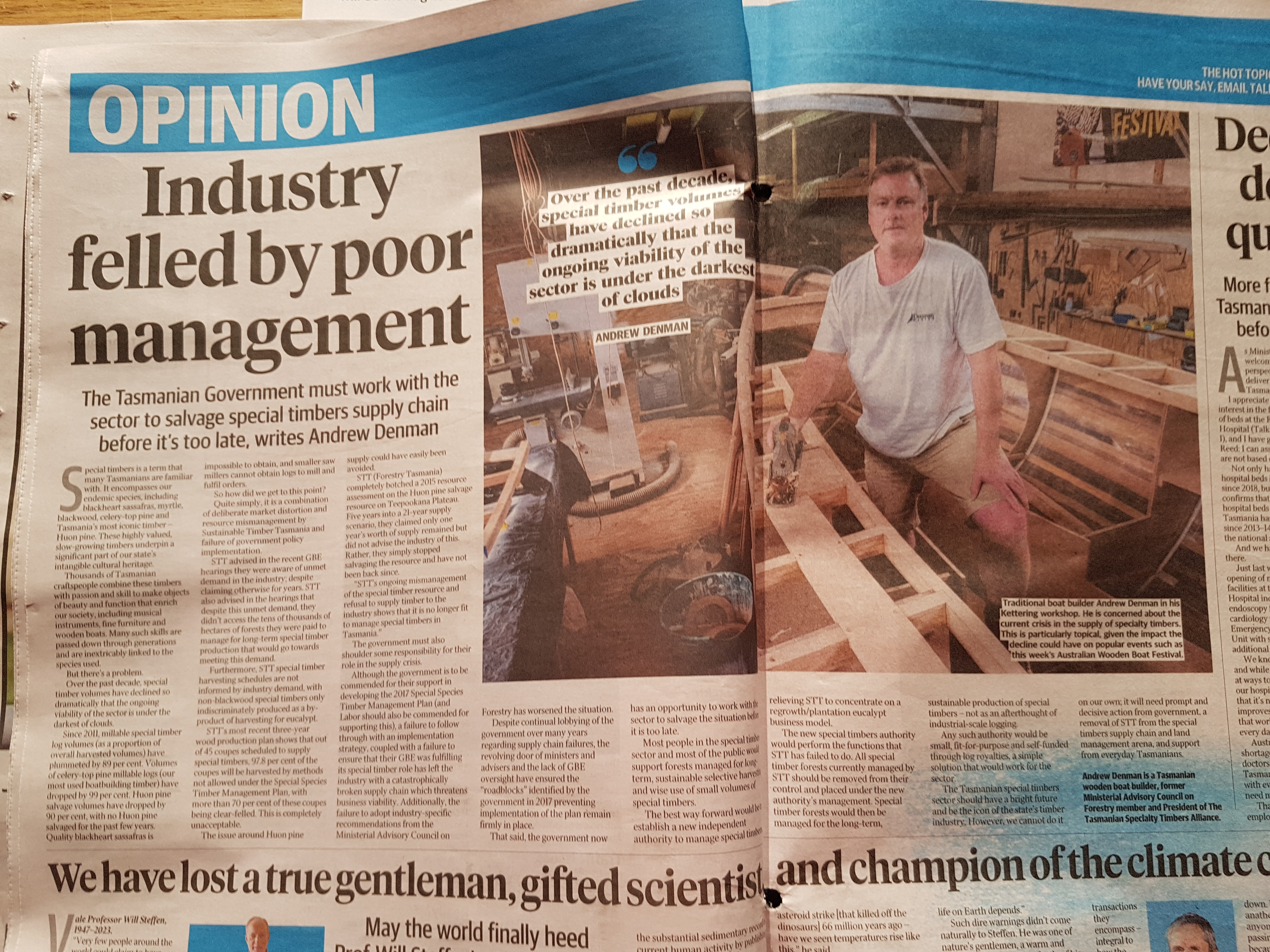
If half of what Mr Denman says of Government policy and STT management is true then Tasmanians should have no faith in either their politicians or their public servants.
With the Tasmanian public native forest industry likely to be shut down within the next 10 years, the special timbers industry are now crying poor. They want to quarantine their special timbers forest welfare from the closure of STT by creating a new government authority just for their welfare.
This article in The Mercury newspaper Tuesday 7th February is perfectly timed just a few days before the start of the Australian Wooden Boat Festival in Hobart. It wouldn’t surprise me if a deal has already been stitched up with the Tasmanian State government to establish a Special Timbers Authority, and the Premier will announce it at the Festival this weekend.
The idea that the politicians who created this mess are now going to fix it is utterly laughable!!
And of course the subtext for this article is that if this proposal doesn’t happen then the wooden boat festival will cease to exist. As I said in my previous blog the Tasmanian government and the Tasmanian community are being held to ransom by the wooden boat community and the rest of the special timbers rentseekers.
“The failure [of the government] to follow through with an implementation strategy, coupled with a failure to ensure that their GBE [ie. STT] was fulfilling its special timbers role….” says enough! For the Government, special timbers is just another political football to gain votes at election time, nothing else!! All promise! No delivery!! And the wooden boat community expect this to change?
The plundering of Tasmania’s oldgrowth forests will continue for many years yet it seems. National Parks and Reserves will not be safe either I suspect.
Mr Denman deliberately ignores the cost to the Tasmanian taxpayer and to Tasmanias oldgrowth forests. Matters of welfare and plunder are apparently unimportant to the wooden boat community.
There is no scientific, economic or social model on which the Special Timbers Authority can stand. It is a smoke screen for plunder-as-usual!
“Most people in the special timbers sector and most of the public would support forests managed for long-term selective harvesting and wise use of small volumes of special timbers”. I would love to see where Mr Denman gets his data for such a grandiose statement. Given the history of politics and the forest industry in Tasmania that really is utter delusion!
“Any such [special timbers] authority would be small, fit-for-purpose and self-funded through log royalties, a simple solution that would work for the sector”. I would classify that statement as a blatant lie!
Industry Felled by greed, ignorance, corruption and politics, and that includes every single forest welfare recipient/rentseeker.
The idea of cutting down 500-1000+ year-old trees to satisfy a handful of boat owners in the 21st century is insanity writ large. Welcome to Tasmania!
With this article in The Mercury newspaper the Australian Wooden Boat Festival has deliberately and intentionally march into the forest war zone! Both the Australian Wooden Boat Festival and the Special Timbers Authority will become the focus of community protest and demonstration. That is 100% guaranteed and apparently what the wooden boat community wishes.
IST is a business enterprise of Sustainable Timber Tasmania (STT) which sources and retails raw material of Tasmanian specialty timbers from harvest or salvage operations conducted on State owned Permanent Timber Production Zone land (PTPZl).
IST is not really a “business” just as the State forest agency Sustainable Timber Tasmania is not a business either. Logging of public native forest in Tasmania requires significant taxpayer subsidies every year.
IST conducted 10 log tenders during the year with 286 cubic metres of special species logs put to public tender. Tasmania defines “special species” as any native forest timber apart from plain grain Tasmanian oak.
Blackwood Results
This is the important bit……
2022 was another champagne year for blackwood, continuing the strong market demand and prices from 2021.
2021 was the year that plain-grain blackwood sawlog broke the $1,000 per cubic metre price barrier. 2022 continued that trend with a record price of $1,150 per cubic metre.
The chart below shows blackwood sales results for the year.
A total of 15 blackwood logs (21.7 cubic metres) were put to tender this year, all of it plain grain. All logs were sold, for an average price of $643 per cubic metre, or a total of $13,950. Average log volume was 1.45 cubic metres – a good size sawlog!
A stand-out result for the year was a massive 2.46 cubic metre blackwood log that sold for $925 per cubic metre, with a total price of $2,276!
The above chart shows a return to strong demand and strong prices for quality plain grain blackwood sawlogs following the pandemic year of 2019-20, with maximum and average prices showing strong increases.
This is the greatest volume of blackwood that IST has put to tender for quite some time, despite the fact that blackwood makes up more than 90% of special species harvested from public native forest in Tasmania. Generally ~9,000 cubic metres of blackwood is harvested annually with 99.999% being sold at heavily discounted Government prices on long term sales contracts.
The Tasmanian government dominates and undermines the blackwood log and timber market. These log tender results need to be interpreted bearing this fact in mind.
Premium plain grain sawlogs are what can be grown in blackwood plantations.
Will this result capture the attention and imagination of Tasmanian farmers?
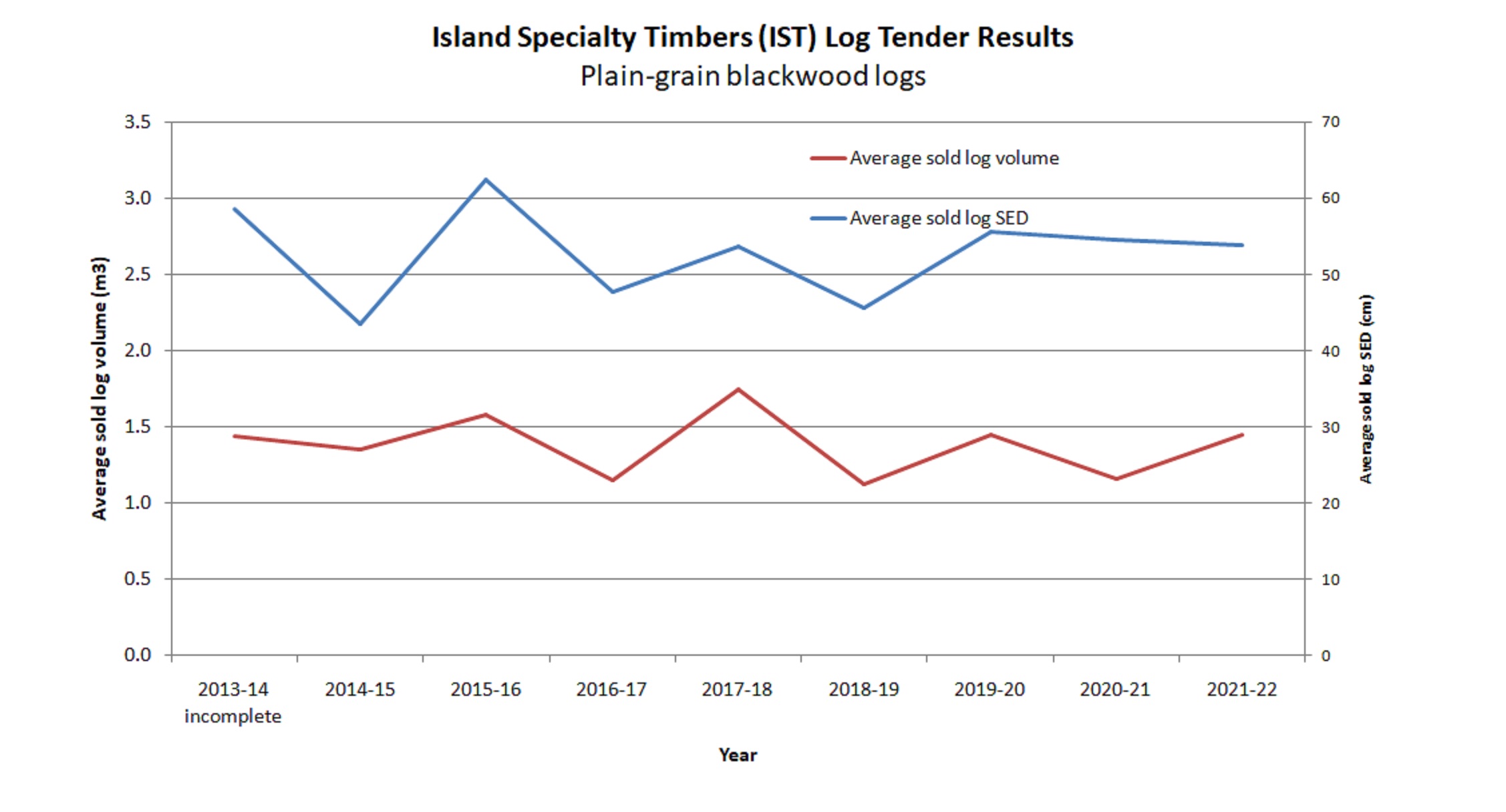
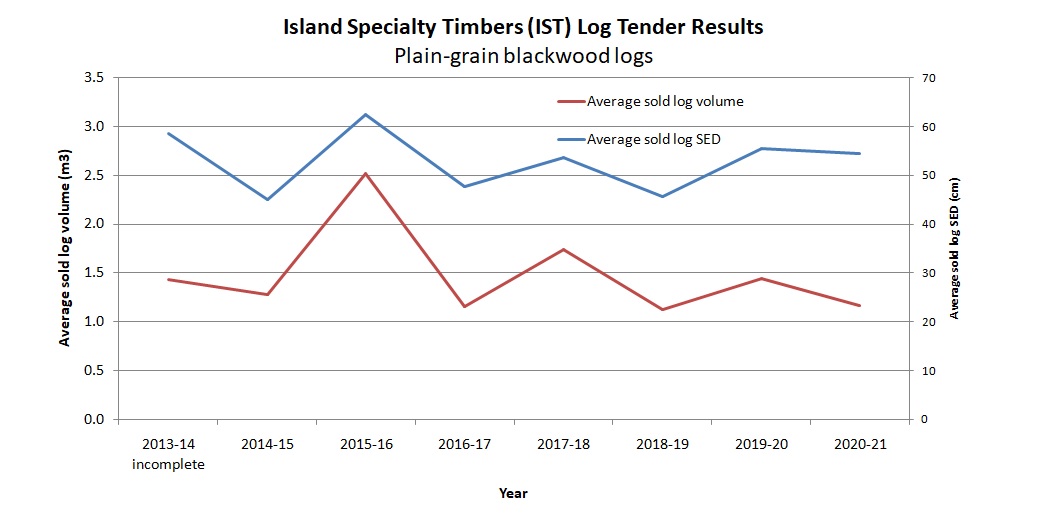
The following chart shows the average size characteristics of plain grain blackwood logs sold at IST tender. The target sawlog from a blackwood plantation has a volume of 1.5 cubic metres and a small end diameter (SED) of around 50 cm.
Remember these IST tender sales represent tiny log volumes sold into the small southern Tasmanian market. They represent mill door prices not stumpages.
Imagine if IST put 10 cubic metres of blackwood sawlog at each tender (100 cubic metres per year) to attract mainland and maybe even overseas buyers.
Imagine if State government forest policy was about profitable tree growers and not sawmill welfare.
Imagine what that change would do for the forest industry and Tasmanian farmers!
These positive blackwood log market signals should be resulting in more blackwood plantations being established, helping to build the industry and make Tasmanian farmers more profitable.
One hectare of well managed blackwood plantation has the potential to produce approx 300 cubic metres of premium sawlog after 30 – 35 years. At $1,000 per cubic metre that equates to $300,000 per ha in todays market.
General Results
Overall IST put 286 cubic metres of specialty timbers to tender in 2021-22 of which 13.8 cubic metres was not sold. Total tender revenue was $230,400.
Last year Sustainable Timbers Tasmania sold 8,825 cubic metres of specialty timbers, so these competitive tender sales represent a mere 3% of specialty timber sales from public native forests in Tasmania.
With the exception of the July 2021 and May 2022 tenders, the tender results were poor with maximum and average prices well down on previous years (see chart below).
The July 2021 tender was dominated by Black heart sassafras logs which generally attract high prices, whilst the May 2022 tender was dominated by Black heart sassafras, Tiger myrtle and figured Huon pine, all of which are premium species attracting premium prices. These tender results show that the market is still prepared to pay premium prices for rare, quality logs.
It was at the latter tender that a new record IST tender price was set for a special species sawlog. This log was a 0.94 cubic metre Tiger myrtle log that sold for $6,100 per cubic metre, total price $5,734!
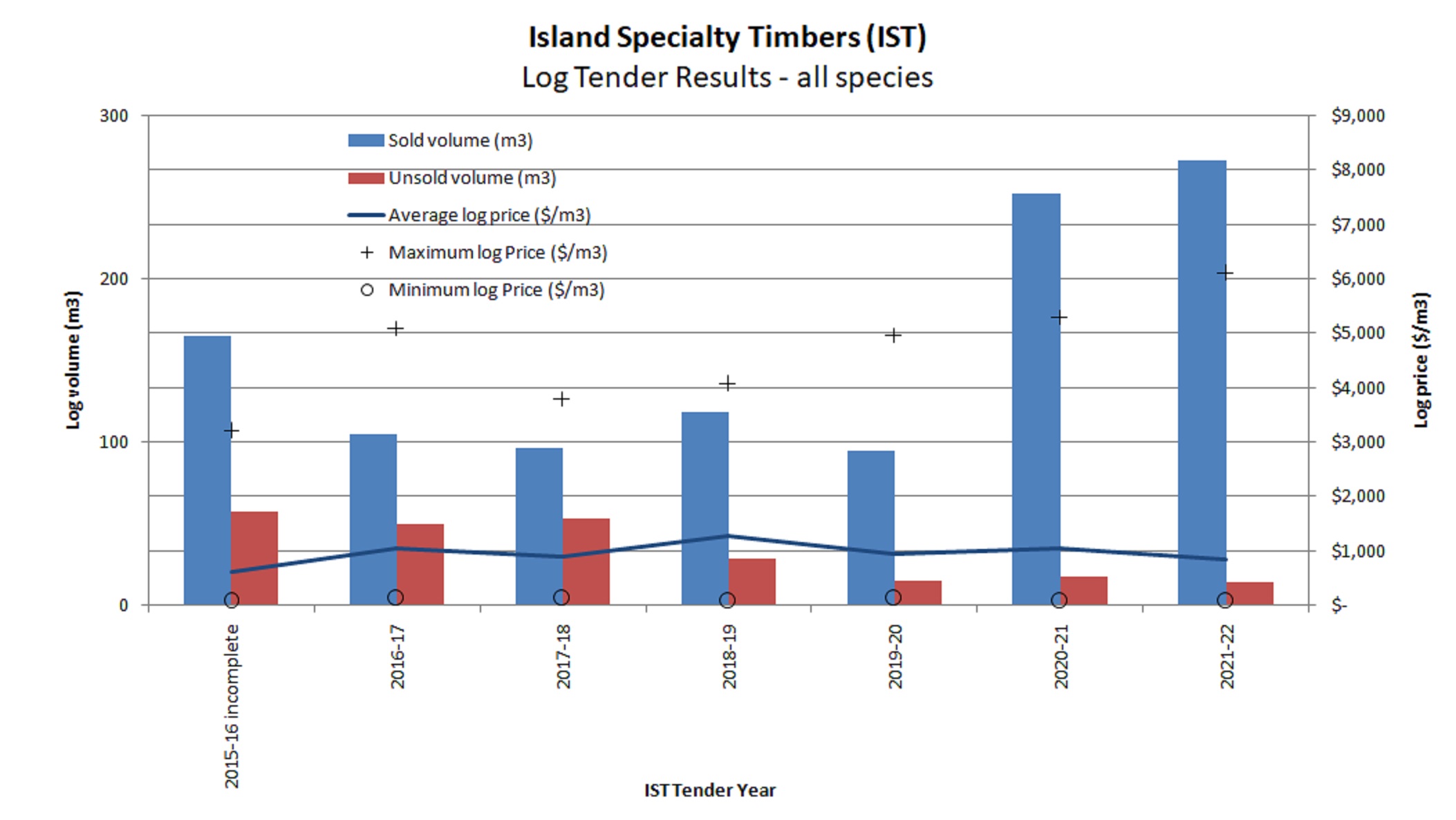
The following chart shows the volume and price summary for 57 log tenders back to 2015.
The tiny volumes and wide variability in species and quality of logs that IST put to tender makes assessing market trends over time difficult.
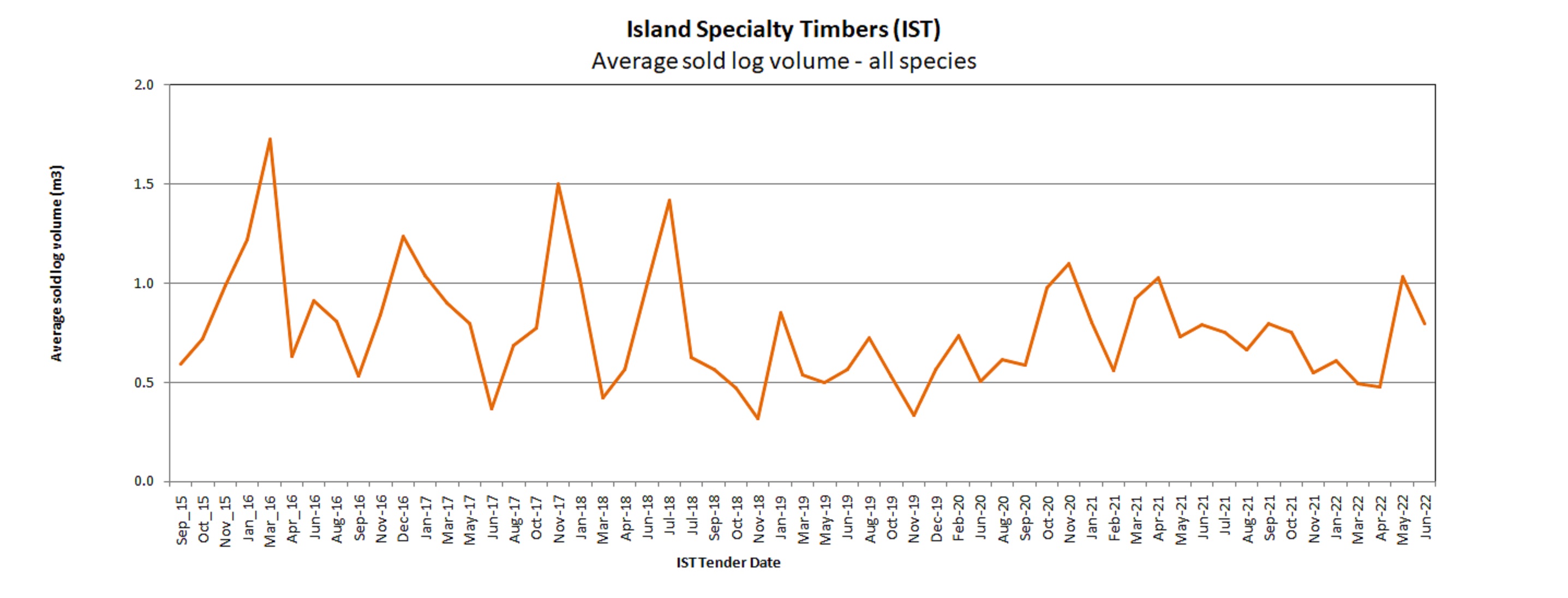
The next chart shows the average volume of the sold logs. Here there is a clear trend of diminishing log size. If it wasn’t for the occasional large eucalypt log IST throws into the tender mix, this trend of diminishing log size would be even more pronounced. The last 12 months shows a steady decline in log size so it is not surprising that prices have reflected a general decline in log quality.
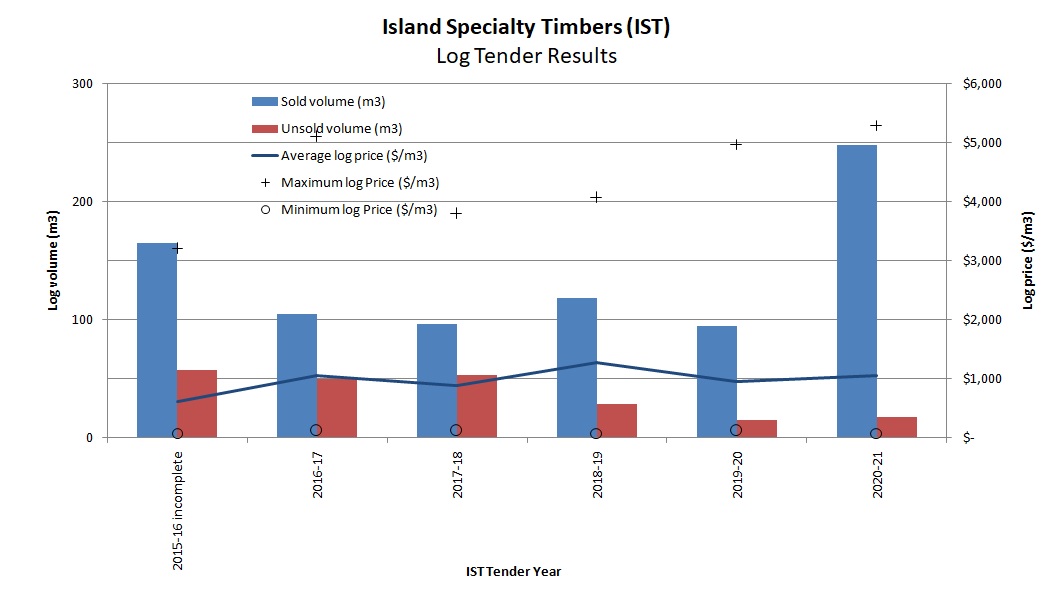
The following 2 charts show the above data summarised by year:
Continuing the trend from last year 2021-22 saw a “significant” volume of specialty species logs put to tender. Despite the higher volumes, average prices have declined, probably in part due to declining log quality.
The average price for all species put to tender in 2022 was $844 per cubic metre, well down from $1,043 per cubic metre in 2021.
The above chart shows a steady rise over the last 4 years in the maximum price paid for these dwindling ancient timber resources, whilst average and minimum prices remain relatively steady.
The main focus of IST tenders is black heart sassafras (Atherosperma moschatum) which can command very high prices for good logs. It made up 35% of log volume put to tender in 2022.
However the tree is slow growing (500+ years to reach commercial size) and is restricted to rainforest and old growth eucalypt forest, so supplies of this species are dwindling.
Blackwood made up just 8% of the volume IST put to tender.
Unfortunately the marketplace continues to show strong support for the plundering of the last of Tasmania’s ancient forests!
Island Specialty Timbers (IST), the only source of competitive, transparent market blackwood log prices, conducted 10 log tenders during the year, making up for the shortfall last year due to the pandemic.
IST is a business enterprise of Sustainable Timber Tasmania (STT) which sources and retails raw material of Tasmanian specialty timbers from harvest or salvage operations conducted on State owned Permanent Timber Production Zone land (PTPZl).
You can read my previous annual tender summaries here:
2021 was the year that plain-grain blackwood sawlog broke the $1,000 per cubic metre price barrier!
Prices for good quality plain grain blackwood sawlogs have been sitting above $800 per cubic metres for the last few years, as seen in the chart below, but this year they broke through the price ceiling.
Premium plain grain sawlogs are what can be grown in blackwood plantations.
Will this result encourage Sustainable Timbers Tasmania/IST to put more blackwood sawlogs to tender?
Will this result capture the attention and imagination of Tasmanian farmers?
This year IST put 10 blackwood logs to tender, a total of 11.9 cubic metres, or 4.4% of the total volume put to tender for the year.
One log was unsold at tender, as was a 2 cubic metre pack of sawn blackwood boards.
Two logs had feature grain and sold between $1,250 and $1,300 per cubic metre.
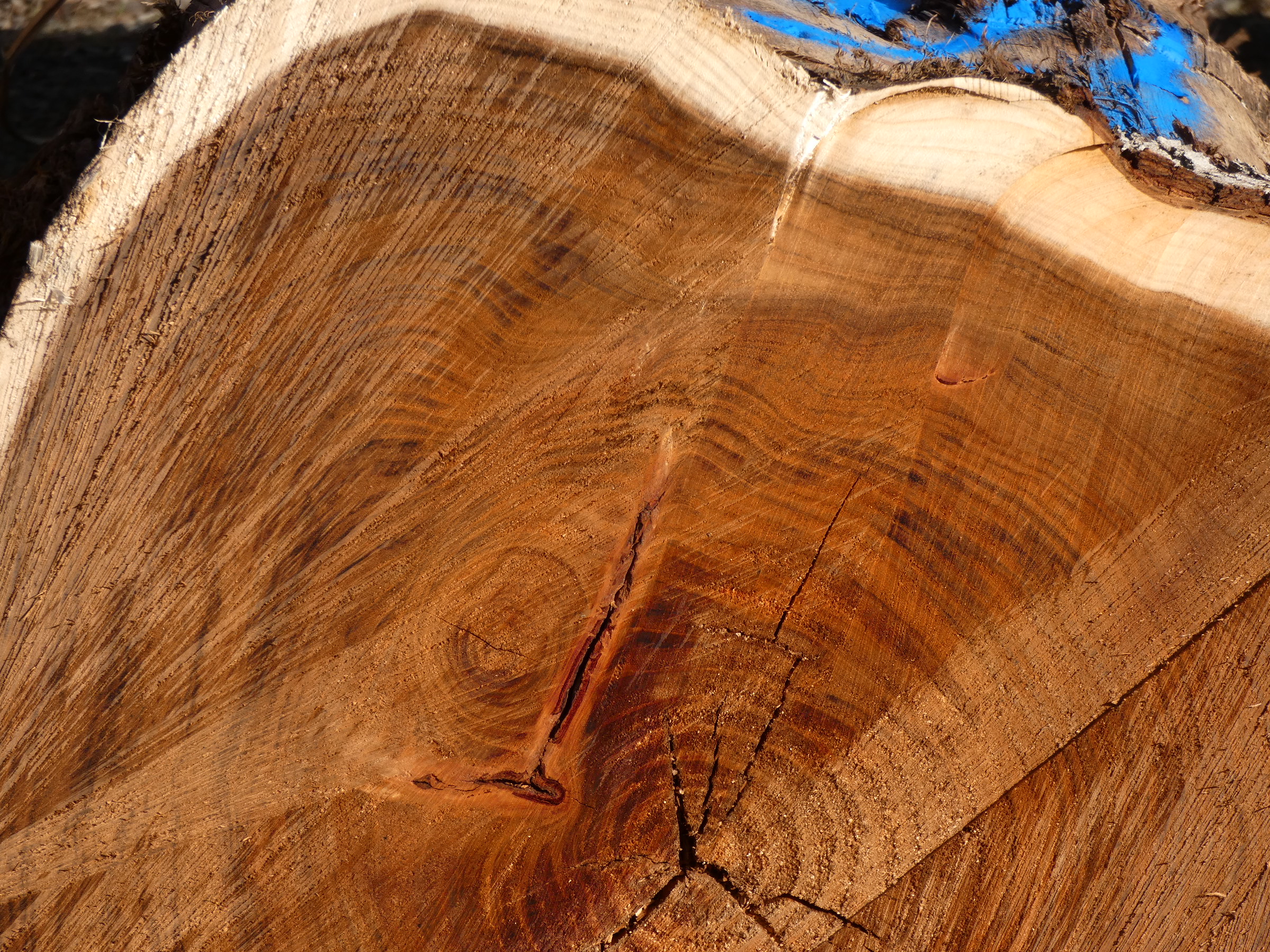
The other 7 logs were plain grain, with prices ranging from $300 to $1,100 per cubic metre. Lower prices were paid for smaller logs and logs with defects (spiral grain, scars, branch knots).
Higher prices were paid for large, good quality logs.
All up the 8.14 cubic metres of plain grain blackwood logs sold for $4,259.
The following chart shows the average size characteristics of sold plain grain blackwood logs. The target sawlog for a blackwood plantation has a volume of 1.5 cubic metres and a small end diameter (SED) of around 50 cm.
Remember these are tiny log volumes sold into the small southern Tasmanian market. They represent mill door prices not stumpages.
As usual IST has a policy of minimising the amount of blackwood logs it puts to tender, despite the fact that around 10,000 cubic metres of blackwood are harvested from public native forests in Tasmania each year, and sold at “Government prices”.
Imagine if IST put 10 cubic metres of blackwood sawlog at each tender, to attract mainland and maybe even overseas buyers.
Imagine if Government forest policy was about profitable tree growers and not sawmill welfare.
Imagine what that change would do for the forest industry and Tasmania!
These positive blackwood log price signals should be resulting in more blackwood plantations being established, helping to build the industry and make Tasmanian farmers more profitable.
One hectare of well managed blackwood plantation has the potential to produce approx 300 cubic metres of premium sawlog after 30 – 35 years. At $1,000 per cubic metre that equates to $300,000 per ha in todays market.
How many Tasmanian farms have difficult corners, steep slopes and weedy areas that could be more productive growing quality wood?
General Results
Overall IST put 272 cubic metres of specialty timbers to tender in 2020-21 of which 252 cubic metres sold for total revenue of $262,700.
Last year Sustainable Timbers Tasmania sold 7,921 cubic metres of specialty timbers, so these competitive tender sales represent a mere 3% of specialty timber sales from public native forests in Tasmania.
The following chart shows the volume and price summary for all log tenders back to 2015. The price spike in the January 2021 tender was due to this tender being an all Huon pine (Lagarostrobos franklinii) tender.
The tiny volumes and wide variability in species and quality of logs that IST put to tender makes assessing trends over time difficult.
The next chart shows the average volume of the sold logs. Here there is a clear trend of diminishing log size. If it wasn’t for the occasional large eucalypt log IST throws into the tender mix, this trend of diminishing log size would be even more pronounced.
The following 2 charts show the above data summarised by year:
2020-21 was significant for a) the major increase in volume of specialty timbers put to tender, and b) a record unit price set for a single log at IST.
The record unit price of $5,300 per cubic metre was for a Black heart sassafras log at the March 2021 tender. The log was only 2.5 metres long with a volume of only 0.16 cubic metres, so total price was only $850!!
The highest price paid for a single log was at the same March 2021 tender where another Black heart sassafras log of 1.3 cubic metres sold for $5,570.
The main focus of IST tenders is black heart sassafras (Atherosperma moschatum) which can command very high prices for good logs.
However the tree is slow growing (500+ years to reach commercial size) and is restricted to rainforest and old growth eucalypt forest, so supplies of this species are dwindling.
Surprisingly the marketplace continues to support the plundering of Tasmania’s last ancient forests!
Five Year Review
Again it is important to recognise that this data represents tiny volumes sold into the small southern Tasmanian market. The results DO NOT represent the wider Tasmanian, Australian or international markets.
The results are also influenced by the fact that IST is NOT a commercial business. Like its parent Sustainable Timbers Tasmania, IST is NOT obliged to make a profit. These rare timber resources are brought to market at taxpayer expense.
Looking at the annual aggregate results of the IST tenders three trends are apparent:
the maximum price paid for quality wood is increasing; and
the volume unsold at tender is decreasing. Whether this is due to a) IST becoming better at excluding logs that will not sell, and/or b) increasing demand for quality wood, is unclear. The fact that both the average and minimum prices paid remain steady indicates better log selection rather than increasing demand. Certainly the quality of product put to tender by IST varies enormously.
the average price paid for quality wood has not changed over the last 5 years, remaining at around $1,000 per cubic metre.
The 7-year trend for plain grain blackwood logs is less clear, but the volumes are microscopic!
In general the prices paid for plain grain blackwood logs have been good, with indications in the last few years of solid price increases.
Since blackwood is the only Tasmanian specialty timber species that can be grown in commercial plantations, this is good news!
Will the Government and the forest industry make use of this valuable positive market information?







 Tasmanian Blackwood Growers Cooperative
Tasmanian Forest Economics Congress – what next?
The much anticipated MONA Forest Economics Congress has been and gone.
I wrote a commentary back in August when the event was first announced.
I did not get an invitation to the congress so I cannot write from personal experience, only from what I have read and my long history in Tasmanian politics and the forest industry.
The congress received considerable media coverage, especially on the mainland.
The only post-congress media coverage was the following article in The Mercury newspaper Saturday 2nd December.
To date MONA has not published any details about the congress – who were the speakers, what was discussed, what was agreed and what was disagreed?
https://mona.net.au/blog/2023/08/forest-economics-congress-new-a-class
As expected, the usual suspects attempted to make political mileage out of the congress, rather than act in a respectful and positive manner. There are plenty of people who want the status quo to remain.
The further “working sessions” that Ms Kaechele plans to organise should be interesting. Where is all this discussion heading? Any change in the forest industry status quo will inevitably result in winners and losers. How do we stop this becoming yet another forestry bun fight?
Edit: We have had “collaboration” before in 2011-2012 with the 2013 Tasmanian Forestry Agreement, but that collaboration was betrayed by Tasmania’s corrupt political system and the 2014 Tasmanian State election. The corrupt political system remains a major threat to Ms Kaechele’s plans.
The fundamental problem is that public native forestry is a political decision made by the Tasmanian government, and the Tasmanian parliament has made it perfectly clear that the status quo is unlikely to change.
If Ms Kaechele wishes to promote change in the forest industry and politics, then she must engage with the wider Tasmanian community. Otherwise she risks repeating the disaster of the 2013 Tasmanian Forestry Agreement/2014 State election. She, and the members of the congress, must convince a significant portion of the Tasmanian community that a better future is available. Otherwise the congress will become yet another forestry political football used to divide and destroy the Tasmanian community, just like the 2013 Forestry Agreement.
The failure of both the Tasmanian government and the Tasmanian forest industry to respond positively to the congress may well be the straw that finally breaks the camel’s back. This charade called public native forestry is teetering on the brink. Any player in the charade may finally decide the game is over, and bring the house of cards crashing to the ground.
We can only hope!!
3 Comments
Posted in Commentary, Politics, Public Native Forestry, Sustainable Timbers Tasmania, Tasmanian Forest Products Association
Tagged MONA