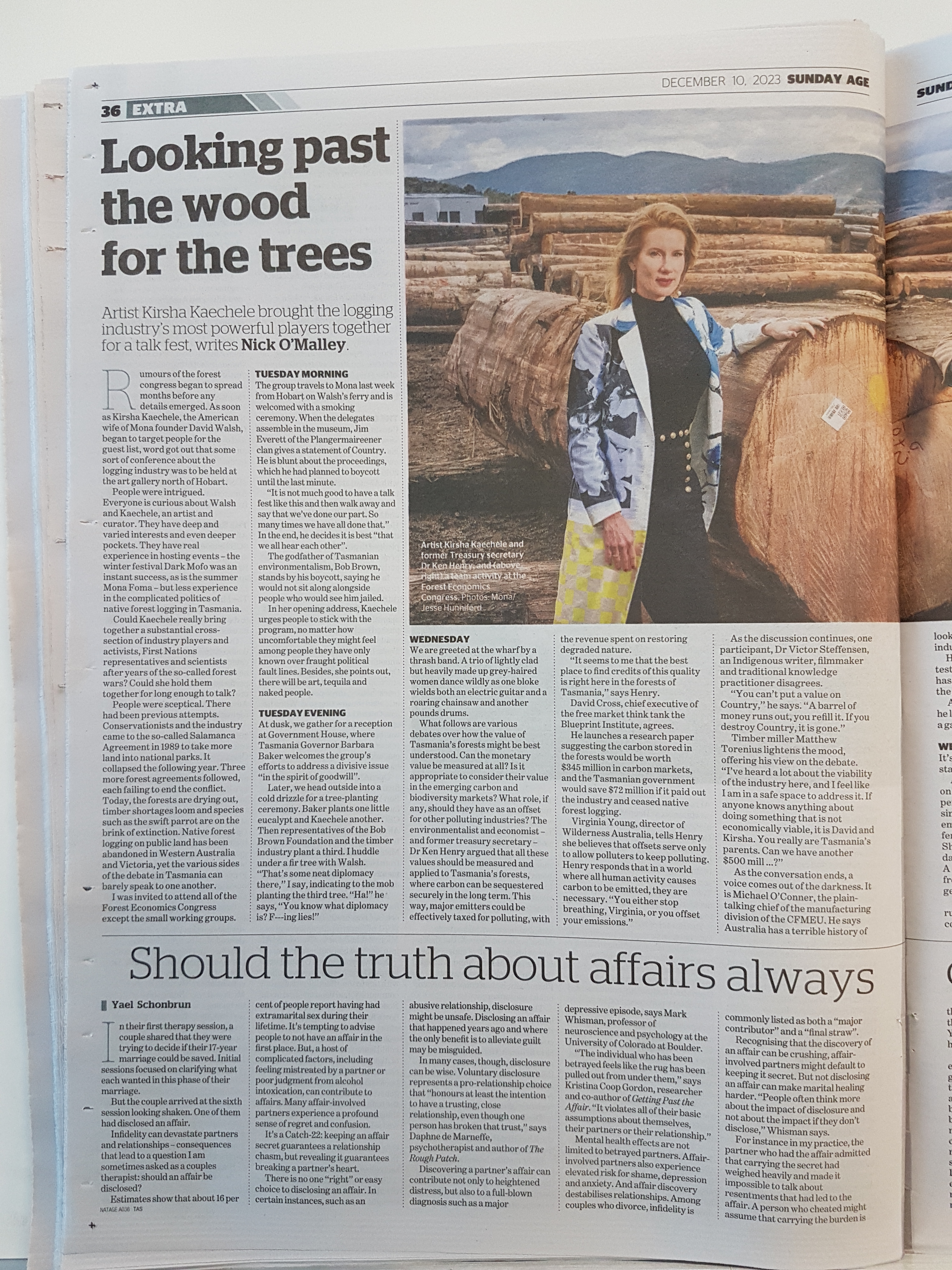
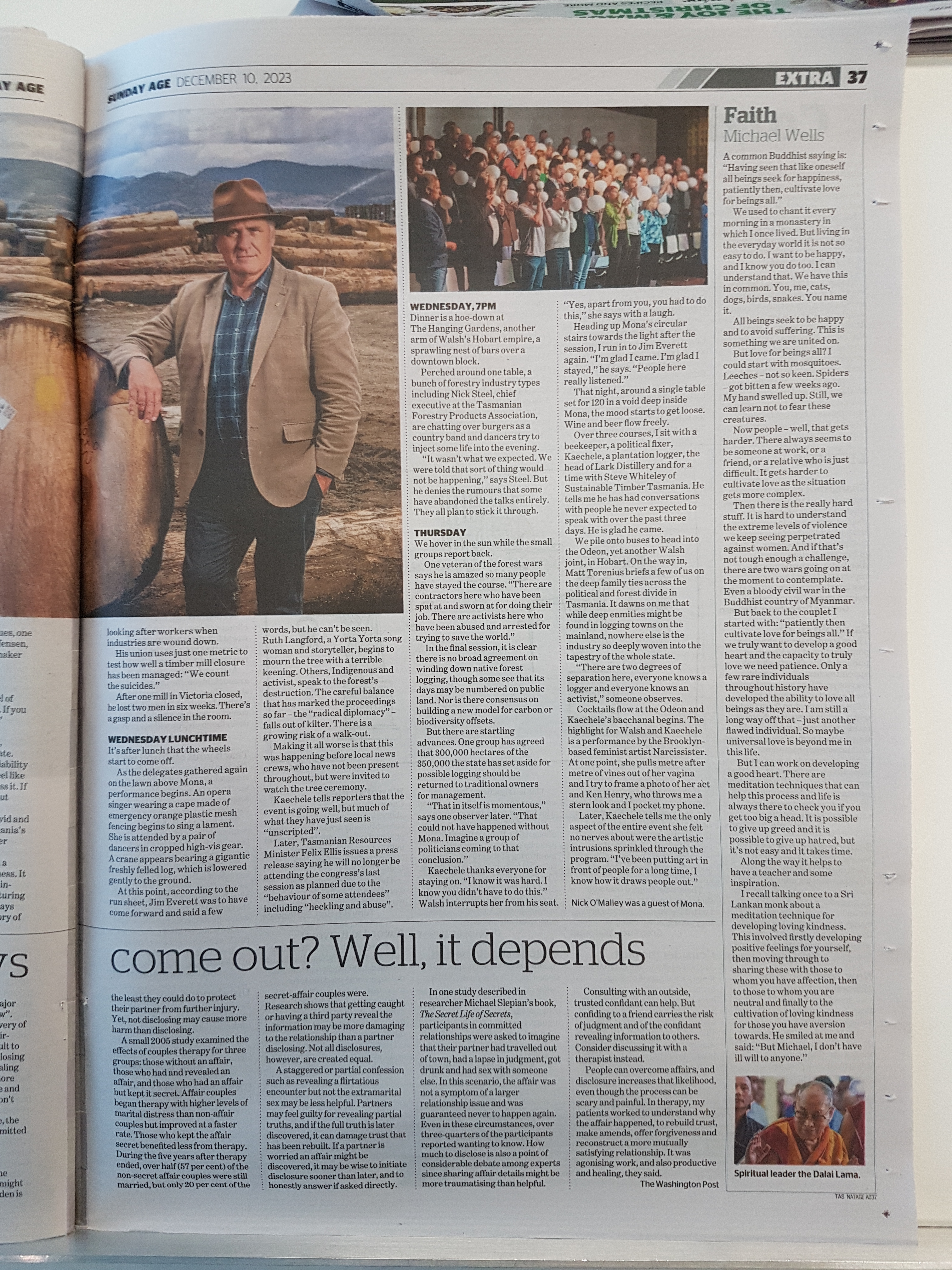
The following 2 page article appeared in The Age newspaper Sunday 10th December written by Nick O’Malley. It is a superficial summary of the three day congress:
It’s a long and wordy article that provides few insights into what actually happened at the congress apart from the artistic interludes.
Given that it took many painful months of negotiation to conclude the 2012 Tasmanian Forestry Agreement, a three day meeting was hardly going to start a revolution.
One gets the impression that the congress made little progress..
The fact that the congress didn’t even issue a joint communiqué expressing thanks to Messrs Kaechele and Walsh, and a hope for the future, tells us that there is unlikely to be any subsequent meetings.
If Ms Kaechele wishes to resolve the 40+ year old Tasmanian Forestry Wars she will have to be more creative and imaginative. A less direct approach to the problem may provide surprises.
I did not get an invitation to the congress so I cannot write from personal experience, only from what I have read and my long history in Tasmanian politics and the forest industry.
The congress received considerable media coverage, especially on the mainland.
The only post-congress media coverage was the following article in The Mercury newspaper Saturday 2nd December.
To date MONA has not published any details about the congress – who were the speakers, what was discussed, what was agreed and what was disagreed?
As expected, the usual suspects attempted to make political mileage out of the congress, rather than act in a respectful and positive manner. There are plenty of people who want the status quo to remain.
The further “working sessions” that Ms Kaechele plans to organise should be interesting. Where is all this discussion heading? Any change in the forest industry status quo will inevitably result in winners and losers. How do we stop this becoming yet another forestry bun fight?
Edit: We have had “collaboration” before in 2011-2012 with the 2013 Tasmanian Forestry Agreement, but that collaboration was betrayed by Tasmania’s corrupt political system and the 2014 Tasmanian State election. The corrupt political system remains a major threat to Ms Kaechele’s plans.
The fundamental problem is that public native forestry is a political decision made by the Tasmanian government, and the Tasmanian parliament has made it perfectly clear that the status quo is unlikely to change.
If Ms Kaechele wishes to promote change in the forest industry and politics, then she must engage with the wider Tasmanian community. Otherwise she risks repeating the disaster of the 2013 Tasmanian Forestry Agreement/2014 State election. She, and the members of the congress, must convince a significant portion of the Tasmanian community that a better future is available. Otherwise the congress will become yet another forestry political football used to divide and destroy the Tasmanian community, just like the 2013 Forestry Agreement.
The failure of both the Tasmanian government and the Tasmanian forest industry to respond positively to the congress may well be the straw that finally breaks the camel’s back. This charade called public native forestry is teetering on the brink. Any player in the charade may finally decide the game is over, and bring the house of cards crashing to the ground.
The Australia Institute is hosting this event at the Hobart Town Hall 1.00 pm Tuesday 14th November.
I wish I could go, but I’ll be away then.
So here are my thoughts on how to end Public Native Welfare Forestry in Tasmania.
The Tasmanian Parliament WILL NEVER, EVER END THE FORESTRY WARS!
That fact is perfectly clear!
Therefore the end of public native forest logging in Tasmania MUST come from outside Tasmania, either from Canberra or the marketplace.
Forest protests have very limited impact on Government policy and no impact on the marketplace.
The current Federal Labor government, led by Prime Minister Anthony Albanese, has proven itself to be a conservative Liberal government in disguise. The Federal Labor government will not enter the national forestry wars!
This leaves us with only one choice – the marketplace!
Traditionally the Australian timber marketplace has been more than happy to support the continuing plunder of our public native forests in the face of overwhelming data and community opposition. Tens of thousands of Australian businesses remain utterly mute on their most important resource.
And to date little community focus has been placed on this marketplace complacency.
I believe it is well past time for the marketplace to be held accountable for its complacency and arrogance.
Bunnings and Mitre10 are the biggest retailers of Tasmanian timber in Australia.
It is time to put significant community pressure on both of these major timber retailers.
The Australia Institute meeting in the Hobart Town Hall must pass a resolution calling upon Bunnings and Mitre10 to stop selling all Tasmanian oak products immediately.
There is no other option to end public native logging in Tasmania.
That is now two States lining up to shut down Welfare Public Native Forestry in Australia after 50 years of divisive, destructive forestry wars.
It is undoubtedly significant that the two States to announce the end of public native forestry currently have very strong Governments and opposition parties in complete disarray. This gives the Government the courage and opportunity to make tough decisions that won’t become divisive political issues at the next election cycle.
Both State Governments also have very good Balance Sheets at the moment so some spending can be used to help sweeten the tough decisions.
No doubt the forest industry will be screaming about political betrayal and cowardice….and jobs, jobs, jobs…… over the coming months.
The truth is the writing has been on the wall for public native forestry for decades.
Ever since industrial woodchipping commenced in Australia in the early 1970’s and the publication of “Fight for the Forests” in 1973, public native forestry has been on the defensive.
The problem was that in the 1970s the forest industry and the forestry profession believed the forestry wars could be won.
Back then the forest industry had a number of alternative approaches it could have chosen in the face of mounting criticism; alternatives that would have broadened the support base, built the plantation sector and created a positive future. Instead the forest industry chose the worst possible course of action.
Here we are 50 years later and the forest industry in Australia is a complete mess!
50 years of conflict has left the forest industry exhausted, demoralised and isolated.
The industry is still committing a significant part of its declining resources defending the indefensible, whilst at the same time depriving the plantation sector of any oxygen at all.
The industry is shrinking rather than expanding, with declining commercial viability.
Back in 1998 when Victoria became the first State Government to privatise its softwood plantation estate the “writing on the wall” became a large, bright, flashing rooftop neon sign! And still the forest industry refused to see the changes coming!!
The lack of understanding and foresight within the Australian forest industry has been breathtaking!
Will the industry survive the death of Public Native Welfare Forestry?
It will be a near-death experience.
And what about all those businesses in Australia that rely on quality, appearance grade timber.
Will they continue to sit back and do nothing to secure their future?
Or will they reach out to Australian farmers to support, encourage and reward farm forestry?
Time is running out!
The end of public native welfare forestry in Australia is now within sight.
50 years of conflict in our forests will soon be at an end.



 Tasmanian Blackwood Growers Cooperative
Tasmanian Forest Economics Congress – what next?
The much anticipated MONA Forest Economics Congress has been and gone.
I wrote a commentary back in August when the event was first announced.
I did not get an invitation to the congress so I cannot write from personal experience, only from what I have read and my long history in Tasmanian politics and the forest industry.
The congress received considerable media coverage, especially on the mainland.
The only post-congress media coverage was the following article in The Mercury newspaper Saturday 2nd December.
To date MONA has not published any details about the congress – who were the speakers, what was discussed, what was agreed and what was disagreed?
https://mona.net.au/blog/2023/08/forest-economics-congress-new-a-class
As expected, the usual suspects attempted to make political mileage out of the congress, rather than act in a respectful and positive manner. There are plenty of people who want the status quo to remain.
The further “working sessions” that Ms Kaechele plans to organise should be interesting. Where is all this discussion heading? Any change in the forest industry status quo will inevitably result in winners and losers. How do we stop this becoming yet another forestry bun fight?
Edit: We have had “collaboration” before in 2011-2012 with the 2013 Tasmanian Forestry Agreement, but that collaboration was betrayed by Tasmania’s corrupt political system and the 2014 Tasmanian State election. The corrupt political system remains a major threat to Ms Kaechele’s plans.
The fundamental problem is that public native forestry is a political decision made by the Tasmanian government, and the Tasmanian parliament has made it perfectly clear that the status quo is unlikely to change.
If Ms Kaechele wishes to promote change in the forest industry and politics, then she must engage with the wider Tasmanian community. Otherwise she risks repeating the disaster of the 2013 Tasmanian Forestry Agreement/2014 State election. She, and the members of the congress, must convince a significant portion of the Tasmanian community that a better future is available. Otherwise the congress will become yet another forestry political football used to divide and destroy the Tasmanian community, just like the 2013 Forestry Agreement.
The failure of both the Tasmanian government and the Tasmanian forest industry to respond positively to the congress may well be the straw that finally breaks the camel’s back. This charade called public native forestry is teetering on the brink. Any player in the charade may finally decide the game is over, and bring the house of cards crashing to the ground.
We can only hope!!
3 Comments
Posted in Commentary, Politics, Public Native Forestry, Sustainable Timbers Tasmania, Tasmanian Forest Products Association
Tagged MONA