Category Archives: Prices

Record price for blackwood sawlog at tender!!!

The results of the August 2015 tender at Island Specialty Timbers have just been posted.

http://www.islandspecialtytimbers.com.au

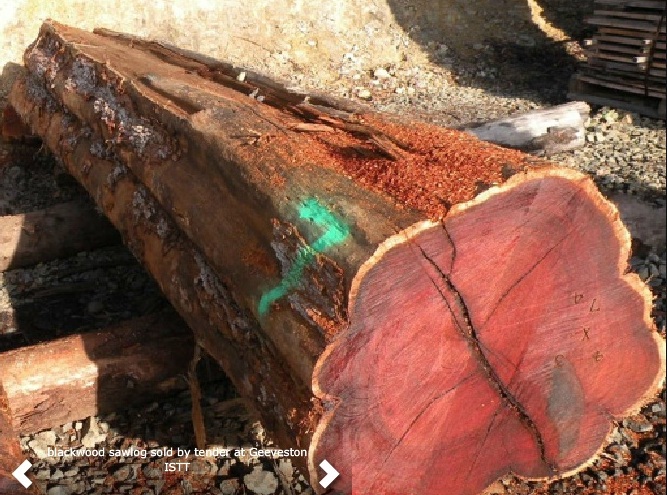
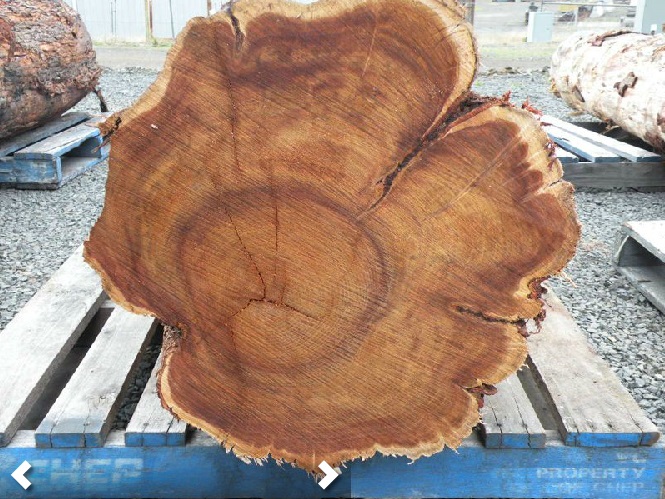
Two small blackwood logs were included amongst the 27 lots tendered.

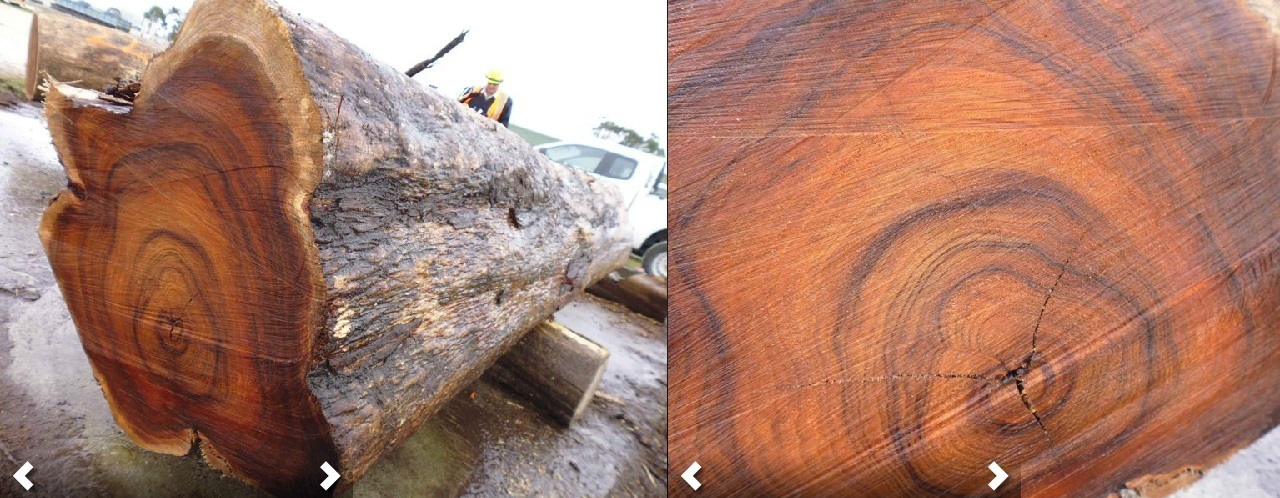
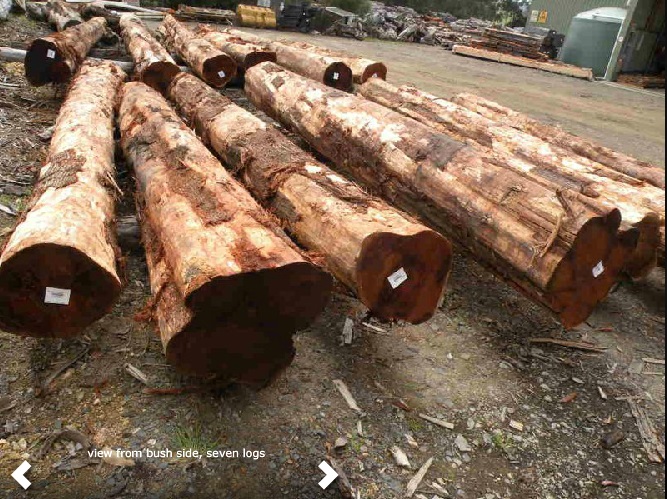
One of the logs (Lot 23) was a plain-grain Utility Grade (NOT Cat 4) blackwood log. The description read:

A good straight log, several bumps, attractive dark stripes in growth rings at butt end. Length 2.7 metres, large end diameter 64 cm, small end diameter 50 cm, volume 0.68 cubic metres.

IST 0815 log23double

This small log sold for the incredible price of $850 per cubic metre!

This is by far the greatest price ever paid for a plain grain blackwood log.

Remember that a commercial blackwood plantation aims to grow sawlogs that are 6.0 metres in length and an average volume of 1.5 cubic metres. The above tendered log would represent the lower half of such a plantation-grown blackwood log.

In other words at this price a single plantation blackwood log could be worth $1,275!

At 300 cubic metres sawlog per hectare that equates to $250,000 per hectare at harvest for a blackwood plantation.

Remember these prices are equivalent to mill-door delivered prices, so harvesting and transport costs need to be deducted to approximate stumpage paid to the grower.

And this is only one small, low quality log sold at tender in Smithton, north west Tasmania.

The other Cat 4 blackwood log sold for $550 per cubic metre.

This is an extraordinary price for a small plain-grain blackwood sawlog and again demonstrates the commercial potential of farm-grown commercial blackwood.

Is anyone interested?

Blackwood sawlogs achieve record price at auction REVISITED

ist_log

Since it was first posted this blog has consistently been one of the most frequently visited by readers of this website.

http://blackwoodgrowers.com.au/2012/06/11/blackwood-sawlogs-achieve-record-price-at-auc/

Clearly it says something that readers find compelling.

In terms of its message and impact on the forest industry, State forest policy, the farming community or the media however there has been little response.

Profitable tree growing and transparent, competitive market processes remain completely irrelevant to State forest policy and the forest industry.

If we treated our dairy, beef and vegetable industries in such a manner Tasmania would be in serious trouble. But the forest industry remains a victim of its heritage dominated by politics, a public resource and a community service ethos.

Does Tasmania want a forest industry? If so then the price of logs and profitable tree-growing must be at the centre of policy and management.

So how can Tasmania move towards a fully commercial and profitable forest industry?

The industry does not need more behind-closed-door deals, nor more reports and strategies. The industry needs to demonstrate serious commercial muscle, and a burning desire to leave the politics and conflict behind.

So tell me readers, why is this blog of such interest to you?

PS. Here’s a thought bubble!

Imagine what the forest industry would look like today if 100 years ago we had included prizes (trophy or ribbon) in our regional agricultural shows for the best sawlogs, in the same way we have prizes for livestock, wool fleeces, fruit, veges, etc. Farmers who managed their forest or plantations would bring in their very best dressed sawlogs to get judged. All of the entries could then be auctioned off.

Imagine a rural community that took as much pride in forest/plantation management is it does in beef, sheep, wool, vegetables, etc. That of course would depend on the marketplace supporting and rewarding such a community attitude, as the marketplace does for most other primary industries.

What do you think? Comments?

IST Blackwood Sawlog Tender Results 2014-15

IST 0515 log 16

Here is a summary of blackwood sawlog tender results from Island Specialty Timbers (IST) for the 2014-15 financial year.

http://www.islandspecialtytimbers.com.au

This follows my inaugural report last year:

http://blackwoodgrowers.com.au/2014/06/14/blackwood-sawlog-tender-results-2013-14/

During the year 14 lots of blackwood logs were put to tender by IST. These were individual logs except for two parcels of small logs in the October 2014 and January 2015 tenders. Only one log was unsold for the year from the August 2014 tender.

Total volume of blackwood logs sold was 31.06 cubic metres (or approximately 0.3% of the total volume of blackwood logs sold by Forestry Tasmania for the year) for a total value of $20,660.

Plain grain logs in 3 lots totalling 18.7 cubic metres sold for an average volume-weighted price of $227 per cubic metre.

Feature grain logs totalling 12.4 cubic metres sold for an average volume-weighted price of $1,325 per cubic metre.

These good prices were achieved despite many of the lots having quality issues (spiral grain, flutes, branch stubs, small diameter). Some of the lots could best be described as craft logs.

This compares with the special timbers average mill door log value of $134 per cubic metre that Forestry Tasmania received in 2013/14.

There was such a variety of log grades and qualities in these 14 lots that for analysis and summary I’ve grouped the logs into just plain and feature grain, as these seem to be the main determinants of price.

In general logs sold by IST are smaller and with more defects compared to logs sold under long-term contract to favoured customers. They do not represent average “run-of-the-bush” quality logs.

Table 1 summarises the tender results.

  Lot count Average of SED (cm) Average of Len (m) Average of Vol (m3) Sum of Vol (m3) Average of Unit Price ($/m3) Total Price ($)
Plain 3 44 5.9 1.0 18.67 $302 $4,244
Figured 10 60 3.9 1.2 12.39 $1,280 $16,420
Sold 13 57 4.3 1.1 31.06 $1,054 $20,664
Plain 1 69 2.4 1.2 1.20
Unsold 1 69 2.4 1.2 1.20

The highlights for the year were:

  • One small feature-grain log that sold for a unit value of $2,400 per cubic metre in the January 2015 tender, and
  • A log (1.6 cubic metres) that sold for $3,260 ($2,000 per cubic metre) in the February 2015 tender, which contained some feature grain but also had significant quality issues (sweep and spiral grain).

The lowest unit price for the year was achieved by the parcel of 13 small plain-grain logs in the October 2014 tender. This parcel totalled 10.1 cubic metres in volume, with average dimensions SED 42cm, LED 47cm, Len 5.0m, vol 0.78 cubic metres. This parcel sold for $200 per cubic metre.

Only one of the logs tendered approximated in size and quality what might be grown in a well managed blackwood plantation. This was Lot 20 in the March 2015 tender that sold for $620 or a unit price of $485 per cubic metre. This is a very good price and puts the value of a blackwood plantation at harvest at well over $100,000 per hectare!

Are any Tasmanian farmers interested?

In 2013/14 IST sold a total of 1,531 cubic metres of product including 136 cubic metres sold through the tender process “to ensure that the best possible prices were obtained” (Forestry Tasmania 2013/14 Annual Report). Only 16.1 of the 136 cubic metres (12%) was blackwood, despite the fact that blackwood comprises 80% of the special timbers harvest annually. I wonder how much of the 1,531 cubic metres of product was blackwood? We will never know. Frustratingly Forestry Tasmania don’t tell us how much the 1,531 or the 136 cubic metres sold for.

These tender results represent the only publically available competitive market prices for blackwood sawlogs. Given that blackwood is the only Tasmanian specialty timber that has the potential to have a commercial future these prices are important in alerting Tasmanian farmers and the wider community to the commercial opportunity that is available.

One thing that is clear from watching the regular IST tender results, the special timbers market is capable of paying extremely high prices for quality special timber logs as evidenced by the massive $5,900 per cubic metre paid for a tiger myrtle log at the April tender.

Caveats:

  1. Island Specialty Timbers (IST) is an enterprise of Forestry Tasmania established in 1992 to increase the recovery, availability and value of specialty timbers from harvesting activities in State forests.
  2. Forestry Tasmania manages its special timbers operations (including IST) as a taxpayer-funded, non-commercial, non-profit, community service.
  3. Note that all logs and wood sold by IST comes from the harvesting of public native old-growth forest and rainforest certified under AFS (PEFC).
  4. It is unlikely that this tiny set of market-based blackwood log prices is representative of the broader blackwood market.
  5. The dataset is too small to allow any analysis or correlations to be made between price and log quality apart from the obvious result that feature-grain logs attract a significant price premium over plain-grain.
  6. Remember also these tender prices are effectively mill door prices that already include harvesting and transport costs. They are not stumpage prices.

It would improve market transparency and stimulate greater investor interest if IST would tender more blackwood logs and demonstrate real commercial focus. Increasing the blackwood volume tendered to even 100 cubic metres per year would be a good start.

But whilst Forestry Tasmania, the State government and the State parliament all regard the special timbers industry as a community service and political play-thing rather than any commercial opportunity, then blackwood’s commercial future remains difficult.

When will Tasmania get a fully commercial, profitable forest industry, based on profitable tree-growing?

Forestry Tasmania fate in balance

Annells

http://www.examiner.com.au/story/2926663/forestry-tasmania-fate-in-balance/?cs=95

[The fate of] Forestry Tasmania hangs in the balance, with its chairman telling staff the company’s immediate future is entirely in the government’s hand.

In an email sent to Forestry Tasmania staff yesterday, chairman Bob Annells [pictured above] responded to mounting concerns that the cash-strapped company may be dissolved and folded into a government department.

[“folded into a government department” What an absolutely terrible idea! What Government department would it fit into? And what would be the point? It would fix none of the existing problems, and create even more new problems. A classic case of duck shoving!]

This article in today’s The Examiner tells us that things are pretty grim at the Government forest management agency.

While no official announcement has been made it now seems clear that FTs application for FSC Certification has been rejected. FSC auditors SCS Global were due to deliver their report last month.

And yet another review into Forestry Tasmania is currently being written. I’ve lost count of how many of those we’ve had. Far too many. And none of them have been at all useful, at least in terms of their implementation.

But enough is already known to understand that FT has absolutely no commercial future.

The Tasmanian Government is no doubt finding it increasingly difficult continuing to sack teachers and nurses whilst propping up the forest industry.

It is now just a matter of how best to clean up the decades of mess and close the organisation down.

It will be a bitter pill for many Tasmanians.

Decades of mismanagement may finally be coming to an end. Or it may drag on for a few more painful, bitter years. History tells me that the latter is more likely eg. the “fold” option.

The shutting down of FT will see the supply of blackwood to the market drop dramatically, with a corresponding rise in price very likely. Will Tasmanian farmers finally reap the rewards of a more competitive blackwood market?

UPDATE:

Seems like the FSC outcome is indeed correct judging by the article in today’s The Examiner. No medal for FT.

http://www.examiner.com.au/story/2929002/demands-on-forestry/?cs=95

So FT will “keep trying”. They don’t have the time nor the money to keep trying.

The longer FT stays in business the longer it will take for private tree growers and private investment to rebuild the forest industry. It just wont happen whilst FT continues to play zombie corporation.

Destructive anti-commercial policies continue at FT

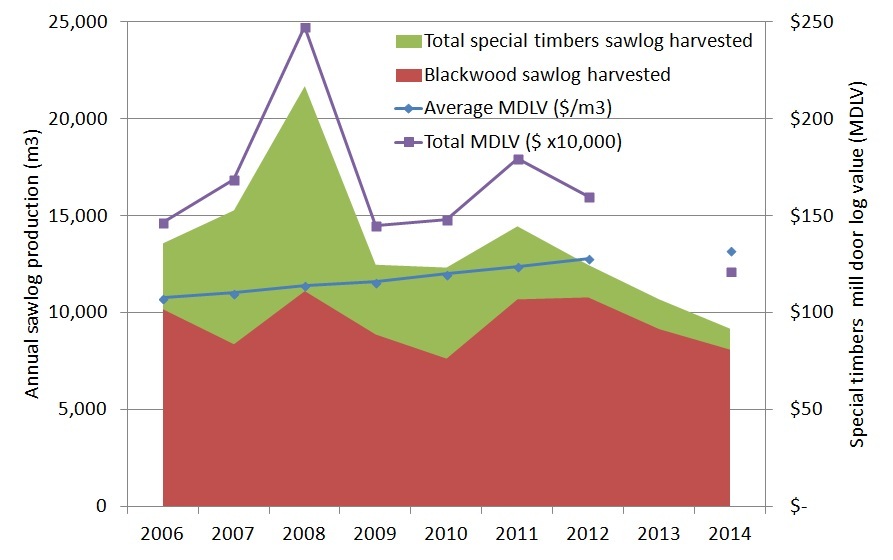
After an absence of a year the Forestry Tasmania 2013/14 Annual Report belatedly includes data on the mill door log value (MDLV) of the various product classes sold including special timbers (Appendix 2 – Supplement to table 3.1). This together with other data in the annual report has allowed me to update a chart I originally published in this blog in June 2013.

http://blackwoodgrowers.com.au/2013/06/13/pricing-blackwood-out-of-the-market/

As most readers will know Forestry Tasmania places a very low priority on commercial matters like getting the best possible price, and making a profit. It is difficult to understand FT’s approach to issues such as sales processes, pricing, markets, costs, supply and demand. None of these issues are discussed in their annual reports. What little information is available shows that good commercial management is absent at Melville St. By behaving in this reckless manner Forestry Tasmania is undermining the profitability and livelihood of all existing and potential future private tree growers and destroying the very industry it is supposed to be supporting. Such is the inevitable outcome of crony capitalism.

Of course Forestry Tasmania is aided and abetted in this behaviour by legislation and politicians that support crony capitalism.

Remember that Forestry Tasmania is by far the largest grower/supplier of premium quality special timbers logs in Tasmania/Australia. But it is not the only existing or potential future grower!

FT_MDLV_chart

The updated chart shows total special timbers and blackwood sawlog harvest for the past 9 years. 2006 was the first year that Forestry Tasmania published Mill Door Log Value data. For some reason no MDLV data were published in 2013.

As can be seen, blackwood makes up the majority of the special timbers harvest from public native forests in Tasmania. The chart also shows the total special timbers mill door log value (effectively what the sawmillers paid for the logs delivered to their mill). I have then calculated the average MDLV ($/m3) by dividing the total value by the total volume, effectively the per cubic metre royalty paid.

As can be seen the average MDLV is effectively a straight line with a gradient of 3.1%. In other words the price paid by sawmillers for these premium timbers is fixed in line with long term inflation. In other words their value does not increase in real terms – exactly the same real price today as 9+ years ago. That’s what I call a great deal!

In 2013/14 the average special timbers MDLV was $132 per cubic metre. That value includes all the administration and overhead costs, plus the costs of harvesting and transport to the mill. One can only guess what the effective stumpage price was, maybe $40 per cubic metre!! What a joke!!

The other obvious trend in the chart is that special timbers log prices are not affected in any way by market conditions – supply, demand, costs of production, etc. For example the Global Financial Crisis of 2007 had absolutely no impact on prices.

And finally the trend in special timbers revenue over the last few years suggests that 2014/15 will see revenue drop below $1 million. We have no idea what the costs are in special timbers management and harvesting because Forestry Tasmania does not provide separate accounts for these “non-profit” activities.

But it doesn’t matter because Forestry Tasmania sends the special timbers bill to the Tasmanian taxpayer! 10,000 cubic metres (or 500 truck loads) of some of the world’s best timbers sold for a song, AND teachers and nurses lose their jobs. Does anyone care? Apparently not!

Is it any wonder that many Tasmanians regard Forestry Tasmania as an albatross around the neck of the community?

Despite the fact that Forestry Tasmania deliberately operates its special timbers operations at a loss, it:

  • Fails to provide separate financial statements for these operations;
  • Fails to provide any commercial management model and objectives that might identify limits to costs and losses;

The Tasmanian community is left with an unmanaged out-of-control special timbers liability. And the situation is going to get worse with the proposed logging inside the World Heritage Area!

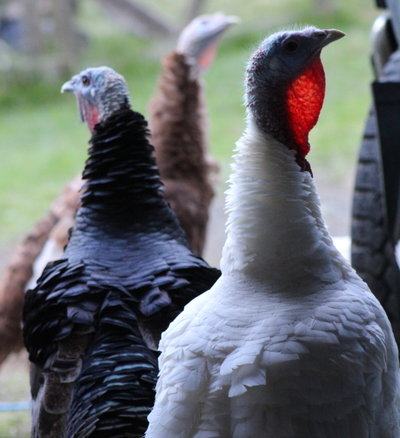
Tasmanian forest turkeys

In response to a comment I received on my earlier blog on the Canadian-US lumber dispute I can’t help but post a link to this excellent article from the British Columbia Private Forest Landowners Association.

http://www.pfla.bc.ca/log-export/what-turkeys-can-teach-us-about-b-c-timber-supply-complaints/

rsz_turkeys

Just so much of the comments and observations on forest policy and practice in British Columbia ring true here in Tasmania.

One major difference is that at least in BC the private forest owners understand that they are being screwed by the Government and its forest industry servants.

Thanks to Rod Bealing, Executive Director of the BC PFLA for the comment and link.

Canada–United States softwood lumber dispute

softwood-lumber

Isn’t it amazing.

Here’s a forest industry story that has strong echoes here in Tasmania.

It seems the forest industry has the same problems around the world.

http://business.financialpost.com/2014/10/31/the-granddaddy-of-all-canadian-u-s-trade-disputes-is-about-to-rear-its-ugly-head-again/

and even a Wikipedia entry about this trade dispute:

http://en.wikipedia.org/wiki/Canada%E2%80%93United_States_softwood_lumber_dispute

So what’s the issue?

Well the Canadian lumber industry is unfairly subsidized by federal and provincial governments (just like here in Tassie), as most timber in Canada is owned by the provincial governments (just like here in Tassie). The prices charged to harvest the timber (stumpage fee) are set administratively (just like here in Tassie), rather than through the competitive marketplace, the norm in the United States.

And why are forest product prices in the US set through the competitive marketplace? Because most forests in the US are privately owned and private owners do not want to be competing against stupid anti-trust Governments. They want to get the best price possible for their trees.

And the National and Provincial Governments in Canada refuse to reform their forest industry and open it up to competitive pricing, just like the Tasmanian Government.

And don’t the American’s hate that!

Hence the massive trade dispute!

Here in Tasmania private tree growing is still a bit of a novelty. Until 20 years ago most farmers regarded trees is a liability not an asset. Governments did forestry, not farmers. After the disaster of the failed MIS schemes of the last 20 years we have returned to that same situation – trees as liabilities. And we still have Tasmanian Government policy deliberately discriminating against existing and potential future private tree growers through taxpayer subsidised Administered log pricing. Echoes of failed Government bureaucracy from around the world.

Now I’m not sure what defines “unfair” subsidies? Sounds like an oxymoron to me.

I just hope the Americans give the Canadians a lesson in economics 101.

Now I wonder how many of those subsidised, anti-trust Canadian forest operations have FSC certification?

And here we are in Tasmania with exactly the same problem, but we don’t have a trade partner like the USA to kick our stupid butt!

A shame really!!


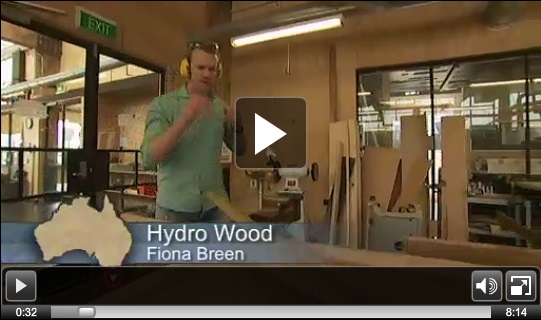
Hydro Wood – Landline – ABC

This is just such a great feel-good story, no one could possibly have any problems with salvaging public timber at taxpayers expense. Could they?

Hydrowood Landline

Hydro Wood – Landline – ABC.

Generally I support the project.

And I congratulate SFM Forest Products for getting the project going.

However I do have a few issues that I think warrant consideration.

And the ABC Landline program was screaming these issues at me loud and clear.

1) The complete disconnect from any commercial reality (but we do have a very long tradition of this in the forest industry). Can the market absorb an extra 20,000 cubic metres of specialty timbers per year? How will the wood be sold to market? Tender? Auction? Mates rates? Will these logs be available for export? What impact will this have on current market prices, especially for blackwood, given that private growers will be competing against even more subsidised wood? For heavens sake!! When will the private forest grower ever get a fair deal in Tasmania? When will we stop bastardising the forest industry? When will we stop thinking of the forest industry as a community service and start thinking of it as a business?

2) If the timber resource is so valuable then why the need for a taxpayer subsidy? The forest industry already has a bad track record of squandering vast millions of Government handouts and subsidies. This just sets yet another bad example, and it didn’t need too. This could have been a fully commercial, profitable operation with no taxpayer funding.

Here’s a recent example from New Zealand that provides a much better model for how to deal with the salvage of a public special timbers resource, and this will result in money going to the Government not costing taxpayers. Why can’t we do it this way in Tasmania?

http://www.doc.govt.nz/about-doc/news/media-releases/2014/first-west-coast-timber-salvage-approved/

And this is just the first of what they hope to be many Hydro special timbers salvage operations!! Excuse me while I scream in frustration!!!

There will be very little investment in blackwood in the next few decades whilst the market is flooded with this cheap subsidised wood.

Screw my plans for a blackwood growers cooperative!

Screw existing private blackwood growers whose resource is now worthless!

I think given this is a private company running the Hydrowood project whose goal it is to look after the interests of private forest growers, a bit more thought on the commercial context and planning would have made this project much more agreeable to private blackwood growers.

As it is I think the project is currently detrimental to the interests of private blackwood growers. This needs to change!

Please can’t we do better than this?

November 2014 Island Specialty Timbers Tender Results

27 of 28 lots sold to 10 of 19 bidders at good to very strong prices for most lots.

http://www.islandspecialtytimbers.com.au/shops/ist/pages/april-may-2008-tender-report

(and scroll down the page for the latest tender results)

Lots 2 and 24 contained blackwood logs.

Lot 2:

A recently harvested good quality log with good colour, a little twist, fluted shape but solid with some tear-drop figure. High quality, large diameter log.  

Length 3.9 metres, butt diameter 79 cm, head diameter 69 cm, volume 1.67 cubic metres.

This log sold for $1,250 per cubic metre or $2,090 for the log.

A very good price!

Lot 24:

This was a parcel of 13 smaller plain-grain blackwood logs.

A fresh parcel of average to good quality Category 4 blackwood sawlogs, on a size and quality scale of 1 – 5, with 5 best quality, this group would rate about 3.5.

Length range 3.7 to 6.5 metres average 5.0 metres, head diameter range 31 to 54 cm average 42 cm, volume range 0.4 to 1.26 cubic metres average 0.78 cubic metres. Total volume 10.1 cubic metres.

This parcel sold for $200 per cubic metre or a total of $2,020.

IST Oct14 Lot24

Once again the domestic market shows that any blackwood logs with figured grain attract great prices, with plain grain logs coming a long way behind in second place.

As usual the black heart sassafras logs dominated the tender and the price action, with the best result being $3,350 per cubic metre.

But who is going to plant sassafras and wait 300 years even for those prices?

Of note, even silver wattle is now attracting good prices. Two of the lots were silver wattle logs that sold for $450 per cubic metre. Not bad at all. Good to see this beautiful timber starting to get the recognition it deserves.

Blackwood sawmillers

PFT_TPWPD2014

Private Forests Tasmania (PFT) has just released an updated Tasmanian Primary Wood Processor Directory.

http://www.pft.tas.gov.au/index.php/publications/market-information

The directory is a listing of 45 of the estimated 57 primary wood processing businesses believed to be operating within the State of Tasmania at the time of publication.

The directory has been primarily developed to help private forest owners with logs for sale to identify potential buyers. As well as enabling the forest owner to more easily locate and contact primary wood processors, it also identifies the log types purchased by them.

The directory also helps the listed primary wood processors to source logs from the Tasmanian private forest estate.

It isn’t at all clear to me how the directory helps the listed primary wood processors to source logs from the Tasmanian private forest estate, but anyway….

18 of the 45 listed processors indicate that they want to buy blackwood logs from private landowners. To find these processors simply download and open the document in Adobe Reader. Once the document is open press the Ctrl+Shift+F keys together on your computer. In the search box type “blackwood” and hit the Search button. All 18 instances of the word “blackwood” will now be shown.

ERRATUM: My apologies! I have just realised that three of the primary processors in the Directory list “special species” without listing blackwood separately. I assume these three processors include blackwood in their definition of special species. So that makes a total of 21 of the 45 listed processors are looking to buy blackwood logs from private growers/farmers. That is a very crowded market!!

That there are so many sawmillers around Tasmania looking to buy blackwood logs from private landowners I find very encouraging.

Clearly there is good demand for blackwood timber.

But what size and quality logs, and at what price? What markets are these processors accessing? These are critical questions that need answers.

If blackwood is Australia’s premier appearance-grade timber species then how do we build this industry into something proud and profitable?

How do we get greater transparency and tradability into the blackwood market?

How do we put the blackwood market on steroids?

I don’t mean artificially inflate the demand. I mean create much greater transparency and tradability into the blackwood market so landowners start to see some realtime market activity. Only then will landowners begin to think about investing in the future of blackwood.

How do we get farmers to make a 30-40 year investment commitment to grow more blackwood for the future as both remnant blackwood forest and in plantations?

ANSWER: By giving farmers as much incentive and positive market sentiment and feedback as we possibly can. Once farmers begin to see the blackwood market operating like other rural commodity markets then we might have some hope.

Every day we see blackwood timber making its way to the very highest of the wood value-adding markets both in Australia and increasingly overseas. Markets such as premium furniture, veneers, and musical instruments. So why isn’t this market demand stimulating grower interest? Why doesn’t Tasmania have a thriving blackwood grower community? Is growing blackwood a profitable investment for a landowner?

These 18 sawmillers can help answer these fundamental questions.

How many of these 18 processors are thinking about the future of the blackwood industry as anything other than a clean-up salvage operation?

Are they waiting for the Government to solve the problems of the forest industry, or are they prepared to take responsibility themselves and take some action?

These blackwood sawmillers are fundamental to the future success of Tasmania’s blackwood industry. But things need to change and change radically.

At the moment the blackwood market is completely obscure, which inhibits growth and investment in the industry.

The day that I can write my first Blackwood Market Report for Tasmanian Country will be a significant day for the blackwood industry.

There is plenty of potential and many opportunities with blackwood provided Tasmanians are prepared to help see them happen.

What’s in it for these sawmillers?

  • Access to more blackwood resource as more farmers participate in the market;
  • Collective marketing with access to more diverse, larger, more profitable markets;
  • Stronger links and relationships to both suppliers and buyers;
  • Being part of an expanding, high-value, niche market.

Or are we going to surrender our blackwood heritage to the New Zealand farmers?

I would like to hear some thoughts and ideas from these blackwood sawmillers. Reply to this blog, or phone or email me so we can have a discussion.

Cheers!