Another year passes since I last looked at premium hardwood (Tas oak) prices at Bunnings hardware. Another year of pretty serious price increases in a timber resource plundered from Tasmanian public native forests at taxpayers expense.
You can read about the “at taxpayers expense” here:
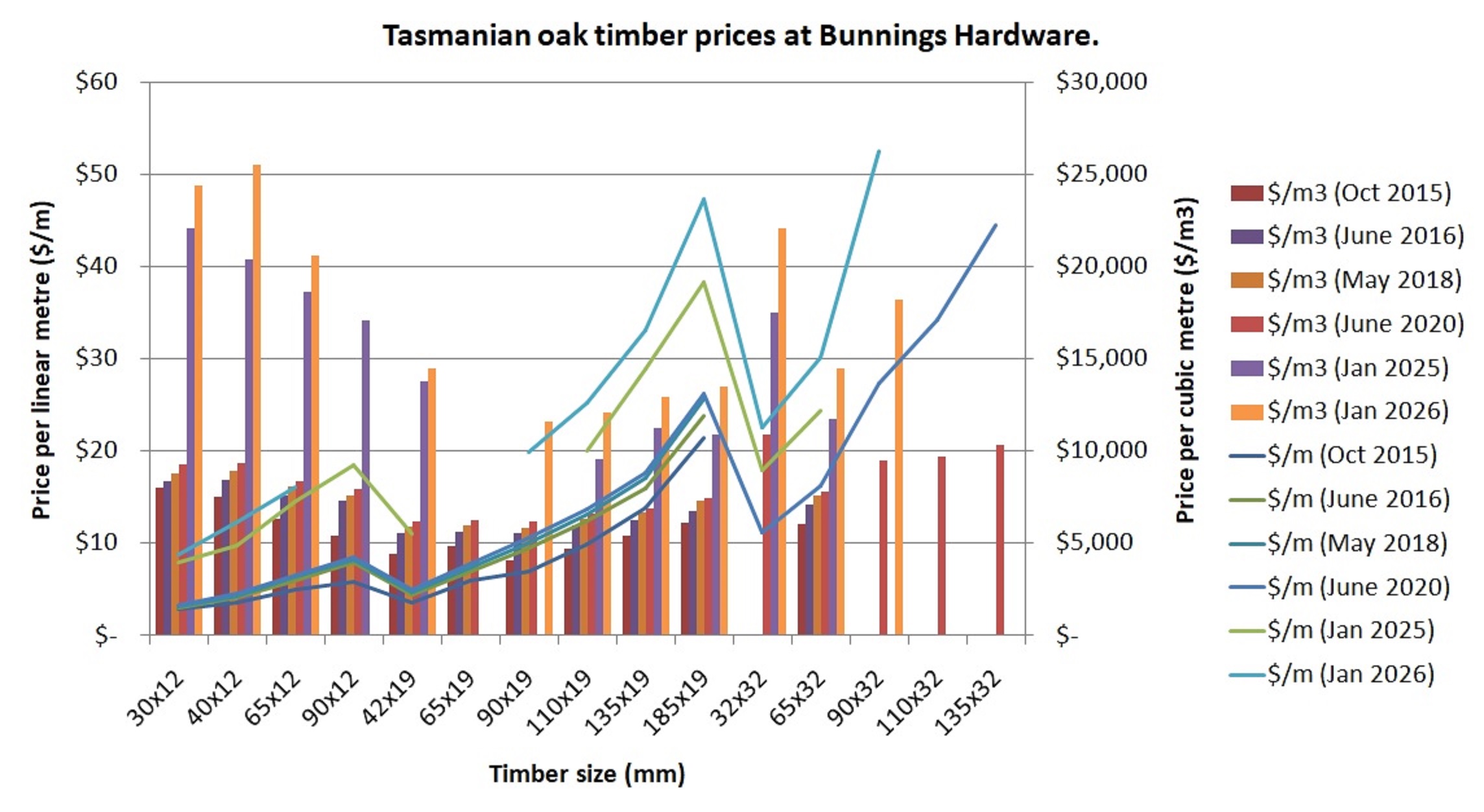
These prices are for Select Grade Tasmanian oak. Prices have increased from 5 to 26% over the last 12 months.
These price increases should be causing an absolute revolution in the forest industry, in timber markets and in the farming community!
Instead all I hear is deathly silence!
Why isn’t the Australian timber market working like any other agricultural market? Increasing prices generally mean an increase in production as farmers look to cash in on low supply, high demand and high profits. That’s how markets work!! Basic economics!
The Australian forest industry and Australian timber markets have never followed basic economics.
You ask an Australian forester about costs and prices, supply and demand, products and markets and they will give you a blank stare in return.
Which is one reason why the Australian farming community has never been engaged to grow and supply premium timber for domestic markets.
And these extraordinary timber price increases are met with utter silence.
Not even Bunnings, Australia’s largest timber retailer, has any interest in engaging with the rural community.
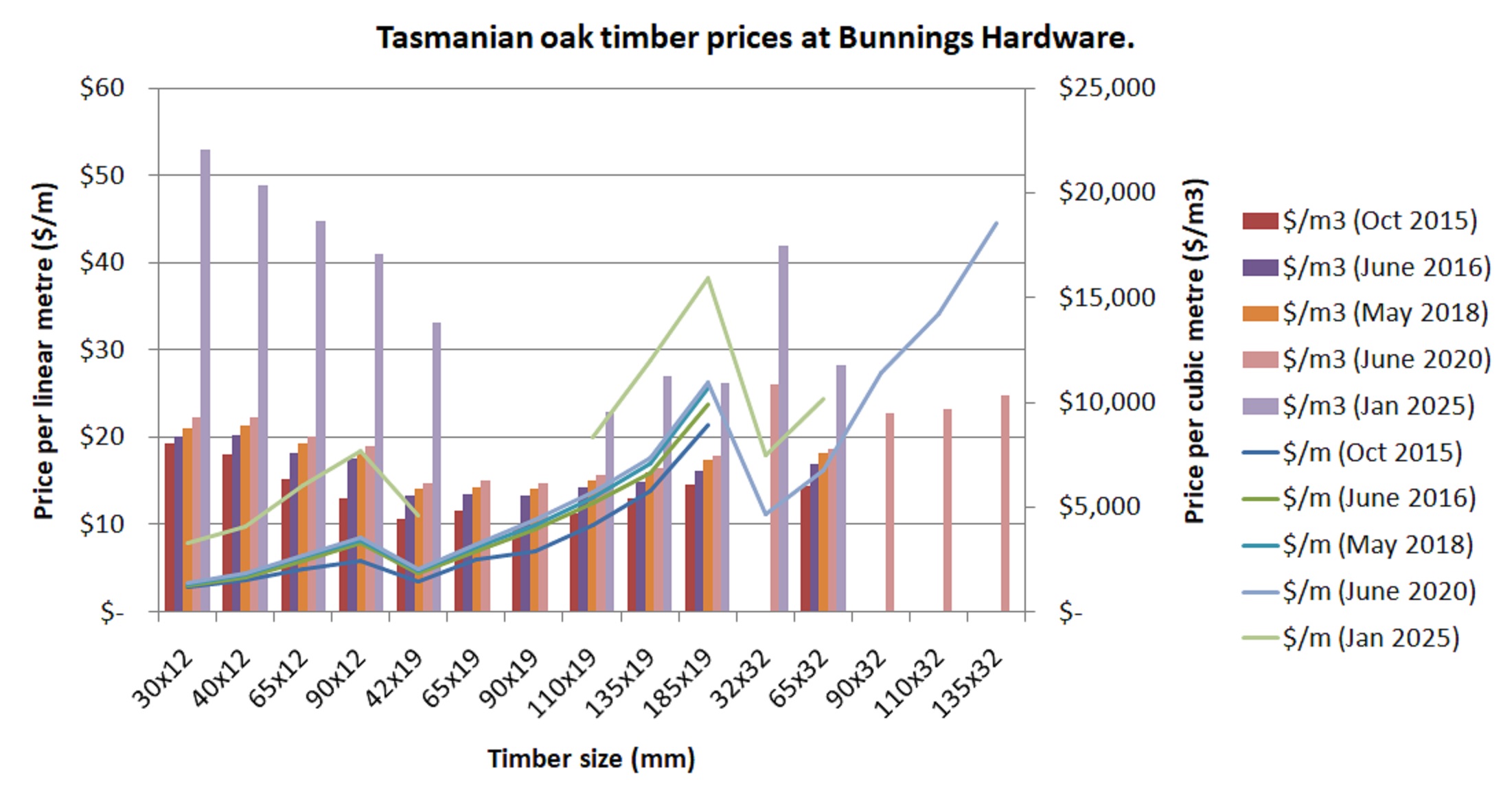
It’s been five years since I checked the prices of conflict-driven, welfare-dependent Tasmanian oak timber at Bunnings Hardware, Australia’s largest timber retailer. Given my previous post about timber prices after the shutdown of welfare forestry in West Australia and Victoria, I thought I should do an update.
It seems that as welfare public forestry is shut down in Australia, the price of hardwood timber has increased dramatically. Small sizes are now over $22,000 per cubic metre and the cheapest at $9,500 per cubic metre. These are massive price increases from 5 years ago!
These massive hardwood timber price increases should be sending ripples through the Australian farming community. So far I’ve seen no evidence that is happening! Why??
The future of the forest industry in Australia is with farm forestry. Surely these hardwood prices now make growing quality hardwood in private plantations a viable and profitable agricultural activity.
I’ve just come back from a holiday in south west Western Australia, where I was reminded once again what great potential the region has for farmers to grow quality hardwoods, and I find this article in the news media!!
Hallelujah!!
Is this the beginning of a REAL forest industry in Australia??
Having put an end to public native WELFARE forestry, are we about to see farmers and the marketplace finally wake up and plant trees for our future wood supply?
I sincerely hope so!
Farm forestry has never really succeeded in Australia whilst State governments have been dominant growers and manipulators of the log marketplace. No farmer wants to grow trees in competition with politicians that’s for sure!
But now with public native welfare forestry in decline around Australia, the marketplace is starting to wake up and realise it is prepared to pay much higher prices for quality hardwood logs.
This powerful message needs to spread far and wide throughout the farming community in Australia.
If Australian sawmillers, log merchants and timber traders want Australian farmers to plant trees then they had better start pumping the market!!!
And instead of perpetually whinging all the time, the orthodox forest industry should instead get on board and focus on profitable farm forestry.
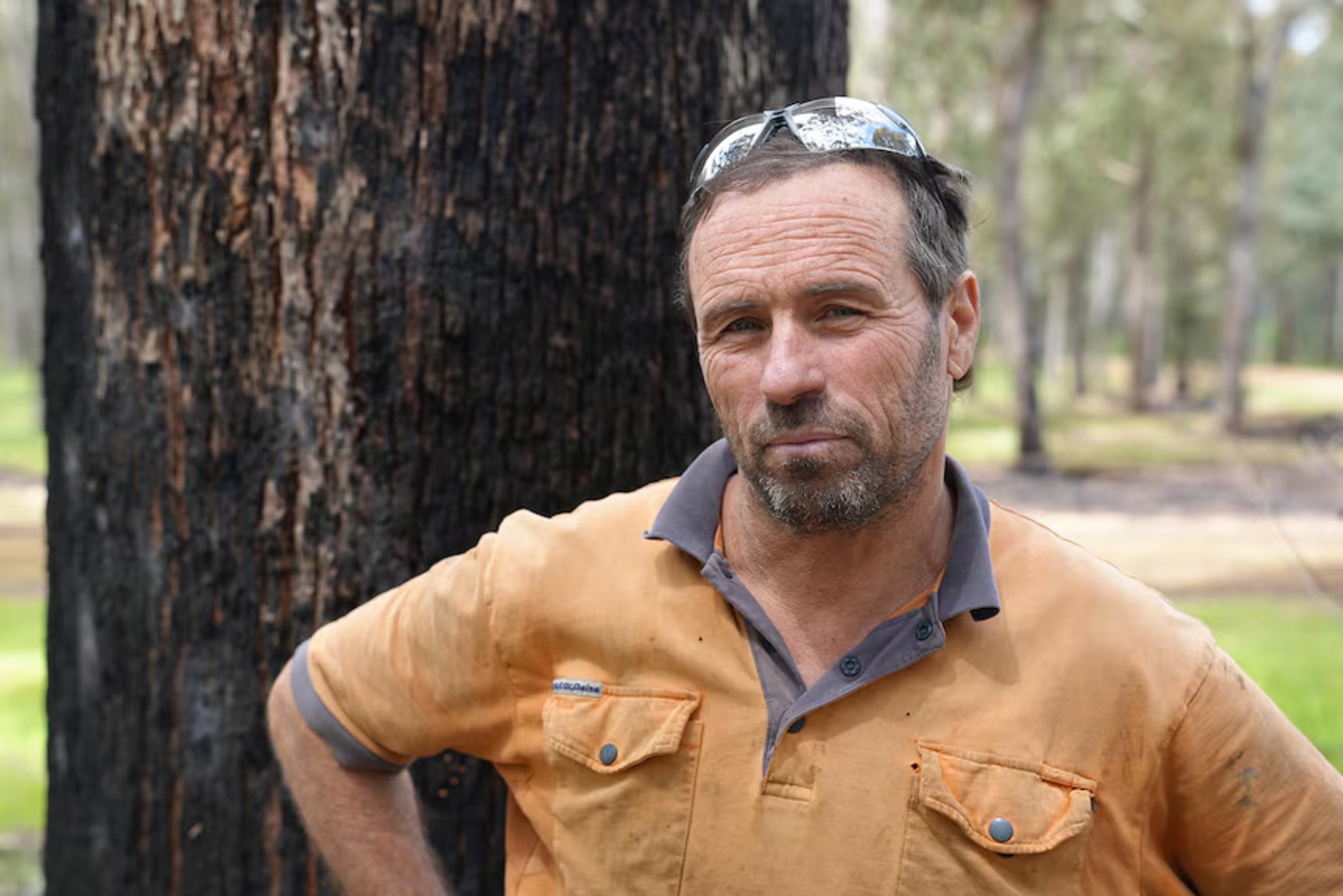
Good luck to Mr North from Walpole, WA! May his trees (and his bank balance) continue to grow!!
It is so good (and rare) to have a positive news story in the forest industry.
Island Specialty Timbers is the only source of competitive, transparent log prices anywhere in Australia, including blackwood sawlog prices. That simple statement tells us a great deal about the dire condition of the forest industry!
IST themselves never do any market updates so I decided to do that job for them. Otherwise the forest industry would have no market information at all.
The lack of commercial credibility is just one of the many challenges facing the forest industry in Australia.
IST is a business enterprise of Sustainable Timber Tasmania (STT) which sources and retails raw material of Tasmanian specialty timbers from harvest or salvage operations conducted on State owned Permanent Timber Production Zone land (PTPZl).
IST is not really a “business” just as the State forest agency Sustainable Timber Tasmania is not a business either. Logging of public native forest in Tasmania requires significant taxpayer subsidies every year.
IST conducted 7 tenders during the year with approximately 280 cubic metres of special species sawlog and craftwood put to public tender. Tasmania defines “special species” as any native forest timber apart from plain grain Tasmanian oak (Eucalyptus sp.).
Blackwood Results
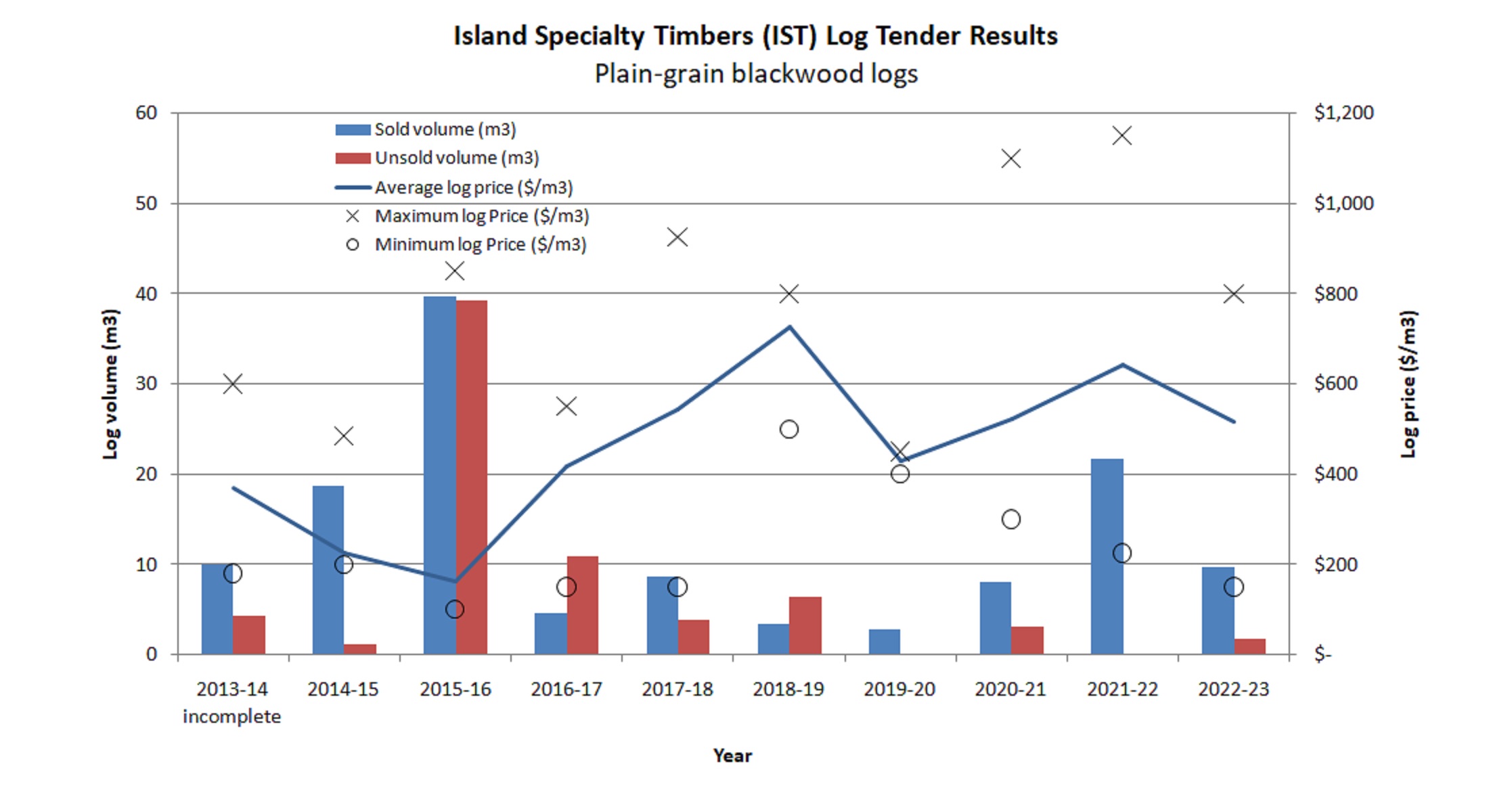
IST put a mere 20 blackwood logs to tender totalling 21.7 cubic metres in 2023-24. Only one log had feature grain, all the rest being straight plain grain logs. Six logs (including the feature grain log) totalling 7.7 cubic metres failed to sell at tender. For the 14.0 cubic metres of sold plain grain logs, prices ranged from $250 to $925 per cubic metre with an average price of $454 per cubic metre.
The last few years have seen mixed results in the market as shown in the following chart. This year saw an increase in the minimum and maximum prices paid but a fall in the average price.
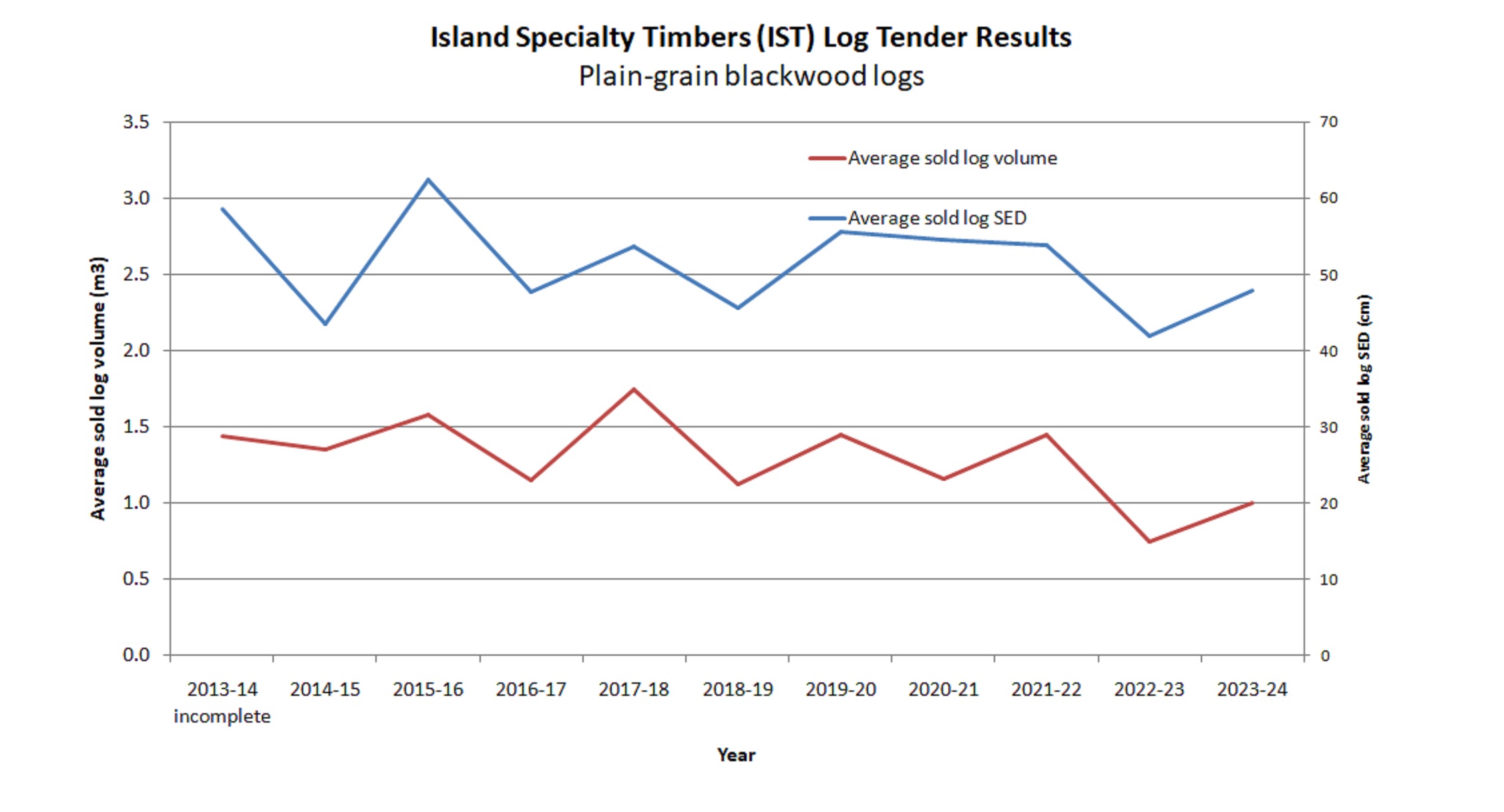
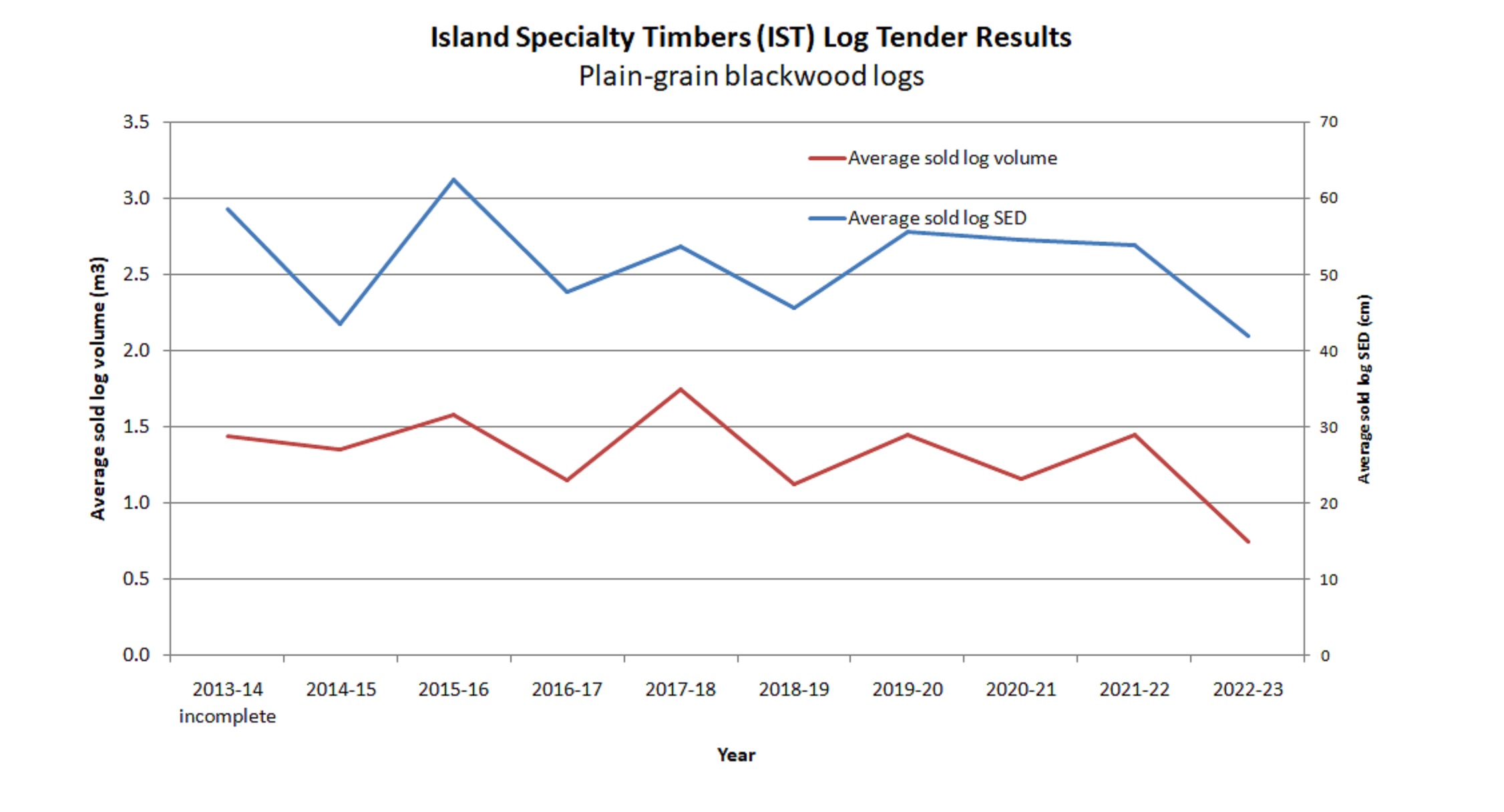
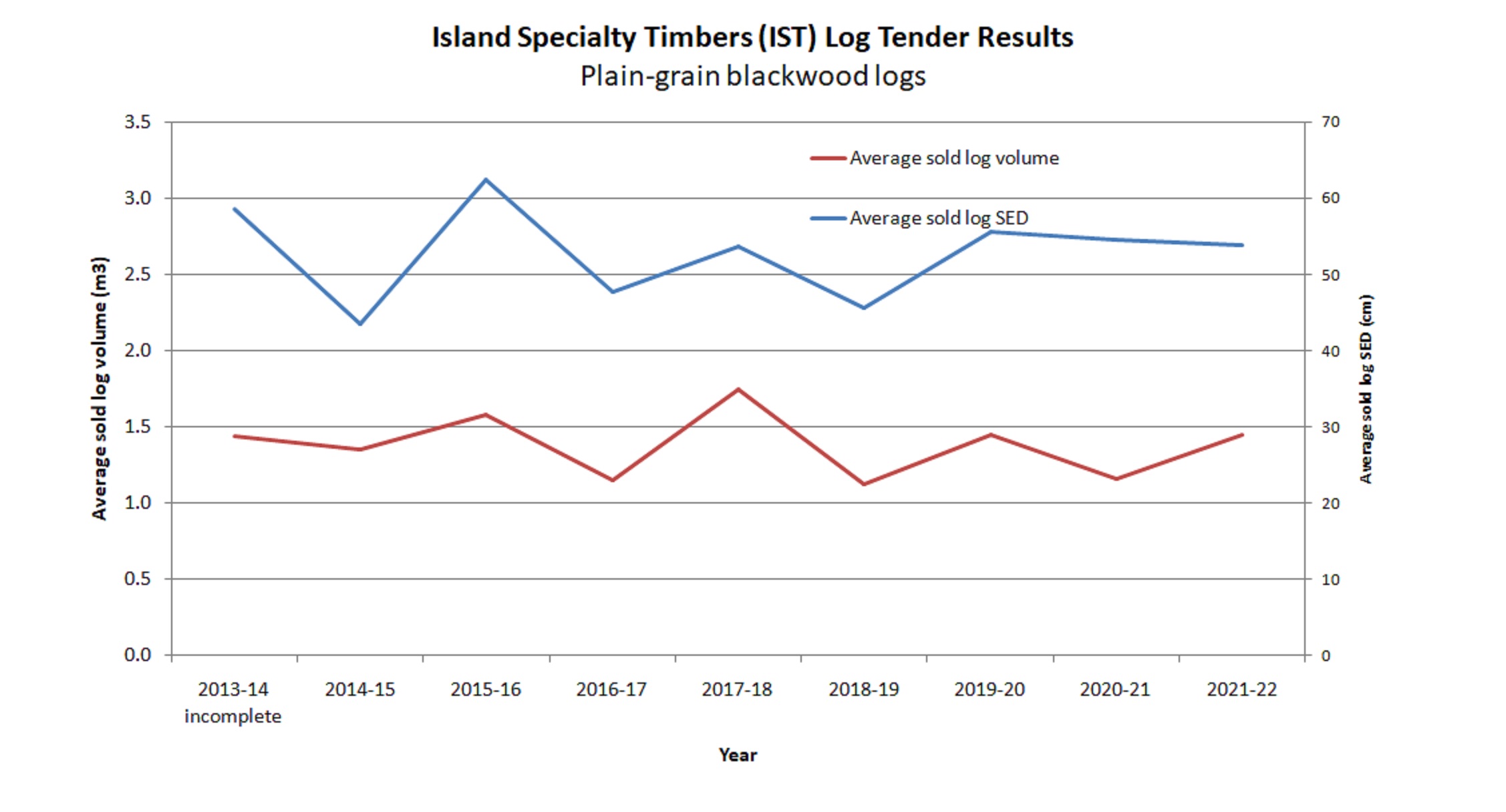
The chart below shows the average volume and small end diameter (SED) for sold blackwood logs. Average log size was slightly up on last years, but still much smaller than a target size for plantation-grown blackwood. Smaller logs mean less sawn timber recovery per log volume so lower prices.
Generally ~9,000 cubic metres of blackwood is harvested annually from Tasmania’s public native forests with 99.99% being sold at heavily discounted Government prices on long term sales contracts. The Tasmanian government deliberately engages in anti-commercial, anti-competitive behaviour. These log tender results need to be interpreted bearing this fact in mind.
Premium plain grain sawlogs are what can be grown in blackwood plantations. The “target” sawlog in a blackwood plantation is 1.5 cubic metres in volume.
This year marks 10 (complete) years of blackwood sawlog price reporting. It is my small contribution to light a candle in the deep dark recesses of the Tasmanian forest industry. To my knowledge none of this price reporting has resulted in any change whatsoever in the blackwood marketplace, either at the farming community end nor in the processor/end user marketplace.
Trying to establish a proper functioning specialty timber market where supply and demand, cost and price are connected and in balance will be a very long process indeed, if it ever happens at all.
General Results
Overall a total of 262 cubic metres of special species sawlog and craftwood were put to public tender during the year. Fifty five cubic metres failed to sell at tender.
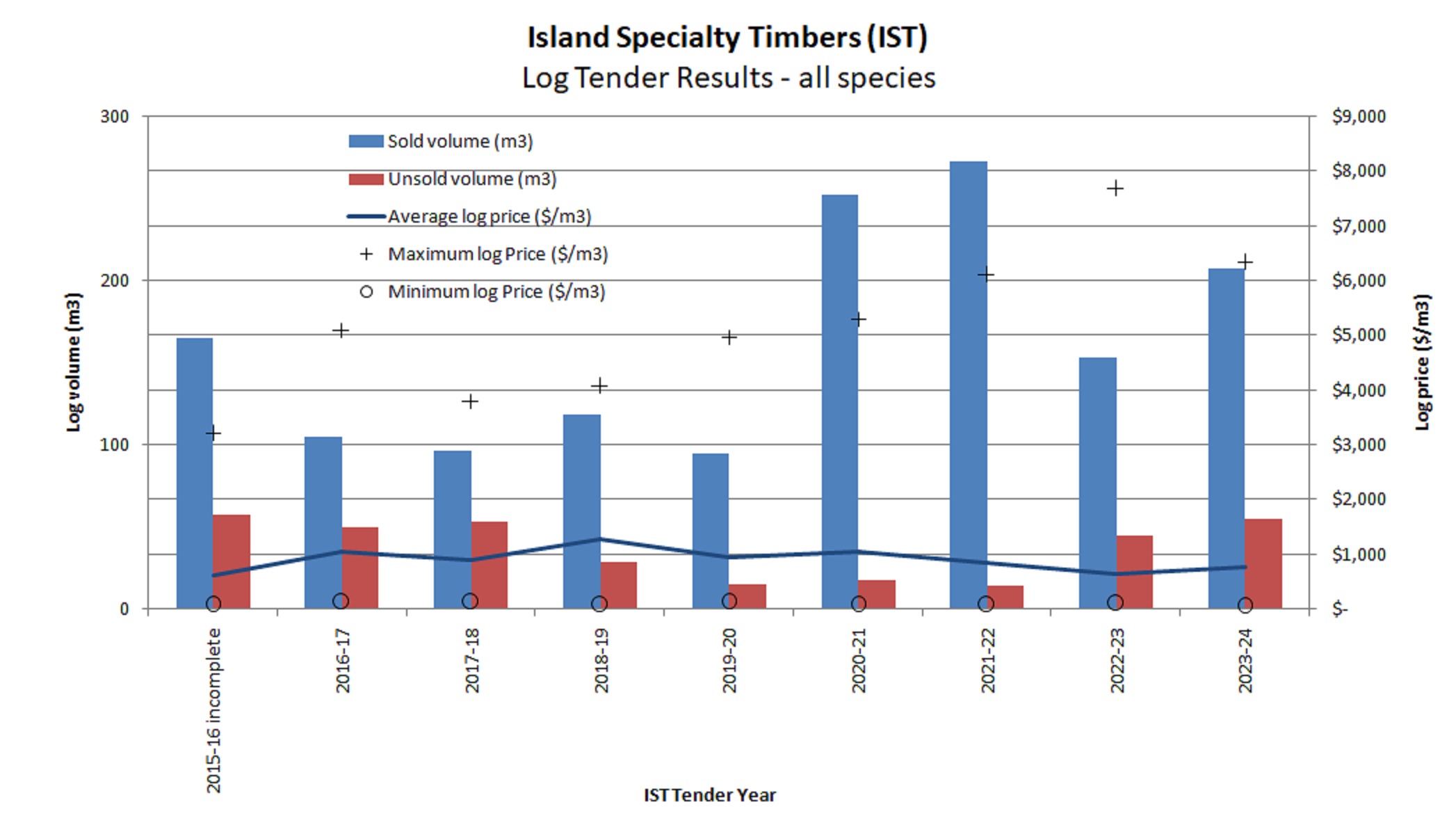
Average log price for 2023-24 ($769 per cubic metre) was slightly up on last year, probably partly helped by the slight increase in average log size.
Total tender revenue for 2023-24 was $159,400, the result of the combined higher volumes and slightly higher prices.
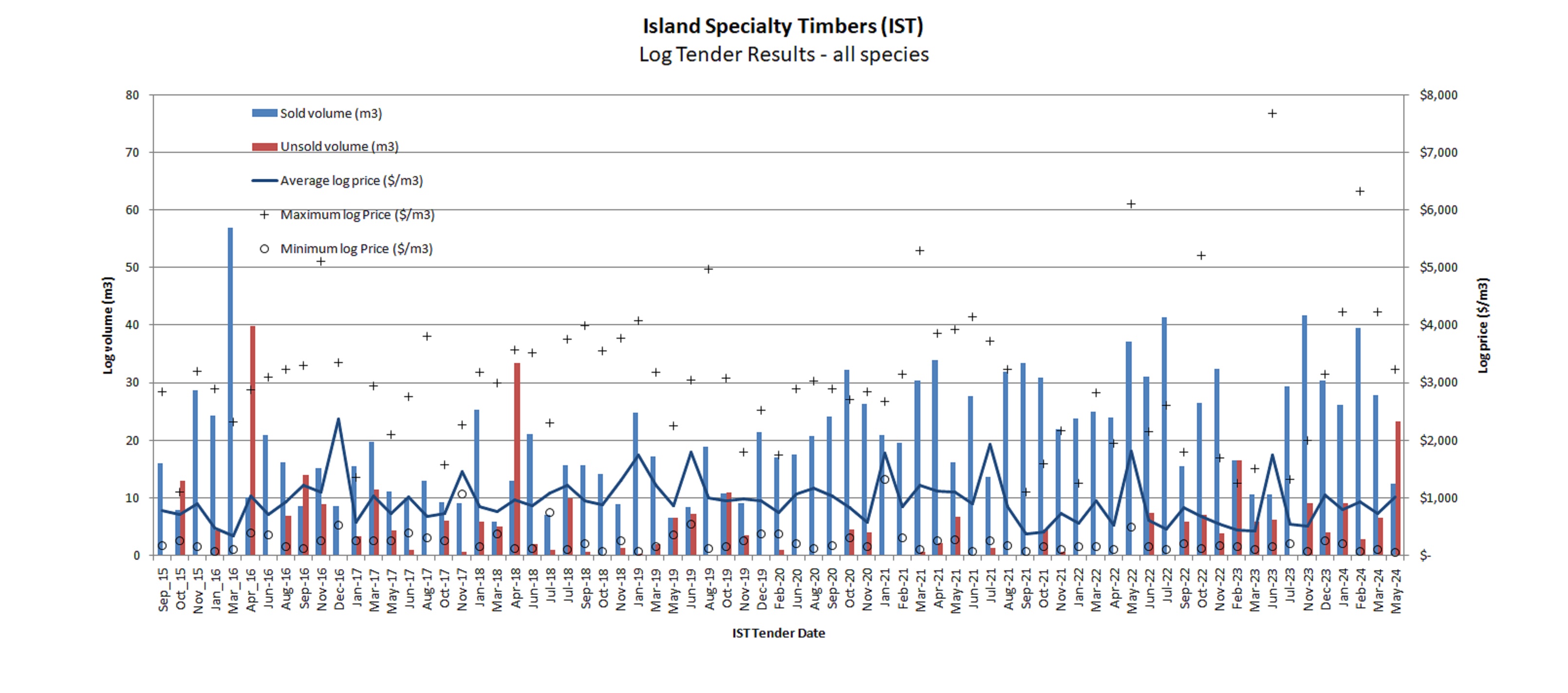
Following 5 years of increasing maximum log price paid for specialty logs this year saw a decline. Does this indicate a softening of the specialty timbers market, in line with the general economy? The prize this year went to a large Huon pine log in the February 2024 tender. This log – 75cm small end diameter, 5.3m length and 3.0 cubic metres volume – sold for $6,325 per cubic metre, or a total price of $18,975!!
Remember these IST tender sales represent tiny log volumes sold into the small southern Tasmanian market. They represent mill door prices not stumpages.
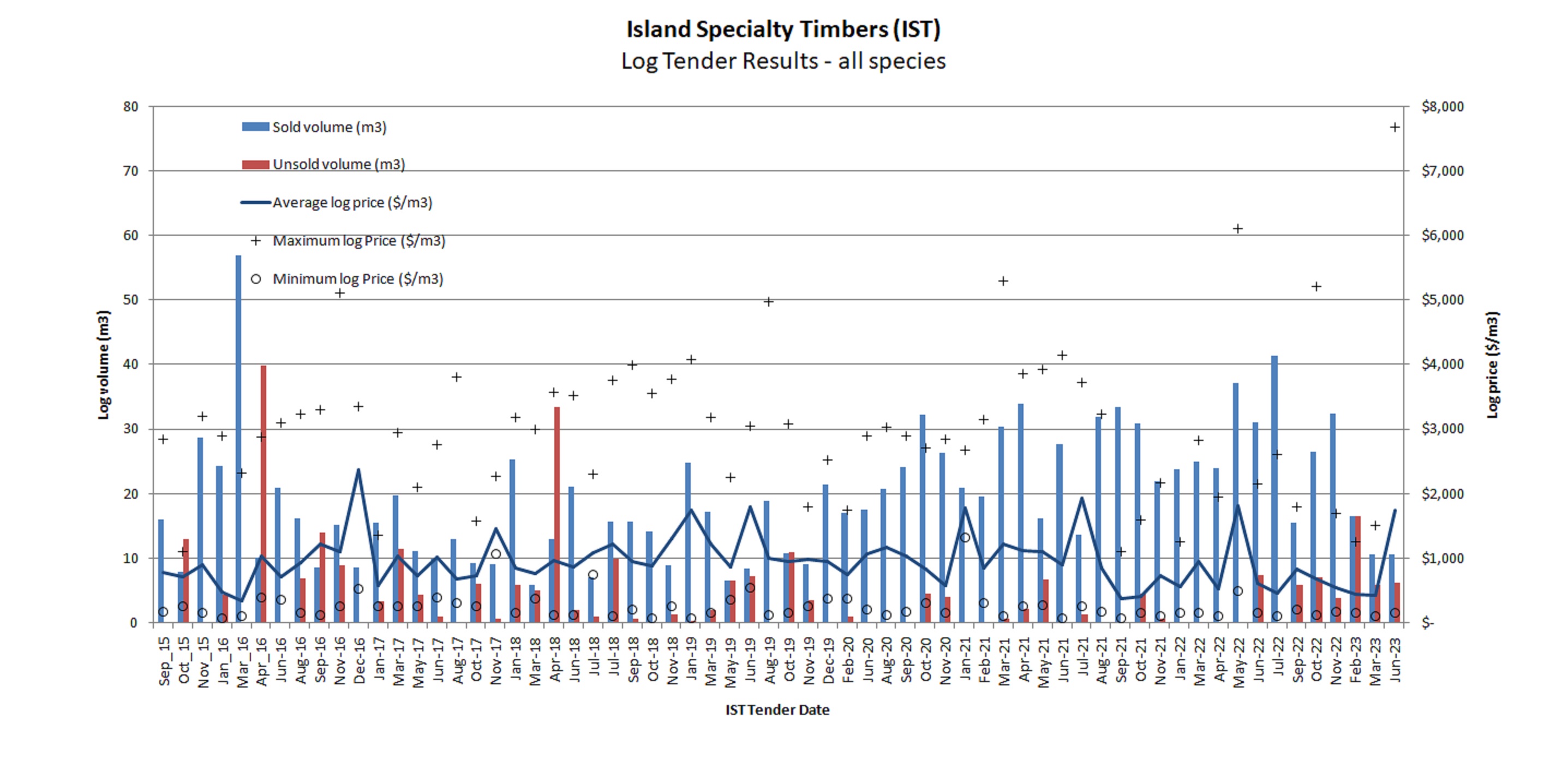
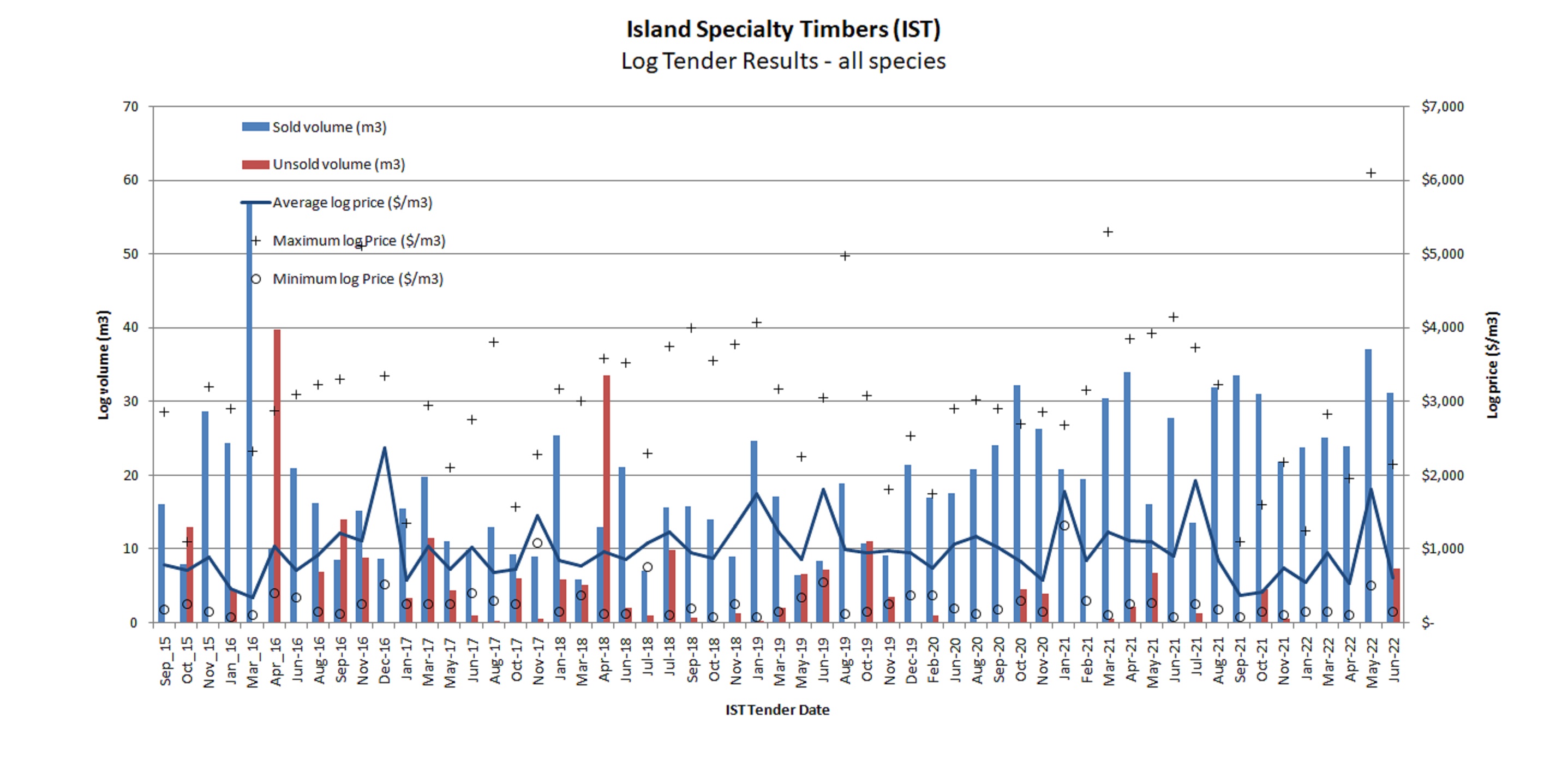
The following chart shows the volume and price summary for 65 IST log tenders back to 2015. That is over 1800 cubic metres of tendered log and craftwood.
The tiny volumes and wide variability in species and quality of logs that IST put to tender makes assessing market trends over time difficult.
One thing is obvious in the above chart is the lack of increase in the average price paid for this rare old growth forest resource over the last 9 years.
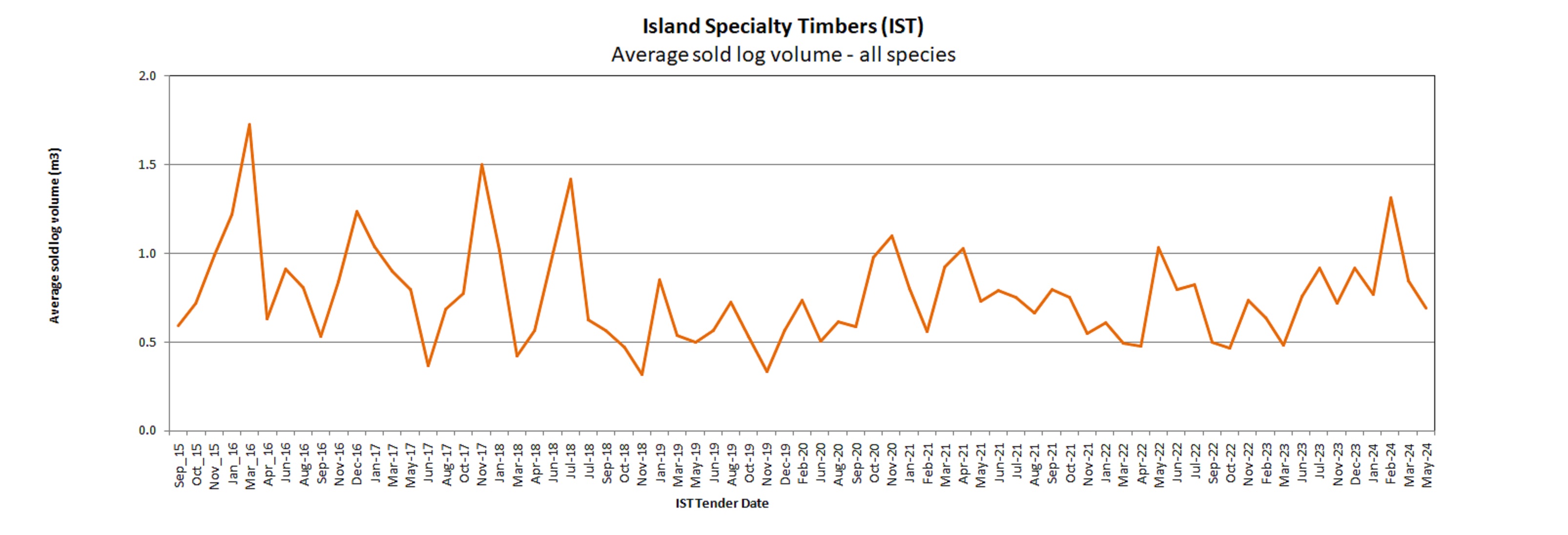
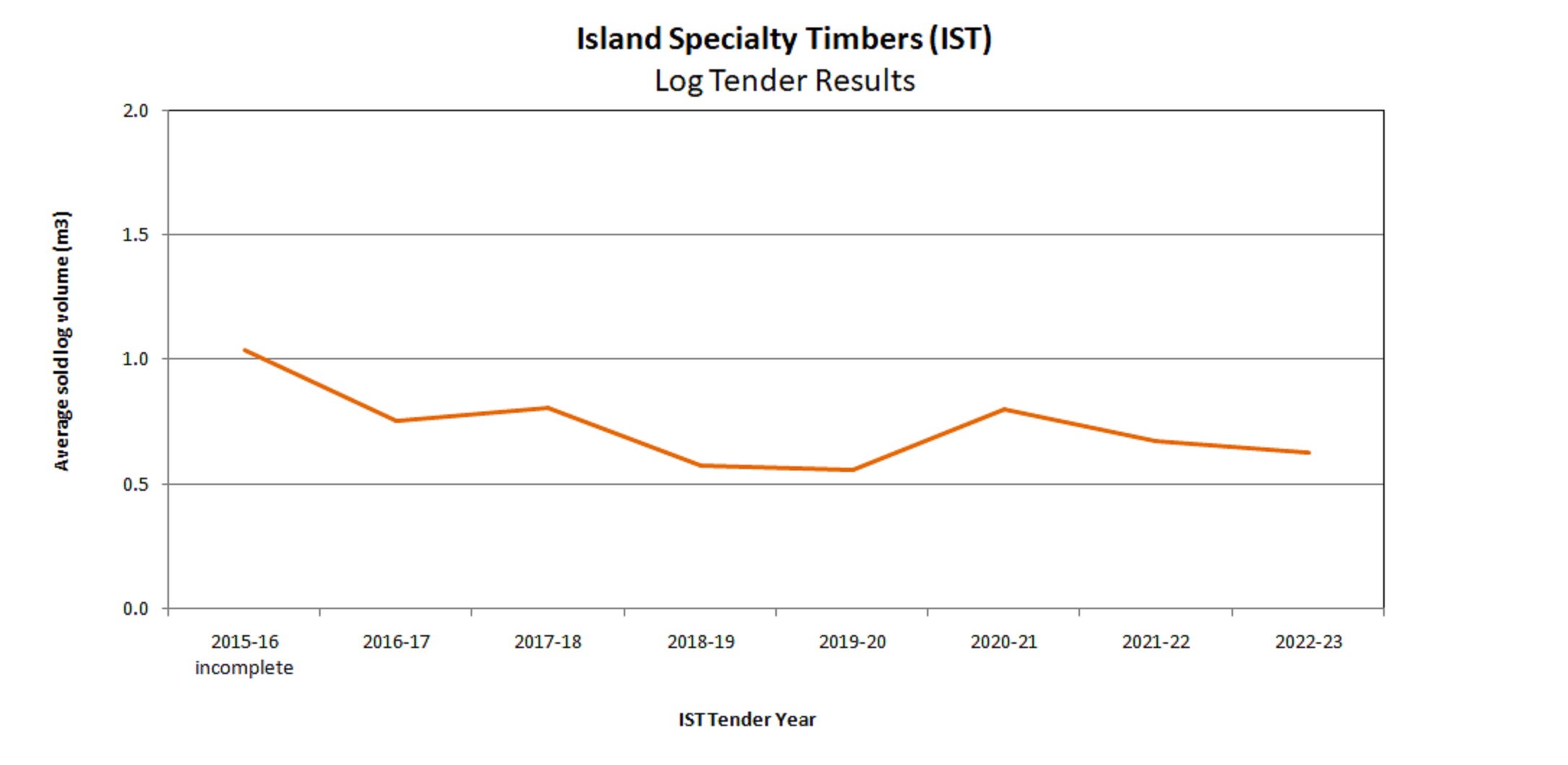
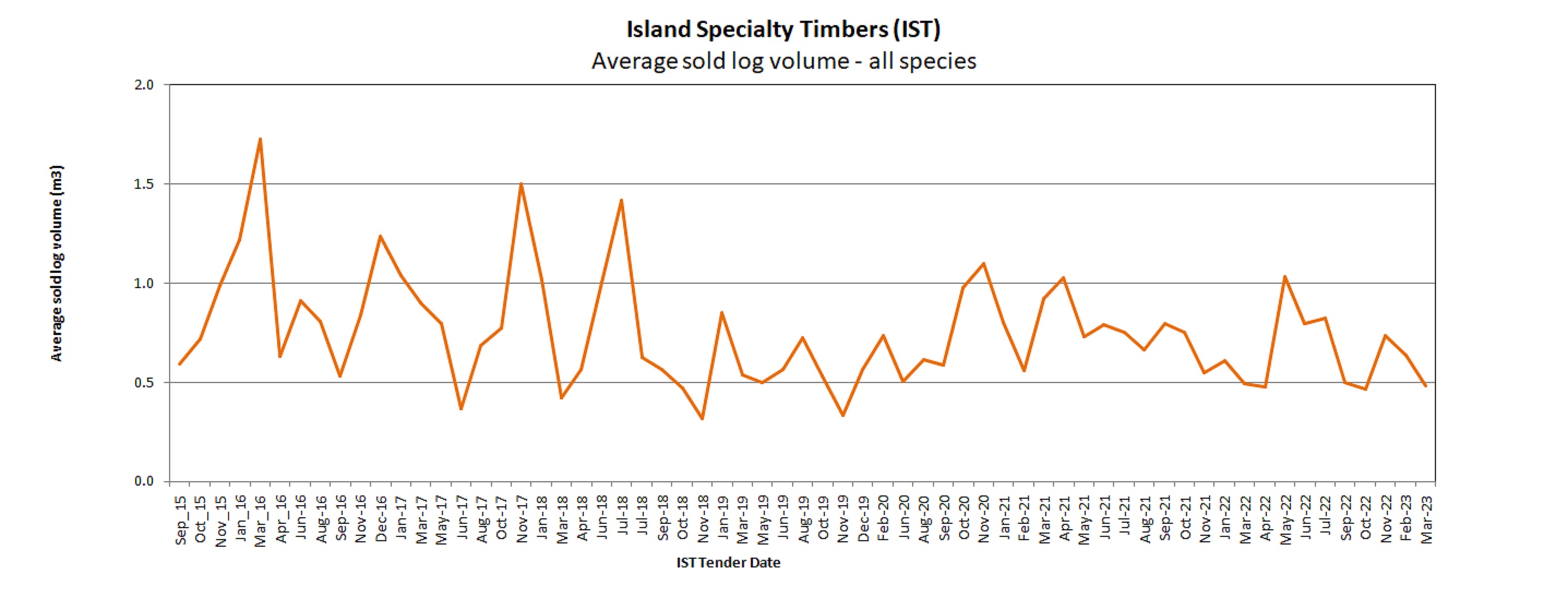
The following chart shows that average log size at the IST tenders continues to be small. Extracting value out of these small logs must present quite a challenge for the buyers.
With Tasmania and New South Wales now being the only States continuing to log public native forest the future of Island Specialty Timbers must now be on borrowed time.
I won’t be writing these annual reports for much longer!
This is a very clear message to the Tasmanian farming community!
Plant trees at your peril!!
This is further to my previous blog, and tells us how utterly broken and corrupt is the forest industry in Tasmania, not to mention our political system.
Government forest policy in Tasmania (and the rest of Australia) has always been about subsidising sawmillers.
It has never been about profitable tree growing.
So here we are in the 21st century still implementing 19th century policy.
And if there is any challenge to that welfare policy the forest industry will scream bloody murder from the mountain tops!
The above link to the Tasmanian Times website provides all the blood-soaked details of the current forestry drama.
As I said in my previous blog, this drama could well end up in the High Court of Australia, with the Tasmanian government facing various commercial and trade practices charges, never mind a blatant breach of the Australian Constitution, which guarantees free trade between States.
As I stated previously, the Tasmanian forest industry does not want a transparent, competitive market for forest products in Tasmania.
The Tasmanian forest industry is demanding market manipulation and price controls to ensure Tasmanian businesses continue to enjoy unfettered access to forest welfare.
The letter from the Tasmanian Forest Products Association to the Tasmanian Premier is clearly and openly demanding that the State government deliberately breach Australia’s consumer and competition laws.
The fact that the State Labor opposition openly supports market manipulation and price control tells us that the forest industry probably does not have a future in Tasmania.
Anyone who is a forest grower will be horrified by this.
Someone needs to write a letter to the Tasmanian Premier threatening to take the Government to the High Court over this whole fiasco.
In fact a Royal Commission into trade practices within the forest industry is long overdue.
Island Specialty Timbers is the only source of competitive, transparent log prices anywhere in Australia, including blackwood sawlog prices. That simple statement tells us a great deal about the dire condition of the forest industry!
The lack of commercial credibility is just one of the many challenges facing the forest industry in Australia.
IST is a business enterprise of Sustainable Timber Tasmania (STT) which sources and retails raw material of Tasmanian specialty timbers from harvest or salvage operations conducted on State owned Permanent Timber Production Zone land (PTPZl).
IST is not really a “business” just as the State forest agency Sustainable Timber Tasmania is not a business either. Logging of public native forest in Tasmania requires significant taxpayer subsidies every year.
IST conducted 7 tenders during the year with a total of 198 cubic metres of special species sawlog and craftwood put to public tender. Tasmania defines “special species” as any native forest timber apart from plain grain Tasmanian oak (Eucalyptus sp.).
Blackwood Results
Following two years of strong price increases for plain grain blackwood logs, this year saw a softening of markets. Maximum, minimum and average log prices all declined in 2022-23.
IST put a mere 16 plain grain blackwood logs to tender totalling 11.5 cubic metres. Three logs totalling 1.8 cubic metres were unsold at tender. Prices ranged from $150 to $800 per cubic metre with an average price of $518.
One possible explanation for the softer prices was the significant drop in log size from previous years. Smaller logs mean less sawn recovery per log volume so lower prices.
One figured grain blackwood log (1.6 cubic metres) was sold at tender for a $800/m3.
Generally ~9,000 cubic metres of blackwood is harvested annually from Tasmania’s public native forests with 99.99% being sold at heavily discounted Government prices on long term sales contracts.
The Tasmanian government dominates and deliberately undermines the blackwood log and timber market. These log tender results need to be interpreted bearing this fact in mind.
Premium plain grain sawlogs are what can be grown in blackwood plantations. The “target” sawlog in a blackwood plantation is 1.5 cubic metres in volume.
General Results
Overall a total of 198 cubic metres of special species sawlog and craftwood were put to public tender during the year. Forty five cubic metres failed to sell at tender, a significant increase over the last few years.
Apart from the June 2023 tender that contained a large volume of Huon pine material, 2022-23 continued the trend from last year of declining average prices.
Total tender revenue for 2022-23 was only $97,400 which is a significant drop from last year, and the result of the combined lower volumes and lower prices.
It’s a good thing Island Specialty Timbers is not run as a business otherwise they would be calling in the receivers. Just more taxpayer-funded welfare for the woodcraft industry.
The one positive result for the year was a record price paid for a Tasmanian special timbers log. The June 2023 tender saw a Huon pine log (66cm LED, 47cm SED, 2.4m length, 0.41 cubic metres volume) sell for $7,675 per cubic metre. This continues the trend of the past five years of ever increasing maximum prices paid for quality premium timber.
After a year 2020-21 where average log size increased, the last 2 years have seen a resumption of falling log size at the IST tenders.
Remember these IST tender sales represent tiny log volumes sold into the small southern Tasmanian market. They represent mill door prices not stumpages.
The following chart shows the volume and price summary for 64 log tenders back to 2015.
The tiny volumes and wide variability in species and quality of logs that IST put to tender makes assessing market trends over time difficult.
The following chart shows that average log size at the IST tenders continues to be very small. Extracting value out of these small logs must present quite a challenge for the buyers.
With Tasmania and New South Wales being the only States that have not committed to closing down public native forestry, the future of Island Specialty Timbers is now very much on borrowed time.
I won’t be writing these annual reports for much longer!
IST is a business enterprise of Sustainable Timber Tasmania (STT) which sources and retails raw material of Tasmanian specialty timbers from harvest or salvage operations conducted on State owned Permanent Timber Production Zone land (PTPZl).
IST is not really a “business” just as the State forest agency Sustainable Timber Tasmania is not a business either. Logging of public native forest in Tasmania requires significant taxpayer subsidies every year.
IST conducted 10 log tenders during the year with 286 cubic metres of special species logs put to public tender. Tasmania defines “special species” as any native forest timber apart from plain grain Tasmanian oak.
Blackwood Results
This is the important bit……
2022 was another champagne year for blackwood, continuing the strong market demand and prices from 2021.
2021 was the year that plain-grain blackwood sawlog broke the $1,000 per cubic metre price barrier. 2022 continued that trend with a record price of $1,150 per cubic metre.
The chart below shows blackwood sales results for the year.
A total of 15 blackwood logs (21.7 cubic metres) were put to tender this year, all of it plain grain. All logs were sold, for an average price of $643 per cubic metre, or a total of $13,950. Average log volume was 1.45 cubic metres – a good size sawlog!
A stand-out result for the year was a massive 2.46 cubic metre blackwood log that sold for $925 per cubic metre, with a total price of $2,276!
The above chart shows a return to strong demand and strong prices for quality plain grain blackwood sawlogs following the pandemic year of 2019-20, with maximum and average prices showing strong increases.
This is the greatest volume of blackwood that IST has put to tender for quite some time, despite the fact that blackwood makes up more than 90% of special species harvested from public native forest in Tasmania. Generally ~9,000 cubic metres of blackwood is harvested annually with 99.999% being sold at heavily discounted Government prices on long term sales contracts.
The Tasmanian government dominates and undermines the blackwood log and timber market. These log tender results need to be interpreted bearing this fact in mind.
Premium plain grain sawlogs are what can be grown in blackwood plantations.
Will this result capture the attention and imagination of Tasmanian farmers?
The following chart shows the average size characteristics of plain grain blackwood logs sold at IST tender. The target sawlog from a blackwood plantation has a volume of 1.5 cubic metres and a small end diameter (SED) of around 50 cm.
Remember these IST tender sales represent tiny log volumes sold into the small southern Tasmanian market. They represent mill door prices not stumpages.
Imagine if IST put 10 cubic metres of blackwood sawlog at each tender (100 cubic metres per year) to attract mainland and maybe even overseas buyers.
Imagine if State government forest policy was about profitable tree growers and not sawmill welfare.
Imagine what that change would do for the forest industry and Tasmanian farmers!
These positive blackwood log market signals should be resulting in more blackwood plantations being established, helping to build the industry and make Tasmanian farmers more profitable.
One hectare of well managed blackwood plantation has the potential to produce approx 300 cubic metres of premium sawlog after 30 – 35 years. At $1,000 per cubic metre that equates to $300,000 per ha in todays market.
General Results
Overall IST put 286 cubic metres of specialty timbers to tender in 2021-22 of which 13.8 cubic metres was not sold. Total tender revenue was $230,400.
Last year Sustainable Timbers Tasmania sold 8,825 cubic metres of specialty timbers, so these competitive tender sales represent a mere 3% of specialty timber sales from public native forests in Tasmania.
With the exception of the July 2021 and May 2022 tenders, the tender results were poor with maximum and average prices well down on previous years (see chart below).
The July 2021 tender was dominated by Black heart sassafras logs which generally attract high prices, whilst the May 2022 tender was dominated by Black heart sassafras, Tiger myrtle and figured Huon pine, all of which are premium species attracting premium prices. These tender results show that the market is still prepared to pay premium prices for rare, quality logs.
It was at the latter tender that a new record IST tender price was set for a special species sawlog. This log was a 0.94 cubic metre Tiger myrtle log that sold for $6,100 per cubic metre, total price $5,734!
The following chart shows the volume and price summary for 57 log tenders back to 2015.
The tiny volumes and wide variability in species and quality of logs that IST put to tender makes assessing market trends over time difficult.
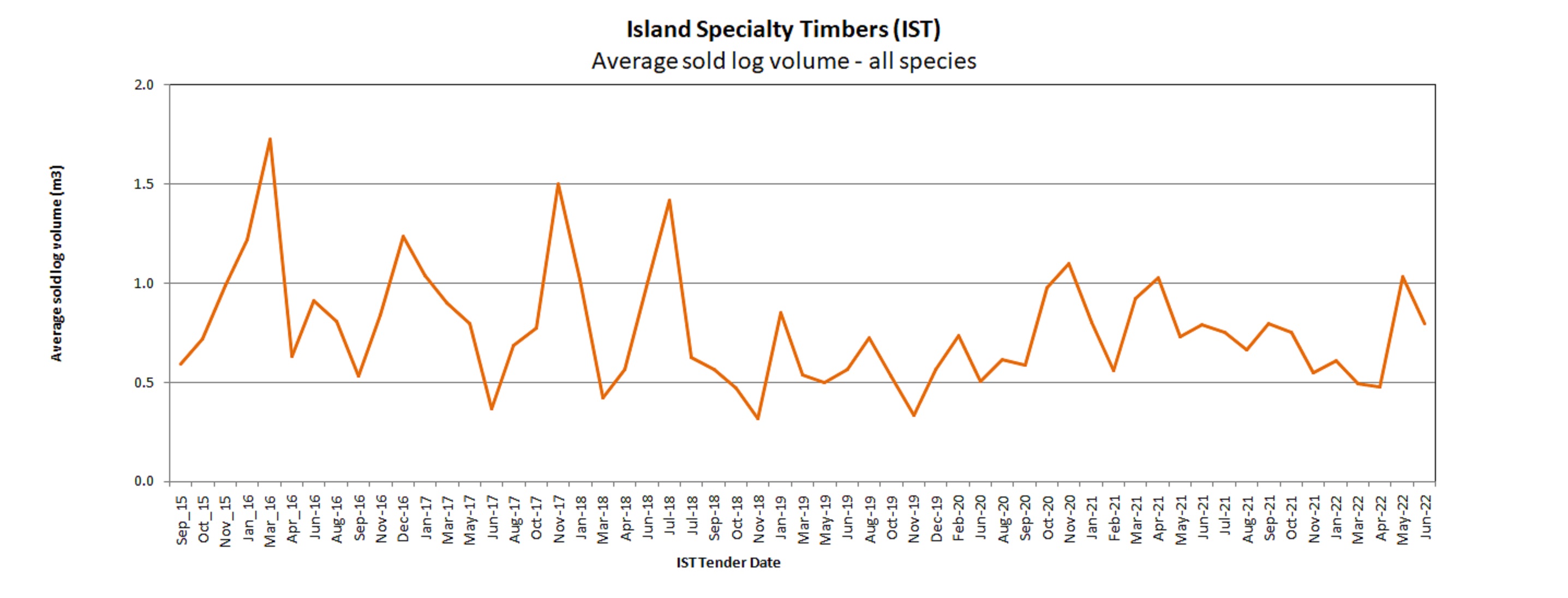
The next chart shows the average volume of the sold logs. Here there is a clear trend of diminishing log size. If it wasn’t for the occasional large eucalypt log IST throws into the tender mix, this trend of diminishing log size would be even more pronounced. The last 12 months shows a steady decline in log size so it is not surprising that prices have reflected a general decline in log quality.
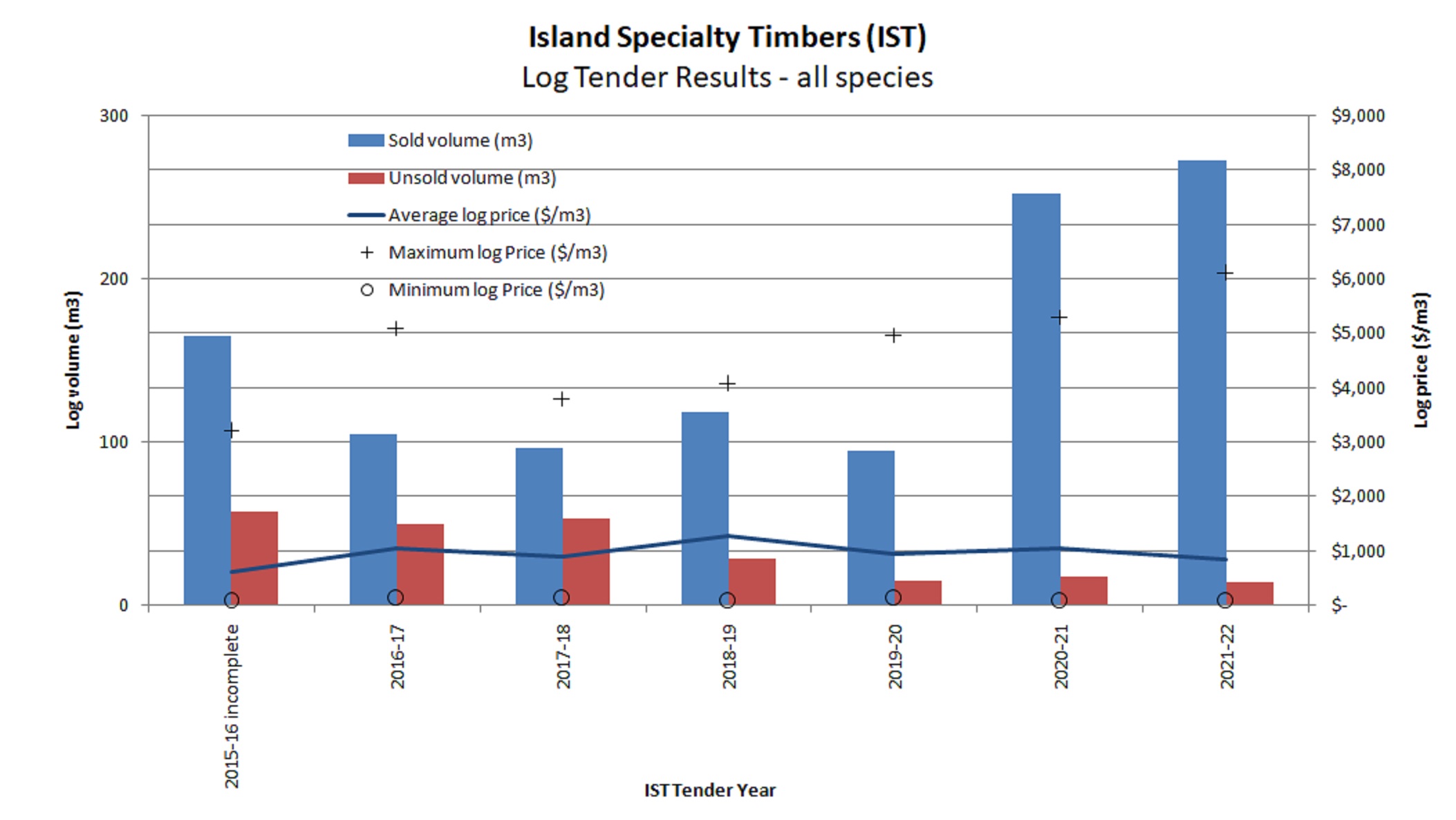
The following 2 charts show the above data summarised by year:
Continuing the trend from last year 2021-22 saw a “significant” volume of specialty species logs put to tender. Despite the higher volumes, average prices have declined, probably in part due to declining log quality.
The average price for all species put to tender in 2022 was $844 per cubic metre, well down from $1,043 per cubic metre in 2021.
The above chart shows a steady rise over the last 4 years in the maximum price paid for these dwindling ancient timber resources, whilst average and minimum prices remain relatively steady.
The main focus of IST tenders is black heart sassafras (Atherosperma moschatum) which can command very high prices for good logs. It made up 35% of log volume put to tender in 2022.
However the tree is slow growing (500+ years to reach commercial size) and is restricted to rainforest and old growth eucalypt forest, so supplies of this species are dwindling.
Blackwood made up just 8% of the volume IST put to tender.
Unfortunately the marketplace continues to show strong support for the plundering of the last of Tasmania’s ancient forests!
Farm grown blackwood timber at Ceres Fair Wood, Melbourne. $10,000 per cubic metre. Ceres Fair Wood is one of the few businesses in Australia that cares about the future of quality wood.
The Past/Present
For thousands of years humans have been using wood for all sorts of reasons – to hunt, cook, stay warm, build shelter and wage war. And for all that time we have had natural forests to plunder. Whatever wood we could find we used, mostly with plenty of contempt and waste.
But the days of plundering natural forests are just about over.
One of the problems this history has created is dysfunctional wood markets.
Cheap plentiful wood from natural forests has meant no one has ever taken responsibility for the future. Cutting down and sawing up trees is simple. Getting trees planted and managed for the future is the real challenge.
There are thousands of businesses in Australia that rely on wood (harvesting, transport, milling, retail, manufacture, craft, music, art, etc.), and 99.99% of them take no interest or responsibility in the future supply of wood.
There is no relationship in the market between using and consuming wood and a tree being planted and managed.
Third party certification schemes such as Responsible Wood/PEFC and FSC are not building the forest industry and growing more wood for the future. Their goal is to save and better manage existing natural forests, not to grow more new wood resources.
The fact that the forest industry in Australia has never established any commercial credibility hasn’t helped the situation.
There must be a credible, transparent relationship between the price of wood and the cost of planting, growing and managing trees; and that relationship must encourage and support more tree planting to meet future demand.
My focus here is especially the premium solid wood market.
Until we build proper functioning wood markets in Australia most of these Australian businesses will disappear. Some will switch to imported wood when public native welfare forestry is shut down, but many will close. All for the want of a proper functioning wood market.
The Future
There are plenty of challenges that need to be addressed in order to build proper functioning wood markets but they are not insurmountable.
Possibly the first and greatest challenge is market (and consumer) recognition and responsibility.
Proper functioning wood markets in Australia must be driven by the market and consumers.
Recent comments in the media by furniture makers and builders in Western Australia (in response to the shutting down of public native forestry) do not provide encouragement. Can you believe they would rather import timber from Indonesia than support local farm forestry?
How the thousands of wood-dependent businesses in Australia will come together to coordinate and plan their future is part of this challenge. Most of these businesses are too small to achieve much by themselves. The Australian Furniture Association could take on this role for furniture makers. Builders, cabinet makers and retailers could possibly join the AFA in this.
2. The second challenge is getting the farming community on board to plant, grow and manage the trees that the market wants.
I personally think this second challenge is by far the easier of the two.
Once farmers see the market change to being responsible and supportive they will quickly get on board.
There will need to be some serious talking and building trust, and careful management of risk.
Unlike the past where the market could pick and choose from a wide variety of natural forest woods, the market must now decide on which species it wishes to promote and support in farm forestry. Species must be fast growing and command sufficient market price to allow farmers to grow them commercially. Given we are talking 30+ years between investment/planting and harvest/revenue/profit, this will require careful consideration, coordination and planning.
The idea that farmers just randomly plant hundreds of different tree species in the hope of finding a buyer in the future just wont work. Farm forestry for the growing of high quality premium solid wood will require coordination and planning, driven by the market.
This is where organisations like the AFA must play a central role.
Final some discussion about markets.
Will there still be demand for premium quality solid wood in 30+ years time?
Certainly over my 40+ year career as a forester I have seen premium quality solid wood go from a being a common cheap product to a scarce expensive product, with all indications leading to its eventual disappearance from the Australian market entirely.
I think this is primarily a supply issue, rather than one of demand.
I see sufficient evidence that the market is prepared to pay very high prices for quality solid wood.
The problem is that in a dysfunctional wood market, these price/demand signals don’t trigger a supply response as they should. If we had a strong farm forestry culture in Australia and proper functioning wood markets, these price/demand signals would be making front page news. That is where we need to get too!
Congratulations on winning the Tasmanian Tree Farmer of The Year 2021 Award.
It’s a prestigious award!
1. Firstly can you give my readers some background? How did you get into farming and into growing trees?
I was raised on my parents farm and for as long as I can remember I wanted to farm and own an area of land and bush. I got into growing trees for their aesthetics and the environmental benefits they provide.
Our farm (Judy, my wife and I) is broken up by a series of short steep drops running basically North to South and were covered in bracken fern and blackberry. The prevailing winds are west/southwest so these banks seemed a percect place to provide erosion control and wind protection. Providing shelter was our primary aim in planting trees.
2. What tree species are you growing and why? How much of your farm is dedicated to growing trees?
I wanted to grow a variety of species (probably too many) that I was interested in and thought may grow reasonably well in our climatic conditions.
Approximately 14 hectares is plantation. Native bush is predominantly backwood.
3. Do you enjoy growing trees?
Yes I enjoy growing trees and I find it very satisfying and fulfilling.
4. Can tree growing be a profitable addition to a farm enterprise in Tasmania?
Tree growing can be a profitable addition to a farming enterprise. We have profitably harvested Blackwood (non plantation). Personally harvested and sold a small plantation of Radiata that was on the farm when purchased. We have just completed a profitable thinning and on site milling of our oldest redwood plantation.
5. As a tree farmer how much support and interest do you get from the local forest industry and wood markets?
As growers of mainly small lots of specialty timbers I dont consider we fit the normal profile for local timber markets, however have had local interest in Redwoods, and can always sell Radiata.
6. How much do you know about wood markets, supply, demand and prices? Is this information readily available to you?
Finding a transparent comparison of prices can sometimes be a little difficult. There are established markets for Radiata, however there are no established markets for Redwoods. C. Macrocarpa is attracting interest, however there is currently no transparent pricing for it.
7. As an award winning tree farmer do you think the market will now sit up and take notice and support and reward your efforts? In other words does the Award have any leverage in the marketplace?
I honestly do not know if the award will provide any leverage in the market place, however this should not be a negative.
8. Can you tell me where you think farm forestry will be in Tasmania in 20 years? Will it be a thriving profitable business or will it continue to struggle as it has for the past 50 years?
A very hard question! I would love to see a time when farmers would plant a crop of trees as readily as a crop of potatoes. I have no crystal ball but I think the reality is that it will continue to limp along.
I sincerely hope that the imperative for farming to achieve carbon neutrality may encourage farmers to store carbon. Hopefully farmers may consider planting speciality timber trees such as blackwood and redwood etc., that can store carbon for the longer term. The carbon credits for these plantations would be passed on with the sale of the farm and thus maybe help overcome the hesitancy of growing trees that require a longer time frame.
9. There are many issues holding farm forestry back in Tasmania. What do you think are the two most important of these issues?
Hard to limit it to two.
I think one is to provide clear and transparent pricing and encouragement from forestry companies so that farmers can be reasonably certain of achieving a satisfactory return for “locking up” part of their farm for a long period of time.
For the majority of farmers timber has to provide a return that at least gets close to equalling the return they may get for any other use they put their land too.
The other issues I see, especially for growers of longer term specialty species is how to encourage farmers to plant trees that personally they are unlikely to realise a monetary profit. Hopefully carbon neutrality may help.
10. Finally on a positive note, can you tell us about your best experience as a tree farmer.
Growing, felling and milling your own timber is extremely satisfying, however the most extreme experience is standing in a 40 year old plantation of Redwoods realising their beauty and knowing they were planted by us!
Kind regards
Graham and Judy
Thankyou Graham for your time, and may your tree-growing efforts not go unrewarded.
Island Specialty Timbers (IST), the only source of competitive, transparent market blackwood log prices, conducted 10 log tenders during the year, making up for the shortfall last year due to the pandemic.
IST is a business enterprise of Sustainable Timber Tasmania (STT) which sources and retails raw material of Tasmanian specialty timbers from harvest or salvage operations conducted on State owned Permanent Timber Production Zone land (PTPZl).
You can read my previous annual tender summaries here:
2021 was the year that plain-grain blackwood sawlog broke the $1,000 per cubic metre price barrier!
Prices for good quality plain grain blackwood sawlogs have been sitting above $800 per cubic metres for the last few years, as seen in the chart below, but this year they broke through the price ceiling.
Premium plain grain sawlogs are what can be grown in blackwood plantations.
Will this result encourage Sustainable Timbers Tasmania/IST to put more blackwood sawlogs to tender?
Will this result capture the attention and imagination of Tasmanian farmers?
This year IST put 10 blackwood logs to tender, a total of 11.9 cubic metres, or 4.4% of the total volume put to tender for the year.
One log was unsold at tender, as was a 2 cubic metre pack of sawn blackwood boards.
Two logs had feature grain and sold between $1,250 and $1,300 per cubic metre.
The other 7 logs were plain grain, with prices ranging from $300 to $1,100 per cubic metre. Lower prices were paid for smaller logs and logs with defects (spiral grain, scars, branch knots).
Higher prices were paid for large, good quality logs.
All up the 8.14 cubic metres of plain grain blackwood logs sold for $4,259.
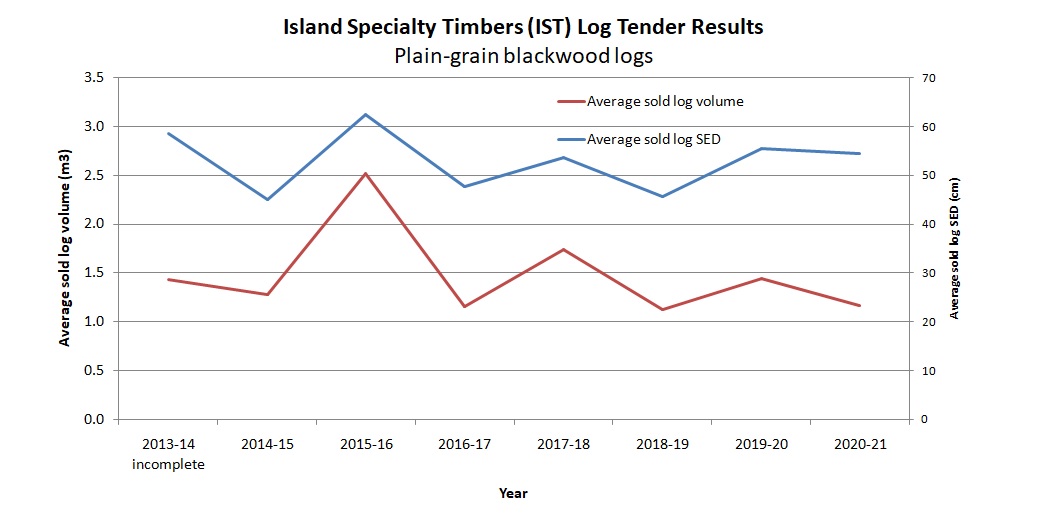
The following chart shows the average size characteristics of sold plain grain blackwood logs. The target sawlog for a blackwood plantation has a volume of 1.5 cubic metres and a small end diameter (SED) of around 50 cm.
Remember these are tiny log volumes sold into the small southern Tasmanian market. They represent mill door prices not stumpages.
As usual IST has a policy of minimising the amount of blackwood logs it puts to tender, despite the fact that around 10,000 cubic metres of blackwood are harvested from public native forests in Tasmania each year, and sold at “Government prices”.
Imagine if IST put 10 cubic metres of blackwood sawlog at each tender, to attract mainland and maybe even overseas buyers.
Imagine if Government forest policy was about profitable tree growers and not sawmill welfare.
Imagine what that change would do for the forest industry and Tasmania!
These positive blackwood log price signals should be resulting in more blackwood plantations being established, helping to build the industry and make Tasmanian farmers more profitable.
One hectare of well managed blackwood plantation has the potential to produce approx 300 cubic metres of premium sawlog after 30 – 35 years. At $1,000 per cubic metre that equates to $300,000 per ha in todays market.
How many Tasmanian farms have difficult corners, steep slopes and weedy areas that could be more productive growing quality wood?
General Results
Overall IST put 272 cubic metres of specialty timbers to tender in 2020-21 of which 252 cubic metres sold for total revenue of $262,700.
Last year Sustainable Timbers Tasmania sold 7,921 cubic metres of specialty timbers, so these competitive tender sales represent a mere 3% of specialty timber sales from public native forests in Tasmania.
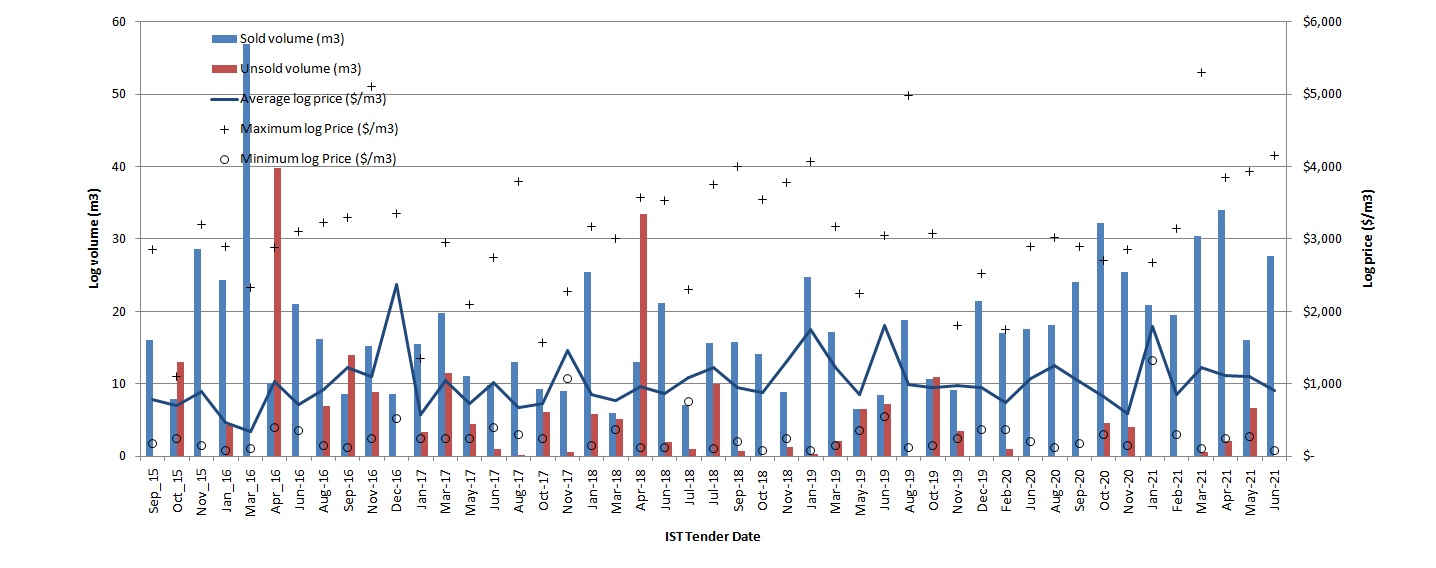
The following chart shows the volume and price summary for all log tenders back to 2015. The price spike in the January 2021 tender was due to this tender being an all Huon pine (Lagarostrobos franklinii) tender.
The tiny volumes and wide variability in species and quality of logs that IST put to tender makes assessing trends over time difficult.
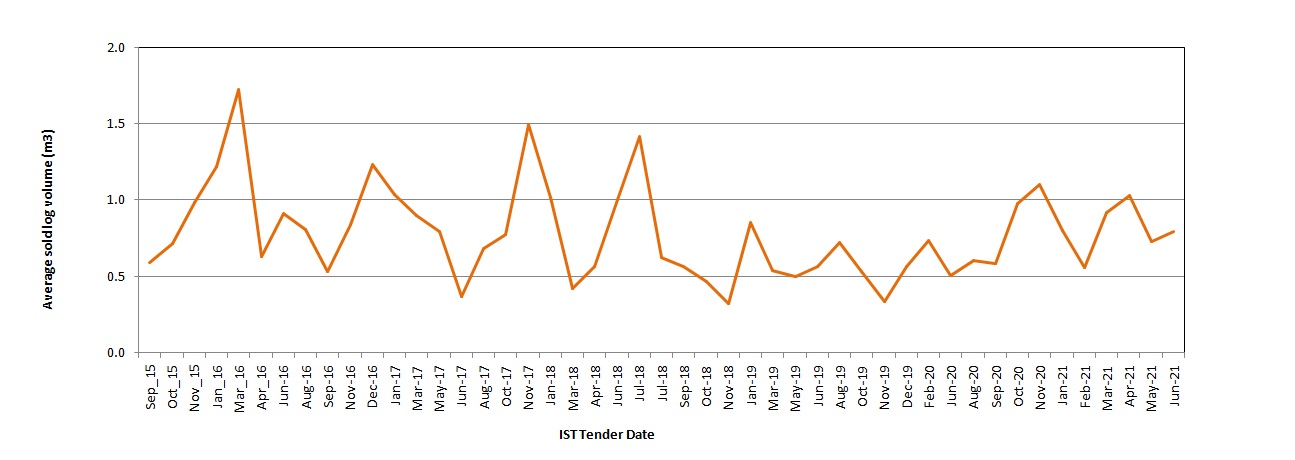
The next chart shows the average volume of the sold logs. Here there is a clear trend of diminishing log size. If it wasn’t for the occasional large eucalypt log IST throws into the tender mix, this trend of diminishing log size would be even more pronounced.
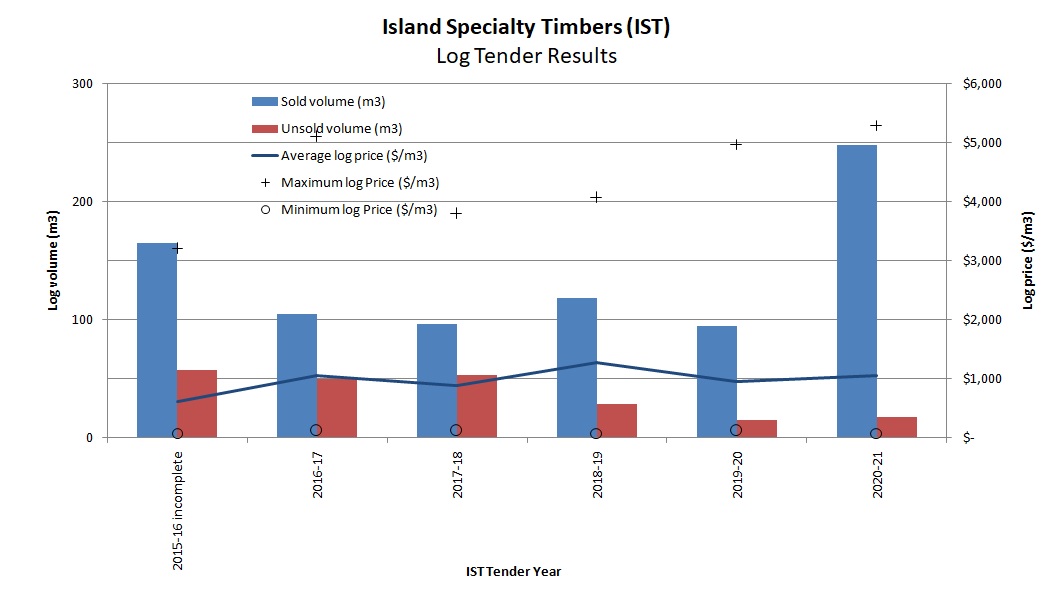
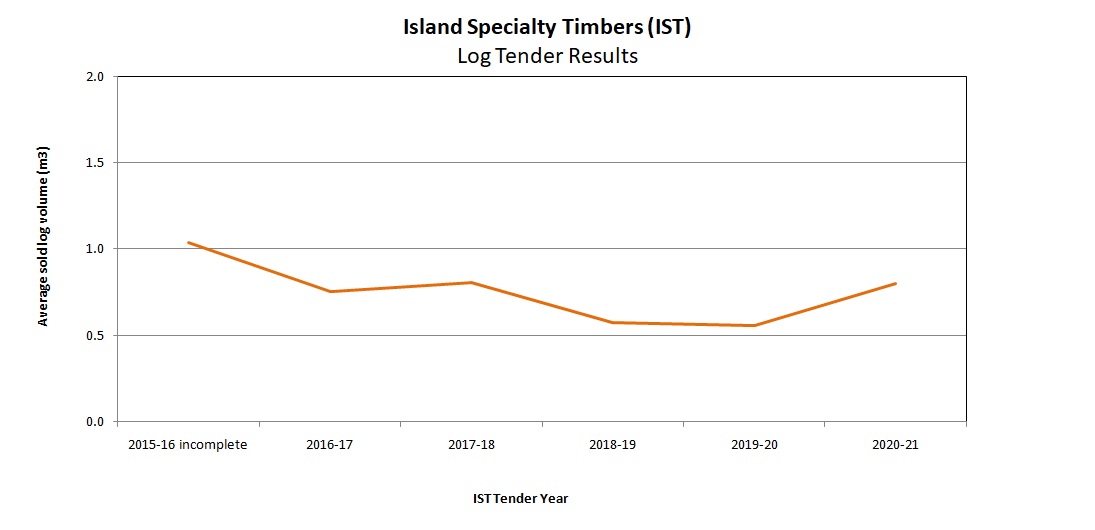
The following 2 charts show the above data summarised by year:
2020-21 was significant for a) the major increase in volume of specialty timbers put to tender, and b) a record unit price set for a single log at IST.
The record unit price of $5,300 per cubic metre was for a Black heart sassafras log at the March 2021 tender. The log was only 2.5 metres long with a volume of only 0.16 cubic metres, so total price was only $850!!
The highest price paid for a single log was at the same March 2021 tender where another Black heart sassafras log of 1.3 cubic metres sold for $5,570.
The main focus of IST tenders is black heart sassafras (Atherosperma moschatum) which can command very high prices for good logs.
However the tree is slow growing (500+ years to reach commercial size) and is restricted to rainforest and old growth eucalypt forest, so supplies of this species are dwindling.
Surprisingly the marketplace continues to support the plundering of Tasmania’s last ancient forests!
Five Year Review
Again it is important to recognise that this data represents tiny volumes sold into the small southern Tasmanian market. The results DO NOT represent the wider Tasmanian, Australian or international markets.
The results are also influenced by the fact that IST is NOT a commercial business. Like its parent Sustainable Timbers Tasmania, IST is NOT obliged to make a profit. These rare timber resources are brought to market at taxpayer expense.
Looking at the annual aggregate results of the IST tenders three trends are apparent:
the maximum price paid for quality wood is increasing; and
the volume unsold at tender is decreasing. Whether this is due to a) IST becoming better at excluding logs that will not sell, and/or b) increasing demand for quality wood, is unclear. The fact that both the average and minimum prices paid remain steady indicates better log selection rather than increasing demand. Certainly the quality of product put to tender by IST varies enormously.
the average price paid for quality wood has not changed over the last 5 years, remaining at around $1,000 per cubic metre.
The 7-year trend for plain grain blackwood logs is less clear, but the volumes are microscopic!
In general the prices paid for plain grain blackwood logs have been good, with indications in the last few years of solid price increases.
Since blackwood is the only Tasmanian specialty timber species that can be grown in commercial plantations, this is good news!
Will the Government and the forest industry make use of this valuable positive market information?











 Tasmanian Blackwood Growers Cooperative
Creating a functional wood market in Australia
The Past/Present
For thousands of years humans have been using wood for all sorts of reasons – to hunt, cook, stay warm, build shelter and wage war. And for all that time we have had natural forests to plunder. Whatever wood we could find we used, mostly with plenty of contempt and waste.
But the days of plundering natural forests are just about over.
One of the problems this history has created is dysfunctional wood markets.
Cheap plentiful wood from natural forests has meant no one has ever taken responsibility for the future. Cutting down and sawing up trees is simple. Getting trees planted and managed for the future is the real challenge.
There are thousands of businesses in Australia that rely on wood (harvesting, transport, milling, retail, manufacture, craft, music, art, etc.), and 99.99% of them take no interest or responsibility in the future supply of wood.
There is no relationship in the market between using and consuming wood and a tree being planted and managed.
Third party certification schemes such as Responsible Wood/PEFC and FSC are not building the forest industry and growing more wood for the future. Their goal is to save and better manage existing natural forests, not to grow more new wood resources.
The fact that the forest industry in Australia has never established any commercial credibility hasn’t helped the situation.
There must be a credible, transparent relationship between the price of wood and the cost of planting, growing and managing trees; and that relationship must encourage and support more tree planting to meet future demand.
My focus here is especially the premium solid wood market.
Until we build proper functioning wood markets in Australia most of these Australian businesses will disappear. Some will switch to imported wood when public native welfare forestry is shut down, but many will close. All for the want of a proper functioning wood market.
The Future
There are plenty of challenges that need to be addressed in order to build proper functioning wood markets but they are not insurmountable.
Proper functioning wood markets in Australia must be driven by the market and consumers.
Recent comments in the media by furniture makers and builders in Western Australia (in response to the shutting down of public native forestry) do not provide encouragement. Can you believe they would rather import timber from Indonesia than support local farm forestry?
How the thousands of wood-dependent businesses in Australia will come together to coordinate and plan their future is part of this challenge. Most of these businesses are too small to achieve much by themselves. The Australian Furniture Association could take on this role for furniture makers. Builders, cabinet makers and retailers could possibly join the AFA in this.
https://australianfurniture.org.au/
Is the AFA up to the challenge?
2. The second challenge is getting the farming community on board to plant, grow and manage the trees that the market wants.
I personally think this second challenge is by far the easier of the two.
Once farmers see the market change to being responsible and supportive they will quickly get on board.
There will need to be some serious talking and building trust, and careful management of risk.
Unlike the past where the market could pick and choose from a wide variety of natural forest woods, the market must now decide on which species it wishes to promote and support in farm forestry. Species must be fast growing and command sufficient market price to allow farmers to grow them commercially. Given we are talking 30+ years between investment/planting and harvest/revenue/profit, this will require careful consideration, coordination and planning.
The idea that farmers just randomly plant hundreds of different tree species in the hope of finding a buyer in the future just wont work. Farm forestry for the growing of high quality premium solid wood will require coordination and planning, driven by the market.
This is where organisations like the AFA must play a central role.
Final some discussion about markets.
Will there still be demand for premium quality solid wood in 30+ years time?
Certainly over my 40+ year career as a forester I have seen premium quality solid wood go from a being a common cheap product to a scarce expensive product, with all indications leading to its eventual disappearance from the Australian market entirely.
I think this is primarily a supply issue, rather than one of demand.
I see sufficient evidence that the market is prepared to pay very high prices for quality solid wood.
The problem is that in a dysfunctional wood market, these price/demand signals don’t trigger a supply response as they should. If we had a strong farm forestry culture in Australia and proper functioning wood markets, these price/demand signals would be making front page news. That is where we need to get too!
So dear reader, what do you think?
Comments and ideas welcome.
2 Comments
Posted in Commentary, Cooperatives, Furniture, Markets, Plantations, Prices, Tonewood