Category Archives: Politics

Insanity …

LogTruck

http://tasmaniantimes.com/index.php?/weblog/article/insanity-1/

Here’s an excellent article by economist Graeme Wells on the failures and incredible waste of past and present Government forest policy in Tasmania. It makes for sober reading.

Unfortunately Tasmania’s political system only exacerbates the problem.

When will Tasmania get a fully commercial, profitable forest industry?

Tasmanian Government Response to the Strategic Growth Plan

MACSGP2017

http://www.stategrowth.tas.gov.au/__data/assets/pdf_file/0011/149438/Tasmanian_Government_Response_To_Growth_Plan.pdf

The Tasmanian Government has released a statement outlining its response to the forest industry Strategic Growth Plan, which I previously reviewed:

https://blackwoodgrowers.com.au/2017/05/08/a-strategic-growth-plan-for-the-tasmanian-forests-fine-timber-and-wood-fibre-industry/

The Response keeps the focus of forest policy firmly on a public forest resource and a failed, self-declared bankrupt public forest manager.

Any transition to profitable private tree growers is completely out of the question.

Absolutely nothing has changed!

The bulk of the Response is about what the long suffering Tasmanian taxpayer will continue to do for the forest industry.

The continuing wanton waste of taxpayer’s money on the forest industry is beyond belief! The forest industry has access to the Treasury piggy bank like no other industry in Tasmania!

It now appears certain that the Tasmanian taxpayer will take over responsibility for funding the construction and maintenance of all thousands of kilometres of forestry roads on public land. This is a direct contravention of competitive neutrality.

Remember there are private forest growers who receive none of these taxpayer benefits.

Finally on to special timbers discussed on page 4 of the Response.

As part of the continuing forest industry gravy train, the Tasmanian taxpayer is throwing money at a propaganda initiative to tell us about the benefits of continuing to plunder the last of Tasmania’s oldgrowth and rainforests for the benefit of a handful of venerable craftspeople.

Tasmanian Special Timber Woodcraft Sector Community, Market Awareness and Engagement Program Funding

Funding of $115 000 has been provided to the Tasmanian Special Timbers Alliance for the development and implementation of a Tasmanian Special Timber Woodcraft Sector Community, Market Awareness and Engagement Program. This program will support the implementation of the Special Species Management Plan.

It is all so sad, pathetic and predictable.

Forestry in Tasmania continues to be nothing but waste, politics, and conflict.

Many Tasmanians seem more than happy with this outcome.

As a forester I find the situation incomprehensible.

40 years of this nonsense and it just goes on and on….

When will Tasmania get a fully commercial profitable forest industry?

Not in the foreseeable future that is for certain!

NSW Forestry Industry Roadmap 2016

NSWFIR

http://www.crownland.nsw.gov.au/forestry/industry-roadmap

This Roadmap was released by the New South Wales (NSW) State Government in August last year.

Yet another forest industry taskforce, yet another forest industry plan.

Do I really want to review it? Just a cursory glance tells me it is another Dead Plan Walking.

Come the next change of State Government this Plan will be history.

The Roadmap has “4 Pillars”. They are:

  1. Regulatory modernisation;
  2. Balancing supply and demand;
  3. Community understanding and confidence;
  4. Industry innovation and new markets.

Nothing there about profitability or commercial performance.  Tree growing in NSW remains a community service. NSW farmers will be pleased about that!

So what are some of the glaring errors and omissions of the Roadmap?

  • The NSW Forest Industries Taskforce, just like the Tasmanian Forestry Advisory Council, is comprised of only forest industry representatives. This Roadmap is a 100% political document. In contrast the Victorian Forest Industry Taskforce includes a range of community representatives;
  • The complete lack of profitable tree growers;
  • The commercial management and profitability of NSW Forestry Corporation (the State’s largest tree grower) is completely ignored;
  • Transparent competitive log markets are completely absent. Apparently the price of logs is completely irrelevant to the future of the forest industry;
  • The complete absence of costings and a budget for the Roadmap. How much is THIS plan going to cost the taxpayer? Haven’t they payed the forest industry enough already?
  • The NSW Government will aim to improve community acceptance of the forestry industry as a sustainable and renewable industry” (p.11). What a terrible statement to make. It sounds like something Joseph Goebbels, Nazi Propaganda Minister, would say. More industry propaganda in other words.
  • There is no mention at all about improving the profitability of the industry – either growers or processors.

One of the issues that is highlighted for me by the Roadmap is the fact that plantation regulation is so completely different across all Australian States. Australian plantation owners cannot compete on a level playing field, even within Australia, because the regulations around plantation establishment and management differ significantly between States. No doubt this is also true with most primary industries.

Does the Roadmap have anything useful to say?

About the only useful thing the Roadmap says is that the Government will move to put both private and public forest growers on the same regulatory playing field. It is certainly curious how competitive neutrality continues to get such a low priority in the forest industry. As for commercial performance that continues to be completely ignored.

Here are three vital reports that the Roadmap completely ignores:

https://blackwoodgrowers.com.au/tag/impediments-to-investment-in-long-rotation-timber-plantations/

Click to access farm-forestry-strategy-nsw.pdf

I also note that the NSW Department of Primary Industries website no longer includes forestry as a primary industry. Clearly NSW farmers are just not interested.

This Roadmap is 14 pages of tedious political/industry marketing hype and nonsense.

I’ve read it all so many times before over many decades. This is nothing more than the continuation of failed forest industry policy. All around Australia the forest industry exists in a perverse parallel universe, where commercial performance is irrelevant and taxpayer subsidies are vital.

When will NSW get a fully commercial profitable forest industry?

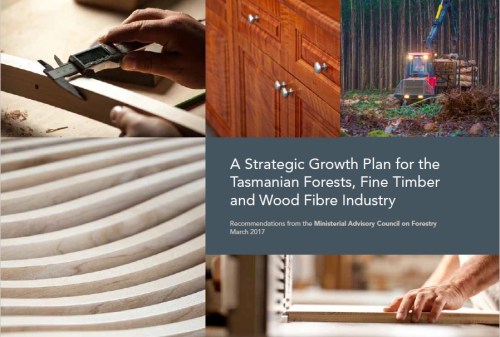
A Strategic Growth Plan for the Tasmanian Forests, Fine Timber and Wood Fibre Industry

MACSGP2017

http://www.stategrowth.tas.gov.au/__data/assets/pdf_file/0004/148855/Strategic_Growth_Plan.PDF (1.3 MB pdf)

The Tasmanian Ministerial Advisory Council on Forestry has finally produced a Strategic Plan for the industry.

Yes another strategic plan for the forest industry!!

Our public library shelves are at breaking point, weighed down by the dozens of these plans, strategies and reviews that have been produced over the past 40 years, all to no avail.

Two issues ensure that the use-by date of this Plan has already expired:

  1. The State Government deliberately excluded non-industry representatives from the Advisory Council. This Plan only represents the interests of a small select group of Tasmanians. It is a 100% political document! This Plan is only as good as the next election if that!
  2. The two most contentious issues of a) public forest management, and b) the future management of Forestry Tasmania, should have been dealt with a separate section within the Plan. Instead these issues are woven through the document, fundamentally compromising the entire Plan. If the forest industry cannot unchain itself from these two issues, and focus on profitable tree growing, then the forest industry is doomed.

If the future of the forest industry is to be based on profitable tree growing then this Plan fails completely!

Reviewing the Plan is therefore an academic/intellectual/painful exercise.

As a forester having read many previous forest industry plans and strategies, reading this Plan is painful and frustrating. Besides the poor structure and legibility, much of the contents are straight out of previous plans I’ve read. There are very few new ideas in this Plan.

The surreality of the Plan is overwhelming, in that the Plan completely ignores the current hostile political, social and economic context of the forest industry.

The Pros

“The future growth potential of private plantations is significant”. This statement on page 6 of the Plan says a lot about the future growth of the forest industry. Unfortunately it is not expanded upon anywhere else in the Plan.

“Government involvement will be as an enabler rather than as a commercial participant.” This statement on page 9 of the Plan is the most curious feature of the Plan. It stands alone with no further detail or explanation of what it might mean. It can be interpreted in a variety of ways.

“It is recommended the Forest Practices Act and the implementation of its provisions be reviewed in keeping with progressive developments in forest practices and science”. A review of the FPA is certainly needed, especially around plantation development and management. Forest plantations should exist within the same regulatory environment as any other primary industry, just like in New Zealand – a level playing field.

“While the industry comprises a diversity of often competing interests and business models, individual stakeholders also share a range of common interests. Within this context, there is a need for an umbrella organisation to develop and represent the shared interests of the whole of the value chain on matters of common concern”. The Plan calls for the formation of a new industry representative body. Private forest growers are the future of the forest industry. They need strong leadership and a strong voice.

That’s it! Four statements in the Plan that I think have some merit and potential. The rest of the Plan is padding or worse.

The Cons

The main con is the absence of non-industry representation on the Advisory Council, making this Plan a 100% political document;

The Plan assumes indefinite ongoing access to taxpayer subsidised public forest resource;

The complete absence of profitable tree growers and profitable tree-growing as the basis of any successful forest industry;

Log pricing is not discussed nor are transparent competitive markets;

The Plan is not a response to a review of the forest industry. Firstly we need a document that lists the major problems and challenges facing the forest industry. Then we need a strategy that addresses those problems and challenges. The logic needs to be transparent – problem, solution, outcome! By itself this document provides the reader with no context by which to judge the strategy, let alone any possible outcomes. I would classify this as a major flaw.

These Plans are always about what the Government can do for the industry, never about what the industry must do for itself; and

Hence always involve spending large amounts of taxpayer money;

Private Forests Tasmania is not mentioned in the Plan!!

The Plan retains the stupid rhetoric about “resource security”. The forest industry does not need “resource security”! The very successful New Zealand forest industry does not talk about resource security, because the NZ industry is based on a private forest resource. “Resource security” in NZ only comes from profitability; either pay a good market price or go out of business! “Resource security” is a forest industry euphemism for loss-making, taxpayer-subsidised, politically protected industry. “Resource security” is anti-competitive and against the principles of competitive neutrality. Private forest growers should not be subject to “resource security” so neither should the public forest grower. In my opinion the word “sustainable” has come to serve the same purpose within the industry. The Plan uses the word “sustainable” ad nauseum whilst the word “profit” appears only once!

The inability of the Strategy to recognise and address issues of competitive neutrality, such as the proposal that the State Government fund forest road construction and maintenance (p. 20). Government money must then also go to private forest growers for road construction and maintenance in order to achieve competitive neutrality!

The section on Meeting Community Expectations (p. 13) is a complete joke, in fact it is laughable.

The section on Special Species Timbers (p. 17) is a joke;

The section on Private Forests (p. 14) is completely inadequate. The objective of private forest growers is profitability. Improving profitability and competitiveness is not discussed in the Plan at all.

I could go on, but the patient is already in the Terminal Ward.

The weaknesses and omissions in this Plan mean that it has already been consigned to the dust bin of history. In 3 years time the Strategic Plan of 2017 will be long forgotten. Yet another failure by the Tasmanian forest industry to reinvent itself.

Another 3 years wasted. More subsidies, more politics, more community conflict can only follow.

PS. Another significant omission from the Plan is the subject of a budget and funding. Of course we all know that the long suffering taxpayer will be asked once again to throw money at the forest industry by way of this Plan, to the tune of $100s millions of dollars. Given the billions of dollars that have been wasted on the forest industry over the past 30 years, taxpayers should be extremely wary of supporting any forest industry plan that does not include significant forest policy and industry reform. This Plan contains very few recommendations for policy and industry reform.

PPS. If the forest industry and the Tasmanian community are serious about the future of the industry then I recommend these two reports as a good place to begin:

Two significant forest industry reports that went nowhere

These reports contain plenty of great recommendations for reform, none of which have ever been implemented.

PPPS.

Speaking of redundant Forestry Growth Plans does anyone remember this one?

Click to access corp_plan_2000.pdf

It’s a complete joke!! By December 2003 ………

Complete cloud cuckoo land stuff. And here we are 14 years later still in cloud cuckoo land. Pathetic!

FIAT (& the TFGA) opposes forestry bill

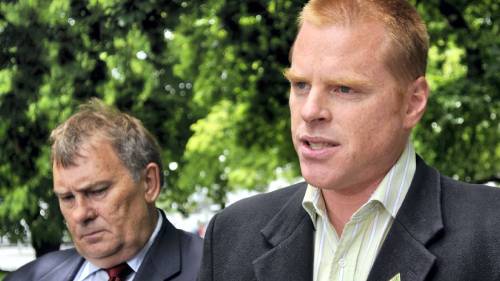
Edwards&Bailey2

Three important news articles in minor Tasmanian newspapers this week shine the light on the growing conflict in Tasmania over Government forest policy.

Firstly a front page article in this week’s Huon News (22/03/2017) is one of the more detailed and informative news articles on the current forestry chaos that I’ve seen.

Huon News 22032017

The Huon News is the weekly newspaper of the Huon Valley, a Tasmanian community that has been particularly hard hit by the 35 years of forestry wars. The community has been left shattered and bitterly divided. And still we have our politicians stirring up trouble and pain.

The second and third articles are in this week’s Tasmanian Country (24/03/2017) newspaper, a weekly newspaper published for the rural community.

Tas Country 24032017

The Tasmanian Government is actively working against the advice of its own forest management agency Forestry Tasmania.

The Government is also acting against the advice of both the Forest Industries Association of Tasmania (FIAT) AND the Tasmanian Farmers and Graziers Association (TFGA) representing private forest growers.

http://www.fiatas.com.au/

http://www.tfga.com.au/

The Tasmanian Government says it is acting on behalf of the Tasmanian community AND it has a mandate from the 2014 election, and on that basis it will ignore these three critical organisations.

After reading these articles you are left scratching your head wondering what on earth is going on?

There are two points I want to highlight from these articles:

  1. FIAT says that the forest industry is not taxpayer subsidised. I beg to differ in the strongest terms. Despite going to the 2014 election promising no more subsidies for the forest industry, in the past 3 years the Tasmanian taxpayer has given over $250 million in subsidies to the forest industry. This includes the Tasmanian taxpayer assuming responsibility for $150 million in superannuation costs from Forestry Tasmania!! So much for health and education. What private company gets that kind of special treatment?
  2. The TFGA talks about bipartisan political support for the forest industry. Given that neither FIAT nor the TFGA have any forest industry policies or plans it is difficult to determine exactly how we are to judge the issue of bipartisan support. Exactly what are the political parties supposed to support? Exactly who is leading? It was blind bipartisan political support that created the Gunns and MIS disasters.

Our political system is deliberately competitive (and ultimately destructive). It’s like a football grand final. Winners AND losers!! Bipartisan political support is an oxymoron. The 2014 State election proved that.

NO ONE HAS A PLAN FOR THE TASMANIAN FOREST INDUSTRY.

Not FIAT, nor the TFGA; neither Liberal or Labor.

And if they did have a plan it would only be as good as the next State election…….if that!

While the State Government remains a major player in the forest industry then the industry is doomed.

In 2014 the people of Tasmania voted against the forest industry at the State election.

No matter what the outcome of the 2018 State election, the Huon Valley community along with the rest of the Tasmanian community and the forest industry will lose.

And on top of this the State Government is looking to bring a 150,000 cubic metres per year sawmill to Tasmania from Victoria. The Victorians have run out of sawlogs and the mill will close.

http://www.abc.net.au/news/2017-03-18/tasmanian-government-claims-vote-of-confidence-after-victorian-/8366344

All available public native forest sawlogs in Tasmania are already fully allocated, so why bring the sawmill here? Hence the concern in the third article.

Nothing makes sense.

The only basis for a successful forest industry is profitable tree growers. None of them in Tasmania!!

Completely toxic – Tasmanian State Election 2018

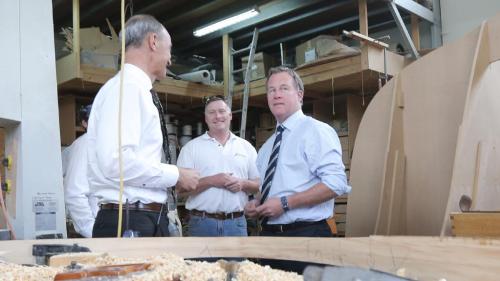
BarnettDenmanHodgman

L to R: Tasmanian Resources Minister Guy Barnett, wooden boat builder Andrew Denham, Tasmanian Premier Will Hodgman.

Tasmania is due for its next State election by March 2018 but we are already in campaign mode. Battlelines are being drawn and as many battlegrounds opened up as the politicians can handle.

The forest industry is an old campaign warhorse. This old nag has been dragged onto every election battlefield for the past 35 years. Up until the 2014 election it was with the support of the forest industry.

But times have changed.

It’s all about logging public native forests; an issue that for a number of reasons (economic, social, political and environmental) is now completely toxic in Tasmania.

At least some sections of the forest industry now recognise the enormous cost of last 35 years of “forestry wars” to both the industry and the Tasmanian community.

The last 3 years have seen the new Liberal State Government dismantling the Tasmanian Forestry Agreement (TFA), which was a landmark agreement between the forest industry and conservationists developed over many years of often difficult negotiation.

The media is already full of campaign stories. Major sections of the forest industry are in open opposition to State Government policy as the Government ramps up its campaign:

Forestry plan set for logjam as industry group prepares opposition campaign

Sawmill boss warns against return to Tasmanian ‘forest wars’, says wood may go unclaimed

Forest Industries Association of Tasmania wants more information on State Government logging plan, not convinced it will be good for the industry, conservationists are strongly opposed

Ruth Forrest MLC calls for proof of demand to unlock forest

But sections of the special timbers community and the Special Timbers Alliance have come out in support of Government policy:

Tasmanian special timbers sector affirms support for Liberals’ forestry plan

Tasmanian Special Timbers Alliance

Pro-forestry advocate wants showdown with the Greens at 2018 Tasmanian election

The next few months will also see the release by the Government of a draft Special Species Timber Management Plan that is perfectly timed to fuel the divisive election campaign.

http://www.stategrowth.tas.gov.au/forestry/special_species_timber_management_plan

How do we build a healthy profitable forest industry within this hostile context?

An angry, divided community/electorate is what the Government wants. How else can they hope to win the election?

The Tasmanian community is not given any opportunity to resolve this dispute amicably. Thirty five years of forestry wars have left the forest industry and the community bitterly divided. The political system exacerbates the problem and the forest industry lacks leadership.

When will the forest industry and the Tasmanian community realise that politics and politicians will never solve the industry’s many problems?

When will the Tasmanian community realise that if it wants a forest industry for the future then a vote at the ballot box every 4 years is not enough?

Rural communities especially need to take the initiative. The future of the forest industry is with profitable private tree growers. The New Zealanders do it. Tasmanians need to do it too.

It’s going to be a long and bitter election campaign with the Tasmanian community the big losers.

The next 12 months will do the Tasmanian blackwood industry and the Tasmanian community no good whatsoever.

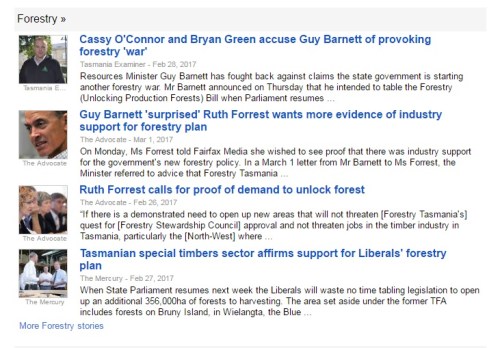
Google News already knows that the forestry wars have recommenced!

GoogleForestry

People thinking of buying or promoting Tasmanian specialty timbers or specialty timber products sourced from public native forest need to think carefully about what their support does for this conflict and the Tasmanian community. Farm grown timber is a safer alternative.

When will Tasmania get a fully commercial profitable forest industry?

Wish List Revisited

Makeawish

The recent Ministerial Statement by Tasmanian Resources Minister Guy Barnett, and the strong negative reaction it provoked from both the community and the forest industry got me thinking about the wish list I wrote last year.

http://www.premier.tas.gov.au/releases/ministerial_statement_-_forestry

So I’ve decided to update my Wish List.

Does Tasmania want a successful forest industry?

If so then here are a few ideas:

  1. Government policy

Tasmanian Government forest policy continues to focus on public native forest, a failed State forest agency, and protecting local jobs at any cost. If we adopted this same thinking for any other primary industry Tasmania would be an economic basket case. Our politicians and large sections of the forest industry and the community still think of the forest industry as a community service, a government employment program.

Sorry guys but it’s the 21st century.

The only basis for a successful modern forest industry is profitable tree growing.

Most wood now grown and sold in Australia comes from private tree growers.

It is time to put the policy focus on profitable private tree growers and away from public native forest and a failed State forest agency.

Implementing the Federal Government’s Farm Forestry National Action Statement 2005 would be a good place to begin.

http://www.agriculture.gov.au/forestry/australias-forests/plantation-farm-forestry/publications/farm_forestry_national_action_statement


  1. Government structure

We need to think of forestry as a primary industry and not as a Government-run, politically-driven, taxpayer-funded employment program.

One example of this change would be to move Private Forests Tasmania (PFT) from the Department of State Growth Tasmania to the Department of Primary Industries, Parks, Water and Environment (DPIPWE). At the moment this DPIPWE website contains no mention of forestry at all:

http://dpipwe.tas.gov.au/agriculture

Why isn’t forestry regarded as a primary industry in Tasmania?

Why isn’t Private Forests Tasmania part of DPIPWE?

So that all commercial forest policy and practice is aligned with primary industry policy the Government Minister responsible for PFT/DPIPWE should also be responsible for Forestry Tasmania. Now does that sound logical or what?

  1. Private Forests Tasmania

Following from the above logic Private Forests Tasmania needs to become the dominant Government forest agency, NOT Forestry Tasmania.

  1. Forestry Tasmania

And following on we need to get the politics, conflict and the anti-competitive policies out of the industry. That means either a) completely transforming Forestry Tasmania into an independent, fully commercial, profitable business, or b) shutting down public native forest logging.

  1. Plantations

The future of the forest industry is plantations. And like all primary industries the only basis for a successful forest industry is for (public and private) tree growing to be transparently profitable. The forest industry and the Government need to do everything they can to encourage profitable market-driven plantation investment. No scams!! See below for my comments on forest practices and markets and transparency for two ways to achieve this.

  1. Native forests

If there is any value/profitability at all left in logging Tasmanian native forest it must be pretty marginal. The Tasmanian Oak brand has been pretty well trashed over the last 50 years. Commercially managing native forest is a very costly operation. The only way it can be viable is by producing very high value products from most of the resource. This has never happened. Certainly in the pulp and construction markets, which account for the vast majority of the wood market, native forests don’t stand a chance competing against plantation-grown wood.

  1. Special Timbers

Using scarce taxpayers money to cut down 400+ year old public native rainforest and oldgrowth in the 21st century, with the excuse that special timbers are an essential part of “Brand Tasmania”, makes no sense whatsoever. All wood production must be fully commercial and profitable. There must be no community-service forestry in Australia. Given that blackwood makes up the vast majority of special timbers production anyway, and it can be grown in commercial plantations, the focus of special timbers policy must change.

  1. Forest practices

I have four thoughts here:

  1. The current Tasmanian forest practices code was developed when community-service public native forestry dominated the industry. However in the spirit of over-regulation it provided a significant hurdle to private plantation development. The forest practices code needs to be reviewed within the light of the following three comments.
  2. We need to create a primary industries level playing field when it comes to environmental management, so that regulation does not distort land use decisions. New Zealand has this approach to “forest practices” with their Resource Management Act 1991. I don’t see why Tasmania should not follow their example.
  3. Following on from b) the Tasmanian Forest Practices Authority should be merged with the Tasmanian Environmental Protection Authority to provide environmental monitoring, regulation and research services across all jurisdictions. Why does the forest industry need its own separate environmental regulation system?

http://www.fpa.tas.gov.au/

http://epa.tas.gov.au/

  1. The Australian forest industry should work towards developing a single set of national plantation management guidelines for the whole country as much as it is able within the maze of different State jurisdictions. At the moment regulations governing plantation management vary enormously across Australia. This is stupid and anticompetitive. It will be a long process but a worthy goal.
  1. Tasmanian Farmers and Graziers Association

The Tasmanian Farmers and Graziers Association (TFGA) needs to become a genuine independent, vigorous advocate for private forest growers. The interests of private forest growers are not the same as those of sawmillers, or Forestry Tasmania nor the Government of the day. A thriving commercially competitive, profitable forest industry can only exist when private tree growers have a strong, fearless, independent voice. The TFGA is the only option currently available.

  1. Competition, prices, markets and transparency

The forest industry in Australia hates open market processes and transparency! This is not surprising given its history. When was the last time you saw a forestry market report in the Australian media? When was the last time you saw a sawmiller hang out his slate looking to buy sawlogs?

In my books this is the major challenge for the industry. There have been a few attempts in the past to change this but they have failed due to lack of industry support. The industry will have no future until it becomes fully commercial – aggressively commercial!!! It’s all about competition, prices, markets and transparency. Farmers will never take the forest industry seriously until this happens.

  1. Where to begin?

Tasmania is a great place for growing trees for wood production.

But Tasmania is a small island a long way from world markets.

Because of our size and remoteness we cannot compete well in commodity markets like pulpwood and construction timber. We must think small volume high value niche markets such as appearance grade timbers and timbers for specialty markets. New Zealand farmers are doing this. But it needs focus and a strategy, not a random shotgun approach. One obvious example is macrocarpa cypress. There is a growing demand for this timber, as a handful of people in Tasmania know very well. NZ has thousands of hectares of cypress plantation growing on farms. Why doesn’t Tasmania?

  1. Blackwood

Tasmanian blackwood provides another ideal example of a low volume high value forest product with which to help rebuild the forest industry. Quality appearance grade timber will always be sort after in the market, especially the super premium market. Tasmania could easily be producing 30,000 cubic metres of premium blackwood sawlog per year with the right policy and industry backing. At $500 per cubic metre that equates to $15 million in farm gate value per year. So where is the policy and industry support that will make this happen?


Unfortunately all of these ideas are so beyond current forest industry and political thinking they will never happen.

Certainly Minister Barnett’s Ministerial Statement contains nothing like the above plan.

No one is campaigning in Tasmania for private forest growers and a fully commercial profitable forest industry!

Tasmania does a good job running a successful dairy industry; and a pretty good job running beef, vegetable, apple, cherry and wine industries. So what is it about the forest industry?

When will Tasmania get a fully commercial profitable forest industry?

Forestry Tasmania’s insolvency report

FTAR2016.jpg

FT is never going to make a profit. It sells its products too cheaply and is locked into too many loss making contracts. It even makes losses from supplying high quality sawlogs.

With brutally honest statements like that finance commentator John Lawrence carves up the latest Annual Report from Forestry Tasmania (FT), Australia’s largest grower and supplier of blackwood timber.

http://tasfintalk.blogspot.com.au/2016/10/forestry-tasmanias-insolvency-report.html

On top of that sawmillers are now threatening to close if they have to take on more of FTs costs or pay higher log prices.

Checkmate!!

http://www.abc.net.au/news/2016-10-27/sawmill-viability-doubts-under-forestry-tasmania-price-rises/7969776

You can get your own copy of the Annual Report here:

http://www.forestrytas.com.au/news/2016/10/forestry-tasmania-s-annual-report-2015-16

Forestry Tasmania is an absolute mess but after decades of poor policy and politics it is certainly no surprise.

Here’s another gem:

The past year is best described as a continuation of the de facto wind-up of FT commenced under the watchful eye of Treasury boss Tony Ferrall once he was appointed [to the FT Board] in May 2015. A complying Board is now in place, stacked with directors whose post nominals as long as your arm indicate academic forestry knowledge. Their insolvency experience however looks a little thin. That is the prime challenge facing the company. FT is not turning the corner. That’s yet to be found. There is no plan to build the forest industry. It’s an insolvency operation. Presumably Mr Ferrall is acting on instructions from Mr Gutwein, which makes the government a two faced outfit.

If you have any interest or “skin” in the blackwood industry as a sawmiller, logger, manufacturer, retailer or consumer you need to read Mr Lawrence’s analysis.

Is the blackwood industry going to go down with the sinking ship called FT, or will it turn to Tasmanian farmers to grow blackwood?

When will Tasmania get a fully commercial profitable forest industry?

Competitive Neutrality in Forestry

pc-competitive-neutrality2

In 2001 the Productivity Commission released a report into the competitive neutrality of the State government forest agencies in Australia.

http://www.pc.gov.au/research/supporting/forestry

The report makes for interesting reading 15 years after it was published.

So what is competitive neutrality?

Competitive neutrality (CN) means that state-owned and private businesses compete on a level playing field. This is essential to use resources effectively within the economy and thus achieve growth and development.

CN policy forms part of the 1995 Council of Australian Governments’ agreement on National Competition Policy (NCP).

CN policy aims to promote efficient competition between public and private businesses. Specifically, it seeks to ensure that government businesses do not enjoy competitive advantages (or suffer from a competitive disadvantage) over their private competitors simply by virtue of their public ownership.

The fact that the Productivity Commission felt the need to write such a report says a great deal about the forest industry in Australia. Remember this was in 2001 immediately after the Regional Forest Agreements (RFA) had been completed and signed.

Why weren’t competitive neutrality issues covered as part of the RFA reforms?

It is certainly my belief one of the major reasons we don’t have a thriving blackwood industry in Tasmania is the absence of competitive neutrality.

Here’s my precise of the report by chapter, and what I regard as some of the more salient points from a blackwood growers perspective.

1 Introduction

Forest products industries source wood from both public and privately managed forests, although public forests have traditionally accounted for the overwhelming bulk of wood supplies.

The situation has changed dramatically over the past 15 years with most wood grown and sold in Australia now coming from private forest growers. But State forest agencies continue to exert a significant influence on the industry especially around policy and politics.

Also the privatization of public plantation assets has introduced new distortions in the marketplace such as new owners being exempt from paying local Government rates and charges, competing against other private forest growers who do pay rates and charges. Local communities are now forced to subsidize the new private forest owners.

As forestry agencies are deemed to be significant government businesses, they are subject to CN. This requires them to:

  • charge prices that reflect costs;
  • pay all relevant government taxes and charges;
  • pay commercial interest rates on their borrowings;
  • earn commercially acceptable returns on their assets;
  • and operate under the same regulatory regime as their private sector counterparts.


To this list I would add:

  1. receive no direct or indirect taxpayer subsidies;
  2. harvest all timber on a fully commercial basis. Undertake no community service timber harvesting;
  3. provide complete and separate annual accounts for all Government-funded community service activities (CSOs).

There would certainly be other CN principles that could be added to this list.

2 Forestry background and institutional framework

Competitive neutrality is about a level playing field but the report provides little insight into the nature of the forest industry playing field and the numerous factors that impact the quality of the playing surface. For example there is a section in Chapter 2 discussing employment in the forestry sector, but no discussion on how sector employment impacts CN and the quality of the playing surface!

Chapter 2 provides a background summary of the industry and its institutional framework. There is discussion about “recent reforms” (many of which never eventuated, or were implemented only to be undone at a future date), National Forest Policy and the Regional Forest Agreements (RFA), the 2020 Plantation Vision, National Competition Policy, and Australian Accounting Standard for Self-Generating and Regenerating Assets (AAS 35). But within all this discussion there is little said about competitive neutrality. For example the discussion about the RFAs says nothing about if or how CN was dealt with within the RFAs.

As for the 1995 National Forest Policy it has never been implemented; and it contains no discussion at all about competitive neutrality.

In fact one of the key objectives of the RFA process should have been to set the State forest agencies on a level competitive playing field with each other AND private forest growers; with the objective to become profitable or cease to exist.

Unfortunately that did not happen; in my opinion a major failure of the RFA process.

There is considerable discussion in the report about Australian Accounting Standard AAS 35 ending with this classic quote:

AAS 35 provides a consistent framework for forest asset valuations across jurisdictions, but gives forest agencies considerable flexibility in implementing it. This has led to differences in asset valuations between agencies, and has particular implications for the implementation of CN by forest agencies.

In other words, never mind the level playing field!!

3 Application of CN to forestry

Chapter 3 talks about the implementation, monitoring and reporting of CN across Australian State forest agencies.

Progress in implementing CN is mixed. Jurisdictional differences in the application of CN to forestry agencies include the:

  • institutional models within which CN compliance is being pursued;
  • pricing and log allocation mechanisms;
  • transparency of CSO funding;
  • determination of target rates of return;
  • allocation of overheads to commercial wood outputs (see box 3.1);
  • approaches to achieving regulatory equivalence;
  • monitoring arrangements; and
  • asset valuation methodology used.


In other words the State forest agencies cannot even create a level playing field between themselves, let alone with private forest growers. So much for National Forest Policy!

[CN] Monitoring arrangements vary across jurisdictions [States].

In Tasmania, Forestry Tasmania is subject to monitoring by the State’s Prices Oversight Commission [now the Office of the Tasmanian Economic Regulator]. It also provides quarterly reports to Treasury on performance against agreed indicators.

Clearly no one is doing any monitoring or reporting in Tasmania. Go to the websites of either of these organisations (OTER or Treasury) and you will find NO information about CN monitoring or reporting by Forestry Tasmania. Forestry Tasmania’s own website contains NO mention of CN policy, objectives or performance.

http://www.economicregulator.tas.gov.au/

https://www.treasury.tas.gov.au/

All State government forest agencies should be required by law to have the exact same competitive neutrality policies, objectives, monitoring and reporting procedures. Otherwise the National Competition Policy is just wasted paper.

The report spends considerable time discussing whether logs are being sold at their ‘full’ market value, without the obvious answer that full contestable market value of public forest assets needs to be regularly and transparently determined “by the market”.

4 Log pricing issues

Over the last twenty years, there has been considerable evidence to suggest that forest agencies have frequently sold logs at less than their full market value. … evidence suggests that, in the past, royalties for sawlogs from State forests have often been some 20 to 70 per cent below their market value.

This doesn’t mean log underpricing began in the 1980s. It’s just that in the 1980s some people began to think this was a serious issue. Some people still think it is still a serious issue.

In 2016 the issue of log prices and marketing from State Government forest agencies remains unresolved. Deliberate underpricing continues unabated. Both Western Australia and Victoria started to go down the road towards market-based log sales and pricing, but changes in State governments saw those policies reversed.

In a fully competitive market environment, a sawmill [or other wood processor] will compete against other processors for log supplies from growers…. In practice, the market for logs sourced from State forests [or other growers] cannot always be regarded as fully competitive.

This market situation is no different to any other primary industry [cows, milk, apples, cabbages, etc.].

One of the issues around State forest agencies is that only wood processors are allowed to purchase public forest assets. Organisations that may wish to purchase public forest assets such as carbon sequestration or conservation are deliberately excluded from the market. This is not the case with privately owned forests in Australia. This is a deliberate breach of CN principles. Why can’t public forest assets be sold to the highest bidder (subject to certain management constraints)?

The Report talks about the various difficulties of determining real market prices for logs.

The Report fails to discuss issues around market and price transparency.

Section 4.3 (p. 36) discusses the impact of underpricing on private forest growers.

The major concern expressed about the price of logs sold by forestry agencies has related to underpricing. Whatever the underlying reason, allegations of underpricing [by State forest agencies] have frequently been cited as a factor impeding the development of private wood growing enterprises.

And

Recent reforms have created incentives for forest agencies to price logs on a more commercial basis. Consequently, it is possible that other factors may now have a greater impact on private growers than underpricing by forest agencies.

In 2001 that was wishful thinking. In 2016 it’s a bad joke!

The Report then discusses how underpricing of logs has left the Australian wood processing industry inefficient and uncompetitive, and therefore unable to pay full market prices for logs. It’s a debilitating spiral to bankruptcy.

A priori, the application of CN would be expected to reduce the incidence of log underpricing, because it requires forest agencies to act more commercially by charging prices that cover all the costs of growing and managing the forest, including a commercially acceptable return to the land and timber assets. This should help ensure that the full market value is realised for logs sold by State forestry agencies.

Lots of hope and optimism with little evidence in 2001 that CN reforms were really being implemented. In 2016 we know that hope was misplaced.

5 CN and the broader policy context

The implementation of CN in forestry will contribute to better cost recovery and pricing policies, and hence a more efficient and better managed public forest estate.

We haven’t seen any evidence of this in the last 15 years!!

It is often argued that the use of competitive tendering (or auctions) for the sale of logs would lead to higher prices because processors would be forced to pay the ‘true’ valuation of the logs.

Outcomes from the relatively few auctions held to date suggest that a competitive market could also lead to greater differentials in log prices.

In other words premium timbers like blackwood would achieve much higher prices than they do under the current system of Government-set prices. Either that or hardwood sawlogs and pulpwood would be at give-away prices.

The role of secondary markets for harvesting rights may be of greater significance in achieving more competitive log pricing in such [one seller/grower, one buyer] markets. Competitive secondary markets for log entitlements would strengthen the processing sector’s incentive to operate efficiently.

Currently, harvesting rights [to public native forest] can only be held by wood processors. However, there would seem to be no reason why parties other than wood processors should not be able to bid for, and hold, such rights. If a timber right was modified to become a right to appropriate all the values of the forest, then holders may be better able to balance all possible uses — particularly in light of the potential development of some markets for environmental services.

Private forest growers are not subject to such market restrictions so why are State forest agencies?

There is very little published information on [log] prices realised by forest agencies. …[log] pricing policies and the terms on which harvesting licenses are allocated are generally confidential.

These are public assets being sold and the public has absolutely no right to understand the basis on which they are commercially managed!!

In the United States, the Department of Agriculture regularly publishes detailed information on stumpage prices (royalties), fob mill prices, harvest rates and sustainable harvest rates by species and region (Warren 2000). While the relatively small size of the Australian industry may prevent the publication of statistics in the same level of detail without breaching confidentiality, the limited information available in Australia denies the community information on a very significant natural asset and inhibits scrutiny of the pricing practices of State forest agencies. This increases the difficulties in assessing the performance of these agencies. At the same time, the absence of public information on market prices and conditions itself may constitute an impediment to private investment in forestry — information about farmgate or market prices is readily available to potential investors in most other natural resource and primary industries.

Overall it is not a great report. It could have been better.

Here’s my thoughts on a few other CN-related issues not discussed in the report:

Public benefit

The NCP allows State Governments to ignore CN principles if they claim public benefit overrides commercial interests. In 2001 when most wood grown and sold in Australia came from State forest agencies this was pretty easy. However in 2016 the reverse is now true, most wood now grown and sold in Australia comes from private forest growers. The public benefit from being a minor player in the forest industry is much more difficult to argue. Growing trees for wood production is now very definitely a commercial business not a community service.

Transparency

One of the fundamental issues around competitive neutrality is that it must be transparent. Private businesses that compete against Government businesses must be able to clearly and readily see that they are operating on a level playing field. The PC Report says:

The focus on cost recovery, and the trend toward greater transparency and accountability of public agencies in their management of public resources, has encouraged forest agencies to evaluate their forest management practices in terms of their impacts on efficiency and financial performance.

Otherwise the Report is generally critical of State governments and State forest agencies in their lack of CN transparency.

Log Export

There always seems to be strong community concern around the export of native forest logs. But the concept of competitive neutrality means that whatever markets are available to private tree growers must also be available to public forest managers. That is the level playing field. If private forest growers look to improve their profitability through log export markets, then the same must be available to the State forest agencies, including the export of sawlogs and specialty timbers. If high value log exports are banned then the viability of commercial native forest management may be compromised. Unfortunately the PC report does not discuss this issue.

Resource Security

Any legislation, regulation or policy that seeks to create a distinction between the public and private commercial forest is in breach of competitive neutrality principles. For example the concept of “resource security” is by definition a breach of competitive neutrality principles, because the concept is only applied to the public forest resource, never to the private resource. The Report even mentions resource security (p. 15) but fails to identify it as a breach of CN!

In New Zealand, where 100% of the forest industry is privately owned, they don’t talk about resource security. They do talk about the tensions between supply and demand, and how to manage fluctuations in supply and demand, but resource security is never mentioned.


State governments and State forest agencies continue to ignore their commitments and responsibilities under the National Competition Policy.

The so called level playing field has never been realised in the forest industry.

Vast sums of taxpayer’s money continue to be squandered on the industry. The most recent example is the Western Australian Government’s announcement of investing $21 million of taxpayers money in softwood plantation expansion without a business case. Presumably “public benefit” overrides the need for wise investment.

https://au.news.yahoo.com/thewest/wa/a/32691021/wa-leads-nation-in-forestry/#page1

Blackwood

Of course with blackwood in Tasmania competitive neutrality has been thrown under a bus with the Government and Forestry Tasmania declaring “public benefit”; blackwood is officially a taxpayer-funded community service not a commercial activity.

It is time for the Productivity Commission to revisit and review the issue of competitive neutrality in the forest industry in Australia.

When will Tasmania get a fully commercial, profitable forest industry?

Native forests are worth more unlogged, so why are we still cutting them down?

possum

http://www.theage.com.au/comment/native-forests-are-worth-more-unlogged-so-why-are-we-still-cutting-them-down-20161004-gruirp.html

This article in The Age newspaper from the editor of Money magazine says a great deal. Like this…

All Australians should be angry about logging of [public] native forests. If you don’t care about the environment, what about the fact your taxes prop up an unviable industry that employs very few people?

Here’s another…

The annual reports for the various state forestry businesses reveal logging native forests is marginally profitable at best, and a sinkhole for taxpayer money at worst.

And here’s how the article finishes..

Victoria offers a glimmer of hope.

Last month the Forest Industry Taskforce, which includes groups such as The Wilderness Society and the CFMEU, requested a methodology for earning ERF credits.

The taskforce represents all Victorian state forests east of the Hume Highway, though the main focus has been on the Central Highlands because of the endangered Leadbeater’s possum. If an ERF method is established, it could be valid nationally.

Let’s hope common sense prevails.

The problem is that the Victorian Forest Industry Taskforce is fundamentally flawed. It has all the same weaknesses as the failed Tasmanian Forestry Agreement, including the fact that come the next change of Government in Victoria, the work of the Taskforce will be thrown on the political scrapheap.

It is guaranteed that common sense will be completely absent.

Politics and ideology (and taxpayer subsidies) are the only things keeping the public native forest industry alive!!

Enjoy the read!