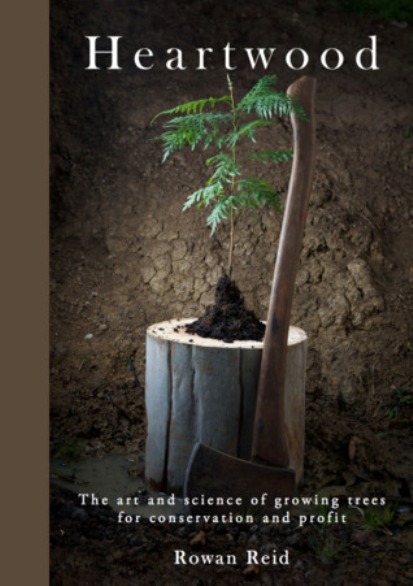
http://www.agroforestry.net.au/main.asp?_=heartwood%20book
Fellow forester Rowan Reid recently wrote this book which has been getting a lot of media coverage. I thought I’d write a review.
Rowan is passionate about trees and farm forestry. And like me he’s pretty critical of the policies and practices of State and Federal Governments and the forest industry. As such Heartwood says very little about past and current industry and Government policies and practices to thwart or encourage farm forestry.
In one respect I can see why he has avoided discussing the current Government, industry and market context. Rowan obviously wants to keep the book positive. The problem is when it comes time to sell your cherished sawlogs you have to deal with that context, and it’s often not a positive experience.
One of the first things I do with a new book is look at the contents page to get an overview of the books structure.
Here’s the Contents page from Heartwood:

With Heartwood that didn’t work. I quickly discovered there was content not shown in the Contents page. So I’ve made a list of the other Contents:
| Quartersawn, backwsawn and shrinkage |
34 |
| The components of a tree trunk |
52 |
| Basic tree felling |
53 |
| How to grow tall trees |
70 |
| How much space does a tree need to grow? |
88 |
| Geotropic and phototropic growth in trees |
108 |
| Attracting wildlife to your farm |
124 |
| Measuring moisture content and wood density |
144 |
| Wood density and tree age |
145 |
| Reaction wood: tension wood and compression wood |
162 |
| Hardwood sawing patterns for a horizontal bandsaw |
178 |
| Tree foliage for supplementary fodder |
200 |
| Pruning trees for sawlogs |
220 |
| Durability of timber |
240 |
| Growing shitake mushrooms on logs |
258 |
| Shelterbelt design |
276 |
| How to plant a tree |
294 |
Heartwood contains a wealth of information and knowledge about trees and farm forestry written in a personal and engaging style. Rowan’s view of farm forestry extends beyond commercial wood production (although that is clearly his main focus, as you can see from the other Contents page). His vision is to reintegrate trees back into the rural landscape to achieve multiple benefits.
If you want a head start in how to grow these trees this is a good place to begin.
The question remains – what are the commercial risks associated with planting these species? After all, the book’s title does include the word PROFIT!
And here’s where I start to have problems with the book.
How do we start a conversation in Australia about profitable tree growing?
Certainly Governments and the forest industry take great efforts in avoiding discussing profitable tree growing. To them it is anathema. Such discussion would inevitably put the spotlight on the failings of public native forestry, and they are at pains to avoid that.
Heartwood avoids any serious discussion about end uses, markets, costs and prices, so it’s hard to see where the profits come from. There’s also no discussion about laws and regulations pertaining to farm forestry. Rowan’s desire to avoid the current “context” and remain positive starts to feel awkward.
Some of the species in the book are quality appearance-grade timber species. In theory they are high value. Appearance grade timbers in Australia have historically either been imported or have come from public native forests. With public native forestry in Australia traditionally run as a community service rather than a business, proper commercial markets for quality timber have never developed.
One example of weak/non-existent markets is the steady stream of phone calls I get from people who have stashes of Australian Red Cedar timber hidden in back sheds for decades. They now want to sell, but can’t find buyers. At the time these sheds full of Red Cedar were seen as a guaranteed investment. But after 100 years the market for Red Cedar has moved on leaving these “stranded assets”.
And yet there are people today planting and growing Red Cedar hoping to revive this long dormant market. Will they succeed?
Heartwood is full of optimism and hope. The forest industry has a long history of unrealised optimism.
Most of the appearance grade species in Heartwood would be destined for the furniture, flooring and cabinetry markets (office and shop fit-outs, etc.); or for the export market. The Australian furniture industry is well aware that it faces a looming timber supply crisis as evident in this recent media article:
http://www.abc.net.au/news/2018-02-16/victoria-ash-timber-facing-fresh-crisis-supply-issues/9424290?smid=Page:%20ABC%20News-Facebook_Organic&WT.tsrc=Facebook_Organic&sf182264054=1
But the furniture industry has no plans to address this crisis besides appeals to Governments. The furniture industry could be supporting and encouraging private tree growers, but so far there is no evidence of this.
Rowan has been working hard for decades promoting farm forestry in Australia but governments, industry, markets and farmer groups have pretty much ignored his efforts.
Heartwood will fundamentally change the way people think about the future of forestry and in doing so it will encourage more landholders to grow more trees for the benefit of their land and all that depend on it.
I’m not sure that statement is true because most of the change/reform that is needed has to happen in the marketplace and with Government policy as much as with landowners.
I see no indication that the marketplace or Governments understand what reform is needed to realise Rowan’s dream; his Third Wave!
By all means get yourself a copy of Heartwood. It is an enjoyable read.
The book is as relevant to furniture and cabinet makers as it is to farmers/landowners. Maybe a few policy makers and forest industry leaders could learn a thing or two.
Thanks Rowan!







 Tasmanian Blackwood Growers Cooperative
Competition, level playing fields and subsidies
The forest industry in Australia has some serious basic issues that need to be fixed before anyone is going to take the industry seriously.
This is one of them.
It has to do with competition, level (commercial) playing fields, ratepayer subsidies and community support.
In Australia we can have the situation of two forest owners who are neighbours, one of whom pays local Government rates (taxes) on their forest land and the other does not.
One owner gets to use local Government roads to carry logs for free, the other has to pay rates to help maintain the roads. The former gets a subsidy (free roads) from his neighbour (and other ratepayers), to the competitive disadvantage of his neighbour, and any other landowner thinking of growing trees for wood production. Why compete against growers who get to use the roads for free.
And why subsidise these forest growers anyway? Everyone else pays rates!!
It’s an astonishing situation.
And local Governments around Australia are complaining more and more. Here are two recent examples:
Oberon mayor will continue fight for better deal on forestry land
Lithgow City Council joins call to abolish Forestry rate exemption
This can be either a) State forest agencies not paying rates on either native forest or plantation land, or b) privatised former Government plantation owners being exempt from paying rates such as in Queensland.
The Mayor of Oberon says a lot of very good things in that article. Well worth reading.
How can the forest industry hope to gain community support if it treats local communities with such blatant contempt?
Ratepayers should be marching on City Halls around the country demanding action!
Why are Australians continuing to subsidise the forest industry?
How many Australians even realise they are subsidising the forest industry through their local rates?
Not very many is my guess.
No forest companies or State forest agencies tell us if they are paying rates on their forest land. And I bet no local Councils/Governments tell their rate payers if they are subsidising the industry. I went to the Oberon local government website and couldn’t find any mention of the issue. Not even the ratepayers of the Oberon Shire, NSW are allowed to know they are being ripped off!
https://www.oberon.nsw.gov.au/
Why does the forest industry accept these deliberate market distortions that destroy competition, inhibit investment and ultimately destroy the industry’s future?
Growing trees for wood production is a business right? Just like every other primary industry.
Removing these deliberate market distortions would help put the forest industry onto a level playing field. It would help make the industry more competitive and encourage investment.
The only basis for a successful forest industry is profitable (unsubsidised) tree growers.
5 Comments
Posted in Commentary, Markets, Politics