Category Archives: Politics

Yet another forestry advisory council & another forest industry plan. Is anyone counting?

Edwards&Bailey

Tasmania gets yet another forest industry council, and another industry plan to add to the vast collection of previous plans and strategies gathering dust down at the State library. I thought the RFA was the forest industry plan to end all plans. Clearly I was mistaken.

http://www.themercury.com.au/all-grow-for-forest-sector-as-resources-minister-paul-harriss-announces-new-advisory-council/story-fnj3twbb-1227026836938

At least FIAT head Terry Edwards understands that a broad balance of membership is essential for the advisory council to be anything more than a straight political play. Full credit to Mr Edwards for coming out and saying so.

http://www.abc.net.au/news/2014-08-17/loggers-back-environmentalists-joining-tasmanian-forests-group/5676356?section=tas

I don’t hold great hopes for anything new coming from this group. At most the Council and Plan will expire at the next State election and be replaced by the next New Council and Plan. This has been the trend for the past 40 years both in Tasmania and elsewhere around Australia.

For what it’s worth here’s my five points to build a successful forest industry for Tasmania:

  1. The Tasmanian forest industry will never succeed while it is dominated by Forest Tasmania and the politically-driven community service/employment program/charity business model. Forestry is business not politics!
  2. Forestry Tasmania must be managed on a fully commercial basis with profit as its primary objective. No other business model will work.
  3. As New Zealand clearly demonstrates, a successful forest industry is all about the growers, not the processors. Tasmania needs a large number of private commercial, profit-driven tree growers, both industrial and farm-based, with the focus on the private tree growers and not Forestry Tasmania.
  4. The existing forest industry processors (sawmillers, exporters, furniture makers, etc.) must engage strongly and directly with all growers to encourage and reward profitable tree growing. Once tree growing is accepted within the community as a legitimate profitable land use then the processors will have a commercial future. The processors will have to compete and struggle to survive but that is exactly what private enterprise does best.
  5. As has been found with other agricultural commodities, Tasmania does not compete terribly well on price. We are a small, high-cost producer a long way from markets. Forestry is no different. Forestry must focus on growing to meet high quality, high-value, niche markets. Blackwood fits this description perfectly.

I don’t expect anyone in the new advisory council to take any notice of this, not even the TFGA and PFT, so I expect the forest industry will continue to decline. But I can at least hope………

The incomplete history and current practice of unsustainable blackwood mismanagement

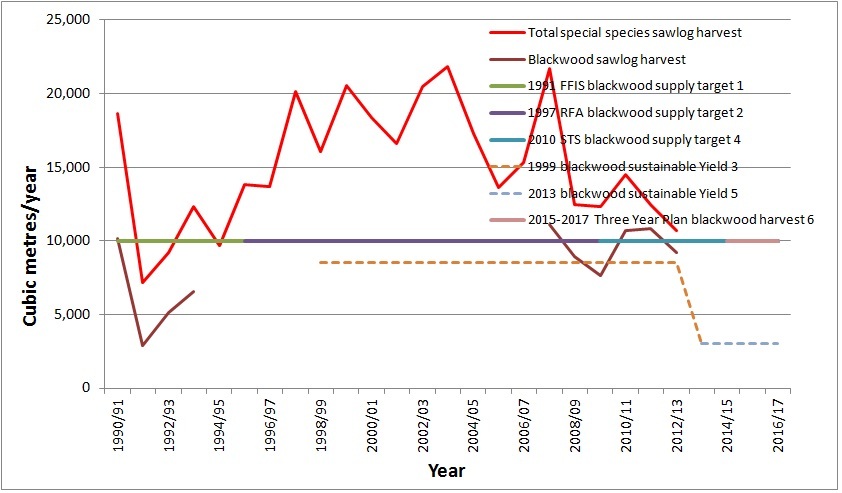
Having spent some time in the library I can now add a bit more detail to the chart that summarises the history of the public blackwood and special species timber resource management over the last 25 years.

http://blackwoodgrowers.com.au/2014/06/23/the-incomplete-history-of-unsustainable-blackwood-mismanagement/

Between 1995 and 2007 Forestry Tasmania published no data on the annual harvest of blackwood sawlog. The next best available data is the total special species sawlog harvest data. Knowing that blackwood comprises the majority of the special species harvested it is clear that blackwood harvest during this time was well above the sustainable level set in the 1999 blackwood resource review. This has been blatant overcutting of the resource; all of it legal and approved by successive Tasmanian Governments and Parliaments.

The contrast between the recent blackwood sawlog resource review sustainable yield estimate and the 2015-17 Three Year Harvest Plan clearly shows that the overcutting of blackwood will continue.

Tasmania’s iconic blackwood industry is heading for extinction.

Incomplete history 2

Chart notes:

  1. The 1991 Forest and Forest Industry Strategy (FFIS) set a blackwood supply target of 10,000 m3 of blackwood sawlogs per year.
  2. The 1997 Tasmanian Regional Forest Agreement (RFA) reaffirmed the FFIS blackwood sawlog supply target.
  3. The Forestry Tasmania 1999 Review of the sustainable blackwood (Acacia melanoxylon) sawlog supply from Tasmanian State forest calculated the Statewide sustainable yield of blackwood sawlog at 8,500 m3 of blackwood sawlogs per year. The figure for just the BMZ was 6,800 m3 of blackwood sawlogs per year, with the remainder coming from the rest of the State.
  4. The Forestry Tasmania 2010 Special Timbers Strategy (STS) continued to reaffirm the supply target of 10,000 m3 of blackwood sawlogs per year until 2019.
  5. The Forestry Tasmania 2013 Review of the Sustainable Sawlog Supply from the Blackwood Management Zone (BMZ) recalculates the blackwood sawlog sustainable yield at 3,000 m3 per year. Production of blackwood sawlog from public forest outside the BMZ is expected to be negligible.
  6. The 2015-2017 Forestry Tasmania Three Year Wood Production Plan shows the harvest of blackwood sawlog will continue at 10,000 m3/year, in blatant disregard for the revised blackwood sawlog sustainable yield.

Overcutting of the public blackwood sawlog resource to continue

Tasmania’s icon blackwood industry is well and truly heading for a complete wipeout.

Future supplies of blackwood timber, veneer and craftwood from Tasmania’s public native forests are looking increasingly endangered as Forestry Tasmania continues to overcut the resource well above sustainable yield.

I outlined in a recent blog the sad past management of the public blackwood resource, in response to the recent release by Forestry Tasmania of a new Review of the Sustainable Sawlog Supply from the Blackwood Management Zone (BMZ).

http://blackwoodgrowers.com.au/2014/06/23/the-incomplete-history-of-unsustainable-blackwood-mismanagement/

Now Forestry Tasmania has released its latest Three Year Wood Production Plan.

http://www.forestrytas.com.au/forest-management/3yp

This plan shows that blackwood sawlog will continue to be harvested from Tasmania’s public native forests at 10,000 cubic metres of sawlog per year for the next three years. The current sustainable sawlog yield is estimated to be 3,000 m3 sawlog per year.

In the name of internationally certified (PEFC/AFS) responsible forest management Forestry Tasmania will be harvesting 3 times the sustainable yield of blackwood for the next three years.

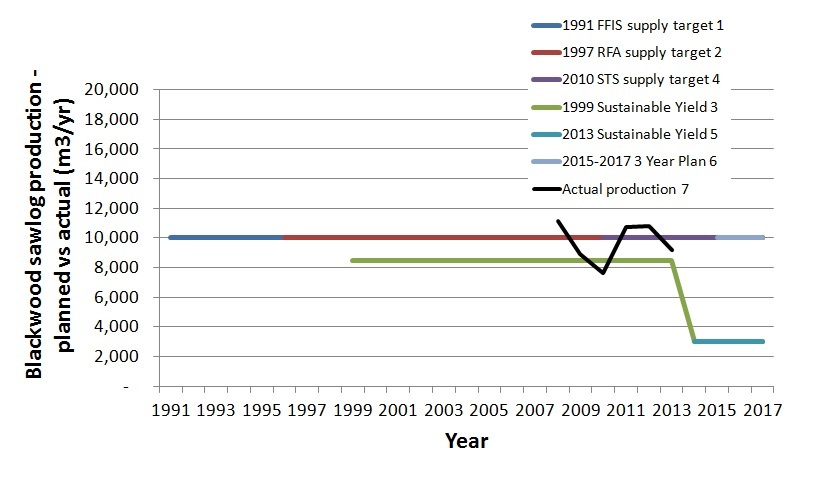
Here’s an update of the chart from the above blog with this new information:

Incomplete history plus 3YP

Chart notes:

  1. The 1991 Forest and Forest Industry Strategy (FFIS) set a blackwood supply target of 10,000 m3 of blackwood sawlogs per year.
  2. The 1997 Tasmanian Regional Forest Agreement (RFA) reaffirmed the FFIS blackwood sawlog supply target.
  3. The Forestry Tasmania 1999 Review of the sustainable blackwood (Acacia melanoxylon) sawlog supply from Tasmanian State forest calculated the Statewide sustainable yield of blackwood sawlog at 8,500 m3 of blackwood sawlogs per year. The figure for just the BMZ was 6,800 m3 of blackwood sawlogs per year, with the remainder coming from the rest of the State.
  4. The Forestry Tasmania 2010 Special Timbers Strategy (STS) continued to reaffirm the blackwood supply target of 10,000 m3 of blackwood sawlogs per year until 2019.
  5. The Forestry Tasmania 2013 Review of the Sustainable Sawlog Supply from the Blackwood Management Zone (BMZ) recalculates the blackwood sawlog sustainable yield at 3,000 m3 per year. Production of blackwood sawlog from public forest outside the BMZ is expected to be negligible.
  6. Planned blackwood sawlog harvest according to the Forestry Tasmania 2015-2017 Three Year Wood Production Plan.
  7. Actual blackwood production figures from 1991 to 2006 are not publically available. The 2013 Review only provides actual blackwood sawlog production figures from 2008. Forestry Tasmania wood production dropped dramatically following the 2007 GFC.

Q. Can a company that operates at a loss achieve FSC certification?

A. The FSC certification standard requires that a forest management entity have sufficient financial resources to manage the defined forest area in conformance with the full scope of the standard. The standard does not require that the certified forest is managed at a profit provided that other sources of working capital are available and sufficient to enable management in conformance with the standard.

http://www.scsglobalservices.com/files/resources/talking_points_for_forestry_tasmania_initiative-042514.pdf

This bombshell of a response comes from the document Talking Points and Frequently Asked Questions Forestry Tasmania Preliminary FSC Assessment (0.5MB pdf) from the website of SCSGlobal Services, the company acting as FSC assessors for Forestry Tasmania.

I have written before about how current forest policy, management and practice in Tasmania creates significant obstacles to private tree growers and private (especially small scale) forest investment.

In my view one of the significant obstacles is the complete lack of commercial focus and commercial management at Forestry Tasmania. And I’m not talking about a single bad year. I’m talking about systematic long-term commercial mismanagement that has been documented and reviewed over many years by John Lawrence and others.

How are current and potential future private tree growers supposed to compete against one of the State’s largest forest growers that behaves as a community service not a business?

And now based on their preliminary assessment the FSC assessors are saying that this sad situation is perfectly acceptable to the FSC.

This is just extraordinary!

FSC are prepared to gold-plate Forestry Tasmania’s continued anti-competitive and anti-commercial practices, as long as Tasmanian taxpayers are prepared to keep wasting money.

How can this result in good forest management outcomes?

How can this rebuild Tasmania’s competitive, efficient, profit-driven forest industry?

It can’t! Quite the opposite!

Forestry Tasmania should not be given FSC Certification whilst it continues to operate as a loss-making, community service forest manager.

The Forest Stewardship Council should not encourage and support the destruction of commercial value of public and private forests.

If you are concerned about this ridiculous outcome then:

SCS Global Services welcomes comments on the forest management practices of any of the applicants listed below [including Forestry Tasmania], or other topics pertinent to their seeking FSC certification. Comments can be submitted via email to Brendan Grady (bgrady@scsglobalservices.com), SCS Director of Forest Management Certification, or by completing the online Stakeholder Questionnaire. All comments and sources will be kept in strict confidence at the request of the commenter.

I seek your support in helping to overturn this pending disaster.

The incomplete history of unsustainable blackwood mismanagement

Forestry Tasmania recently and quietly released the latest Review of the Sustainable Sawlog Supply from the Blackwood Management Zone (BMZ). As I predicted last year Tasmania’s iconic blackwood industry is about to go into serious decline if not disappear.

http://blackwoodgrowers.com.au/certification-and-supply/

Last year I reviewed the available information on the public blackwood resource and predicted a serious reconciliation in the near future. The reconciliation has now begun.

http://www.forestrytas.com.au/sfm/review-of-the-sustainable-sawlog-supply-from-the-blackwood-management-zone

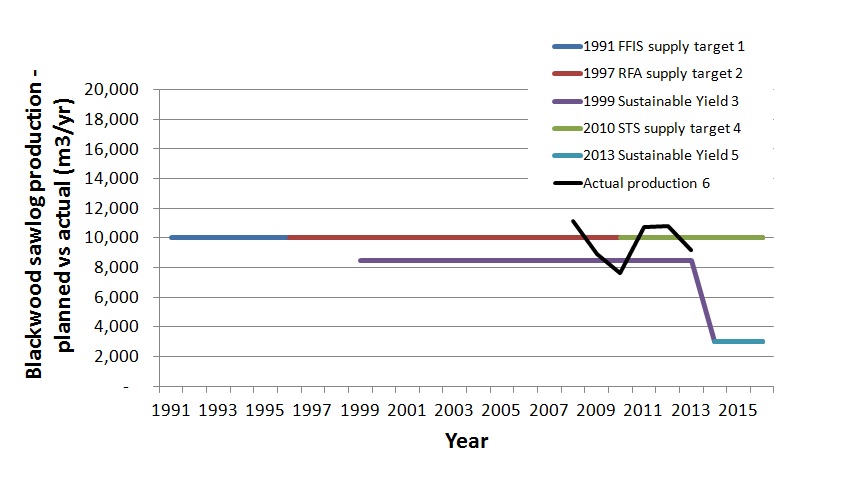
The 2013 Review is a difficult document to read and understand. Important information is missing making it nearly impossible to “join the dots”. To help better understand the 19 page review I have compiled a chart of the planned vs actual production data that is scattered throughout the document. In fact the chart neatly summarises about 80% of what the review has to say, but it is still a very incomplete picture. There is no chart like this in the review.

Incomplete history

Chart notes:

  1. The 1991 Forest and Forest Industry Strategy (FFIS) set a blackwood supply target of 10,000 m3 of blackwood sawlogs per year.
  2. The 1997 Tasmanian Regional Forest Agreement (RFA) reaffirmed the FFIS blackwood sawlog supply target.
  3. The Forestry Tasmania 1999 Review of the sustainable blackwood (Acacia melanoxylon) sawlog supply from Tasmanian State forest calculated the Statewide sustainable yield of blackwood sawlog at 8,500 m3 of blackwood sawlogs per year. The figure for just the BMZ was 6,800 m3 of blackwood sawlogs per year, with the remainder coming from the rest of the State.
  4. The Forestry Tasmania 2010 Special Timbers Strategy (STS) continued to reaffirm the blackwood supply target of 10,000 m3 of blackwood sawlogs per year until 2019.
  5. The Forestry Tasmania 2013 Review of the Sustainable Sawlog Supply from the Blackwood Management Zone (BMZ) recalculates the blackwood sawlog sustainable yield at 3,000 m3 per year. Production of blackwood sawlog from public forest outside the BMZ is expected to be negligible.
  6. Actual blackwood production figures from 1991 to 2006 are not publically available. The 2013 Review only provides actual blackwood sawlog production figures from 2008. Forestry Tasmania wood production dropped dramatically following the 2007 GFC.

Blackwood generally comprises >80% of all special species sawlog production from State forest. Between 2000 and 2007 special timbers production averaged 17,000 m3 per year, with some years exceeding 20,000 m3 (Forestry Tasmania Annual Reports). Clearly neither the so called supply target nor the 1999 sustainable yield estimate had any relevance to the actual production of blackwood sawlogs.

Where are the actual blackwood sawlog production figures between 1991 and 2007?

Why is Forestry Tasmania so reluctant to clearly demonstrate sustainable blackwood management and production?

Here are some other highlights from my analysis of the 2013 Review of the Sustainable Sawlog Supply from the Blackwood Management Zone:

  1. No mention is made in the 2013 Review of the fact that in 2010 Forestry Tasmania classified it’s blackwood and other special timber operations as “non-commercial, non-profit”, and subject to a significant taxpayer subsidy. There is no discussion of what impact this non-commercial focus will have on future blackwood forest management and production (it will have a major impact), or its impact on blackwood production from Tasmanian farms;
  2. An update of the current area of the Fenced Intensive Blackwood (FIB) resource is provided but still, after 30 years, no estimate is provided of it’s likely contribution to the future blackwood industry. There are no details of the financial investment that has been spent to date on creating this resource. The 1999 Review estimated this resource would provide over 250,000 cubic metres of blackwood sawlog to industry between 2040 and 2050.
  3. The major investment to establish 880 ha of blackwood plantations in the early 1990s has now officially been written off and will contribute nothing to the blackwood industry. The 1999 Review estimated this plantation resource would contribute over 370,000 cubic metres of blackwood sawlog to industry. No estimate is provided of the financial loss due to this asset write-off.
  4. As mentioned the 2013 Review provides grossly inadequate details and analysis of blackwood sawlog production since 1991. There is absolutely no way to verify whether blackwood has been sustainably managed or not. Limited available information indicates that since 1991 blackwood has been grossly over-cut;
  5. There is no discussion why in 1999 blackwood sawlog production did not drop to match the sustainable yield estimate. There is also no discussion or explanation of why actual blackwood production appears to have greatly exceeded even the FFIS/RFA/STS 10,000 m3 supply target.
  6. The 2013 Review provides no details at all about the commercial management of blackwood or the contribution of blackwood to the commercial performance and profitability of Forestry Tasmania. Given that the new Forest Management Bill 2013 provides Forestry Tasmania with a greater commercial focus does that mean that all blackwood operations will now be reclassified as “commercial and profitable”?
  7. The 2013 Review contains no discussion about the past and ongoing Sovereign Risk to blackwood production;
  8. Without any discussion or explanatory information the 2013 Review drops the blackwood sawlog sustainable yield from the BMZ from 6,800 m3 per year in 1999, to 3,000 m3 sawlog per year. It provides absolutely no details about how the 3,000 m3 estimate was calculated. It’s a number out of a hat! I personally doubt even this figure. I suspect the real figure is somewhere between 1,500 and 2,000 m3.
  9. The 2013 Tasmanian Forestry Agreement had little impact on the area of the BMZ, so the dramatic drop in production is due to causes other than the TFA.
  10. And that concludes the 2013 Review. No mention at all of a major drop in blackwood supply. No mention of whether the 10,000 m3 supply target will remain in force. No discussion about what impact this drop in supply will have on Forestry Tasmania’s profitability, nor on the Tasmanian blackwood industry. Is 3,000 m3 per year even commercially viable to log, or is the BMZ now a liability?

The Review proudly states:

The blackwood forests are managed on a sustainable basis on a rotation length of about 70 years.

I’m not convinced. There is absolutely no evidence of ecological, commercial, political or social sustainability here at all. How can a drop in sawlog production from 10,000 to 3,000 m3 per year be called sustainable?

By 21st century commercial business standards the 2013 Review of the Sustainable Sawlog Supply from the Blackwood Management Zone is a profoundly deficient document.

As an example of an organisation seeking Forest Stewardship Council (FSC) Certification the 2013 Review completely fails. No meeting with stakeholders, no press conference, no presentation, no Q&A.

As a stakeholder in the Tasmania’s iconic blackwood industry I consider this is a complete disaster. Yet another Tasmanian forest industry catastrophe.

On the positive side the drop in supply from public forests should mean that blackwood log prices will increase. This will help attract the interest of farmers.

But on the negative side the forest product markets and prices in Tasmania have never been transparent. This continues to be one of the forest industries biggest problems. Also the volume of blackwood trade will drop dramatically. Businesses will close. The blackwood market will contract. Options for farmers to sell blackwood timber will shrink. And we still have many legislative, policy and management issues that inhibit private farm forestry, not the least of which is Forestry Tasmania’s taxpayer-subsidised blackwood production.

It is ironic that Tasmania is about to lose its iconic blackwood industry at the very time that New Zealand farmers are about to crank up blackwood production across the Tasman Sea.

Tasmanian blackwood has been Australia’s premier timber species for over a century. It is a Tasmanian icon.

Is the Tasmanian community going to surrender its blackwood heritage and commercial potential to New Zealand farmers?

Or will the necessary legislative, policy and management changes be made to allow Tasmanian farmers to rebuild the Tasmanian blackwood industry?

Will the forest industry open up and become more market transparent?

And will the Tasmanian community take up the opportunity?

Storey (sic) needs a happy ending

The Mercury 10/5/2014.

It was great seeing someone from the special timbers industry, who understands that peace is fundamental to the future of the forest industry getting some good media coverage.

John Young

http://www.themercury.com.au/news/opinion/storey-needs-a-happy-ending/story-fnj4f64i-1226912229617

http://www.themercury.com.au/news/tasmania/timber-resource-at-risk-if-tasmanian-forest-agreement-is-ripped-up/story-fnj4f7k1-1226912333391

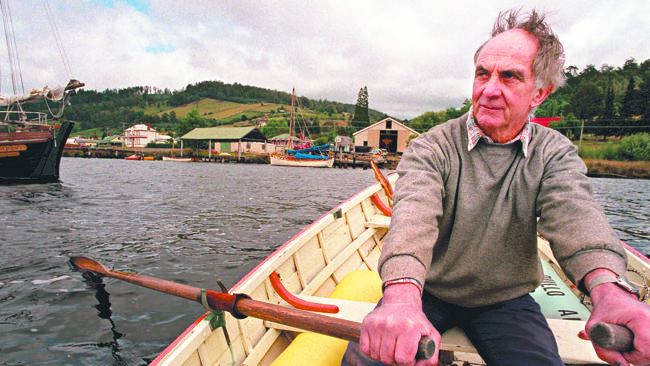
John Young, wooden boat builder and founder of the Shipwrights Point School of Wooden Boatbuilding in Franklin, had many interesting comments and suggestions to make about the past and current state of the Tasmanian forest industry, and forest management. And while I totally agree that peace in the forests is the first priority and absolutely fundamental to the future of the industry, Mr Young’s comments and ideas raised more questions than provided answers.

As a special timbers commercial competitor on private land, Mr. Young’s comments left me with the impression he does not regard special timbers as a commercial resource requiring fully dedicated profit-driven commercial management. Such a position clearly undermines the ability of Tasmanian farmers to grow commercial blackwood. It also shows a great disregard for Tasmanian taxpayers who are currently subsidising the special timbers industry, while our State health and education systems are in financial crisis.

If Tasmania cannot maximise the sustainable commercial return from it’s public special timbers resource then it should not be logged. Special timbers should not continue to be managed as a taxpayer-funded community service.

My other concern regarding Mr Young’s comments is that I’ve been reading and hearing “alternative” forest management strategies like this for the past 30+ years.  All of the dreams of “if only they” and “why don’t they” of a better forestry world. I think what the past 30 years have clearly demonstrated is that these dreams have never amounted to anything. The politicians, Forestry Tasmania and the forest industry “heavy weights” have never expressed any interest in changing the pro-industrial mass-harvest forestry model. Not in any comprehensive meaningful way. Certainly the Tasmanian Forestry Agreement (TFA) showed no change at all to the status quo and neither has the new Liberal State government.

And now the sector of the forest industry most clearly disadvantaged by this pro-industrial model, the special timbers industry, is being used by the politicians and sectors of the community as the pretext for returning Tasmania to the forestry wars. Tearing up the TFA is all about the special timbers industry. Blatant naked hypocrisy!

There is not bright new happy future. There is no special timbers business plan or management plan.

I think after 30 years of failed “alternative” forestry dreams it should be obvious to just about everyone that the dreamers are now part of the problem. They are now being shamelessly manipulated for political ends. Keep dreaming and you help to feed the cycle of forestry conflict and failure.

The Tasmanian community has paid a huge price for the forestry wars and it is time to stop.

It is blatantly obvious after 30+ years that Tasmania does not have the skills required to commercially manage its public native forest in a manner that is sustainable, maximises commercial returns, whilst minimising social and political conflict.

It is time for the forest industry, including the special timbers industry, to move 100% onto private land. To me that seems the only way we will ever put the forestry wars behind us.

For Mr Young and the wooden boat builders that will be a difficult transition. Mr Young wants peace and a happy ending. But the past 30 years have shown the reality regarding boat building timbers on public land, and that reality shows no sign of changing. On the contrary the situation is getting worse.

The only happy ending that is now apparent will be when we end public native forest logging. The last State election demonstrated that beyond any doubt whatsoever.

Reality bites: Part 2

Tasmanian economic commentator John Lawrence has written a magnificent summary of current “on-the-fly” forest policy, especially as it relates to the public native forest special timbers industry. It is deeply disturbing and illustrates the madness and stupidity that continues to be forest policy and management in Tasmania. Good reading.

http://www.tasfintalk.blogspot.com.au/2014/04/reality-bites-part-2.html

What Mr Lawrence fails to point out that is especially relevant is that since 2010 Forestry Tasmania have deliberately run their special timbers operations as “non-profit non-commercial”. They harvest these timbers to deliberately lose money! Makes absolutely no sense to me, and within the current economic, political and policy context is completely insane.

As Mr. Lawrence summaries, “I can’t recall such monumental idiocy”.

All this mismanagement and poor policy deliberately undermines the ability of private tree growers to make a living and destroys market confidence. And all of this stupidity is supported by the Australian Forestry Standard. Obviously good commercial and financial management is not part of good forest management. It certainly makes a mockery of the forest certification process.

The sooner we get the special timbers industry into the hands of farmers and away from the politicians, Forestry Tasmania and public native forest the better it will be for just about everyone.

Black Friday

Last Friday March 21st 2014 Will Hodgman Premier-Elect of Tasmania on behalf of the forest industry, and particularly on behalf of the special timbers industry, officially declared war on the Tasmanian community.

That was my immediate and clear response to this news item:

http://www.abc.net.au/news/2014-03-21/no-detail-on-forestry-future-after-dumpoing-of-peace-deal/5336956?section=tas

Does the special timbers industry want to be part of this war?

Does the special timbers industry want to be used and manipulated as the reason for this war?

As a member of the special timbers industry trying to establish a business to help move the industry onto private land and away from the politics and conflict of public forest management I certainly do not!
Hodgman_Edwards

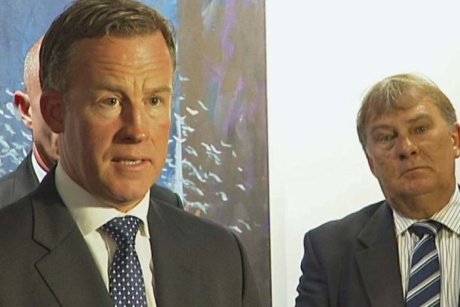
In the last 30 years I don’t recall the forestry wars being so formally declared, not with such blatant hostility and certainly not with the forest industry as reluctant (?) participants. Poor Terry Edwards (FIAT Chief Executive) standing behind Mr Hodgman looks more like a refugee trying to escape a warzone than a General about to lead what remains of his troops. “The world has moved on.” Indeed it has!

Some people think this is just a war against “the greenies” or those who failed to vote Liberal this time. But conflicts affect everyone. There are never winners in conflict; everyone loses, some more than others, often the innocent are the biggest losers. And the last 30 years of the forestry wars have been littered with false hopes and promises, and thousands of innocent victims. Politicians come and go while the victims are piled higher.

The losers over the last 30 years have been the forests, the forest industry and the Tasmanian community. That fact should be obvious to everyone. This time is no different.

Having spent last weekend as an exhibitor at the inaugural Deloraine Stringfest, it became very clear to me that this may have been the first and last Stringfest. Stringfest is a celebration of Tasmanias world-class timbers, the craftspeople who turn them into musical instruments, and the artists who play them. I was the only exhibitor representing the first link in the chain back to the trees and the people who grow them. That link needs to be strengthened and promoted. Farmers as proud tree growers need to become an integral part of Stringfest if it is to grow and have a sustainable future. There was no one at Stringfest representing Forestry Tasmania and public native forest management.

I spent the weekend at Stringfest wearing a black armband in mourning for the forest industry and the people of Tasmania.

Landmark events such as Stringfest and the Wooden Boat Festival, which showcase special timbers, will be used by our politicians as weapons to escalate the conflict. Even retailers, consumers and artists will be used as pawns in the battle.

The special timbers industry, whether it likes it or not, is being used as a weapon against the Tasmanian community. Talking to people at Stringfest there was a wide range of opinions within the industry. There was certainly no possibility for consensus on a future strategy. Many were resigned to the wars as passive observers. Some in the industry have already moved their supply sources onto private land in an attempt to avoid the conflict. A few are even looking forward to the coming battle in the hope that they will succeed. The last 30 years clearly show that outcome is very unlikely.

Many people have a “why don’t they….?” or “if only they would….” attitude to the problem. “The forests are there, if only we could manage them properly, then everything would be ok and everyone would be happy”. This fairytale dream just won’t happen. If anything the real world has moved in the opposite direction. The more people hold onto this fairytale the worse the nightmare becomes. In my opinion this fairytale has now become part of the problem. We need to give up the fairytale and move on.

Many people will not accept my interpretation of these events. That’s fine by me. People believe what they want to believe. Everyone has a different view on life.

Does the special timbers industry, including retailers, artists and consumers, want to be used and manipulated as the reason for this war?

What is more important?

Continuing to have access to conflict-ridden, unsustainable, taxpayer-subsidised special timbers from our public native forests, or moving the industry onto private land and bringing peace and prosperity to Tasmania?

For some in the special timbers industry this transition will be impossible, but for many it is a very real alternative. Many have already made the transition.

Please don’t be a pawn in Mr. Hodgman’s political power games. It is time to decide!

State election and the future of the forest industry

With the State election over I guess I need to make some comments on the outcome and what it means for the future of the forest industry, special timbers and blackwood. I’ve been a passionate supporter of forestry and special timbers for many, many  years, but it has been a very hard road. The next few years will most likely bring no relief.

There is no doubt the election was a resounding defeat for the incumbent Labor Government. But in my experience of Australian elections, if there is a change of Government the story is primarily about dissatisfaction with incumbents. In very few cases I have witnessed have Governments changed because of Opposition policies. The main reason Opposition parties win elections is because it is mostly a two horse race and one horse goes lame. Some people call this the “Bradbury effect” (no relation by the way).

Another thing that was absolutely perfectly clear in the election campaign was that Labor and the Greens promised to uphold and support the Tasmanian Forestry Agreement (TFA), while the Liberal Party made it perfectly clear they had a very strong adversarial forest policy. No Liberal candidate I heard or read said anything about peace in the forests. A vote for the Liberal Party was a clear vote for a return to chaos and conflict in the forest industry.

For the Liberal Government to now say that the people have spoken and all opposition to Liberal forest policy must cease is just nonsense. This is akin to saying that opposition parties in Parliament must cease questioning Government policy. I never saw Will Hodgman behave in this manner when he was in opposition. That elections are a clear decision-making process on any single issue is in my opinion drawing a very long bow indeed, but that is the game politicians like to play.

So like it or not Tasmanian’s voted overwhelmingly for a return to chaos and conflict in the forest industry.

If I was Alan Kohler on the nightly TV News I would now be showing a chart of Sovereign Risk in the forest industry plotted against Investor Confidence. And guess what? The former line would now be rocketing skyward, while the latter (if it was visible at all) would be negative and heading south.

The new Liberal Government has promised to tear up the TFA, and to rescind part of the recent additions to the World Heritage Area. Under these conditions the chance of Forestry Tasmania achieving Forest Stewardship Council (FSC) certification is now very slim indeed. No FSC Certification means very limited market opportunities for Tasmanian timber. Forestry Tasmania is technically bankrupt and cannot survive for much longer under these conditions.

The special timbers industry, which is currently mostly dependent on logging old-growth public native forest, must now play the final game. My guess is that the new Government will allow this logging to resume, at increasing taxpayer’s expense. Perhaps even allowing logging within our National Parks. It will be a complete and very expensive disaster. When the political tide turns again there will be nothing left.

In some ways this should bode well for a blackwood growers cooperative. Markets should begin calling for alternative sustainable supplies of special timbers, which are profitable and free of politics. What will likely happen however is that media and political attention will focus entirely on the drama and spectacle of the escalating forestry wars. Options for the future will be ignored. Unless members of the blackwood and special timbers industry want to be swept away in the coming tsunami then they had better think carefully about their future.

And all of these shenanigans impact the forest industry Australia wide. Tasmania continues to be the pariah that infects the whole country. As has been the case these last 30+ years, forestry is all about politics in this country. It has very little to do with commerce and business. And so it shall remain for the foreseeable future.

It’s going to be a very interesting and entertaining year.

IST March Tender Results

The Island Specialty Timbers March tender results posted today show a dramatic drop in market sentiment. Prices for all species were dramatically down on recent trends.

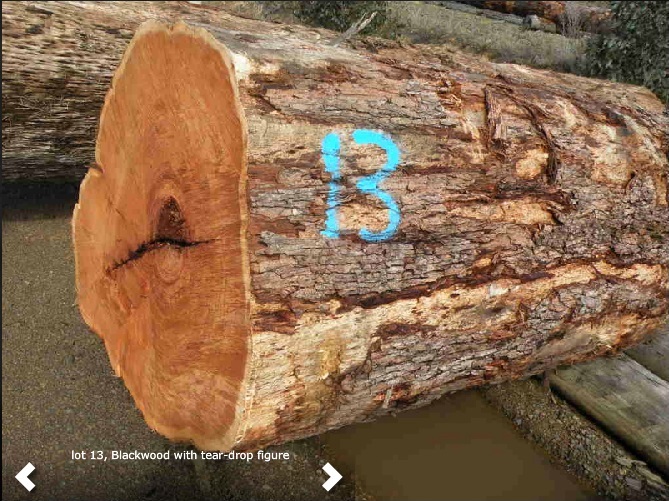
Lot 13

Whether this is a temporary dip or the start of something bigger remains to be seen. Certainly the increased political debate and tensions around the forest industry as a result of the new Federal Government and the State election campaign are severely damaging for the forest industry and general market sentiment. Why would anyone want to invest in an industry at the centre of such a destructive storm?

Only two blackwood logs were included in the March tender of 22 items. Prices were subdued for all species, even for the popular blackheart sassafras.

Both blackwood logs were of good size with plain grain; but prices were a disappointing $180 and $300 per cubic metre, representing $277 and $405 per log. Remembering that two of the three logs tendered last November failed to sell, this continues to demonstrate a weak blackwood market over the past few months.

Then again, even at $180 per cubic metre for good plain-grain blackwood sawlog, that still represents a profitable $50,000 per hectare for a mature blackwood plantation.