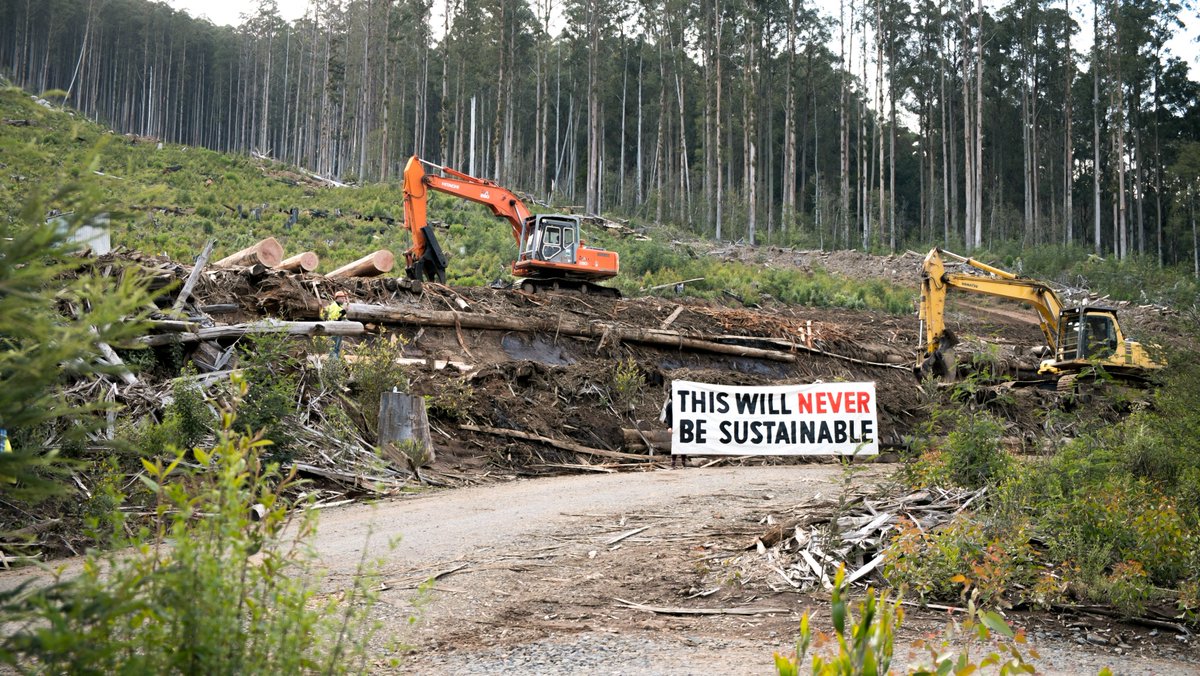
Category Archives: Politics

Tasmanian Forest Economics Congress – what next?

The much anticipated MONA Forest Economics Congress has been and gone.

I wrote a commentary back in August when the event was first announced.

I did not get an invitation to the congress so I cannot write from personal experience, only from what I have read and my long history in Tasmanian politics and the forest industry.

The congress received considerable media coverage, especially on the mainland.

The only post-congress media coverage was the following article in The Mercury newspaper Saturday 2nd December.

To date MONA has not published any details about the congress – who were the speakers, what was discussed, what was agreed and what was disagreed?

https://mona.net.au/blog/2023/08/forest-economics-congress-new-a-class

As expected, the usual suspects attempted to make political mileage out of the congress, rather than act in a respectful and positive manner. There are plenty of people who want the status quo to remain.

The further “working sessions” that Ms Kaechele plans to organise should be interesting. Where is all this discussion heading? Any change in the forest industry status quo will inevitably result in winners and losers. How do we stop this becoming yet another forestry bun fight?

Edit: We have had “collaboration” before in 2011-2012 with the 2013 Tasmanian Forestry Agreement, but that collaboration was betrayed by Tasmania’s corrupt political system and the 2014 Tasmanian State election. The corrupt political system remains a major threat to Ms Kaechele’s plans.

The fundamental problem is that public native forestry is a political decision made by the Tasmanian government, and the Tasmanian parliament has made it perfectly clear that the status quo is unlikely to change.

If Ms Kaechele wishes to promote change in the forest industry and politics, then she must engage with the wider Tasmanian community. Otherwise she risks repeating the disaster of the 2013 Tasmanian Forestry Agreement/2014 State election. She, and the members of the congress, must convince a significant portion of the Tasmanian community that a better future is available. Otherwise the congress will become yet another forestry political football used to divide and destroy the Tasmanian community, just like the 2013 Forestry Agreement.

The failure of both the Tasmanian government and the Tasmanian forest industry to respond positively to the congress may well be the straw that finally breaks the camel’s back. This charade called public native forestry is teetering on the brink. Any player in the charade may finally decide the game is over, and bring the house of cards crashing to the ground.

We can only hope!!

Tasmanian Forest Economics Congress

The forest industry has been in the media a lot lately.

That is no surprise as we have now entered the final battle in the decades long Forestry Wars.

The old forest warriors are back in the trenches – shouting and vilifying, rattling sabres and thumping hairy chests. Just like the good old days!

One thing different this time is the so called Forest Economics Congress being organised by Kirsha Kaechele later this year, as reported in The Mercury newspaper Saturday 19th August.
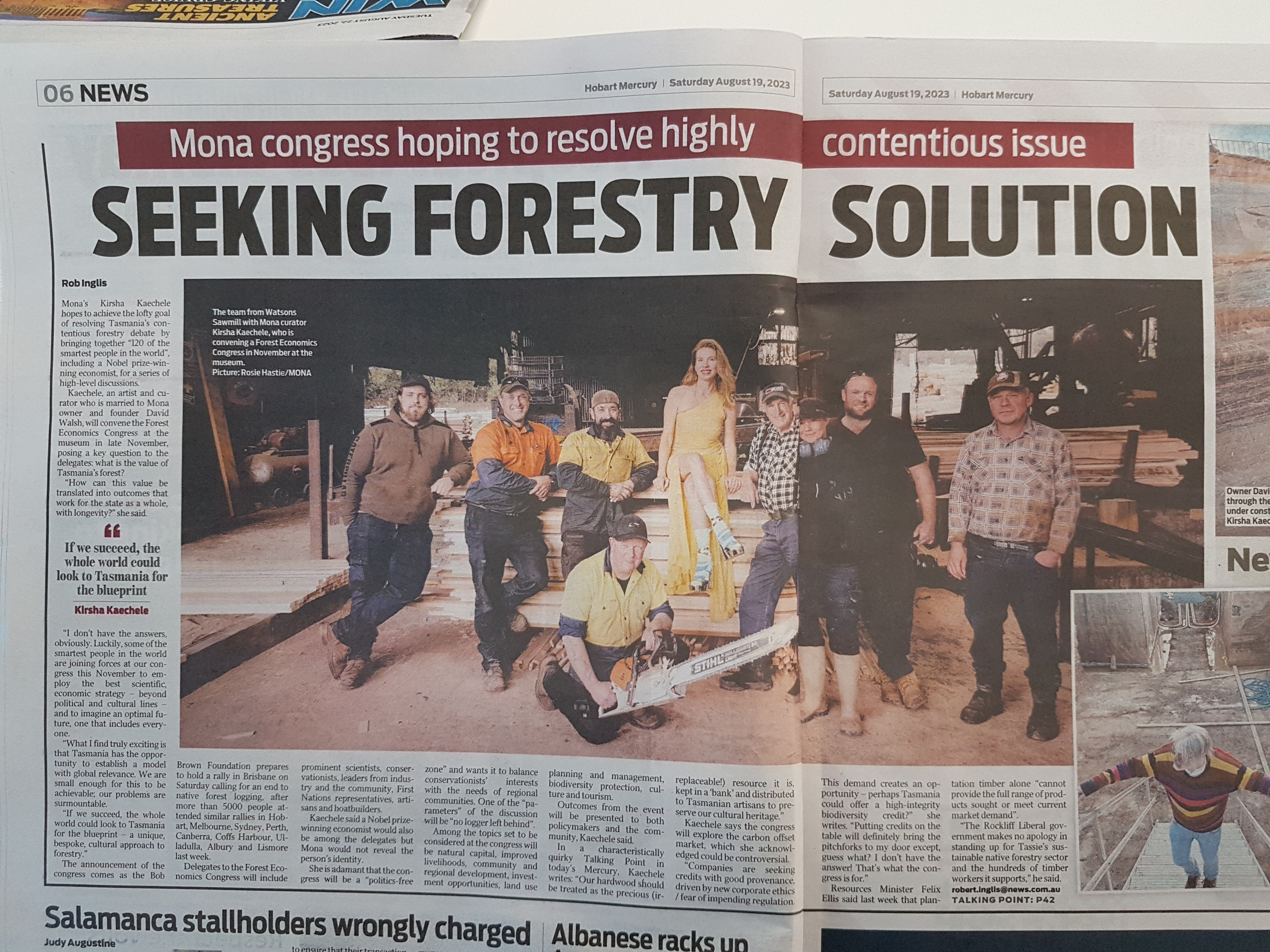
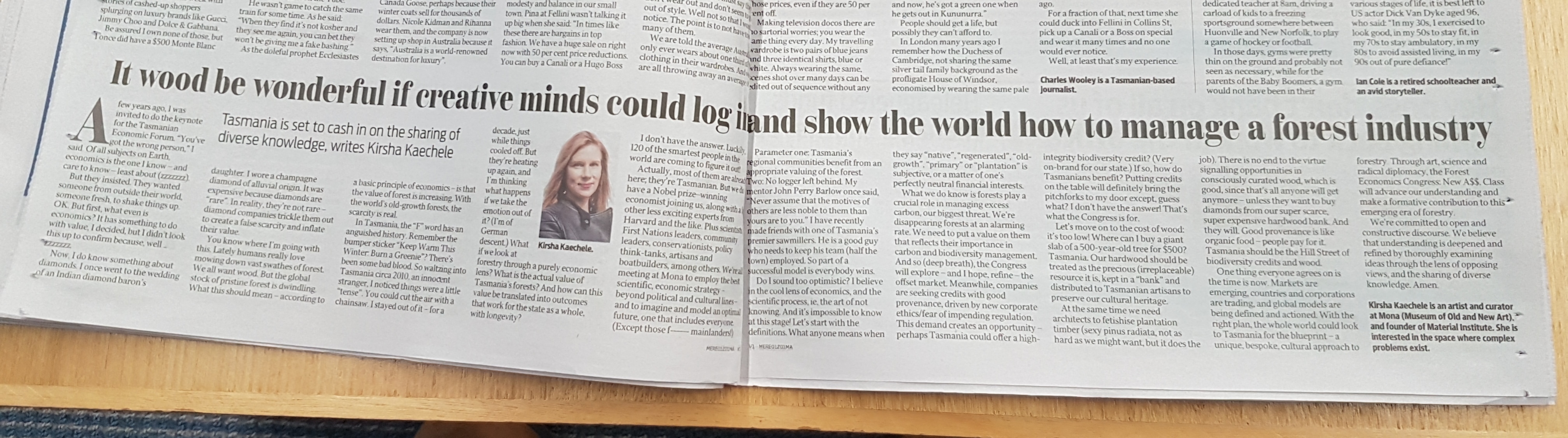
The idea that after decades of bitter conflict a bunch of people can sit down and solve the forestry wars seems completely fanciful. Especially so after the 2014 Tasmanian State election when the last attempt at discussion and compromise was destroyed by Tasmania’s corrupt political system.

Ms Kaechele is promising free and open discussion about a positive forestry future for Tasmania.

Part of the problem however is that Ms Kaechele has already set a long list of Terms of Reference for the Congress that are identified in these two articles.

These Terms of Reference include:

  • the continued logging of public native forests, including oldgrowth forests;
  • “artisans and boatbuilders” will be given preferential access to our public native forests;
  • sawmillers are our friends!

It seems that many outcomes from the Congress have already been determined

Curiously Ms Kaechele fails to mention anything about politics, as if the Congress will define and implement a positive forestry future completely independent of our State parliament.

Q. How can a public resource (our forests) be managed outside of the political system in a small corrupt fishbowl like Tasmania?

A. It can’t! Never has, never will!!

I could ask 100 people in the forest industry what their vision of the future is and I would get 150 different answers, many of them mutually exclusive. Many people are not prepared to compromise, and many people have utterly fanciful ideas about our forests. There is much distrust, anger and hostility in the mix as well.

How can common ground be reached under these difficult conditions?

Many of the fundamental issues facing timber markets and the forest industry are not mentioned in either of these articles. Fundamental issues like the complete absence of proper functioning timber markets in Australia, the absence of level playing fields for all tree growers, farm forestry, etc..

No doubt the Congress will provide some interesting discussion, but I for one am not holding much hope. One thing is guaranteed – the forestry wars will not be resolved by the Tasmanian parliament. The Tasmanian parliament can only enflame and exacerbate the conflict.

That is the reality that Kirsha Kaechele faces.

PS. Never mind that John Lawrence has spent the last 18 years repeatedly destroying Forestry Tasmania’s business model and their very dodgy accounting practices. What really are they going to talk about in November?

http://tasfintalk.blogspot.com/search/label/Forestry%20Tasmania
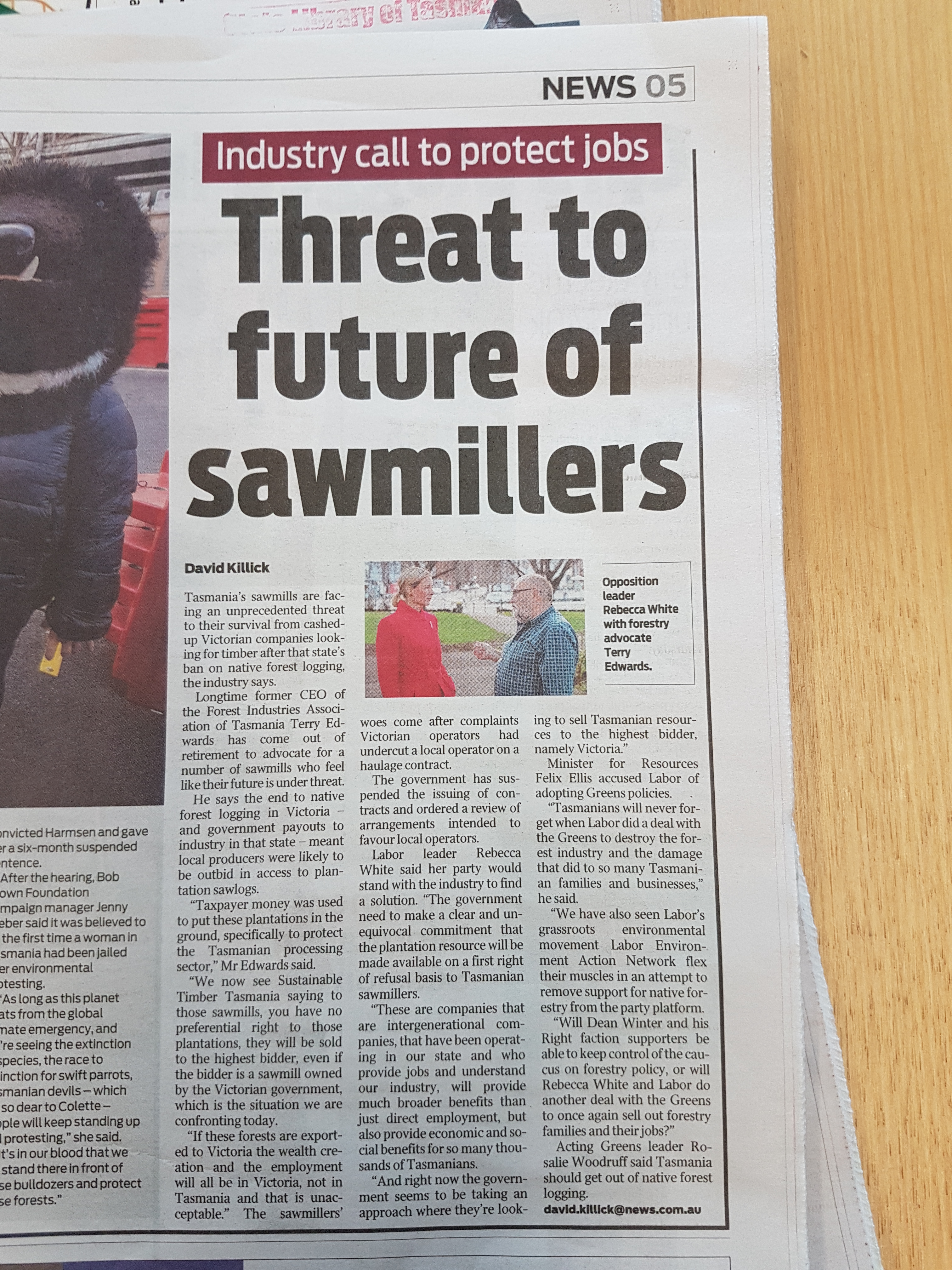
Blatant market manipulation

20230719_105036.jpgThis article appeared in The Mercury newspaper last Saturday the 15th July.

It’s a monster!

Terry Edwards is the old Tasmanian forest industry warhorse now retired. But old warhorses never really retire.

And here is Terry back beating the war drums once again.

This time it’s not “The Greenies” he is raging against but the State government!

How dare the Tasmanian State government not continue to subsidise the very welfare dependent forest industry.

How dare the Tasmanian State government sell it’s forest products onto the open commercial market, and not give them to local sawmillers.

It’s an outrage!!!

No! It’s the forest welfare industry doing what it has always done – cry poor and play politics!

It doesn’t say but I assume the sawlogs being discussed are the first harvest of Regional Forest Agreement pruned hardwood plantation sawlogs, that the local sawmillers said they weren’t interested in 25 years ago when they were planted.

My how times change! And old behaviours and attitudes don’t!

What Terry Edwards is saying is that the Tasmanian sawmillers don’t want to operate in a competitive commercial marketplace. They haven’t for 200+ years and they certainly are in no position to be competitive now. Two hundred years living on forest welfare has left the Tasmanian industry a complete basket case.

Subsidizing sawmillers has been government policy in Australia since 1788, which is why our forest industry today is now at deaths door.

The other message from Mr Edwards is about sawlog price control and manipulation. The forest industry does not want an open competitive market operating in Tasmania.

That is a very clear message to Tasmanian farmers to never plant a tree for the forest industry because you will never ever get a fair market price!

Terry Edwards wants the forest industry to wither and die.

I could also point out that what Mr Edwards is proposing is in breach of numerous commercial and trade practice laws. Those cashed up Victorian sawmillers may very well take the Tasmanian government to the High Court, and bring the whole facade crashing down.

Now that would be fun to watch!

Until we get all the welfare recipients and their supporters (like Mr. Edwards) out of the forest industry there will no future.

The end of public native welfare forestry – 2023 update

I’m back from holidays and it’s time to comment on events over the past few weeks.

Victoria

Firstly in Victoria, where the State government has brought forward the closure of native forest logging from 2030 to December 2023!

What a complete surprise that was to everyone!

https://www.abc.net.au/news/2023-05-25/death-of-timber-industry-rocks-victorian-logging-communities/102385506

https://www.theguardian.com/australia-news/2023/may/23/end-of-native-logging-in-victoria-a-monumental-win-for-forests-say-conservationists

We will probably never know the real history of public native forestry in Victoria (or any other State for that matter) and the reasons why it failed. History was never on the side of native forest logging anyway, it was always a matter of time and circumstances.

New Zealand made the right decision 30 years ago. It’s a shame that Australia didn’t change then also. As a result the New Zealand forest industry is now much more advanced than ours in Australia.

The problem here in Australia is that the forest industry is preparing to die in the trenches over public native forestry. According to forest industry leaders, dying in the trenches is a better strategy than have a plan for the future. I can’t see the logic in that thinking myself.

Tasmania

Following the announcement in Victoria, the adrenalin started pumping over in Tasmania where forest industry leaders think they see a major commercial opportunity coming their way.

https://www.abc.net.au/news/2023-05-27/tasmanian-timber-industry-greater-access-native-forests/102386256

Swimming against the tide as usual the forest industry in Tasmania wants greater access to public forests to take advantage of the lack of competition on the mainland. Instead of seeing their future now very much on borrowed time, the Tasmanian industry thinks their ship has come in!!

That demonstrates beyond doubt just how utterly deluded the forest industry has become.

There is no doubt that New South Wales will be the next State to end public native welfare forestry in the next 1-3 years, leaving Tasmania as the recalcitrant State as usual.

After almost 60 years of forestry wars in Australia the end of the war is finally in sight.

Much damage has been done politically, environmentally and socially. Many people will never recover from their wounds and deep prejudices. Such is the way of human stupidity and ego.

Probably Tasmania is the State that has suffered the most from the Forestry Wars. It has permanently corrupted our political system and left the community deeply divided.

The damage to the Tasmanian forest industry is probably permanent.

In my next blog I will reflect on possible futures for timber markets and the forest industry.

Stay tuned!

If not native jarrah, where does WA get its hardwood?

https://www.abc.net.au/news/2021-10-29/jarrah-price-spike-spurs-indonesian-hardwood-imports/100575880

This is the conversation we should have been having 50 years ago when the forestry wars began!

These are the important questions that will determine the future of the forest industry in Australia.

The end of Public Native Welfare Forestry in Australia has been coming for decades. But so many people dependent on it have chosen to ignore this fact.

Most furniture makers and builders just expect quality timber to be in the marketplace ready to buy. They have no interest in securing their own future.

How do furniture makers support farm forestry? Will furniture makers and builders support farm forestry??

New Zealand farmers have been happily growing quality timbers including lots of different eucalypt species, and blackwood, for decades. Why can’t Australian farmers?

Why don’t Australian furniture makers support New Zealand farmers and buy New Zealand grown quality wood? New Zealand farmers would love to sell their quality wood to Australian furniture makers.

If New Zealand wants timber, New Zealand farmers grow it!!

Why can’t Australian farmers grow timber for Australia??

Australia has never had a proper forest industry. Nor has it ever had proper functioning wood markets.

It has all been welfare, ideological and political!!

Not an ounce of commercial reality anywhere!!

Imagine if Australian furniture makers got behind and supported farm forestry in Australia. Just imagine the huge transformation that would initiate!!

The argument that you can’t make quality furniture out of plantation timber is of course utter bullshit. It is part of the bullshit the forest industry says to justify plundering taxpayers and our public native forests.

“We’ve never been able to grow jarrah or karri well in plantations,” Mr de Fégely said.

That is true for Jarrah, but not true for Karri. Karri is a very fast growing eucalypt species. It has been grown in plantations in South Africa for almost a century.

When it comes to defending public native welfare forestry, the forest industry will completely disparage farm forestry.

The final comments from forestry head Rob de Fégely are utterly stupid.

Growing trees for wood production is NOT welfare, it is business!!

Mr de Fégely wants to keep defending the welfare forestry model.

It’s time we gave welfare forestry the flick!!

It is time to support farm forestry in Australia!!

Tasmanian State Policy on the Protection of Agricultural land 2009

Tasmania has had a rabidly pro-forestry Parliament for generations; at least rabid in terms of rhetoric!

But when it came to developing a State policy on the protection of agricultural land plantation forestry was the only primary industry specifically mentioned.

http://www.dpac.tas.gov.au/divisions/policy/state_policies

Plantation forestry is the ONLY primary production that is specifically excluded from designated prime agricultural land in Tasmania.

Principles 3.10 and 3.11 of the Policy specifically discuss plantation forestry. Principe 3.10 provides a general exclusion of plantation forestry from Prime Agricultural Land, whilst 3.11 allows plantation forestry to be excluded from any other agricultural land.

What is the purpose of the Policy?What developments are affected?Where does the Policy apply?
To conserve and protect agricultural land so that it remains available for the sustainable use and development of agriculture, recognising the particular importance of prime agricultural land. ‘Agricultural use’ includes use of the land for propagating, cultivating or harvesting plants or for keeping and breeding of animals, excluding domestic animals and pets. It includes the handling, packing or storing of agricultural produce for dispatch to processors or markets and controlled environment agriculture and plantation forestry.Proposed non-agricultural use and development that is ‘discretionary ‘or ‘prohibited’ on land zoned either Significant Agriculture or Rural Resources in planning schemes or land adjoining these zones but with a different zoning.All agricultural land in Tasmania zoned either Significant Agriculture or Rural Resources in planning schemes

Prime Agricultural Land (PAL) is defined as land with Land Capability Classes 1-3, as discussed in the following website:

https://dpipwe.tas.gov.au/agriculture/land-management-and-soils/land-and-soil-resource-assessment/land-capability

PAL comprises 108,000 ha or just 4.3% of Tasmanian private land.

So why specifically exclude plantation forestry from 4.3% of Tasmania’s private land?

Why not exclude mohair goats, walnuts or truffles as well? Why pick on trees?

For a rabidly pro-forestry Parliament this Policy makes no sense whatsoever.

If a farmer plants a tree on any of these 108,000 ha are they breaking the law? Will they be prosecuted?

I know lots of farmers say you can’t eat wood, but as the recent global timber shortage demonstrated, neither can you build houses out of vegetable waste!!

As I’ve said many times before the forest industry in Tasmania is struggling to build a future. It wants to encourage farm forestry, but the Government has put numerous hurdles in its path. This Policy is one such hurdle.

Another hurdle is the treatment of plantation forestry under the Forest Practices Code. Plantation forestry should be treated just like any other primary industry, subject to the same rules and regulations. Just like it is in New Zealand!

It’s called a level playing field, and allows farmers to make better investment decisions to improve their commercial performance.

Now I think about it, the only reason plantation forestry is specifically mentioned in this policy is a warning to politicians. Under current markets the only way forest plantations would be grown on prime agricultural land is if politicians intervened to distort and corrupt markets as they did during the Managed Investment Scheme (MIS) disaster.

But as the world continues to run short of timber and wood prices increase, this Policy will need to be reviewed. The Tasmanian Government will need to start encouraging farmers to grow trees instead of discouraging them.

Timber supply chain constraints in the Australian plantation sector – The Report

Back in June last year (2020) I wrote a submission to a Federal Parliament House of Representatives Standing Committee inquiry into plantation log supply constraints in Australia.

Here is the link to the inquiry including the final report and submissions:

https://www.aph.gov.au/Parliamentary_Business/Committees/House/Standing_Committee_on_Agriculture_and_Water_Resources/Timbersupply

As I noted at the time, the Terms of Reference for the inquiry were very typical for the forest industry in Australia, ie. the focus was all on the processors and “jobs”.

And the title for the final report says it all (what a f*****g joke!):

Aussie logs for Aussie jobs

Inquiry into timber supply chain constraints in the Australian plantation sector

Was the inquiry about supporting, encouraging and rewarding profitable tree growers?

Not on your life!

The primary focus of the inquiry was about protectionism and market manipulation.

Don’t get me wrong! I’m happy to support local processing of forest products, but not if it means denying growers the right to open, competitive, transparent markets. Making long term investments, like growing timber, is hard enough without Governments and industry slamming the door in your face.

And this Inquiry and this Report provide absolutely no comfort to existing and potential timber growers, that such market interference wont happen!

So what can I say about the Report?

At least the report is more honest about the current state of the forest industry in Australia than a lot of previous reports.

The picture is rather gloomy!!

The forest plantation sector in Australia is in decline, losing resource and becoming less competitive.

The focus of the report is on commodity wood (pine and hardwood woodchips), with no mention of high value appearance grade forest products.

If nothing else, I recommend reading the section on Farm Forestry which begins on page 59 of the Report. I don’t agree with everything it says, I do agree that there are significant issues, most of which are not being addressed.

One curiosity is the mention in the Report of a “National Farm Forestry Strategy”. Apparently the Federal Government is producing one, but if you Google “National Farm Forestry Strategy” nothing appears!! We have had these strategies before and they have all failed. Let us wait and see!

And the biggest issue for me is the culture and attitude of the forest industry itself, and the “head-in-the sand” attitude of the marketplace!

Happy reading!!

Fraud by Nature

The Forestry Wars are well and truly back in their full Tasmanian community devastation.

The toxic rhetoric is raining down upon us as if the last 30 years meant nothing.

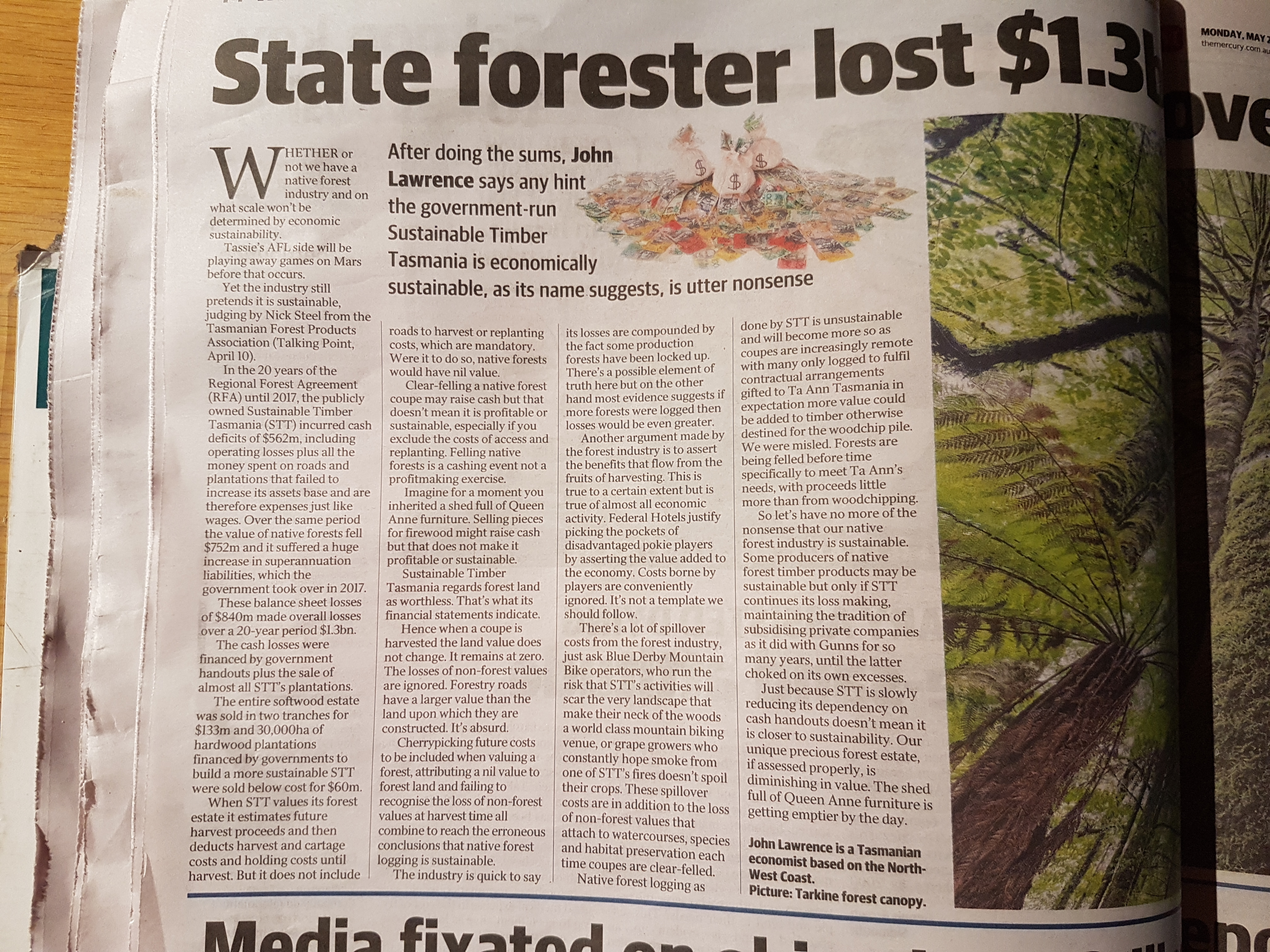
Here is a piece from The Mercury newspaper from Monday 24th May.

It is written by economist John Lawrence and relates to the State Government forest agency Sustainable Timbers Tasmania:

https://www.sttas.com.au/

Here is the article on John’s own website:

http://tasfintalk.blogspot.com/2021/05/whether-or-not-we-have-native-forest.html

John Lawrence wrote a similar more detailed piece for The Guardian newspaper 3 years ago. You can find it here:

https://www.theguardian.com/environment/2018/mar/29/tasmanian-forest-agreement-delivers-13bn-losses-in-giant-on-taxpayers

The fact that this article can appear in the main Tasmanian media, with $1.3 billion in taxpayers cash and assets stolen, and:

  • not a single question will be asked in the Tasmanian Parliament;
  • there will be no Royal Commission;
  • the Tasmanian Integrity Commission (https://www.integrity.tas.gov.au/) will never launch an enquiry;
  • there will be no police investigation;
  • no one will ever face prosecution;

tells us everything we need to know about Tasmanian politics and corruption in Tasmania.

It certainly tells us everything we need to know about the forest industry in Tasmania.

The fact that Australia’s two largest retailers of this stolen property, Bunnings Hardware and Mitre 10 Hardware, are in complete support of this fraud is just another disturbing feature of the forest industry.

https://www.bunnings.com.au/

https://www.mitre10.com.au/

So how do we end this?

There is no way to end this except endless protest!!

Unless Bunnings and Mitre 10 make a stand and stop supporting this fraud, things will only get worse.

Local Communities and the Forest Industry

This recent commentary from the forest industry demonstrates yet again the arrogance, contempt and feral attitude that the industry shows towards the Australian community:

The Murrindindi Shire in the Central Highlands of Victoria is Ground Zero for public native welfare forestry in Victoria. Not surprisingly the local Murrindindi community are getting increasingly agitated and concerned about the impact forestry is having on their lives and livelihoods.

https://www.murrindindi.vic.gov.au/Your-Council/Statement-on-the-Management-of-Central-Highlands-Forests

But the forest industry demonstrates nothing but contempt for the community’s concerns.

https://www.murrindindi.vic.gov.au/logging

The arrogance in the language of the Timberbiz commentary is nothing short of offensive!

If the forest industry loses the support of local communities then it only has itself to blame.

Treating local communities with such blatant arrogance and contempt will only hasten the isolation and decline of the forest industry.

Murrindindi Shire is close to the City of Melbourne, so many of the residents are not dependent on forestry welfare, hence the growing concern and criticism.

The Murrindindi Council are the elected representatives of the local community, a fact which the forest industry chooses to ignore.

As a forester I fully support the Murrindindi community in their right to show care and concern for their future.

As a forester I condemn the offensive attitude and language of the forest industry.

Tree Alliance – MIS revisited?

https://www.treealliance.com.au/

Does anyone remember the Managed Investment Scheme (MIS) disaster of the 1990s?

It was the biggest corporate fraud in Australia’s history.

There was no Royal Commission and no one went to jail.

Billions of investor and taxpayer dollars disappeared, and thousands of Australian lives were ruined.

And the forest industry, which started the MIS schemes, refused to accept any responsibility for their actions!

It was a complete disaster!

And it had its beginnings in much the same way as the Tree Alliance is now starting off.

The forest industry has been very quiet the past 10 years as it has rebuilt from the ashes of the MIS disaster.

The MIS was a near-death experience for the forest industry. A few people made extraordinary wealth, but left the industry a smoking ruin.

Below is a list of those who support the Tree Alliance:

Supporters of the Tree Alliance:

The Tree Alliance aims to bring together a range of organisations to collaborate to achieve the tree planting and communication objectives. Current supporters include:

  • Tasmanian Farmers and Graziers Association
  • Tasmanian Agricultural Productivity Group
  • Tasmanian Timber
  • Tasmanian Forests and Forests Product Network
  • We Act
  • Climate Friendly
  • The Centre For Sustainable Architecture With Wood (University of Tasmania)
  • CSIRO
  • NRM South

Note that the above list contains no sawmillers, wood processors, log merchants,  exporters, or retailers. No one in the real forest industry supports the Tree Alliance!

Does that make you suspicious?

It should!!!

I wander through the Tree Alliance website and I see history repeating itself.

I see the forest industry (or at least public servants, scientists, NGOs and politicians) big-talking! Lots of promises and potential, just like the start of the MIS disaster.

BEWARE!

As I tell all my clients and those who make enquiries about growing blackwood:

“No one wants you to grow trees for future wood production!”

The real forest industry (including the marketplace) has not the slightest interest in your tree-growing dreams!

I get phone calls and hear stories of people who are bulldozing their trees they once planted and can now find no markets for!!

The Tree Alliance has all the features, promises and rhetoric of a giant fraud, just like the Managed Investment Scheme disaster.

BEWARE!

I support a real forest industry! New Zealand has a real forest industry; Australia does not!

In New Zealand the forest industry talks about prices, costs, supply, demand, markets, etc.; all those things that farmers understand and deal with every single day.

No one in the forest industry in Australia talks about such matters!

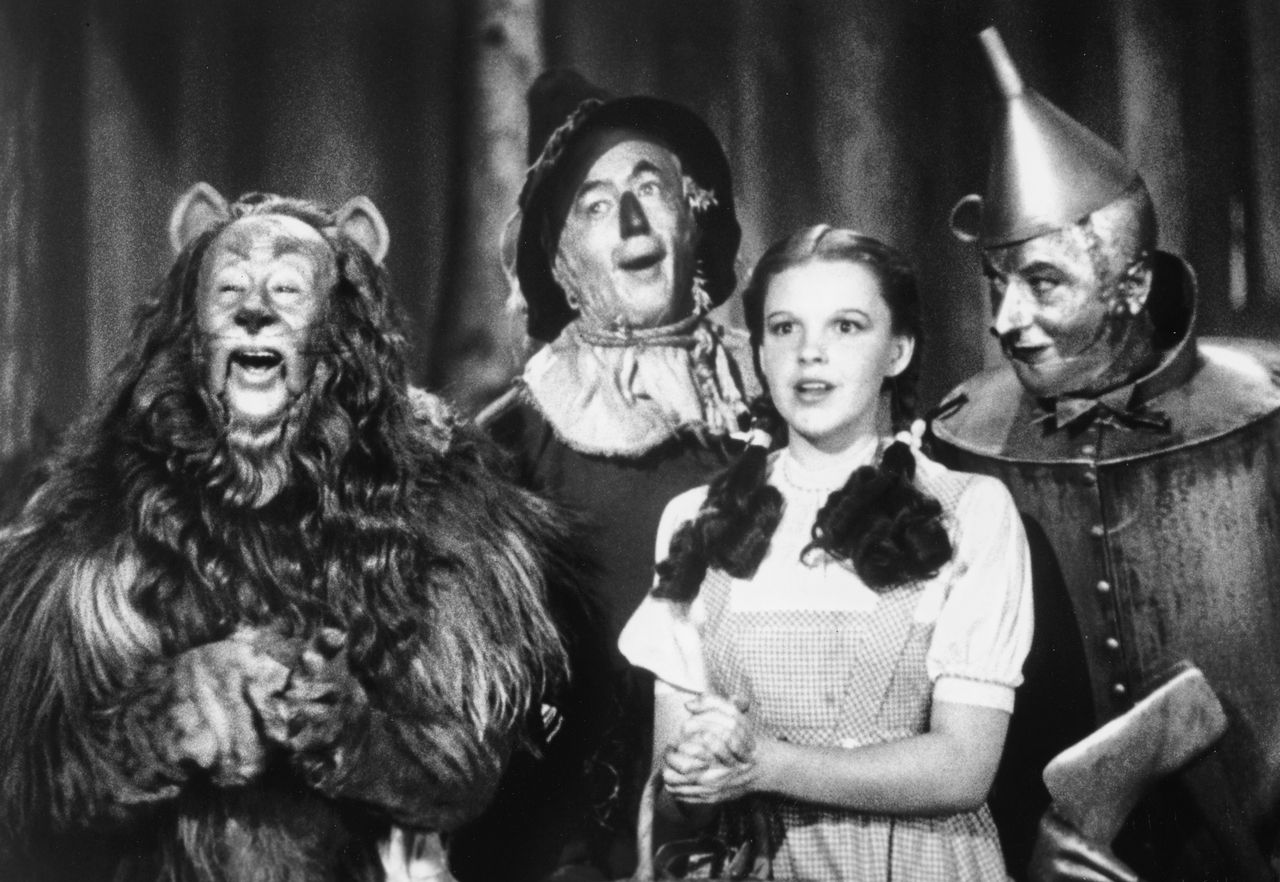
Looking at the Tree Alliance is like watching Dorothy and the Tin Man skipping down the Yellow Brick Road.

BEWARE!

Until the real forest industry (including the wider marketplace) WANTS a future I would steer clear of any hyper-marketing “forest industry” b***shit.

Cheers!