https://nz.pfolsen.com/about-pf-olsen/case-studies/great-returns-from-small-blocks/
Following on from my previous blog about the importance of front line troops in the forest industry, here coincidently is a recent fantastic example from New Zealand.
This is the kind of media the forest industry needs to generate on a regular basis to stimulate interest and investment.
New Zealand has a very successful forest industry which is a major contributor to that country’s economy, without taxpayer subsidies.
Sure they have their challenges – that’s fundamental in business. Any business that doesn’t have challenges is going out of business quick smart.
Those clever Kiwis know how to run a proper forest industry.
It’s nothing to do with blackwood apart from showing that farmers can grow trees on a small scale and make very good money, provided Government and industry policies are right and the market’s working properly.
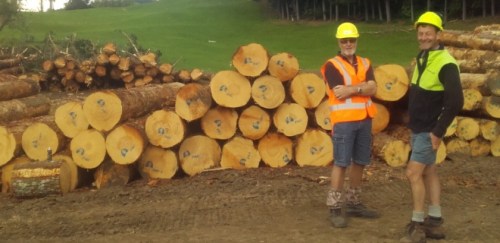
Kevin Thomsen, a small farm forester at Hawkes Bay, harvested just 8.6 hectares of well managed pine grown on land not suited to other land uses. And here are the results:
The harvesting results far exceeded expectations for 24 and 25 year old trees. Key statistics averaged across the two blocks (both Radiata pine) are:
Per hectare log yield of 875 tonnes over 8.6 hectares.
Net income (stumpage) of $NZ528,297
Net income (stumpage) per hectare $NZ61,430
Net income (stumpage) per hectare per year of $NZ2,507
Net income (stumpage) per tonne of $NZ67.63
Kevin credits a lot of this successful result and “stress-free harvesting” to PF Olsen and “the specialised marketing division based in Rotorua who have access to a number of competing overseas buyers of our logs.”
Clearly Mr Thomsen, besides having a well managed quality resource to sell, was close to markets and had easy harvesting conditions.
What a great story!
And another thing we don’t have here in Australia – great forest product market information like that provided by PF Olsen:
https://nz.pfolsen.com/market-info-news/
When will Tasmania get a fully commercial profitable forest industry?







 Tasmanian Blackwood Growers Cooperative
New Zealand Historical Pine Log Price Data
In the early 1990s the New Zealand Government made the fateful decision to hand the forest industry over to the private sector.
It was a brave and visionary decision.
Before then the New Zealand forest industry was a Government run community service that included plundering public native forests and running a massive pine plantation employment program.
Public native forestry was shut down and the pine plantation resource was sold to the private sector.
The forest industry was mortified! Apoplectic!
Twenty five (25) years later and NZ has one of the most successful forest industries in the world, based on profitable private tree growers. Can anyone challenge this assessment?
Forestry was third in the list of exports by value in 2016 in New Zealand (after dairy and meat; with no Government subsidies):
http://atlas.cid.harvard.edu/explore/?country=166&partner=undefined&product=undefined&productClass=HS&startYear=undefined&target=Product&year=2016
Once the pine plantation resource was privatised then pine log prices became realistic and meaningful and the NZ Ministry of Primary Industries began recording pine log price data.
So here we have twenty five (25) years of export pine log price data.
http://www.mpi.govt.nz/news-and-resources/open-data-and-forecasting/forestry/wood-product-markets/historic-indicative-new-zealand-radiata-pine-log-prices/
What an astonishing achievement!
Well done New Zealand!!
I’ve converted the data into a chart and added some second order polynomial trend lines.
Before June 2017 the data is numerical average price. Post June 2017 the prices are weighted average which should mean more realistic and stable data.
The obvious trends are a major spike in 1994 due to the Northern Spotted Owl crisis in North America (1) followed by a gradual price decline until the GFC in 2007/08. Following the Global Financial Crisis export pine log prices have seen a steady 10-year price improvement, to the advantage of NZ pine growers.
The other interesting trend in the chart is the convergence over the last 10 years of the A Grade, K Grade and Pulp log prices. Pruned pine log prices have continued show a significant price differential.
Oh how I wish we had meaningful long term blackwood log price data.
No chance! Not in Tasmania!
Good luck to New Zealand pine growers!!
Leave a comment
Posted in Commentary, Markets, New Zealand