Category Archives: Markets

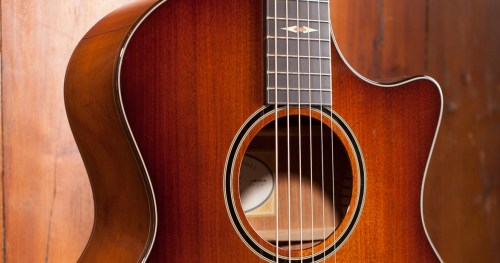
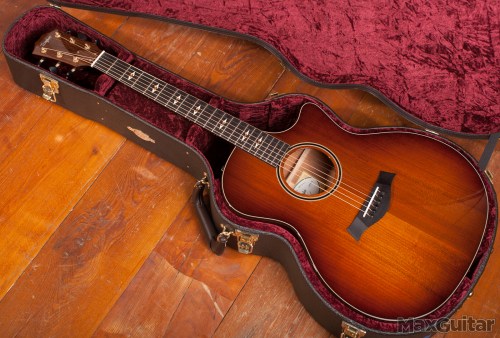
Taylor Custom Shop Grand Auditorium all Blackwood

Taylor Custom GA BW1

https://www.maxguitarstore.com/products/taylor-custom-shop-grand-auditorium-all-blackwood/

Here’s a great Taylor Custom Shop Grand Auditorium (GA) all blackwood guitar currently on the market at Max Guitars in The Netherlands.

Imagine a unique Taylor guitar that’s just yours, brought to life with Taylor’s legendary craftsmanship. Your Taylor. Your way! It’s possible.

Max Guitar stocks a great selection of these Custom Made Taylor Guitars. And lots of customers either pick one from stock or use our stock to inspire them to compose their own design! Simply Choose your category of guitar, pick your body shape, select from a rich assortment of our finest tonewoods including non-standard species and grades, choose from a full palette of appointments, and more. Then we’ll get to work building your Taylor guitar that’s uniquely personalized for your tastes. Ready? Talk to us?

Taylor Custom Shop 9009 is a Unique Custom shop model made at the Taylor El Cajon factory and picked especially by Robbert for Max Guitar!

The exquisite Grand Auditorium Custom model is a special order made in El Cajon and sports a Venetian Cutaway. Built up out of superb tone woods. A Blackwood back and sides and a very resonant Blackwood top that sounds really full! Furthermore ebony fingerboard, MOP binding, dot inlay, Gotoh 510 tuners, The whole instrument is finished in a warm Sunburst and extremely thin gloss finish. Comes with COA and Hardcase.

Bring Your Dream Guitar to Life! Imagine a Taylor guitar that’s uniquely yours, brought to life with Taylor’s legendary craftsmanship.

At €4930 or $A7480 it’s not cheap.

But then it is a custom build.

Things I like about this guitar:

  • The all blackwood body
  • The shaded edgeburst
  • The gold Gotoh 510 tuners (I think gold goes well with blackwood)
  • Those neat fretboard inlays look pretty cool too!

Taylor Custom GA BW3

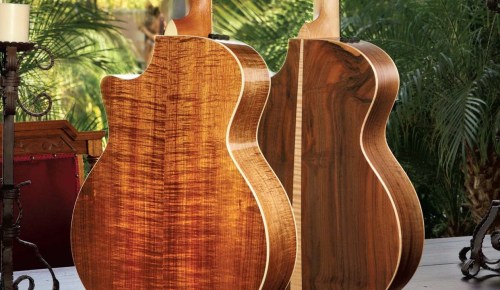
Made with farm-grown Tasmanian blackwood courtesy of Tasmanian tonewoods:

https://tasmaniantonewoods.com/

https://www.taylorguitars.com/

Taylor 2010 Spring Limited Editions

2010SpringLTDsa

Above L-R: Tasmanian Blackwood 514ce-LTD, Walnut 414ce-LTD

For the fourth consecutive year Taylor Guitars included Tasmanian blackwood in a limited edition set. Spring 2010 saw 9 limited edition models of which 2 featured Tasmanian blackwood, this time in the 500 series thanks to the highly figured blackwood.

Bob Taylor and his design team herald spring’s arrival with a quartet of limiteds that promise to invigorate the senses.

Our Spring Limiteds have become one of those typically atypical Taylor design projects. Rather than making a firm commitment to come up with something each spring, Bob and his fellow designers wait to see if the product development stars align. Are there any reserves of exotic woods available that invite special treatment? Which models are generating lots of excitement around the factory? We think you’ll be happy with this year’s outcome (Wood & Steel Vol 63).

Tasmanian blackwood is often compared to its better-known cousin, Hawaiian koa. We gathered an assortment of impressively figured backs and sides for this run, making this a special upgrade to our 500 Series. Tonally, blackwood shares koa’s blend of midrange bloom and top end brightness, and will grow sweetly mellower over time, with great dynamic range.

Both models are topped with Sitka spruce and include Ivoroid binding, an abalone rosette, and an all-gloss finish [and gold-coloured tuners].

Tasmanian blackwood is often compared with Hawaiian koa as a tonewood. It’s a natural comparison to make but it can quickly turn to blackwood’s disadvantage if overdone as a marketing strategy. I think Tasmanian blackwood is more than capable of standing on its own two feet (roots??) as a quality tonewood.

Here’s a Spring Taylor 2010 516ce-LTD for sale on Reverb:

https://reverb.com/item/4445536-taylor-516ce-ltd-spring-limited-2010-tasmanian-blackwood-sitka

Production numbers (courtesy of Taylor Guitars) were:

MODEL PRODUCTION
514ce-LTD 301
516ce-LTD 215


https://www.taylorguitars.com/

Over four consecutive years 2007-2010 Taylor Guitars produced almost 2,700 guitars across 9 Limited Edition models featuring Tasmanian blackwood.

My next spotlight will be on the 2012 Spring Limited Edition GS mini models.

Previous Taylor spotlights:

2004 Fall Limited Editions – when Taylor Guitars first introduced Tasmanian blackwood

Taylor GS4e 2007 Fall Limited Edition

Taylor 2008 Spring Limited Editions

Taylor 2009 Spring Limited Editions

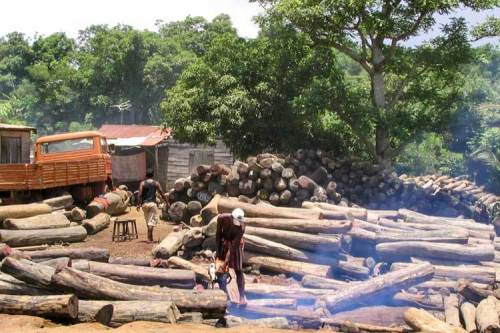
The Radical Sawmill

Sunrise

Sawlogs take a long time to grow! Decades long!!

So if you are a sawmiller looking to secure your resource/business beyond next week or next year, you need to be aggressive in the market place.

Selling sawn timber is fine but if there are no sawlogs coming in, then its game over.

Under the unique resource conditions of the forest industry it could be argued that for a sawmiller, buying sawlogs is actually more important than selling timber!

So here is one sawmiller from Ashville, North Carolina, USA who is very aggressive and up front about securing their future.

http://sunrisesawmill.com/

This sawmill provides a current table of prices they are prepared to pay forest growers for logs delivered to their mill, by species and log grade.

I have never seen a sawmiller in Australia who actively seeks to buy sawlogs in the open market like this.

This is one Radical Sawmiller!

http://sunrisesawmill.com/log-prices/

Converting these prices into something that Australian/New Zealand readers can understand is problematic because:

  • Americans trade logs using board feet (12” x 1” x 1”) as a volume measure; and
  • They confuse the log pricing issue even more by then applying a sawn recovery scaling factor so that the board foot volume changes depending upon the small end diameter of the log. Sunrise use the Doyle Log scaling factor.

The use of a log scaling factor makes the job of the forest grower even more difficult than it already is!

The job of the forest grower should be to grow quality and size/volume. It should be the responsibility of the log buyer to then recover the best value from the logs via markets and/or technology.

The Doyle Log scaling factor uses the log small end diameter (under bark) and log length. There is no allowance for log taper.

So I took the Doyle Table provided by Sunrise Sawmills and did a bit of maths to produce the following chart. As a straight forward conversion there are 424 board feet (BF) in a cubic metre (CUM). With the Doyle Log Scaling factor the number of board feet per cubic metre in a log increases as the diameter increases as the chart shows. This is to account for the fact that sawn recovery increases as log diameter increases. So in the USA log buyers only buy based on a notional “recovery”. The grower pays for wastage. In Australia and New Zealand logs are traded based on total log volume, with the buyers then responsible for maximising the value from the log.

I also did some calculations to see what effect a 2% log taper would have. Obvious it means that the grower is paying for even more waste (less recovery).

BF_CUMratio

On the positive side you could say that using the Doyle Scaling factor encourages/rewards growers for growing bigger trees, with larger logs getting three times the price of smaller logs.

But my feeling is that using this method for trading logs just confuses the issues.

With this chart in mind it is interesting to note the price difference at Sunrise between the veneer vs the prime sawlog. With veneer logs it is possible to get over 95% recovery. So in terms of volume recovered, the veneer and prime sawlogs are essentially the same price! But appearance grade veneer sells for much more by volume than sawn timber. These prices don’t quite add up.

These guys even have their own Facebook page:

https://www.facebook.com/Sunrise-Sawmill-193257651998/

It is good to see a sawmiller who understands the importance of aggressive transparent marketing in buying sawlogs and securing their future.

The question remains outstanding; does this aggressive marketing and log prices translate into a prosperous community of forest growers in North Carolina?

For Australian readers it needs to be understood that the eastern USA forest industry is entirely dominated by private forest owners. There is no logging of public native forest in the eastern USA. No subsidised sawlogs. If you are a sawmiller in the eastern USA you need to be low cost, efficient and aggressive in the marketplace. It’s all business; no politics! Just like in New Zealand there is no such thing as “resource security” in the forest industry in the USA. Such a concept doesn’t exist!

Oh how I wish this would happen in Australia.

The only basis for a successful forest industry is profitable tree growing (and radical sawmillers).

PS. A target blackwood plantation sawlog (60cm dbh pruned 6m) has approx 360 board feet by the Doyle Scaling factor. At $US1,000 per 1000 MF (Sunrise price for Black Walnut) that equates to $US360 per log. At the current exchange rate of $AU0.80 to $US1.00 that equates to $AU450 per log mill door. In my books that is a pretty acceptable price…….for a premium sawlog. For a premium veneer log I’d be expecting much, much more.

The message couldn’t be clearer

CFM.png

Dear Martin enthusiast,

……………………………..

I’d like to ask you personally to be open to the use of alternative materials.

I love tradition as much as anyone. I believe it’s possible that the new woods we are introducing today can become the accepted and traditional [and sustainable] woods of tomorrow.


Sincerely,

C.F. Martin IV

Chairman & CEO

C.F. Martin & Co., Inc.

Having ranted about the guitar industry a few blogs back here I am eating a serve of humble pie.

This is a clear message to guitar buyers everywhere from Chris Martin, CEO at Martin Guitars. This message is in the latest Martin Journal (Vol. 7, p. 9):

https://www.martinguitar.com/about/martin-journal/

Being an old company with a significant product heritage can be a bonus and a drag.

When a large part of your customer base is focused exclusively on your heritage and not on where you want to go in the future then it can be a real problem.

Chris Martin is calling to his “heritage bound” customers –

Loosen up and give us a future……please!

To help drive that message home:

  • CF Martin should start a narrative. A narrative about change and the environment. About customers and guitars. They have made a start (I think) with an article on page 29 of the Martin Journal. It’s a good start but we need more of it; and
  • That message needs to be on the front page of CF Martins website; right there in everyone’s face! You won’t change your customers habits by having the message in the bottom draw of your desk.

The message is clear. There just needs to be more of it.

Good move Mr Martin!

Keep building the momentum for change.

PS. With such a powerful message from Chris Martin, I am surprised that the Martin Journal did not contain a feature article on alternative tonewoods. Was this a missed opportunity?

Guitar Makers Challenged by New Rosewood Restrictions—and What This Means for Players

rosewood2

This article appeared in the August 2017 issue of Acoustic Guitar magazine. It makes for interesting reading.

http://acousticguitar.com/guitar-makers-challenged-by-new-rosewood-restrictions-and-what-it-means-for-players/

It doesn’t provide much in the way of new information, but gives insight into the challenges the guitar industry is facing in a rapidly changing tonewood market, and the different responses.

So will the price of rosewood tonewood increase as a result of the new CITES restrictions?

Of course it will!

As supplies of illegal rosewood become restricted the demand for Indian rosewood will increase. Indian rosewood supply will not increase in the short term so price must go up. The basic laws of economics.

Guitar makers are caught between a guitar-buying public that is resistant to alternative species and a shrinking supply of traditional tonewoods.

But anyone who goes to any guitar maker’s website will see plenty of images and products made from rare and exotic tonewoods. Try and find the word “sustainable” on these websites!

The guitar industry does not seem to be terribly serious about the problem.

Bedell Guitars are one of the few standout examples of a company that is trying hard to build a sustainable tonewood future and pushing the market in that direction. Their website is pretty good.

http://bedellguitars.com/

Bedell still believe that logging rainforest and oldgrowth is sustainable and where their future is; unlike Taylor Guitars who are making the move towards plantation tonewoods.

When it comes to alternatives [tonewoods], there’s much more likelihood of supply chains being erratic in terms of quality and supply.”

Given that most of the world’s forests have been systematically plundered this is not surprising.

The guitar industry needs to start from scratch and help replant and grow new tonewood resources. Taylor Guitars are doing this. It’s time for the rest of the industry to get on board.

Tasmanian farmers are waiting to hear from the tonewood market.

Tasmanian blackwood – the [potentially] sustainable tonewood.

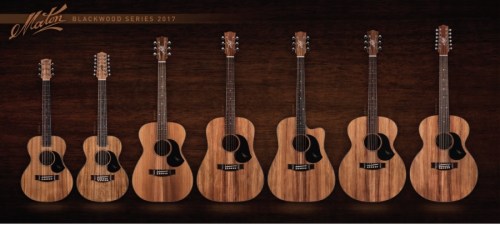
The New Maton Blackwood Series

Maton_Blackwood_Line_up_900_405_s

https://maton.com.au/product/the-maton-blackwood-series

Simplicity and purity of tone lay at the heart of the Blackwood range of Guitars.

Pure Blackwood tone -clear, bright trebles, strong mid range and full bass. The all Blackwood construction produces a unique compression, blending frequencies into a new, unique voice.

The Dreadnought Cutaway and the 808 from the New Maton Blackwood Series will be available from the 14th August 2017, the rest of the range will be available later in the year.

There were rumours of this new series of blackwood guitars earlier this year.

And here they are finally in all their blackwood glory.

As a blackwood enthusiast what can I say?

The all-blackwood acoustic guitar should be an Aussie music icon.

Cole Clark has been doing this for a few years now. And finally Maton has joined the team.

My wish is that Maton would open up and tell us the back story of where the wood comes from.

Does the guitar industry want to encourage farmers to grow more quality tonewoods?

Where does this blackwood timber come from? Who grew it? Please tell us the story so that other farmers are inspired!

This new blackwood series would be the ideal opportunity to start that journey.

In the mean time congratulations to Maton.

I hope they sell like hot blackwoods!!

When someone does a video review of these I’ll post it here.

Cheers!

So here is a video of the new all-blackwood EBW70c from Maton Guitars courtesy of The Acoustic Centre in Melbourne, Victoria:

Nice guitar!

Here’s another video from Music Junction in Melbourne:

This new Blackwood Series from Maton seems to be creating quite a stir.

Enjoy!

IST Tender Results 2016-17 addendum

https://blackwoodgrowers.com.au/2017/07/27/ist-tender-results-2016-17/

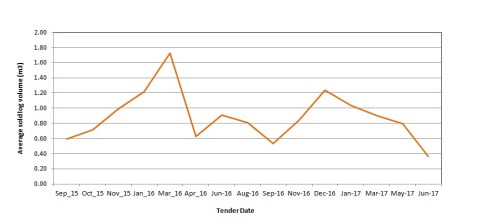
Looking at how small some of the IST tendered logs are, I thought I’d create a chart showing average sold log volume.

ISTSoldVol

For some context to this chart, the target plantation blackwood log is 1.5 cubic metres in volume (DBH 60 cm pruned to 6 metres).

So you can see from the above chart that IST sold logs are pretty small. In fact given that the chart shows the average volume, some of them are downright tiny (less than 0.1cubic metres).

That these small logs can command such high prices is quite extraordinary.

I’ll include this chart in future reports.


IST Tender Results 2016-17

ist

http://www.islandspecialtytimbers.com.au

Back in December last year I wrote my first report summarizing all tender results for Island Specialty Timbers given that IST itself provides little market information.

https://blackwoodgrowers.com.au/2016/12/13/island-specialty-timbers-tender-results/

So here is my half yearly update and financial year summary of their tender results.

A separate report looks specifically at IST blackwood tender results, given that blackwood is the only specialty timber species for which this information might have some use for market and investment purposes. No one is going to invest money based on the tender results for the other specialty species, which are too slow growing to allow for profitable investment.

https://blackwoodgrowers.com.au/2017/06/12/ist-blackwood-log-tender-results-2016-17/

Six-monthly update

The last 6 months have seen 4 IST tenders with total volume of 83 cubic metres of specialty timbers put to tender of which 58 cubic metres were sold, and total revenue of $49,100.

Financial year

The 12 months to June 2017 saw IST conduct 8 tenders with total volume of 166 cubic metres of specialty timbers of which 107.5 (64%) cubic metres sold for total revenue of $114,300.

This 166 cubic metres represents about 1% of the annual harvest of special timbers from Tasmania’s public native forests. The rest is sold at Government prices on long term sales contracts.

For harvesting the 166 cubic metres of special timbers in the year Forestry Tasmania received an additional $14,000 from Tasmanian taxpayers as compensation.

Compare this with the 3,000 tonne of specialty timbers auctioned by the Western Australian Forest Products Commission every year:

https://blackwoodgrowers.com.au/2017/05/01/special-timbers-in-western-australia/

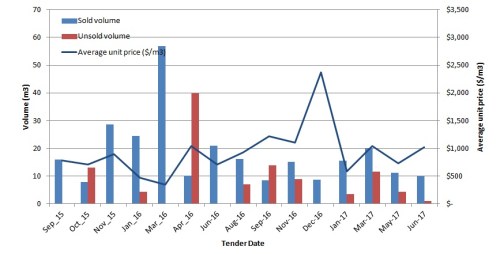
IST2017pricechart

The above chart shows the log volumes and average unit prices paid per tender.

The price spike for December 2016 reflects a tender of 7 Huon pine lots.

The highest unit price for the year was a small black heart sassafras log of 0.49 cubic metres that sold for $5,100 per cubic metre!! This is an extraordinary price for such a small log.

The highest total price paid for a log was for a Huon pine log of 1.75 cubic metres that sold for $5,160.

These results show that when subject to competitive forces even the little southern Tasmanian special timbers market can afford to pay very good prices for quality logs.

Three species attracted strong demand and high prices over the year, these being black heart sassafras, huon pine and banksia with average log prices over $1,000 per cubic metre. Celery top pine sold for an average price of $630 per cubic metre. All of these species take 400-1,000+ years to reach maturity so I suspect even these prices are cheap.

Black heart sassafras made up 25% of the successful tendered volume but made up 44% of the sales revenue. Blackwood, the dominant special timber, made up 7% of the successful tendered volume but only 5% of the revenue. Huon pine made up 20% tendered volume and 11% revenue.

Black heart sassafras, blackwood, myrtle and wattle comprised 15%, 24%, 16% and 20% respectively of unsold log volume.

The low volume and variable quality of products tendered by IST makes it difficult to draw conclusions from these results, except to repeat that quality wood is worth big money.

Remember these prices are equivalent to mill door log prices, so harvesting and transport costs are theoretically included in the prices.

And don’t forget these public native forest specialty timbers come to you courteously of an $86.27 per cubic metre direct taxpayer subsidy.

https://blackwoodgrowers.com.au/2016/11/13/special-timbers-subsidised-charade-continues/

Tasmanian taxpayers certainly have abundant generosity (and deep pockets) when it comes to the forest industry.

Unintentional path dependence: Australian guitar manufacturing, bunya pine and legacies of forestry decisions and resource stewardship

Bunya-Mountains-Bunya-Pines

Back in July last year I wrote about two academics from The University of Wollongong, NSW (Chris Gibson and Andrew Warren) who came down to Tasmania as part of a project they are working on concerning the guitar industry and its response to changes in the tonewood market.

At that time they had just published the first paper from their research:

https://blackwoodgrowers.com.au/2016/07/10/resource-sensitive-global-production-networks-gpn-reconfigured-geographies-of-timber-and-acoustic-guitar-manufacturing/

They have now published a second paper which looks specifically at the Australian industry and its use of Bunya pine (Araucaria bidwillii).

http://www.tandfonline.com/doi/abs/10.1080/00049182.2017.1336967?journalCode=cage20

Once again like the first paper, this is not an easy paper to read, containing dense academic text.

Being a forester I was already aware of the history of Bunya pine, and the trial plantings made by the Queensland Government in the early to mid 20th century on public land.

New to me was some of the history about the use of native timbers in the local guitar industry, particularly Maton and Cole Clark. Bunya pine is a major sound board tonewood for these two companies.

But the article makes clear that both these companies are now relying on the old Government Bunya trials for their supply, and the future of those trials is clearly subject to the whims of political fortune. The pressure to clear the Bunya trials and replant with the faster growing more profitable Hoop Pine is always there. Future Bunya tonewood supply hangs by a thread unless alternative supplies can be established.

BunyaPineS

Maton and Cole Clark are clearly struggling to secure and control their future tonewood supply.

It’s a complex and difficult challenge. Not the least of the challenges is that Bunya takes 60+ years to reach a size that allows soundboards to be sawn from the logs.

Unfortunately the article provides few clues as to how the problem can be resolved.

Long term thinking and commitment is needed.

Both of these companies appreciate that relying on Governments for their timber supply doesn’t work.

What we need here is a business model that encourages farmers/landowners to plant tonewoods for both commercial return and non-commercial planting. This will involve the collaboration and support of many players, especially Maton and Cole Clark. These companies are too small to have the resources to grow their own tonewoods.

Perhaps a “Tonewood Alliance” is needed to get the ball rolling?

CF Martin & Tasmanian blackwood

OM45TBc

CF Martin is possibly the name in steel string acoustic guitars in the world.

https://www.martinguitar.com/

As a tree grower, to have your product associated with the CF Martin brand is as good as it gets.

But the Tasmanian farmers who grew this wood never got that recognition and support. If they had, they might now be growing more quality tonewood.

Unfortunately the tonewood market and the guitar industry don’t work that way.

Not yet!!

Martin admits their customer base is conservative and fickle; they have a hard time introducing new tonewoods into their product range. Tasmanian blackwood has been a disappointment for them in terms of market acceptance.

Nevertheless here’s a not-so-complete summary of CF Martin’s use of Tasmanian blackwood.

For those unfamiliar with Martin’s product codes, the OM is an Orchestra Model body shape/size and D is for Dreadnought body shape; the 42/45 designates the amount of bling (abalone and other exotica) on the guitar with “45” being bling-max!

Eight months after Taylor Guitars first introduced Tasmanian blackwood into their Limited Editions, CF Martin also introduced blackwood into their Limited Edition models at the 2005 Summer NAMM Show. And whilst Taylor went for a more affordable market, Martin went for the top shelf market.

These are rare premium guitars from a premium builder!

https://blackwoodgrowers.com.au/2017/02/17/2004-fall-limited-editions-when-taylor-guitars-first-introduced-tasmanian-blackwood/

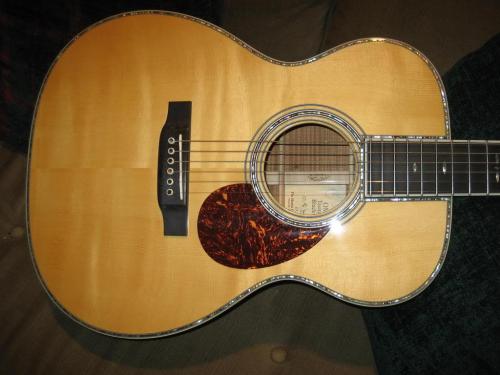
2005 OM-45 Tasmanian Blackwood (The Sounding Board Vol. 19 p. 8)

The OM-45 Tasmanian Blackwood NAMM Show Special is tonally enhanced with an extremely rare flamed Engelmann spruce soundboard, and bookmatched back, sides and headplate of highly flamed Tasmanian blackwood. Special appointments include fossilized ivory bridge pins and endpin, Style 45 abalone trim with a boxed endpiece, Style 45 snowflake fingerboard inlays, gold plated Waverly hand-engraved tuning machines, a modified torch headstock inlay nested beneath the C. F. Martin & Co. logo inlaid in abalone, and a premium Accord case. This NAMM Show Special will be limited to no more than thirty instruments. Dealers may only place orders in person during the 2005 Indianapolis NAMM Show.

Here’s a link with some images of the OM-45 TB:

http://acousticguitarforum.com/forums/showthread.php?t=287129
OM45TB

2010 D-42 Tasmanian Blackwood (The Sounding Board Vol. 29 p. 11)

Once again, Martin has produced a NAMM Show Special guitar which truly lives up to its “special” designation – the D-42 Blackwood. Backs and sides of this exquisite instrument are crafted of flamed Tasmanian Blackwood, a close relative of Hawaiian Koa both in looks and tone, and which grows primarily on the island of Tasmania off the southeast coast of Australia. Its tone is clear and bright and highly reflective, a perfect match for the D-42’s Adirondack (Red Spruce) top, prized for its resonance and big, open bass voice. Top braces, also Adirondack, are carefully scalloped and tapered. The small maple bridgeplate is typical of Golden Era 30s Martins. As a special touch, European flamed maple is used for the top binding, fingerboard binding, heelcap and endpiece. The entire top perimeter and fingerboard extension are inlaid with colorful heart abalone pearl as is the style 45 rosette. A polished and beveled Delmar tortoise pickguard accents the pearl binding. Ebony fingerboard (inlaid with Golden Era snowflake, cats eye & concave squares) and bridge (with long bone saddle). “Alternative” flower pot headplate inlay. Only 10 of these unique guitars will be offered. Orders will be taken only at the Summer NAMM Show.

Here’s a link with some images of the D-42 TB:

http://theunofficialmartinguitarforum.yuku.com/topic/103988#.WOHlJtKGNdg


2011 OM-42 Tasmanian Blackwood (The Sounding Board Vol. 31 p. 27)

We should have called OM-42 Tasmanian Blackwood NAMM Show Special the “Show Stopper!” This magnificent 14-fret, longscale (25.4″), Orchestra Model exemplifies the very best that Martin has to offer the discriminating collector and player. For starters, back and sides are crafted of rare flamed Tasmanian blackwood from Eastern Australia. Visually, it’s similar to premium figured Hawaiian koa. Tonally, it shares the brightness of koa but with the rich overtones of rosewood, giving it a unique and very balanced voice. With its solid Adirondack spruce top and 1/4″ scalloped “Golden Era” braces, it’s also got a big voice, with plenty of volume when you need it. Finger-picking or rhythm, this is your guitar. In the 42-style, the top, rosette and fingerboard extension are inlaid with colorful Paua pearl. Martin’s early (and rarer) “alternate” pearl torch design is inlaid into a polished ebony headplate. The ebony fingerboard is likewise inlaid with “Golden Era” snowflakes. A vintage 1930s ebony “belly” bridge features long bone saddle, bone bridge pins (and end pin) with pearl dots. European flame maple top binding, heelcap and endpiece. Gold engraved Gotoh tuners. Modified V neck, of course. Only 15 of these beautiful instruments will be offered, each personally signed by C. F. Martin IV and numbered in sequence. Exquisite. Resonant. And oh-so-limited.

Here’s a link with some images of the OM-42 TB:

https://artisanguitars.com/2011-martin-om-42-limited-edition-adirondack-and-tasmanian-blackwood-5-8-id-6647

2011 was the last time Tasmanian blackwood featured on a Martin Limited Edition guitar. Perhaps aiming at the top shelf market wasn’t best way to introduce a new tonewood into the market.

In addition to these limited release NAMM Show Specials Martin continues to produce the occasional custom model featuring Tasmanian blackwood, some of which have featured on this website over the years, including the Martin Custom Shop 018-T-Tasmanian Blackwood and the Martin Custom CEO7 Tasmanian Blackwood.

https://blackwoodgrowers.com.au/category/cf-martin-guitars/

With CF Martin’s focus on FSC as their lifeline to a sustainable future, Tasmanian blackwood will have a hard time staying in Martin’s tonewood catalogue. There is currently no FSC certified Tasmanian blackwood available anywhere, and this is unlikely to change in the foreseeable future. The best chance of FSC Blackwood will come from New Zealand as farmers there ramp up production over the coming years.

https://blackwoodgrowers.com.au/2017/03/28/c-f-martin-guitars-sustainable-tonewoods/

Tasmanian blackwood needs lots of market support to reach the stage where it may be possible to achieve FSC certification. It’s up to the market to build a sustainable future for Tasmanian blackwood. The FSC won’t achieve that by itself.