Category Archives: Island Specialty Timbers

IST Blackwood Sawlog Tender Results 2014-15

IST 0515 log 16

Here is a summary of blackwood sawlog tender results from Island Specialty Timbers (IST) for the 2014-15 financial year.

http://www.islandspecialtytimbers.com.au

This follows my inaugural report last year:

http://blackwoodgrowers.com.au/2014/06/14/blackwood-sawlog-tender-results-2013-14/

During the year 14 lots of blackwood logs were put to tender by IST. These were individual logs except for two parcels of small logs in the October 2014 and January 2015 tenders. Only one log was unsold for the year from the August 2014 tender.

Total volume of blackwood logs sold was 31.06 cubic metres (or approximately 0.3% of the total volume of blackwood logs sold by Forestry Tasmania for the year) for a total value of $20,660.

Plain grain logs in 3 lots totalling 18.7 cubic metres sold for an average volume-weighted price of $227 per cubic metre.

Feature grain logs totalling 12.4 cubic metres sold for an average volume-weighted price of $1,325 per cubic metre.

These good prices were achieved despite many of the lots having quality issues (spiral grain, flutes, branch stubs, small diameter). Some of the lots could best be described as craft logs.

This compares with the special timbers average mill door log value of $134 per cubic metre that Forestry Tasmania received in 2013/14.

There was such a variety of log grades and qualities in these 14 lots that for analysis and summary I’ve grouped the logs into just plain and feature grain, as these seem to be the main determinants of price.

In general logs sold by IST are smaller and with more defects compared to logs sold under long-term contract to favoured customers. They do not represent average “run-of-the-bush” quality logs.

Table 1 summarises the tender results.

  Lot count Average of SED (cm) Average of Len (m) Average of Vol (m3) Sum of Vol (m3) Average of Unit Price ($/m3) Total Price ($)
Plain 3 44 5.9 1.0 18.67 $302 $4,244
Figured 10 60 3.9 1.2 12.39 $1,280 $16,420
Sold 13 57 4.3 1.1 31.06 $1,054 $20,664
Plain 1 69 2.4 1.2 1.20
Unsold 1 69 2.4 1.2 1.20

The highlights for the year were:

  • One small feature-grain log that sold for a unit value of $2,400 per cubic metre in the January 2015 tender, and
  • A log (1.6 cubic metres) that sold for $3,260 ($2,000 per cubic metre) in the February 2015 tender, which contained some feature grain but also had significant quality issues (sweep and spiral grain).

The lowest unit price for the year was achieved by the parcel of 13 small plain-grain logs in the October 2014 tender. This parcel totalled 10.1 cubic metres in volume, with average dimensions SED 42cm, LED 47cm, Len 5.0m, vol 0.78 cubic metres. This parcel sold for $200 per cubic metre.

Only one of the logs tendered approximated in size and quality what might be grown in a well managed blackwood plantation. This was Lot 20 in the March 2015 tender that sold for $620 or a unit price of $485 per cubic metre. This is a very good price and puts the value of a blackwood plantation at harvest at well over $100,000 per hectare!

Are any Tasmanian farmers interested?

In 2013/14 IST sold a total of 1,531 cubic metres of product including 136 cubic metres sold through the tender process “to ensure that the best possible prices were obtained” (Forestry Tasmania 2013/14 Annual Report). Only 16.1 of the 136 cubic metres (12%) was blackwood, despite the fact that blackwood comprises 80% of the special timbers harvest annually. I wonder how much of the 1,531 cubic metres of product was blackwood? We will never know. Frustratingly Forestry Tasmania don’t tell us how much the 1,531 or the 136 cubic metres sold for.

These tender results represent the only publically available competitive market prices for blackwood sawlogs. Given that blackwood is the only Tasmanian specialty timber that has the potential to have a commercial future these prices are important in alerting Tasmanian farmers and the wider community to the commercial opportunity that is available.

One thing that is clear from watching the regular IST tender results, the special timbers market is capable of paying extremely high prices for quality special timber logs as evidenced by the massive $5,900 per cubic metre paid for a tiger myrtle log at the April tender.

Caveats:

  1. Island Specialty Timbers (IST) is an enterprise of Forestry Tasmania established in 1992 to increase the recovery, availability and value of specialty timbers from harvesting activities in State forests.
  2. Forestry Tasmania manages its special timbers operations (including IST) as a taxpayer-funded, non-commercial, non-profit, community service.
  3. Note that all logs and wood sold by IST comes from the harvesting of public native old-growth forest and rainforest certified under AFS (PEFC).
  4. It is unlikely that this tiny set of market-based blackwood log prices is representative of the broader blackwood market.
  5. The dataset is too small to allow any analysis or correlations to be made between price and log quality apart from the obvious result that feature-grain logs attract a significant price premium over plain-grain.
  6. Remember also these tender prices are effectively mill door prices that already include harvesting and transport costs. They are not stumpage prices.

It would improve market transparency and stimulate greater investor interest if IST would tender more blackwood logs and demonstrate real commercial focus. Increasing the blackwood volume tendered to even 100 cubic metres per year would be a good start.

But whilst Forestry Tasmania, the State government and the State parliament all regard the special timbers industry as a community service and political play-thing rather than any commercial opportunity, then blackwood’s commercial future remains difficult.

When will Tasmania get a fully commercial, profitable forest industry, based on profitable tree-growing?
Blackwood Sawlog Tender Results 2013-14

images2

Here’s a summary of tender results for blackwood logs sold by Island Specialty Timbers (IST) for the 2013-14 financial year. In the absence of any IST Market Report or any better market information, this small dataset is as good as it gets.

Island Specialty Timbers, an enterprise of Forestry Tasmania, was established at Geeveston in 1992 to increase the recovery, availability and value of specialty timbers from harvesting activities in State forests.

Unfortunately this laudable “mission statement” is not translated into anything concrete or measureable like a business plan. Are these objectives being achieved? What are the measurable performance criteria? How has performance changed over the years? Unfortunately IST does not produce any annual reports, market reports or sales summaries. Also Forestry Tasmania does not report separate financial results for its special timbers activities including IST. So while the “mission statement” is couched in pseudo-commercial language, unfortunately IST exhibits all the hallmarks of a politically motivated public relations exercise.

How do special timbers contribute to Forestry Tasmania’s profitability?

Such a non-commercial, anti-competitive environment makes it difficult to convince farmers that the forest industry is about business and not politics.

It is also curious that although over 80% of the volume of special timbers sold by Forestry Tasmania is blackwood, blackwood makes up only a minor component of the volume of logs tendered by IST every year.

Note that all of the logs and wood sold by IST comes from the harvesting of public native forest. Remember also these tender prices are effectively mill door prices that already include harvesting and transport costs. They are not stumpage prices.

Still I am grateful for the small scraps of commercially useful information that IST provides. This is my attempt to summarise these scraps for the past 12 months.

Summary

For the year 2013-14 a total of 12 blackwood logs were put up for tender by IST. Three of these logs, including the single log in the June 2014 tender, failed to sell. The total value of blackwood logs sold at tender for 2013-14 by IST was $20,800.

The highlight for the year were two very large tear-drop grain logs from the one tree which sold for $9,600 and $7,500 ($2,900 and $2,750 per cubic metre respectively) or a total of $17,100 for 6.04 cubic metres of log from the one exceptional tree. The combination of feature grain, good log quality and large size clearly attracts a significant price premium.

With such incredible prices the obvious question is can blackwood of this size and quality be grown on private land? There are a few key issues that need to be discussed:

Size

The butt log from the above tree had a diametre of over 1 metre, with a total combined merchantable length of 9 metres. Even at the top of the top log the diameter was 83 cm! That is a big blackwood by anyone’s reckoning. Such a log could really only be grown in a (public or private) native forest environment. So yes! Private native forest could be managed to grow blackwood of this size and value given enough time and good management. The goal in blackwood plantations is to produce trees with a diameter at breast height (dbh) of 60 cm in about 35 years. It would take at least 50-60 years to grow a 1 metre diameter blackwood even in a fast-growing environment.

Figured grain

The other key factor with the above logs was the tear-drop grain. Figured grain of any sort is relatively rare in blackwood, tear-drop grain being more rare than fiddleback. Little research has been done on figured grain in trees anywhere in the world. My own belief is that it is both genetic and physiological in origin. Just about all trees have some fiddleback in their stumps as a response to physiological stress. If figure has a genetic component to its origin then there is the potential for cloning. I know a few people in Tasmania who have spent time trying to clone blackwood fiddleback. If feature grain can be cloned then the prospects for commercial blackwood growers improve dramatically. But cloning will only happen within the context of a private blackwood growers industry.

Plain-grain logs

Seven (7) plain grain blackwood logs totalling 10.0 cubic metres sold at tender during the year for a mean of $390 per cubic metre, or a volume-weighted mean of $370 (see Table 1). Some of these logs may be considered equivalent to those grown in commercial blackwood plantations. Logs ranged in size from 0.57 to 3.46 cubic metres, with the smallest log attracting the biggest unit price of $600 per cubic metre!

TABLE 1

  Number Average of SED (cm) Average of Len (m) Average of Vol (m3) Sum of Vol (m3) Average Unit Price ($/m3) Sum of Value ($)
Sold 7 59 4.1 1.4 10.05 $390 $3,707
Unsold 3 59 4.5 1.5 4.35
Plain Total 10 59 4.3 1.4 14.40 $390 $3,707
Sold 2 88 4.5 3.0 6.04 $2,825 $17,107
Tear drop Total 2 88 4.5 3.0 6.04 $2,825 $17,107

Notes: SED is log small end diameter, Len is log length, Vol is average log volume.

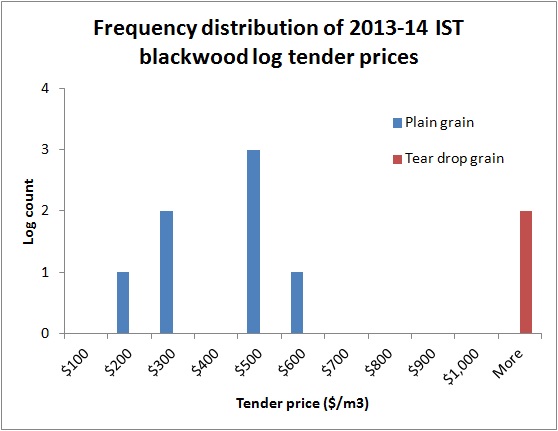
Figure 1 shows the frequency distribution of prices for the blackwood logs sold. For plain grain blackwood logs prices ranged from $180 to $600 per cubic metre. With a mean sale price of $390 per cubic metre, blackwood is attracting a similar price to good quality pruned Macrocarpa cypress sawlogs in New Zealand (see Allan Laurie’s great website). This is surprising given the long heritage of blackwood in the market compared to Macrocarpa which is a relative newcomer to the premium timber market. I have yet to see any equivalent mill-door prices for New Zealand grown blackwood.

FIGURE 1

IST price histogram

The dataset was too small to allow any analysis or correlations to be made between price and log quality for the plain grain logs. The fact that the very large 3.5 cubic metre log from the April tender, by far the biggest plain grain log for the year, sold for only $430 per cubic metre indicates that log size by itself does not necessarily attract a price premium.

It seems unlikely that this tiny set of market-based blackwood log prices is representative of the broader blackwood market, given that they represent just 0.18% of the annual blackwood harvest (excluding the unknown volume sold from private property). I suspect the IST tenders attract only a very limited range of small, custom buyers with limited purchasing power.

It would certainly improve market transparency and stimulate greater investor confidence if IST would tender more blackwood and demonstrate real commercial focus. Increasing the blackwood volume tendered to even 100 cubic metres per year would be a good start. At a bare minimum IST could produce an annual summary of tender results.

In the mean time I look forward to providing another summary of IST blackwood tender results next year.

At $390 per cubic metre a mature blackwood plantation is still valued at over $100,000 per hectare!

Now how do I get Tasmanian farmers interested?

Premium blackwood sawlog sells for $9,600!!

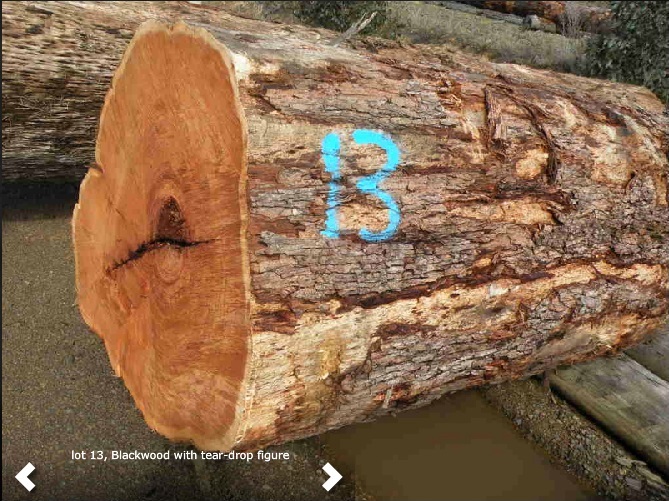
The results of the Island Specialty Timbers October auction have been posted. Lot 13 didn’t quite make the magic number of $10,000 as I had hoped but came very close at $9,600. On a cubic metre basis the log sold for $2,900, $200 per cubic metre more than the head log at the August tender.

That’s a total of $17,000 for the two logs totalling six (6) cubic metres from the one tree! An extraordinary price for one extraordinary blackwood tree.

Here’s a description of the Lot 13:

Lot 13

Will this blackwood sawlog sell for over $10,000?

IST described the October tender price results as “sensible, fair prices” which is a very odd thing to say.

Anyway it was a fantastic result!

One reason this log achieved such a great price was the tear drop figured grain. Feature grain in any quality log such as fiddleback or tear drop will improve the market value significantly. While little research has been done into the origins and causes of feature grain in any species, it is generally believed that this trait is at least under partial genetic control. This means it can potentially be cloned.

But cloning of feature grain blackwood (like Lot 13) will only happen within the context of a profitable, commercially driven blackwood growers cooperative. There is no point cloning feature grain blackwood unless you can grow the stuff in profitable plantations. The sooner we get Tasmanian farmers growing commercial blackwood the sooner we can start thinking about cloning tear drop and fiddleback blackwood.

The two plain grain logs in the October tender (lots 11 and 12) went for good prices although the logic behind the prices seems contrary. The larger log (lot 11) sold for $300 per cubic metre while the smaller log (lot 12) sold for $600 per cubic metre!! Was there a typo or a data entry error? It makes no sense, unless there was some quality aspect in the larger log that was not properly reported. Either way the results were good, and indicates that plain grain blackwood logs are attracting good prices. At $300 per cubic metre a well managed blackwood plantation would be worth $90,000 per hectare after 30-35 years. And at $600 a hectare of plantation would be worth……..

Anyone interested?

Will this blackwood sawlog sell for over $10,000?

Not content with breaking the blackwood sawlog price record at their August tender, Island Specialty Timbers have saved the best til last. It turns out that the record breaking August sawlog was just the head log from what must have been a truly magnificent blackwood tree. The butt log from this same tree is now up for tender at IST Geeveston – lot 13. Tenders close 22nd October 2013.

Lot 13

Here’s the description of this log:

Lot 13, Blackwood, figured.  A fresh, very large diameter log with little taper, excellent dark colour and tear drop figure.  This is the butt log from below log 3 sold in the August tender. One of the best logs offered in an IST tender!  Length 4.4 metres, butt diameter 103 cm, head diameter 93 cm, volume 3.31 cubic metres, weight about 3650 kg.

This butt log is of similar length to the August sawlog but has 20% more volume, so the potential sawn recovery will be very high. The August sawlog went for $2750 per cubic metre for a total value of $7,500. What will this massive sawlog sell for?

The October IST tender also includes two other blackwood sawlogs amongst the 22 lots, one of which equates in size and quality to what might be grown in a blackwood plantation (lot 11). It will be interesting to see what price this log achieves.

Blackwood is the only Tasmanian special species which has the potential to be grown commercially and profitably by Tasmanian farmers in either plantations (like NZ farmers) or through better management of existing on-farm blackwood. While sawlogs of this quality are not common, the prices being achieved should be gaining interest amongst the rural community. Clearly the market for premium appearance grade timber is very much alive and in good health. When will the Tasmanian rural community wake up to the opportunity?

Record price achieved for premium blackwood sawlog at IST tender

The August tender of special timbers at Island Specialty Timbers achieved a record price for a blackwood sawlog. Described by IST as possibly the best blackwood log ever offered for tender at IST Geeveston, the log achieved a price of $2750 per cubic metre for a total value of $7,500!!

Here is the description of the log from IST:

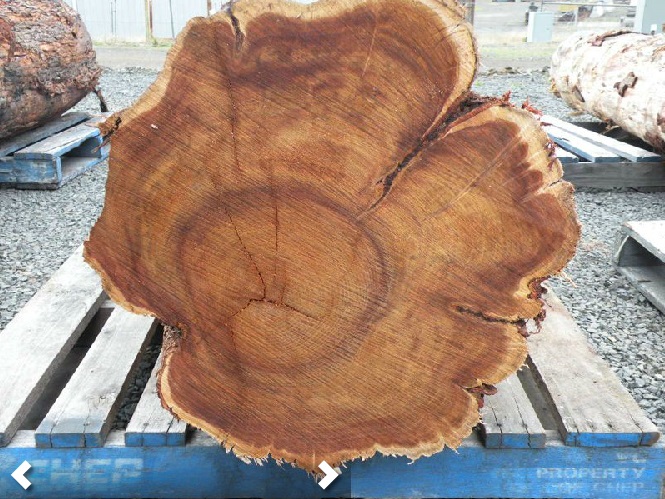
A large diameter fresh log with dark wood, tight grain and tear-drop figure affecting its full length.  Probably the best blackwood log offered for tender at IST Geeveston.   Length 4.5 m, butt diameter 93 cm, head diameter 83 cm, volume 2.73 cubic metres, weight about 2000 kg. 

The log had two important attributes that contributed to its premium price: very large size, and tear-drop grain figure. Tear-drop is a relatively rare feature grain.

The other blackwood log sold at the August tender was a standard grade log with plain grain that achieved a good price of $420 per cubic metre. This log was of equivalent size and quality to what would be achieved in plantation grown blackwood. At these prices blackwood plantations are a good investment.

Blackwood plantations produce approximately 300 cubic metres of premium sawlog per hectare, which at $420 per cubic metre equates to approx. $120,000 per hectare at harvest in 35 years!! Is anyone interested?

There is also some evidence that figured grain is under at least partial genetic control which means that tear-drop grained blackwood could potentially be cloned. But this will only happen with private blackwood investment. At $825,000 per hectare in 35 years that seems like a reasonable investment!

The other tender result worth noting was the price paid for a high quality blackheart sassafras log of $5,000 per cubic metre!! Unlike blackwood, sassafras cannot be domesticated as a commercial species. But the result clearly demonstrates the ability of the specialty timbers market to pay very high prices for quality sawlogs.

Clearly the market for premium appearance grade timber is very much alive and in good health.