
It’s time for my annual summary of Island Specialty Timbers (IST) log tender results.
http://www.islandspecialtytimbers.com.au/
This is the only competitive market forest log price data publically available anywhere in Australia.
General
During the year Island Specialty Timbers conducted 7 tenders putting a total of 154 cubic metres of special species logs, craftwood and sawn wood to tender.
Total sold volume was 99.8 cubic metres (65%).
Total tender revenue was $90,900.

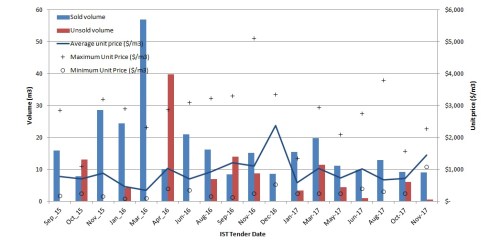
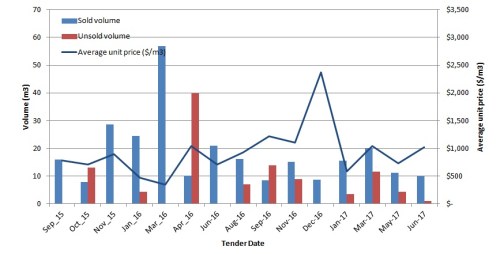
The above chart shows the log volumes and log prices paid per tender. Craftwood and sawn wood are not included in this chart.
The large volume of unsold logs at the April 2018 tender was mostly due to a large parcel of Silver wattle (Acacia dealbata) logs.
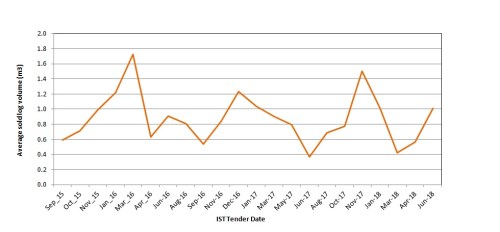
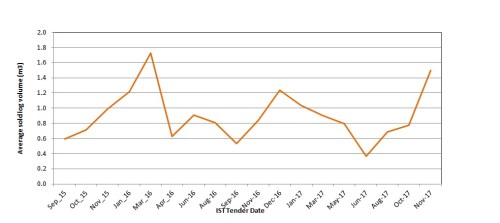
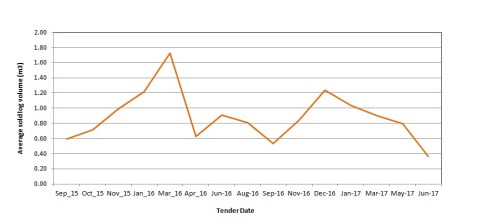
The above chart shows the average volume of logs sold at tender by IST. For some context to this chart, the target plantation blackwood log is 1.5 cubic metres in volume (DBH 60 cm pruned to 6 metres). So it can be seen most of the IST logs sold at tender are small to very small in size.
The highlights for the year were a) a tiny black heart sassafras log (1.1m length, 30 cm small end diameter, 0.07 cubic metres volume) that sold for $3,800 per cubic metre. Indeed at this August 2017 tender 5 small BH sassafras logs totalling 0.54 cubic metres sold for a total of $2,025; and b) a very large huon pine log (4.3 cubic metres) sold for a total $4,623.
Two species attracted strong demand and high prices during the year, these being black heart sassafras (BHS) and huon pine, with average log prices well over $1,000 per cubic metre. BHS and huon pine made up 21% and 13% respectively of the sold volume. Blackwood and feature eucalypt/tas oak were the other major sellers at 18% and 23% of sold volume.
In fact 2 tear-drop grain tas oak logs sold for over $1,700 per cubic metre, an extraordinary price for a wood that the market generally regards as a cheap commodity.
Celery top pine sold for an average $580 per cubic metre (3.7 cubic metres total sold).
Silver wattle and blackwood made up 76% and 15% respectively of the unsold volume for the year.
So what can we say with three years of IST tender results in the chart?
Answer: Not much!
There is no apparent trend in price over the last 3 years. Sure the volumes are small, the market is restricted and the quality of produce is highly variable.
What can be said is that even given these limitations the market will pay very good prices for quality wood when it wants to, with maximum prices averaging $3,000 per cubic metre, even for tiny logs!
These tendered log volumes represent less than 1% of the special timbers annual harvest, and a mere 0.01% of the wood harvested annually from public native forest in Tasmania. The rest is sold at Government (non-market) prices on long term, perpetual sales contracts.
According to Forestry Tasmania’s Annual Report in 2016/17 IST sold a total of 829 cubic metres of product [tender and direct sales]. The annual report does not give separate accounts for IST so their income and costs are unknown.
Blackwood
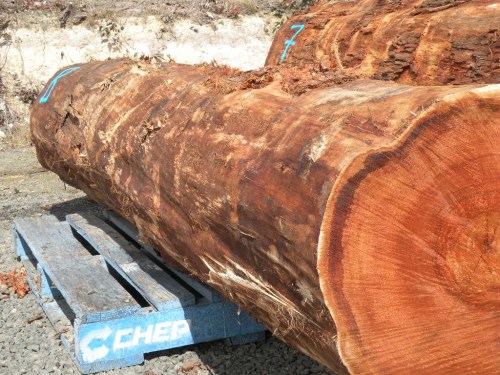
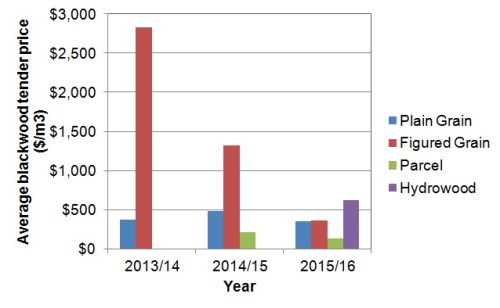
In general the IST tender results provide little information that is useful to the marketplace with the exception of blackwood. Tasmanian blackwood is the only Tasmanian “special species” that has the potential to be grown commercially; the other species being too slow growing.
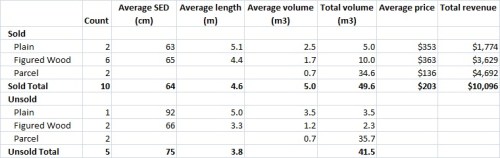
Sixteen blackwood logs (23.5 cubic metres) were put to tender in 2017-18 of which 10 were sold (16.3 cubic metres) for a total of $12,210.
Five of the sold logs (7.6 cubic metres), described as having figured grain, sold for a total of $7,460. These logs averaged 5.2 metres length, 57 cm small end diameter and 1.5 cubic metres volume.
The 5 plain grain logs (8.7 cubic metres) sold for a total of $4,754, an average price of $545 per cubic metre. These five logs averaged 6.0 metres in length, 54 cm small end diameter and 1.7 cubic metres volume. In other words these were good size, quality logs equivalent to what can be grown in a well managed blackwood plantation, which would produce approx. 300 cubic metres of high quality sawlog per hectare at harvest.
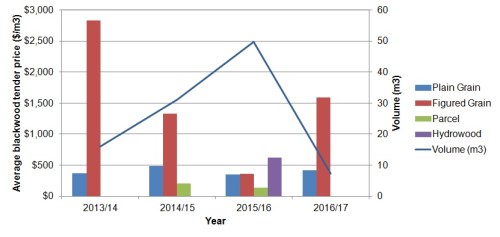
This is a very good price and a substantial increase on the last three years.
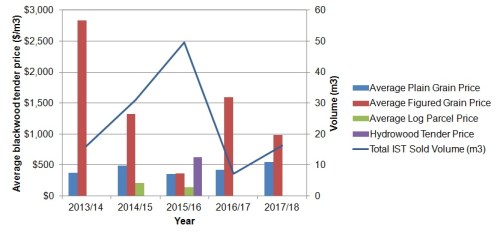
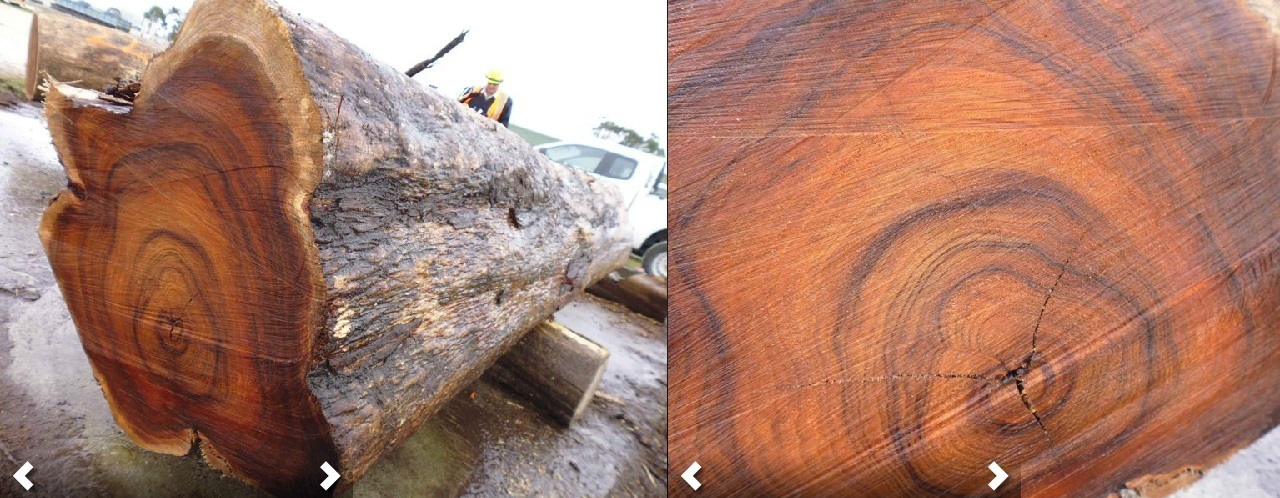
The stand out blackwood results for the year were a) $1,300 per cubic metre for a 1.76 cubic metre log containing tear-drop figured grain, and b) $2,467 total price for a very large (2.53 cubic metre) figured log.
The unsold blackwood logs consisted of a) one huge figured grain log measuring 5.7m length 75 cm small end diametre and 3.4 cubic metre volume, and b) 5 plain grain logs averaging 4.3 metres length, 46 cm small end diameter and 0.8 cubic metres volume.
Remember these are tiny volumes in a small market (southern Tasmania). Whether they represent the broader blackwood market is unknown.
Remember these prices are “mill door” equivalent prices with harvesting and transport costs already “included”. They are not stumpage prices.
Also remember that Sustainable Timbers Tasmania/IST is a taxpayer funded community service organisation bringing these timbers to market from Tasmania’s public native oldgrowth and rainforests:
Tasmanian regional forest agreement delivers $1.3bn losses in ‘giant fraud’ on taxpayers





 Tasmanian Blackwood Growers Cooperative
Special Timbers in Western Australia
Forest Products Commission (FPC) of Western Australia (the Government forest agency) puts all special timbers that come from Crown land and State forest to public auction. The objective is not for the Forest Products Commission to maximise revenue (unfortunately that is not one of their corporate objectives), but to be impartial in terms of who gets access to the limited resource, and attempt to ensure some kind of fair market price is paid. I’m guessing much of this because the FPC actually tells us very little about their special timbers operations.
http://www.fpc.wa.gov.au/timberauctions
http://www.fpc.wa.gov.au/speciality-timbers-go-under-hammer
There are generally four auctions per year, the first for 2017 is this Saturday the 6th of May. Over 100 lots are to be auctioned this Saturday totalling over 1,000 tonnes of specialty woods.
Here’s the auctioneers website:
https://www.auctions.com.au/auctions/2017/05/06/wa-log-burl-burl-slices-craft-packs-and-slabs-auction.html
Western Australia doesn’t have a Special Timbers Management Plan. Whatever wood is salvaged from other activities on Crown Land and State forest is what special timbers are available and that’s it.
There are no taxpayer subsidies (that I can see anyway) and no logging of parks and reserves just to pander to the wood craft people.
In 2016 FPC auctioned approximately 3000 tonnes (approx. 3,000 cubic metres) of specialty timbers. That’s 150 truckloads of specialty timbers. Compare that with just 200 cubic metres tendered by Island Specialty Timbers/Forestry Tasmania last year.
The FPC is reluctant to talk about their specialty timbers operations, apart from announcing the auction dates. Here is the sum total of what the last FPC Annual Report had to say:
Local buyers bid keenly for a variety of Goldfields timbers for musical instruments, wood turning projects and unique pieces of furniture. Wood from this region is difficult to access, and bidders at the auction were impressed by the bold colours and patterns found in the timber.
Also on offer was a selection of South West native forest specialty feature timbers including marri, blackbutt and sheoak.
That’s it!!
Just some motherhood statements!!
No discussion about sales highlights, market conditions, total volume sold or total revenue.
If the FPC wanted to engage with stakeholders and the general public this would be a great opportunity. Apparently not!!
Like Forestry Tasmania the Forest Products Commission is not run as a commercial business but as a community service to achieve political objectives. Being a profitable tree grower is not the vision of either of these public forest managers.
Remember the only basis for a successful forest industry is profitable tree growers and public auctions are a great way to maximise profitability and create greater market transparency.
Leave a comment
Posted in Commentary, Island Specialty Timbers, Markets