Category Archives: Forestry Tasmania

Draft TWWHA Management Plan Representation

Tasmanian State forest industry policy continues to be highly politicised, divisive, destructive and costly to taxpayers.

The Draft Tasmanian Wilderness World Heritage Area Management Plan is just such a case in point with the plan by Government to start logging the WHA for special timbers. I wouldn’t care if it was gold or diamonds. The idea is just rubbish.

Here’s my submission to the Plan review. It’s not at all complementary. I could have said a lot more but this will do for beginners.

Cheers!

DTWWHAMP

Dear Project Team,

http://dpipwe.tas.gov.au/conservation/tasmanian-wilderness-world-heritage-area/new-tasmanian-wilderness-world-heritage-area-management-plan

Special Species Timbers

As a forester and member of the forest industry for the past 35 year my representation is entirely confined to the issue of special species timbers harvesting as it is mentioned in the DTWWHAMP.

I will make my representation as clear and concise as possible since the issue of special timbers in Tasmania is so hopelessly clouded by confusion, passion and misguided policy and ideology.

It’s time for Tasmania to get real! Forestry (including special timbers) is business. It’s about commerce and profits. It is not community service or the provision of Centrelink services. And it is certainly not about wedge politics and crony capitalism.

1. The first mention of special timbers in the DTWWHAMP is on page 28. Special timbers harvesting is listed as an allowed activity in Conservation Areas and Regional Reserves.

So why is special timbers harvesting listed as a sustainable use in Conservation Areas, but only a controlled use in Regional Reserves? How are sustainable use and controlled use defined? Why the difference in use between the two reserve types? What other natural resources besides special timbers can be used in these reserve classes, or are special timbers the only resources available for use?


Reserve Class Purpose of Reservation


Conservation Area The protection and maintenance of the natural and cultural values of the area of land and the sustainable use of the natural resources of that area of land including special species timber harvesting.
Regional Reserve Mineral exploration and the development of mineral deposits in the area of land, and the controlled use of other natural resources of that area of land, including special species timber harvesting, while protecting and maintaining the natural and cultural values of that area of land.


2. The second mention of special species timbers is on page 74 where the zones where special species timber harvesting is allowed are listed – all zones except Visitor Services Zones.

Activity Visitor Services Zone Recreation Zone Self-Reliant Recreation Zone Remote Recreation Zone
Extraction of special species timber (in regional reserves and conservation areas only. Not including Huon pine salvage from the Gordon River area) Prohibited Permitted by authority or a licence issued by the Minister in accordance with the NPRMA Permitted by authority or a licence issued by the Minister in accordance with the NPRMA Permitted by authority or a licence issued by the Minister in accordance with the NPRMA


3. The third and final mention of special species timbers in the DTWWHAMP is in section 3.6.2 on page 81 where the main discussion on special timbers harvesting is located.

3.6.2 Huon Pine Salvage and Special Species Timber

The salvage of Huon pine from the shoreline of Macquarie Harbour pre-dates the declaration of the TWWHA. The activity is permitted under a longstanding arrangement between the PWS and Forestry Tasmania. Most of the timber originates from the Gordon River and is sourced from trees that were cut down many decades ago during the height of the pining activities in the western rivers that are now in the TWWHA. Salvage operations, which occur mostly in response to flooding in the Gordon River catchment, make an important contribution to supplies of this rare and valuable timber, and are important for the economy of the region. Only commercial salvage is permitted and it must be in accordance with the PWS-Forestry Tasmania agreement, which is reviewed every five years. Salvage operations will be considered by the RAA process and any other applicable assessment and approval process.

The objectives of regional reserves and conservation areas, as set out in Schedule 1 of the NPRMA, provide for the harvesting of special species timber. Special species timber is defined within the Forestry (Rebuilding the Forestry Industry) Act 2014 and includes blackwood (Acacia melanoxylon), myrtle (Nothofagus cunninghamii), celery-top pine (Phyllocladus aspleniifolius), sassafras (Atherosperma moschatum), huon pine (Lagarostrobos franklinii), silver wattle (Acacia dealbata) and timber of any other species or timber with particular properties as may be prescribed through the associated regulations. Extraction of special species timbers will be considered through the RAA process and any other assessment and approval process or applicable legislative process.


Over 50% of section 3.6.2 discusses in the most general terms the current salvage of Huon pine from the shores of Macquarie Harbour. A number of unsubstantiated claims are made about this resource and its importance/significance. No supporting data is provided. These operations are undertaken in accordance with some PWS-FT agreement document. This agreement document is not referenced nor is it available to the public. Why not?

The remaining 100 words of section 3.6.2 tell us that special timbers harvesting is provided for under Schedule 1 of the NPRMA, and will be considered through the RAA and any other assessment and approval process as required!! Relevant special species available for harvesting are listed, along with any other species or timber with particular properties.

It is difficult to imagine a more opened ended and uninformative a statement as this. It serves no practical purpose whatsoever.

The 2014 Forestry Tasmania Draft Forest Management Plan provides us with a bit more information about special timbers management in Tasmania:

“The Forestry (Rebuilding the Forest Industry) Act requires the Minister for Resources to cause a special species management plan to be made before October 2017. The special species plan will specify the land to which it applies, the supply level of each species of special species timber in relation to the land, and take into account the management of conservation and cultural heritage values of the land.

Forestry Tasmania indicates its planned annual supply of special species timbers in its Three Year Wood Production Plan, which is updated annually. Forestry Tasmania’s future management of special species timbers from PTPZ land will be informed by the special species management plan when it becomes available.” Forestry Tasmania will not be involved in any way with any special timbers harvesting outside the PTPZ.

In other words special timbers management in Tasmania is in chaos! Forestry Tasmania is scaling down its special timbers commitments in line with its diminished capacity to supply. And a Special Species Management Plan won’t be available until the next Tasmanian State election in 2017!

The DTWWHAMP contains no statement of Government special timbers policy, no guarantees of any assessment, management or performance standards at all. Nothing but silence. It appears that this major change in TWWHA management is to be taken entirely on trust.

In summary the DTWWHAMP tells us virtually nothing about the existing special timbers salvage that does occur in the WHA, and tells us even less about the planned expansion of special timbers logging in the TWWHA. Given the bitter, long and ongoing conflict in Tasmania around the so-called commercial management of public native forests the special timbers provisions within the DTWWHAMP are entirely inadequate.

The subject of special timbers harvesting is of such enormous significance to the future of Tasmanias Wilderness World Heritage Area it is worthy of an entire chapter in the DTWWHAMP in its own right it.

As an absolute minimum if special timbers logging must go ahead (against all logic and reason) it should not proceed until the management plan and harvest operations have received Forest Stewardship Council (FSC) Certification, to guarantee forest operations are of the highest possible standards (as befitting a World Heritage Area) and meet with clear majority community support.

Completely inadequate is the only way to describe the special timbers provisions of the DTWWHAMP. Not at all worthy of the high standards of the World Heritage Convention. A thorough and complete rewrite is recommended.


Yours sincerely,


Dr. Gordon Bradbury

Tasmanian Blackwood Growers Cooperative.

Destructive anti-commercial policies continue at FT

After an absence of a year the Forestry Tasmania 2013/14 Annual Report belatedly includes data on the mill door log value (MDLV) of the various product classes sold including special timbers (Appendix 2 – Supplement to table 3.1). This together with other data in the annual report has allowed me to update a chart I originally published in this blog in June 2013.

http://blackwoodgrowers.com.au/2013/06/13/pricing-blackwood-out-of-the-market/

As most readers will know Forestry Tasmania places a very low priority on commercial matters like getting the best possible price, and making a profit. It is difficult to understand FT’s approach to issues such as sales processes, pricing, markets, costs, supply and demand. None of these issues are discussed in their annual reports. What little information is available shows that good commercial management is absent at Melville St. By behaving in this reckless manner Forestry Tasmania is undermining the profitability and livelihood of all existing and potential future private tree growers and destroying the very industry it is supposed to be supporting. Such is the inevitable outcome of crony capitalism.

Of course Forestry Tasmania is aided and abetted in this behaviour by legislation and politicians that support crony capitalism.

Remember that Forestry Tasmania is by far the largest grower/supplier of premium quality special timbers logs in Tasmania/Australia. But it is not the only existing or potential future grower!

FT_MDLV_chart

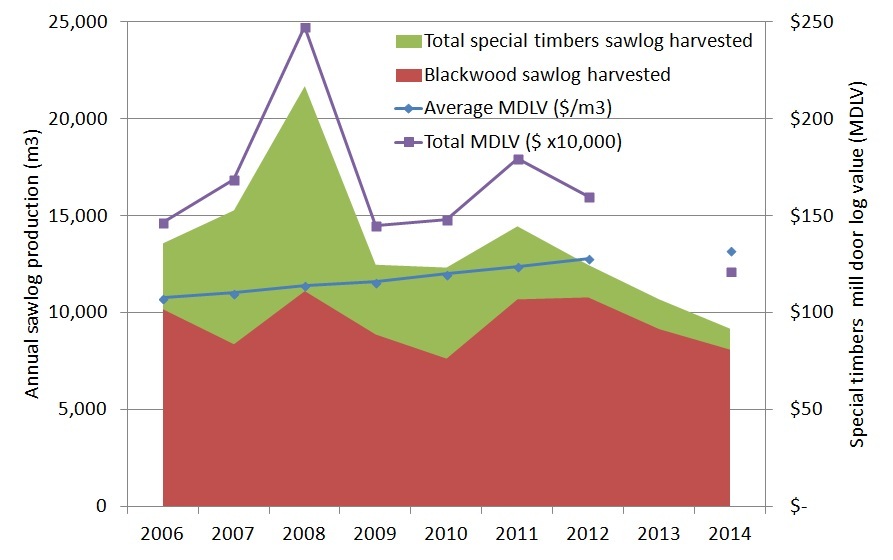
The updated chart shows total special timbers and blackwood sawlog harvest for the past 9 years. 2006 was the first year that Forestry Tasmania published Mill Door Log Value data. For some reason no MDLV data were published in 2013.

As can be seen, blackwood makes up the majority of the special timbers harvest from public native forests in Tasmania. The chart also shows the total special timbers mill door log value (effectively what the sawmillers paid for the logs delivered to their mill). I have then calculated the average MDLV ($/m3) by dividing the total value by the total volume, effectively the per cubic metre royalty paid.

As can be seen the average MDLV is effectively a straight line with a gradient of 3.1%. In other words the price paid by sawmillers for these premium timbers is fixed in line with long term inflation. In other words their value does not increase in real terms – exactly the same real price today as 9+ years ago. That’s what I call a great deal!

In 2013/14 the average special timbers MDLV was $132 per cubic metre. That value includes all the administration and overhead costs, plus the costs of harvesting and transport to the mill. One can only guess what the effective stumpage price was, maybe $40 per cubic metre!! What a joke!!

The other obvious trend in the chart is that special timbers log prices are not affected in any way by market conditions – supply, demand, costs of production, etc. For example the Global Financial Crisis of 2007 had absolutely no impact on prices.

And finally the trend in special timbers revenue over the last few years suggests that 2014/15 will see revenue drop below $1 million. We have no idea what the costs are in special timbers management and harvesting because Forestry Tasmania does not provide separate accounts for these “non-profit” activities.

But it doesn’t matter because Forestry Tasmania sends the special timbers bill to the Tasmanian taxpayer! 10,000 cubic metres (or 500 truck loads) of some of the world’s best timbers sold for a song, AND teachers and nurses lose their jobs. Does anyone care? Apparently not!

Is it any wonder that many Tasmanians regard Forestry Tasmania as an albatross around the neck of the community?

Despite the fact that Forestry Tasmania deliberately operates its special timbers operations at a loss, it:

  • Fails to provide separate financial statements for these operations;
  • Fails to provide any commercial management model and objectives that might identify limits to costs and losses;

The Tasmanian community is left with an unmanaged out-of-control special timbers liability. And the situation is going to get worse with the proposed logging inside the World Heritage Area!

Forest Industry Dictatorship

This blog was originally called “Groundhog Day”. But on reflection I think things have gone well beyond a Hollywood fantasy comedy. The events of the past week when added to the events of the past 12 months clearly demonstrate that Tasmania is now a forest industry dictatorship. Logic, reason, common sense and all other interests (including health and education) have now become subservient to the interests of the politically-driven forest industry in Tasmania. It is beyond contempt!

groundhog-day-driving

As a consequence of the 1993 American fantasy comedy movie of the same name, the phrase “Groundhog Day” has entered common use as a reference to an unpleasant situation that continually repeats.

Working in the forest industry in Tasmania is definitely a Groundhog Day existence.

The past week was another terrible example with the annual fiasco that is the Government Businesses Scrutiny Committees hearings.

http://www.parliament.tas.gov.au/ctee/House/Archived/hagbe14.htm

This should be an example of the epitome of good corporate governance. Instead every year it becomes a political circus. This year was no exception.

Once again the Tasmanian community (including private forest owners) finds itself continuing to subsidise Forestry Tasmania for yet another year despite emphatic promises to the contrary by the new State Government. At the same time Tasmanian teachers, nurses and other public servants are losing their jobs!

And judging by the comments from readers in the newspapers many Tasmanians are thoroughly sick and tired of the stupidity and continuing waste.

This continues to be extraordinary!

And private forest owners (who are being total screwed in all of this disaster) remain completely mute on the issue. I just don’t get it!

http://www.abc.net.au/news/2014-12-05/forestry-tasmania-asks-the-public-to-have-faith-in-its-future/5948360?section=tas

http://www.abc.net.au/news/2014-12-04/tasmania-power-users-to-supply-30m-to-forestry-tasmania/5945404?section=tas

http://www.abc.net.au/news/2014-12-04/millions-in-tas-forestry-exit-funds-to-be-spent-on-industry/5945212?section=tas

http://www.themercury.com.au/news/politics/storm-over-tasnetworks-30-million-payout-to-forestry-tasmania/story-fnpp9w4j-1227145291339

http://www.examiner.com.au/story/2745241/forestry-tasmania-to-face-scrutiny-hearings/?cs=95

And to add insult Forestry Tasmania Chairman Bob Annells was quoted as saying this:

Forestry Tasmania is asking Tasmanians to have faith the company will eventually return to profitability.  Chairman of the state-owned forester Bob Annells said the loss-making company had fundamentally changed how it did business.

Every time Tasmania has had yet another another forestry agreement or peace deal over the last 30 years we have been told to have faith. Every time we have had a State election over the past 30 years we have been told to have faith. And every time our faith has been betrayed.

Mr Annells seems not to appreciate that the community’s store of faith has run dry.

Sacking teachers and nurses whilst subsidising woodchips is well and truly beyond contempt let alone faith.

fundamentally changed how it did business”?

I have seen not one dot of evidence to support this claim. Not a smudge of evidence.

No! It is definitely Groundhog Day again (and again and again and again…..).

For the past 30 years the forest industry in Tasmania has been caught in a perpetual Groundhog Day and it has to stop. It must stop! Someone within the industry with integrity and leadership must step forward and call a halt to this madness or it will continue indefinitely.

Does the industry have anyone of that calibre?

Happy Groundhog Day!

Summary of Stakeholder Submissions and Responses

seeking_your_input_blog_banner_2014

My apologies for such a long blog but the ongoing fiasco of Tasmanian State forest policy and practice continues to dominate the commercial and political landscape.

I wish it were different!

As part of the application process for Forest Stewardship Council (FSC) certification Forestry Tasmania recently released a summary of issues raised by stakeholders and Forestry Tasmania’s responses to these issues. These two reports are available from their website.

http://www.forestrytas.com.au/topics/2014/11/forestry-tasmania-s-forest-management-plan-now-available

As usual my comments relate to Forestry Tasmania’s commercial management and performance, as well as to special timber issues. These are discussed in the report Forest Management Plan – Public Summary of Stakeholder Submissions and Responses (103kb PDF).

Commercial management

The first thing that is immediately obvious in the response documents is the ongoing absence of any serious discussion around commercial management and performance. There is not even a section in the document with the heading Commercial Management and Performance.

I find this utterly extraordinary. Actually I find it quite offensive!!

At a time when Tasmania faces a budgetary crisis and we are sacking teachers and nurses and dropping other essential public services, we continue to subsidise Forestry Tasmania. A Government Business Enterprise wasting scarce taxpayer’s money getting native forest products to market!

This is apparently more important than our children’s education or the health of the community!

It also says a lot about the lack of corporate governance by the State Government and the State Parliament.

Clearly FT does not regard taxpayers as important stakeholders. Also not enough Tasmanian taxpayers are visiting their local FT offices and complaining about this ongoing waste! Common people! Get to it!!

Here’s some stakeholder comments on commercial matters:

  • A common comment was that insufficient consideration was given to production and economic considerations. Some stakeholders were concerned that there was an over emphasis on environmental and social considerations compared to economic considerations in the draft plan.
  • Some stakeholders commented that Forestry Tasmania needs to be financially self sufficient and return a profit to its shareholders.


I couldn’t agree more with these stakeholder comments. And here’s FT’s response:

Positive financial outcomes are one of six strategic objectives now identified in the released Plan. Forestry Tasmania will implement the systems and strategies outlined in the Plan to meet the other five objectives, while also seeking to meet the objective of achieving positive financial outcomes. Forestry Tasmania’s Ministerial Charter details the activities that the Government expects us to undertake. In addition, Forestry Tasmania also produces a Statement of Corporate Intent, which is available on our website and describes the organisation’s financial performance targets as agreed by its Board and shareholder Ministers.

I find this response pretty pathetic especially within the context of the State budget crisis. Both the Ministerial Charter and the Statement of Corporate Intent are incredibly lightweight documents. You can find them here:

http://www.forestrytas.com.au/forest-management/policies

and

http://www.forestrytas.com.au/forest-management/forestry-tasmania-ministerial-charter

They provide little information on how FT is going to improve its commercial management and performance. I would think that given the ongoing State budget crisis and need for taxpayer support, that these matters would form a major part of the Forest Management Plan. Instead the FMP ignores these important issues.

Clearly the stakeholder concerns expressed above are in fact correct and have yet to be dealt with.

Forestry Tasmania continues with the charade that wood production is not a profit-driven, commercial business. Curious really. All private tree growers against which Forestry Tasmania competes in the marketplace, certainly regard wood production as a profit-driven, commercial business.


Special Timbers

At least there is a section in the document dealing specifically with special timbers (page 5). Not surprising given that this issue has dominated much State parliament discussion.

Here’s what the report says about special timbers:

The long term sustainable supply of special species timbers including blackwood was of concern to a number of stakeholders. This was expressed in a number of ways including:

o Suggestions that the Permanent Timber Production Zone land would not be able to sustainably supply industry needs.

Haven’t we known this for decades? Despite all the gloss, spin and promises the supply of special timbers has never been on a sustainable basis.

o Suggestions that current harvesting practices are leading to poor recovery and waste of special species timber.

The inevitable result of poor commercial management and an industrial forestry business model. Again no surprises.

o Requests for a detailed inventory of special species.

Such an inventory would cost more than the resource is actually worth. Which is why FT has never done one.

Response

  • Forestry Tasmania acknowledges the concerns stakeholders have about special species supplies. The Plan has been updated to detail how recent legislative changes affect the special species timbers supply from Permanent Timber Production Zone land. These changes have reduced the area of the Special Timbers Zone managed by Forestry Tasmania from 97 000 to 56 000 hectares. The Forestry (Rebuilding the Forest Industry) Act 2014 requires the Minister for Resources to develop a special species management plan by October 2017. The final Plan indicates that Forestry Tasmania’s future management of special species timbers from PTPZ land will be informed by the special species management plan when it becomes available.

So it’s going to take 3 years (!) to produce a plan that will tell us that the public native forest special timbers industry is over??!! Now let me guess! When is the next State election due? Oh that’s convenient! It’s just after the plan comes out. Stand by for yet another State election dominated by the forest industry! This is just too much! If it’s anything like the last Strategy in 2010 this plan will be a joke.

  • The Plan has been updated to include the results of the December 2013 review of the sustainable level of harvesting from Forestry Tasmania’s blackwood management zone.

This is true! It is now mentioned on page 32 of the Forest Management Plan (FMP). What is not discussed is why the ongoing harvest of blackwood from our public forests continues well above the sustainable yield at 10,000 cubic metres of sawlog per year. Is this blatant fraud or deception?

  • Forestry Tasmania is obligated to make available a minimum of 137 000 cubic metres per year of high quality eucalypt sawlog and veneer log from Permanent Timber Production Zone land. In the process of harvesting this product, a range of other forest products are generated, including special species timbers. Forestry Tasmania has a range of systems in place to maximise the economic value, use and recovery of all forest products arising from harvesting operations. The Plan has been updated to include that in addition to supplying sawmill customers with special species timber, Forestry Tasmania maintains its commitment to its Island Specialty Timber business in order to stock and supply specialty timber products to meet market demand. This includes a tender system for higher quality products.

I could really go to town on this one! Why do we have a legislated sawlog production volume but absolutely NO commercial performance objectives or criteria? It is the epitome of stupidity! And as for the “range of systems …. to maximise the economic value, use and recovery”. Clearly the systems have failed! Either that or the forest products produced by Forestry Tasmania are worthless! Either way the system clearly doesn’t work!

  • Forestry Tasmania is presently conducting an inventory of the special species timber resource , using LiDAR imagery, as a consultancy for the State Government.

What can I say? A futile exercise that will arrive just in time to dominate the next State election. I can’t wait! All of this for a “non commercial” activity! It really is a deeply offensive joke!


Well at least FT is being more transparent about the commercial management of special timbers. Here’s what the revised Forest Management Plan has to say:

In general, the harvest of special species timbers from the blackwood and eucalypt forest zones is a commercial activity while the harvest of special species timbers from the rainforest zone is a non-commercial activity and requires funding support (FMP, p. 32).

So a “commercial activity” is defined as one that requires ongoing taxpayer support, whilst a “non-commercial activity” is defined as one that also requires ongoing taxpayer support.

OK! Clear as mud!

Appendix 1 of the FMP (Summary of recent legislative changes related to land previously managed by Forestry Tasmania) is also worth reading as it sets the stage for the next State election campaign, and further blood-letting around the special timbers industry.

Conclusion

The stupidity around State forest policy and management is clearly set to continue for many years to come.

Whilst FT appears to have made some minor progress is terms of transparency and stakeholder engagement, there is still a very long and difficult road ahead.

As a member of the private special timber-growers industry my message to the FSC remains clear and simple:

Absolutely no FSC certification for Forestry Tasmania until:

  1. FT is restructured, managed and governed on a fully commercial and profitable basis;
  2. All harvesting of wood from public native forest both inside and outside the Permanent Timber Production Zone must be on a profitable, commercial basis. Absolutely no taxpayer support for public native forest wood harvesting at all.

And finally…

Just so I don’t have to repeat this experience in 12 months time here’s some guidance for the FT Annual Report editors.

Special Timbers content outline for 2014/15 Forestry Tasmania Annual Report:

  1. Is the harvesting of special timbers profitable? Supporting data…
  2. Is the harvesting of special timbers sustainable? Supporting data…
  3. Review of major events and highlights of the past 12 months? Markets, sales, planning, harvesting, resources, etc…
  4. Outline of major events and highlights of the coming year? Markets, sales, planning, harvesting, resources, etc…

It’s pretty basic stuff really, instead of the mealy-mouth rubbish we normally get in the annual reports.

I also highly recommend reading John Lawrence’s review of the financial management and performance of FT from their 2014 Annual Report. It makes for pretty depressing reading especially when you think about all the political games being played around forestry.

http://www.tasfintalk.blogspot.com.au/2014/11/forestry-tasmania-nothing-has-changed.html

The forest industry in Tasmania hasn’t got a future whilst this madness continues.

Hopefully my next story will be a good news story.

Further reflections on the FT 2014 Annual Report

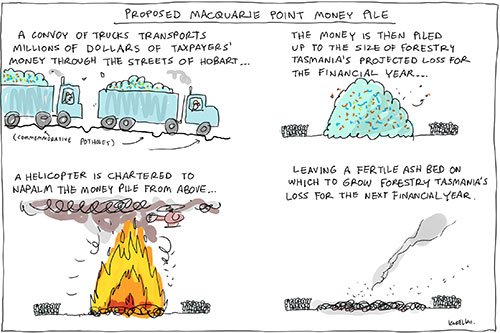
Kudelka 011114

www.kudelka.com.au

Cartoonist Jon Kudelka has identified a new version of Brand Tasmania. One that we can all identify with. The one element missing in the above image (in addition to the crumbling roads) is the queue of sacked Tasmanian teachers and nurses outside the local Centrelink office.

Please take note Forest Stewardship Council! Good commercial management and performance is absolutely fundamental to good forest management; especially when the forest in question is publically owned!

As a stakeholder in the special timbers industry attempting to build a profitable blackwood growers industry based on Tasmanian farmers, it is difficult to read the latest Forestry Tasmania annual report and get any satisfaction. In fact the overwhelming response is frustration, anger and astonishment.

We have been told repeated over the past few years, both in the media and in State Parliament that the special timbers industry is in crisis. Even to the point of having to start logging our reserves and conservation areas to keep the industry going a while longer. This looming crisis has been obvious to me for many years as the industry has survived on the residues of old growth industrial forestry.

So here we have an Annual Report that reads like nothing is wrong. The Special Timbers section (pages 25-26) contains such superficial information as to be worthless.

So is there in fact a crisis in the special timbers industry? Not according to the Annual Report. New State legislation just requires a review of “our supply strategy in future years”. A resource review is currently underway, but no mention of when this will be completed.

The new 2013 blackwood sawlog resource review is mentioned, but there is absolutely no discussion about its impact on the current or future supply of blackwood from our public forest resource, despite a significant drop in the estimated sawlog sustainable yield. Never mind that the planned harvest of blackwood sawlog will continue at well above the sustainable yield.

What about the proposed logging of special timbers in our parks and reserves?

Absolutely no mention of it.

What about a strategy for the future that might actually be useful and meaningful.

Again no mention of the future of the special timbers industry in the Annual Report.

Just amazing!

A complete white wash!

So when the discussion of special timbers in the Annual Report finishes with the off-hand mention of the tender sale price for a single blackheart sassafras log I feel absolutely insulted and ripped off. As if the sales price of sassafras sawlogs has any market significance. No one is going to invest in growing sassafras; it takes too long to grow. As if Forestry Tasmania gives a “flying fig” about sawlog prices anyway!

Forestry Tasmania is a complete basket case aided and abetted by scheming politicians.

As Mr. Kudelka clearly illustrates with his cartoon, the folly around State forest policy and practice continues unabated, and the burning of precious taxpayers money will likely continue for many years to come.

And the potential to develop and expand a profitable private blackwood industry remains frustrated.

Continuing the decline – Forestry Tasmania 2014 Annual Report

6057_StewardshipReport13-14_cover

The recent release of the Forestry Tasmania Annual Report 2014 provides me with yet another opportunity to highlight the continuing destruction of Tasmania’s special timbers industry (including the blackwood industry).

http://www.forestrytas.com.au/news/2014/10/forestry-tasmanias-stewardship-report-2013-14-now-available

My critique will be limited to special timbers. I will leave it to others to highlight the many other unresolved issues. Special timbers are discussed on pages 26-27 of the report. It starts off:

Special timbers are an integral part of the Tasmanian brand. They are used to produce high-value furniture and craftwood products, and include blackwood, blackheart sassafras, myrtle, silver wattle and celery top pine. These timbers are just so incredibly high value they must be taxpayer subsidised (at the expense of our health and education systems).

Production

Total special timbers production for 2013/14 was 9,199 cubic metres which represented a miniscule 0.9% of total public native forest production by Forestry Tasmania. And for this morsel special timbers dominates State forest policy (and Parliamentary time) like no other issue.

Historical data

A curious addition to this year’s report is the inclusion of a chart showing detailed historical special timbers production back to 2003/04 (p. 26). This chart is not referenced at all in the text. Why is it in the Report?

The chart does include four years worth of previously unavailable production data from 2003 to 2007. Only 9 years worth of detailed special timbers production data still remain publically unavailable.

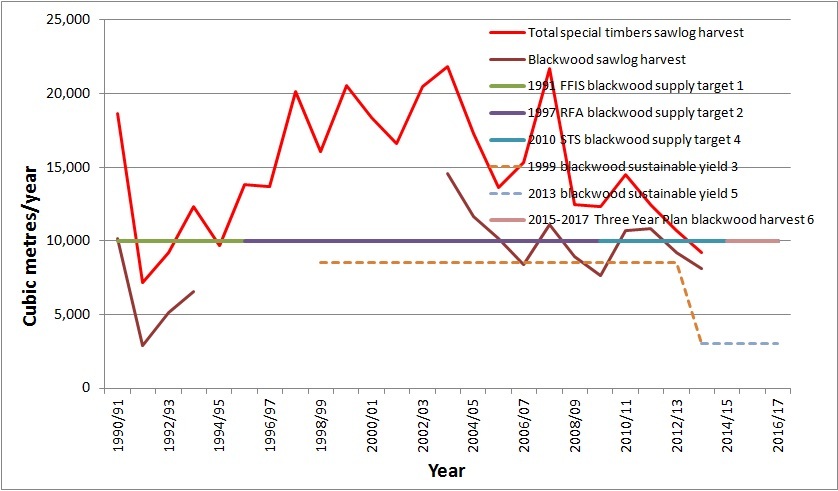
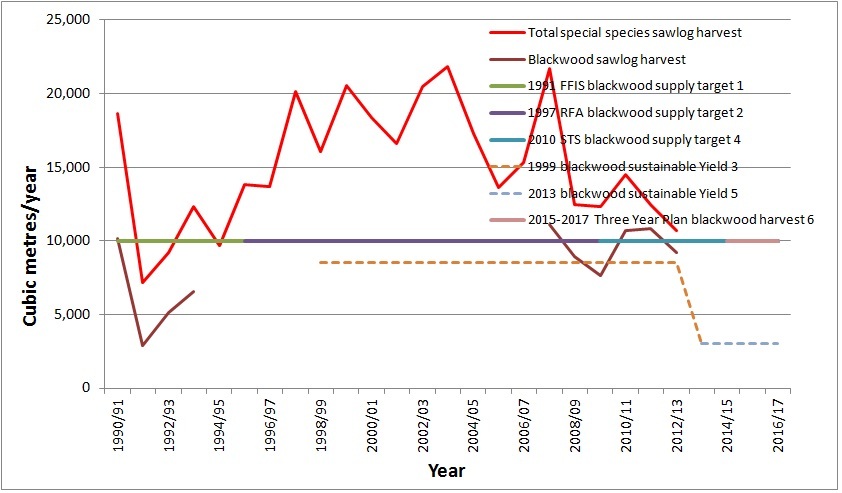
The chart is of limited value as it does not show special timbers production in relation to either sustainable yield, or the RFA/STMS supply target. Therefore in order to improve public understanding and debate I have added the new historical data (including estimating blackwood production by measuring directly off the chart) to my chart of special timbers mismanagement (note the 9 years of missing blackwood production data). If anyone can see in this chart the relationship between planned versus sustainable versus actual production they clearly have a better imagination than I.

http://blackwoodgrowers.com.au/2014/08/14/the-incomplete-history-and-current-practice-of-unsustainable-blackwood-mismanagement/

Incomplete history chart update 1014

As noted in a previous blog, the overcutting of the public native blackwood resource continues apace but FT don’t mention this at all.

http://blackwoodgrowers.com.au/2014/07/23/overcutting-of-the-public-blackwood-sawlog-resource-to-continue/

 Resource review

The Report tells us that a review of the special timbers resource on Permanent Timber Production Zone land is currently underway, but doesn’t say when this review will be completed or if it will be published. The Report completely avoids any discussion of the planned harvesting of special timbers from Tasmania’s reserves and conservation areas, and the impact this will have on the forest industry and on the broader community.

The Report notes the completion during the year of the blackwood sawlog resource review, noting the new sustainable blackwood sawlog supply of 3,000 cubic metres per year. For my scathing review of this document go here:

http://blackwoodgrowers.com.au/2014/06/23/the-incomplete-history-of-unsustainable-blackwood-mismanagement/

And also see the above discussion re. historical data and imagination.

Island Specialty Timbers

For the very first time in an annual report the performance of Island Specialty Timbers (IST) gets a mention. On page 27 we learn that:

  • A total of 1,531 cubic metres of specialty timbers were sold through the three IST outlets;
  • 136 cubic metres of this (of which only 16.1 cubic metre was blackwood) were sold through the public competitive tender process to ensure that the best possible prices were obtained.
  • The tendering program continued to receive strong interest;
  • The highlight for the year being an 87-centimetre diameter blackheart sassafras log that sold for $5,000 per cubic metre.

I’m happy to be corrected but I reckon this is the very first time that a good product sales result has ever been trumpeted by FT in its annual report, even if they have treated it as a minor footnote, and this information about a single sassafras log has almost no market significance whatsoever.

What we didn’t learn:

  • The financial performance of IST. How much did the 1531 and 136 cubic metres sell for? How much is the Tasmanian taxpayer subsidising the specialty timbers industry through IST? Somehow I doubt that 1500 cubic metres of sales would have brought a profit.
  • What impact did the open competitive tender prices have on the administered pricing system used by FT for the bulk of its special timbers sales? If there was no impact then what exactly is the purpose of the tender system?
  • Why were only 9% of the total sales done through the tender process, when the whole business is being subsidised by taxpayers? Why not 50% or even 100%?

Conclusion

In the current difficult financial times when we are sacking Tasmanian teachers and nurses, why must Tasmanian taxpayers continue to subsidise the special timbers industry? Why can’t the special timbers industry be run as a fully commercial, profit-driven business? What in fact does “high-value” or “special” mean at Forestry Tasmania?

The complete absence of information and discussion in the Annual Report around the commercial management and performance of special timbers is pretty symptomatic of Forestry Tasmania’s culture and its many problems.

Forestry Tasmania continues to demonstrate a complete lack of interest in commercial management and performance.

They don’t even have the integrity to tell Tasmanian taxpayers how much they are deliberately subsidising the special timbers industry.

As an example of open honest transparent stakeholder engagement I continue to identify significant opportunities for improvement from Forestry Tasmania in their reporting.

Can anyone please tell me why this complete disaster continues to get Parliamentary approval and support?

Go Deloraine Stringfest! – a reply

http://blackwoodgrowers.com.au/2014/03/25/go-deloraine-stringfest/#comments

I thought this recent comment to one of my earlier blogs was worthy of a more full response.

While I believe Gordon’s point of view might be an important point of view, it is certainly not the only point of view. In fact, I have some deep reservations about what Gordon is on about, not just about the future for instrument makers, but for craft and furniture makers in general.

Plantation timber is not ideal for every one, in fact, for some it is just plain wrong.

I believe it is of almost no interest to artistic wood turners, for example. They usually like the most gnarly, twisted, knotted, stressed and complex timber they can find, and it is almost totally without exception found to be old-growth timber.

Many users like their timber to be old, slow-growing, stable, rich, dark, and close in grain structure. I have never seen plantation-grown timber of any sort that looks like that. While some luthiers would definitely like straight-grained timber, there are plenty of others, such as the solid-body electric guys who want the most spectacular timber they can find, and I can give examples.

I would have less of a problem with Gordon if he were to not be saying that all the old-growth Blackwood forests should be locked up so that it could give a free kick to the fledgling Blackwood plantation growers – even John Gay did not ask for that!

Hi George,

Thanks for your comment. It’s great to hear from you.

Here’s my response to your concerns:

  1. No one has ever claimed that my views are supreme. I openly welcome other opinions and ideas.
  2. The wood qualities you describe “most gnarly, twisted, knotted, stressed and complex timber they can find” might appeal to a small number of artisans and craftspeople. But by far the major markets for blackwood – veneer, furniture, cabinetry, flooring, and commercial (as distinct from custom) instrument makers all prefer straight-grained wood for its uniformity, stability and ease of machining and workability. Feature grain such as fiddleback blackwood is also highly prized by these markets, but has only ever been available in very limited ad hoc supply anyway. Supply has never been guaranteed. New Zealand instrument makers are already using plantation blackwood.
  3. Plantation blackwood is my main focus because it is the best way to meet the dominant market demand and is the only way to expand and develop the blackwood industry. But I also have a focus on the remnant blackwood forest that exists on private land and how this can be better managed to improve productivity and value. With time (and perhaps even right now) this resource could easily supply the type of wood you describe including featured grain material. In fact it is already supplying the specialised craft and custom market.
  4. The genetic potential of blackwood is huge. A blackwood selection and breeding program could well provide improved, specialised wood properties of consistent quality to meet a number of different markets. These could be based around wood hardness, density and colour and perhaps even figured grain. Such genetic potential will only ever be realised once blackwood cultivation is well established and profitable. We are currently a long way from reaching that point!
  5. if he were to not be saying that all the old-growth Blackwood forests should be locked up”. George can you please identify where I have said this? I am more than happy for public native forest to be commercially managed PROVIDED it is done properly and profitably. I have certainly said that Tasmania has clearly demonstrated over the past 30 years that we do not have the commitment nor the skills to commercially manage our public native forests to meet social, ecological, political and commercial objectives. Every week our newspaper headlines scream this fact to the world. Many Tasmanians are thoroughly sick and tired of it.

I am not against your interests at all George. I want good professional, fully commercial and profitable forest management. I want a fair go and a “level playing field” for both public AND private tree growers. That’s all I want. Is that too much to ask?

Apparently it is.

Right now the policies and practices of the Government and Forestry Tasmania are deliberately undermining my attempts to build a private commercial blackwood venture. In fact your precious public native forest blackwood resource is being wiped out by overcutting! Does this concern you at all George?

http://blackwoodgrowers.com.au/2014/08/14/the-incomplete-history-and-current-practice-of-unsustainable-blackwood-mismanagement/

When I look at the forest industry I look at as many aspects as I can, not just the quality of the wood resource. Right now there is very little about the forest industry and Tasmanian State forest policy that I find positive or useful. Unlike others I do not ignore the numerous political, social and commercial challenges facing the industry. I certainly do not support the use of taxpayer funds to log Tasmania’s conservation reserves for special timbers. Such stupidity will foment community conflict the likes of which we haven’t seen since the dark days of the Franklin River blockade.

The Deloraine Stringfest is a fantastic festival that in time will become a unique international event, highlighting the complete supply chain for stringed instruments from grower to artist. It has significant appeal to a wide audience. But while Stringfest sits within the current political, social and commercial malaise that is the forest industry in its current form, it will struggle to gain momentum and support.

It is well and truly time for fresh thinking and a new start.

That’s where I want to head George. A new beginning and a new vision.

Forestry is business. It is not about community service, or taxpayer subsidies whilst we are sacking teachers and nurses and closing schools. Forestry is about building wealth, not destroying it.

Go Stringfest!

FSC Certification Evaluation of Forestry Tasmania

seeking_your_input_blog_banner_2014

SCS Global Services,

2000 Powell Street, Ste. 600

Emeryville,

CA 94608 USA


Dear Dr. Hrubes,

RE: FSC Certification Evaluation of Forestry Tasmania

Thankyou for the opportunity to participate in the stakeholder consultation process.

As a forester and forest industry representative my submission to the Forestry Tasmania FSC Certification Evaluation focuses on just two issues.

1. Commercial Management


The forest industry in Tasmania is currently home to two mutually incompatible business models competing in the same marketplace.

The historical, traditional and still dominant business model is the taxpayer-subsidised, community service business model that frames current Tasmanian forest policy, and public forest management by Forestry Tasmania.

The fundamental basis of this model is that public forests managed for wood production are there to serve the community largely through providing regional employment. Good business, commercial management and profit play no part in this business model.

The second business model has always been present in Tasmania but has recently become more significant with the expansion of private plantations and the sale of public plantations to the private sector. This business model is used by private plantation and forest owners; it is the fully commercial, market-focused, profit-driven business model.

It is the same business model that will help drive my goal of establishing a Tasmanian Blackwood Growers Cooperative.

These two business models cannot succeed in the same marketplace. This situation is unstable and ultimately destructive to the entire forest industry. It is also a missed opportunity to realise and develop Tasmania’s significant commercial forest potential.

The traditional business model represents nothing more than a destructive antitrust, anti-competitive business model. It undermines the ability of the marketplace to function properly and put a proper price on forest products. It destroys the value of private forest assets and investment.

At the moment logs from public native forest are being transported to market at taxpayers’ expense, whilst private tree growers do not have access to any taxpayer subsidy. This is blatant antitrust behaviour.

Also please read this brief analysis of the deliberate decline in commercial focus at Forestry Tasmania over the past 20 years. Forestry Tasmania is a storm-tossed, rudderless ship:

http://tasmaniantimes.com/index.php?/article/forestry-tas-devoid-of-commercial-purpose/

The Forest Stewardship Council (FSC) must not give its support to this antitrust behaviour. Forestry Tasmania must not be given FSC Certification until it is restructured and managed on a fully commercial profitable basis.


2. Public blackwood forest resource mismanagement


For the last 25 years Forestry Tasmania have been overcutting the public native blackwood resource that currently forms the basis for Tasmania’s iconic blackwood industry. Using Forestry Tasmania’s own data I have summarised this sad sorry episode.

Incomplete history 2

http://blackwoodgrowers.com.au/2014/08/14/the-incomplete-history-and-current-practice-of-unsustainable-blackwood-mismanagement/

http://blackwoodgrowers.com.au/2014/06/23/the-incomplete-history-of-unsustainable-blackwood-mismanagement/

Forestry Tasmania perpetuates the message that the public blackwood forest resource is being responsibly and sustainably managed, when their own data (as shown in the above chart) clearly shows this is not the case!

The recently released Review of the Sustainable Sawlog Supply from the Blackwood Management Zone is a grossly misleading and inadequate document.

http://www.forestrytas.com.au/sfm/review-of-the-sustainable-sawlog-supply-from-the-blackwood-management-zone

The fact that in 2010 Forestry Tasmania announced that henceforth blackwood and all other special timber species were to be managed on a “non-commercial non-profit” basis was a severe blow to the Tasmanian farmers and the blackwood industry.

Blackwood (Acacia melanoxylon) is Australia’s premier appearance-grade timber species. It is a common tree on farmland across northern Tasmania, most of which is unmanaged and until recently had little commercial value. But this is now changing.

The only way to build and grow Tasmania’s blackwood industry is by encouraging Tasmanian farmers to grow it, just as New Zealand farmers have been for the past 30 years. But Tasmania’s blackwood industry will be gone in 5-10 years due to the mismanagement and overcutting of the public resource by Forestry Tasmania. The local blackwood markets and industries will be gone before Tasmanian farmers have a chance to contribute. Tasmanian farmers will have to start the whole industry from scratch with no market price or demand signals.

The Forest Stewardship Council (FSC) must not give its support to this blatant mismanagement of Tasmania’s public forest resource. Forestry Tasmania must not be given FSC Certification until it provides a full and correct report on the nature of the blackwood resource, and manages that resource on a fully commercial, profitable and sustainable basis.

From my perspective as a forest industry representative and stakeholder there is very little positive that can be said about the current state of forest industry policy and practice in Tasmania. The industry is continuing to go backwards year after year. This comes as no surprise to me at all.

Major review and reform is desperately needed.

The Forest Stewardship Council (FSC) should not add its support to this mess by granting FSC Certification to Forestry Tasmania; not until major reforms are implemented.


Yours Sincerely,


Dr. Gordon Bradbury

14th October 2014

War and peace – and war again? The battle for Tasmania’s ancient forests

The Guardian

18/09/2014

Guardian

I sure do get tired of all the politics in this business. I wish I could just focus on good news stories but they are far outnumbered by stories of politics and conflict.

But this story in The Guardian is very well written, if a bit long. And it has a nice focus on the human aspect of the whole terrible ongoing battle.

http://www.theguardian.com/world/2014/sep/18/-sp-tasmanian-forestry-peace-deal

Tasmania does not have a forest industry.

It has a war zone.

And all of this madness whilst the State forest management agency Forestry Tasmania remains technically bankrupt, and only able to survive by continuing taxpayer subsidies.

It’s a taxpayer subsidised war zone.

Enjoy the read.