Category Archives: Commentary

Fears of Timber Shortage

The Mercury 18/12/2013

Apologies for continuing the political stuff, but as I say forestry is politics here in Tasmania. The two are unfortunately inseparable, and the damage continues.

Amongst the many news stories on forestry in today’s newspaper was this one about special timbers (of which blackwood is the predominant species).

The Mercury181213s

It’s just the same predictable rhetoric, scare mongering and posturing that surrounds so much of the so called forestry “debate” in Tasmania.

Will there be a specialty timbers supply shortage in Tasmania in the near future?

Absolutely!

Does either the specialty timbers industry or the Government have a long-term, viable solution to this problem (that has been coming for decades)?

No!

Is it possible to sustainably harvest specialty timbers from our public native forests?

A very common question, and at the most basic elementary level the answer is yes (trees do grow and can theoretically be harvested). But as soon as you try and move to the next point of logic you quickly become overwhelmed by the technical, commercial, political and social challenges. Even with all the goodwill and trust in the world it would be a difficult task. But there is very little trust and goodwill in Tasmania. So the chances of this happening successfully are exactly zero! Impossible!! To try this would set Tasmania up for yet another forestry train wreck. Haven’t we had enough of those already?

Is either the specialty timbers industry or the Government interested in supporting a farmer-based blackwood growers cooperative, to build and grow the industry on a fully commercial basis?

No! Not yet at least.

And the Government is “working as hard as possible to provide solutions for the special species sector.”

I don’t think so!

So the iconic Tasmanian special timbers industry continues on its merry way towards it’s own private mini train wreck, to emulate the magnificent train wreck that has befallen the greater forest industry here in Tasmania.

For readers from outside Tasmania this must appear like some weird Hollywood script. Welcome to Tasmania folks!

Forestry Tasmania’s challenges

Being part of the forest industry in Tasmania is tough at the best of times with all the bad media, the politics, conflict, ideology, mismanagement, etc. I usually try and keep the politics off the website; politics is mostly bad for business.

But in Tasmania forestry is politics, which is its biggest problem.

So this commentary by economist/accountant and social commentator John Lawrence has my complete support, and says what needs to be said about the mismanagement and poor governance of Forestry Tasmania. Recommended reading:

http://www.tasfintalk.blogspot.com.au/2013/12/forestry-tasmanias-challenges.html

One of the major weaknesses (and there are many) of the Tas Forestry Agreement is that it continues to enshrined Forestry Tasmania as the cornerstone of the industry. And as Mr Lawrence clearly demonstrates, Forestry Tasmania is a dead, defunct, insolvent entity with no future. While it remains the cornerstone, the forest industry will continue its long, slow, painful decline.

FT SR 201213

My own response to reading the latest FT Annual Report was akin to reading a death notice in the newspaper. The Report reflects an organisation completely off track, detached from any commercial reality and devoid of vision and purpose. Forestry Tasmania has dozens of performance criteria but not one single commercial performance criteria. That’s right – NONE!! The word “productivity” only appears in the Annual Report in relation to trees growing wood – productive forests. The word “productivity” as a measure of commercial performance is completely foreign to FT.

I shudder to think they may soon have FSC Certification. What a complete joke that will be.

It is perfectly clear that the politicians and FT management fail to understand that forestry is a commercial, profit-driven business at all levels of the industry including public and private tree growers. Given that most wood now grown and sold in Australia comes from private growers the continuing failure of FT is deeply significant. FT is like an infected wound that impacts on the whole industry. Politics and mismanagement only serve to create uncertainty and discourage investment. It certainly makes getting a commercial blackwood growers cooperative established that much harder.

Insects, habitat, dead trees and blackwoods

Here is a post from a grower that may interest some readers:

As well as intentionally planted trees, our area in the Strzeleckis has a lot of blackwood growing as paddock trees, in  roadside verges and so on.

I was clearing out some thistles and blackberries from the verge yesterday. Within about 20 metres along the side of the road I noticed 3 wild bee colonies. These were all Apis mellifera or European honeybee. Although not a native these insects do sterling work in pollination.

All 3 colonies were in hollows in blackwoods. One was in the upper section of a dead blackwood that had fallen over years ago, another was only a few metres away in a hollow of a half-dead blackwood and another was in the remaining trunk segment of a blackwood that had died a while ago and lost its crown and any side branches.

Interesting that all three bee colonies were using blackwood hollows. Some agroforestry commentators suggest leaving an occasional dead tree (if a stem dies or perhaps killed as part of thinning) to form a stag for habitat.

Hi David,
It’s an interesting story, if a bit marginal to what I’m trying to achieve.
Some random responses:
What other trees around where you were have hollows? I suspect mainly blackwoods.
Also blackwoods, once they die, quickly start to rot out, so they are a natural and ready source of hollows, if only short lived before the tree falls and rots entirely.
But I definitely take your point. Leaving dead trees AND logs is important for insect habitat. We humans are too quick to tidy up and leave the forest/road verge looking like a park, rather than a forest with all its litter and chaos – and insects.
What about in a blackwood plantation?
Trees randomly die and fall over. Should we leave a few as habitat? Or will this just build up insect populations that then attack living trees? I don’t know the answer. I suspect that insects that inhabit dead trees are different to those that attack living trees. Perhaps those that live in dead trees are predators of insects that attack living trees. Ultimately the answer will vary depending upon the inclinations of each land owner. Some will give some favour to habitat while others will go for maximum tidiness and “hygiene”.
Thanks for the story.
Cheers,
Gordon

Forestry Tasmania stakeholder registration now open

FT Help Us Improve

As part of the move towards applying for FSC Certification Forestry Tasmania are now seeking community feedback and stakeholder engagement. Stakeholder registration is now open. Visit the website:

http://www.forestrytas.com.au/help-us-improve

Current FT policy and practice effectively prevents private investment in blackwood by treating the public special timbers and blackwood resource as a non-profit, publicly subsidised charity. No private blackwood investment will happen until the special timbers industry is reformed on a fully commercial basis. Without this change the special timbers industry is doomed, and all your favourite Tasmanian timbers will no longer be commercially available.

For more information read my blog here:

http://blackwoodgrowers.com.au/markets/

You can help bring about this important change by becoming a FT stakeholder and letting them know that reform is vital to the future of blackwood as a profitable commercial opportunity.

They have a online survey you can also do to provide FT with some quick feedback.

Help support the future of Tasmania’s special timbers industry and demand change.

Thanks for your support!

Another record price at IST tender

The September tender of special timbers at Island Specialty Timbers achieved yet another record result.  The price wasn’t for a blackwood log (none were offered in the September sale) but the result clearly demonstrates that the market for premium timbers is very strong indeed.

An incredible $5,380 per cubic metre was paid for a high quality tiger-stain myrtle sawlog, the highest unit price ever paid at an IST special timbers tender.

Unfortunately Myrtle (Nothofagus cunninghamii) cannot be domesticated as a commercial crop, so this sales result has no direct commercial importance. It takes at least 200 years for Myrtle to reach commercial size, and the fungal infection that produces the tiger staining has not yet been identified. Those few lucky Tasmanian farmers who have existing Myrtle on their properties now have a better appreciation of what they may have growing. Other farmers may have areas suitable for growing a few Myrtles as a hobby or special interest (eg. river reserve or steep south-facing slope).

But if farmers want to grow these high-value premium timbers as a profitable commercial crop then blackwood is the clear and obvious answer. That is the clear indirect message from these latest tender results from IST. The premium timber market is beginning to shout at farmers and landowners – please grow high quality timber. Are any farmers listening?

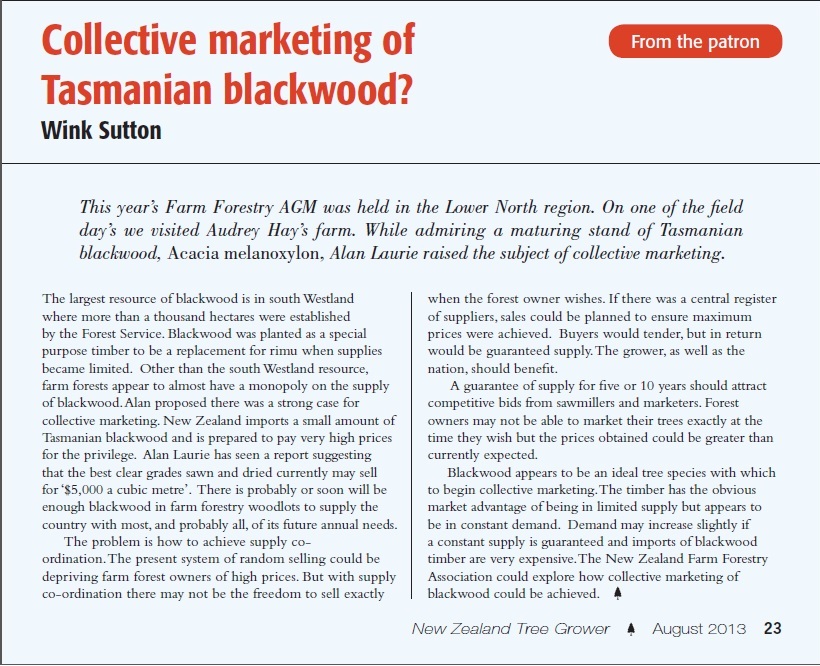
Collective marketing of Tasmanian blackwood?

Collective marketing - Tree Grower 34-3

This is an interesting article from the latest New Zealand Tree Grower journal from the New Zealand Farm Forestry Association, and potentially represents a significant milestone in the fledgling NZ blackwood industry.

Alan Laurie runs Laurie Forestry Ltd a progressive and commercially focused forest management, harvesting and marketing business. I always enjoy reading Alan’s regular forestry market reports that always me to know much more about what is happening with the NZ forest industry than I know about the industry here in Australia.

For Alan to make these comments about the potential of New Zealand blackwood is a significant vote of confidence in the industry. While there is a blackwood interest group (AMIGO) established under the NZFFA, they have yet to evolve into a marketing cooperative despite the fact that steady volumes of quality NZ blackwood timber are now coming onto the NZ market. Certainly what needs to happen soon is greater market transparency and feedback, so that prices and return on investment allow more potential blackwood growers to take an interest and help build the industry.

Blackwood appears to be an ideal tree species with which to begin collective marketing. The timber has the obvious market advantage of being in limited supply but appears to be in constant demand. Demand may increase slightly if a constant supply is guaranteed and imports of blackwood timber are very expensive.

To this comment from Alan Laurie I would also add that blackwood also has the advantage of a well established market presence and profile as a premium quality timber, so marketing and sales should be straight forward, compared to many lesser-known species.

So can the NZFFA/AMIGO evolve into a marketing cooperative and help take the NZ blackwood industry to the next level?

I would think given Alan Laurie’s knowledge, experience and place in the industry he could play a pivotal role in making the collective marketing happen.


Happy tree-growing farmers

In travelling around and talking to Tasmanian farmers and others about growing blackwood I’m often faced with the statement (or some variation of it) – “but they take so long to grow!”

I’m certainly not saying that time and money are not essential issues in investment; but good money can still be made on investments up to around 40 years. And this is without considering the many other benefits in growing trees on farms.

Amongst the blackwoods

So how do farmers get past this initial resistance to investing in trees and including trees in their farming business?

As a passionate forester I’m always inspired by the stories from New Zealand where many farmers have taken to growing trees as part of their farming business. Twenty years ago the New Zealand Government (which was then the major player in the forest industry) decided that politics and forestry didn’t mix, and if the forest industry was to succeed and thrive then it was time for the Government to exit the industry. So the Government shut down the public native forest industry and sold off the large public plantation and sawmilling assets. It was a controversial decision that was opposed at the time by the industry and the forestry profession, but the Government still went ahead. Today the forest industry is a thriving cornerstone of the NZ economy, and the farmers are the beneficiaries of that brave decision 20 years ago. I only wish Tasmanian farmers were in the same situation.

The organisation that represents New Zealand farm foresters is the NZ Farm Forestry Association. Their website has a vast array of information and ideas. One is this collection of farm case studies that showcase 15 farmers and their experiences with growing trees. They are all well worth reading. Some of the stories include farmers growing blackwood.

http://www.nzffa.org.nz/farm-forestry-model/case-studies/

These stories demonstrate that farmers can overcome their reluctance to long-term investment of trees. Where the opportunity allows, a series of forestry investments over time can eventually make a major ongoing contribution to farm income. Some of the case studies include harvesting and the financial returns that have been achieved. Perhaps the best example is “Hockings, Bulls, Wanganui” the sixth on the list that includes a table showing the significant contribution of forestry to farm income over an 18 year period. Very impressive! Indeed I have read of NZ farmers who over time have converted their entire properties to forestry and become 100% tree farmers. They have discovered that farming trees is both enjoyable and profitable.

And because blackwood is high-value, smaller investments are still viable and profitable, compared to hardwood pulpwood or radiata pine where scale of investment is more important.

I hope you find these stories inspirational and educational.

Blackwood – the yet-to-be sustainable tonewood

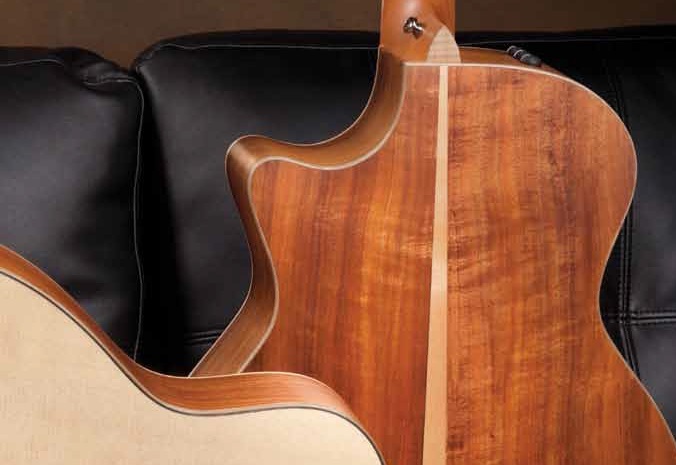
Blackwood also is sourced from forests that are responsibly managed, making it a sustainable wood for guitar making.”

Guitar

This is a quote I recently found in a newsletter published by a major guitar maker.

Regular readers of this blog will understand that “responsible” and “sustainable” are not words I would use to describe blackwood management and production in Tasmania. Not yet anyway.

Not that blackwood is in danger of becoming extinct as a species. Far from it. But in the next 2-3 years it will become commercially extinct; that is the wood volumes available for harvesting will drop to levels that only allow a craft industry to persist. But the forest industry is not yet prepared to admit this disaster, and is currently heading in the opposite direction required to fix the problem.

Nor am I implying deception on the part of the guitar maker. It is easy to be swayed by the official forest industry information into thinking that all is well. But you don’t need to scratch hard to begin finding problems.

Most blackwood timber comes from the harvesting of public native forests that have been the subject of increasingly bitter community conflict over the past 30 years. These forests are managed by the Government forest agency Forestry Tasmania. Blackwood is also a common tree on farmland across northern Tasmania, and while there is a small amount of blackwood timber harvested from private land most farmers do not regard their blackwood as having any commercial value. The forest industry here has traditionally been a Government dominated closed shop so most farmers know not to bother growing trees for wood production.

But the only possibility for restoring responsible, sustainable blackwood supply back to commercial levels is from private land. And the blackwood industry (including guitar makers) needs to understand, appreciate and openly support this.

In three recent blogs I discussed in detail the numerous issues that the blackwood industry currently faces around the public blackwood resource and State forest policy, some of which directly hinder the development of the private blackwood industry. These include:

  • Long term overcutting of the resource;
  • Poor resource management;
  • Major decline in supply in the next 2-3 years;
  • Failed new resource initiatives;
  • Non-profit taxpayer-subsidised business model;
  • Anti-competitive sales and pricing processes;
  • Lack of market competition and transparency.

Meanwhile the blackwood industry sits quietly on it’s hands and says nothing, hoping that a fairy godmother will soon arrive and fix this ungodly mess. Certainly no farmer or anyone else will invest in blackwood under these conditions.

Tasmanian blackwood could be a sustainable tonewood supplying international markets. It is a recognised premium tonewood. It is fast growing. The establishment of a plantation program could see a selection and breeding strategy commenced to grow the best possible blackwood for the tonewood market. But not yet. Under current policy and practice Tasmanian blackwood timber production is anything but responsible and sustainable.

A meeting with Forestry Tasmania

I had a meeting last week with representatives of Forestry Tasmania (FT) to discuss special timbers and blackwood issues. The meeting was in response to my recent commentary about public subsidies and pricing policies. It was an informal meeting with no minutes recorded. Here is a brief summary of what I learnt and concluded:

  • FT did not dispute my figures and analysis regarding the special timbers subsidy and pricing.

Business model

  • FT regards special timbers very much as a non-profit, non-commercial community service requiring public subsidies. The worse the special timbers economics become (and there appears to be no bottom-line to this) the greater the public subsidy that will be required.
  • FT has no interest in getting a better price for its special timbers sawlogs.
  • I got the impression that FT would continue to support the current beneficiaries of subsidised public special timbers while the current beneficiaries resist any attempts to introduce commercial reforms.

(NB. The special timbers industry appears to have convinced many people that paying real market prices for special timbers sawlogs would destroy the industry! While opening up the special timbers market is vital for the success of private special timbers growers.)

  • Island Specialty Timbers (IST) appears to be deliberately run as a loss-making venture, breaking even in the occasional good year, but generally operating at a loss. Apparently no attempt is made to make IST profitable or commercially focused. IST compete directly with many small private sawmill operators around Tasmania. Anticompetitive behaviour clearly doesn’t seem to bother these guys.
  • The IST tender results are used to inform the contracted price for special timbers, with tender prices “informing” the upper limit to contract prices. See my discussion here for further analysis and commentary of FT pricing policy.

Supply

  • The supply of special timbers, including blackwood, from State forest will be greatly reduced with the implementation of the Tasmanian Forestry Agreement (TFA), with increasing public subsidies the likely outcome under current policy.
  • The 880 ha of blackwood plantation established by FT 20 years ago have now apparently been written off as a failure. These plantations were originally expected to contribute over 250,000 cubic metres of blackwood sawlog to the sustainable yield beginning in 2018, but will now contribute nothing to the future blackwood industry.  Over $4 million was spent establishing these plantations.

(NB. Most of these plantations were located at Beulah, south of Sheffield on a site unsuited to growing commercial blackwood, using a complex and risky silvicultural model).

  • Production of blackwood sawlog from the Fenced Intensive Blackwood (FIB) areas has now been pushed back from 2033 to at least 2050. These areas were expected to contribute at least another 250,000 cubic metres of sawlog to the sustainable yield. However it is unknown whether these areas are being managed or are performing according to original expectations.
  • For at least the next 40 years therefore the production of blackwood sawlog from State forest will be centred on the swamp forests of Circular Head. My estimation is that supply will shrink to about 3,000 cubic metres per year.

The future

  • FT regards any private person (including yours truly) who thinks they can grow blackwood commercially and profitably either now or in the future as seriously misguided, and certainly not deserving of a fair go let alone to be encouraged by the introduction commercial reforms and a real market price.
  • On that basis FT regard the non-profit, taxpayer-subsidised management of the public blackwood resource as having no bearing whatsoever on any existing or potential future private blackwood development by Tasmanian farmers.

This cavalier attitude to Tasmanian farmers and the special timbers industry ignores the fact that New Zealand farmers have been successfully growing blackwood for the past 30 years. Also as I have noted previously, when New Zealand blackwood expert Ian Nicholas last visited Tasmania in 2011 he was very frustrated and disappointed with the way the blackwood industry was being managed. He thought farm-grown blackwood had a great future in Tasmania. In fact it was Ian’s enthusiasm that got me thinking about a growers cooperative. And finally I am not aware of anyone in Tasmania (including FT) applying the successful New Zealand model for growing blackwood including the use of the Three Principles, so significant opportunity remains for further technical development and understanding.

The proposition that FT must manage its special timbers business activities as a non-profit community service is extraordinary and certainly deserving of the commentary and criticism in The Mercury Editorial of September 24, 2011 “Strong medicine for GBEs”.

The proposition that the special timbers industry cannot survive paying real market sawlog prices is logically self-contradictory and straight economic nonsense. Only real market prices can determine the viability and sustainability of the special timbers industry.

The proposition that Tasmanian farmers should be denied the opportunity of growing commercial blackwood in contrast to their New Zealand peers is an extraordinary expression of State forest policy.

If we were talking about any other primary industry such as beef, dairy, vegetables or fruit Tasmanian farmers would be marching on Parliament house. Fortunately, for example, we do not have a non-profit dairy GBE, but many farmers have an intimate knowledge of dairy markets and a long history of running profitable dairy farms. Unfortunately we do have a non-profit forestry GBE, whilst few farmers have much knowledge of forestry markets and little history or understanding of how to profitably grow trees for wood production.

This must now change because profitable, commercially-focused private growers now supply the vast majority of wood grown and harvested in Australia. Why do we therefore persist with State forest agencies that are managed on any other basis, while denying our farmers commercial opportunities, and wasting taxpayers money?

The special timbers and blackwood industries remain in serious crisis with things about to get a whole lot worse, with no indication of any positive change.


As we were leaving the meeting one of the FT representatives asked me whether I thought the TFA would succeed and save the forest industry. I thought it was a curious question given that I had just experienced a perfect 30 minute demonstration of exactly why the forest industry is in its current crisis, and why the TFA faces significant challenges.

Pricing blackwood out of the market

2013 UPDATE:

As of 2012/13 Forestry Tasmania have stopped reporting their average mill door log values (MDLV) by product grade, so it is no longer possible to track and report on their product sales and pricing performance. So much for greater accountability and transparency.

________________________________________________________

It is very clear from recent pricing and production from Forestry Tasmania that the special timbers industry is completely divorced from any commercial reality. The administered sales and pricing policies are sucking what little life there is left out of the industry, and consequently the blackwood industry has a very bleak future unless there is serious change.

This is the second part in my analysis of the special timbers market in Tasmania. In the first part I discussed how in 2010 Forestry Tasmania decided that henceforth their special timbers business activities would be non-profit non-commercial, and therefore deserving of a massive 50%+ taxpayer subsidy to the value of $5.1 million dollars over the past 3 years. In part one I discussed how this change of forest policy disadvantaged private forest growers, the Tasmanian community and would ultimately lead the special timbers industry down the same road as Ford Australia.

In this second part I look at the special timbers pricing and sales policies of Forestry Tasmania and how they contribute to this perfect commercial storm, effectively destroying the industry and any potential that the blackwood industry has of a prosperous, profitable future based on a farm-grown resource.

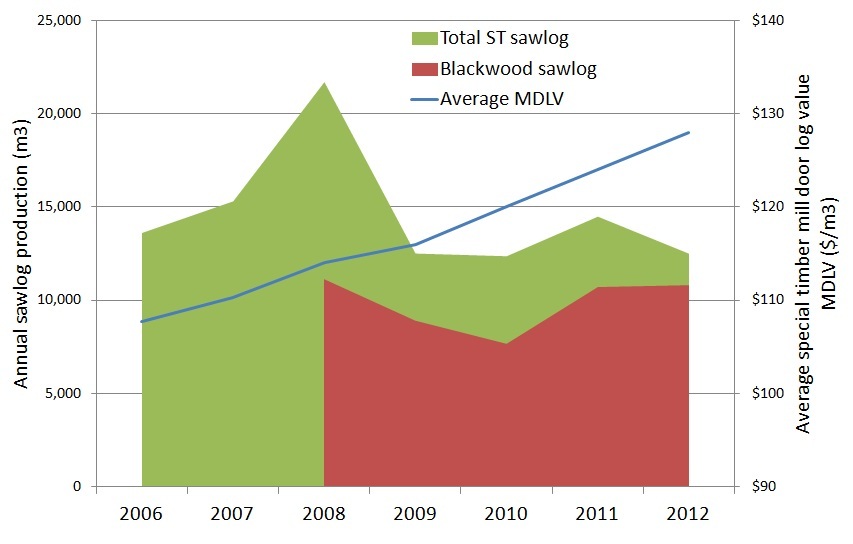
Forestry Tasmania (FT) is the major special timbers grower in Tasmania so analysing their production and revenue figures provides useful insights into the opaque world of the “administered” special timbers market. With blackwood comprising 70% of special timbers production by volume over the last 5 years this analysis is largely relevant to the blackwood market and its future. Over the last 5 years Forestry Tasmania has provided separate blackwood production figures but not separate blackwood revenue figures. The chart below shows total special timbers (ST) and blackwood production, and the average unit special timbers mill door log value (MDLV). All data is from FT annual reports.

FT chart

The chart shows that the introduction by Forestry Tasmania in 2010 of the non-profit non-commercial policy plus major taxpayer subsidy appears to have had no impact on the price or production of special timbers. Certainly none of the subsidy appears to have been passed on to the rest of the industry, unless the industry was already enjoying heavily discounted prices, and FT was just seeking formal reimbursement from the Tasmanian taxpayer.

We also know that FT sells their sawlog through “administered pricing” that “are not determined by regular market forces of supply and demand”. These administered prices are even immune to global financial disasters. The global financial crisis that struck half way through the 2007-08 financial year had a significant impact on demand, with special timbers production almost halving, but had no impact on the administered price. Extraordinary!

Forestry Tasmania provides no information on what basis they determine administered special timbers sawlog prices. With a non-profit business objective and a generous taxpayer subsidy the administered special timbers sawlog pricing policy is anything but clear.

What is clear from the above chart is that special timbers sawlog prices are basically indexed to inflation. Over the above 7 year period sawlog prices increased by an average 3.4% per annum – the long-term inflation rate. In other words special timbers prices are not determined by regular market forces of supply and demand, and do not increase in real terms over time. If that is not a disincentive to private growers and investment I don’t know what is!

All of this has little relevance except for the fact that:

  • blackwood is the dominant special timber species;
  • blackwood is common on many Tasmanian farms;
  • farmers already sell small quantities of blackwood into the special timbers market in competition with dedicated non-profit Forestry Tasmania;
  • blackwood is the only Tasmanian special timber species that has the potential to be grown profitably by farmers to grow and develop the blackwood industry as farmers are doing in New Zealand; and
  • All the other special timber species are too slow growing, and too rare on Tasmanian farms to be of commercial importance.

So what does the above chart mean for blackwood sawlog prices and the blackwood market in the Tasmania?

  1. Blackwood sawlog prices in Tasmania are dominated by Forestry Tasmania and are clearly heavily discounted to the point where even a global financial disaster has no impact.
  2. With prices having absolutely no connection to any market reality it reinforces the understanding developed in Part 1 that the blackwood market is effectively closed to private growers and investment.

Another useful perspective special timbers pricing is gained from looking at tender prices achieved by Forestry Tasmania subsidiary Island Specialty Timbers (IST).  IST provides the only market-based special timbers price information available anywhere. IST only tender a tiny volume of special timbers every year (less than 100 cubic metres) so their tender results may not represent actual market conditions. But if the tenders are competitive and the results show the best offers received then they are much more indicative of real current market value than the FT administered price. IST doesn’t produce any regular market report or annual report so tracking their performance is impossible.

What is clear is that there is a significant disparity between the IST tender results and the average administered price received by Forestry Tasmania ($128 per cubic metre in 2012).  Obviously Forestry Tasmania does not use its own tender results to inform their administered pricing rules, and why the special timbers industry is receiving a massive taxpayer subsidy while these price discrepancies exist raises serious questions.

Presumably blackwood administered sawlog prices are less than the average price of $128/m3, due to it’s greater availability and quicker growth rates compared to the other species. However given the dominance and the importance of the blackwood market to the future of the special timber industry and to private growers IST provides scant information on this species. Current tender results for plain-grain blackwood sawlogs range from $250 – $450 per cubic metre, significantly higher than $128. This shows that the market is prepared to pay significantly more than the administered price for special timbers. But to help gain greater accuracy, detail and transparency into the blackwood market IST should be tendering at least 500 cubic metres of blackwood sawlog per year and publishing more detailed and regular market reports.

If Forestry Tasmania’s administered pricing more closely reflected IST tender results we could potentially have a tripling of FT special timbers revenue. The industry would then be transparently profitable, no longer in need of a significant public subsidy and would instead contribute revenue to the State Treasury and the community.

These changes would also provide significant stimulus into the blackwood market, Tasmanian farmers would be selling more blackwood at higher prices and wondering how to grow more. And that is where the blackwood growers cooperative proposal becomes important.

To help put these special timbers sawlog prices into some perspective (which is not easy as sawlog prices in Australia are extremely opaque, while New Zealand sawlog prices are very transparent), current NZ Pinus radiata pruned sawlogs are $AU103 per cubic metre at wharf (allowing for differences in the exchange rate), while NZ unpruned douglas fir sawlog at wharf is $AU96. Pruned, farm-grown NZ Cupressus macrocarpa sawlogs are $AU240 per cubic metre at mill door, with macrocarpa grown on ~35 year rotations. Based on these comparisons Forestry Tasmania’s administered prices for our premium timbers are very shabby indeed and do not justify any public subsidy.

For the past 2 years I have been trying to understand why blackwood, a product that has been a quality Tasmanian icon for over 100 years, seems to have so little market activity, profile, price or transparency. Blackwood isn’t just an icon, it’s an enigma.

The commercial management of the special timbers industry by Forestry Tasmania and the State government is an unqualified disaster. The accounting, sales and pricing policies of Forestry Tasmania are directly inhibiting blackwood investment, destroying the special timbers industry and costing the Tasmanian community money at a time when the State can least afford it.

So what do you think?

Is Tasmania getting a fair deal for its public special timbers resource?

Do you think the industry has a great future as a profitable commercial Tasmanian icon?

Should FT change its sales and pricing policies to give Tasmanians and Tasmanian farmers a better deal for their special timbers?

Is a consumer boycott of the special timbers industry needed to motivate the industry to change?