Category Archives: Commentary

Storey (sic) needs a happy ending

The Mercury 10/5/2014.

It was great seeing someone from the special timbers industry, who understands that peace is fundamental to the future of the forest industry getting some good media coverage.

John Young

http://www.themercury.com.au/news/opinion/storey-needs-a-happy-ending/story-fnj4f64i-1226912229617

http://www.themercury.com.au/news/tasmania/timber-resource-at-risk-if-tasmanian-forest-agreement-is-ripped-up/story-fnj4f7k1-1226912333391

John Young, wooden boat builder and founder of the Shipwrights Point School of Wooden Boatbuilding in Franklin, had many interesting comments and suggestions to make about the past and current state of the Tasmanian forest industry, and forest management. And while I totally agree that peace in the forests is the first priority and absolutely fundamental to the future of the industry, Mr Young’s comments and ideas raised more questions than provided answers.

As a special timbers commercial competitor on private land, Mr. Young’s comments left me with the impression he does not regard special timbers as a commercial resource requiring fully dedicated profit-driven commercial management. Such a position clearly undermines the ability of Tasmanian farmers to grow commercial blackwood. It also shows a great disregard for Tasmanian taxpayers who are currently subsidising the special timbers industry, while our State health and education systems are in financial crisis.

If Tasmania cannot maximise the sustainable commercial return from it’s public special timbers resource then it should not be logged. Special timbers should not continue to be managed as a taxpayer-funded community service.

My other concern regarding Mr Young’s comments is that I’ve been reading and hearing “alternative” forest management strategies like this for the past 30+ years.  All of the dreams of “if only they” and “why don’t they” of a better forestry world. I think what the past 30 years have clearly demonstrated is that these dreams have never amounted to anything. The politicians, Forestry Tasmania and the forest industry “heavy weights” have never expressed any interest in changing the pro-industrial mass-harvest forestry model. Not in any comprehensive meaningful way. Certainly the Tasmanian Forestry Agreement (TFA) showed no change at all to the status quo and neither has the new Liberal State government.

And now the sector of the forest industry most clearly disadvantaged by this pro-industrial model, the special timbers industry, is being used by the politicians and sectors of the community as the pretext for returning Tasmania to the forestry wars. Tearing up the TFA is all about the special timbers industry. Blatant naked hypocrisy!

There is not bright new happy future. There is no special timbers business plan or management plan.

I think after 30 years of failed “alternative” forestry dreams it should be obvious to just about everyone that the dreamers are now part of the problem. They are now being shamelessly manipulated for political ends. Keep dreaming and you help to feed the cycle of forestry conflict and failure.

The Tasmanian community has paid a huge price for the forestry wars and it is time to stop.

It is blatantly obvious after 30+ years that Tasmania does not have the skills required to commercially manage its public native forest in a manner that is sustainable, maximises commercial returns, whilst minimising social and political conflict.

It is time for the forest industry, including the special timbers industry, to move 100% onto private land. To me that seems the only way we will ever put the forestry wars behind us.

For Mr Young and the wooden boat builders that will be a difficult transition. Mr Young wants peace and a happy ending. But the past 30 years have shown the reality regarding boat building timbers on public land, and that reality shows no sign of changing. On the contrary the situation is getting worse.

The only happy ending that is now apparent will be when we end public native forest logging. The last State election demonstrated that beyond any doubt whatsoever.

Reality bites: Part 2

Tasmanian economic commentator John Lawrence has written a magnificent summary of current “on-the-fly” forest policy, especially as it relates to the public native forest special timbers industry. It is deeply disturbing and illustrates the madness and stupidity that continues to be forest policy and management in Tasmania. Good reading.

http://www.tasfintalk.blogspot.com.au/2014/04/reality-bites-part-2.html

What Mr Lawrence fails to point out that is especially relevant is that since 2010 Forestry Tasmania have deliberately run their special timbers operations as “non-profit non-commercial”. They harvest these timbers to deliberately lose money! Makes absolutely no sense to me, and within the current economic, political and policy context is completely insane.

As Mr. Lawrence summaries, “I can’t recall such monumental idiocy”.

All this mismanagement and poor policy deliberately undermines the ability of private tree growers to make a living and destroys market confidence. And all of this stupidity is supported by the Australian Forestry Standard. Obviously good commercial and financial management is not part of good forest management. It certainly makes a mockery of the forest certification process.

The sooner we get the special timbers industry into the hands of farmers and away from the politicians, Forestry Tasmania and public native forest the better it will be for just about everyone.

More Stringfest Thoughts

In the review of my experiences and thoughts on the inaugural Deloraine Stringfest I said the major element missing were the proud, passionate and profitable tree-growing farmers – the first link in the chain from tree to instrument, farmer to artist. I was the only one exhibiting at Stringfest representing existing and future growers of blackwood and other special timbers.

From a business/market process point of view the Stringfest exhibitors (luthiers and tonewood merchants) were all pushing in the one direction. The luthiers were promoting and selling their instruments to players and performers, while tonewood merchants were promoting and selling their timbers to the luthiers – links in a chain. But there was little action in the opposite direction.

Why do we need action in the opposite direction? What action?

Markets work by an interplay/tension between supply and demand. The push and pull of the marketplace. If we are to encourage farmers to grow our special timbers for us then we need to provide as much incentive and information as possible. Trees are a challenging investment at the best of times so Stringfest provides an ideal forum for providing market, price and demand information in BOTH directions back to the farmer/tree grower all the way to the consumer/artist. All that passion, dedication and commitment can help drive some significant market activity.

At Stringfest the tonewood merchants should be looking to both sell their tonewood timbers to luthiers AND buy suitable trees/logs from farmers, and establish long-term relationships with tree-growing farmers. It would have been great to see some “LOGS WANTED” signs showing at Stringfest. Even some information telling people about what goes to making a good tonewood log, species, sizes, indicative prices, etc. The average farmer has absolutely no idea about the tonewood market. This needs to change and change quickly, so the more information the better.

Similarly Stringfest provides an ideal opportunity for luthiers to talk to tonewood merchants about their wood requirements and indicative prices. I saw plenty of this happening at the weekend, hopefully with some positive outcomes.

At Stringfest I spoke to a number of people who had trees they were interested in selling and I pointed them towards the tonewood merchants. I heard of a number of follow-ups being arranged which was great. At the moment the Blackwood Growers Coop remains more a dream than a reality. As the Coop develops then building relationships and markets with sawmillers and tonewood merchants will be an important goal. Hopefully in the future I will have “LOGS FOR SALE” as part of my Stringfest display.

Stringfest was not really marketed at the farming community but the farming community needs to be brought into the audience in future.

The question of the future supply of our special timbers was definitely the “elephant in the room” at Stringfest, especially given the extraordinary political events on the Friday. Stringfest provides a brilliant focus and opportunity to help resolve that question and remove the elephant once and for all. I’m already thinking about next years festival.

Cheers!

Black Friday

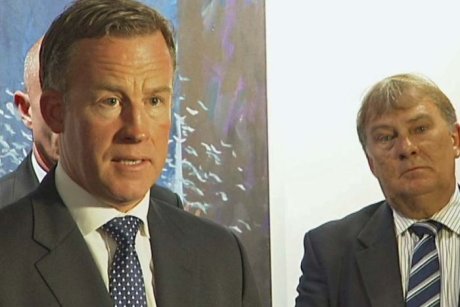
Last Friday March 21st 2014 Will Hodgman Premier-Elect of Tasmania on behalf of the forest industry, and particularly on behalf of the special timbers industry, officially declared war on the Tasmanian community.

That was my immediate and clear response to this news item:

http://www.abc.net.au/news/2014-03-21/no-detail-on-forestry-future-after-dumpoing-of-peace-deal/5336956?section=tas

Does the special timbers industry want to be part of this war?

Does the special timbers industry want to be used and manipulated as the reason for this war?

As a member of the special timbers industry trying to establish a business to help move the industry onto private land and away from the politics and conflict of public forest management I certainly do not!

Hodgman_Edwards

In the last 30 years I don’t recall the forestry wars being so formally declared, not with such blatant hostility and certainly not with the forest industry as reluctant (?) participants. Poor Terry Edwards (FIAT Chief Executive) standing behind Mr Hodgman looks more like a refugee trying to escape a warzone than a General about to lead what remains of his troops. “The world has moved on.” Indeed it has!

Some people think this is just a war against “the greenies” or those who failed to vote Liberal this time. But conflicts affect everyone. There are never winners in conflict; everyone loses, some more than others, often the innocent are the biggest losers. And the last 30 years of the forestry wars have been littered with false hopes and promises, and thousands of innocent victims. Politicians come and go while the victims are piled higher.

The losers over the last 30 years have been the forests, the forest industry and the Tasmanian community. That fact should be obvious to everyone. This time is no different.

Having spent last weekend as an exhibitor at the inaugural Deloraine Stringfest, it became very clear to me that this may have been the first and last Stringfest. Stringfest is a celebration of Tasmanias world-class timbers, the craftspeople who turn them into musical instruments, and the artists who play them. I was the only exhibitor representing the first link in the chain back to the trees and the people who grow them. That link needs to be strengthened and promoted. Farmers as proud tree growers need to become an integral part of Stringfest if it is to grow and have a sustainable future. There was no one at Stringfest representing Forestry Tasmania and public native forest management.

I spent the weekend at Stringfest wearing a black armband in mourning for the forest industry and the people of Tasmania.

Landmark events such as Stringfest and the Wooden Boat Festival, which showcase special timbers, will be used by our politicians as weapons to escalate the conflict. Even retailers, consumers and artists will be used as pawns in the battle.

The special timbers industry, whether it likes it or not, is being used as a weapon against the Tasmanian community. Talking to people at Stringfest there was a wide range of opinions within the industry. There was certainly no possibility for consensus on a future strategy. Many were resigned to the wars as passive observers. Some in the industry have already moved their supply sources onto private land in an attempt to avoid the conflict. A few are even looking forward to the coming battle in the hope that they will succeed. The last 30 years clearly show that outcome is very unlikely.

Many people have a “why don’t they….?” or “if only they would….” attitude to the problem. “The forests are there, if only we could manage them properly, then everything would be ok and everyone would be happy”. This fairytale dream just won’t happen. If anything the real world has moved in the opposite direction. The more people hold onto this fairytale the worse the nightmare becomes. In my opinion this fairytale has now become part of the problem. We need to give up the fairytale and move on.

Many people will not accept my interpretation of these events. That’s fine by me. People believe what they want to believe. Everyone has a different view on life.

Does the special timbers industry, including retailers, artists and consumers, want to be used and manipulated as the reason for this war?

What is more important?

Continuing to have access to conflict-ridden, unsustainable, taxpayer-subsidised special timbers from our public native forests, or moving the industry onto private land and bringing peace and prosperity to Tasmania?

For some in the special timbers industry this transition will be impossible, but for many it is a very real alternative. Many have already made the transition.

Please don’t be a pawn in Mr. Hodgman’s political power games. It is time to decide!

Go Deloraine Stringfest!

What a hoot!

I had a fantastic time as an exhibitor at the inaugural Deloraine Stingfest.

It was fantastic meeting so many people in the industry as tonewood merchants, luthiers, and artists. It was also fantastic meeting and talking to so many of the public who came along. I had many great conversations with people.

I met many farmers and landowners who expressed interest in becoming commercial blackwood growers. I will be contacting the most enthusiastic to arrange a visit, and hope to get phone calls or emails from many others.

I want to thank and congratulate the organisers and people who volunteered their time and talents to make Stringfest happen. And to the people of Deloraine who helped make the event such a success.

As an exhibitor I didn’t get to see much of the festival myself. But I saw 5.5 hours of absolutely brilliant performances on Saturday night. It was a long day but well worth it.

Stringfest definitely has the potential to become a major Tasmanian cultural and community event. It features so many aspects that attract and interest a wide audience. And there is no doubt about the quality, the passion and commitment.

From my point of view one major aspect missing (under-represented??) was the proud, passionate tree-growing farmers. I was there promoting that dream, that opportunity, but if Stringfest is to have a sustainable future then all the links in the chain from tree to instrument, from farmer to artist must be represented and promoted. This is especially true within the current political madness and conflict with the public native forest resource.

I spoke to a few people about the idea of having a mini-Stringfest stall at Agfest to help promote and build interest and relationships with the farming community; to help create that first link in the Stringfest chain. Some of us are discussing this idea to make it happen in 2015. Anyone interested?

Create the full chain from farm to stage and Stringfest could easily become a unique major international event.

Thanks to Kevin for buying the two display blackwood trees that I brought up from Hobart and didn’t want to bring back home. I hope they have found a good home.

Cheers!

State election and the future of the forest industry

With the State election over I guess I need to make some comments on the outcome and what it means for the future of the forest industry, special timbers and blackwood. I’ve been a passionate supporter of forestry and special timbers for many, many  years, but it has been a very hard road. The next few years will most likely bring no relief.

There is no doubt the election was a resounding defeat for the incumbent Labor Government. But in my experience of Australian elections, if there is a change of Government the story is primarily about dissatisfaction with incumbents. In very few cases I have witnessed have Governments changed because of Opposition policies. The main reason Opposition parties win elections is because it is mostly a two horse race and one horse goes lame. Some people call this the “Bradbury effect” (no relation by the way).

Another thing that was absolutely perfectly clear in the election campaign was that Labor and the Greens promised to uphold and support the Tasmanian Forestry Agreement (TFA), while the Liberal Party made it perfectly clear they had a very strong adversarial forest policy. No Liberal candidate I heard or read said anything about peace in the forests. A vote for the Liberal Party was a clear vote for a return to chaos and conflict in the forest industry.

For the Liberal Government to now say that the people have spoken and all opposition to Liberal forest policy must cease is just nonsense. This is akin to saying that opposition parties in Parliament must cease questioning Government policy. I never saw Will Hodgman behave in this manner when he was in opposition. That elections are a clear decision-making process on any single issue is in my opinion drawing a very long bow indeed, but that is the game politicians like to play.

So like it or not Tasmanian’s voted overwhelmingly for a return to chaos and conflict in the forest industry.

If I was Alan Kohler on the nightly TV News I would now be showing a chart of Sovereign Risk in the forest industry plotted against Investor Confidence. And guess what? The former line would now be rocketing skyward, while the latter (if it was visible at all) would be negative and heading south.

The new Liberal Government has promised to tear up the TFA, and to rescind part of the recent additions to the World Heritage Area. Under these conditions the chance of Forestry Tasmania achieving Forest Stewardship Council (FSC) certification is now very slim indeed. No FSC Certification means very limited market opportunities for Tasmanian timber. Forestry Tasmania is technically bankrupt and cannot survive for much longer under these conditions.

The special timbers industry, which is currently mostly dependent on logging old-growth public native forest, must now play the final game. My guess is that the new Government will allow this logging to resume, at increasing taxpayer’s expense. Perhaps even allowing logging within our National Parks. It will be a complete and very expensive disaster. When the political tide turns again there will be nothing left.

In some ways this should bode well for a blackwood growers cooperative. Markets should begin calling for alternative sustainable supplies of special timbers, which are profitable and free of politics. What will likely happen however is that media and political attention will focus entirely on the drama and spectacle of the escalating forestry wars. Options for the future will be ignored. Unless members of the blackwood and special timbers industry want to be swept away in the coming tsunami then they had better think carefully about their future.

And all of these shenanigans impact the forest industry Australia wide. Tasmania continues to be the pariah that infects the whole country. As has been the case these last 30+ years, forestry is all about politics in this country. It has very little to do with commerce and business. And so it shall remain for the foreseeable future.

It’s going to be a very interesting and entertaining year.

More concerns for the public blackwood resource

Here’s an extract from an email I recently received from another forest industry employee.

My guess is that Forestry Tasmania will cease to exist within a few years. I ……… know something of the [public] resource that is left in the North West and it’s not much. Available mature [eucalypt] resource has been largely logged and most of what is left is either not economic or has been locked up. High quality [eucalypt] regrowth sawlog resource has mostly been logged. What FT has available is mostly younger regrowth that is too young for sawlog, most of which is earmarked for Ta Ann. The blackwood resource is limited and I suspect has 5 years left at current harvest rates.

That’s 5 years of public blackwood sawlog resource remaining to be harvested before it’s all over. This certainly correlates with my own expectations of the available public resource.

The end of the blackwood industry as we know it.

AFS and FSC Certification will count for nothing under the current scenario.

As part of the Tasmanian Forestry Agreement Forestry Tasmania is currently undertaking a special timbers resource review which is due for release later this year. It is not known whether this review will include blackwood. Given the increasing uncertainty about the public blackwood resource, the resource review report will have to be very convincing in its detail and analysis. The last blackwood resource review in 1999 was anything but convincing and detailed. The fact that Forestry Tasmania has been harvesting blackwood well above the sustainable yield since the last review is just one of many points of concern.

As I’ve said before the transparent process of regularly planning, executing, managing, reviewing and reporting the sustainable blackwood sawlog production from public native forest is clearly not up to scratch, and is certainly not worthy of FSC certification.

The growing uncertainty about the sustainability of the Tasmania’s blackwood industry is cause for concern. But questions about the sustainability of the resource may be over-shadowed by more immediate issues such as the State election in March, and now the dire state of the State Government budget. Post-election the new incoming Government will have no option but to make major cuts to Government spending. Schools and hospitals will be obvious targets. But there will be no more hand-outs for the forest industry. Non-performing assets like Forestry Tasmania will be told in no uncertain terms to ship-up or shape-out. Forestry Tasmania may be forced to abandon its “non-profit, non-commercial” special timbers activities even before the resource review is finished!

It’s going to be another very hard year for the forest industry.

The only future for the blackwood industry is to focus on private growers. There is a small existing resource that can be utilised, but the focus must turn to rebuilding the resource base on private land with a dedicated growers cooperative. Engage private land owners to learn to manage and grow more blackwood. A key part of this strategy must be greater market and price transparency.

The only other option is that we all disappear into the dusty pages of history, and let the New Zealand farmers take our blackwood heritage and industry.

PS. Meanwhile the forest industry in New Zealand just keeps going from strength to strength – absolutely unstoppable!

http://www.scoop.co.nz/stories/BU1402/S00316/stars-align-for-nz-foresters-as-wall-of-wood-comes-on.htm

Markets for farm-grown timber?

money

Here’s an email I recently received from a client that raises a number of important issues.

There’s no point growing trees for timber production if there’s no market for the timber. It appears that in NZ and Tasmania there are a number of places that farm forestry growers could sell blackwood as log or possibly sawn. What’s available in Victoria? I asked this question recently of one Victorian agroforestry consultancy. They didn’t have an answer. There are some furniture manufacturers in Victoria who use blackwood so they might be interested in taking timber but I’m guessing only if it has been sawn and seasoned. Perhaps some of the timber sellers will buy from growers but again I suspect if it has been sawn and seasoned. There are markets such as the craft/hobby/specialists such as luthiers which will take small volumes. I guess they could be supplied directly, through WWW fora or by selling to distributors.

This lack of clearly defined sales opportunities for species beyond E. globulus and Pinus radiata (and some niche opportunities such as several species that the Yarram sawmill actively pursues) is IMO a serious impediment for farm forestry in Victoria generally. I raised this issue in a submission to the Vic farm forestry strategy initiative a year or so ago. Perhaps that initiative will lead to some clarity of what can be sold where in Vic. There was an excellent guide published in Qld some years ago, for example, that details what timber is required for what markets and what prices may be expected.

There’s a great deal I could say in reply to this.

There are various reasons why farm forestry has never taken off in Australia despite the AFG having being around since the late 1960’s when the industry was much bigger than it is today. To me the main reason has been poor forest policy and management, and above all a lack of commercial process and management. The forest industry until recently has been run as a sheltered workshop for a select few, centred around a public native forest and plantation resource. So no transparent, competitive markets have ever developed for wood products in Australia. Farmers have never been encouraged to become commercial tree growers through proper market processes and competitive, transparent prices.

With the steady decline in the industry over the last 40 years, and especially since the GFC, the few remaining markets are rapidly disappearing. Sawmillers have traditionally played “rent seeker” with State Governments, rather than behave in a rational commercial manner and engage all landowners (public and private) to grow and supply them with sawlogs. Remarkably they are still behaving as rent seekers even as they now face almost certain extinction. The political games will keep them alive but it will be a long slow painful death; much like a cat playing with a mouse.

We are fast approaching the point where the hardwood sawmilling industry in Australia will collapse and disappear, and will have to be rebuilt from scratch, as they are attempting to do in New Zealand. In this new environment, portable sawmills will play a major role. Here are two examples of what the future may look like:

http://www.northcoasttimbers.net/ based in north-coast NSW, and

http://mobilesawmilling.com/ based in SE Queensland.

I can’t imagine why similar businesses are not operating in Victoria, such as one in Gippsland, another in the north east, perhaps another working the Otway/Ballarat area. Farmers who have small volumes of logs to saw for their own use or to sell would readily make use of such a service. And the portable sawmill owners could develop a network of contacts in the market to on-sell sawn timber. Being small, portable and efficient seems to be the key to success.

I suspect that most of our eucalypt hardwoods will never be valuable enough to support investment beyond this basic level, supplying small local niche markets. Even where high-value species are concerned, such as blackwood, the future will be difficult, unless those species already have significant local and international market profile (such as blackwood). The timber volumes required by the local market will be small even if the prices might potentially be high. Unless enough of a species is grown to allow access to export markets, then it will just be local niche craft markets. It’s a “chicken and egg” situation. Scale of planting and log value against local and/or export markets. One can’t happen without the other.

It will be interesting to watch how NZ blackwood farmers develop towards a collective marketing model for their trees that are now reaching commercial maturity. They have enough potential volume to begin accessing export markets so the rewards could be very good if they succeed.

Selling small parcels of logs and single logs will always be difficult, even if they are excellent quality logs of premium timber.

The fact that our sawmillers aren’t in the marketplace aggressively looking to buy sawlogs from wherever they can source them is a great curiosity to me. I can only interpret this behaviour as meaning that the logs are just not worth buying. The value of the timber is just not worth the effort. There are plenty of sawmiller websites around but I have yet to find one that has a “Wanted to buy” sign out the front. They are all about what they have to sell. Despite the collapsing industry the remaining sawmillers think their future supply is 100% secure. Very curious!

People like Jon Lambert at Heartwood Plantations have a much more commercial focus and a different business model, but I think even they don’t push the market hard enough. I’d love to know what they think of the current situation.

While the forest industry in Australia avoids becoming hard-nosed commercial and remains bogged down in politics and ideology, then farm forestry will continue to be a hard road. You mention the new Victorian farm forestry strategy. I’ve seen so many strategies come and go over the years with no impact at all, I’m afraid I’ve little faith in political support anymore.

So coming back to a farmer/growers viewpoint, you need to think carefully about what you are trying to achieve, and that means understanding the factors that will help or hinder you selling your wood in the future. Planting a lot of different species might be fun and interesting, but when it comes time to sell, you will find very few buyers unless you have done your homework.

What are the main local markets for premium timber? Cabinetry, flooring, furniture, panelling??? I don’t think structural solid hardwood has any future. What little structural hardwood that the market wants will all come from reconstructed wood such as LVL. So what species can you grow to supply the flooring and panelling market? Etc., etc…

I’m comfortable promoting blackwood because it has a well established local market profile and a growing international profile. But I realise my time is limited. If the remaining forest industry crashes and burns, as seems likely, then getting a growers cooperative going will be that much harder. Blackwood has a great future, but for the foreseeable future the Kiwis will be the drivers and dominant players in the blackwood market.


Seeking Stakeholder Feedback

FT Help Us Improve

Within the chaos and conflict being generated around the up-coming State election in March, Forestry Tasmania is in the initial stages of their Forest Stewardship Council (FSC) certification process. What a complete debacle!

They have called for feedback on their initial draft FSC Objectives and Criteria, with a closing date of 31st January.

http://www.forestrytas.com.au/help-us-improve

My feedback is purely focused on commercial management and practices at Forestry Tasmania. Private companies that apply for FSC certification don’t need to demonstrate good commercial management, it is fundamental to their very existence. Not so Government agencies such as Forestry Tasmania. They traditionally have no commercial focus. Forestry Tasmania has a very poor history of commercial management and performance. Therefore the FSC process provides a rare opportunity to put pressure on FT to improve its commercial performance.

At the moment FT is directly undermining my efforts to create a blackwood growers cooperative. FT is also draining $100 millions of taxpayer dollars from the State Treasury. This is money that should be going to improve our schools, hospitals and roads, not propping up an underperforming forest industry. These issues should be of vital importance to the FSC assessors.

In fact at a general level FT are applying for FSC certification even although nothing fundamentally has changed over the last 2 years. FT is still the same organisation with the same values and modus operandi. Given the last 30 years of conflict there seems to be little basis for hope in any of this.

So here is my submission for initial feedback, which I have emailed to them and posted here for your enjoyment. It will be interesting to see where all this goes, especially within the context of the State election. FT and the forest industry are very politically exposed. No matter what happens it will be another bad year for the industry.

[insert]

Dr Gordon Bradbury

12/12 Saunders Cres.

South Hobart, 7004, TAS.


January 28, 2014

Mr. Steve Whiteley

Chief Executive Officer

Forestry Tasmania

79 Melville St.

Hobart, TAS. 7000.


Dear Mr Whiteley:


Re: Draft Forestry Tasmania Management Plan FSC Criteria and Objectives


Firstly congratulations to Forestry Tasmania for seeking to gain Forest Stewardship Council (FSC) Certification. Good luck!

I will focus my feedback on the business/commercial aspects of the draft FSC Criteria & Objectives (C&O).

Generally-

It is very clear that the draft Forestry Tasmania FSC C&O continues the culture of community service and charity that has been the heritage of Forestry Tasmania for many decades, and completely ignores the significant commercial realities facing the forest industry today. This attitude will guarantee the continuing decline and extinction of the forest industry in Tasmania. Here are some basic facts:

  1. The growing of trees for wood production in Australia is a commercial business. It has nothing at all to do with community service, industry support, charity or any other politically-driven outcomes.
  2. The vast major of wood now grown and sold in Australia is grown by commercially driven private forest growers with which Forestry Tasmania competes in the marketplace. These private tree growers seek to maximise profit within the context of good forest management. That is their primary objective, as with all businesses.
  3. For Forestry Tasmania to operate in any way other than fully commercial and profitable is anti-competitive, disrespectful to all Tasmanians and destructive of the forest industry.

I repeat!

Forestry is a business!

Forestry Tasmania has a poor history of corporate governance, commercial management and performance. All reports and indications (including the recent URS Report) show that commercial viability will remain the major challenge for Forestry Tasmania. Potentially hundreds of millions of taxpayers’ dollars will be needed to prop up Forestry Tasmania for the foreseeable future. This is money that should be going to our roads, schools and hospitals not the forest industry. From a financial reporting and commercial management viewpoint the Forestry Tasmania Annual Report is a failure (for a better example of a State forest agency annual report see the NSW Forestry Corporation here).

Examining company websites is a useful way to gauge the focus, discipline and management of a business. Looking at Forestry Tasmania’s website it is difficult to see exactly what business they are in; certainly it does not appear to be wood production!

So it worries me that the C&O contains such nonsense statements as:

•           Provide the foundation for a strong, competitive and sustainable Tasmanian forest industry and support local processing and value adding of wood products.

•           Make available an ongoing supply of forest products (including high quality sawlogs, peeler billets and special species timber) in accordance with the Forest Management Act 2013 and the Tasmanian Forest Agreement Act 2013.

•           Maximize the recovery and utilisation of wood products from forest operations.  

There is no mention at all of “commercial, efficient, competitive, profitable wood production”. No mention of regular annual dividends to be paid to the Tasmanian Treasury. Absolutely no commercial focus at all.

Forestry Tasmania continues to regard the forest industry as disabled or handicapped, in need of continuous prosthetic support. The forest industry is not disabled or handicapped. The only handicap the industry has is being too willingly dependent on Government largesse, lack of commercial focus and proper market processes.

No private tree grower would ever consider adopting these three objectives. They represent commercial suicide. For Forestry Tasmania to adopt these objectives is anti-commercial and anti-competitive. They undermine the competitiveness and profitability of the entire industry, and existing and potential future private forest growers.

For examples of sensible FSC C&O that have been developed for commercially-focused private tree growers check out:

http://www.sfmes.com.au/wp-content/uploads/2013/10/SFM-Forest-Management-Plan.pdf

and

http://www.pfolsen.com/nz_index.php?sect=fsc&inc=ogs

There is no mention in these examples of industry support or obligated wood supply, or meeting political objectives, and certainly no mention of picking up the last piece of firewood regardless of cost/profitability. That’s not what private tree growers want at all. There is no mention of competitive, efficient and profitable either because these goals are fundamentally implicit in running a private business. Not so with a government business enterprise.

The only commercial objective Forestry Tasmania needs is to be a fully commercial, competitive, efficient and profitable grower of wood.

Now to specifics-

And now to the specific reason for my critical submission. For the past 3 years I have been attempting to get a blackwood growers cooperative established in Tasmania, but with limited success. This is in part due I believe to poor State forest policy and the policies and practices of Forestry Tasmania.

Special timbers represent the very worst example of “commercial” management by Forestry Tasmania. The fact that Forestry Tasmania no longer regards special timbers as part of its commercial operations is absolute nonsense, commercial sabotage and disrespectful of the Tasmanian community. That Australia’s “most valuable” timbers are supplied to the market as a taxpayer-subsidised community service is an absolute disgrace. What a joke the forest industry has become.

The only forests that should be harvested are those that can be harvested profitably. There should be no “cost-neutral”, “non-profit” or taxpayer-subsidised harvesting of public (or private) native forests.

This Forestry Tasmania “non-commercial” policy undermines my attempts to create a blackwood growers cooperative. Blackwood has been Australia’s premier appearance-grade timber for over 100 years. Blackwood (Acacia melanoxylon) represents approximately 80% of the annual harvest of special timbers by Forestry Tasmania, with Forestry Tasmania being by far the dominant supplier. Blackwood is the only Tasmanian native timber that can be grown in commercial plantations, which New Zealand farmers have been doing for the past 30 years. Blackwood also occurs commonly on private land across northern Tasmania. Therefore any “non-profit, subsidised” blackwood harvesting by Forestry Tasmania directly undermines the ability of existing and future private land owners to grow and harvest commercial blackwood.

I will save my criticisms of the sales and marketing policies and processes used by Forestry Tasmania for a later submission.

The corporate governance, commercial management and performance of Forestry Tasmania have been the subject of much analysis and criticism for many years by many observers, including the State’s own Auditor-General. The draft FSC C&O provide no cause for optimism that this is about to change. The current commercial management at Forestry Tasmania encourages and rewards rent seeking behaviour within the forest industry that results in negative economic outcomes.  Forestry Tasmania must either be managed like a commercially-focused profit-driven private forest grower or it must be shut down.

In conclusion, these so-called commercial objectives in the draft FSC C&O are a joke. They are anti-commercial, anti-competitive, and disrespectful to the Tasmanian community at a time when the State is already financially challenged. For the forest industry to continue to be a drain on the public purse whilst discouraging new investment is unacceptable and unworthy of FSC recognition and support.


Sincerely,


Dr. Gordon Bradbury.

Seasons Greetings

Well another year comes to a close. It’s time to wish everyone a happy and safe festive season, and a bright and prosperous new year; and to reflect on the year past and the year ahead.

2013 saw the Tasmanian Forestry Agreement Act passed through the State Parliament but with no funding support for the blackwood growers cooperative. But the TFA provides little comfort for anyone including the forest industry.

2013 also saw the sad passing in March of New Zealand blackwood scientist and advocate Ian Nicholas following a brief illness. He will be missed. But Ian managed to leave one final fantastic legacy for blackwood growers in the online video “Blackwood in New Zealand”. For existing blackwood growers or farmers wanting to find out about growing commercial blackwood this is a brilliant resource. Thankyou Ian!

2013 also saw the record-breaking prices for blackwood logs at Island Specialty Timbers tenders. Firstly at the August tender where a record price of $2,750 per cubic metre was set. This was followed by the October tender where the record was reset at $2,900 per cubic metre. Extraordinary results and indicative of what the market is prepared to pay for premium blackwood.

2014 promises to be yet another turbulent destructive year for the forest industry in Tasmania, with the State election in March looking to undermine the TFA and reignite political and community tensions. 2014 also promises progress with FSC Certification for Forestry Tasmania, to cement in place a failed business model for the forest industry and taxpayer support for years to come. It will also see progress perhaps on the public special timbers resource and even more politics and stupidity. Oh what fun!

In 12 months time the forest industry in Tasmania will be in even greater crisis than it is already. That is a very easy prediction to make.

Despite the lack of official support for the blackwood coop, modest progress continues. There continues to be a steady stream of enquiries from farmers/landowners and others. It comes as no surprise to me that more enquiries come from the mainland than Tasmania. Whenever anyone in Tasmania thinks of trees or forestry they immediately think of politics, conflict and failed MIS schemes. Mainlanders happily do not suffer from this affliction.

Progress was made during the year with a small but growing number of successful blackwood plantations. Their stories can be read here. Highlights include the successful first thinning at the Carrabin plantation, and the discovery and visit to the Robertson plantation in NSW. These plantations demonstrate the potential for commercial blackwood as a farm investment. Yes there is still much to learn, and there will be failures and disappointments as we continue to discover where and how we can and can’t grow commercial blackwood. But the number of successes will increase and the failures decrease as our knowledge and understanding continues to grow.

New Zealand blackwood farmers move gradually towards their first significant harvests in the next few years, with many of them actively coordinating to build markets, processes and infrastructure.  By 2020 New Zealand will be producing more blackwood timber than Australia. I can only hope that their success will attract interest from Tasmanian farmers.

Looking back 2013 has been a big year. 2014 promises to be another big year full of forestry chaos and hopefully progress with the blackwood coop. It would certainly help me to find a benevolent sponsor or a business model that provided me with some income. In the mean time I will soldier on.

Thanks to everyone for your support this year. See you in 2014.