Category Archives: Commentary

War and peace – and war again? The battle for Tasmania’s ancient forests

The Guardian

18/09/2014

Guardian

I sure do get tired of all the politics in this business. I wish I could just focus on good news stories but they are far outnumbered by stories of politics and conflict.

But this story in The Guardian is very well written, if a bit long. And it has a nice focus on the human aspect of the whole terrible ongoing battle.

http://www.theguardian.com/world/2014/sep/18/-sp-tasmanian-forestry-peace-deal

Tasmania does not have a forest industry.

It has a war zone.

And all of this madness whilst the State forest management agency Forestry Tasmania remains technically bankrupt, and only able to survive by continuing taxpayer subsidies.

It’s a taxpayer subsidised war zone.

Enjoy the read.

Tasmania’s magnificent blackwoods

The forest industry TV series “Going Bush” offers a traditional view of the “public service/public forest” forest industry. It’s a view dominated by science and professionalism. In my view that is a very 19th century attitude to forestry that just doesn’t work in the 21st century.

As their website says:

The television show about our forests, the people who work in them and the industries they support. Going Bush is designed to be entertaining, informative and most of all give the proud and passionate people that work in our forest industries a voice, a chance to tell their stories.

http://www.goingbush.tv/

This particular video on blackwood is an excerpt from Series 4 Episode 2 and comes from a few years ago.

The video showcases some of the issues around public native blackwood forest management and the blackwood industry. There is no doubt that Forestry Tasmania has contributed significantly to our understanding of native blackwood forest management, in the same way that New Zealand farmers and foresters have dominated research into successful commercial blackwood plantation management.

The video is a bit of forest industry propaganda that highlights the “good bits”. There is a “business-as-usual, everything is going really well, don’t you worry” persona about the video that hides the very real turmoil within the industry. Blackwood issues such as the overcutting and mismanagement of the public resource, taxpayer subsidies, the incessant politics and community conflict are conveniently ignored.

And as for the remark by the hosts near the end of the video that there will be “blackwood sawlogs for decades to come” that is a long way from the truth.

Apart from that it’s entertaining.

Enjoy!

Continuing into the abyss

With resolute determination, precision and predictability the Tasmanian forest industry continues its long, slow, painful journey towards extinction with the dismantling of the Tasmanian Forestry Agreement 2013.

http://www.abc.net.au/news/2014-08-28/tasmanian-forestry-repeal-bill-passes-parliament/5702524?section=tas

http://www.themercury.com.au/news/tasmania/liberals-forestry-bill-passes-first-vote-in-legislative-council/story-fnj4f7k1-1227038639934

http://www.examiner.com.au/story/2519505/mlcs-poised-to-axe-forest-deal/?cs=95

And despite numerous promises by the State Treasurer and the State Resources Minister to not continue using scarce Tasmanian taxpayers money to subsidise the logging of public native forest, that is exactly what has been announced for yet another year.

With no plan for the forest industry and no plan to change Forestry Tasmania into a fully commercial profitable Government Business Enterprise, there is now little hope for the future of the industry.

With the forestry wars resuming it is unlikely Forestry Tasmania will gain FSC certification. Not that it matters. Either way no one but the Chinese will buy Tasmanian forest products; and the Chinese will only buy if the Tasmanian taxpayer pays for the harvesting and transport.

It’s pretty much all over! There is nothing left but a whole lot more pain for the community to endure.

It’s now just a case of watching the last remaining customers close business – the sawmills, the furniture factories, the craft shops and retailers.

This is economic and commercial mismanagement that the Tasmanian economy can well do without. Private forest growers are just overwhelmed by the tidal wave of negative political and market sentiment.

New group looks to become Fonterra of forestry

Here’s a great story for all those 14,000 New Zealand farm forest growers with plantations coming due for harvesting. If this is successful it will revolutionise the already very successful New Zealand forest industry. Forestry is New Zealand’s third largest export earner after dairy and meat. Last year’s total forestry exports were worth $NZ4.3 billion.

Yesterday a new forestry company, United Forestry Group, targeting owners of small forests in New Zealand was launched. Its cornerstone shareholder is a joint venture between international timber marketer Pentarch, which is headquartered in Melbourne and has been operating in New Zealand for more than 10 years, and a Chinese conglomerate, Xiangyu Group. The company’s offering small forest owners (there are around 14,000 forests under 1000 hectares which account for just over a third of New Zealand’s plantation resource) benefits similar to the pastoral sector’s co-operatives such as Fonterra in marketing and economies of scale.

It is believed production from New Zealand’s small forest growers over the next 20 years could be worth $NZ30 billion.

http://www.fridayoffcuts.com/#1

http://www.3news.co.nz/United-Forestry-Group-aims-to-fight-wall-of-wood/tabid/421/articleID/357877/Default.aspx#ixzz3B9znGRRR

I wonder if the United Forestry Group will form sub-groups to offer these services to growers of other species besides Pinus radiata, such as blackwood? New Zealand blackwood growers would really benefit from such a service.

Those New Zealanders really do understand what forestry is all about.

I will be following this story closely over the coming years to see how it develops and keep readers informed. It’s good to have a good news story.

Belligerent

Important market update

PaulHarrissMHA

Not many people would regard the Forestry (Rebuilding the Forest Industry) Bill 2014 currently before Tasmania’s Legislative Council as anything other than an act of belligerence.

http://www.abc.net.au/news/2014-08-20/vote-to-tear-up-forest-peace-deal-delayed/5684846?section=tas

http://www.themercury.com.au/news/forestry-bill-set-to-pass-as-robert-armstronng-throws-his-weight-behind-the-plan/story-fnj4f7kx-1227031161942

The Bill provides privileged treatment for the so called special timbers industry. It effectively puts the special timbers industry above the law, subject to no effective planning, regulation or control.

The Bill gives anyone (excluding Forestry Tasmania) the opportunity to harvest special timbers from reserves, conservation areas and other public forest.

The Bill gives no consideration to commercial matters, profitability, sustainability or good forest management.

This will likely produce a special timbers free-for-all as everyone scrambles to take all the special timbers accessible from the existing road network, legally or otherwise. Never mind the land tenure, have ute and chainsaw – will harvest. Tasmanian sheds will be overflowing. A belligerent Government may well turn a blind eye.

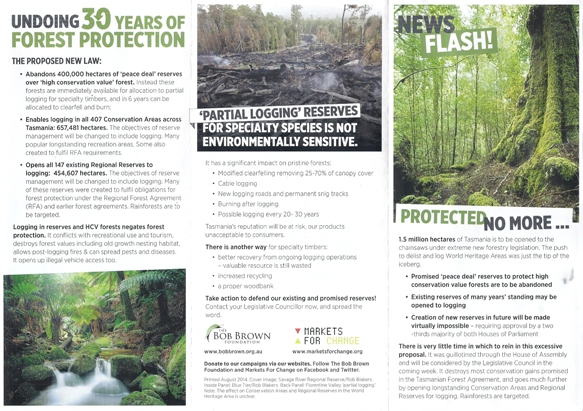
This situation is already generating a swift, negative reaction from the Tasmanian community and the broader market. A consumer boycott of Tasmanian timbers including blackwood is almost inevitable.

This just arrived in the letterbox today so the community reaction is underway.

Special Timbers Protests

Special timbers events such as the Wooden Boat Festival and the Deloraine Stringfest will be particularly hard hit by the negative reaction.

The problem for my business is the there is no way for the market to distinguish between special timbers from private growers, and that harvested from public forest under this new legislation, or simply stolen.

Everyone in the special timbers industry will be significantly impacted, from sawmillers to merchants, craftspeople, and furniture and guitar makers all the way through to retailers.

The broader forest industry runs the very real risk that this issue wont be quarantined to just the special timbers industry, but will impact on the broader forest industry market. After all:

Forestry = politics = Tasmania!

Continuing to treat the special timbers industry as a taxpayer-funded sacred cow with free-reign to the public forest resource is guaranteed to turn very ugly. This has every chance of becoming Tasmania’s next forest industry disaster.

It will discourage existing and potential private special timbers growers from investing in the future of the industry. It is difficult to understand why the Government wants to destroy the iconic special timbers industry.


Yet another forestry advisory council & another forest industry plan. Is anyone counting?

Edwards&Bailey

Tasmania gets yet another forest industry council, and another industry plan to add to the vast collection of previous plans and strategies gathering dust down at the State library. I thought the RFA was the forest industry plan to end all plans. Clearly I was mistaken.

http://www.themercury.com.au/all-grow-for-forest-sector-as-resources-minister-paul-harriss-announces-new-advisory-council/story-fnj3twbb-1227026836938

At least FIAT head Terry Edwards understands that a broad balance of membership is essential for the advisory council to be anything more than a straight political play. Full credit to Mr Edwards for coming out and saying so.

http://www.abc.net.au/news/2014-08-17/loggers-back-environmentalists-joining-tasmanian-forests-group/5676356?section=tas

I don’t hold great hopes for anything new coming from this group. At most the Council and Plan will expire at the next State election and be replaced by the next New Council and Plan. This has been the trend for the past 40 years both in Tasmania and elsewhere around Australia.

For what it’s worth here’s my five points to build a successful forest industry for Tasmania:

  1. The Tasmanian forest industry will never succeed while it is dominated by Forest Tasmania and the politically-driven community service/employment program/charity business model. Forestry is business not politics!
  2. Forestry Tasmania must be managed on a fully commercial basis with profit as its primary objective. No other business model will work.
  3. As New Zealand clearly demonstrates, a successful forest industry is all about the growers, not the processors. Tasmania needs a large number of private commercial, profit-driven tree growers, both industrial and farm-based, with the focus on the private tree growers and not Forestry Tasmania.
  4. The existing forest industry processors (sawmillers, exporters, furniture makers, etc.) must engage strongly and directly with all growers to encourage and reward profitable tree growing. Once tree growing is accepted within the community as a legitimate profitable land use then the processors will have a commercial future. The processors will have to compete and struggle to survive but that is exactly what private enterprise does best.
  5. As has been found with other agricultural commodities, Tasmania does not compete terribly well on price. We are a small, high-cost producer a long way from markets. Forestry is no different. Forestry must focus on growing to meet high quality, high-value, niche markets. Blackwood fits this description perfectly.

I don’t expect anyone in the new advisory council to take any notice of this, not even the TFGA and PFT, so I expect the forest industry will continue to decline. But I can at least hope………

Overcutting of the public blackwood sawlog resource to continue

Tasmania’s icon blackwood industry is well and truly heading for a complete wipeout.

Future supplies of blackwood timber, veneer and craftwood from Tasmania’s public native forests are looking increasingly endangered as Forestry Tasmania continues to overcut the resource well above sustainable yield.

I outlined in a recent blog the sad past management of the public blackwood resource, in response to the recent release by Forestry Tasmania of a new Review of the Sustainable Sawlog Supply from the Blackwood Management Zone (BMZ).

http://blackwoodgrowers.com.au/2014/06/23/the-incomplete-history-of-unsustainable-blackwood-mismanagement/

Now Forestry Tasmania has released its latest Three Year Wood Production Plan.

http://www.forestrytas.com.au/forest-management/3yp

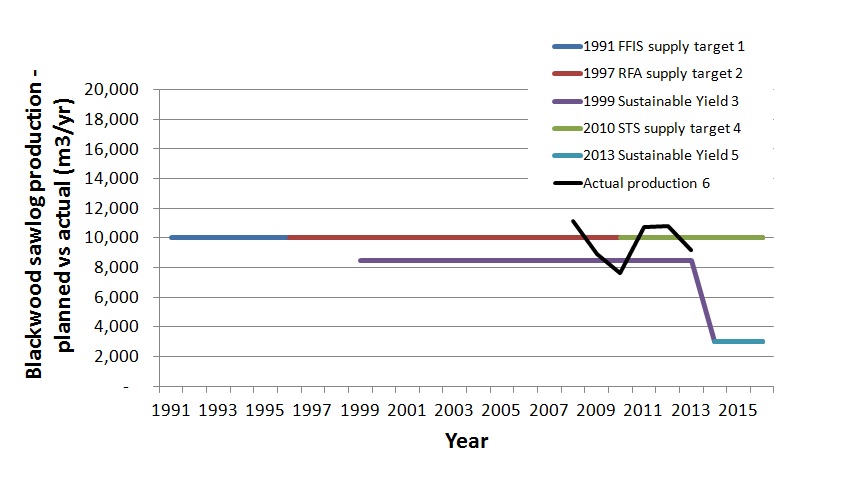
This plan shows that blackwood sawlog will continue to be harvested from Tasmania’s public native forests at 10,000 cubic metres of sawlog per year for the next three years. The current sustainable sawlog yield is estimated to be 3,000 m3 sawlog per year.

In the name of internationally certified (PEFC/AFS) responsible forest management Forestry Tasmania will be harvesting 3 times the sustainable yield of blackwood for the next three years.

Here’s an update of the chart from the above blog with this new information:

Incomplete history plus 3YP

Chart notes:

  1. The 1991 Forest and Forest Industry Strategy (FFIS) set a blackwood supply target of 10,000 m3 of blackwood sawlogs per year.
  2. The 1997 Tasmanian Regional Forest Agreement (RFA) reaffirmed the FFIS blackwood sawlog supply target.
  3. The Forestry Tasmania 1999 Review of the sustainable blackwood (Acacia melanoxylon) sawlog supply from Tasmanian State forest calculated the Statewide sustainable yield of blackwood sawlog at 8,500 m3 of blackwood sawlogs per year. The figure for just the BMZ was 6,800 m3 of blackwood sawlogs per year, with the remainder coming from the rest of the State.
  4. The Forestry Tasmania 2010 Special Timbers Strategy (STS) continued to reaffirm the blackwood supply target of 10,000 m3 of blackwood sawlogs per year until 2019.
  5. The Forestry Tasmania 2013 Review of the Sustainable Sawlog Supply from the Blackwood Management Zone (BMZ) recalculates the blackwood sawlog sustainable yield at 3,000 m3 per year. Production of blackwood sawlog from public forest outside the BMZ is expected to be negligible.
  6. Planned blackwood sawlog harvest according to the Forestry Tasmania 2015-2017 Three Year Wood Production Plan.
  7. Actual blackwood production figures from 1991 to 2006 are not publically available. The 2013 Review only provides actual blackwood sawlog production figures from 2008. Forestry Tasmania wood production dropped dramatically following the 2007 GFC.

Q. Can a company that operates at a loss achieve FSC certification?

A. The FSC certification standard requires that a forest management entity have sufficient financial resources to manage the defined forest area in conformance with the full scope of the standard. The standard does not require that the certified forest is managed at a profit provided that other sources of working capital are available and sufficient to enable management in conformance with the standard.

http://www.scsglobalservices.com/files/resources/talking_points_for_forestry_tasmania_initiative-042514.pdf

This bombshell of a response comes from the document Talking Points and Frequently Asked Questions Forestry Tasmania Preliminary FSC Assessment (0.5MB pdf) from the website of SCSGlobal Services, the company acting as FSC assessors for Forestry Tasmania.

I have written before about how current forest policy, management and practice in Tasmania creates significant obstacles to private tree growers and private (especially small scale) forest investment.

In my view one of the significant obstacles is the complete lack of commercial focus and commercial management at Forestry Tasmania. And I’m not talking about a single bad year. I’m talking about systematic long-term commercial mismanagement that has been documented and reviewed over many years by John Lawrence and others.

How are current and potential future private tree growers supposed to compete against one of the State’s largest forest growers that behaves as a community service not a business?

And now based on their preliminary assessment the FSC assessors are saying that this sad situation is perfectly acceptable to the FSC.

This is just extraordinary!

FSC are prepared to gold-plate Forestry Tasmania’s continued anti-competitive and anti-commercial practices, as long as Tasmanian taxpayers are prepared to keep wasting money.

How can this result in good forest management outcomes?

How can this rebuild Tasmania’s competitive, efficient, profit-driven forest industry?

It can’t! Quite the opposite!

Forestry Tasmania should not be given FSC Certification whilst it continues to operate as a loss-making, community service forest manager.

The Forest Stewardship Council should not encourage and support the destruction of commercial value of public and private forests.

If you are concerned about this ridiculous outcome then:

SCS Global Services welcomes comments on the forest management practices of any of the applicants listed below [including Forestry Tasmania], or other topics pertinent to their seeking FSC certification. Comments can be submitted via email to Brendan Grady (bgrady@scsglobalservices.com), SCS Director of Forest Management Certification, or by completing the online Stakeholder Questionnaire. All comments and sources will be kept in strict confidence at the request of the commenter.

I seek your support in helping to overturn this pending disaster.

The incomplete history of unsustainable blackwood mismanagement

Forestry Tasmania recently and quietly released the latest Review of the Sustainable Sawlog Supply from the Blackwood Management Zone (BMZ). As I predicted last year Tasmania’s iconic blackwood industry is about to go into serious decline if not disappear.

http://blackwoodgrowers.com.au/certification-and-supply/

Last year I reviewed the available information on the public blackwood resource and predicted a serious reconciliation in the near future. The reconciliation has now begun.

http://www.forestrytas.com.au/sfm/review-of-the-sustainable-sawlog-supply-from-the-blackwood-management-zone

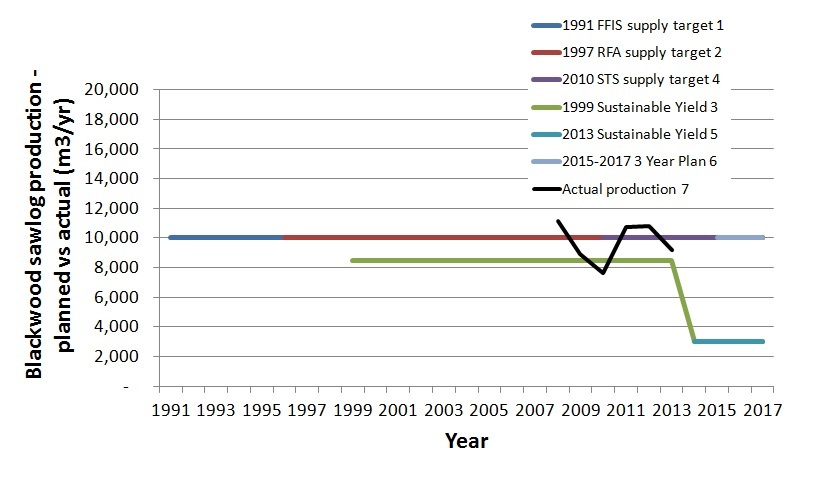
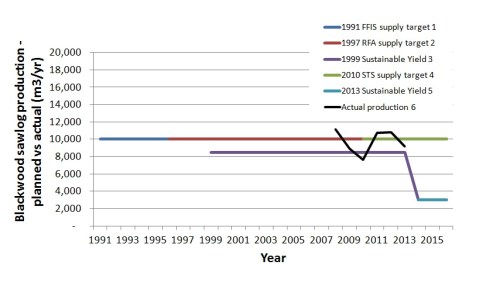
The 2013 Review is a difficult document to read and understand. Important information is missing making it nearly impossible to “join the dots”. To help better understand the 19 page review I have compiled a chart of the planned vs actual production data that is scattered throughout the document. In fact the chart neatly summarises about 80% of what the review has to say, but it is still a very incomplete picture. There is no chart like this in the review.
Incomplete history

Chart notes:

  1. The 1991 Forest and Forest Industry Strategy (FFIS) set a blackwood supply target of 10,000 m3 of blackwood sawlogs per year.
  2. The 1997 Tasmanian Regional Forest Agreement (RFA) reaffirmed the FFIS blackwood sawlog supply target.
  3. The Forestry Tasmania 1999 Review of the sustainable blackwood (Acacia melanoxylon) sawlog supply from Tasmanian State forest calculated the Statewide sustainable yield of blackwood sawlog at 8,500 m3 of blackwood sawlogs per year. The figure for just the BMZ was 6,800 m3 of blackwood sawlogs per year, with the remainder coming from the rest of the State.
  4. The Forestry Tasmania 2010 Special Timbers Strategy (STS) continued to reaffirm the blackwood supply target of 10,000 m3 of blackwood sawlogs per year until 2019.
  5. The Forestry Tasmania 2013 Review of the Sustainable Sawlog Supply from the Blackwood Management Zone (BMZ) recalculates the blackwood sawlog sustainable yield at 3,000 m3 per year. Production of blackwood sawlog from public forest outside the BMZ is expected to be negligible.
  6. Actual blackwood production figures from 1991 to 2006 are not publically available. The 2013 Review only provides actual blackwood sawlog production figures from 2008. Forestry Tasmania wood production dropped dramatically following the 2007 GFC.

Blackwood generally comprises >80% of all special species sawlog production from State forest. Between 2000 and 2007 special timbers production averaged 17,000 m3 per year, with some years exceeding 20,000 m3 (Forestry Tasmania Annual Reports). Clearly neither the so called supply target nor the 1999 sustainable yield estimate had any relevance to the actual production of blackwood sawlogs.

Where are the actual blackwood sawlog production figures between 1991 and 2007?

Why is Forestry Tasmania so reluctant to clearly demonstrate sustainable blackwood management and production?

Here are some other highlights from my analysis of the 2013 Review of the Sustainable Sawlog Supply from the Blackwood Management Zone:

  1. No mention is made in the 2013 Review of the fact that in 2010 Forestry Tasmania classified it’s blackwood and other special timber operations as “non-commercial, non-profit”, and subject to a significant taxpayer subsidy. There is no discussion of what impact this non-commercial focus will have on future blackwood forest management and production (it will have a major impact), or its impact on blackwood production from Tasmanian farms;
  2. An update of the current area of the Fenced Intensive Blackwood (FIB) resource is provided but still, after 30 years, no estimate is provided of it’s likely contribution to the future blackwood industry. There are no details of the financial investment that has been spent to date on creating this resource. The 1999 Review estimated this resource would provide over 250,000 cubic metres of blackwood sawlog to industry between 2040 and 2050.
  3. The major investment to establish 880 ha of blackwood plantations in the early 1990s has now officially been written off and will contribute nothing to the blackwood industry. The 1999 Review estimated this plantation resource would contribute over 370,000 cubic metres of blackwood sawlog to industry. No estimate is provided of the financial loss due to this asset write-off.
  4. As mentioned the 2013 Review provides grossly inadequate details and analysis of blackwood sawlog production since 1991. There is absolutely no way to verify whether blackwood has been sustainably managed or not. Limited available information indicates that since 1991 blackwood has been grossly over-cut;
  5. There is no discussion why in 1999 blackwood sawlog production did not drop to match the sustainable yield estimate. There is also no discussion or explanation of why actual blackwood production appears to have greatly exceeded even the FFIS/RFA/STS 10,000 m3 supply target.
  6. The 2013 Review provides no details at all about the commercial management of blackwood or the contribution of blackwood to the commercial performance and profitability of Forestry Tasmania. Given that the new Forest Management Bill 2013 provides Forestry Tasmania with a greater commercial focus does that mean that all blackwood operations will now be reclassified as “commercial and profitable”?
  7. The 2013 Review contains no discussion about the past and ongoing Sovereign Risk to blackwood production;
  8. Without any discussion or explanatory information the 2013 Review drops the blackwood sawlog sustainable yield from the BMZ from 6,800 m3 per year in 1999, to 3,000 m3 sawlog per year. It provides absolutely no details about how the 3,000 m3 estimate was calculated. It’s a number out of a hat! I personally doubt even this figure. I suspect the real figure is somewhere between 1,500 and 2,000 m3.
  9. The 2013 Tasmanian Forestry Agreement had little impact on the area of the BMZ, so the dramatic drop in production is due to causes other than the TFA.
  10. And that concludes the 2013 Review. No mention at all of a major drop in blackwood supply. No mention of whether the 10,000 m3 supply target will remain in force. No discussion about what impact this drop in supply will have on Forestry Tasmania’s profitability, nor on the Tasmanian blackwood industry. Is 3,000 m3 per year even commercially viable to log, or is the BMZ now a liability?

The Review proudly states:

The blackwood forests are managed on a sustainable basis on a rotation length of about 70 years.

I’m not convinced. There is absolutely no evidence of ecological, commercial, political or social sustainability here at all. How can a drop in sawlog production from 10,000 to 3,000 m3 per year be called sustainable?

By 21st century commercial business standards the 2013 Review of the Sustainable Sawlog Supply from the Blackwood Management Zone is a profoundly deficient document.

As an example of an organisation seeking Forest Stewardship Council (FSC) Certification the 2013 Review completely fails. No meeting with stakeholders, no press conference, no presentation, no Q&A.

As a stakeholder in the Tasmania’s iconic blackwood industry I consider this is a complete disaster. Yet another Tasmanian forest industry catastrophe.

On the positive side the drop in supply from public forests should mean that blackwood log prices will increase. This will help attract the interest of farmers.

But on the negative side the forest product markets and prices in Tasmania have never been transparent. This continues to be one of the forest industries biggest problems. Also the volume of blackwood trade will drop dramatically. Businesses will close. The blackwood market will contract. Options for farmers to sell blackwood timber will shrink. And we still have many legislative, policy and management issues that inhibit private farm forestry, not the least of which is Forestry Tasmania’s taxpayer-subsidised blackwood production.

It is ironic that Tasmania is about to lose its iconic blackwood industry at the very time that New Zealand farmers are about to crank up blackwood production across the Tasman Sea.

Tasmanian blackwood has been Australia’s premier timber species for over a century. It is a Tasmanian icon.

Is the Tasmanian community going to surrender its blackwood heritage and commercial potential to New Zealand farmers?

Or will the necessary legislative, policy and management changes be made to allow Tasmanian farmers to rebuild the Tasmanian blackwood industry?

Will the forest industry open up and become more market transparent?

And will the Tasmanian community take up the opportunity?

What the market wants is not always what the research says is the best

This story has nothing to do with blackwood, but in the tonewood business this recent research regarding Sitka spruce (Picea sitchensis) should be causing considerable discussion.

Sitka spruce is the mostly widely used timber in soundboards in acoustic guitars. Sitka spruce grows in the NW USA, western Canada and into Alaska. It has been heavily logged over the last 100 years to meet many market demands and end uses. Consequently sources of big old trees suitable for the tonewood market are becoming scarce.

Tradition has it that slow, even-grown sitka spruce makes the best soundboards. This tradition of slow even growth for soundboard timber goes back centuries to the violin makers of Italy, and possibly before that time.

But with the supply of this kind of timber in peril, a bit of research can go a long way.

One of the major suppliers of Sitka soundboard timber is Pacific Rim Tonewoods, based in Washington State. They recently sponsored some research to compare the wood properties of Sitka spruce of different growth rates.

It’s not the best written report, and there is no presentation of statistical analysis. But despite this the results should be turning the musical instrument world on it’s head.

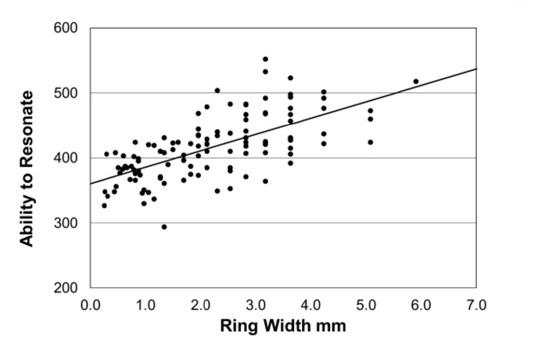
Guess what? After hundreds of years of tradition the research clearly showed that faster grown Sitka spruce had better sound qualities than slow grown Sitka!

Fast grown Sitka in this case was defined as having an average annual growth ring width of 4.5mm, compared to slow grown Sitka at 1.1mm ring width.

Sitka1

This is great news as it means that much more timber is now potentially available for the soundboard market. I say “potentially” because in the music instrument market traditions can be hard to break. You and I as consumers need to understand the consequences of our choices. But in this case changing our spending preferences is a win for us and a win for the forests.

So next time you go shopping for a new acoustic guitar, look out for those guitars with the nice even, wide growth rings. They will give you a better sound, and help save the forests. I noticed one in my local music store just the other day.

Thanks to Pacific Rim Tonewoods for helping us all make better choices for ourselves and the planet.