Category Archives: Commentary

Summary of Stakeholder Submissions and Responses

seeking_your_input_blog_banner_2014

My apologies for such a long blog but the ongoing fiasco of Tasmanian State forest policy and practice continues to dominate the commercial and political landscape.

I wish it were different!

As part of the application process for Forest Stewardship Council (FSC) certification Forestry Tasmania recently released a summary of issues raised by stakeholders and Forestry Tasmania’s responses to these issues. These two reports are available from their website.

http://www.forestrytas.com.au/topics/2014/11/forestry-tasmania-s-forest-management-plan-now-available

As usual my comments relate to Forestry Tasmania’s commercial management and performance, as well as to special timber issues. These are discussed in the report Forest Management Plan – Public Summary of Stakeholder Submissions and Responses (103kb PDF).

Commercial management

The first thing that is immediately obvious in the response documents is the ongoing absence of any serious discussion around commercial management and performance. There is not even a section in the document with the heading Commercial Management and Performance.

I find this utterly extraordinary. Actually I find it quite offensive!!

At a time when Tasmania faces a budgetary crisis and we are sacking teachers and nurses and dropping other essential public services, we continue to subsidise Forestry Tasmania. A Government Business Enterprise wasting scarce taxpayer’s money getting native forest products to market!

This is apparently more important than our children’s education or the health of the community!

It also says a lot about the lack of corporate governance by the State Government and the State Parliament.

Clearly FT does not regard taxpayers as important stakeholders. Also not enough Tasmanian taxpayers are visiting their local FT offices and complaining about this ongoing waste! Common people! Get to it!!

Here’s some stakeholder comments on commercial matters:

  • A common comment was that insufficient consideration was given to production and economic considerations. Some stakeholders were concerned that there was an over emphasis on environmental and social considerations compared to economic considerations in the draft plan.
  • Some stakeholders commented that Forestry Tasmania needs to be financially self sufficient and return a profit to its shareholders.


I couldn’t agree more with these stakeholder comments. And here’s FT’s response:

Positive financial outcomes are one of six strategic objectives now identified in the released Plan. Forestry Tasmania will implement the systems and strategies outlined in the Plan to meet the other five objectives, while also seeking to meet the objective of achieving positive financial outcomes. Forestry Tasmania’s Ministerial Charter details the activities that the Government expects us to undertake. In addition, Forestry Tasmania also produces a Statement of Corporate Intent, which is available on our website and describes the organisation’s financial performance targets as agreed by its Board and shareholder Ministers.

I find this response pretty pathetic especially within the context of the State budget crisis. Both the Ministerial Charter and the Statement of Corporate Intent are incredibly lightweight documents. You can find them here:

http://www.forestrytas.com.au/forest-management/policies

and

http://www.forestrytas.com.au/forest-management/forestry-tasmania-ministerial-charter

They provide little information on how FT is going to improve its commercial management and performance. I would think that given the ongoing State budget crisis and need for taxpayer support, that these matters would form a major part of the Forest Management Plan. Instead the FMP ignores these important issues.

Clearly the stakeholder concerns expressed above are in fact correct and have yet to be dealt with.

Forestry Tasmania continues with the charade that wood production is not a profit-driven, commercial business. Curious really. All private tree growers against which Forestry Tasmania competes in the marketplace, certainly regard wood production as a profit-driven, commercial business.


Special Timbers

At least there is a section in the document dealing specifically with special timbers (page 5). Not surprising given that this issue has dominated much State parliament discussion.

Here’s what the report says about special timbers:

The long term sustainable supply of special species timbers including blackwood was of concern to a number of stakeholders. This was expressed in a number of ways including:

o Suggestions that the Permanent Timber Production Zone land would not be able to sustainably supply industry needs.

Haven’t we known this for decades? Despite all the gloss, spin and promises the supply of special timbers has never been on a sustainable basis.

o Suggestions that current harvesting practices are leading to poor recovery and waste of special species timber.

The inevitable result of poor commercial management and an industrial forestry business model. Again no surprises.

o Requests for a detailed inventory of special species.

Such an inventory would cost more than the resource is actually worth. Which is why FT has never done one.

Response

  • Forestry Tasmania acknowledges the concerns stakeholders have about special species supplies. The Plan has been updated to detail how recent legislative changes affect the special species timbers supply from Permanent Timber Production Zone land. These changes have reduced the area of the Special Timbers Zone managed by Forestry Tasmania from 97 000 to 56 000 hectares. The Forestry (Rebuilding the Forest Industry) Act 2014 requires the Minister for Resources to develop a special species management plan by October 2017. The final Plan indicates that Forestry Tasmania’s future management of special species timbers from PTPZ land will be informed by the special species management plan when it becomes available.

So it’s going to take 3 years (!) to produce a plan that will tell us that the public native forest special timbers industry is over??!! Now let me guess! When is the next State election due? Oh that’s convenient! It’s just after the plan comes out. Stand by for yet another State election dominated by the forest industry! This is just too much! If it’s anything like the last Strategy in 2010 this plan will be a joke.

  • The Plan has been updated to include the results of the December 2013 review of the sustainable level of harvesting from Forestry Tasmania’s blackwood management zone.

This is true! It is now mentioned on page 32 of the Forest Management Plan (FMP). What is not discussed is why the ongoing harvest of blackwood from our public forests continues well above the sustainable yield at 10,000 cubic metres of sawlog per year. Is this blatant fraud or deception?

  • Forestry Tasmania is obligated to make available a minimum of 137 000 cubic metres per year of high quality eucalypt sawlog and veneer log from Permanent Timber Production Zone land. In the process of harvesting this product, a range of other forest products are generated, including special species timbers. Forestry Tasmania has a range of systems in place to maximise the economic value, use and recovery of all forest products arising from harvesting operations. The Plan has been updated to include that in addition to supplying sawmill customers with special species timber, Forestry Tasmania maintains its commitment to its Island Specialty Timber business in order to stock and supply specialty timber products to meet market demand. This includes a tender system for higher quality products.

I could really go to town on this one! Why do we have a legislated sawlog production volume but absolutely NO commercial performance objectives or criteria? It is the epitome of stupidity! And as for the “range of systems …. to maximise the economic value, use and recovery”. Clearly the systems have failed! Either that or the forest products produced by Forestry Tasmania are worthless! Either way the system clearly doesn’t work!

  • Forestry Tasmania is presently conducting an inventory of the special species timber resource , using LiDAR imagery, as a consultancy for the State Government.

What can I say? A futile exercise that will arrive just in time to dominate the next State election. I can’t wait! All of this for a “non commercial” activity! It really is a deeply offensive joke!


Well at least FT is being more transparent about the commercial management of special timbers. Here’s what the revised Forest Management Plan has to say:

In general, the harvest of special species timbers from the blackwood and eucalypt forest zones is a commercial activity while the harvest of special species timbers from the rainforest zone is a non-commercial activity and requires funding support (FMP, p. 32).

So a “commercial activity” is defined as one that requires ongoing taxpayer support, whilst a “non-commercial activity” is defined as one that also requires ongoing taxpayer support.

OK! Clear as mud!

Appendix 1 of the FMP (Summary of recent legislative changes related to land previously managed by Forestry Tasmania) is also worth reading as it sets the stage for the next State election campaign, and further blood-letting around the special timbers industry.

Conclusion

The stupidity around State forest policy and management is clearly set to continue for many years to come.

Whilst FT appears to have made some minor progress is terms of transparency and stakeholder engagement, there is still a very long and difficult road ahead.

As a member of the private special timber-growers industry my message to the FSC remains clear and simple:

Absolutely no FSC certification for Forestry Tasmania until:

  1. FT is restructured, managed and governed on a fully commercial and profitable basis;
  2. All harvesting of wood from public native forest both inside and outside the Permanent Timber Production Zone must be on a profitable, commercial basis. Absolutely no taxpayer support for public native forest wood harvesting at all.


United Forestry Group NZ

UFG

Notice was given of the formation of this New Zealand organisation in my story back in August.

http://blackwoodgrowers.com.au/2014/08/23/new-group-looks-to-become-fonterra-of-forestry/

So here they are up and running with their own website.

http://www.unitedforestrygroup.co.nz/

And here’s a collection of “cut and paste” from that website to give you an idea of what they have to offer the small forest owner in New Zealand.

United Forestry Group | UFG

A strong new company, United Forestry Group Ltd (UFG), has been formed in New Zealand to help the owners of some 14,000 small plantation forests, totalling more than half a million hectares, with the challenge of marketing a  “wall of wood” coming to maturity  over the next two decades.

Mission Statement

To unite the interests of forest owners to provide innovative and attractive harvesting options incorporating world class logistics and marketing resources delivering excellent commercial and community benefits.

Our approach will assist small forest owners to compete with the owners of larger forests who currently enjoy the advantages of economies of scale and greater expertise.

About Us

Joining with United Forestry Group (UFG) will enable small forest owners to compete more successfully and achieve better returns than by trying to go it alone.

United Forestry Group (UFG) shareholders bring local forestry management expertise and contacts together with considerable financial resources, long established contacts in the Asian and local markets, and shipping and supply chain expertise.

Joint Venture Superpen Limited, a NZ company, is a cornerstone investor in the new company. Partners in the joint venture are major players in timber exporting – international timber marketer Pentarch of Australia and Chinese conglomerate Xiamen Xiangyu, which has considerable logistics, shipping and and supply chain assets.

The Superpen joint venture will deliver expertise, contacts with timber buyers, shipping services and financial strength to United Forestry Group (UFG).

Financial Strength

Our financial strength, our expertise and contacts, and a strategy devised to improve the return from small forests whether by marketing to local processors or overseas buyers, are the key.

Our size and resources will enable us to buy and consolidate existing forests and co-ordinate orderly harvesting, marketing and shipping. Our approach enables small foresters to join with us and extract the maximum possible return – the lowest possible cost and and the best possible price. At the same time we offer forest owners investment opportunities if they wish to participate in the wider forestry industry.

Asset Protection and Security

We believe that union is strength and that owners of a single small forest are vulnerable because of their limited bargaining power and marketing ability.

Consolidating forests through UFG (United Forestry Group) will enable you to enjoy the benefits of economies of scale, greater bargaining power and greater expertise. It will be possible to manage a consolidated forest resource sustainably to produce better outcomes and to time the market better.

Consolidation will protect your asset and give you greater security.


I doubt we will see anything like this in Tasmania anytime soon but it sure sounds like a great idea.

It will be interesting to see whether they can attract the support of small forest growers and become a major player in the New Zealand forest industry.

Those New Zealand farm foresters are lucky to have such an option.

Go to the website and check them out.

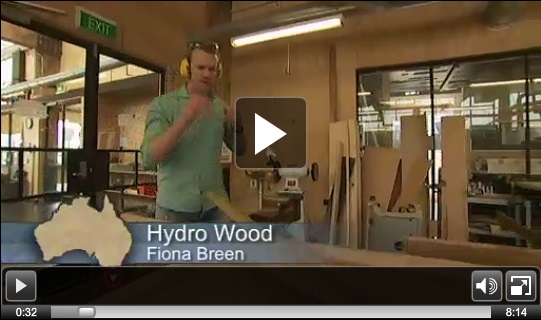
Hydro Wood – Landline – ABC

This is just such a great feel-good story, no one could possibly have any problems with salvaging public timber at taxpayers expense. Could they?

Hydrowood Landline

Hydro Wood – Landline – ABC.

Generally I support the project.

And I congratulate SFM Forest Products for getting the project going.

However I do have a few issues that I think warrant consideration.

And the ABC Landline program was screaming these issues at me loud and clear.

1) The complete disconnect from any commercial reality (but we do have a very long tradition of this in the forest industry). Can the market absorb an extra 20,000 cubic metres of specialty timbers per year? How will the wood be sold to market? Tender? Auction? Mates rates? Will these logs be available for export? What impact will this have on current market prices, especially for blackwood, given that private growers will be competing against even more subsidised wood? For heavens sake!! When will the private forest grower ever get a fair deal in Tasmania? When will we stop bastardising the forest industry? When will we stop thinking of the forest industry as a community service and start thinking of it as a business?

2) If the timber resource is so valuable then why the need for a taxpayer subsidy? The forest industry already has a bad track record of squandering vast millions of Government handouts and subsidies. This just sets yet another bad example, and it didn’t need too. This could have been a fully commercial, profitable operation with no taxpayer funding.

Here’s a recent example from New Zealand that provides a much better model for how to deal with the salvage of a public special timbers resource, and this will result in money going to the Government not costing taxpayers. Why can’t we do it this way in Tasmania?

http://www.doc.govt.nz/about-doc/news/media-releases/2014/first-west-coast-timber-salvage-approved/

And this is just the first of what they hope to be many Hydro special timbers salvage operations!! Excuse me while I scream in frustration!!!

There will be very little investment in blackwood in the next few decades whilst the market is flooded with this cheap subsidised wood.

Screw my plans for a blackwood growers cooperative!

Screw existing private blackwood growers whose resource is now worthless!

I think given this is a private company running the Hydrowood project whose goal it is to look after the interests of private forest growers, a bit more thought on the commercial context and planning would have made this project much more agreeable to private blackwood growers.

As it is I think the project is currently detrimental to the interests of private blackwood growers. This needs to change!

Please can’t we do better than this?

Blackwood Markets

Thanks to those blackwood sawmillers who contacted me in response to my recent blog.

http://blackwoodgrowers.com.au/2014/10/27/blackwood-sawmillers/

Here are some of the things I learned from these discussions – some very good, some not so good.

THE GOOD

Firstly there is strong demand for blackwood from export markets.

Local domestic markets remain generally quite.

Blackwood growers wanting to get a good price need to search out those few processors who are accessing these markets.

Prices “on stump” of up to $500 per cubic metre for good quality plain-grain logs are being offered, with exceptional logs going well above this.

Access to these export markets is available from anywhere in the State.

One processor is currently shipping an average one container of logs a day and is looking to increase this dramatically next year. They are accessing markets in 7 different countries!

Will Tasmanian farmers be able to meet this demand?

Strong demand for quality appearance-grade wood and a falling Aussie dollar are helping to drive interest in the blackwood market.

At these prices a blackwood plantation at harvest would be valued at well over $100,000 per hectare! Anyone interested?

Do I have a problem with exporting blackwood logs? Not at all!

Farmers should have the option to access whatever markets they wish for their products. If local processors can’t offer a good price then export it is. As I often remind people, forestry is business. Growing trees for wood production is about profit and good forest/land management.

The absolute foundation of any successful forest industry must be profitable tree growing. Not community service! Not taxpayer subsidises! Not ideology!

THE NOT SO GOOD

But the blackwood marketplace is not functioning anywhere near as well as it could/should.

All of this commercial activity is happening “off the radar”.

Instead of building interest in the farming community, creating much-needed positive sentiment in the forest industry, and building support and interest from the wider Tasmanian community the blackwood marketplace is still pretty invisible.

Why?

Fear and mistrust

With so many processors (at least 21) in the private blackwood business in Tasmania it is a very competitive, and at times cut-throat business. Hence the industry is dominated by fear and mistrust. Because of this fear all business is done quietly by word-of-mouth. No advertising. No promotion. No marketing.

Invisibility

Because of the fear and mistrust within the industry Tasmania remains ignorant of what is happening in the blackwood market. Farmers are generally unaware of the current and future potential of growing and selling commercial blackwood.

A lost opportunity for Tasmania.

The blackwood industry will only grow and prosper if there is greater transparency and integrity.

The market clearly wants quality blackwood timber and is prepared to pay good prices.

No voice

The forest industry in Tasmania is dominated and controlled by a select few sawmillers and processors. Private forest growers essentially have no voice or power/influence in the industry. Any forest industry that is dominated by the processors is doomed to fail. Forestry is fundamentally about making profits by growing trees. If tree growers have no power or voice in the game then no one will grow trees. It’s that simple.

State forest policy and Forestry Tasmania

There was plenty of criticism in the discussions with processors, about State forest policy and Forestry Tasmania. It is a myth that the Tasmanian forest industry is united and speaks with one voice. We generally only hear one voice because the dissenters fear the consequences of speaking out. The forest industry can be a rough trade at times.

These processors who deal with private forest growers know very well the damage that past and current State forest policy and practice is having on the industry.

CONCLUSION

The discussions with blackwood processors gave me a great sense of hope. But there are still plenty of challenges ahead.

The market clearly wants more Tasmanian blackwood.

The industry is currently too crowded and cut-throat. It needs 2-3 processor/operators that are prepared to cut through the mistrust with openness and integrity, and an efficient low-cost business model that delivers what the market wants whilst building trust and good relationships with the farming community.

With so much negative sentiment and bad experiences it will take a lot of work to rebuild trust within the farming community. Keeping “off the radar” is not the way to rebuild trust and interest. Most farmers will respond positively to a professional, honest, transparent approach. But good long-term relationships take time to develop.

Getting farmers to make a 30+ year investment by planting blackwood will require as much positive support and encouragement as possible. We need lots of flag waving and trumpet blowing on a major scale. And plenty of market “pull”.

And finally…

Just so I don’t have to repeat this experience in 12 months time here’s some guidance for the FT Annual Report editors.

Special Timbers content outline for 2014/15 Forestry Tasmania Annual Report:

  1. Is the harvesting of special timbers profitable? Supporting data…
  2. Is the harvesting of special timbers sustainable? Supporting data…
  3. Review of major events and highlights of the past 12 months? Markets, sales, planning, harvesting, resources, etc…
  4. Outline of major events and highlights of the coming year? Markets, sales, planning, harvesting, resources, etc…

It’s pretty basic stuff really, instead of the mealy-mouth rubbish we normally get in the annual reports.

I also highly recommend reading John Lawrence’s review of the financial management and performance of FT from their 2014 Annual Report. It makes for pretty depressing reading especially when you think about all the political games being played around forestry.

http://www.tasfintalk.blogspot.com.au/2014/11/forestry-tasmania-nothing-has-changed.html

The forest industry in Tasmania hasn’t got a future whilst this madness continues.

Hopefully my next story will be a good news story.

Further reflections on the FT 2014 Annual Report

Kudelka 011114

www.kudelka.com.au

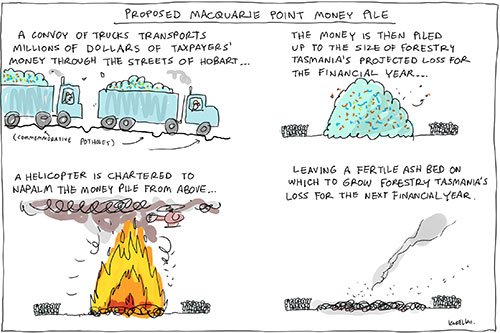
Cartoonist Jon Kudelka has identified a new version of Brand Tasmania. One that we can all identify with. The one element missing in the above image (in addition to the crumbling roads) is the queue of sacked Tasmanian teachers and nurses outside the local Centrelink office.

Please take note Forest Stewardship Council! Good commercial management and performance is absolutely fundamental to good forest management; especially when the forest in question is publically owned!

As a stakeholder in the special timbers industry attempting to build a profitable blackwood growers industry based on Tasmanian farmers, it is difficult to read the latest Forestry Tasmania annual report and get any satisfaction. In fact the overwhelming response is frustration, anger and astonishment.

We have been told repeated over the past few years, both in the media and in State Parliament that the special timbers industry is in crisis. Even to the point of having to start logging our reserves and conservation areas to keep the industry going a while longer. This looming crisis has been obvious to me for many years as the industry has survived on the residues of old growth industrial forestry.

So here we have an Annual Report that reads like nothing is wrong. The Special Timbers section (pages 25-26) contains such superficial information as to be worthless.

So is there in fact a crisis in the special timbers industry? Not according to the Annual Report. New State legislation just requires a review of “our supply strategy in future years”. A resource review is currently underway, but no mention of when this will be completed.

The new 2013 blackwood sawlog resource review is mentioned, but there is absolutely no discussion about its impact on the current or future supply of blackwood from our public forest resource, despite a significant drop in the estimated sawlog sustainable yield. Never mind that the planned harvest of blackwood sawlog will continue at well above the sustainable yield.

What about the proposed logging of special timbers in our parks and reserves?

Absolutely no mention of it.

What about a strategy for the future that might actually be useful and meaningful.

Again no mention of the future of the special timbers industry in the Annual Report.

Just amazing!

A complete white wash!

So when the discussion of special timbers in the Annual Report finishes with the off-hand mention of the tender sale price for a single blackheart sassafras log I feel absolutely insulted and ripped off. As if the sales price of sassafras sawlogs has any market significance. No one is going to invest in growing sassafras; it takes too long to grow. As if Forestry Tasmania gives a “flying fig” about sawlog prices anyway!

Forestry Tasmania is a complete basket case aided and abetted by scheming politicians.

As Mr. Kudelka clearly illustrates with his cartoon, the folly around State forest policy and practice continues unabated, and the burning of precious taxpayers money will likely continue for many years to come.

And the potential to develop and expand a profitable private blackwood industry remains frustrated.

Continuing the decline – Forestry Tasmania 2014 Annual Report

6057_StewardshipReport13-14_cover

The recent release of the Forestry Tasmania Annual Report 2014 provides me with yet another opportunity to highlight the continuing destruction of Tasmania’s special timbers industry (including the blackwood industry).

http://www.forestrytas.com.au/news/2014/10/forestry-tasmanias-stewardship-report-2013-14-now-available

My critique will be limited to special timbers. I will leave it to others to highlight the many other unresolved issues. Special timbers are discussed on pages 26-27 of the report. It starts off:

Special timbers are an integral part of the Tasmanian brand. They are used to produce high-value furniture and craftwood products, and include blackwood, blackheart sassafras, myrtle, silver wattle and celery top pine. These timbers are just so incredibly high value they must be taxpayer subsidised (at the expense of our health and education systems).

Production

Total special timbers production for 2013/14 was 9,199 cubic metres which represented a miniscule 0.9% of total public native forest production by Forestry Tasmania. And for this morsel special timbers dominates State forest policy (and Parliamentary time) like no other issue.

Historical data

A curious addition to this year’s report is the inclusion of a chart showing detailed historical special timbers production back to 2003/04 (p. 26). This chart is not referenced at all in the text. Why is it in the Report?

The chart does include four years worth of previously unavailable production data from 2003 to 2007. Only 9 years worth of detailed special timbers production data still remain publically unavailable.

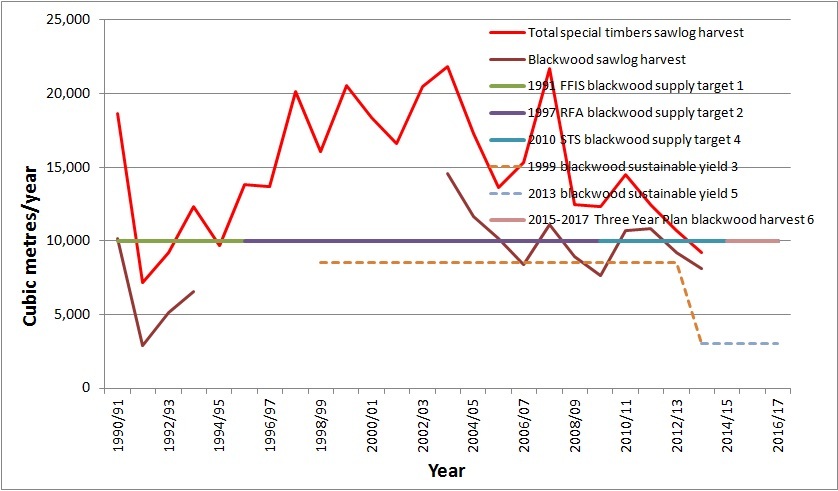
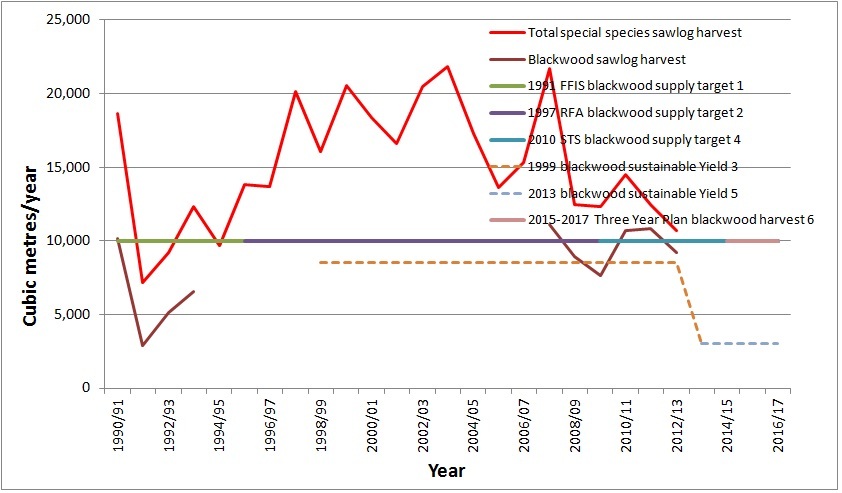
The chart is of limited value as it does not show special timbers production in relation to either sustainable yield, or the RFA/STMS supply target. Therefore in order to improve public understanding and debate I have added the new historical data (including estimating blackwood production by measuring directly off the chart) to my chart of special timbers mismanagement (note the 9 years of missing blackwood production data). If anyone can see in this chart the relationship between planned versus sustainable versus actual production they clearly have a better imagination than I.

http://blackwoodgrowers.com.au/2014/08/14/the-incomplete-history-and-current-practice-of-unsustainable-blackwood-mismanagement/

Incomplete history chart update 1014

As noted in a previous blog, the overcutting of the public native blackwood resource continues apace but FT don’t mention this at all.

http://blackwoodgrowers.com.au/2014/07/23/overcutting-of-the-public-blackwood-sawlog-resource-to-continue/

 Resource review

The Report tells us that a review of the special timbers resource on Permanent Timber Production Zone land is currently underway, but doesn’t say when this review will be completed or if it will be published. The Report completely avoids any discussion of the planned harvesting of special timbers from Tasmania’s reserves and conservation areas, and the impact this will have on the forest industry and on the broader community.

The Report notes the completion during the year of the blackwood sawlog resource review, noting the new sustainable blackwood sawlog supply of 3,000 cubic metres per year. For my scathing review of this document go here:

http://blackwoodgrowers.com.au/2014/06/23/the-incomplete-history-of-unsustainable-blackwood-mismanagement/

And also see the above discussion re. historical data and imagination.

Island Specialty Timbers

For the very first time in an annual report the performance of Island Specialty Timbers (IST) gets a mention. On page 27 we learn that:

  • A total of 1,531 cubic metres of specialty timbers were sold through the three IST outlets;
  • 136 cubic metres of this (of which only 16.1 cubic metre was blackwood) were sold through the public competitive tender process to ensure that the best possible prices were obtained.
  • The tendering program continued to receive strong interest;
  • The highlight for the year being an 87-centimetre diameter blackheart sassafras log that sold for $5,000 per cubic metre.

I’m happy to be corrected but I reckon this is the very first time that a good product sales result has ever been trumpeted by FT in its annual report, even if they have treated it as a minor footnote, and this information about a single sassafras log has almost no market significance whatsoever.

What we didn’t learn:

  • The financial performance of IST. How much did the 1531 and 136 cubic metres sell for? How much is the Tasmanian taxpayer subsidising the specialty timbers industry through IST? Somehow I doubt that 1500 cubic metres of sales would have brought a profit.
  • What impact did the open competitive tender prices have on the administered pricing system used by FT for the bulk of its special timbers sales? If there was no impact then what exactly is the purpose of the tender system?
  • Why were only 9% of the total sales done through the tender process, when the whole business is being subsidised by taxpayers? Why not 50% or even 100%?

Conclusion

In the current difficult financial times when we are sacking Tasmanian teachers and nurses, why must Tasmanian taxpayers continue to subsidise the special timbers industry? Why can’t the special timbers industry be run as a fully commercial, profit-driven business? What in fact does “high-value” or “special” mean at Forestry Tasmania?

The complete absence of information and discussion in the Annual Report around the commercial management and performance of special timbers is pretty symptomatic of Forestry Tasmania’s culture and its many problems.

Forestry Tasmania continues to demonstrate a complete lack of interest in commercial management and performance.

They don’t even have the integrity to tell Tasmanian taxpayers how much they are deliberately subsidising the special timbers industry.

As an example of open honest transparent stakeholder engagement I continue to identify significant opportunities for improvement from Forestry Tasmania in their reporting.

Can anyone please tell me why this complete disaster continues to get Parliamentary approval and support?

Blackwood sawmillers

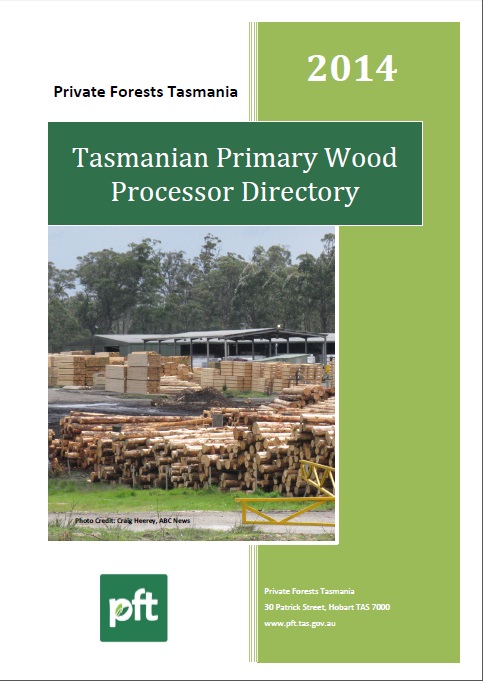
PFT_TPWPD2014

Private Forests Tasmania (PFT) has just released an updated Tasmanian Primary Wood Processor Directory.

http://www.pft.tas.gov.au/index.php/publications/market-information

The directory is a listing of 45 of the estimated 57 primary wood processing businesses believed to be operating within the State of Tasmania at the time of publication.

The directory has been primarily developed to help private forest owners with logs for sale to identify potential buyers. As well as enabling the forest owner to more easily locate and contact primary wood processors, it also identifies the log types purchased by them.

The directory also helps the listed primary wood processors to source logs from the Tasmanian private forest estate.

It isn’t at all clear to me how the directory helps the listed primary wood processors to source logs from the Tasmanian private forest estate, but anyway….

18 of the 45 listed processors indicate that they want to buy blackwood logs from private landowners. To find these processors simply download and open the document in Adobe Reader. Once the document is open press the Ctrl+Shift+F keys together on your computer. In the search box type “blackwood” and hit the Search button. All 18 instances of the word “blackwood” will now be shown.

ERRATUM: My apologies! I have just realised that three of the primary processors in the Directory list “special species” without listing blackwood separately. I assume these three processors include blackwood in their definition of special species. So that makes a total of 21 of the 45 listed processors are looking to buy blackwood logs from private growers/farmers. That is a very crowded market!!

That there are so many sawmillers around Tasmania looking to buy blackwood logs from private landowners I find very encouraging.

Clearly there is good demand for blackwood timber.

But what size and quality logs, and at what price? What markets are these processors accessing? These are critical questions that need answers.

If blackwood is Australia’s premier appearance-grade timber species then how do we build this industry into something proud and profitable?

How do we get greater transparency and tradability into the blackwood market?

How do we put the blackwood market on steroids?

I don’t mean artificially inflate the demand. I mean create much greater transparency and tradability into the blackwood market so landowners start to see some realtime market activity. Only then will landowners begin to think about investing in the future of blackwood.

How do we get farmers to make a 30-40 year investment commitment to grow more blackwood for the future as both remnant blackwood forest and in plantations?

ANSWER: By giving farmers as much incentive and positive market sentiment and feedback as we possibly can. Once farmers begin to see the blackwood market operating like other rural commodity markets then we might have some hope.

Every day we see blackwood timber making its way to the very highest of the wood value-adding markets both in Australia and increasingly overseas. Markets such as premium furniture, veneers, and musical instruments. So why isn’t this market demand stimulating grower interest? Why doesn’t Tasmania have a thriving blackwood grower community? Is growing blackwood a profitable investment for a landowner?

These 18 sawmillers can help answer these fundamental questions.

How many of these 18 processors are thinking about the future of the blackwood industry as anything other than a clean-up salvage operation?

Are they waiting for the Government to solve the problems of the forest industry, or are they prepared to take responsibility themselves and take some action?

These blackwood sawmillers are fundamental to the future success of Tasmania’s blackwood industry. But things need to change and change radically.

At the moment the blackwood market is completely obscure, which inhibits growth and investment in the industry.

The day that I can write my first Blackwood Market Report for Tasmanian Country will be a significant day for the blackwood industry.

There is plenty of potential and many opportunities with blackwood provided Tasmanians are prepared to help see them happen.

What’s in it for these sawmillers?

  • Access to more blackwood resource as more farmers participate in the market;
  • Collective marketing with access to more diverse, larger, more profitable markets;
  • Stronger links and relationships to both suppliers and buyers;
  • Being part of an expanding, high-value, niche market.

Or are we going to surrender our blackwood heritage to the New Zealand farmers?

I would like to hear some thoughts and ideas from these blackwood sawmillers. Reply to this blog, or phone or email me so we can have a discussion.

Cheers!

Go Deloraine Stringfest! – a reply

http://blackwoodgrowers.com.au/2014/03/25/go-deloraine-stringfest/#comments

I thought this recent comment to one of my earlier blogs was worthy of a more full response.

While I believe Gordon’s point of view might be an important point of view, it is certainly not the only point of view. In fact, I have some deep reservations about what Gordon is on about, not just about the future for instrument makers, but for craft and furniture makers in general.

Plantation timber is not ideal for every one, in fact, for some it is just plain wrong.

I believe it is of almost no interest to artistic wood turners, for example. They usually like the most gnarly, twisted, knotted, stressed and complex timber they can find, and it is almost totally without exception found to be old-growth timber.

Many users like their timber to be old, slow-growing, stable, rich, dark, and close in grain structure. I have never seen plantation-grown timber of any sort that looks like that. While some luthiers would definitely like straight-grained timber, there are plenty of others, such as the solid-body electric guys who want the most spectacular timber they can find, and I can give examples.

I would have less of a problem with Gordon if he were to not be saying that all the old-growth Blackwood forests should be locked up so that it could give a free kick to the fledgling Blackwood plantation growers – even John Gay did not ask for that!

Hi George,

Thanks for your comment. It’s great to hear from you.

Here’s my response to your concerns:

  1. No one has ever claimed that my views are supreme. I openly welcome other opinions and ideas.
  2. The wood qualities you describe “most gnarly, twisted, knotted, stressed and complex timber they can find” might appeal to a small number of artisans and craftspeople. But by far the major markets for blackwood – veneer, furniture, cabinetry, flooring, and commercial (as distinct from custom) instrument makers all prefer straight-grained wood for its uniformity, stability and ease of machining and workability. Feature grain such as fiddleback blackwood is also highly prized by these markets, but has only ever been available in very limited ad hoc supply anyway. Supply has never been guaranteed. New Zealand instrument makers are already using plantation blackwood.
  3. Plantation blackwood is my main focus because it is the best way to meet the dominant market demand and is the only way to expand and develop the blackwood industry. But I also have a focus on the remnant blackwood forest that exists on private land and how this can be better managed to improve productivity and value. With time (and perhaps even right now) this resource could easily supply the type of wood you describe including featured grain material. In fact it is already supplying the specialised craft and custom market.
  4. The genetic potential of blackwood is huge. A blackwood selection and breeding program could well provide improved, specialised wood properties of consistent quality to meet a number of different markets. These could be based around wood hardness, density and colour and perhaps even figured grain. Such genetic potential will only ever be realised once blackwood cultivation is well established and profitable. We are currently a long way from reaching that point!
  5. if he were to not be saying that all the old-growth Blackwood forests should be locked up”. George can you please identify where I have said this? I am more than happy for public native forest to be commercially managed PROVIDED it is done properly and profitably. I have certainly said that Tasmania has clearly demonstrated over the past 30 years that we do not have the commitment nor the skills to commercially manage our public native forests to meet social, ecological, political and commercial objectives. Every week our newspaper headlines scream this fact to the world. Many Tasmanians are thoroughly sick and tired of it.

I am not against your interests at all George. I want good professional, fully commercial and profitable forest management. I want a fair go and a “level playing field” for both public AND private tree growers. That’s all I want. Is that too much to ask?

Apparently it is.

Right now the policies and practices of the Government and Forestry Tasmania are deliberately undermining my attempts to build a private commercial blackwood venture. In fact your precious public native forest blackwood resource is being wiped out by overcutting! Does this concern you at all George?

http://blackwoodgrowers.com.au/2014/08/14/the-incomplete-history-and-current-practice-of-unsustainable-blackwood-mismanagement/

When I look at the forest industry I look at as many aspects as I can, not just the quality of the wood resource. Right now there is very little about the forest industry and Tasmanian State forest policy that I find positive or useful. Unlike others I do not ignore the numerous political, social and commercial challenges facing the industry. I certainly do not support the use of taxpayer funds to log Tasmania’s conservation reserves for special timbers. Such stupidity will foment community conflict the likes of which we haven’t seen since the dark days of the Franklin River blockade.

The Deloraine Stringfest is a fantastic festival that in time will become a unique international event, highlighting the complete supply chain for stringed instruments from grower to artist. It has significant appeal to a wide audience. But while Stringfest sits within the current political, social and commercial malaise that is the forest industry in its current form, it will struggle to gain momentum and support.

It is well and truly time for fresh thinking and a new start.

That’s where I want to head George. A new beginning and a new vision.

Forestry is business. It is not about community service, or taxpayer subsidies whilst we are sacking teachers and nurses and closing schools. Forestry is about building wealth, not destroying it.

Go Stringfest!

FSC Certification Evaluation of Forestry Tasmania

seeking_your_input_blog_banner_2014

SCS Global Services,

2000 Powell Street, Ste. 600

Emeryville,

CA 94608 USA


Dear Dr. Hrubes,

RE: FSC Certification Evaluation of Forestry Tasmania

Thankyou for the opportunity to participate in the stakeholder consultation process.

As a forester and forest industry representative my submission to the Forestry Tasmania FSC Certification Evaluation focuses on just two issues.

1. Commercial Management


The forest industry in Tasmania is currently home to two mutually incompatible business models competing in the same marketplace.

The historical, traditional and still dominant business model is the taxpayer-subsidised, community service business model that frames current Tasmanian forest policy, and public forest management by Forestry Tasmania.

The fundamental basis of this model is that public forests managed for wood production are there to serve the community largely through providing regional employment. Good business, commercial management and profit play no part in this business model.

The second business model has always been present in Tasmania but has recently become more significant with the expansion of private plantations and the sale of public plantations to the private sector. This business model is used by private plantation and forest owners; it is the fully commercial, market-focused, profit-driven business model.

It is the same business model that will help drive my goal of establishing a Tasmanian Blackwood Growers Cooperative.

These two business models cannot succeed in the same marketplace. This situation is unstable and ultimately destructive to the entire forest industry. It is also a missed opportunity to realise and develop Tasmania’s significant commercial forest potential.

The traditional business model represents nothing more than a destructive antitrust, anti-competitive business model. It undermines the ability of the marketplace to function properly and put a proper price on forest products. It destroys the value of private forest assets and investment.

At the moment logs from public native forest are being transported to market at taxpayers’ expense, whilst private tree growers do not have access to any taxpayer subsidy. This is blatant antitrust behaviour.

Also please read this brief analysis of the deliberate decline in commercial focus at Forestry Tasmania over the past 20 years. Forestry Tasmania is a storm-tossed, rudderless ship:

http://tasmaniantimes.com/index.php?/article/forestry-tas-devoid-of-commercial-purpose/

The Forest Stewardship Council (FSC) must not give its support to this antitrust behaviour. Forestry Tasmania must not be given FSC Certification until it is restructured and managed on a fully commercial profitable basis.


2. Public blackwood forest resource mismanagement


For the last 25 years Forestry Tasmania have been overcutting the public native blackwood resource that currently forms the basis for Tasmania’s iconic blackwood industry. Using Forestry Tasmania’s own data I have summarised this sad sorry episode.

Incomplete history 2

http://blackwoodgrowers.com.au/2014/08/14/the-incomplete-history-and-current-practice-of-unsustainable-blackwood-mismanagement/

http://blackwoodgrowers.com.au/2014/06/23/the-incomplete-history-of-unsustainable-blackwood-mismanagement/

Forestry Tasmania perpetuates the message that the public blackwood forest resource is being responsibly and sustainably managed, when their own data (as shown in the above chart) clearly shows this is not the case!

The recently released Review of the Sustainable Sawlog Supply from the Blackwood Management Zone is a grossly misleading and inadequate document.

http://www.forestrytas.com.au/sfm/review-of-the-sustainable-sawlog-supply-from-the-blackwood-management-zone

The fact that in 2010 Forestry Tasmania announced that henceforth blackwood and all other special timber species were to be managed on a “non-commercial non-profit” basis was a severe blow to the Tasmanian farmers and the blackwood industry.

Blackwood (Acacia melanoxylon) is Australia’s premier appearance-grade timber species. It is a common tree on farmland across northern Tasmania, most of which is unmanaged and until recently had little commercial value. But this is now changing.

The only way to build and grow Tasmania’s blackwood industry is by encouraging Tasmanian farmers to grow it, just as New Zealand farmers have been for the past 30 years. But Tasmania’s blackwood industry will be gone in 5-10 years due to the mismanagement and overcutting of the public resource by Forestry Tasmania. The local blackwood markets and industries will be gone before Tasmanian farmers have a chance to contribute. Tasmanian farmers will have to start the whole industry from scratch with no market price or demand signals.

The Forest Stewardship Council (FSC) must not give its support to this blatant mismanagement of Tasmania’s public forest resource. Forestry Tasmania must not be given FSC Certification until it provides a full and correct report on the nature of the blackwood resource, and manages that resource on a fully commercial, profitable and sustainable basis.

From my perspective as a forest industry representative and stakeholder there is very little positive that can be said about the current state of forest industry policy and practice in Tasmania. The industry is continuing to go backwards year after year. This comes as no surprise to me at all.

Major review and reform is desperately needed.

The Forest Stewardship Council (FSC) should not add its support to this mess by granting FSC Certification to Forestry Tasmania; not until major reforms are implemented.


Yours Sincerely,


Dr. Gordon Bradbury

14th October 2014