Category Archives: Commentary

Forestry Tasmania fate in balance

Annells

http://www.examiner.com.au/story/2926663/forestry-tasmania-fate-in-balance/?cs=95

[The fate of] Forestry Tasmania hangs in the balance, with its chairman telling staff the company’s immediate future is entirely in the government’s hand.

In an email sent to Forestry Tasmania staff yesterday, chairman Bob Annells [pictured above] responded to mounting concerns that the cash-strapped company may be dissolved and folded into a government department.

[“folded into a government department” What an absolutely terrible idea! What Government department would it fit into? And what would be the point? It would fix none of the existing problems, and create even more new problems. A classic case of duck shoving!]

This article in today’s The Examiner tells us that things are pretty grim at the Government forest management agency.

While no official announcement has been made it now seems clear that FTs application for FSC Certification has been rejected. FSC auditors SCS Global were due to deliver their report last month.

And yet another review into Forestry Tasmania is currently being written. I’ve lost count of how many of those we’ve had. Far too many. And none of them have been at all useful, at least in terms of their implementation.

But enough is already known to understand that FT has absolutely no commercial future.

The Tasmanian Government is no doubt finding it increasingly difficult continuing to sack teachers and nurses whilst propping up the forest industry.

It is now just a matter of how best to clean up the decades of mess and close the organisation down.

It will be a bitter pill for many Tasmanians.

Decades of mismanagement may finally be coming to an end. Or it may drag on for a few more painful, bitter years. History tells me that the latter is more likely eg. the “fold” option.

The shutting down of FT will see the supply of blackwood to the market drop dramatically, with a corresponding rise in price very likely. Will Tasmanian farmers finally reap the rewards of a more competitive blackwood market?

UPDATE:

Seems like the FSC outcome is indeed correct judging by the article in today’s The Examiner. No medal for FT.

http://www.examiner.com.au/story/2929002/demands-on-forestry/?cs=95

So FT will “keep trying”. They don’t have the time nor the money to keep trying.

The longer FT stays in business the longer it will take for private tree growers and private investment to rebuild the forest industry. It just wont happen whilst FT continues to play zombie corporation.

Salvaged Timber?

Salvaged Timber Sign_s

I discovered this small inconspicuous sign in a business I recently visited in Hobart. I found the sign rather curious. Other customers also found the sign curious.

The sign says a great deal about the mixed, confused emotions and morals, and acute sensitivity that surround the special timbers industry in Tasmania.

The business, like many in Tasmania, features Tasmanian timber in the shop fittings.

So is the sign an explanation or an apology?

I’m not sure.

Or perhaps it is a statement of pride.

If so it leaves me confused.

Here’s what I think the sign is saying:

A patch of old growth native forest in North West Tasmania was clearfelled to feed the industrial forestry business model that dominates Tasmania. After the industrial clearfelling operation was completed, a second smaller operation recovered some craftwood from the site including the 400-year-old Myrtle stump. The logging coupe was then burnt and resown to native forest. Or perhaps the coupe was converted to plantation. The harvesting duo (industrial and craft) then moved on to the next old growth forest logging coupe to repeat the cycle of sin and redemption.

Is that what the sign is about? Sin and redemption!

It’s a pretty standard story about the fate of Tasmanian old growth forest.

Most people regard the clearfelling of Tasmanian old growth forest as unacceptable practice in the 21st century.

But somehow the idea of “salvaging” after the industrial clearfelling has finished attracts some crumb of virtue.

Why? Where is the virtue?

For the past 40 years the Tasmanian special timbers industry only existed because it was a minor subset of the industrial forestry business model. It needed the industrial harvesting to continue for its own existence.

But to improve its status and product differentiation from those industrial loggers the special timbers industry adopted the word “salvage”.

“Are’t we good people! We help save all that good special timber that would have been wasted.”

No that’s not quite true now is it?

Yes there has been plenty of waste. That’s to be expected when dealing with a low value commodity. But to call the special timbers craftwood operation a virtuous salvage is specious indeed.

No virtue attached at all.

Just a marketing con.

The old growth forest in North West Tasmania is gone. Where is the virtue in that?

But the market now believes the virtuous salvage story and continues to buy these special timbers.

So perhaps the sign could just as well read:

This timber veneer was harvested from a 400 year old Myrtle stump as part of an old growth forest clearfelling operation. It comes from North West Tasmania. The site was subsequently burnt, cleared and converted to eucalypt pulp plantation.

It would be just as informative and a lot more honest!

By the way what did happen to the 400-year-old Myrtle tree that sat upon the stump? Where did it end up?

A second point is that the word salvage should automatically imply to the reader there is no notion of sustainability. It’s a cleanup operation, that’s all! But in the forest industry you will sometimes see the phrase sustainable salvage being used. I don’t think so. Another marketing con job.

Now is there such a thing as genuine virtuous timber salvage?

Absolutely!

The Hydrowood operation on the west coast comes close. Unfortunately it is wrapped up in the wrong marketing spin.

http://www.abc.net.au/landline/content/2014/s4129593.htm

Dead, dying and storm-damaged trees can also be honestly salvaged. They do this under strict Government supervision and competitive tender on Crown Land in New Zealand:

http://www.nzherald.co.nz/nz/news/article.cfm?c_id=1&objectid=11278973

And private property in Tasmania:

http://tasmaniantonewoods.com/salvaging-old-growth-standing-dead-blackwood/

But a craftwood harvest that is part of regular industrial old growth forest clearfelling operations does not classify as salvage in my books. And certainly has no virtue!

Finally now that Gunns has gone industrial forestry in our native forests is looking pretty sick. But never mind, the mouse has now become the lion. The (public native forest dependent) special timbers industry now dominates and controls old growth forest policy in Tasmania, with the Tasmanian Wilderness World Heritage Area firmly in its sights. It will be wrapped up in a glossy “strategy” and the language of virtue, but don’t be fooled.

Customers need to understand the consequences of their purchase decisions.

Ask for special timbers that are grown on private property. Let’s give Tasmanian farmers the clear message that they can grow and supply the profitable, sustainable special timbers market.

What do you think?

Post your comments.
Rise and Rise of Crony Capitalism….

and the Destruction of the Tasmanian Community!

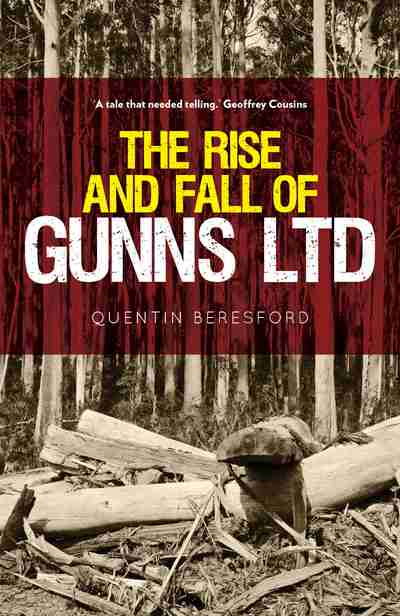
You can’t live in Tasmania without this book and the story it tells having a deep impact. If you are in anyway connected with the forest industry in Tasmania the impact is magnified tenfold. The book was recently released and is a timely reminder that Tasmania has significant political, commercial and social issues that remain unresolved.

The decade 2003-2013 saw Tasmania in a state of virtual civil war with Gunns Ltd at its epicentre.

http://en.wikipedia.org/wiki/Gunns

http://en.wikipedia.org/wiki/Bell_Bay_Pulp_Mill

The book has little to do with growing commercial blackwood apart from the fact that it details the corrupt hostile commercial, political and social context in which my dream of a blackwood growers cooperative is trying to become a reality.

Am I wasting my time? As a forester this book makes for sad, depressing reading.

If we can’t turn Australia’s number one premium appearance grade timber species into a commercial opportunity then it is due to a profound failure of policy, business and politics.

And as the author so clearly articulates in the Afterword of the book Tasmania continues to head in the wrong direction. Power and corruption continue to dominate the island State.

A fabulous read. Highly recommended!

Beresfordcover

Buy the book directly from the publishers:

https://www.newsouthbooks.com.au/books/rise-and-fall-gunns-ltd/

The book is also available on Amazon:

http://www.amazon.com/The-Rise-Fall-Gunns-Ltd/dp/1742234194/ref=tmm_pap_title_0?ie=UTF8&qid=1423691070&sr=8-1

and hopefully at Book Depository:

http://www.bookdepository.com/Rise-Fall-Gunns-Ltd-Quentin-Beresford/9781742234199

Forestry Tasmania and the Economic Regulator

FT logo

The Government’s willingness to breach the spirit of national competition policy by its use of State resources to prop up Forestry Tasmania whilst imposing austerity on broader sections of the Tasmanian community has struck a discordant note with many of the affected. If prices charged by Forestry Tasmania were required to fully cover costs [never mind the idea of actually making a profit] then it would be required to cease its unprofitable native forest harvesting.


A willingness by the affected to pursue remedies and solutions has precipitated this note.


Competitive neutrality complaints are handled by the Office of the Tasmanian Economic Regulator (OTTER) pursuant to the Economic Regulator Act 2009 .

http://www.tasfintalk.blogspot.com.au/2014/12/ft-and-economic-regulator.html

This blog by Tasmanian finance and economics commentator John Lawrence came out before Christmas, but it drives home the continuing failure of policy and corporate governance that is the hallmark of Government Business Enterpises such as Forestry Tasmania.

The fundamental lesson remains that Governments should not be in the business of competing with private business. Forestry is a business and there are many private tree growers who are being disadvantaged by Government policy and action.

One of the many failures in all of this is that farmer representative bodies such as the TFGA fail to bring the Government to account. If the Government opened a public service-run dairy, sold milk at below cost and then sacked teachers and nurses to help pay for it, the TFGA, dairy farmers and the rest of the Tasmanian community would be marching on Parliament. But for some reason forestry is different. Disadvantaging dairy farmers is out of the question but apparently disadvantaging private tree growers is perfectly acceptable behaviour amongst the farming community. It is very curious!

Another failure, as John Lawrence highlights, is that the so called Economic Regulator is a toothless tiger that spends more time licking the hands of politicians than biting their ankles.

http://www.energyregulator.tas.gov.au/

It is certainly curious that Forestry Tasmania, the one Government agency that clearly competes with the private sector (unlike gas, electricity and water), is completely off the Regulator’s radar. Coincidence? I doubt it!

So forestry industry workers enjoy complete Government protection whilst front line services such as nurses and teachers continue to lose their jobs. And forestry markets remain completely distorted and corrupted by Government policy.

When will Tasmania wake up? When will farmers and private tree growers rally of the lawns of Parliament House and demand reform?

Draft TWWHA Management Plan Representation

Tasmanian State forest industry policy continues to be highly politicised, divisive, destructive and costly to taxpayers.

The Draft Tasmanian Wilderness World Heritage Area Management Plan is just such a case in point with the plan by Government to start logging the WHA for special timbers. I wouldn’t care if it was gold or diamonds. The idea is just rubbish.

Here’s my submission to the Plan review. It’s not at all complementary. I could have said a lot more but this will do for beginners.

Cheers!

DTWWHAMP

Dear Project Team,

http://dpipwe.tas.gov.au/conservation/tasmanian-wilderness-world-heritage-area/new-tasmanian-wilderness-world-heritage-area-management-plan

Special Species Timbers

As a forester and member of the forest industry for the past 35 year my representation is entirely confined to the issue of special species timbers harvesting as it is mentioned in the DTWWHAMP.

I will make my representation as clear and concise as possible since the issue of special timbers in Tasmania is so hopelessly clouded by confusion, passion and misguided policy and ideology.

It’s time for Tasmania to get real! Forestry (including special timbers) is business. It’s about commerce and profits. It is not community service or the provision of Centrelink services. And it is certainly not about wedge politics and crony capitalism.

1. The first mention of special timbers in the DTWWHAMP is on page 28. Special timbers harvesting is listed as an allowed activity in Conservation Areas and Regional Reserves.

So why is special timbers harvesting listed as a sustainable use in Conservation Areas, but only a controlled use in Regional Reserves? How are sustainable use and controlled use defined? Why the difference in use between the two reserve types? What other natural resources besides special timbers can be used in these reserve classes, or are special timbers the only resources available for use?


Reserve Class Purpose of Reservation


Conservation Area The protection and maintenance of the natural and cultural values of the area of land and the sustainable use of the natural resources of that area of land including special species timber harvesting.
Regional Reserve Mineral exploration and the development of mineral deposits in the area of land, and the controlled use of other natural resources of that area of land, including special species timber harvesting, while protecting and maintaining the natural and cultural values of that area of land.


2. The second mention of special species timbers is on page 74 where the zones where special species timber harvesting is allowed are listed – all zones except Visitor Services Zones.

Activity Visitor Services Zone Recreation Zone Self-Reliant Recreation Zone Remote Recreation Zone
Extraction of special species timber (in regional reserves and conservation areas only. Not including Huon pine salvage from the Gordon River area) Prohibited Permitted by authority or a licence issued by the Minister in accordance with the NPRMA Permitted by authority or a licence issued by the Minister in accordance with the NPRMA Permitted by authority or a licence issued by the Minister in accordance with the NPRMA


3. The third and final mention of special species timbers in the DTWWHAMP is in section 3.6.2 on page 81 where the main discussion on special timbers harvesting is located.

3.6.2 Huon Pine Salvage and Special Species Timber

The salvage of Huon pine from the shoreline of Macquarie Harbour pre-dates the declaration of the TWWHA. The activity is permitted under a longstanding arrangement between the PWS and Forestry Tasmania. Most of the timber originates from the Gordon River and is sourced from trees that were cut down many decades ago during the height of the pining activities in the western rivers that are now in the TWWHA. Salvage operations, which occur mostly in response to flooding in the Gordon River catchment, make an important contribution to supplies of this rare and valuable timber, and are important for the economy of the region. Only commercial salvage is permitted and it must be in accordance with the PWS-Forestry Tasmania agreement, which is reviewed every five years. Salvage operations will be considered by the RAA process and any other applicable assessment and approval process.

The objectives of regional reserves and conservation areas, as set out in Schedule 1 of the NPRMA, provide for the harvesting of special species timber. Special species timber is defined within the Forestry (Rebuilding the Forestry Industry) Act 2014 and includes blackwood (Acacia melanoxylon), myrtle (Nothofagus cunninghamii), celery-top pine (Phyllocladus aspleniifolius), sassafras (Atherosperma moschatum), huon pine (Lagarostrobos franklinii), silver wattle (Acacia dealbata) and timber of any other species or timber with particular properties as may be prescribed through the associated regulations. Extraction of special species timbers will be considered through the RAA process and any other assessment and approval process or applicable legislative process.


Over 50% of section 3.6.2 discusses in the most general terms the current salvage of Huon pine from the shores of Macquarie Harbour. A number of unsubstantiated claims are made about this resource and its importance/significance. No supporting data is provided. These operations are undertaken in accordance with some PWS-FT agreement document. This agreement document is not referenced nor is it available to the public. Why not?

The remaining 100 words of section 3.6.2 tell us that special timbers harvesting is provided for under Schedule 1 of the NPRMA, and will be considered through the RAA and any other assessment and approval process as required!! Relevant special species available for harvesting are listed, along with any other species or timber with particular properties.

It is difficult to imagine a more opened ended and uninformative a statement as this. It serves no practical purpose whatsoever.

The 2014 Forestry Tasmania Draft Forest Management Plan provides us with a bit more information about special timbers management in Tasmania:

“The Forestry (Rebuilding the Forest Industry) Act requires the Minister for Resources to cause a special species management plan to be made before October 2017. The special species plan will specify the land to which it applies, the supply level of each species of special species timber in relation to the land, and take into account the management of conservation and cultural heritage values of the land.

Forestry Tasmania indicates its planned annual supply of special species timbers in its Three Year Wood Production Plan, which is updated annually. Forestry Tasmania’s future management of special species timbers from PTPZ land will be informed by the special species management plan when it becomes available.” Forestry Tasmania will not be involved in any way with any special timbers harvesting outside the PTPZ.

In other words special timbers management in Tasmania is in chaos! Forestry Tasmania is scaling down its special timbers commitments in line with its diminished capacity to supply. And a Special Species Management Plan won’t be available until the next Tasmanian State election in 2017!

The DTWWHAMP contains no statement of Government special timbers policy, no guarantees of any assessment, management or performance standards at all. Nothing but silence. It appears that this major change in TWWHA management is to be taken entirely on trust.

In summary the DTWWHAMP tells us virtually nothing about the existing special timbers salvage that does occur in the WHA, and tells us even less about the planned expansion of special timbers logging in the TWWHA. Given the bitter, long and ongoing conflict in Tasmania around the so-called commercial management of public native forests the special timbers provisions within the DTWWHAMP are entirely inadequate.

The subject of special timbers harvesting is of such enormous significance to the future of Tasmanias Wilderness World Heritage Area it is worthy of an entire chapter in the DTWWHAMP in its own right it.

As an absolute minimum if special timbers logging must go ahead (against all logic and reason) it should not proceed until the management plan and harvest operations have received Forest Stewardship Council (FSC) Certification, to guarantee forest operations are of the highest possible standards (as befitting a World Heritage Area) and meet with clear majority community support.

Completely inadequate is the only way to describe the special timbers provisions of the DTWWHAMP. Not at all worthy of the high standards of the World Heritage Convention. A thorough and complete rewrite is recommended.


Yours sincerely,


Dr. Gordon Bradbury

Tasmanian Blackwood Growers Cooperative.

Destructive anti-commercial policies continue at FT

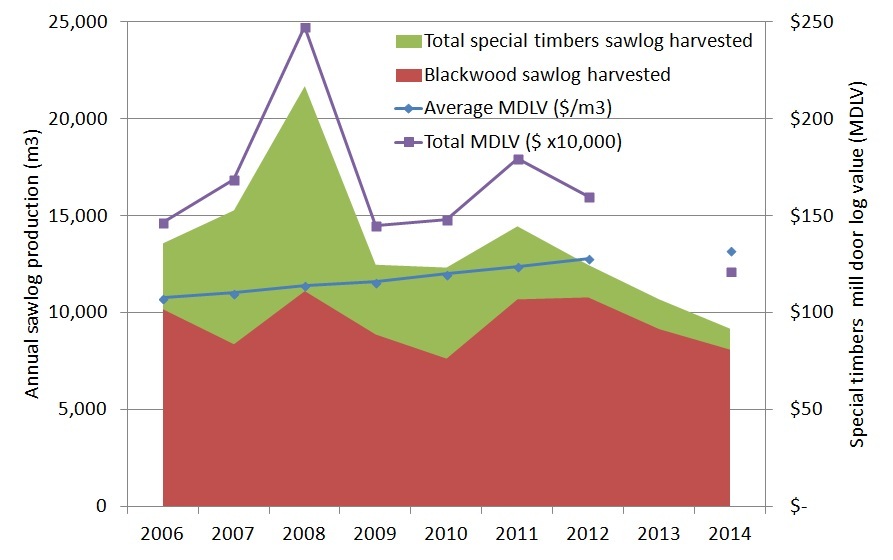
After an absence of a year the Forestry Tasmania 2013/14 Annual Report belatedly includes data on the mill door log value (MDLV) of the various product classes sold including special timbers (Appendix 2 – Supplement to table 3.1). This together with other data in the annual report has allowed me to update a chart I originally published in this blog in June 2013.

http://blackwoodgrowers.com.au/2013/06/13/pricing-blackwood-out-of-the-market/

As most readers will know Forestry Tasmania places a very low priority on commercial matters like getting the best possible price, and making a profit. It is difficult to understand FT’s approach to issues such as sales processes, pricing, markets, costs, supply and demand. None of these issues are discussed in their annual reports. What little information is available shows that good commercial management is absent at Melville St. By behaving in this reckless manner Forestry Tasmania is undermining the profitability and livelihood of all existing and potential future private tree growers and destroying the very industry it is supposed to be supporting. Such is the inevitable outcome of crony capitalism.

Of course Forestry Tasmania is aided and abetted in this behaviour by legislation and politicians that support crony capitalism.

Remember that Forestry Tasmania is by far the largest grower/supplier of premium quality special timbers logs in Tasmania/Australia. But it is not the only existing or potential future grower!

FT_MDLV_chart

The updated chart shows total special timbers and blackwood sawlog harvest for the past 9 years. 2006 was the first year that Forestry Tasmania published Mill Door Log Value data. For some reason no MDLV data were published in 2013.

As can be seen, blackwood makes up the majority of the special timbers harvest from public native forests in Tasmania. The chart also shows the total special timbers mill door log value (effectively what the sawmillers paid for the logs delivered to their mill). I have then calculated the average MDLV ($/m3) by dividing the total value by the total volume, effectively the per cubic metre royalty paid.

As can be seen the average MDLV is effectively a straight line with a gradient of 3.1%. In other words the price paid by sawmillers for these premium timbers is fixed in line with long term inflation. In other words their value does not increase in real terms – exactly the same real price today as 9+ years ago. That’s what I call a great deal!

In 2013/14 the average special timbers MDLV was $132 per cubic metre. That value includes all the administration and overhead costs, plus the costs of harvesting and transport to the mill. One can only guess what the effective stumpage price was, maybe $40 per cubic metre!! What a joke!!

The other obvious trend in the chart is that special timbers log prices are not affected in any way by market conditions – supply, demand, costs of production, etc. For example the Global Financial Crisis of 2007 had absolutely no impact on prices.

And finally the trend in special timbers revenue over the last few years suggests that 2014/15 will see revenue drop below $1 million. We have no idea what the costs are in special timbers management and harvesting because Forestry Tasmania does not provide separate accounts for these “non-profit” activities.

But it doesn’t matter because Forestry Tasmania sends the special timbers bill to the Tasmanian taxpayer! 10,000 cubic metres (or 500 truck loads) of some of the world’s best timbers sold for a song, AND teachers and nurses lose their jobs. Does anyone care? Apparently not!

Is it any wonder that many Tasmanians regard Forestry Tasmania as an albatross around the neck of the community?

Despite the fact that Forestry Tasmania deliberately operates its special timbers operations at a loss, it:

  • Fails to provide separate financial statements for these operations;
  • Fails to provide any commercial management model and objectives that might identify limits to costs and losses;

The Tasmanian community is left with an unmanaged out-of-control special timbers liability. And the situation is going to get worse with the proposed logging inside the World Heritage Area!

2014 The Year in Review

santa

It’s that time of the year to wish everyone a safe and happy festive season, and to recap on another year in the Tasmanian forest industry.

I have to admit not much progress was made during the year in getting Tasmanian farmers growing commercial blackwood, nor in getting the various players in the blackwood marketplace to open up and help build the blackwood industry.

This is not surprising. The forest industry continues to be overwhelmed by negative sentiment and politics.

The Good:

The Inaugural Deloraine Stringfest

Until I got a phone call from the organiser asking me to participate I had not heard about this event. What a great event it was and such a natural fit with developing the commercial future for blackwood, one of the world’s great sustainable tonewoods. Unfortunately Stringfest remains significantly enslaved to the unsustainable public native forest special timbers fiasco. Until these ties are broken Stringfest remains a festival compromised. But it’s on again next year and hopefully bigger and better than 2014. See you there!

Taylor Guitars 2014 Fall Limited edition guitars

US guitar giant Taylor Guitars continued to show their support for Tasmanian tonewoods in 2014 with the successful Fall Limited series.  True it was the stunning blackheart sassafras models rather than the plainer blackwood that captured most of the market attention. But it’s the blackwood that remains the quiet achiever and the tonewood with the future. The feature article in the Fall 2014 Wood & Steel magazine was also great promotion.

Strong export markets and prices

Meeting some blackwood processors who are involved in private blackwood log export was a real eye-opener. The first surprise was the high quality of the private blackwood logs being sourced. That blackwood of this quality is still available from private land in Tasmania was a real eye opener for me. The second revelation was the obvious high demand for quality blackwood from so many countries, and a willingness to pay good prices! Especially at a time when the domestic markets remain subdued.

That all this good trading is happening completely “off the radar” is the real disappointment. No advertising, no media coverage. This positive forestry story remains completely unknown to most Tasmanians. And the commercial future and potential of blackwood remains thwarted. Just how do we get the blackwood marketplace to open up and work properly? Because until it does then Tasmanian farmers and the Tasmanian community will be the losers.

The Not So Good:

2014 was another year dominated by negative sentiment and politics on almost a weekly basis.

The State Election

Yet another State election campaign dominated by the forest industry. No wonder Tasmanians are fed up! And anyone would think that the public native forest special timbers industry is fundamental to Tasmania’s economic prosperity the way the politicians behave. It really is a joke. And it will all be repeated again in 2017/18 at the next State election (see below)!

The Scrapping of the TFA, Rebuilding the Forest Industry Bill 2014, the Workplaces (Protection from Protesters) Bill 2014, the Triabunna witch-hunt and finally the annual Government Businesses Scrutiny Committees

There is absolutely no doubt whatsoever that politics dominates and controls the forest industry in Tasmania. It dominates and controls just about every aspect of the industry on a daily basis. There is nothing about business or commerce here at all. The new State Liberal Government plans to rebuild the industry without even the outline of a Plan, whilst the new anti-protest legislation has been soundly condemned by just about everyone without a vested interest in a draconian future.

Even the distressed residents of Triabunna eventually came to realise that the political witch-hunt around the sale of the woodchip mill was a waste of time and money, not to mention the opening of old wounds for no apparent gain.

And lastly the annual week of Government Businesses Scrutiny Committees turned into another political fiasco, demonstrating the real value of political rhetoric and promises. So we now have the stupidity of Tasnetwork customers subsidising Forestry Tasmania. Tasnetwork customers would include a large number of existing and potential future private forest growers. Private forest growers subsidising the public grower! And for this we sack teachers and nurses. The nonsense and stupidity just has no end and knows no bounds!

Why aren’t people out in the streets protesting this nonsense? Tasmanians are just too placid when it comes to politics!

The FT Blackwood Resource Review

Forestry Tasmania released the first blackwood sawlog resource review since 1999. There was essentially no relationship at all between the 1999 and the 2014 review, with no demonstration of sustainability let alone profitability. Very disappointing!

The FT draft FMP and FSC application

As part of Forestry Tasmania’s FSC Certification application the draft Forest Management Plan (FMP) shows some improvement in transparency and accountability but there is still a very long way to go. It sure fails to demonstrate any commercial management skills whatsoever. The FMP also tells us that the next State election campaign will once again be dominated by forestry issues especially around the special timbers industry and harvesting in parks and reserves. I just can’t wait!

The continuing commercial failure of FT

Forestry Tasmania itself acknowledges that it will continue to make losses for the foreseeable future, 2014 being no exception. But with no commercial objectives and no plan to improve commercial performance what hope is there? And all this while we sack teachers and nurses!

Whilst the major grower of high quality timber and special timber to the market continues to be managed as a taxpayer subsidised community service the forest industry will keep going backwards.

Conclusion

I can’t imagine a more hostile business environment for a forest industry than in Tasmania. On almost a weekly basis the Tasmanian media broadcasts to the world how dysfunctional our politically driven forest industry really is.

As I said 12 months ago 2014 was only ever going to be a bad year for the forest industry and so it has been!

And 2015 looks like being no different. More politics, more conflict and more stupidity!

Forestry Tasmania will most likely fail in its first attempt at FSC Certification. This will result in much agitation, shouting and finger-pointing in State Parliament and sections of the community. In fact given the highly politicised nature of forestry in Tasmania FSC certification is unlikely in the foreseeable future. Forestry Tasmania will also declare yet another financial loss and another taxpayer subsidy for the year whilst teachers and nurses will continue to lose their jobs.

Will Tasmanians ever wake up?

And what of blackwood as a commercial opportunity in 2015?

Stringfest 2015 will be bigger and better which will be good for my coop dream. Don’t forget the field trip to the private blackwood plantation I am organised as part of Stringfest.

Who knows what Taylor Guitars will do in 2015 but the rhetoric surely indicates they have something planned for blackwood and Tasmania.

As I build my network of blackwood industry and market contacts hopefully I can bring you more up-to-date market information on demand, supply and prices in 2015.

So dear readers I trust you have a safe and happy festive season. See you all in 2015.

Forest Industry Dictatorship

This blog was originally called “Groundhog Day”. But on reflection I think things have gone well beyond a Hollywood fantasy comedy. The events of the past week when added to the events of the past 12 months clearly demonstrate that Tasmania is now a forest industry dictatorship. Logic, reason, common sense and all other interests (including health and education) have now become subservient to the interests of the politically-driven forest industry in Tasmania. It is beyond contempt!

groundhog-day-driving

As a consequence of the 1993 American fantasy comedy movie of the same name, the phrase “Groundhog Day” has entered common use as a reference to an unpleasant situation that continually repeats.

Working in the forest industry in Tasmania is definitely a Groundhog Day existence.

The past week was another terrible example with the annual fiasco that is the Government Businesses Scrutiny Committees hearings.

http://www.parliament.tas.gov.au/ctee/House/Archived/hagbe14.htm

This should be an example of the epitome of good corporate governance. Instead every year it becomes a political circus. This year was no exception.

Once again the Tasmanian community (including private forest owners) finds itself continuing to subsidise Forestry Tasmania for yet another year despite emphatic promises to the contrary by the new State Government. At the same time Tasmanian teachers, nurses and other public servants are losing their jobs!

And judging by the comments from readers in the newspapers many Tasmanians are thoroughly sick and tired of the stupidity and continuing waste.

This continues to be extraordinary!

And private forest owners (who are being total screwed in all of this disaster) remain completely mute on the issue. I just don’t get it!

http://www.abc.net.au/news/2014-12-05/forestry-tasmania-asks-the-public-to-have-faith-in-its-future/5948360?section=tas

http://www.abc.net.au/news/2014-12-04/tasmania-power-users-to-supply-30m-to-forestry-tasmania/5945404?section=tas

http://www.abc.net.au/news/2014-12-04/millions-in-tas-forestry-exit-funds-to-be-spent-on-industry/5945212?section=tas

http://www.themercury.com.au/news/politics/storm-over-tasnetworks-30-million-payout-to-forestry-tasmania/story-fnpp9w4j-1227145291339

http://www.examiner.com.au/story/2745241/forestry-tasmania-to-face-scrutiny-hearings/?cs=95

And to add insult Forestry Tasmania Chairman Bob Annells was quoted as saying this:

Forestry Tasmania is asking Tasmanians to have faith the company will eventually return to profitability.  Chairman of the state-owned forester Bob Annells said the loss-making company had fundamentally changed how it did business.

Every time Tasmania has had yet another another forestry agreement or peace deal over the last 30 years we have been told to have faith. Every time we have had a State election over the past 30 years we have been told to have faith. And every time our faith has been betrayed.

Mr Annells seems not to appreciate that the community’s store of faith has run dry.

Sacking teachers and nurses whilst subsidising woodchips is well and truly beyond contempt let alone faith.

fundamentally changed how it did business”?

I have seen not one dot of evidence to support this claim. Not a smudge of evidence.

No! It is definitely Groundhog Day again (and again and again and again…..).

For the past 30 years the forest industry in Tasmania has been caught in a perpetual Groundhog Day and it has to stop. It must stop! Someone within the industry with integrity and leadership must step forward and call a halt to this madness or it will continue indefinitely.

Does the industry have anyone of that calibre?

Happy Groundhog Day!

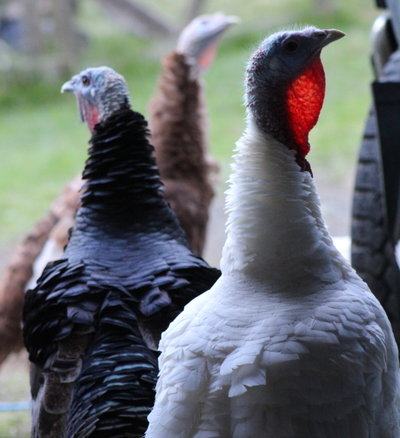
Tasmanian forest turkeys

In response to a comment I received on my earlier blog on the Canadian-US lumber dispute I can’t help but post a link to this excellent article from the British Columbia Private Forest Landowners Association.

http://www.pfla.bc.ca/log-export/what-turkeys-can-teach-us-about-b-c-timber-supply-complaints/

rsz_turkeys

Just so much of the comments and observations on forest policy and practice in British Columbia ring true here in Tasmania.

One major difference is that at least in BC the private forest owners understand that they are being screwed by the Government and its forest industry servants.

Thanks to Rod Bealing, Executive Director of the BC PFLA for the comment and link.

Canada–United States softwood lumber dispute

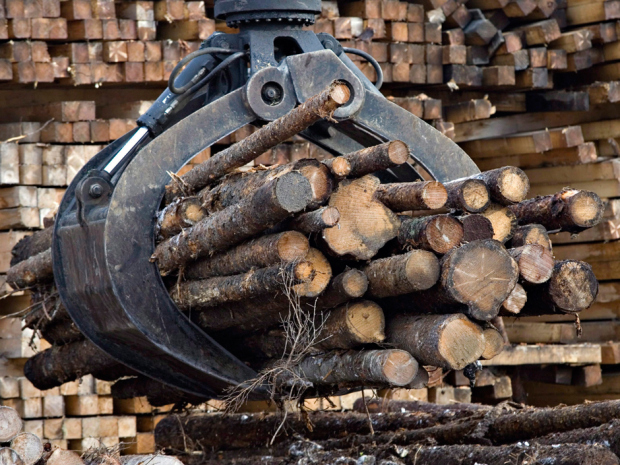
softwood-lumber

Isn’t it amazing.

Here’s a forest industry story that has strong echoes here in Tasmania.

It seems the forest industry has the same problems around the world.

http://business.financialpost.com/2014/10/31/the-granddaddy-of-all-canadian-u-s-trade-disputes-is-about-to-rear-its-ugly-head-again/

and even a Wikipedia entry about this trade dispute:

http://en.wikipedia.org/wiki/Canada%E2%80%93United_States_softwood_lumber_dispute

So what’s the issue?

Well the Canadian lumber industry is unfairly subsidized by federal and provincial governments (just like here in Tassie), as most timber in Canada is owned by the provincial governments (just like here in Tassie). The prices charged to harvest the timber (stumpage fee) are set administratively (just like here in Tassie), rather than through the competitive marketplace, the norm in the United States.

And why are forest product prices in the US set through the competitive marketplace? Because most forests in the US are privately owned and private owners do not want to be competing against stupid anti-trust Governments. They want to get the best price possible for their trees.

And the National and Provincial Governments in Canada refuse to reform their forest industry and open it up to competitive pricing, just like the Tasmanian Government.

And don’t the American’s hate that!

Hence the massive trade dispute!

Here in Tasmania private tree growing is still a bit of a novelty. Until 20 years ago most farmers regarded trees is a liability not an asset. Governments did forestry, not farmers. After the disaster of the failed MIS schemes of the last 20 years we have returned to that same situation – trees as liabilities. And we still have Tasmanian Government policy deliberately discriminating against existing and potential future private tree growers through taxpayer subsidised Administered log pricing. Echoes of failed Government bureaucracy from around the world.

Now I’m not sure what defines “unfair” subsidies? Sounds like an oxymoron to me.

I just hope the Americans give the Canadians a lesson in economics 101.

Now I wonder how many of those subsidised, anti-trust Canadian forest operations have FSC certification?

And here we are in Tasmania with exactly the same problem, but we don’t have a trade partner like the USA to kick our stupid butt!

A shame really!!