Category Archives: Commentary

Tasmanian Wilderness World Heritage Area logging proposal

Tasmania’s forestry wars are well and truly back with a vengeance.


2000

Groundhog Day.

The media has been buzzing the last week with the to and fro of political banter, bluster, vilification and hypocrisy over the outcome from the UNESCO World Heritage Committee meeting last week.

It really does beggar belief.

The proposal to log specialty species timber in the Tasmanian Wilderness World Heritage Area is policy madness. Such a move would set Tasmania back another 10 years. The damage to the economy and the community would be significant. There is just so much community opposition to this proposal.

The State Government is clearly out to antagonize as many “green” thinking people as it possibly can with the sabre rattling and chest thumping. What better way to foster a social, cultural and economic boycott of the State. Wedge and polarise the community in order to win the next election.

Politics pure and simple.

Given the legacy of the last 30 years and the continuing political and community heat around this issue there is no way UNESCO will accept logging in the TWWHA. But elements of the special timbers industry and our politicians will push this regardless of the risk and damage.

The tourism industry understands that this conflict is not just about the forest industry. It impacts the entire economy making Tasmania a less attractive place for investors and business.

There is absolutely no notion of communication, negotiation, understanding respect or tolerance in any of this. The TFA and the last State election demonstrated beyond any doubt that any attempts at dialogue and negotiation will be quickly sabotaged and undermined. Once again we are facing another crash through or crash situation, and based on past performance the only outcome will be the latter.

Just how dysfunctional can Tasmania become?

http://www.abc.net.au/news/2015-07-02/un-environment-committee-criticises-tasmania-forests-plan/6588452?section=tas

http://www.abc.net.au/news/2015-07-02/mining-ruled-out-in-tasmanias-world-heritage-area/6590214?section=tas

http://www.abc.net.au/news/2015-07-03/specialty-timber-workers-want-unesco-tick-for-tasmanian-logging/6594506?section=tas

http://www.themercury.com.au/news/tasmania/tasmanias-wha-draft-plan-rejected-by-world-heritage-committee/story-fnj4f7k1-1227424700964

http://www.theguardian.com/australia-news/2015/jul/02/un-calls-for-ban-on-logging-and-mining-in-tasmanias-world-heritage-area

http://www.themercury.com.au/talking-point-money-talks-and-its-saying-hodgman-has-lost-the-world-heritage-area-fight/story-fnj3twbb-1227429396506

World Heritage Committee delegates will visit Tasmania before the State submits an updated report [Management Plan] to UNESCO by 1 February next year.

Tasmania and the forest industry remain embroiled in the continuing conflict and going nowhere.

Trying to encourage farmers to grow profitable commercial blackwood while the special timbers industry is run as a taxpayer-funded community service is a tough challenge.

Here’s some of my previous blogs on this issue:

http://blackwoodgrowers.com.au/2015/05/31/unesco-calls-for-changes-to-tasmanias-draft-world-heritage-management-plan-to-prohibit-logging-and-mining/

http://blackwoodgrowers.com.au/2015/02/10/draft-twwha-management-plan-representation/

Wish List

Makeawish

The forest industry in Tasmania is heading towards oblivion, at least the part of the industry dependent on the public native forest resource. Decades of poor policy, politics and conflict have reduced the industry to a smoking ruin. But we seem to have trouble learning from past mistakes and from other people’s successes. Getting people to invest in the forest industry (from planting trees to investing in sawmilling and processing equipment) just won’t happen under the current regime. So here is my one dozen wish list:

  1. We need to start thinking of forestry as a primary industry and not as a Government-run, politically-driven, employment program. Sure it has a few unique features like a long investment time lag, but forestry is about business and profits; markets, costs and prices. It is not about politics or employment! Most wood now grown and sold in Australia comes from private tree growers. It is time to put the policy focus on private growers.One example of this change in focus would be to move Private Forests Tasmania (PFT) from the Department of State Growth Tasmania to the Department of Primary Industries, Parks, Water and Environment (DPIPWE). At the moment this DPIPWE website contains no mention of forestry at all:http://dpipwe.tas.gov.au/agricultureWhy isn’t forestry regarded as a primary industry in Tasmania?

    Also the Government Minister responsible for PFT/DPIPWE should also be responsible for Forestry Tasmania, so that all commercial forest policy and practice is aligned with primary industry policy. Does that sound logical or what?

  2. And like all primary industries the only basis for a successful forest industry is for tree growing (public and private) to be transparently profitable.That’s the golden rule! It’s that simple!Commercially focused, profitable tree growers are the foundation of a successful forest industry. The forest industry is not about subsidizing the sawmillers, papermakers, or woodchippers, or the furniture makers, craftsmen, luthiers or boatbuilders. These people are important, but without profitable tree growers they are irrelevant. Forest industry policy should be focused on profitable tree growers.
  3. We need to get the politics and conflict out of the industry. That means either a) completely transforming Forestry Tasmania into an independent, fully commercial, profitable business, or b) shutting down public native forest logging. There are no other options!
  4. Public and private tree growers must be able to compete in the marketplace on a level playing field. This means no more subsidies or political protection for public tree growers. Forestry Tasmania must be structured and managed just like a private tree grower – independent, fully commercial and profitable. Anything else is anti-competitive.
  5. The Tasmanian Farmers and Graziers Association (TFGA) needs to become a genuine independent, vigorous advocate for private forest growers. The interests of private forest growers are not the same as those of sawmillers, or Forestry Tasmania nor the Government of the day. A thriving commercially competitive, profitable forest industry can only exist when private tree growers have a strong, fearless, independent voice.
  6. It’s time for the forest industry (and I’m talking about everyone here from tree growers to wood processors and log exporters) to publically demonstrate some real commercial muscle. Where are the profits? Where are the prices? Where are the markets? Where is the transparency and market feedback? For far too long the industry has focused on political muscle. It’s time to “put the rubber to the road” and lead by commercial example.
  7. Unlike many other primary industry markets, Australia’s forestry markets have historically been opaque to near invisible, and continue to be that way. Hidden markets do not encourage investment in planting and infrastructure. The forest industry in New Zealand issues regular monthly market reports. This helps everyone better understand the marketplace. We desperately need similar transparency in forestry markets here in Australia.
  8. To help overcome the natural reluctance of many people to make the long-time investment in forestry (the time between planting and harvesting), the industry needs to be incredibly (aggressively??) transparent in the marketplace. This means lots of market reports and updates, lots of price and demand information, etc. We need significant market stimulation to help landowners get past the big time factor!!
  9. Farmers need to have greater understanding and confidence in forestry markets. Again this requires forestry markets to be much more transparent and commercially focused; just like other rural commodities. Investing in forestry is not easy. There’s the technical stuff and the long investment period, and just the switch to thinking “long term”. When we start getting forestry market updates in the rural media then I will know that the forest industry has come of age.
  10. The forest industry needs a new Forest Practices Code, or rather it doesn’t. Let me explain.The forest industry in New Zealand is huge (bigger than Australia’s) and very successful, but New Zealand does not have a Forest Practices Code. Imagine that! In New Zealand they regard the forest industry as just another primary industry, which must abide by the same code of environmental practice as all the other primary industries. It’s called a level playing field.The code is called the Resource Management Act 1991, and it applies to most primary industries. It is designed to protect environmental values regardless of land use. So growing trees for wood production has the same regulatory framework as other primary land uses. A brilliant idea!Here in Tasmania the forest industry is far and away the most (over?) regulated primary industry in the State. This creates market distortions and discourages sensible land use and investment decisions.Forest plantations on already cleared land should be no more or less regulated that any other agricultural crop. For many Tasmanians that will be a very difficult thing to imagine after the MIS hardwood plantation disaster.

    (And whilst on the subject of New Zealand, the forest industry there survives without any resource security. That’s right! Whatever trees the private forest growers have to sell is the only resource available to industry. That’s all. If a sawmiller wants “resource security” then they need to pay a competitive price to stay in business. The issue of “resource security” is a furphy!)

  11. And following on from the previous item, why do we have Private Timber Reserves in Tasmania?http://www.pft.tas.gov.au/index.php/services/services/1-website-articleWhy not Private Onion Reserves, Private Poppy Reserves, Private Cow Reserves or Private Apple Reserves? In fact why not make all primary industries subject to a single Statewide planning system? Wouldn’t that be fairer? We could even call it the Resource Management Act!
  12. And finally I’d like to see Tasmanian farmers incorporate commercial blackwood growing into their business models (either plantation or native bush), developing the skills, passion and expertise in growing this iconic quality Tasmanian product. But this won’t happen to any extent unless change occurs within the forest industry and Government policy.

When you compare my wish list with the current forest industry you can see an enormous abyss. Current forest policy is focused on a public native forest resource, a bankrupt, non-commercial public forest manager, a handful of taxpayer-subsidised sawmillers and processors, and enormous amounts of politics and community conflict. It has been this way for decades!

It seems that none of this will change unless the TFGA (on behalf of private forest growers) start demanding reform. And based on recent events I can’t see this happening any time soon.

What do you think? Comments? Continue reading

Gagged!

gagged

Isn’t this just so predictable and pathetic?

Just when we start to get some real debate and transparency into the Tasmanian forestry wars along comes the Honourable Minister and slams the door.

It was so newsworthy that it made both the major State news media.

http://www.abc.net.au/news/2015-06-19/forests-minister-tells-advisory-council-to-keep-opinions-private/6559572?section=tas

and

http://www.themercury.com.au/news/politics/resources-minister-paul-harriss-puts-clamp-on-forestry-tasmania-talk/story-fnpp9w4j-1227406689089

What is the purpose of an advisory council if “everyone is on the same page”? That’s not an advisory council. That’s a political smokescreen, a whitewash!

The whole purpose of an advisory council, as Sue Smith said, is to promote and foster vigorous, open discussion and canvas as wide a range of opinions and options as possible.

The Tasmanian forest industry is going absolutely nowhere until the future of Forestry Tasmania is resolved. And after 21 years we know that the GBE business model has been a total failure. Forestry Tasmania remains the “albatross around the neck” of the forest industry.

So vigorous and open debate about this issue is absolutely fundamental.

And yesterday the State government shut that debate down.

Judging by the response in the media the Tasmanian community is absolutely sick and tired of the continuing political games and squandering of taxpayers money on the forest industry. But the advisory council and our politicians just aren’t listening.

The issue of retaining skills is yet another forest industry furphy. The one and only skill that Forestry Tasmania needs right now is to be fully commercial and profitable. Without this fundamental skill everything else is completely irrelevant.

The advisory council is now a lame duck with no integrity, credibility or purpose. Send the bill to the Tasmanian taxpayer.

When will Tasmania get a fully commercial profitable forest industry?

TFGA supports continuation of failure

TFGA_Skillern

TFGA CEO Mr Peter Skillern

Well the TFGA retains its historical position as being incredibly conflicted and confused about the role of the private forest grower and the future of the forest industry in Tasmania.

http://www.abc.net.au/news/2015-06-19/tfga-supports-forestry-tasmania-dismantle-discussion/6558536

With the Forestry Tasmania GBE business model being shown to be a complete disaster over the past 21 years the TFGA comes out today and says that’s fine, keep it going!

It’s pretty pathetic and shows a complete lack of independence and vision.

Typical!

Private forest owners now dominate the forest harvest in Tasmania for perhaps the first time ever.

State forest policy should now be focused entirely on building a profitable, commercially focused private forest grower base.

But the TFGA appears not to want this. Instead the TFGA wants State forest policy to remain 100% focused on the public forest resource and a failed GBE.

More politics and conflict and a failed forest industry.

The TFGA is the only representative and voice of the private forest grower in Tasmania.

I just don’t understand!

At least Sue Smith had the guts to have a go and say something different.

Eye fillet, sausages and guitars

cow

I’ve recently been engaged in an email discussion with the supply chain manager of a major guitar maker that has opened my eyes to some of the wood resource and marketing issues facing the industry.

The conversation started when I enquired whether the company would be interested in buying farm-grown Tasmanian blackwood to use in their guitars. The unequivocal answer came back that to date the company has found it difficult to sell guitars made from Tasmanian blackwood and hence would be reluctant to purchase more timber.

This and a few other comments they made got me thinking.

For the past 100 years and more the guitar industry has been able to access the very best cuts of wood available from around the world with which to build guitars. Rosewood, mahogany, ebony, quilted koa and maple, etc. All of these premium cuts have been accessible largely due to the plundering of the worlds old-growth and rainforest that is now coming to an end.

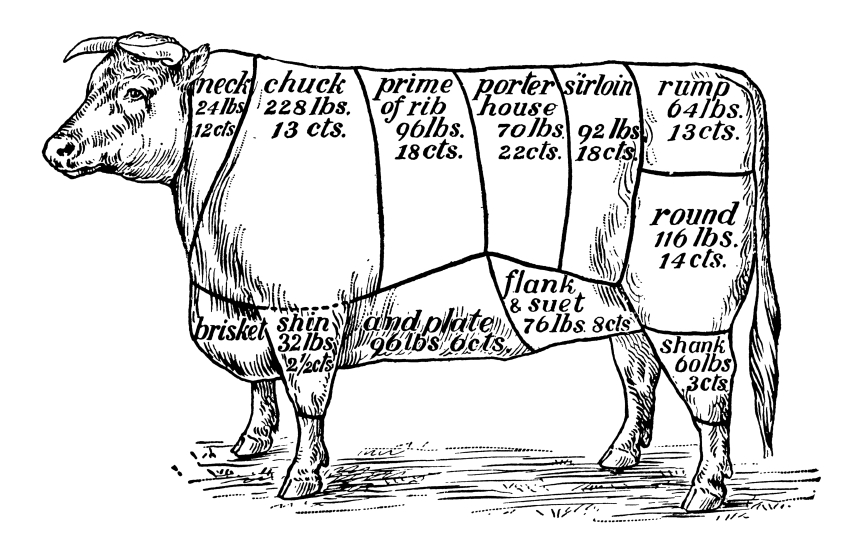
The guitar industry was like a butcher shop that only sold eye fillet steak. No mince, no sausages. Just premium quality meat. The fact that the rest of the forest products went to other markets helped the guitar industry enormously.

But the wild herds of bison, like the old growth and rainforests, have nearly all gone. Now the butcher shop has to start stocking rump steak, as well as the mince and sausages in order to stay in business, but after 100+ years the customers are finding it hard adjust to this change in diet.

So too the guitar makers are finding it difficult to identify and source sausages and mince that customers might want to buy. Many guitar makers appear to still be peddling nothing but premium cuts.

The words “alternative woods”, “sustainable” and “certified” are slowly becoming part of the daily life for guitar makers, and less so for consumers.

But the butcher shop analogy does have its limitations.

Many of these alternative woods are perfectly good for making quality guitars. In no way do they reflect a move to mince or sausage grade timber, but they do reflect the changes being forced upon guitar makers and reluctant consumers by a changing wood resource. But to the ordinary guitar buyer it feels like an eye fillet vs sausages decision.

What’s worse, the eye fillet, mince and sausages are often all priced the same. So given the choice the consumer is reluctant to try the alternative woods. I think this has been one of the problems with introducing Tasmanian blackwood onto the international tonewood market. Customers often need some incentives to try a new product.

And it’s not just new species of timber that is challenging guitar makers and buyers.

In some cases the eye fillet steak has simply been wood that is highly figured like maple and koa, with plain, straight-grain maple and koa having never featured in the guitar market to any extent. So the above major guitar maker has excess quantities of straight-grain koa and maple wood that they cannot sell to the guitar-buying public. Beautiful timber and great for making quality guitars but it’s just not eye fillet steak!

This is curious because straight grain rosewood and mahogany are perfectly acceptable to the guitar buying public. Years of being fed eye fillet steak has clearly made the market resistant to change.

Now from a forester and commercial blackwood grower’s view point all of this is a bit of a disaster.

Going back to the butcher shop again, a cattle farmer would quickly go out of business if they could only sell eye fillet steak. To be viable the farmer has to sell the whole animal with the various cuts of meat priced according to the supply and the demand. Basic economics 101.

Ditto for tree growers. Highly figured wood is rare. Straight-grain wood is more common. But the guitar market doesn’t reflect this supply situation, either in price or in marketing.

If guitar makers want to help tree growers, then they need to adjust their product development, marketing and sales to better reflect the supply situation regarding plain vs feature grain timber. Plain grain koa, maple and Tasmanian blackwood are great quality tonewoods just like plain grain mahogany and rosewood. Feature grain wood of any species should attract a premium price that is clearly over and above plain grain guitars.

Some guitar makers are better at product design than others. Putting a clear finish on a plain grain guitar especially if the wood is new or alternative may not meet with much buyer enthusiasm. Staining, edge-shading,  a bit of bling, and a price to encourage buyer interest will go a long way to help overcome the conservative guitar buyer.

But for the moment it seems that this major guitar maker won’t be encouraging Tasmanian farmers into the commercial blackwood tonewood market anytime soon.

Comments and ideas?

UNESCO calls for changes to Tasmania’s draft World Heritage Management Plan to prohibit logging and mining

DTWWHAMP

In the ABC News yesterday:

http://www.abc.net.au/news/2015-05-30/unesco-calls-for-world-heritage-area-draft-plan-changes/6508506?section=tas

So the UNESCO World Heritage Committee is now questioning the policies of the Tasmanian State Government.

In Paris overnight, UNESCO’s WHC urged the draft plan be changed. An initial review cited concerns that the plan appeared to create potential for logging operations and mining activity in the World Heritage Area.

An article by Vica Bayley on Tasmanian Times provides more details:

http://tasmaniantimes.com/index.php?/weblog/article/unesco-drafts-a-damning-rejection-of-world-heritage-management/

The draft decision of the World Heritage Committee, for consideration at its [forthcoming] June meeting, represents a damning rejection of the Tasmanian Government’s proposed management of Tasmania’s World Heritage Area.

The draft decision identifies ……. prohibiting logging and mining via upgraded conservation tenure as key actions that need to be taken.

Informed by expert reports from the Committee’s advisory bodies, the draft decision …. urges … that commercial logging and mining are not permitted within the entire [WHA] property, and that all areas of public lands within the property’s boundaries… have a status that ensures adequate protection (p. 56).

The draft Committee decision can be found at:

http://whc.unesco.org/archive/2015/whc15-39com-7BAdd-en.pdf. (1.8MB pdf file).

Pages 54 and 56 of the document are the most relevant.

It appears that Tasmania’s special timbers industry is fast running out of options, at least in terms of access to a taxpayer subsidised public forest resource. The World Heritage Committee will not accept special timbers logging within the Tasmanian Wilderness World Heritage Area.

Here are some of my previous stories about the Draft Tasmanian Wilderness World Heritage Area Management Plan:

http://blackwoodgrowers.com.au/2015/02/10/draft-twwha-management-plan-representation/

http://blackwoodgrowers.com.au/2015/03/25/tourism-council-sees-the-light/

Curiously the ABC news article says that the Tasmanian tourism Industry supports the draft Plan, when in fact the Tourism Council’s own submission is extremely qualified in its support, with strong opposition to the logging and mining proposals in the Plan.

http://blackwoodgrowers.com.au/2015/03/09/deloraine-stringfest-world-heritage-area-logging/

So when will Tasmania get a fully commercial, profitable forest industry?

FT closer to closure

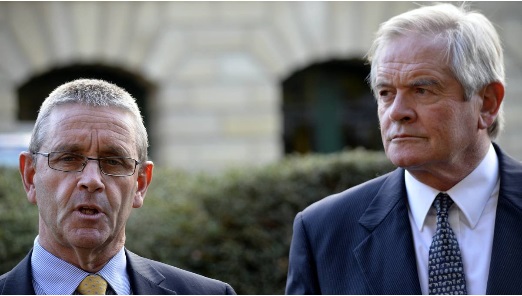
Harriss&Annells Resources Minister Paul Harriss (L) & Forestry Tasmania Chairman Bob Annells (R)

The ministerial statement on the future of Forestry Tasmania today was a de facto announcement of the appointment of an Administrator.

Expressions of interest are to be invited for some of FT’s assets, mainly the hardwood plantations, which hopefully will be enough to cover the costs of Administration.

FT will then almost certainly be wound up.

http://www.tasfintalk.blogspot.com.au/2015/04/ft-closer-to-closure.html

I was going to write my own response to Wednesdays announcements by Resources Minister Paul Harriss but John Lawrence beat me to it and with much greater depth and understanding.

http://www.premier.tas.gov.au/releases/securing_the_future_of_forestry_tasmania http://www.premier.tas.gov.au/releases/ministerial_statement_review_of_forestry_tasmania

Thank you John. And I fully agree with his analysis.

Please read John Lawrence’s analysis and response to yesterdays announcements.

Remember that Forestry Tasmania is the largest grower/supplier of Tasmanian blackwood timber to the market. When FT goes the blackwood industry will have some tough times adjusting.

I will leave you with John’s closing statement:

Minister Harriss hasn’t produced a plan. Rather a plea. Help me.

After all the talk about growing the industry when the figures suggested growing the industry will grow the losses has left him with the credibility of miracle cancer survivor Belle Gibson and the strategic smarts of Colonel Custer.

One good reason for maintaining FT for a while longer is that sale of assets will be more easily effected by a GBE.

When Minister Harriss talks about finding a way to fund a transition, he is referring to the transition from Administration to Liquidation.

Nothing else is likely at this stage.

PS. This is not to say it will be the end of the forest industry. Quite the opposite.

I believe the best option now available is to recognise that the future of the industry is with private forest growers and farmers. It already is! Most wood now grown and sold in Australia comes from private forest growers. This is even now true in Tasmania. The future is already here.

The sooner we move on and get the conflict and politics out of the industry the better it will be for everyone, including blackwood growers.

Special Species Timber Management Plan Update #1

FTSTS2010

Continuing on from my previous blog:

http://blackwoodgrowers.com.au/2015/04/19/an-invitation-to-participate-in-the-special-species-timber-management-plan/

and the invitation from Minister Paul Harriss to participate in the Special Species Timber Management Plan, I was contacted by Mr Blair Freeman from the consulting firm Indufor. We ended up talking for about an hour over the phone.

Here are some brief comments:

A survey form was sent out by Indufor to selected members of the special timbers industry to provide critical information with regard to industry preferences, demand for wood, drivers of demand and sensitivity of customers to market change.

SST Market Demand Survey Sawmillers

My one comment about the survey form was the obvious omission from the survey of any opportunity for stakeholders to make comments on strategic, political or policy issues. If special timbers stakeholders had any questions or concerns about any of these issues then the Minister and the Special Timbers Sub-Committee of the Ministerial Advisory Council are just not interested!

If logging the Tasmanian Wilderness World Heritage Area at taxpayers’ expense is of any concern to stakeholders the Minister Paul Harriss doesn’t want to know about it!

So much for accurate and relevant information!

Given that just about all of my comments relate directly to strategic, political and policy issues around special timbers I found the survey form frustrating. Luckily Mr. Freeman anticipated my frustration and instead we opened up the conversation to address broader issues.

I see my business as being in direct competition with the Government/Forestry Tasmania. And I’m not short of criticism of my competitor.

Putting aside for one moment the political/policy issues, the one primary objective of the proposed Special Species Timber Management Plan should be to clearly demonstrate that growing and harvesting special timbers is profitable within normal competitive, transparent market processes.

The primary purpose of the Plan should not be to demonstrate the existence of a resource, nor of demand, nor analyse current employment or the characteristics of the special timbers marketplace. These issues are completely irrelevant without the fundamental commercial foundation of tree-growing profitability.

Value-adding begins in the forest or plantation and not at the sawmill or the furniture factory.

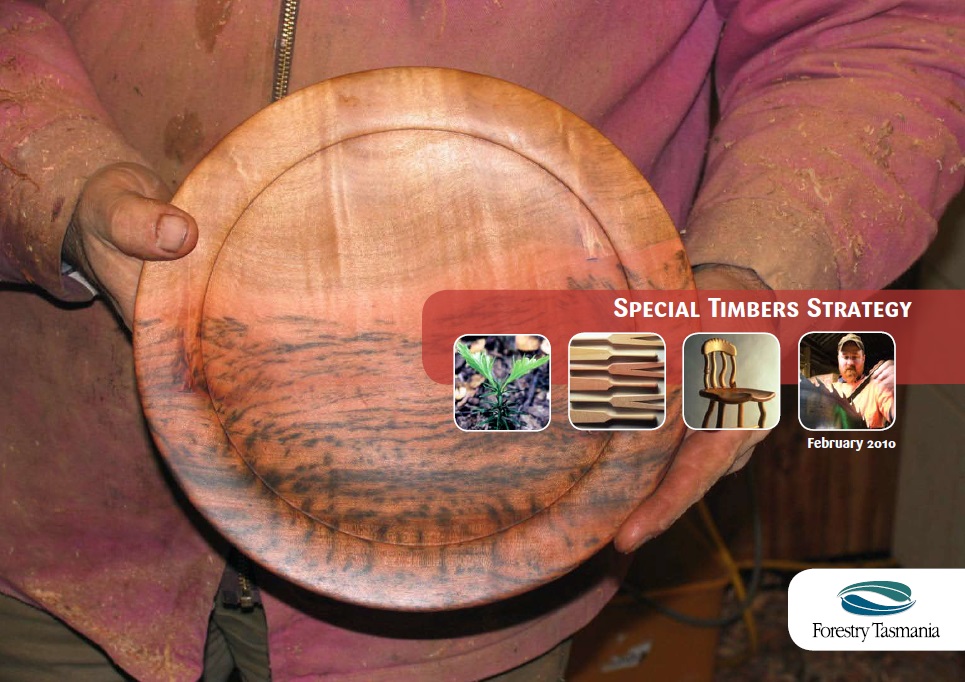
As far as I’m aware no study is being conducted into the profitability of growing special timbers as input into the proposed management plan. Using the “horse and cart” analogy, this proposed Management Plan will say much about the cart and tell us nothing at all about the horse! Just like the 2010 Special Timbers Strategy.

Mr Freeman indicated in our conversation an awareness of the politically-charged nature of their assignment, and Indufors limited ability to influence the outcome. Why they chose to take the job in the first place is an interesting question.

As I say on (too?) many occasions I think Tasmanian blackwood has a great future as an iconic profitable, farm-based industry; but not until we get the politics and ideology out and get the policy settings working properly.

Thanks to Mr. Blair Freeman for his time and interest. Good luck!

Only another 2 years before the Management Plan is completed/released.

Stay tuned!

An invitation to participate in the Special Species Timber Management Plan

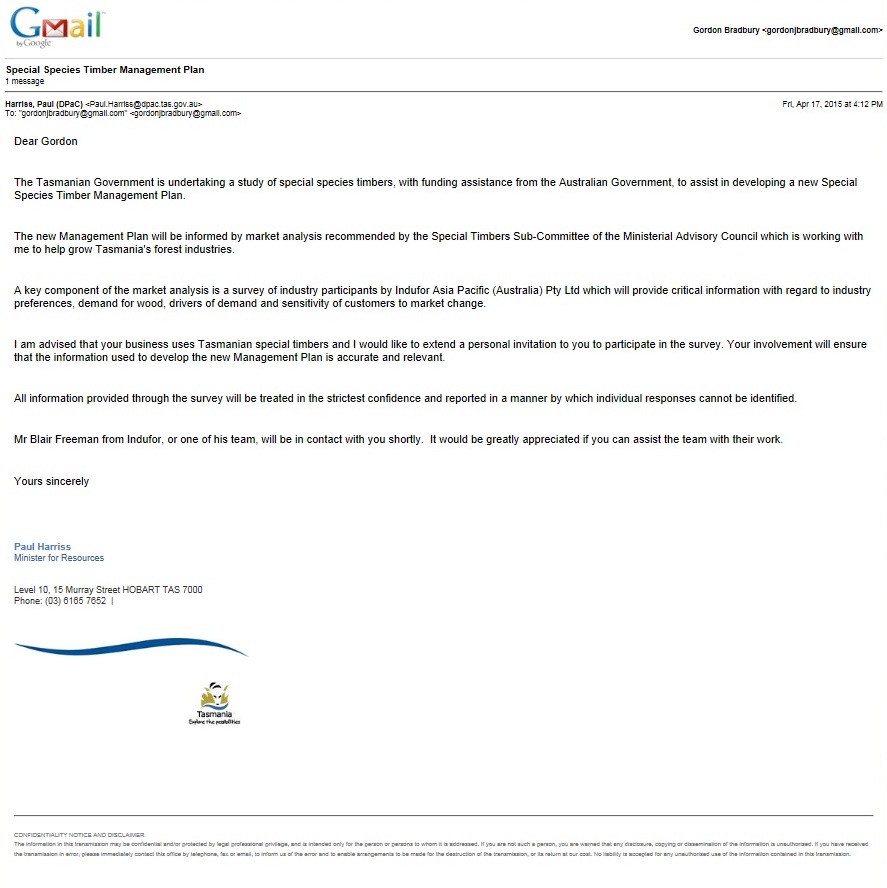
stsmp email

This email arrived in my inbox on Friday from Minister for Resources Paul Harriss. This may be interesting. Or else it will be the same old stuff we’ve seen before – or worse!!

I am not holding out much hope.

But I do pity the poor consultants who sign up for these jobs. Imagine helping to justify logging the Tasmanian Wilderness World Heritage Area at taxpayers’ expense whilst we are sacking teachers and nurses. How on earth do you keep any sort of professional integrity or reputation in all of that?

I’m looking forward to having a discussion with “Mr Blair Freeman or one of his team”. I wonder if they understand that forestry is a business not a division of Centrelink Australia?

This management plan is not due to be completed/released before 2017 in time for the next State election.

One thing is absolutely guaranteed. This management plan will not contain any discussion of commercial issues. Nor will it consider the possibility of Tasmanian farmers growing special timbers.

The idea that Tasmanian farmers are already growing and harvesting special timbers, and would likely grow more if given the right market signals, will be completely ignored in this management plan.

The fundamental assumption will be that special timbers can only come from taxpayer-subsidised Tasmanian public native forests.

In other words it will not be a business plan but a glossy political/marketing document, like the 2010 Special Timbers Strategy.

I shall keep you informed as this proceeds.

Deloraine Stringfest & World Heritage Area logging

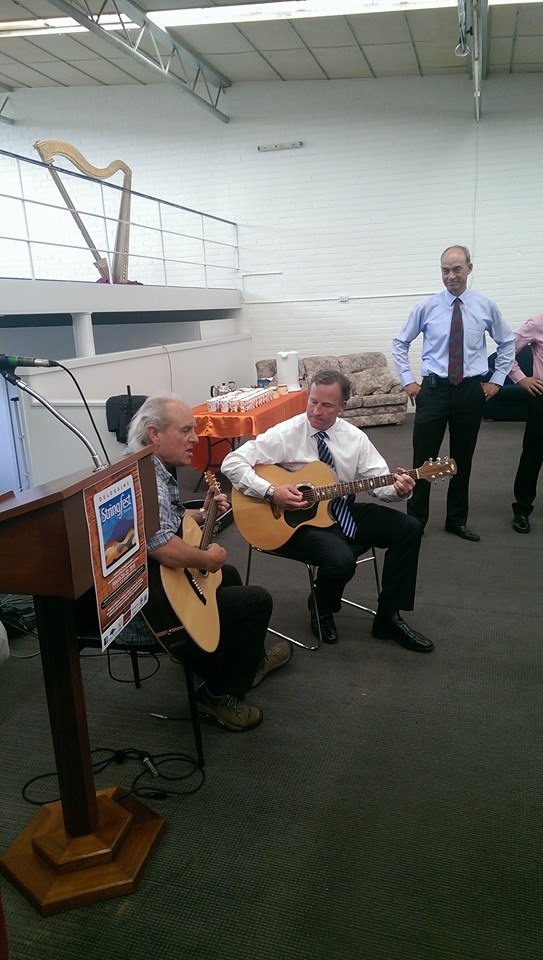
Hodgman_Stringfest

This was going to happen sooner or later. But the Deloraine Stringfest is now becoming associated with Tasmanian State Government forest policy and the logging of the Tasmanian Wilderness World Heritage Area (TWWHA). This is courtesy of the Premier Will Hodgman and his press release associated with the recent launch of the 2015 Stringfest.

http://www.premier.tas.gov.au/releases/stringfest_showcases_tasmanian_timbers

We want to ensure craftsmen like Daniel can continue to create instruments from Tasmanian timbers, which is why we are committed to rebuilding the forest industry.

As many people know, State forest policy now includes the planned logging of special timbers including Tasmanian tonewoods from the TWWHA. See my recent blog:

http://blackwoodgrowers.com.au/2015/02/10/draft-twwha-management-plan-representation/

and

http://www.abc.net.au/news/2015-01-15/world-heritage-areas-to-be-opened-up-to-tourism-projects-under-/6018508

Daniel Brauchli certainly doesn’t support current Government forest policy, but the Premier seems happy to risk damaging the reputations of our craftpersons and artists.

The proposed logging of the TWWHA will become yet another divisive and destructive episode in the long running Tasmanian forestry wars.

Last year at Stringfest 2014 the elephant in the room was the ongoing supply of tonewoods to sustain the festival. That elephant was a mere calf.

This year the elephant has grown considerably into a cow elephant. The prospect of the Festival becoming associated with the logging of tonewoods from the TWWHA will see the elephant become a rampaging bull. It will destroy the Festival.

The Deloraine Stringfest depends on attracting major performing artists. Once the Festival becomes associated with TWWHA tonewoods, no major (and many minor) artists will want to be associated with the Festival.

End of Festival!

By all means please come along and enjoy the 2015 Deloraine Festival, but spot the elephant hiding in the room, or wandering the streets of Deloraine with deliberate intent.

It may even be hiding behind me. Come and look!

The Deloraine Stringfest is a fantastic festival, but given the highly politicised and conflict-driven nature of forestry in Tasmania, the future of Stringfest hangs in the balance.

Stringfest has now become a political weapon. The reputations of those associated with the Festival are now at risk.

Say “No” to World Heritage tonewoods!

[Come along and talk to me about conflict-free, farm-grown Tasmanian blackwood.]