Here’s an interesting article in the latest AMIGO Newsletter from New Zealand by New Zealand blackwood grower Ian Brown based on a trip to Chile in 2012.
In 2012 Chile had 2,000 ha of private blackwood plantation, much of it a work in progress, with the objective to reach 4,000 ha in the near future. 4,000 ha of well managed fully productive blackwood plantation could be producing around 40,000 cubic metres of sawlog per year.
That is a lot of blackwood!
But they aren’t there yet!
The Chileans have their own unique view on growing Tasmanian blackwood, with the current emphasis on maximising volume rather than value. Hence the very high stocking, small tree sizes and the long rotations.
But at least they are doing active research with the objective of encouraging private investment in blackwood planting. How different to the Tasmanian approach where politics, waste, community service and a squandered public blackwood resource are the objectives.
A lot of Ian Brown’s comments on the Chilean approach to blackwood reflect the more successful New Zealand experience, where the focus is on maximising value not volume.
Hopefully the Chileans will eventually get the blackwood management sorted out.
We will then be importing Tasmanian blackwood from Chile when the local industry collapses.
Acacias in Chile – Report from a visit made in 2012
Ian Brown
September 2015 AMIGO Newsletter
In 2012 a small group of us spent a week in Chile at the invitation of INFOR (Institutio Forestal), the Chilean forest research institute. We were hosted by Juan-Carlos Pinilla, whose responsibilities include research into acacia species. Juan-Carlos is a delightful guy, well informed, and great company. He was a good friend of Ian Nicholas, who led our group, and fulfilled a long term wish to look at acacias in Chile. Tragically this was Ian’s last trip, and on the day of his return he experienced the first symptoms of the illness that took his life three months later.
Acacias were introduced into the Lake District in Southern Chile in the 1950s. The Lake District is a very scenic landscape in the central valley, between the coastal ranges and the Andes. It is good forestry country: the soils are deep, fertile, and free-draining, with average temperature 12.5 degrees, annual rainfall over 2000mm, and little wind.
Exotic forestry in Chile has been based on radiata pine and eucalypt species, following NZ and Australian models. Acacias were introduced to provide some diversity in forest products, A. melanoxylon for decorative timber, A.dealbata for pulp, and A. mearnsii for tannin.
Acacia melanoxylon
About 2000 Ha of blackwood have been planted in Chile, and this is expected to increase to 4000 Ha. Sample plots have been established on at least 14 locations. In addition there are sites with natural regeneration, mixed plantings, and shelterbelts.
The current silvicultural regime recommended by INFOR involves close planting at up to 2600 per Ha. The trees are gradually thinned by extraction of 250 trees ( hopefully for pulp) every 7 years, down to a final crop of 350 per Ha. at age 40. Harvest is anticipated at 41 years, with a predicted mean DBH of about 40 cm. Two clearwood prunings will be carried out at age 11 and 16.
Futrono: Blackwood plantation
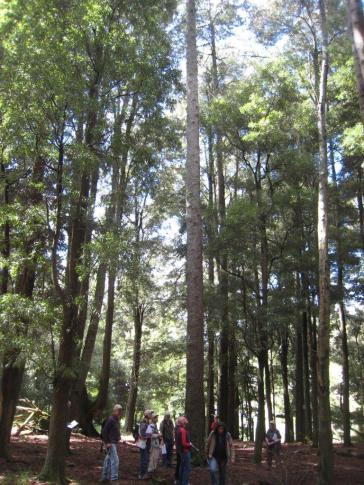
Our first exposure to plantation blackwood was at Futrono, on a privately owned woodlot of 6 Ha., one of the 3 best performing sites for blackwood measured among the trial plots in Chile. We expected to see some very good trees, and the best of these were spectacular. There were about 6 to 8 exceptional trees, at age 42, 30 metres tall, and pruned to half their height, DBH in the mid-50s, and perfect form. If Chile can produce trees like this, we have a serious competitor.
The trees had been planted at high density, about 2600 per Ha. , lightly thinned, and had no form pruning. If the best trees were so good, what of the rest of them? Well, these were much less impressive. At age 40 they were highly stocked at 900 per Ha., with a mean height of 27.5 m., and DBH of just 31.3 cm., and the form was variable. There is a lot of wood in the stand , but I would expect the output of quality sawlogs would be disappointing.
I have a problem with the regime, and will comment on this:
- the aim in close planting is to give a high selection ratio, and to encourage straight growth through competition for light. However it is an expensive option when the stocking is to be reduced in the course of the rotation to a much lower level. Most would regard as the optimal final stocking to be about 200 trees per Ha. The stocking in this stand is far too high, and as a consequence diameter growth will be very slow.
- experience with pure and mixed stands has shown that form pruning is required to limit stem malformation to a minor proportion of trees.
- when thinning is delayed, the live crowns compete for light and retreat, and this has an adverse effect on diameter growth. To prevent this, thinning should be completed early in the rotation ( in my view, within the first 10 years)
- it is expected that the thinned trees will be extracted for pulp. I think the economics of this are very questionable.
- a large volume of data has been collected from the trial plots, and I would question the need for much of this. The sites have been intensively monitored, with measurements of diameter, tree height, and total wood volume. These are appropriate data when assessing most of our exotic plantation species, and even A.dealbata when grown for pulp. However they are unnecessary and even misleading when assessing blackwood, where the value of the tree is likely to be confined to the pruned stem. All we need to know is its height( usually 4 to 6 metres), straightness, and diameter. Above this the crown has no commercial value, and is likely to end up as firewood.
- However the crown has real physiological value, in that it determines the volume of wood in the butt log. In blackwood, a tall tree is not a cause for celebration but a sign of trouble. It is an indication of late thinning in the stand, and is linked to slow diameter growth and a very long rotation. In Chile it has been noted, as we have found here, that there is an inverse relationship between the height and diameter of the trees in a blackwood plantation. To prevent this, INFOR have suggested that clearwood pruning should be delayed in support of diameter growth. It seems to me that all this would achieve would be to increase the defect core, and would have no effect on diameter. I think the correct interpretation of the relationship between height and diameter is that it is a consequence of delayed thinning, This causes the crown to retreat, and when this has occurred, it is irreversible.
Other plots
Data were provided for other sites, and ignoring the height and stand volume, three of the better ones are as follows:
Chiloe – at 20 years , mean DBH24 cm.
Arauco – at 28 years, mean DBH 22.5 cm.
Central valley – at 30 years, mean DBH 31 cm.
These figures are not as good as they could be, and I am sure there is a simple explanation. All of these stands are what we would consider to be grossly overstocked. This seems to be due to a misplaced emphasis on total wood volume, at the cost of what really matters, the size and quality of the butt log. However the trip to Futrono showed the real potential for blackwood in Chile.
Lanco: Provenance trial
A trial incorporating 14 provenances was established in 1999 at Lanco, on a property owned by an expatriate Austrian count. It contained 30 random blocks, at 84 plants per block, at 3 by 2 metre spacing. The provenances were from Tasmania, Victoria, South Australia, and Queensland.
When measured in 2008, the Queensland provenances had very high mortality, and the South Australian trees had poor growth. The best performers were from Tasmania (King Island, Queenstown, the North-East), and the Otways in Victoria. Interestingly, the provenance from NW Tasmania, where most of our blackwoods were sourced, came further down in the order.
The location appears similar to the sites in northern New Zealand in which blackwoods grow well, so the trial probably has some relevance for us, bearing in mind some limitations: the limited number of provenances, and the lack of data on form, and on wood quality. It matches the data from a 65 provenance trial on my property at Pirongia in the Waikato, which suggests that the provenances best suited to our conditions are in Northern Tasmania, although not necessarily in the North-West.
Quepe: Seed collection
This is a 2.5 Ha. site, in which blackwoods had been interplanted with eucalypts 24 years ago. The eucalypts were felled on one Ha. at 16 years, and the blackwoods that remained were graded for form and vigour, and thinned to 110 per Ha. The best of them were then selected for seed collection as part of a breeding program.
What is now apparent is that many of the trees that were performing less well at age 16 have now caught up with the plus trees. This has been attributed to the need to trim branches in the plus trees for seed collection, but I have some reservations about this. To have this effect, the pruning would have to be very severe. A study in Tasmania has shown that up to 30% of the foliage can be removed from blackwood at one hit without any impact on diameter or height. At 50% there is some effect on diameter. It may be that the “plus trees “had been favoured by a microsite advantage in the original mixture, and now they are on a more level playing field after removing the eucalypts, this effect has been cancelled out.
Another reservation is that the form of the trees, which is generally very good, has been strongly influenced by the adjacent eucalypts, and has had little genetic influence. An assumption that underlies breeding programs that have been carried out in the past for blackwood is that the basic attributes of vigour and form are likely to be inherited. That is certainly true for radiata pine, redwoods, and cypress. However in blackwood , environmental influences, on form in particular, are strongly expressed. Wood colour may be a different matter.
Conclusion
Before our visit to Chile we had heard stories suggesting that we would see some exceptional blackwoods. After more than a week visiting plantations and viewing trees from the roadside we were left in no doubt that the Lake District in Southern Chile is highly suited for blackwood forestry. It has ideal climate and soils.
Because of its geographical separation from Australia, Chile is also free from acacia psyllids. These pests have been shown to reduce the height growth in young blackwoods by up to 40%. They also contribute to malformation. (they are not primarily responsible for multi-leadering in blackwood : this is a consequence of growth periodicity, in which the shoots terminate their growth periods by aborting and then replacing the growth tips. The absence of psyllids will make life easier for the grower, but will not eliminate the need for form pruning).
I am sure the full potential for blackwood could be realised with some adjustments in silvicultural practice. This has been influenced by practices derived from other plantation species, and by a wish to utilise the whole tree. Blackwoods are different. To grow them well we need to abandon the techniques and assumptions that underlie the silviculture of other commercial species. The commercial value of blackwood is likely to be confined to the butt log, and the silvicultural focus should be to grow this as straight and as wide as possible . This requires form pruning, and early and aggressive thinning in the stand. We know from studies in both New Zealand and Tasmania that fast growth in blackwood has no adverse effect on wood quality.
It will be interesting to follow the tree breeding program in Chile. I think this will be challenging because of the strong impact of the environment on several attributes of blackwood, in particular form, and to a lesser degree vigour. However I am prepared to be proved wrong.
Reproduced with kind permission of the author.
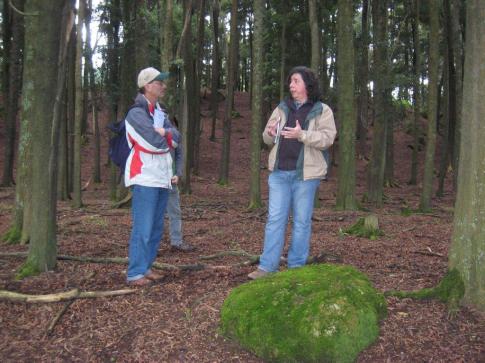
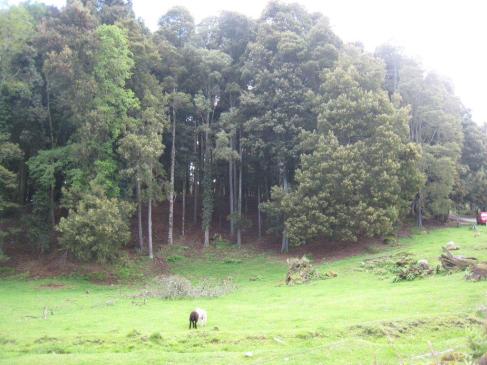
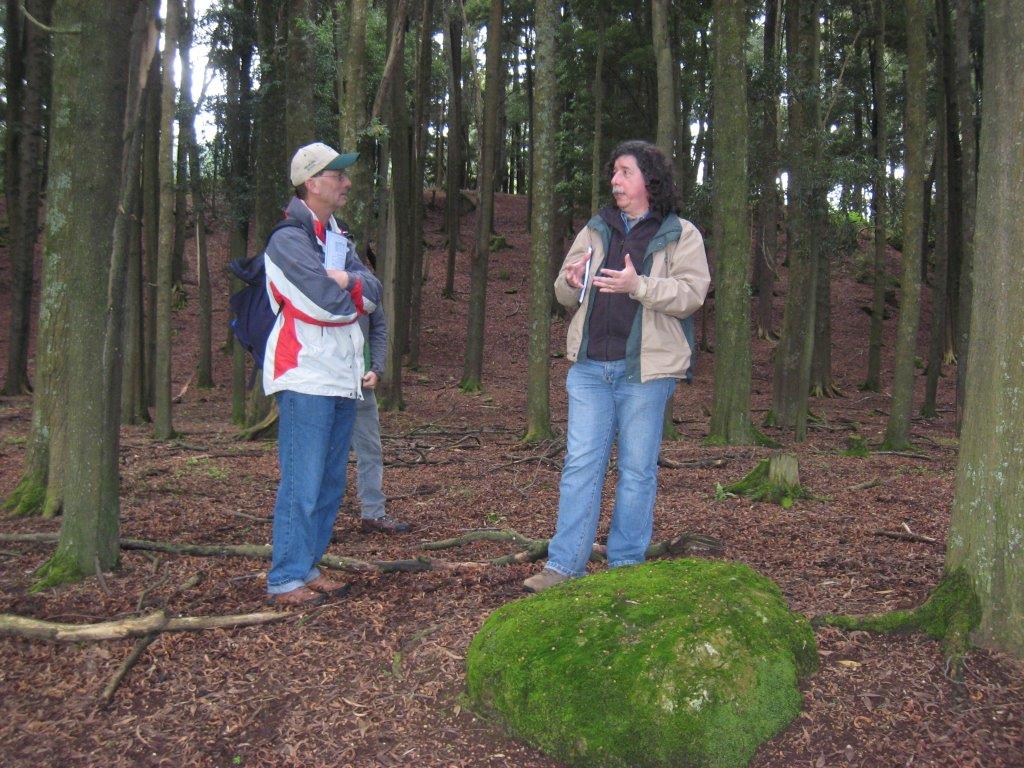
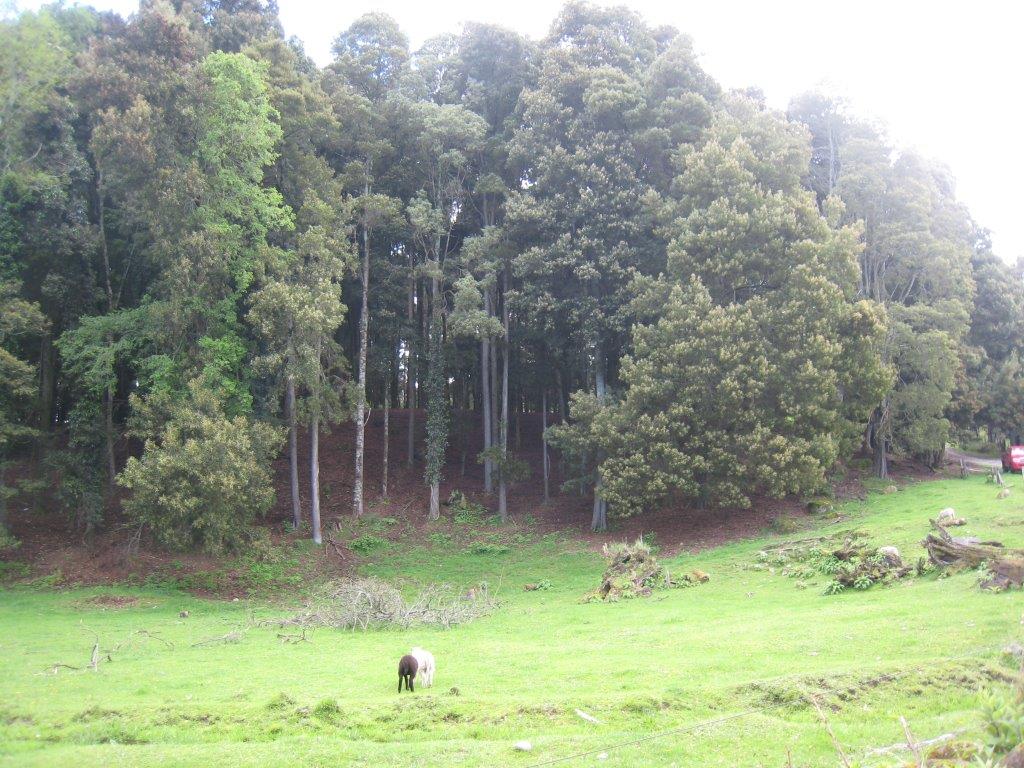
The Futrono plantation. Photo 1 the best tree benefiting from attention and some space, Photo 2 effects of delayed pruning, and Photo 3 general view of Futrono plantation.







 Tasmanian Blackwood Growers Cooperative
Craft War!
I just found this article in The Australian from 10th October 2015 by the Tasmania correspondent Matthew Denholm.
http://www.theaustralian.com.au/life/weekend-australian-magazine/tasmanian-forests-timber-craftsmen-and-another-looming-battle/story-e6frg8h6-1227563469827
Oh the sad stories of taxpayer-funded cultural and family heritage. It’s enough to make one weep with sympathy.
But as a forester after watching this fiasco for 35 years these stories don’t work for me anymore. My sympathy was consumed in the forestry wars of the last 20 years, and the ongoing blatant politicisation of the forest industry in Tasmania.
Forestry is just about wedging the community and winning elections – nothing more.
Now I’ve had enough of the sob stories. In fact I feel deeply offended by this ongoing stupidity.
The public native forest special timbers industry has never been and never will be sustainable nor profitable. And all the fine craftsmanship and beauty in the world will not make it so.
This is not a Tony Abbott moment revisited! Good [special timbers] forestry does not start tomorrow, nor any other day.
The past 30 years have clearly demonstrated that good, profitable public native forestry will never happen in this State.
Most special timber craftsmen lay much of blame for the emerging crisis on the politicians and timber barons who presided over a forestry industry that “wasted” vast volumes of special timbers in a head-long rush to clear old-growth forests.
Excuse me!! Ever since I can remember the special timbers industry has pretty much universally supported the industrial forestry orthodoxy and State Government policy, including the 1996 Tasmanian Regional Forestry Agreement. They didn’t really have any choice in the matter. All the forest policy was made for the big boys. The cheap subsidized wood provided by large scale industrial forestry is exactly what allowed the special timbers industry to thrive over the past 40 years.
So to turn around now and blame the politicians and greenies is disingenuous in the extreme.
…until the politicians squandered it!
The politicians did indeed squander it [our public native forest resource] and the vast majority of Tasmanians including the special timbers industry were right there in full support. Millions of tonnes of special timbers burnt and chipped over the last 40 years.
And now it’s time for tears and regrets?
Find someone else to blame? Don’t take any personal responsibility?
No! It’s now game over!!
No sympathy! No excuses! No exceptions! No Tony-Abbott promises of “good forestry tomorrow”!!
What little remains of our precious old growth and rainforest must not be used for further political games, waste, and stupidity.
However, Paul Harriss faces stiff resistance from many of the craftsmen in whose name he is -acting. They might be united in condemnation of previous “waste” of their resource, but they are divided when it comes to securing new ¬supplies from within the TWWHA.
“If a government decision was taken to harvest inside a World Heritage Area, I think we would suffer a backlash,”
Absolutely!
The community reaction would rival if not exceed the Franklin Dam blockade. The damage done to Tasmania’s reputation, as a recalcitrant belligerent State would take decades to heal.
Brand Tasmania would be completely trashed!!
The article finishes with what I regard as a complete falsehood:
Whichever way the issue plays out, the special timbers and traditional skills that shaped a state are in ¬danger of being consigned to its past.
It’s the usual dramatic scaremongering that the mainstream media loves to peddle.
This article did not cover anything like half the real story of the special timbers industry. It just repeated what has been repeated many times before. There are many aspects of the story that were completely ignored.
The special timbers and the skills will not be consigned to the history books and museums. They will be confronted with reality just like the ivory traders and whalers were. Those that choose too can adapt and change to the new reality. Those that choose not to change will no doubt chew their old bones for comfort.
My own proposal to develop the commercial potential of growing blackwood timber via a blackwood growers cooperative is just one of the many special timbers opportunities waiting to be developed. But it’s not likely to happen whilst the old wars and the old warriors continue to play their games.
When will Tasmania get a fully commercial and profitable forest industry?
Leave a comment
Posted in Commentary, Markets, Politics
Tagged Craft wars, Matthew Denholm, special timbers, Tasmanian Wilderness World Heritage Area, World Heritage Area logging