Category Archives: Commentary

Legislative Council GBE Oversight Committee 2015 – Forestry Tasmania

HarrissAnnells

Following on from my previous blog I have now reviewed the GBE Scrutiny transcripts in relation to special timbers. They provide me with no cause for optimism.

I don’t know why we have Corporate Governance standards in Australia.

Clearly they don’t apply to Government business enterprises.

Even more clearly our politicians have no understanding of their corporate governance responsibilities.

Friday the 4th of December was the annual fiasco called the GBE Oversight Committee with Forestry Tasmania as one of the performing circus acts.

The transcript from the 3.5 hour performance is available here:

http://www.parliament.tas.gov.au/ParliamentSearch/isysquery/9b76370a-4ba7-473d-9766-61717c5e7862/1/doc/

It makes for sad reading. In fact I would advise against reading all 52 pages. Severe brain haemorrhaging may result.

My review here focuses on special timbers/blackwood as they were discussed by the committee.

Special timbers are mentioned 28 times in the 52 pages of transcripts, on pages 2, 17, 18, 37, 39, 40, 49, 50, and 51.

Blackwood is mentioned only 3 times, even although blackwood comprises 80 % of special timbers harvest volumes, on pages 18, 49 and 51.


Community service obligations (CSO)/grants are mentioned only in relation to roads not special timbers!

The World Heritage Area is mention 9 times in the transcripts, on pages 39, 40, 46 and 48.

The word “profit” is mentioned 26 times even although Forestry Tasmania has no corporate objective to generate a profit.

So what matters pertaining to special timbers were discussed in the annual “scrutiny”?

What clarity, meaning and understanding does the annual scrutiny hearings provide for special timbers?

Page 2

Spin from the Resources Minister trying to oversell FTs performance including “and the speciality timbers effort has also been buoyant – I think more buoyant this year than even two years ago, at about 11 000 cubic metres of speciality timber”. Most of this 11 000 cubic metres is craftwood and outspec log for which FT has no supply contracts or commitments. FT is supposed to produce 12 500 cubic metres of special timbers sawlog per year.

Pages 17 & 18

A question from MLC Ivan Dean about the profitability of special timbers:

“CHAIR – That was the point of your question: how long before you can see the business becoming profitable as a whole?

Mr DEAN – That is very clearly it. With specialty timbers, is there a profit returned to Forestry Tasmania?

Mr ANNELLS – It depends who you ask.

Mr DEAN – That’s why I am asking you. You are the chairman and you ought to know – and with the minister here I would thought we would get the truth.

Mr ANNELLS – I certainly hope you would.

Mr DEAN – I would hope so.

Mr ANNELLS – I will flick it to my chief executive.

Mr WHITELEY – With special timbers, some portion of it is profitable and others it is done as a CSO. Things like blackwood swamps and those sorts of things are really profitable. Wood that is picked up associated with native forest harvesting is profitable in the sense that roading has been provided by an outscale operation. Things like Huon pine aren’t profitable in their own right. We receive some assistance in recovering Huon pine – and it varies. Within our operations there is a profitable component and another component that requires some support.

Mr DEAN – Why can’t it be profitable? It’s a very sought-after timber worldwide. The users of it tell us they are paying higher prices for it where they are getting it from – obviously a lot of it through Forestry Tasmania. Why is it not possible to make it profitable in the circumstances – Huon pine, for instance?

Mr ANNELLS – Basically because the market will only pay a certain price. It is not an inexhaustible or elastic price mechanism. Huon pine is harvested like a lot of specialty timbers, as a by-product of our main activity. At the moment we have very significant costs for roading and other establishment costs that if we try to apply it against Huon pine, for example, would take it beyond the reach of all but the very few. We choose to sell special species timber at what we think the market will bear, but we do not seek to gouge in that process because to do so, we think, would lead to more bad publicity and, quite frankly, the market would simply dry up until we reduced the price again.

I have a lot of confidence in our people who are setting the price for this sort of stuff. You will always be able to find examples where people say, ‘You could have got more for this or that’. That is why we set up Island Specialty Timbers, much criticised in certain places, but it was a genuine attempt to bring some stability into the marketplace and to test the marketplace pricewise on a more regular basis”.


And the answer is a lot of mealy-mouth waffle.

No mention of the fact that in 2014-15 FT received a $900 000 taxpayer subsidy for it special timbers operations. That’s $82 per cubic metre subsidy.

Given the context of the question I find Chairman Bob Annell’s answer “It depends on who you ask” to be highly offensive; as if squandering taxpayers money is of no consequence whatsoever. And none of the MLCs called him on his attitude!

Mr Dean was after “the truth”. Instead he got obfuscation.

Some parts are profitable some parts aren’t. Why can’t it be profitable? “because the market will only pay a certain price!” “we choose to sell special species timber at what we think the market will bear!”

Has anyone heard of competitive market-based pricing?

It’s enough to make you cry!

These are adult businessmen talking as though they know absolutely nothing about economics and markets.

“That is why we set up Island Specialty Timbers, much criticised in certain places, but it was a genuine attempt to bring some stability into the marketplace and to test the marketplace pricewise on a more regular basis.”

Even although the tiny amount of wood that IST sells through tender and the prices they get bear no relationship at all to the administered price that FT sells to its long term customers.

And no member of the oversight committee sought any further clarification or understanding around wood prices and markets!!

No mention of the CSO grant and no question about how the $900 000 of taxpayers money was spent?

Pathetic!!


Page 37

A very specific question about 72 kilometres of new roading for special timbers from Ivan Dean, for which he got no answer.

Page 39

A question from Rob Valentine about special timbers regeneration following clearfelling. A question that seems completely irrelevant as it is generally known that the eucalypt regeneration will be harvested again long before the special species are of any commercial value for wood or honey.

Page 40

A question from the committee Chair MLC Tania Rattray about the UNESCO delegation visit and special timbers harvesting in the World Heritage Area.

Given the political and social significance of special timbers logging in the World Heritage Area the lack of any serious questions from the committee about this subject is truly negligent. True it doesn’t directly involve Forestry Tasmania, but this is the main forum for discussing public native forest management and special timbers, so why the silence?

Pages 49, 50 and 51

More questions from MLCs Ivan Dean and Tania Rattray about special timbers supply and demand, which produce no clear credible answers. A new management plan is mentioned. The Three Year Wood Production Plan is mentioned. Hydrowood is mentioned, but not by name. By page 51 the mind is confused and exhausted.

Not one of the committee members seems to understand that the Hydrowood project may have significant positive and negative impacts on the special timbers industry. Certainly no one asked any questions in this regard.

Mssrs Dean and Rattray seem to be the committee members who have an interest in special timbers, but they seem to share the general view that our forests are a community service not a commercial resource. Never mind the fact that private growers are also competing with FT in the special timbers market.

I guess our elected representatives are busy people and just don’t have the time or interest to understand the special timbers industry and forest economics generally.

Three and a half hours and barely one useful question and certainly no useful answers.

I’m not sure what is more pathetic – the lack of quality and depth of the questions or the lack of quality and depth of the answers.

Even reading small parts of these transcripts is a mind numbing experience. The lack of clarity, purpose and outcome in these scrutiny hearings is truly staggering.

Twelve highly paid people in one room for 3.5 hours wasting time and money.

Three and a half hours of scrutiny and the special timbers industry is no better off than before.

Perhaps I should send a list of questions to the committee members next year so that they may better perform their corporate governance responsibilities, and the Tasmanian community may actually get some useful information from this circus act.

When will Tasmania get a fully commercial profitable forest industry?

The Slow Awakening

HarrissAnnells

Many members of our State Parliament have been long-time staunch supporters of Forestry Tasmania as the foundation of our forest industry to the point where simple logic and commonsense fail to persuade.

This wonderful review by finance commentator John Lawrence of last Friday’s performance at the annual GBE scrutiny hearing is just inspired. The Minister for Resources (and forests) Paul Harriss was clearly on his mettle.

http://tasfintalk.blogspot.com.au/2015/12/will-minister-harriss-outlast-ft.html

Here’s the Parliamentary website for the review committees:

http://www.parliament.tas.gov.au/ctee/Council/Archived/lcgbe2015.htm

But it does show that after so many decades at least some of our elected representatives are finally beginning to understand they have backed the wrong horse.

Is Forestry Tasmania broke?

Yes!

Is Forestry Tasmania (and the State government) acting to disadvantage private forest growers?

Yes!

You can almost hear the old rusted pennies drop. Kerclunk!!

And it’s all too late!!

No legislation will save FT now. The application for FSC certification is just a political smoke screen.

All the decades of chest thumping and sabre (chainsaw??) rattling were for nothing.

Game over!

As John Lawrence poses the question, which will happen first? Will FT be shut down or will Minister Harriss be consigned to the backbenches?

For existing and potential (disadvantaged) blackwood growers both events can’t come soon enough.

Special Timbers Management Plan Update #2

FTSTS2010

http://www.stategrowth.tas.gov.au/forestry/special_species_timber_management_plan

Over at the Tasmanian Department of State Growth website they now have some information about special timbers.

Yet another Special Timbers Management Plan is being prepared.

The Management Plan is required to be in place by October 2017, with the draft Plan available for public comment in early 2017.

So get those pens warmed up. You only have 18 months to wait before you are permitted to have your say!!

Current work to inform the development of the Management Plan includes:

  • A resource assessment of the special timber resource available in existing production forest managed by Forestry Tasmania;
  • Market demand research is being undertaken to better understand demand for special timbers;
  • celery-top pine harvesting trial as part of investigations into alternative harvesting techniques;

It’s an incredibly myopic view of special timbers:

  • No mention is made of the fact that blackwood is by far the dominant special timber, accounting for over 90% of volume harvested each year.
  • No mention is made of the commercial potential of private grown Tasmanian blackwood.
  • No mention is made of the fact that blackwood sawlog supply and Tasmania’s iconic blackwood industry is now in jeopardy due to decades of overcutting and mismanagement by Forestry Tasmania and successive State governments.
  • No mention is made of the current and recent markets for special timbers including price and demand history. For example a summary and review of The Island Specialty Timbers public tender results for the past 5 years would make for very interesting reading. See my annual reviews of IST blackwood tender results as an example:

http://blackwoodgrowers.com.au/2015/06/18/ist-blackwood-sawlog-tender-results-2014-15/

  • No mention is made about possible sales, costs, prices and marketing arrangements;
  • No mention is made of the continuing fiasco of Tasmania’s most valuable timbers being a taxpayer-funded community service.
  • No mention is made of how the ongoing harvesting of special timbers from public forest will be funded, or how much it is likely to cost. One suspects that (as in the past) financial and commercial matters will not be discussed in this forthcoming management plan.
  • There’s no mention of the new Hydrowood project that is going to be supplying the market with significant volumes of salvaged special timbers over the next 5-10 years.

http://blackwoodgrowers.com.au/2015/11/21/hydrowood-update/

  • Unfortunately there is also absolutely no information about the proposal to log the Tasmanian Wilderness World Heritage Area, and the recent visit to Tasmania by delegates from UNESCO. This issue of international importance is completely ignored! I guess the Tasmanian Government does not want the UNESCO delegates to be fully informed, let alone anyone else who has concerns about World Heritage management.
  • They can’t even provide a Table of Contents, an indication of the scope of the management plan.

Would I be correct in guessing that State government special timbers policy is all about politics and supporting a handful of woodworking mates?

There is nothing here about commercial opportunity or industry development.

There is absolutely nothing here for existing and prospective commercial blackwood growers.

Once again its totally pathetic!

http://blackwoodgrowers.com.au/2015/04/23/special-species-timber-management-plan-update-1/

When will Tasmania get a fully commercial and profitable forest industry?

Specialty timber industry has Tasmanian Government support, despite [WHA] logging doubts

ST1

http://www.abc.net.au/news/2015-11-24/state-government-backs-speciality-timber-industry/6969944

http://www.abc.net.au/news/2015-11-23/hodgman-hoping-to-convince-unesco-delegation-of-logging-plan/6966218

http://www.themercury.com.au/news/tassie-tourism-leaders-in-key-talks-with-united-nations-heritage-body/story-fnj4f7kx-1227620092494

Mr Hodgman was confident of changing the [UNESCO] delegation’s mind.

“We’ve every confidence that the delegation are open to understanding what we do in Tasmania and accepting, we believe, that an appropriate balance is in place,” he said.

“Any harvesting would be subject to considerable controls and environmental protection, including at a national level.”

But if unsuccessful, the Premier said logging would be banned.


The UNESCO delegation is in town to find out “what we do in Tasmania”.

what we do in Tasmania”…???

What we do in Tasmania is make stupid forest policy and then stuff things up, again and again!

What is perfectly obvious from the last 35 years is that politically-driven forest policy in Tasmania has been a disaster for both the forest industry and the Tasmanian community.

The “appropriate balance” in place is nothing more than wedging the community and winning elections.

It has nothing to do with good profitable sustainable forest management.

And as for “considerable controls and environmental protection” haven’t these been in place for decades but still the special timbers industry is in crisis?

It’s not about the controls and protection is it? The dominant issue continues to be the politics and conflict.

Our forest industry will never be profitable and sustainable because logging public native forests is just too political. There is no resolution to this problem except stopping the logging of public native forest. That is the fundamental lesson of the last 35 years.

One thing is absolutely 100% guaranteed. Any logging of the Tasmanian Wilderness World Heritage Area would be an ongoing battleground that would further damage the Tasmanian community and our political system for decades to come. Not to mention the incredible waste of money and time it would entail.

Both of the major political parties DO NOT support the special timbers industry because they DO NOT support profitable tree growers.

Without profitable tree growers the special timbers industry has no future at all.

Tasmanian politics really does beggar belief!

When will Tasmania get a fully commercial profitable forest industry?

Hydrowood update

hydowoodS

The long anticipated Hydrowood project is finally under way on Lake Pieman on Tasmania’s west coast salvaging specialty timbers from flooded hydro dams.

http://www.examiner.com.au/story/3505999/lake-pieman-site-of-australian-first-underwater-logging-video/?cs=95

http://www.abc.net.au/news/2015-11-20/the-hunt-for-sunken-treasure-harvesting-underwater-timber/6957388?WT.ac=statenews_tas

Here is the projects new website.

http://hydrowood.com.au/

I have both hopes and fears for this project in terms of what it could do for the special timbers/blackwood market.

My hopes are that through Hydrowood sales the company will provide much needed special timbers price and market transparency. This is unlikely to happen but I will certainly be encouraging the company management to adopt a commercial/transparent model.

The main driver that will encourage Tasmanian farmers to grow commercial blackwood is if there is much more price and market transparency. Can I get Hydrowood on board?

Ideally I would like to see Hydrowood set aside the very best logs from the salvage operation and every 3-6 months have a major auction.

Let us put 1,000 cubic metres of Tasmania’s finest timbers on the auctioneers table every 3 months and see what the market is prepared to pay!

Let us clearly demonstrate that the forest industry has commercial muscle and is no longer a community service.

Let us use this opportunity to stimulate interest in the real value of quality timber, and growing trees as a profitable investment and primary industry.

The fears are that a) they will flood the market and drive down prices, or b) the ST oligarchy that are currently pushing for World Heritage logging will force the Government to put restrictions on the Hydrowood markets/prices, or c) given the history of the last 40 years that this will turn into yet another Tasmanian forest industry disaster.

Hydrowood estimates they will salvage 80,000 cubic metres of special timbers over the next 3 years, with the possibility of the project lasting another 5 years. This is far more special timbers than has ever been supplied to market before. I would be surprised if the Australian market can absorb this volume of wood. Some of it will have to go to export markets. Perhaps all of it should go to export markets.

Much of this 80,000 cubic metres will be blackwood.

I don’t have a problem with our valuable timbers going for export, especially if they are attracting premium prices and the market is kept informed.

What this huge volume of premium wood will do for the special timbers market and for prices will soon enough become apparent.

The Hydrowood project will definitely have a prolonged and significant impact on the profitability of a number of important Tasmanian businesses. Consequently there will be political repercussions.

So now the Tasmanian special timbers market has four different classes of suppliers:

  1. Forestry Tasmania and its subsidiary Island Specialty Timbers selling taxpayer-subsidised, community service special timbers from public native forests, for which the Tasmanian/Australian taxpayer contributes $80 per cubic metre to subsidise the sawmillers and craftspeople [unprofitable and unsustainable];
  2. Hydrowood supplying salvaged special timbers from Hydro dams, at a cost that reflects the cost of salvage [profitable (??) and unsustainable];
  3. Tasmanian farmers selling salvage special timbers from their farms at a cost that reflects the cost of salvage [profitable and unsustainable];
  4. Tasmanian farmers who are actually growing commercial, sustainable special timbers where the cost of the wood actually reflects the cost of growing, harvesting and replanting the trees [profitable (??) and sustainable]. These poor farmers now have a very difficult market in which to operate and compete. They have absolutely no support from the Government or industry. Do they have any support from the market?

If the State Government goes ahead with logging the Tasmanian Wilderness World Heritage Area there will be a fifth supplier in the special timbers market – taxpayer-subsidised, unprofitable and unsustainable.

If that’s not a buyers dream market I don’t know what is!

How can Tasmania’s special timbers and blackwood industries have any future with this mess of a marketplace?

The only business model for a successful forest industry is profitable tree growing. So where are the profitable tree growers in any of this mess?

Does Tasmania really want a special timbers industry? It sure doesn’t look like it!

Dear reader, please think carefully before making your next special timbers purchase.

It really is a pathetic joke!

But good luck to the Hydrowood team.

It’s a shame we can’t have a profitable, commercial and sustainable special timbers industry in Tasmania, as well as the clean-up and salvage.

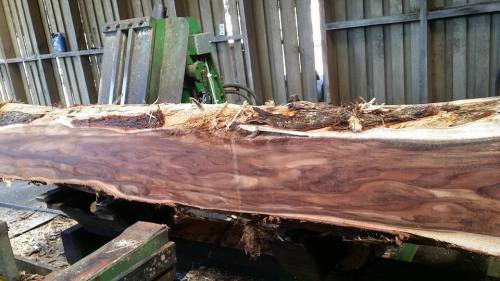
HydrowoodBlackwood

Some Hydrowood salvaged blackwood – unique but how valuable is it?


Calling all furniture makers!

My friend and fellow forester Rowan Reid has posted this on his Bambra Agroforestry Farm Facebook page. It’s a call I heartily support and encourage.

The furniture industry is the heart and soul of the blackwood industry.

For the future of the industry it’s well and truly time for the furniture industry to get behind and support farm grown Tasmanian blackwood.


To fine furniture makers in Victoria (Please SHARE if you are friends with a local furniture maker)It's time to look…

Posted by Bambra Agroforestry Farm on Tuesday, November 17, 2015


Price List from Hell Revised

Ok I need to check the fine print!

My original assessment of this sellers blackwood price list was pretty harsh.

http://blackwoodgrowers.com.au/2015/11/04/another-blackwood-price-list-from-hell/

But when I read the fine print about kiln-drying costs and length price premiums, things don’t look quite so bad.

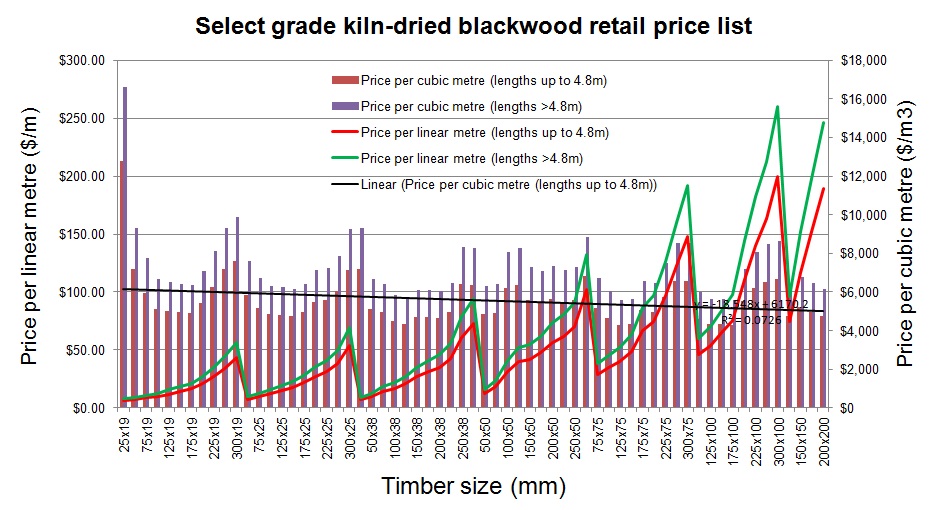
Here’s what the revised price list looks like when kiln drying costs are included and the 30% length price premium is added.

These prices are for rough-sawn kiln-dried select grade blackwood.

BPL3KD

Excluding the 25×19 size blackwood, the average price for the kiln-dried blackwood for lengths up to 4.8 metres is $5,500 per cubic metre, and $7,100 per cubic metre for lengths over 4.8 metres.

I think these are good starting prices for the smaller size boards. But the price list still excludes the cost of time to grow the larger trees from which the bigger boards must be sawn.

This price list still tells us that larger older trees are cheaper to grow than smaller younger trees! This is the complete opposite of reality!!

The fact that the price list includes a significant price premium for length BUT NOT for width and thickness is illogical. There is a small price premium for increasing width and thickness but it declines with increasing size. This is what the linear trendline shows.

This price list tells the marketplace that growing commercial blackwood is potentially profitable (especially if the grower does their own sawmilling and drying), but not the growing of larger older trees.

The objective in a commercial blackwood plantation is to produce 6 metre long sawlogs hence potentially attracting the 30% length price premium.

So what do these sawn blackwood prices mean for blackwood growers and the future of the blackwood industry?

Another blackwood price list from Hell

Here’s another example of a blackwood timber retail price list from Hell.

No I haven’t made this up! This is for real!!

This seller is working really hard to destroy the blackwood industry.

BPL3

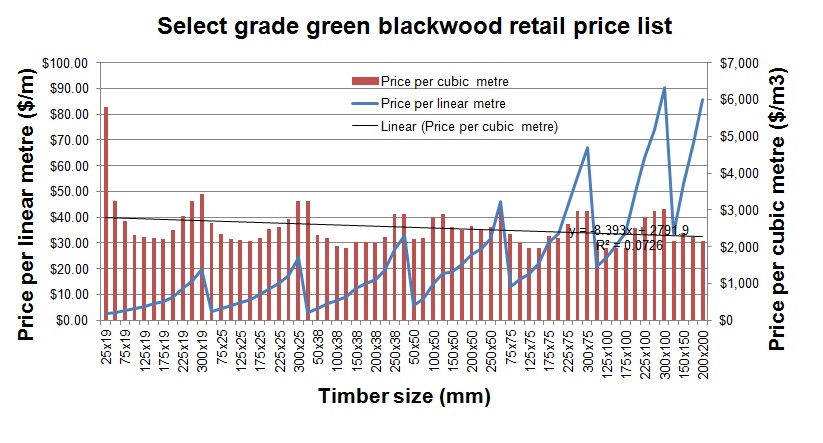
Not only is this blackwood incredibly cheap (cheaper than Radiata pine), but the blackwood grower is actually being punished for growing large trees. I’ve added a linear trendline to the cubic metre price data to show how the cubic metre price drops as the timber size increases.

You can only cut large size timber from larger older trees. Larger older trees cost time and money to grow.

This seller is screaming to the marketplace:

don’t anyone bother growing blackwood timber, and you will certainly be punished if you grow large blackwood trees.

No wonder the forest industry in Tasmania is in such diabolical trouble. Some people in the industry have absolutely no idea about the economics of forestry and the marketplace.

The fact that the State Government and the dominant blackwood grower, Forestry Tasmania, regards growing blackwood as a taxpayer-funded community service certainly doesn’t help!

It’s a unique price list because it has a price premium for the smaller width boards (≤75mm) presumably to reflect the extra cost in sawing these smaller sizes, AND another price premium for the wider boards (≥200mm). But thicker boards become progressively cheaper. It makes no sense!

I would love to know the logic behind this pricing or see the sawing cost/recovery data.

Australia’s premier appearance grade timber sold at $2,000 per cubic metre is give-away prices. Yes it is green and not kiln dried blackwood timber but kiln drying is not that expensive.

The Tasmanian blackwood industry has no future while the forest industry continues this kind of behaviour.

Does anyone care?

The last comment on this price list is the incredible range of sizes available, up to a whopping 300x100mm. That is a mega-slab of blackwood timber! And so ridiculously cheap!!

See my previous blogs on blackwood pricing here:

http://blackwoodgrowers.com.au/2015/10/26/blackwood-pricing-and-the-forest-industry-2/

http://blackwoodgrowers.com.au/2015/10/19/blackwood-pricing-and-the-forest-industry-1/


Another year of special timbers obfuscation and decline

FTAR2015

The Tasmanian State Government and Forestry Tasmania regard special timbers production as a taxpayer-funded community service. Tasmania’s most valuable timbers are produced for the poor, the needy, and the deserving.

Forestry Tasmania recently released their annual report for 2015, and it provides another wonderful opportunity to demonstrate the disaster that is public native forest management in Tasmania in the 21st century.

http://www.forestrytas.com.au/news/2015/10/2014-2015-forestry-tasmania-annual-report

Things are going from bad to worse. For my review of last years Annual Report go here:

http://blackwoodgrowers.com.au/2014/10/31/continuing-the-decline-forestry-tasmania-2014-annual-report/

But first an apology to readers. I have just become aware that I have been a victim of Forestry Tasmania’s special timbers obfuscations. Forestry Tasmania has an obligation and commitment to supply and report on “millable” special timbers sawlog production. But by including non-millable “outspec” and “craftwood” products in the reporting mix since 2008, they have created confusion and obfuscation to the point where “non-millable” products now dominate special timbers production and reporting. But FT has no obligation or commitment to produce or report on non-millable special timbers. Reporting on special timbers “millable” products is now at a minimum. Sustainable yield has become irrelevant. See below for details.

Special timbers are mentioned in many places in the Annual Report with the main production discussed on pages 21-22. Once again there is absolutely no discussion of commercial matters.

Deception #1

In 1991 with the Tasmanian Forests and Forest Industry Strategy, again in 1997 with the Tasmanian Regional Forestry Agreement (RFA), and again in 2010 with the Special Timbers Strategy Forestry Tasmania made the commitment to supply 12,500 cubic metres per year of millable special timbers sawlogs to the market (see Table below). This comprised 10,000 cubic metres of blackwood with the remainder being other species. That’s 25 years of commitment to supply and report on special timbers sawlog production.

This commitment was given within the context of significant ongoing “sovereign risk” concerning access to and management of the public native forest resource.

There has never been an obligation or commitment to supply or report on non-sawlog special timbers production.

In addition in both 1999 and in 2013 Forestry Tasmania published sustainable yield estimates for blackwood sawlog production. This has significance as the only other sustainable yield calculation that FT produces is for native forest eucalypt sawlog.

FT is therefore obliged to report against their repeated special timbers commitments and against the blackwood sawlog sustainable yield estimates.

However you have to go all the way back to the 2007 Forestry Tasmania Annual Report to get a clear unambiguous report on the production of total special timbers “millable logs”. In that year there was a separate table showing non-millable (craftwood & outspec) production. This was the first time that non-millable production was ever mentioned in the annual report.

Between 1995 and 2007 (12 years) Forestry Tasmania did not publish special timbers sawlog production by species. Only total production figures are available for this period.

From 2008 onwards the reporting of special timbers production becomes increasingly obfuscated. From 2008 onwards it is unclear exactly what the actual sawlog production by species is, as non-sawlog (outspec and craftwood) becomes mixed into the reporting structure.

The use of simple production tables and charts to show production by product and species, and hence demonstrate sustainability/profitability is completely absent.

Instead FT uses charts to show production by species, but it is unclear whether these charts relate to combined millable and unmillable production, or just the millable production. By 2014 and 2015 however it is clear that the charts of production by species refer to the combined and not the millable sawlog production. [Never mind the fact that the 2015 chart (p. 22) shows “Area (hectares)” and not “Production (cubic metres)”].

These are experienced, professional people who know how to write reports.

This is pure obfuscation!

So much for commitment! So much for transparency!

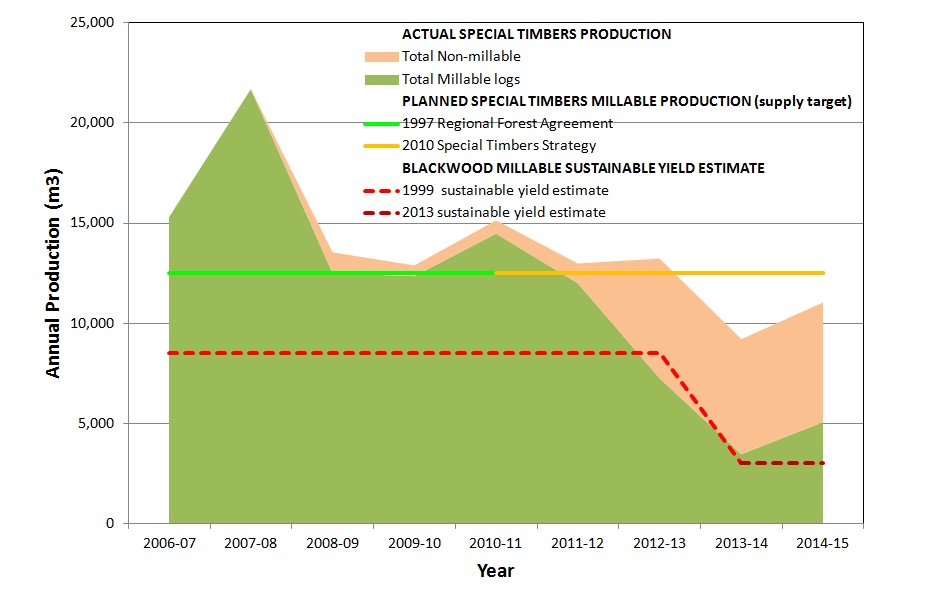
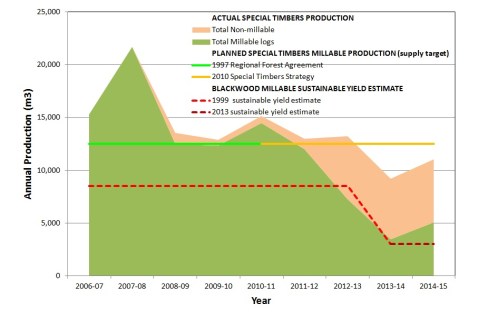
It’s a deliberate attempt to obscure the fact that millable special timbers sawlog production has plummeted, due to decades of overcutting of the resource and sovereign risk. See Chart below.

Here is the table of special timbers millable sawlog production commitments made by Forestry Tasmania in 1991, 1997 and again in 2010, against which they have not reported since 1995.

Annual supply targets for special timbers millable* logs for the ten-year period to 2019.

Species Annual volume (m3)
Blackwood 10,000
Silver Wattle 500
Myrtle 500
Sassafras 500
Celery-top pine 500
Huon pine 500
King Billy pine Arisings only
Other species (including figured eucalypt) Arisings only
Total 12,500+

* Millable logs include ‘Category 4’ sawlogs and ‘utility’ logs (Special Timbers Strategy 2010, p. 21).

I have contacted FT in the hope of gaining some clarity around their special timbers millable log production data.

Deception #2

The 2013/14 Forestry Tasmania Annual Report had a list of objectives for the 2014/15 year which included:

Produce 11,300 cubic metres of special species timber [quality unspecified], and conduct at least 12 tenders for special species logs (2014 Sustainability Report p.56).

That is an immediate breach of their commitment to produce 12,500 cubic metres per year of millable special timbers sawlog per year.

And so to this year’s Annual Report:

During 2014/15, Forestry Tasmania produced a total of 11,042 cubic metres of special timbers from Permanent Timber Production Zone land. This comprised 5,051 cubic metres of millable logs, with the remainder being [non-millable] ‘out of specification’ sawlog and craftwood.

Of the 11,042 cubic metres special timbers produced 3,744 cubic metres (34%) were “sold” through Island Specialty Timbers (IST). Of the 3,744 cubic metres “sold” through IST 220 cubic metres (2.0% and 5.9% respectively) were sold through the online tendering process to ensure that the best possible prices were obtained.

I created the chart below to clearly show what we currently know with certainty about special timbers production for the last 9 years from Tasmania’s public native forests. You won’t find a chart like this in any Forestry Tasmania publication.

Over the last 3 years FT has collected a whopping 17,700 cubic metres of special timbers non-millable craftwood off the forest floor at taxpayers expense for which they have no supply obligation or commitment!! That’s equivalent to 900 truck loads. For the same period only 15,700 cubic metres of special timbers sawlog was produced. That’s 20,000 cubic metres of sawlog short of the supply commitment!! Most of the missing volume is blackwood sawlog.

Why aren’t the alarm bells ringing??

Where is this vast volume of craftwood going? Who is buying it?

What are the sawmillers/boatbuilders/furniture makers doing with no sawlog resource?

Remember most of the special timbers story is about blackwood which makes up to 90% of annual production. So despite having a commitment to supply 10,000 cubic metres of blackwood sawlog per year, plus a sustainable yield estimate against which to demonstrate good forest management, we do not know with any certainly exactly how much blackwood sawlog has been harvested over the past 9 years.

Instead the chart shows the final declining years of Tasmania’s special timbers industry, including our iconic blackwood industry. Blackwood timber could be grown by Tasmanian farmers if they were encouraged. Instead all we get is politics, conflict and wasted taxes.

Welcome to Tasmania!
FTSTchart

Only two other useful pieces of information are provided in the Report concerning special timbers production. One is that 216 cubic metres of Huon pine sawlogs and 128 cubic metres of Huon pine craftwood were recovered from West coast forests, rivers and beaches. No information is available on how much it cost Tasmanian taxpayers to have this timber brought to market.

The other information is the curious comment:

The [IST] tendering program received strong interest, with the highlight for the year being a 0.57 cubic metre blackheart sassafras log that sold for $3,815 per cubic metre.

It’s curious because a) the Government has absolutely no interest in the real market value of its special timbers assets, and b) my records show that the IST highlight for the year was in fact a Tiger Myrtle log which sold at the April 2015 tender for $5,900 per cubic metre!! Curious!!

http://blackwoodgrowers.com.au/2015/06/18/ist-blackwood-sawlog-tender-results-2014-15/

Clearly the market is prepared to pay exceptional prices for quality Tasmanian timber. But forestry is not about business or profits. It’s a community service funded by taxpayers. Prices apparently are completely irrelevant.

Deception #3

Finally after many years we get a clear statement of exactly how much taxpayers money is being wasted subsidising boat builders, furniture makers, guitar makers and Salamanca trinket makers.

The community service obligations costs are set out on page 64-65 of the 2015 Annual Report. They total $6.87 million dollars of which $0.9 million dollars (13%) is used to fund special timber workers. That is a subsidy of $81.56 per cubic metre of special timber produced.

Community Service Obligations

In August 2014 the State Treasurer and the Minister for Resources directed Forestry Tasmania to provide the following community services. In undertaking these community service obligations Forestry Tasmania incurred net costs and was funded to the extent indicated below.

Special species management

  • Net cost $0.90 million
  • Government funding $0.90million
  • Identify, manage and harvest special species timber and manage the Huon pine log stockpile (Annual Report p. 64).

Tasmania is subsidizing wood that sells for hundreds to thousands of dollars per cubic metre in raw log form.

Tasmanian blackwood timber retails for $7,500 per cubic metre, and Tasmanian taxpayers subsidise this!! Why?

http://blackwoodgrowers.com.au/2015/10/26/blackwood-pricing-and-the-forest-industry-2/

Can anyone please provide me with some logic here?

That’s a $900,000 Tasmanian taxpayer subsidy so that the best possible prices are achieved on just 2.0% of the special timbers produced!!

So what’s the deception?

The deception is that any of this special timbers management and sales are logical let alone reasonable. Logic and reason, let alone profitable, sustainable forest management are completely absent.

Our forest managers and our politicians are definitely playing us for fools.

That this fiasco provides a sound moral, political, social and commercial basis for logging the Tasmanian Wilderness World Heritage Area is just offensive.

That this fiasco is applying for Forest Stewardship Council (FSC) certification is just a joke. Forestry Tasmania is a million light years from good profitable, sustainable forest management.

That this fiasco already has PEFC Australian Forestry Standard (AFS) certification makes a complete mockery of that particular certification system.

For his usual brilliant review of FTs miserable commercial performance and management for 2014/15 you should read John Lawrence’s blog here:

http://www.tasfintalk.blogspot.com.au/2015/10/has-ft-turned-corner.html

My apologies for such a long blog but what can one do when faced with such a disaster.

When will Tasmania get a fully commercial, profitable forest industry?

Blackwood pricing and the forest industry #2

In the previous blog on blackwood prices I discussed some of the issues around blackwood pricing and markets using an actual blackwood price list “from hell”.

http://blackwoodgrowers.com.au/2015/10/19/blackwood-pricing-and-the-forest-industry-1/

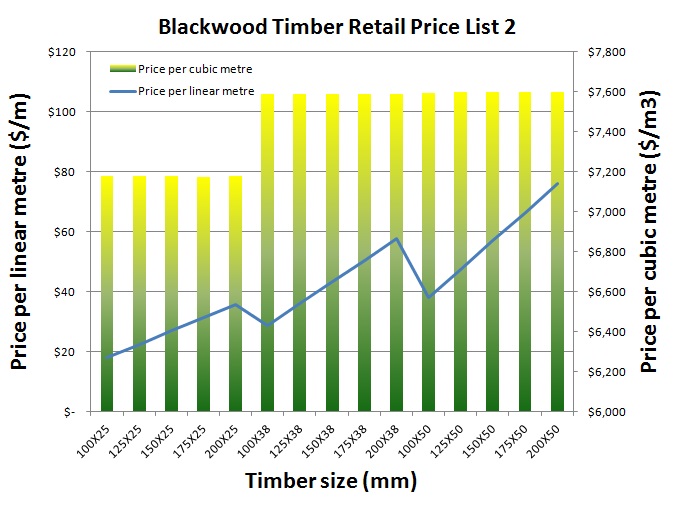
Here I present some better examples of timber price lists including another real blackwood price list, but this one should definitely stir some interest from existing and potential growers.

This retail blackwood price list exhibits both excellent overall prices from a grower and sawmillers viewpoint, but also includes allowance for the cost of time it takes to grow bigger trees to produce the larger size boards. Hence the 5.8% “step-up” in the price per cubic metre for the 38mm and 50mm thick boards. I’m assuming of course that this pricing structure reflects in some degree what was paid to the growers, with larger logs attracting better prices than smaller logs.

Remember that Tasmanian blackwood is Australia’s premium appearance grade timber species.

BPL2

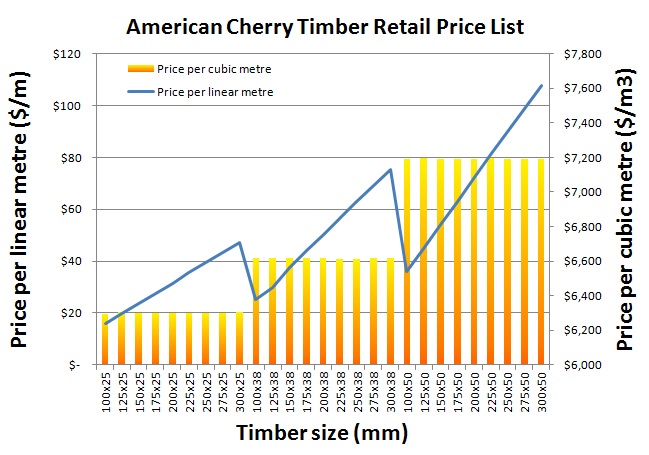
By way of comparison here is a price list for American Cherry (Prunus serotina) from the same retailer. American Cherry is regarded as the number one premium appearance timber in the USA. Almost all American Cherry is grown in native forest by a vast number of small private forest growers, so the markets are very competitive. These prices therefore are likely to accurately reflect real market conditions, including grower profitability. The same certainly can’t be said for Tasmanian blackwood.

I’ve made both the blackwood and the cherry charts are on the same scales to allow for easy comparison.

ACPL

Notice the cherry price list has two step-ups in the cubic metre price (4.9 and 8.8%, with the over increase of 14.1%) to reflect the three timber thickness grades, and the cost of time needed to grow larger trees to produce the bigger boards.

By way of comparison Premium clear grade Radiata pine retails for about $2,500 per cubic metre.

So if retailers and sawmillers (but not the growers) are making money selling blackwood at $2,500 per cubic metre, surely at $7,000+ per cubic metre there is plenty of potential for growers to be rewarded sufficiently to consider commercial blackwood as a profitable investment.

Much more than any other primary industry, forestry relies upon growers getting a fair deal and a good price, otherwise the forest industry has no future. A 30+ year investment to grow trees involves an exceptional amount of goodwill, trust and fair play in the marketplace. So far the forest industry does not have a good reputation in this regard.

The only other option is for growers to do the harvesting, sawmilling, and selling themselves. A Growers Cooperative then becomes the natural result of this outcome. But this still requires the marketplace to provide price and demand signals.

Both the blackwood and cherry price lists potentially provide incentive and reward/profit to forest growers to produce these beautiful premium timbers, as well as recognise and encourage the growing of large trees to produce the large wide boards that the market demands. These are the just rewards of time, patience, good forest/plantation management and a forest industry/marketplace working together to build a future.

The private American Cherry growers keep managing their native forest and growing and selling their Cherry timber.

But what about the growers of Tasmanian blackwood?


It is an interesting footnote that Tasmanian taxpayers pay to have public native blackwood forest logged (Forestry Tasmania deliberately makes a loss) in order that approximately $40,000,000 worth of blackwood timber and veneer is sold every year. Why does blackwood need to be subsidised?