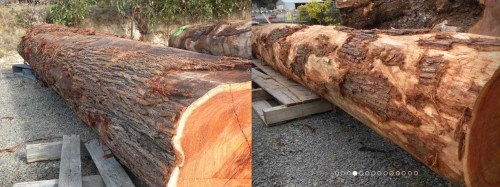
In the interests of greater market and price transparency in the forest industry here is my annual summary of blackwood log tender results from Island Specialty Timbers (IST) for the 2016-17 financial year.
http://www.islandspecialtytimbers.com.au
This is the only publically available competitive market price data for blackwood logs.
During the year 20 blackood lots, totalling 20.4 cubic metres, were put to tender over 5 of the 8 tenders held by IST. That equates to 1 single truck load of blackwood material! Of the 20 lots put to tender only 6 were sold, totalling 7.2 cubic metres!
It’s been a quiet year for the local blackwood market.
Last year (2015-16) Forestry Tasmania sold 9,580 cubic metres of blackwood logs and craftwood, with the vast bulk of this volume sold on private long term sales contracts. The tiny volume sold through public tender by IST represents just 0.07% of the blackwood harvested from the Tasmania’s public native forest.
http://www.forestrytas.com.au/about-us/publications
For the August and September 2016 tenders IST put to tender 7 lots comprising pairs of blackwood logs. In the August tender the pairs were logs cut from single trees, whilst in the September tender the pairs were from different trees. All were plain grain logs. Only 2 of the pairs from the August tender sold.
None of the 11 blackwood lots from the September and November 2016 tenders sold!
Then came the March 2017 tender where 2 large blackwood logs from the same tree featuring tear drop grain were put to tender. Total volume for these two logs was 2.59 cubic metres. The larger butt log went for $1575 per cubic metre whilst the smaller head log sold for $1625. Total value for this single blackwood tree totalled $4130!! These logs provided the highlight in an otherwise quiet year.
Actually despite the low volumes sold plain grain blackwood logs didn’t do so bad. The 4 plain grain lots that sold averaged $418 per cubic metre for some reasonable quality logs, with prices up to $550 per cubic metre. I regard that as a good price.
The table below summarises the IST blackwood tender results for the 2016-17 financial year:

The 20.4 cubic metres of blackwood put to tender compares with the total of 166 cubic metres of specialty timbers that IST put to tender in 2016-17, or only 12% of the total volume. This is despite the fact that blackwood is by far the dominant specialty timber harvested in Tasmania.
The chart below shows the average blackwood tender prices and total volumes for the past 4 years.
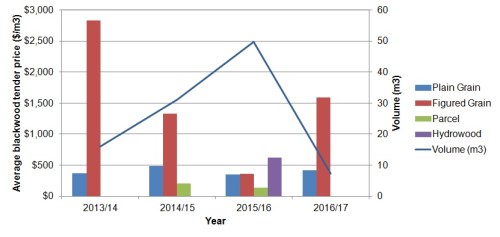
Unfortunately the volume of IST blackwood tender material is too small and the quality too variable to allow meaningful market/price comparisons between years. Also IST generally only caters to the local southern Tasmanian craftwood market.
Large volumes of large, good quality logs from blackwood plantations should generally command better prices than shown by the IST result.
The blackwood market desperately needs more tradability, more transparency and more commercial credibility.
The only basis for a successful forest industry is profitable tree growers within a competitive, transparent marketplace.
Caveats:
- Island Specialty Timbers (IST) is an enterprise of Forestry Tasmania established in 1992 to increase the recovery, availability and value of specialty timbers from harvesting activities in State forests.
- Forestry Tasmania manages its special timbers operations (including IST) as a taxpayer-funded, non-commercial, non-profit, community service. Last year each cubic metre of blackwood log harvested by Forestry Tasmania received a taxpayer subsidy of $86! No private blackwood grower received any taxpayer subsidy.
- Note that all logs and wood sold by IST come from the harvesting of public native old-growth forest and rainforest certified under AFS (PEFC).
- It is unlikely that this tiny set of market-based blackwood log prices is representative of the broader blackwood market.
- The dataset is too small and variable in quality to allow any analysis or correlations to be made between price and log quality apart from the obvious result that feature-grain logs attract a significant price premium over plain-grain.
- These tender prices are effectively mill door prices that already include harvesting and transport costs. They are not stumpage prices.
So whilst Forestry Tasmania, the State government and the State parliament all regard the special timbers industry as a taxpayer-funded community service and political play-thing rather than a commercial opportunity, then blackwood’s commercial future remains difficult.
“The lack of price transparency for forest products, particularly from hardwood forests/plantations [in Australia], represents an impediment to the uptake of farm forestry. Unlike other commodities, price information for forest products is not published through the newspaper or accessible online. Better price transparency is required to encourage smallscale investment in trees” (p. 71. FWPA Report PN: PNA243-1112/2, 2013).
http://www.fwpa.com.au/rd-and-e/market-access/229-the-case-for-renewed-development-in-plantations-identifying-forest-values-and-the-constraints-to-attainment-stage-one-and-two.html
This quote from a recent forest industry report says it all. Even the forest industry recognises price transparency is a major issue, but then does nothing about it. One of the authors of this report was none other than the Director of Forestry Tasmania!
For previous years IST tender reviews see:
https://blackwoodgrowers.com.au/2016/06/23/ist-blackwood-log-tender-results-2015-16/
https://blackwoodgrowers.com.au/2015/06/18/ist-blackwood-sawlog-tender-results-2014-15/
https://blackwoodgrowers.com.au/2014/06/14/blackwood-sawlog-tender-results-2013-14/




 Tasmanian Blackwood Growers Cooperative
It can’t be “fixed”!
http://www.themercury.com.au/news/opinion/latest-policy-proposals-would-have-done-nothing-to-resolve-issues-in-tasmanias-forestry-industry/news-story/4d90132d87faf0c065a6725126f0334c
This excellent article in today’s Mercury newspaper succinctly captures the pain suffering and the high cost to Tasmania of the failures of the last 35 years.
But I certainly don’t agree with the authors final note that the political system can somehow find a solution to the problem.
The one fundamental lesson of the last 35 years is that Tasmania’s political system cannot solve the forestry crisis.
Whilst we continue to log public native forest there will always be politics, conflict, corruption and waste.
That is the fundamental lesson.
This is true not just in Tasmania, which provides the most extreme case, but in all Australian States where public native forest is logged.
Putting our hopes in the political system again, when all indications are that the forthcoming State election will be a bitter and divisive contest with forestry once more a major issue, is sheer lunacy; a classic example of Einstein’s definition of insanity.
No political party (Liberal, Labor or Greens) has a plan to resolve Tasmania’s forestry crisis.
It is time to stop the endless madness.
It is time for the Tasmanian community to speak.
Leave a comment
Posted in 2018 State Election, Commentary, Politics